
Argentina Wire and Cable Market Size and Share
Market Overview
| Study Period | 2020 - 2031 |
|---|---|
| Forecast Data Period | 2026 - 2031 |
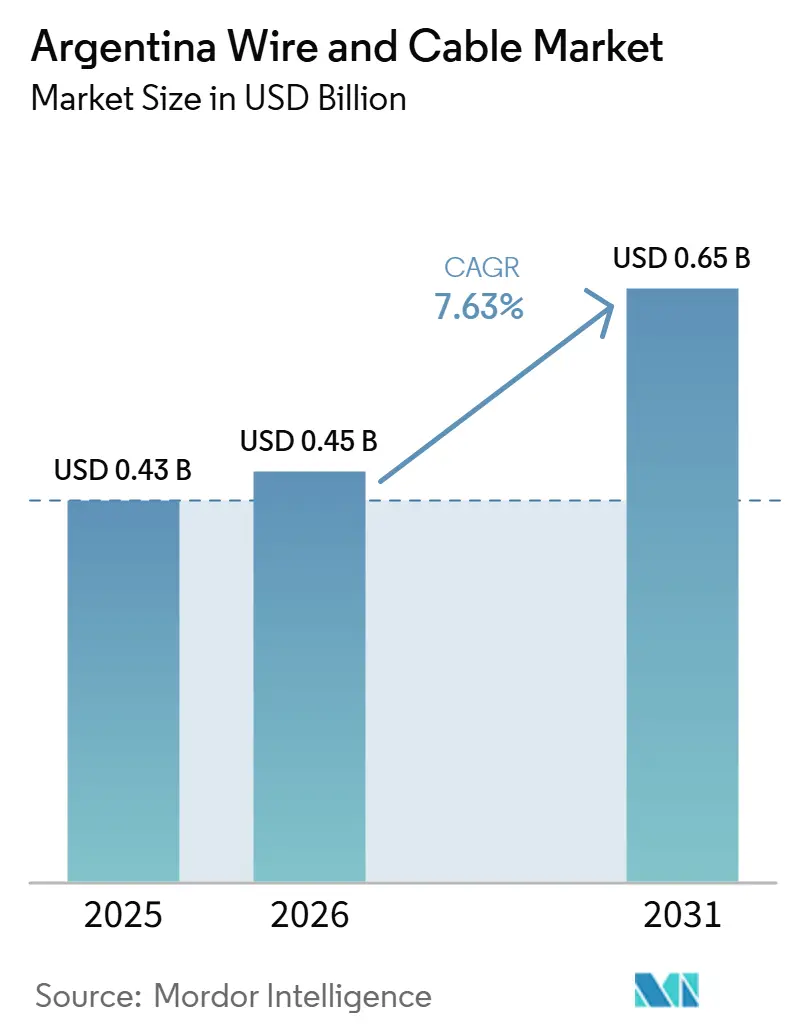
| Base Year Market Size (2025) | USD 0.43 Billion |
| Market Size (2026) | USD 0.45 Billion |
| Market Size (2031) | USD 0.65 Billion |
| Growth Rate (2026 - 2031) | 7.63 % |
| Market Concentration | Medium |
Major Players *Disclaimer: Major Players sorted in no particular order Image © Mordor Intelligence. Reuse requires attribution under CC BY 4.0. | |
Argentina Wire and Cable Market Analysis by Mordor Intelligence
The Argentina wire and cable market size is projected to be USD 0.43 billion in 2025, USD 0.45 billion in 2026, and reach USD 0.65 billion by 2031, growing at a CAGR of 7.63% from 2026 to 2031. Grid investment, renewable generation, and digital network deployment are expanding demand for power, control, and fiber-optic products. The investment cycle also favors suppliers that can meet technical specifications for transmission and specialized cable applications. Private transmission financing can shorten procurement schedules because individual projects are less dependent on public budget cycles. Higher metal costs and inflation continue to test manufacturers that buy inputs in U.S. dollars while serving a domestic market priced in pesos. The Argentina wire and cable market also offers room for local suppliers with certified products, regional logistics, and insulation portfolios that address security and reliability requirements.
Key Report Takeaways
- By voltage, low-voltage cables held 45.76% of Argentina wire and cable market share in 2025, while extra- and high-voltage cables are projected to expand at an 8.65% CAGR through 2031.
- By cable type, power cables accounted for 36.87% of the Argentina wire and cable market in 2025, while fiber-optic cables are projected to grow at an 8.98% CAGR through 2031.
- By conductor material, copper conductors held 54.98% of Argentina wire and cable market share in 2025, while aluminum conductors are projected to grow at a 9.01% CAGR through 2031.
- By installation, underground cables accounted for 43.12% of the Argentina wire and cable market in 2025, while submarine cables are projected to expand at a 9.87% CAGR through 2031.
- By end-user vertical, power infrastructure accounted for 31.22% of the Argentina wire and cable market in 2025, while telecommunications and data centers are projected to grow at an 8.99% CAGR through 2031.
- By insulation, insulated cables held 79.11% of the Argentina wire and cable market size in 2025 and are projected to expand at a 9.56% CAGR through 2031.
Note: Market size and forecast figures in this report are generated using Mordor Intelligence’s proprietary estimation framework, updated with the latest available data and insights as of January 2026.
Argentina Wire and Cable Market Trends and Insights
Drivers Impact Analysis*
| DRIVER | (~) % IMPACT ON CAGR FORECAST | GEOGRAPHIC RELEVANCE | IMPACT TIMELINE |
|---|---|---|---|
| Electrification and Grid Modernization | +2.1% | National, with concentration in Greater Buenos Aires, Patagonia, Cuyo, and Northwest Argentina transmission corridors | Short term (≤ 2 years) |
| Renewable Generation and Grid-Connection Buildout | +1.8% | Patagonian wind corridors, the Cuyo solar belt, Northwest Argentina, and the national SADI grid | Medium term (2-4 years) |
| Fiber-Optic, 5G, and Data-Network Expansion | +1.5% | Greater Buenos Aires, Córdoba, Rosario, and the underserved provinces | Short term (≤ 2 years) |
| Construction and Industrial Activity | +1.0% | National, with stronger activity in Buenos Aires province and energy-rich provinces covered by RIGI | Medium term (2-4 years) |
| Import Substitution and Regional Supply Integration | +0.6% | National, with spillover to MERCOSUR partners | Long term (≥ 4 years) |
| Anti-Theft Distribution Cable Adoption | +0.3% | Distribution networks in Neuquén, Chubut, Santa Cruz, and the Buenos Aires periphery | Short term (≤ 2 years) |
| Source: Mordor Intelligence | |||
Electrification and Grid Modernization
Argentina's transmission system requires sustained renewal as aging assets and technical losses affect network reliability. The Argentina wire and cable market benefits from utilities replacing older conductors and modernizing substations. In April 2026, the government completed the sale of its 50% interest in Citelec, the holding company that controls Transener. The transaction placed the transmission operator under a new ownership structure and reinforced private-sector interest in long-term grid assets. ENRE Resolution 102/2026 approved a 132 kV double-circuit link between San Rafael and General Alvear in Mendoza. The approval supports a wider group of national-priority SADI expansion works.[1]Government of Argentina, “Resolución ENRE N° 102/2026, Solicitud de Ampliación del Sistema de Transporte de Energía Eléctrica,” Argentina.gob.ar, argentina.gob.ar.
Renewable Generation and Grid-Connection Buildout
Renewable projects require cable systems that connect generation equipment, substations, and the national grid. The distance between resource areas and demand centers can raise the need for transmission, control, and protection cabling. In March 2026, IFC committed USD 110 million toward the USD 275 million Olavarría wind project in Buenos Aires province. The project included a 25 km high-voltage line connecting 185.6 MW of wind capacity to SADI. It also included upgrades at the Olavarría and Ezeiza substations.[2]International Finance Corporation, “IFC Supports Landmark Wind Power and Transmission Project To Boost Clean Energy Supply, Jobs, and Private Investment in Argentina,” International Finance Corporation, ifc.org.
Fiber-Optic, 5G, and Data-Network Expansion
The shift from hybrid fiber-coaxial networks to fiber-to-the-home alters the demand profile for communications cabling. Fiber-optic connections surpassed cable-modem connections in Argentina during 2025. The change supports recurring demand for access-network, backbone, and installation products. Data center investment can add demand for high-count fiber bundles, data cables, and internal power cabling. A planned second international submarine fiber landing point in Chubut would introduce an additional specialized cable requirement. The Argentina wire and cable market can benefit where network investment moves beyond large metropolitan access builds into regional backbone infrastructure.
Construction and Industrial Activity
Construction and industrial projects underpin demand for low-voltage wiring, control cables, and instrumentation products. The formal RIGI framework has encouraged investment proposals in energy, mining, and infrastructure. These projects require cable procurement during construction and equipment installation. Their requirements are more fragmented than large transmission tenders because each site needs several cable types. This favors responsive domestic supply networks with a broad range of certified products. The Argentina wire and cable market therefore gains from a mix of large infrastructure work and dispersed private construction demand.
Restraints Impact Analysis*
| RESTRAINT | (~) % IMPACT ON CAGR FORECAST | GEOGRAPHIC RELEVANCE | IMPACT TIMELINE |
|---|---|---|---|
| Copper and Aluminum Price Volatility | -1.8% | Global commodity exposure, concentrated in Buenos Aires and Córdoba manufacturing hubs | Short term (≤ 2 years) |
| Inflation, Currency Volatility, and Import Restrictions | -1.5% | National, with stronger effects in import-dependent manufacturing regions | Short term (≤ 2 years) |
| Certification Bottlenecks for Specialized Cables | -0.5% | National, with the greatest effect on SADI-grade high-voltage approvals | Medium term (2-4 years) |
| Skilled-Labor and Capacity Constraints | -0.3% | Manufacturing centers in Buenos Aires province and Córdoba | Medium term (2-4 years) |
| Source: Mordor Intelligence | |||
Copper and Aluminum Price Volatility
Metal prices remain a direct challenge for cable producers because copper and aluminum are core inputs. Higher copper prices can narrow margins when contracts cannot be repriced quickly. The pressure is greatest in competitive tenders and lower-voltage applications with limited differentiation. It also encourages utilities and industrial buyers to consider aluminum conductor designs where permitted. Aluminum products can offer cost and availability advantages for long-span overhead and grid-scale uses. The Argentina wire and cable market is thus moving toward a more balanced material mix.
Inflation, Currency Volatility, and Import Restrictions
Inflation and exchange-rate changes complicate planning for manufacturers that import metal, polymer, and specialized components. Input purchases may be denominated in U.S. dollars, while many local sales are negotiated in pesos. This creates repricing risk for contracts that run across several months. The easing of import controls can also increase competition from finished wire and cable imports. The effect is most visible in low-voltage and construction products, which have fewer technical barriers. Producers must protect margins without losing competitiveness in price-sensitive accounts.
*Our forecasts treat driver/restraint impacts as directional, not additive. The impact forecasts reflect baseline growth, mix effects, and variable interactions.
Segment Analysis
By Voltage: Low-Voltage Demand Supports a Growing High-Voltage Project Pipeline
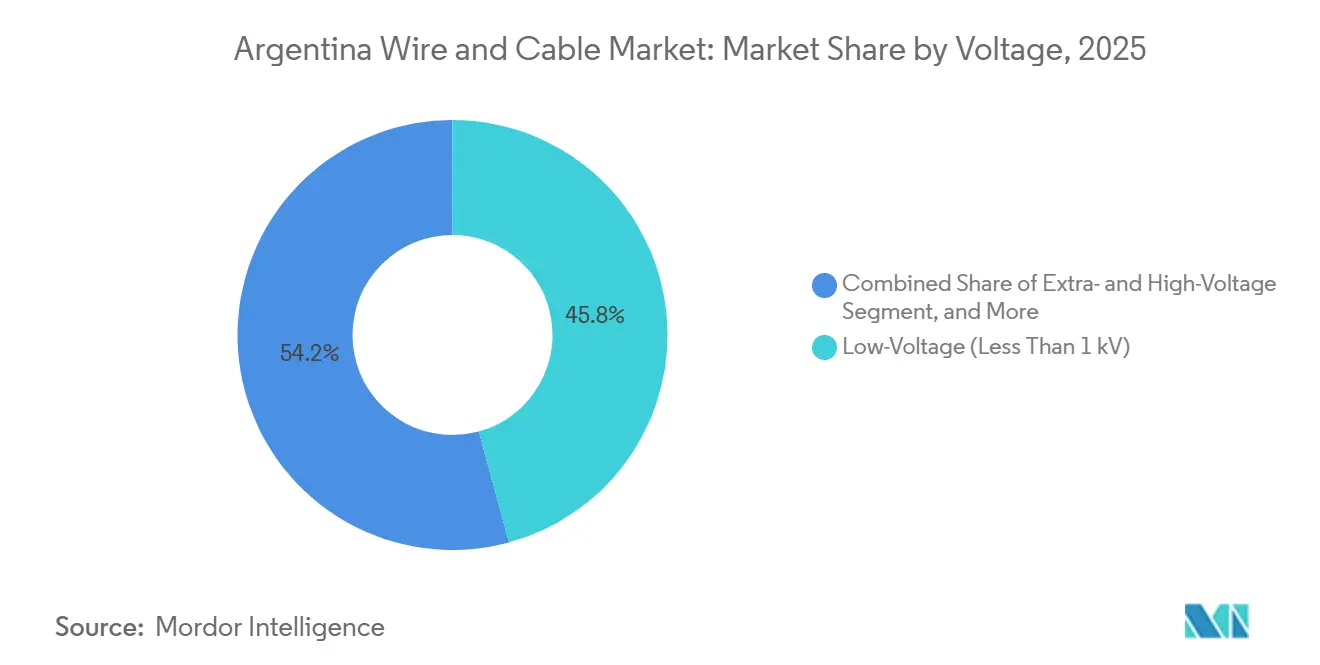
Low-voltage cables held 45.76% of the Argentina wire and cable market in 2025. Their broad use in residential, commercial, industrial, and distribution applications supports a diversified demand base. Construction wiring and final distribution connections account for a substantial share of low-voltage procurement. These purchases are often fragmented across contractors, distributors, and smaller projects. Extra- and high-voltage cables are projected to grow at an 8.65% CAGR through 2031. Their growth reflects transmission expansion, new generation connections, and substation works.
The San Rafael-General Alvear link illustrates the importance of formal grid approvals for high-voltage demand. ENRE authorized the 132 kV double-circuit expansion in 2026. Medium-voltage products connect transmission substations to distribution feeders. They are also relevant to urban undergrounding and anti-theft distribution programs. Product selection across all voltage classes depends on technical approval and installation conditions. The Argentina wire and cable industry therefore combines a large, recurring low-voltage base with a more specialized high-voltage growth pipeline. The two demand patterns require different production planning, inventory management, testing capability, and sales support. Low-voltage volumes depend on broad distributor coverage and dependable availability for contractors. High-voltage orders require earlier engineering engagement, formal documentation, and coordination with utilities and project owners. A supplier that serves both groups can maintain activity across uneven construction and infrastructure cycles. This balance makes voltage coverage a meaningful part of competitive positioning.



By Cable Type: Power Cables Anchor Revenue While Fiber-Optic Products Lead Growth
Power cables held 36.87% of the Argentina wire and cable market share in 2025. Utility procurement, renewable interconnections, industrial facilities, and distribution upgrades support their leading position. The category serves both large transmission projects and smaller electrical installations. Its demand pattern is linked closely to the pace of grid modernization. Fiber-optic cables are projected to grow at an 8.98% CAGR through 2031. This expansion is tied to fiber-to-the-home deployment, 5G backhaul, data networks, and regional connectivity projects.
Signal and control cables serve industrial plants, oil and gas facilities, and equipment automation. Coaxial and data products support a smaller but important part of the communications ecosystem. A second submarine cable landing point in Chubut would create demand for highly specialized fiber infrastructure. The proposed project is intended to improve international connectivity resilience. Fiber growth does not displace power cables, because digital projects also need reliable electrical and control connections. This mix enables the Argentina wire and cable market to address utility and digital infrastructure requirements simultaneously. Power projects typically require reliable electrical products that meet utility specifications and project schedules. Communications projects need products that support access networks, backbone routes, equipment connections, and protected installation. The purchasing teams and delivery patterns may differ, yet the underlying need for reliable cable systems remains the same. Producers with complementary power and communications ranges can serve several stages of infrastructure development. That broader offering can be useful when project investment changes between energy and digital networks.
By Conductor Material: Copper Retains Scale While Aluminum Gains Ground
Copper conductors held 54.98% of the Argentina wire and cable market in 2025. Their position reflects established urban wiring practices and strong conductivity for many industrial applications. Existing standards and installed infrastructure also favor continued copper use. Copper products remain central to building wiring, industrial equipment, and several power applications. Aluminum conductors are projected to grow at a 9.01% CAGR through 2031. The faster rate reflects cost considerations and the suitability of aluminum for long-span overhead systems.
The relative cost of copper and aluminum affects procurement decisions in grid and industrial projects. Aluminum can be attractive when buyers seek lower material costs without compromising approved performance requirements. The option is strongest for utility installations where conductor weight and route length matter. Suppliers must still qualify aluminum designs under IRAM and ENRE specifications. Optical glass and polymer conductors remain important for fiber-optic products and industrial monitoring systems. Material flexibility gives producers a clearer route to manage pricing risk in the Argentina wire and cable market. It also allows technical teams to respond when utility specifications permit a different conductor solution. Material choice must remain aligned with safety standards, conductor performance, installation conditions, and the expected operating life of the system. Buyers will continue to use copper where its technical characteristics and existing designs are needed. Aluminum can become more relevant where the application supports its weight and cost benefits. Manufacturers that understand both material pathways can offer more practical options to customers.
By Installation: Underground Cables Lead While Submarine Projects Expand the Opportunity
Underground cables held 43.12% of the Argentina wire and cable market in 2025. Urban undergrounding, weather resilience, and security concerns support the segment's position. Utilities also use underground systems where service continuity and public-space constraints are important. Submarine cables are projected to grow at a 9.87% CAGR through 2031. This is the fastest-growing category among the installation categories. The expected Chubut landing point provides a defined demand catalyst for specialized submarine fiber systems.
Overhead installation remains important for rural distribution and long-distance transmission. It offers a practical route where population density is low and underground construction is costly. However, copper theft can shift procurement toward covered aerial and anti-theft cable designs. CEARCA introduced a three-phase anti-theft aerial distribution cable in July 2025 for high-risk distribution networks.[3]CEARCA S.A., “Nuevo Cable de Distribución Aérea Antihurto,” CEARCA S.A., cearca.com. The product shows how security needs can convert traditional overhead applications toward insulated designs. Installation choices therefore depend on cost, geography, reliability, and network security across the Argentina wire and cable market. Underground projects require careful route planning, coordination of civil works, and products suited to protected conduits or direct burial. Overhead systems need designs that account for exposure, span length, maintenance, and theft risk. Submarine work has a separate technical profile because it requires specialized design and project execution capability. These installation differences shape the supplier base available for each project. They also explain why product breadth alone may not be enough to win specialized contracts.
By End-User Vertical: Power Infrastructure Leads While Telecommunications and Data Centers Grow Faster
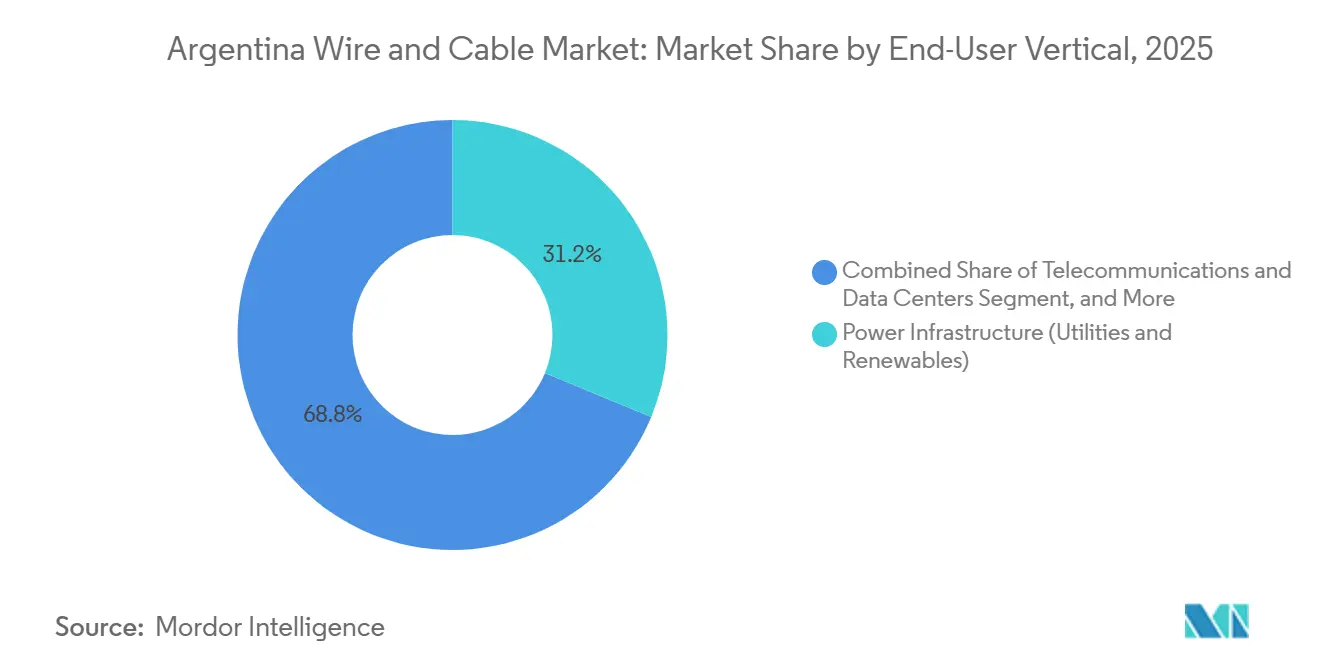
Power infrastructure held 31.22% of the Argentina wire and cable market share in 2025. Utilities and renewable developers purchase medium-voltage and high-voltage cables for grid links, substations, and distribution upgrades. This vertical remains the main buyer of specialized power products. Its order pipeline depends on permits, financing, and project execution schedules. Telecommunications and data centers are projected to grow at an 8.99% CAGR through 2031. Fiber-to-the-home expansion, 5G deployment, and data processing capacity support this faster growth.
Residential and commercial construction create recurring demand for low-voltage cable products. Oil, gas, and petrochemical facilities require control, signal, and specialized industrial products. Alcable states that its portfolio serves oil and gas and industrial cable applications.[4]Alcable S.A., “Nosotros,” Alcable S.A., alcable.com.ar. Manufacturing and automotive activity also require electrical wiring and equipment connections. No single end-user group meets every demand requirement. A broad customer mix can help suppliers balance longer utility projects with shorter commercial orders in the Argentina wire and cable market. Utility programs can provide large volumes, but their timing depends on regulatory approvals, financing, and formal procurement stages. Construction and industrial orders are smaller, yet they can create recurring demand through distributors and contractors. Telecommunications and data projects introduce another buyer group with different specifications and delivery expectations. Suppliers that manage these different sales cycles can reduce concentration in a single customer category. This matters when infrastructure investment follows different timelines across the economy.
By Insulation: Insulated Cables Lead Both Scale and Growth
Insulated cables held 79.11% of the Argentina wire and cable market in 2025. They are also projected to grow at a 9.56% CAGR through 2031. The same category leads in scale and growth because safety, reliability, and theft prevention matter across many applications. Insulated products serve utilities, buildings, industrial sites, and communications installations. Their growth is faster than the overall Argentina wire and cable market CAGR of 7.63%. This points to a continuing shift away from bare conductor use in many end uses.
Non-insulated cables remain relevant in certain rural overhead and specific industrial applications. Their use is more limited where physical enclosure or established network design provides protection. IRAM and ENRE requirements can favor the approval of insulated alternatives for grid-connected work. CEARCA's July 2025 anti-theft product launch reflects this shift from traditional aerial configurations to insulated cable solutions. Producers without a broad insulation portfolio may lose access to faster-growing procurement categories. Insulation capability is therefore a central requirement for continued participation in the Argentina wire and cable industry. Product development must account for the operating environment, voltage class, safety needs, and applicable technical approvals. Utilities may require covered products to enhance security and reduce exposure in vulnerable parts of their networks. Building and industrial users also rely on insulated designs for dependable installation and operation. A complete insulated portfolio can support participation in power, construction, industrial, and communications projects. This gives suppliers a more durable base as end users move away from legacy bare-conductor configurations.
Geography Analysis
Buenos Aires province and the Autonomous City of Buenos Aires form the largest concentration of industrial, construction, and telecommunications demand in the Argentina wire and cable market. The area also hosts important manufacturing capacity, including Prysmian's Quilmes plant and CEARCA's La Tablada operation. CEARCA states that its energy-cable output capacity is 10,000 tonnes per year. Greater Buenos Aires combines dense electricity demand with a large base of homes, businesses, and communications users. This supports purchases of low-voltage construction wiring, distribution cable, and fiber products. The metropolitan area brings together end users, contractors, distributors, and manufacturers in a relatively concentrated commercial setting. This can shorten delivery routes and support closer technical coordination for projects that need specialized products. It also creates a large replacement market because dense networks require regular maintenance and renewal. Suppliers need to combine volume availability with reliable documentation for utility and building applications. The region, therefore, remains important for both recurring sales and project-based orders.
Patagonia is developing as a major demand area for high-voltage, specialized industrial, and potential submarine cable systems. Neuquén, Río Negro, Chubut, and Santa Cruz combine energy resources with long-distance infrastructure needs. The Olavarría wind and transmission project demonstrates the type of private financing now supporting grid-connected renewable capacity. IFC's financing covered a project with a 25 km high-voltage line and substation upgrades. Resource projects in remote areas require durable cable systems that can operate over long distances and under demanding conditions. Long distances between generation sites, industrial facilities, and demand centers can increase the importance of transmission and control systems. Project developers also need suppliers that can coordinate delivery with complex construction schedules. The mix of energy resources and planned digital infrastructure gives Patagonia a different cable profile from Buenos Aires. Specialized high-voltage, industrial, and potentially submarine products may gain greater importance there. This makes the region a relevant source of longer-term project demand.
Cuyo, Northwest Argentina, Córdoba, and Santa Fe have distinct requirements linked to solar projects, agro-industry, utility modernization, and vehicle manufacturing. Mendoza's San Rafael-General Alvear 132 kV link shows continuing transmission investment in the interior. These regional markets require suppliers to manage distribution, technical approvals, and varying procurement practices. No single geography determines demand across the Argentina wire and cable market. Manufacturers that combine local service with specialized product capability can address the different requirements of urban, industrial, and resource-led regions. Regional coverage is important because transport distance, local contractors, and provincial procurement practices can affect delivery and service. A standardized product portfolio may not meet every application without local technical support. Suppliers also need to maintain approvals and product documentation for the relevant voltage and installation conditions. These requirements make distribution planning part of a firm's commercial capability. Geographic diversity can offer opportunities, but it also underscores the need for disciplined execution.
Competitive Landscape
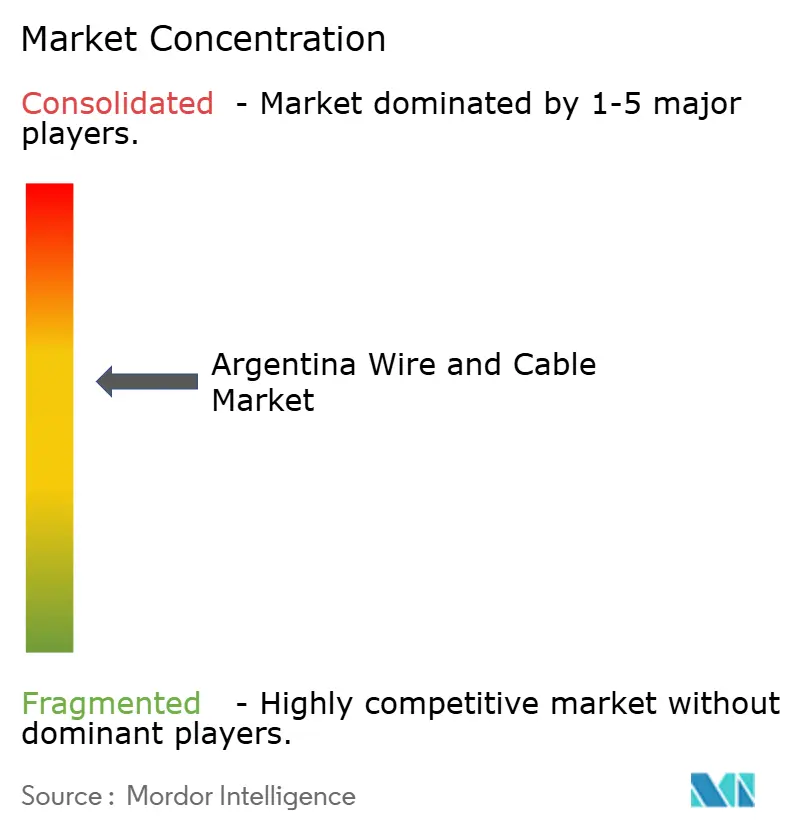
The Argentina wire and cable market is moderately fragmented. Prysmian Energía Cables y Sistemas de Argentina S.A. and Nexans Indelqui S.A. compete with a broad group of domestic producers. Domestic companies serve volume energy-cable requirements and selected applications in oil and gas, automotive wiring, and fiber distribution. Competition is shaped by more than price because grid-connected applications require proven technical compliance. IRAM and ENRE type approvals are important barriers for suppliers seeking SADI-related contracts. Established manufacturers can leverage their certification records and local delivery capabilities to defend their position. Certification can take time, particularly for products used in grid-connected high-voltage applications. This limits the ability of new entrants and lower-cost imports to respond quickly to specialized tenders. Domestic producers may also benefit from familiarity with local utility requirements and contractor practices. International manufacturers can draw on broader technical resources and established product ranges. Competition, therefore, remains active, but entry barriers are higher in applications with demanding compliance requirements.
CEARCA provides an example of a domestic supplier responding to a specific distribution-network issue. The company launched a new anti-theft three-phase aerial distribution cable in July 2025. The launch addressed cable theft risks in high-risk urban and semi-urban areas. It also shows how product design can respond to utility reliability and security requirements. The company's stated 10,000-tonne annual energy-cable capacity supports its role in local supply. Such moves are relevant where utilities want products tailored to local operating conditions. Anti-theft designs can help buyers address security issues without relying solely on repairs after an incident. The example also shows the value of developing products around a defined customer problem rather than competing only on standard specifications. Local producers can use their knowledge of operating conditions to shape product development and customer support. This approach can be particularly useful in distribution networks that face recurring theft or service reliability concerns. It gives specialist domestic firms a way to compete alongside larger manufacturers.
The Olavarría project offers a second strategic example because it integrated privately financed transmission with a renewable development connected to SADI. Its structure may encourage suppliers to prepare for earlier project-level procurement. A third example is the San Rafael-General Alvear expansion, where regulatory approval created a clear technical framework for a 132 kV link. Competitive advantage will depend on aluminum product qualification, insulation capabilities, fiber expertise, and service across regions. Companies that lack specialized approvals or product breadth may find it harder to compete in higher-value projects. The Argentina wire and cable market remains open to both established international firms and capable domestic suppliers. International firms can bring scale, established technology, and experience across several cable applications. Domestic suppliers can compete through regional distribution, shorter service routes, and products designed for local conditions. The strongest positions are likely to combine compliant product design with dependable manufacturing and technical support. Project developers and utilities will continue to evaluate suppliers against price, certification, delivery, and performance requirements. This leaves room for several firms, while rewarding companies that can serve the faster-growing specialized categories.
Argentina Wire and Cable Industry Leaders
CEARCA S.A.
Nexans Indelqui S.A.
Prysmian Energía Cables y Sistemas de Argentina S.A.
Cimet Optel S.A.
Industria Metalúrgica Sud Americana S.A.
- *Disclaimer: Major Players sorted in no particular order

Recent Industry Developments
- July 2026: The government of Chubut and ENACOM signed a letter of intent to develop Argentina's second international submarine fiber-optic cable landing point on the Chubut Atlantic coast under the Chubut Hub Digital 2030 program, targeting international investment in data centers, AI infrastructure, and telecommunications to reduce the country's reliance on the single Las Toninas landing point.
- April 2026: FinDev Canada committed USD 30 million to GEAR PEO, Generación Eléctrica Renovable I S.A., for the 185.6 MW Olavarría wind project and expansion of transmission capacity along the Bahía Blanca-Abasto high-voltage corridor, reducing grid congestion in a wind-resource zone connected to Argentina's main electricity demand center and expected to avoid 35,000 tonnes of greenhouse gas emissions annually.
- March 2026: IFC announced USD 110 million in financing, expandable to USD 140 million, for the USD 275 million Olavarría wind farm in Buenos Aires province. The project was the first renewable energy project in Argentina to incorporate privately financed transmission infrastructure integrated into SADI, including a 25 km high-voltage transmission line and upgrades to the Olavarría and Ezeiza substations under the RIGI scheme.
- July 2025: CEARCA S.A. launched a new anti-theft three-phase aerial distribution cable designed to deter copper theft from electricity distribution networks in high-risk urban and semi-urban areas, addressing a documented and growing pattern of infrastructure vandalism driven by elevated copper prices.


Argentina Wire and Cable Market Report Scope
The Argentina Wire and Cable Market Report is Segmented by Voltage (Extra- and High-Voltage [Greater Than 35 kV], Medium-Voltage [1–35 kV], and Low-Voltage [Less Than 1 kV]), Cable Type (Power Cable, Fiber-Optic Cable, Signal and Control Cable, and Coaxial and Data Cable), Conductor Material (Copper, Aluminum, and Optical Glass / Polymer), Installation (Overhead, Underground, and Submarine), End-User Vertical (Residential Construction, Commercial Construction, Power Infrastructure, Telecommunications and Data Centers, Oil and Gas and Petrochemicals, Automotive and Mobility, and Industrial Manufacturing), and Insulation (Insulated, and Non-Insulated). The Market Forecasts are Provided in Terms of Value (USD).
| Extra- and High-Voltage (Greater Than 35 kV) |
| Medium-Voltage (1–35 kV) |
| Low-Voltage (Less Than 1 kV) |
| Power Cable |
| Fiber-Optic Cable |
| Signal and Control Cable |
| Coaxial and Data Cable |
| Copper |
| Aluminum |
| Optical Glass / Polymer |
| Overhead |
| Underground |
| Submarine |
| Residential Construction |
| Commercial Construction |
| Power Infrastructure (Utilities and Renewables) |
| Telecommunications and Data Centers |
| Oil and Gas and Petrochemicals |
| Automotive and Mobility |
| Industrial Manufacturing |
| Insulated |
| Non-Insulated |
| By Voltage | Extra- and High-Voltage (Greater Than 35 kV) |
| Medium-Voltage (1–35 kV) | |
| Low-Voltage (Less Than 1 kV) | |
| By Cable Type | Power Cable |
| Fiber-Optic Cable | |
| Signal and Control Cable | |
| Coaxial and Data Cable | |
| By Conductor Material | Copper |
| Aluminum | |
| Optical Glass / Polymer | |
| By Installation | Overhead |
| Underground | |
| Submarine | |
| By End-User Vertical | Residential Construction |
| Commercial Construction | |
| Power Infrastructure (Utilities and Renewables) | |
| Telecommunications and Data Centers | |
| Oil and Gas and Petrochemicals | |
| Automotive and Mobility | |
| Industrial Manufacturing | |
| By Insulation | Insulated |
| Non-Insulated |


Key Questions Answered in the Report
What is the Argentina wire and cable market size?
The Argentina wire and cable market size is projected to increase from USD 0.45 billion in 2026 to USD 0.65 billion by 2031, at a CAGR of 7.63%. Grid renewal, renewable generation links, and communications infrastructure support this outlook across several cable categories. The forecast also reflects the role of construction and industrial projects, which create demand for installation wiring, control cable, and specialized electrical products. The outlook covers both recurring replacement demand and larger project orders, which together broaden the buyer base across utilities, contractors, industrial operators, and communications providers.
What is driving demand for wire and cable in Argentina?
Grid modernization, renewable interconnections, fiber deployment, construction activity, and industrial installations support demand. Each activity needs different products, ranging from low-voltage building wire to high-voltage, control, and fiber-optic cable systems. Product demand is also shaped by technical standards, project location, and whether work involves new construction, replacement, or network expansion. This creates a need for manufacturers to offer reliable quality, application-specific support, and delivery capabilities that match multiple distinct project schedules.
Which cable type is expected to grow the fastest in Argentina?
Fiber-optic cables are projected to expand at a 8.98% CAGR through 2031, supported by investment in network and data infrastructure. Fiber-to-the-home deployment, 5G backhaul, regional backbone routes, and data facilities support this requirement. These projects require cabling for access networks, equipment interconnection, and long-distance communications routes, not only for household connections.
Why are aluminum conductors gaining importance?
Aluminum conductors are projected to grow at a 9.01% CAGR as buyers seek a qualified alternative for suitable grid and industrial applications. Adoption depends on approved designs, the application, installation conditions, and the relative cost of copper and aluminum. Aluminum is particularly relevant for qualified overhead and long-span uses, while copper remains important for many established wiring and equipment applications.
Which end-user group purchases the most cable products?
Power infrastructure held 31.22% of demand in 2025, supported by utility, renewable, transmission, and distribution projects. It purchases cables for generation connections, substations, major grid links, and feeder upgrades. Procurement can range from large transmission programs to localized distribution work, creating requirements for several voltage classes and product specifications.
What factors limit expansion for cable manufacturers?
Metal-price changes, inflation, currency risk, import competition, certification lead times, and capacity limitations remain key constraints. These factors can affect pricing, input availability, project timing, and a producer's ability to respond to specialized demand. Suppliers that maintain certifications, dependable inventory, and technical flexibility are better positioned to manage the uncertainty.
Page last updated on:





