
Argentina Seed Processing Machinery Market Size and Share
Market Overview
| Study Period | 2021 - 2031 |
|---|---|
| Forecast Data Period | 2026 - 2031 |
| Base Year Market Size (2025) | USD 38.80 Million |
| Market Size (2026) | USD 40.82 Million |
| Market Size (2031) | USD 52.59 Million |
| Growth Rate (2026 - 2031) | 5.20 % |
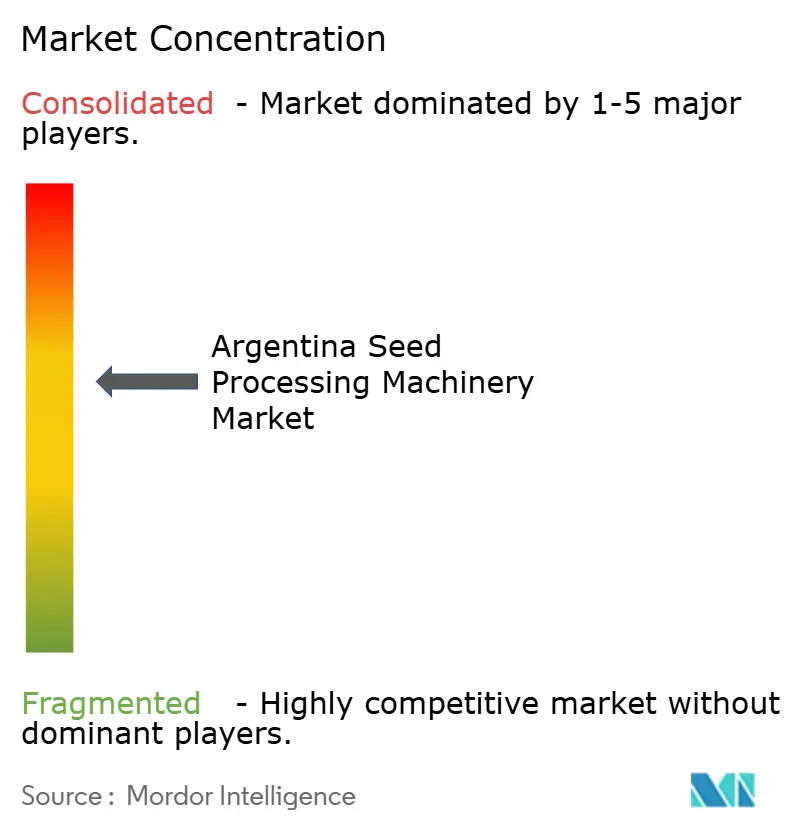
| Market Concentration | Medium |
Major Players
*Disclaimer: Major Players sorted in no particular order Image © Mordor Intelligence. Reuse requires attribution under CC BY 4.0. |
|
Argentina Seed Processing Machinery Market Analysis by Mordor Intelligence
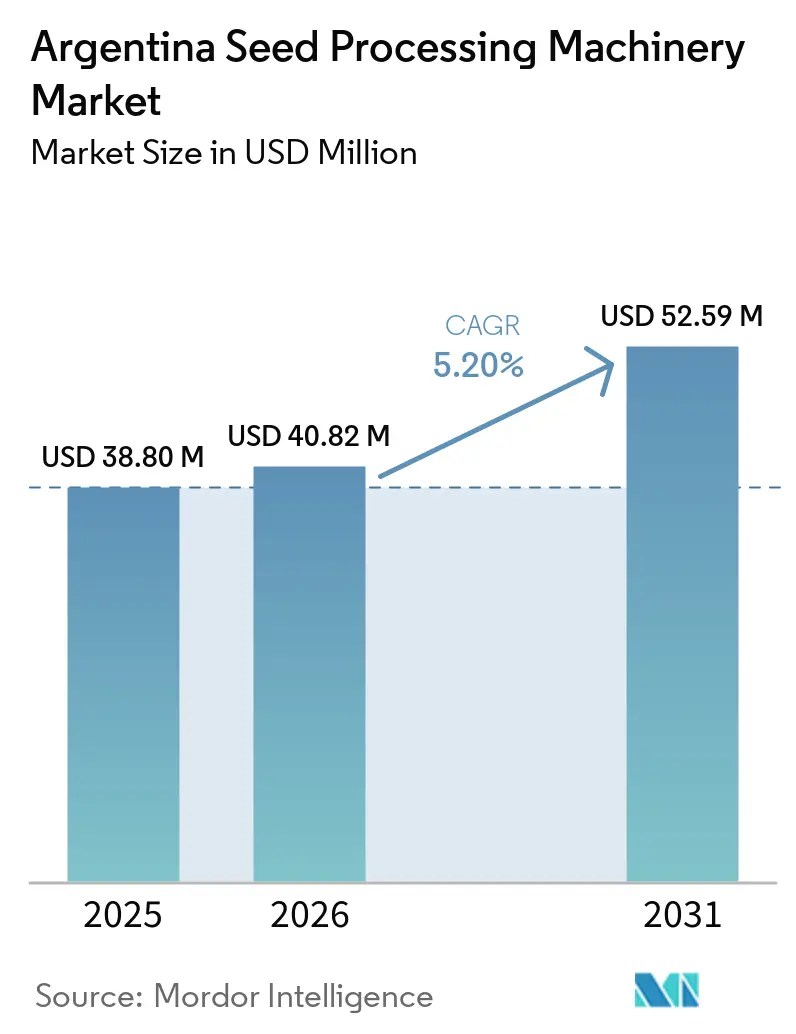
The Argentina seed processing machinery market is forecast to grow from USD 38.80 million in 2025 to USD 40.82 million in 2026, and is anticipated to reach USD 52.59 million by 2031, at a CAGR of 5.20% during the forecast period 2026-2031. Argentina's large soybean, corn, and wheat crop base supports recurring demand for equipment used to prepare seed lots for planting, certification, and export. Corn output reached 61 million metric tons in marketing year (MY) 2025/26, while wheat output reached 27.9 million metric tons in MY 2025/26, increasing the processing volumes handled across the main agricultural regions[1]Source: USDA FAS, "Argentina: Grain and Feed Annual," fas.usda.gov. Investments in oilseed capacity are also shaping the market, driving demand for seed cleaning, separation, and quality control equipment. Buyers are balancing automation and certification requirements against foreign-component costs, limited technical support outside major centers, and financing constraints. Modernization of existing plants generates equipment demand where full line replacement is difficult to finance.
Key Report Takeaways
- By machinery type, cleaners were the largest segment, and held 40.0% of the Argentina seed processing machinery market share in 2025, while optical sorters are the fastest-growing segment, and are forecast to grow at a 7.6% CAGR between 2026 and 2031.
- By operation mode, automatic systems were the largest segment and held 64.0% of the Argentina seed processing machinery market size in 2025, while automatic systems are the fastest-growing segment and are forecast to expand at a 6.8% CAGR between 2026 and 2031.
- By end user, commercial seed processing plants were the largest segment, and held 52.0% market share in 2025, while on-farm facilities are forecast to grow at a 6.4% CAGR between 2026 and 2031.
Note: Market size and forecast figures in this report are generated using Mordor Intelligence’s proprietary estimation framework, updated with the latest available data and insights as of January 2026.
Argentina Seed Processing Machinery Market Trends and Insights
Drivers Impact Analysis*
| Driver | (~) % Impact on CAGR Forecast | Geographic Relevance | Impact Timeline |
|---|---|---|---|
| Mechanization of Soybean, Corn, and Wheat Seed Processing | +1.5% | Pampa Húmeda core, with spillover to northwestern Argentina (NOA) and northeastern Argentina (NEA) | Long term (≥ 4 years) |
| Export Quality, Certification, and Traceability Requirements | +1.0% | National, with early gains in Santa Fe, Córdoba, and Buenos Aires export corridors | Medium term (2-4 years) |
| Expansion of Commercial Seed Multiplication Capacity | +0.9% | National, concentrated in Córdoba and Santa Fe multiplication zones | Medium term (2-4 years) |
| Automation of Optical Sorting and Grading | +0.8% | National, with strongest adoption in commercial seed plants near major export ports | Short term (≤ 2 years) |
| Expansion of Mobile Seed Processing Solutions | +0.7% | National, with emphasis on interior provinces distant from Buenos Aires | Long term (≥ 4 years) |
| Retrofit Demand for Import-Substitution and Line Modernization | +0.6% | National, with the strongest pipeline in aging processing facilities in Santa Fe and Entre Ríos | Medium term (2-4 years) |
| Source: Mordor Intelligence | |||
Mechanization of Soybean, Corn, and Wheat Seed Processing
Large field-crop volumes are increasing the need for cleaning, grading, treating, drying, and packaging capacity at commercial seed plants. Higher seed flows require plants to maintain consistent early-stage operations, as delays in cleaning or grading can affect later stages of handling and packaging. Greater supply can prompt export customers to apply stricter quality requirements, encouraging processors to upgrade pre-cleaners and gravity separators. Sunflower expansion introduces an oilseed stream with different sorting and grading needs compared to soybean-focused lines. Commercial investment in oilseed infrastructure strengthens demand for machinery that supports consistent seed inputs. The Argentina seed processing machinery market benefits when plants require flexible lines that can be adapted to different crops without disrupting core cleaning and grading operations.
Export Quality, Certification, and Traceability Requirements
Export-oriented facilities require reliable sampling, identification, and batch records to support seed quality management. This requirement favors automated processing systems that can maintain stable throughput and record processing conditions with less dependence on manual handling. Optical sorting is transitioning from a specialized addition to a more integral part of high-value seed lines, as it reduces reliance on manual grading. PETKUS Technologie GmbH introduced AI-assisted optical sorting and germination-based sorting technologies in 2025, demonstrating the ability to classify seeds by viability in addition to visible quality defects. Cimbria A/S describes its SEA.IQ Plus system as using full-color, near-infrared (NIR), and short-wave infrared indium gallium arsenide (SWIR-InGaAs) sensors, alongside its BRAIN AI module, to identify up to 14 defect categories in a single pass. The Argentina seed processing machinery market is more dependent on suppliers that combine sorting equipment with practical data, operator guidance, and service support.
Expansion of Mobile Seed Processing Solutions
The availability of mobile seed-processing equipment in Argentina is creating a flexible alternative to fixed processing facilities, particularly for operators serving seed-production locations across dispersed agricultural areas. LS-ARG, an Argentina-based seed-processing equipment supplier, offers an automated mobile seed-treatment unit mounted on a chassis/trailer, with a nominal capacity of 5 metric tons per hour and configurations designed for crops including soybean, wheat, and corn. The National Institute of Seeds (INASE) also recognizes mobile processors within its registration framework for commercial seed processing, confirming that mobile processing is an established operating model rather than only an emerging equipment concept. As mobile units can be transported between locations and reduce the need to move unprocessed seed to centralized facilities, they can make professional cleaning, treatment, and conditioning services more accessible to smaller processors and farms. This flexibility can encourage investment in trailer-mounted and transportable processing systems where establishing a permanent plant is less economical. Consequently, the expansion of mobile seed-processing solutions creates an additional channel for equipment demand in Argentina, particularly for service providers and operators processing seed across multiple locations.
Retrofit Demand for Import-Substitution and Line Modernization
Import restrictions and capital controls left many facilities with aging conveyors, aspiration equipment, and control interfaces. Since 2023, a more open import environment has allowed plants to consider targeted upgrades rather than full line replacements. Programmable logic controller (PLC) controls, aspiration modules, and grading heads can be upgraded at a lower cost than a new greenfield line, allowing operators to address specific operational issues first. Tecno Merced S.R.L. supplies locally manufactured seed and grain classifiers and reports more than 45 years of field experience, supporting its relevance in retrofit work. Local sourcing also helps operators manage maintenance costs where imported components are subject to currency risk. The Argentina seed processing machinery market maintains a continuing base of smaller modernization projects during periods of constrained investment.
Restraints Impact Analysis*
| Restraint | (~) % Impact on CAGR Forecast | Geographic Relevance | Impact Timeline |
|---|---|---|---|
| Limited Agricultural Financing and Long Equipment Payback Periods | -0.7% | National, with the strongest constraint in smaller interior provinces | Long term (≥ 4 years) |
| Operator and Service-Skill Bottlenecks | -0.4% | National, with gaps most acute in NOA and Patagonia | Medium term (2-4 years) |
| Peso Volatility, Import Duties, and Component Replacement Exposure | -0.5% | National, with a disproportionate impact on precision imported-component segments | Medium term (2-4 years) |
| High Up-Front Machinery Cost | -0.5% | National, with the strongest impact on small and medium-sized seed operators | Short term (≤ 2 years) |
| Source: Mordor Intelligence | |||
Limited Agricultural Financing and Long Equipment Payback Periods
Limited agricultural financing and long equipment payback periods continue to restrain the adoption of advanced seed processing machinery in Argentina. Integrated seed processing lines comprising pre-cleaners, optical sorters, seed treatment systems, and automated packaging equipment require substantial upfront capital, making them less accessible for small and medium-sized seed processors. The seasonal nature of agricultural revenues further complicates investment decisions, as machinery repayment periods often do not align with cash flow cycles. Consequently, many processors postpone equipment modernization or opt for incremental upgrades rather than investing in fully integrated processing lines. These financial constraints are anticipated to slow the adoption of advanced seed processing machinery, particularly among smaller commercial operators, while creating demand for modular and cost-effective automation solutions.
Peso Volatility, Import Duties, and Component Replacement Exposure
Peso volatility, import duties, and dependence on imported components continue to restrain the Argentina seed processing machinery market. Advanced seed processing equipment, including optical sorters, precision seed treatment systems, electronic sensors, and control units, relies heavily on imported machinery and components, exposing manufacturers and end users to exchange rate fluctuations and trade-related costs. Currency volatility increases the cost of imported equipment and replacement parts, while import duties further raise capital and maintenance expenses. According to the World Trade Organization (WTO) World Tariff Profiles 2025, Argentina's average Most-Favoured-Nation (MFN) applied tariff on mechanical, office and computing machinery is 11.8%, while certain tariff lines within this product group are subject to import duties of up to 35%[2]Source: WTO ITC UNCTAD, "WTO ITC UNCTAD World Tariff Profiles 2025," wto.org/statistics. These factors increase the total cost of ownership, delay equipment replacement, and discourage investment in advanced seed processing technologies, particularly among small and medium-sized seed processors.
*Our forecasts treat driver/restraint impacts as directional, not additive. The impact forecasts reflect baseline growth, mix effects, and variable interactions.
Segment Analysis
By Machinery Type: Cleaners Retain the Largest Role While Optical Sorters Grow Fastest
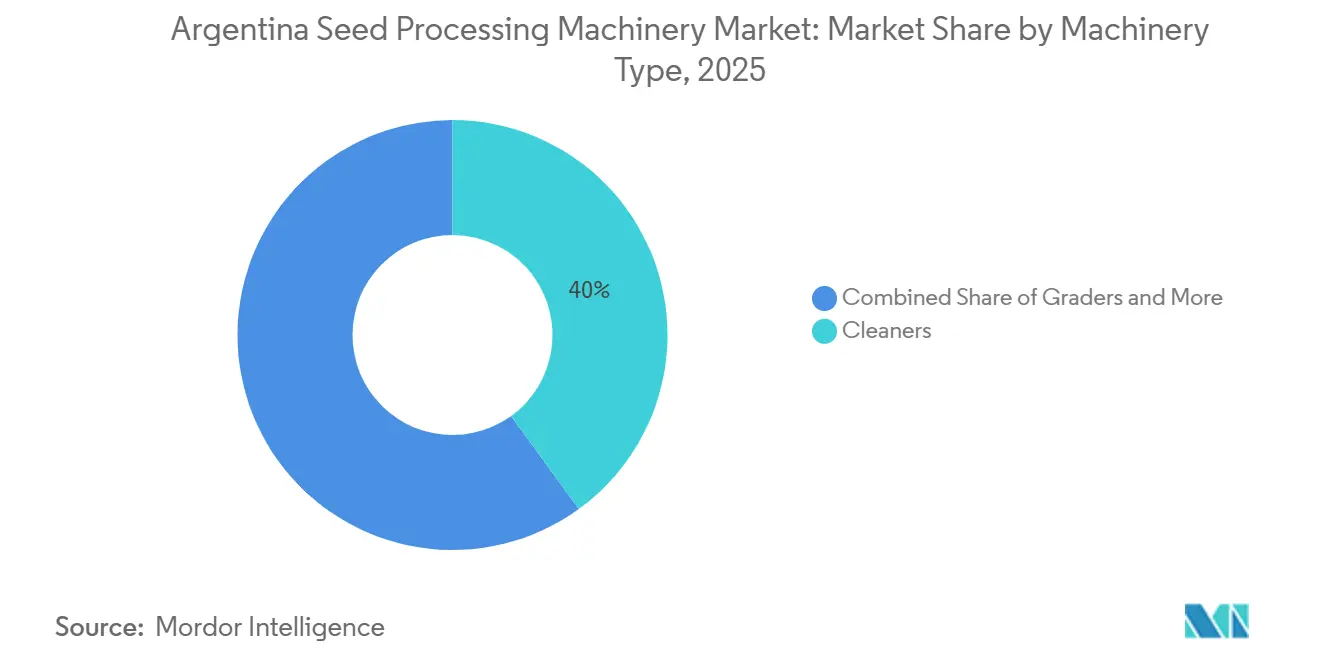
Cleaners accounted for 40.0% of the Argentina seed processing machinery market share in 2025, making them the largest machinery segment. Their dominance stems from their critical role as the primary processing stage in commercial seed lines, where impurities such as dust, chaff, broken seeds, and other foreign materials are removed before subsequent processing. Cleaners improve the efficiency of downstream operations and help maintain consistent seed quality across soybean, corn, wheat, sunflower, and sorghum seed processing. Pre-cleaners complement this process by removing larger contaminants immediately after harvest, while graders ensure uniform seed size and weight, improving the effectiveness of subsequent treatment and sorting operations. Dryers also play an important role in maintaining optimum seed moisture for storage and certification, particularly in regions with variable harvest conditions.
Optical sorters are forecast to grow at a CAGR of 7.6% during 2026–2031. The segment is anticipated to benefit from growing demand for precision seed quality assessment, varietal purity verification, and automated defect detection as seed companies increasingly focus on producing high-quality certified seeds. In 2025, Argentina's Secretariat of Agriculture approved the use of AI-based optical markers for soybean varietal identification, enabling real-time image processing for seed variety verification and highlighting the increasing role of imaging technologies in seed quality control [3]Source: Legislation and Official Notices, "MINISTRY OF ECONOMY SECRETARIAT OF AGRICULTURE, LIVESTOCK AND FISHERIES," boletinoficial.gob.ar. Equipped with advanced imaging systems and sensor-based technologies, optical sorters improve processing accuracy and support digital traceability across commercial seed processing facilities.



By Operation Mode: Automatic Systems Lead Export-Facing Processing Lines
Automatic seed processing machinery accounted for 64.0% of the Argentina seed processing machinery market size in 2025, making it the dominant automation segment. The widespread adoption of automatic systems is driven by the need for higher processing efficiency, consistent seed quality, and digital traceability across commercial seed processing facilities. Automated lines enable continuous operation from cleaning and grading to seed treatment and packaging while minimizing manual intervention and improving process consistency. As certified seed production expands, large commercial processors increasingly prefer automated systems to handle higher processing volumes and meet stringent quality standards. In contrast, semi-automatic systems continue to serve medium-sized seed producers, research institutions, and on-farm processing units by providing a cost-effective solution that automates selected processing stages while allowing manual intervention where operationally feasible.
Automatic seed processing machinery is also the fastest-growing segment, forecast to grow at a CAGR of 6.8% during 2026–2031. Growing investments in digitalization, sensor-based process monitoring, and AI-enabled quality assessment are anticipated to accelerate the adoption of fully automated processing lines across Argentina's seed industry. Modern automatic systems increasingly integrate real-time monitoring, batch traceability, and precision process controls to improve operational efficiency and reduce processing variability. As labor costs rise and demand for certified, high-quality seeds increases, seed processors are anticipated to transition from semi-automatic to fully automated systems, supporting the modernization of commercial seed processing facilities throughout the forecast period.
By End User: Commercial Plants Lead Demand While On-Farm Facilities Expand
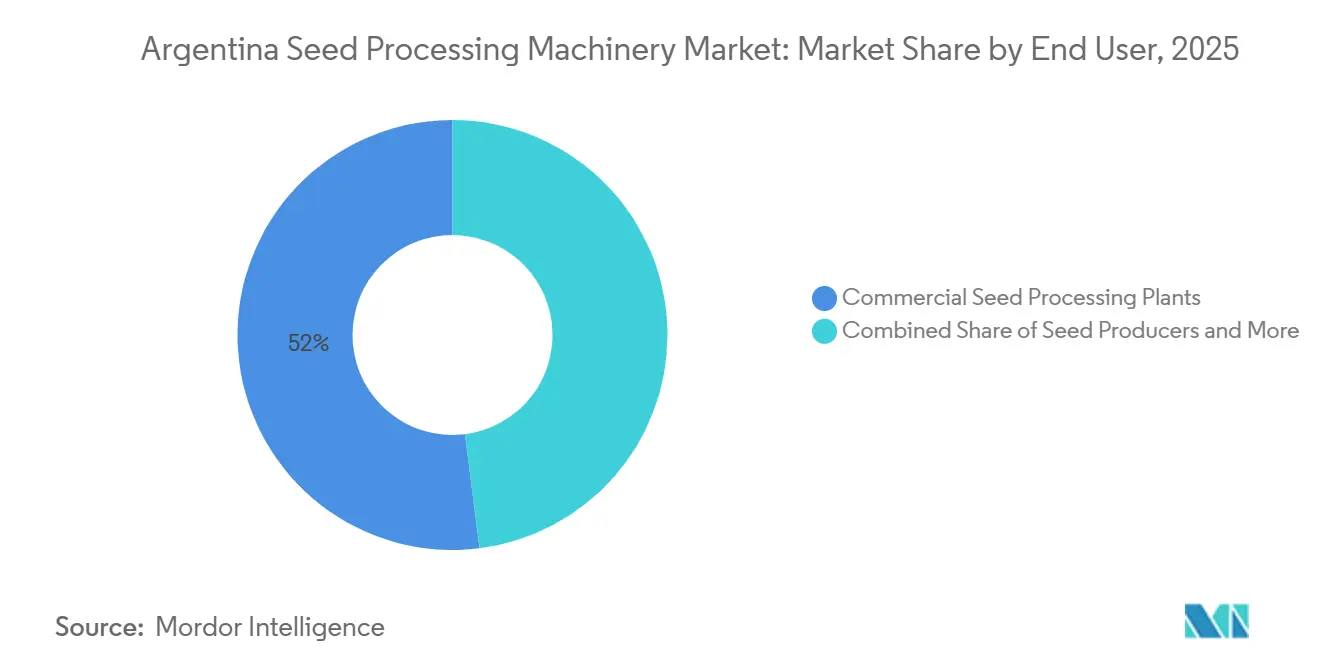
Commercial seed processing plants accounted for 52.0% of the market by end user in 2025. This share reflects high processing volumes, certification requirements, and the cost of automated equipment, which are more manageable in professionally operated facilities. These facilities set procurement standards for optical sorters, automatic treaters, and high-speed packaging systems, and also define the service response levels required from equipment suppliers, particularly for equipment that must operate within compressed seasonal windows. Independent seed producers that multiply licensed varieties represent another significant customer group and are increasingly adopting automatic and semi-automatic machinery to meet documentation requirements.
On-farm facilities are forecast to grow at a CAGR of 6.4% between 2026 and 2031, making them the fastest-growing end-user segment. Improved access to agricultural financing and the availability of compact modular equipment are supporting this growth by making smaller installations more practical for operators with lower processing volumes. Agro-industrial businesses occupy a position between commercial processing plants and farm operations, generating demand for equipment suited to intermediate volumes and allowing for gradual capacity upgrades. Research institutions represent a smaller customer group but serve as early adopters of AI-based seed quality analyzers and multispectral imaging systems ahead of broader commercial adoption. Grain handling facilities also purchase processing equipment for pre-export quality work, providing equipment suppliers with demand beyond certified seed production.
Geography Analysis
The Pampas (Pampa Húmeda) represent the largest regional market for seed processing machinery in Argentina, driven by the concentration of commercial seed production and processing activities in Buenos Aires, Córdoba, Santa Fe, and La Pampa. These provinces account for the majority of the country's soybean, corn, wheat, and sunflower seed multiplication, creating sustained demand for seed cleaning, grading, drying, treatment, and packaging equipment. Well-developed grain handling infrastructure, storage facilities, and the Rosario agro-industrial corridor further support investments in modern seed processing technologies by improving logistics efficiency and facilitating access to domestic and export markets.
The Pampas continue to dominate the Argentina seed processing machinery market owing to the presence of large commercial seed processing plants that require integrated, high-capacity processing lines to maintain certified seed quality and operational efficiency. The concentration of seed companies, cooperatives, and machinery suppliers in the region also strengthens aftermarket services, technical support, and spare-parts availability, encouraging the adoption of advanced equipment such as optical sorters, automated seed treatment systems, and digital process monitoring solutions. These factors make the Pampas the primary market for seed processing machinery investments in Argentina.
Beyond the Pampas, the Northwest Argentina (NOA) region, comprising Catamarca, Jujuy, La Rioja, Salta, Santiago del Estero, and Tucumán, and the Northeast Argentina (NEA) region, comprising Chaco, Corrientes, Formosa, and Misiones, are emerging markets supported by expanding cultivation of soybean, corn, sorghum, cotton, rice, and other specialty crops. Compared with the Pampas, these regions have fewer large commercial processing facilities and therefore exhibit greater demand for compact processing lines, dryers, and semi-automatic equipment suited to medium-scale operations. Meanwhile, Patagonia, particularly Río Negro and Neuquén, represents a niche market where seed processing machinery demand is primarily driven by vegetable, forage, and grass seed production, requiring specialized processing equipment rather than large-scale field crop seed processing systems.
Competitive Landscape
The Argentina seed processing machinery market is moderately concentrated, with Bühler AG, Cimbria A/S, PETKUS Technologie GmbH, Satake Corporation, and Ag Growth International Inc. as the key players. Global original equipment manufacturers (OEMs) from Europe and Japan serve premium cleaning, optical sorting, and turnkey-line requirements where buyers seek advanced machine functions. Argentine fabricators and Brazilian equipment suppliers compete more strongly in mechanical equipment, local lead times, and service responsiveness. Tecno Merced S.R.L. is relevant in locally manufactured classifiers and retrofit work, as it provides domestic seed and grain equipment. This combination leaves room for specialized distributors and new entrants in mid-range automation.
Service capability is a central part of competition because downtime caused by imported components can delay processing during critical agricultural windows. Suppliers that maintain local spare-parts stock, certified technicians, and multi-year service arrangements can strengthen their position in procurement decisions and reduce the uncertainty that buyers associate with imported equipment. Industry developments focused on combining seed cleaning systems with advanced color-sorting technologies to improve sorting accuracy, throughput, and quality control. Westrup ApS partnered with 3U Vision in 2025 to provide advanced, tailored optical-sorting solutions alongside its seed-cleaning equipment, broadening its offering for customers seeking integrated cleaning and sorting capabilities from a single supplier. Cimbria's SEA.IQ Plus platform represents another example of product differentiation through multispectral sensing and AI-supported sorting tools.
The Argentina seed processing machinery market is also influenced by whether equipment can generate data suitable for a buyer's quality and traceability processes. Suppliers that rely on manual records may be less attractive to larger plants that require consistent documentation and a clear processing history for each lot. Westrup ApS reported in 2025 that its net profit doubled in the financial year 2024/25, driven by international expansion and optical-sorting partnerships. Competition in the market is based on technical fit, access to service, lifecycle cost, and the ability to support plant modernization.
Argentina Seed Processing Machinery Industry Leaders
-
Bühler AG
-
PETKUS Technologie GmbH
-
Satake Corporation
-
Ag Growth International Inc.
-
Cimbria A/S (Grain & Protein Technologies)
- *Disclaimer: Major Players sorted in no particular order

Recent Industry Developments
- June 2026: Louis Dreyfus Company (LDC) confirmed a USD 400 million investment to construct one of the world's largest sunflower and soybean processing facilities at its existing Bahía Blanca complex, Buenos Aires Province. Once operational, the greenfield plant will crush up to 4,000 metric tons/day of sunflower seeds or soybeans.
- June 2026: GR Group committed USD 8 million to launch a new non-GMO soybean seed production and export business unit at its PT Farm in Carmen de Areco, Buenos Aires Province. The investment covers an experimental greenhouse, seedbed facilities, certified seed storage, and associated infrastructure, targeting a planted area of 15,000 hectares under contract this season with a purchase commitment of 65,000 metric tons from a North American buyer. The move signals emerging demand for dedicated seed-certification and handling infrastructure in Argentina's nascent non-GMO corridor.
- October 2025: Argentina's National Institute of Agricultural Technology (INTA) expanded its non-GMO soybean seed multiplication program into northern Argentina, registering seven new soybean varieties and increasing industry participation to 16 companies. The expansion is anticipated to increase demand for dedicated cleaning, optical sorting, and segregated processing systems to prevent cross-contamination between non-GMO and transgenic seed lots.


Argentina Seed Processing Machinery Market Report Scope
Seed processing machinery encompasses equipment used in agriculture to clean, sort, grade, dry, treat, and package seeds, improving their quality and viability for planting. These machines play a critical role in removing impurities, ensuring uniformity, and safeguarding seeds from pests and diseases
The Argentina Seed Processing Machinery Market Report is Segmented by Machinery Type (Pre-Cleaners, Cleaners, Dryers, Graders, Polishers, Optical Sorters, Seed Packagers, Coaters and Treaters, Separators and Destoners, and Other Specialized Equipment), by Operation Mode (Automatic and Semi-Automatic), and by End-User (Commercial Seed Processing Plants, Seed Producers, On-Farm Facilities, and Grain Handling Facilities). The Market Forecasts are Provided in Terms of Value (USD).
| Pre-Cleaners |
| Cleaners |
| Dryers |
| Graders |
| Coaters and Treaters |
| Separators and Destoners |
| Polishers |
| Optical Sorters |
| Seed Packagers |
| Other Specialized Equipment |
| Automatic |
| Semi-Automatic |
| Commercial Seed Processing Plants |
| Seed Producers |
| Research Institutions |
| On-Farm Facilities |
| Grain Handling Facilities |
| By Machinery Type | Pre-Cleaners |
| Cleaners | |
| Dryers | |
| Graders | |
| Coaters and Treaters | |
| Separators and Destoners | |
| Polishers | |
| Optical Sorters | |
| Seed Packagers | |
| Other Specialized Equipment | |
| By Operation Mode | Automatic |
| Semi-Automatic | |
| By End User | Commercial Seed Processing Plants |
| Seed Producers | |
| Research Institutions | |
| On-Farm Facilities | |
| Grain Handling Facilities |


Key Questions Answered in the Report
What is the Argentina seed processing machinery market size?
The Argentina seed processing machinery market was valued at USD 38.80 million in 2025 and is forecasted to reach USD 52.59 million by 2031 at 5.20% CAGR.
What is driving demand for seed processing equipment in Argentina?
Large field-crop volumes, commercial plant investment, export-quality requirements, and modernization of existing lines support demand. The Argentina seed processing machinery market also needs processing configurations that can handle soybean, corn, wheat, sunflower, sorghum, and specialty crops without compromising the operating sequence required for each seed lot.
Which machinery type leads sales in Argentina?
Cleaners led machinery type demand with 40.0% share in 2025. Most seed lots require cleaning before treatment, optical sorting, grading, or packaging, which makes the function central to commercial processing. Pre-cleaners and graders support this role by preparing material for the later stages of the line.
Why are automatic seed processing systems important?
Automatic systems are important because they support repeatable processing, higher throughput, and digital batch records. They are most relevant for export-facing plants that process larger volumes, need more consistent lot documentation, and must reduce variation introduced by manual material handling.
Page last updated on:





