
Argentina Pet Treats Market Size and Share
Market Overview
| Study Period | 2021 - 2031 |
|---|---|
| Forecast Data Period | 2026 - 2031 |
| Base Year Market Size (2025) | USD 139.12 Million |
| Market Size (2026) | USD 148.43 Million |
| Market Size (2031) | USD 205.19 Million |
| Growth Rate (2026 - 2031) | 6.69 % |
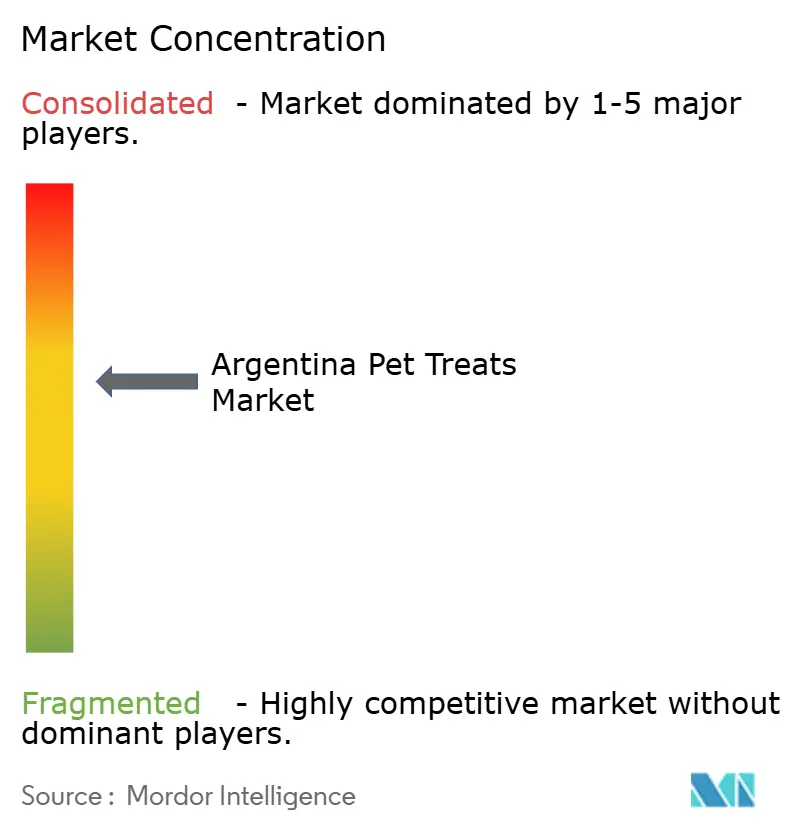
| Market Concentration | Medium |
Major Players *Disclaimer: Major Players sorted in no particular order Image © Mordor Intelligence. Reuse requires attribution under CC BY 4.0. | |
Argentina Pet Treats Market Analysis by Mordor Intelligence
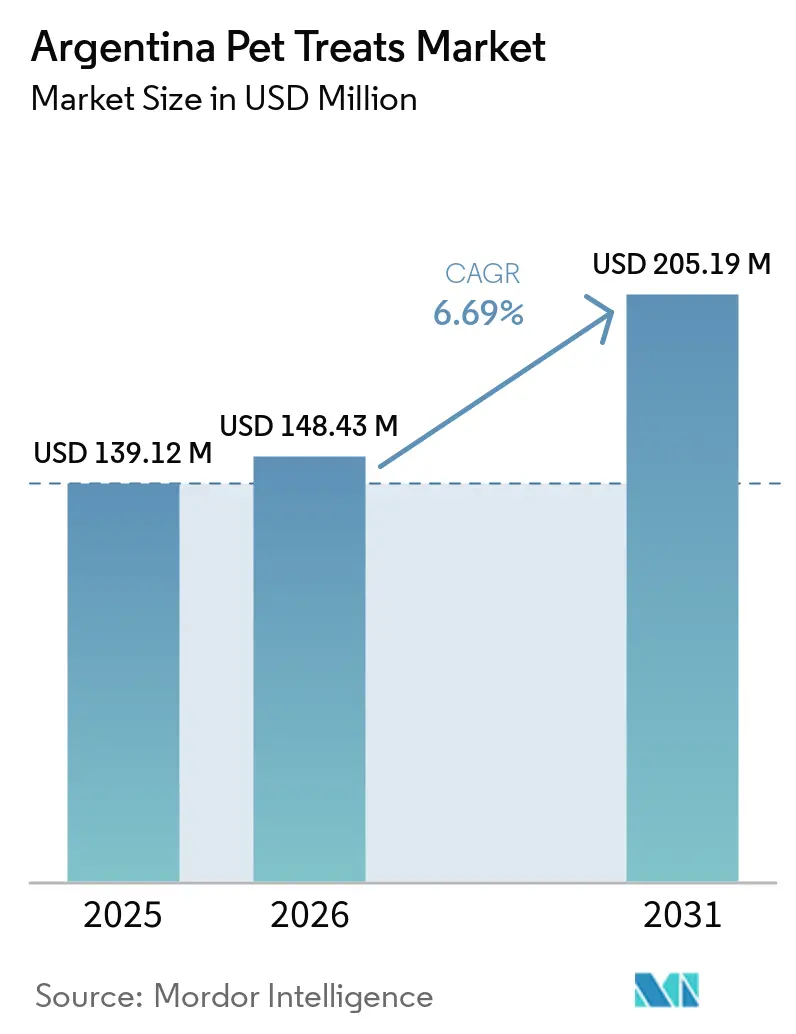
The Argentina pet treats market size was valued at USD 139.12 million in 2025 and is projected to increase from USD 148.43 million in 2026 to USD 205.19 million by 2031. The market is forecast to grow at a CAGR of 6.69% from 2026 to 2031. The market is being influenced by a growing preference for premium and functional products, as pet owners increasingly purchase items such as dental sticks, high-protein jerky, and freeze-dried treats that emphasize health and quality. Additionally, Argentina's economic stabilization is contributing to market growth, as lower inflation compared to the 2023-2024 peak is gradually restoring household discretionary spending and encouraging the adoption of premium products. The market is also experiencing a shift in distribution channels, driven by the expansion of online subscriptions, marketplaces, and hybrid retail models, which are enhancing repeat purchases across Buenos Aires and other provinces. However, fluctuations in input costs for animal proteins and the regulatory challenges posed by the National Service for Agrifood Health and Quality (SENASA) Resolution 1415/2024 are increasing operational pressures, particularly for smaller producers with limited procurement and compliance capabilities. In 2025, the Argentina pet treats market was moderately concentrated and this leaves opportunities for domestic competitors to grow in segments such as cat treats, veterinary-led formats, and premium offerings through e-commerce channels.
Key Report Takeaways
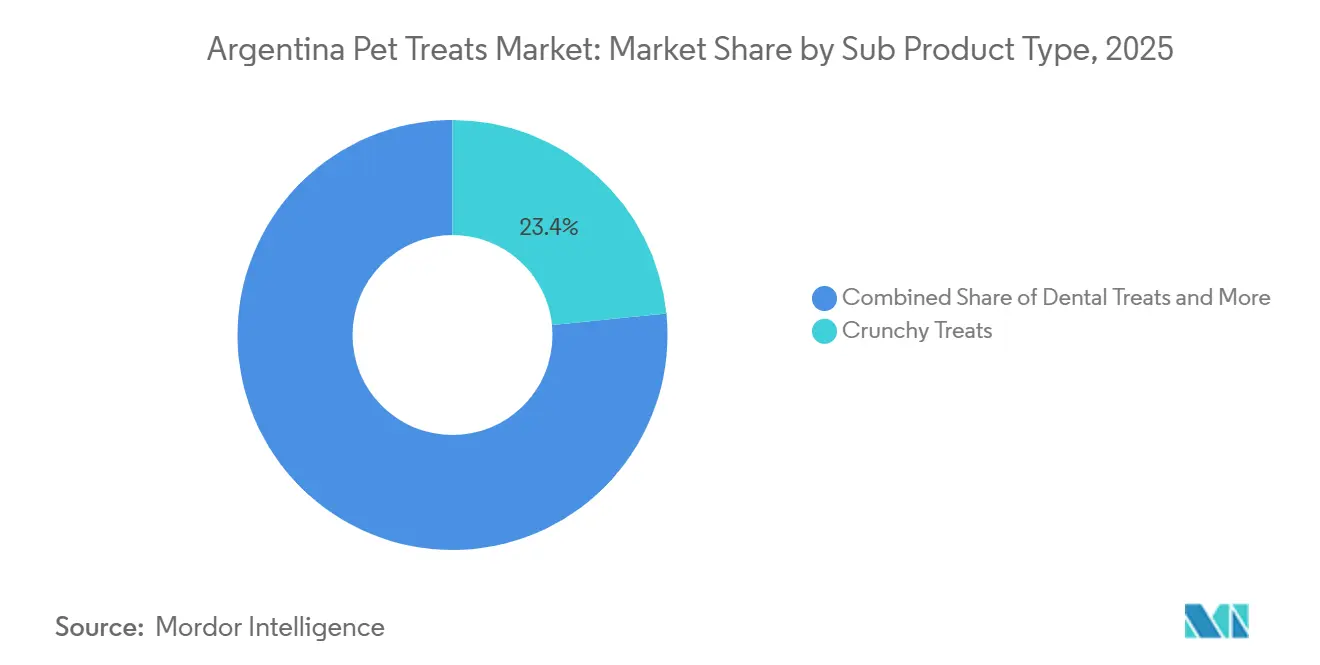
- By sub product type, crunchy treats were the largest segment, accounting for 23.4% of the Argentina pet treats market share in 2025, while freeze-dried and jerky treats are forecast to grow at a CAGR of 7.4% from 2026 to 2031.
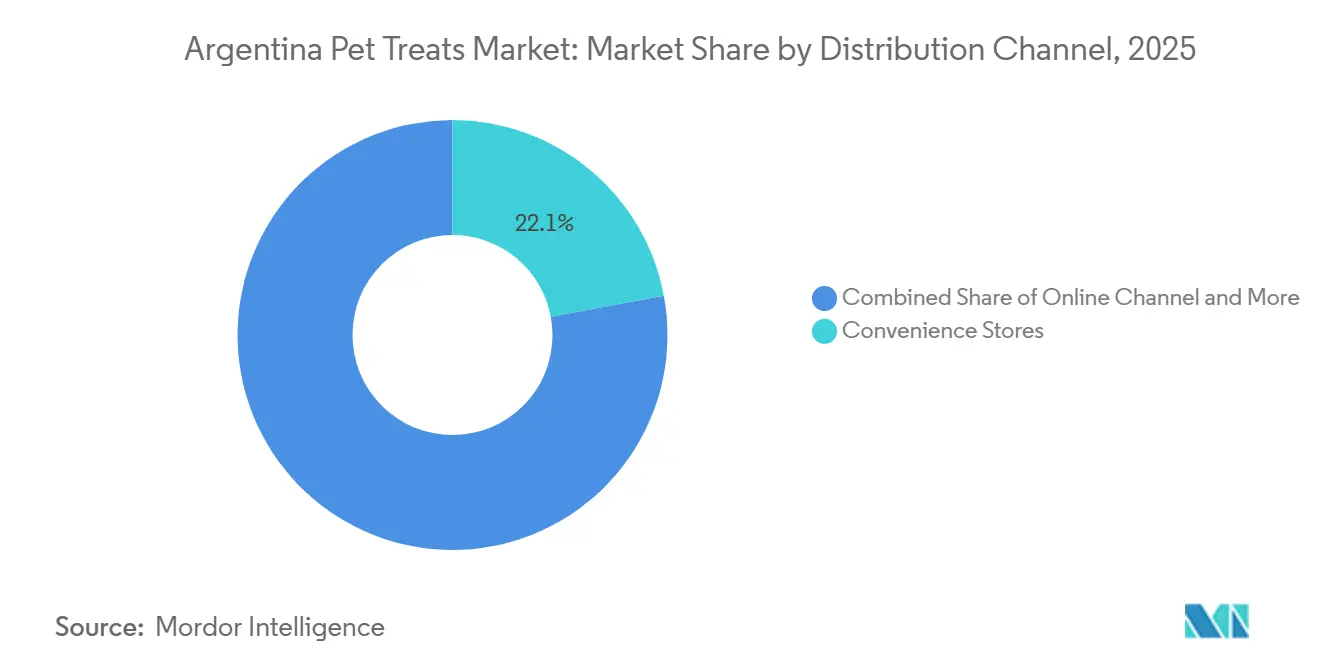
- By distribution channel, convenience stores were the largest segment, accounting for 22.1% of the Argentina pet treats market share in 2025, while the online channel is forecast to grow at a CAGR of 8.0% from 2026 to 2031.
- By pets, dogs were the largest segment, accounting for 57.1% of the Argentina pet treats market share in 2025. The dog segment is also forecast to be the fastest-growing segment, with a CAGR of 7.7% from 2026 to 2031.
Note: Market size and forecast figures in this report are generated using Mordor Intelligence’s proprietary estimation framework, updated with the latest available data and insights as of January 2026.
Market Trends and Insights
Drivers Impact Analysis of Argentina Pet Treats Market*
| Driver | (~) % Impact on CAGR Forecast | Geographic Relevance | Impact Timeline |
|---|---|---|---|
| Humanization of Pets and Premiumization of Treats | +1.5% | Argentina national, strongest pull in Buenos Aires and Córdoba | Medium term (2-4 years) |
| Accelerated Dental-Health Focus in Companion Animals | +1.3% | Argentina national, highest density in Greater Buenos Aires Metropolitan Area (AMBA) urban corridor | Short term (≤ 2 years) |
| Expansion of Direct-to-Consumer Subscription Models | +1.2% | Argentina national, deepening through interior provinces via Mercado Libre | Short term (≤ 2 years) |
| Retailer Private-Label Expansion in Emerging Economies | +1.1% | Argentina national, significant pull in mid-market retail corridors | Medium term (2-4 years) |
| Advanced Extrusion Technologies Reducing Processing Costs | +0.9% | Argentina national, centered in Córdoba manufacturing cluster | Long term (≥ 4 years) |
| Upcycling of Meat By-Products Into Sustainable Treats | +0.8% | Argentina national, leverages strong domestic livestock supply chains | Long term (≥ 4 years) |
| Source: Mordor Intelligence | |||
Humanization of Pets and Premiumization of Treats
Pet care in Argentina has increasingly shifted toward emotionally driven spending, driving demand for premium treat formats. In 2024, Argentines spent over USD 2,200 million on pet food and related products, demonstrating the resilience of this category even during challenging economic conditions. Within the Argentina pet treats market, this trend is boosting demand for protein-rich jerky, dental treats, botanical soft chews, and portion-controlled snacks, which are perceived as more purposeful compared to traditional biscuits. The appeal of these premium products extends beyond affluent consumers, as the data indicates that the intent to prioritize premiumization persists despite household budget constraints. Consequently, the Argentina pet treats market is experiencing stronger value growth driven by product mix enhancements and brand trust, rather than solely by an increase in consumption volume.
Accelerated Dental-Health Focus in Companion Animals
Dental health is becoming an important consideration in companion animal care, creating opportunities for functional dental treats in the Argentina pet treats market. According to a study published in the Journal of Small Animal Practice in March 2026, periodontal disease was reported in 50.5% of 12,753 dogs highlighting the prevalence of oral-health concerns among companion animals[1]. This reinforces the relevance of preventive oral-care products, including dental chews and treats designed to help control plaque and tartar accumulation. Products such as Pedigree DentaStix address this demand through chew-based dental-care formulations, providing an established product proposition for consumers seeking functional benefits alongside rewards. Local manufacturers can also explore this segment through recipes incorporating animal proteins and ingredients suited to domestic consumer preferences. Veterinary clinics and pet specialty stores remain important distribution channels because veterinary recommendations can influence awareness and purchasing decisions for functional pet-care products. Consequently, greater attention to preventive dental health creates opportunities for manufacturers to differentiate treat portfolios through functional formulations and veterinary-supported product positioning.
Expansion of Direct-to-Consumer Subscription Models
Recurring online purchases are influencing shopping frequency in the Argentina pet treats market, particularly in urban areas where pet owners frequently use digital channels for regular restocking. Subscription boxes and auto-ship models reduce reliance on shelf competition and enable brands to secure repeat purchases in a fragmented retail environment. This is significant in a market where convenience stores, pet shops, and veterinary outlets distribute demand across numerous small touchpoints. For instance, Golocan operated through 1,200 retail points in the Greater Buenos Aires Metropolitan Area (AMBA) in 2024 while also expanding its e-commerce presence and exports, demonstrating the increasing commercial viability of hybrid omnichannel models[2]. In the Argentina pet treats market, this trend primarily drives growth by increasing purchase frequency rather than raising unit prices.
Upcycling of Meat By-Products Into Sustainable Treats
Argentina's extensive livestock resources provide local manufacturers with a significant input advantage in the pet treats market, particularly for products centered on animal proteins and by-products. This cost advantage enables local producers to develop high-protein formulations using a sourcing model that imported products find challenging to replicate. Additionally, this approach aligns with sustainability trends, as younger pet owners increasingly prioritize waste reduction and transparency in ingredient sourcing. In 2026, Kalbby invested USD 1 million and obtained the National Service for Agrifood Health and Quality (SENASA) authorization for its Biologically Appropriate Raw Food (BARF) model, demonstrating the transition of minimally processed, by-product-based formulations into formal commercial production[3]. For producers in Argentina's pet treats market, protein upcycling offers both a cost-effective strategy and a compelling product narrative that meets premium market demands while reducing reliance on imported specialty ingredients.
Restraints Impact Analysis of Argentina Pet Treats Market*
| Restraint | (~) % Impact on CAGR Forecast | Geographic Relevance | Impact Timeline |
|---|---|---|---|
| Price Inflation in Key Animal-Protein Inputs | -1.5% | Argentina national, particularly acute in interior livestock-dependent supply chains | Short term (≤ 2 years) |
| Regulatory Scrutiny of Novel Functional Ingredients | -1.2% | Argentina national, compliance factors concentrated in Buenos Aires and Córdoba | Long term (≥ 4 years) |
| Rising Competition From Homemade Treat Communities | -0.9% | Argentina national, strongest in cost-sensitive Greater Buenos Aires Metropolitan Area (AMBA) and mid-tier urban centers | Medium term (2-4 years) |
| Supply-Chain Volatility in Specialty Botanicals | -0.8% | Argentina national, supply exposure to Andean and South American botanical corridors | Medium term (2-4 years) |
| Source: Mordor Intelligence | |||
Price Inflation in Key Animal-Protein Inputs
Price inflation in animal protein remains a significant cost concern for the Argentina pet treats market through 2026, as beef offal, poultry by-products, and fish meal continue to be essential components in premium and functional formulations. While Argentina's overall inflationary pressures have eased since their peak in 2023-2024, raw material price volatility persists, affecting margin planning and pricing strategies. Producers typically address these challenges through reformulation, reducing pack sizes, or passing costs onto consumers. However, each of these strategies risks dampening demand in a market that remains highly price-sensitive. Smaller domestic suppliers face greater challenges, as they lack the ability to offset Argentine input cost fluctuations through global sourcing networks, unlike multinational companies. This structural disparity provides larger operators with a competitive advantage in the Argentina pet treats market and has led to increased interest among local processors in establishing closer supply partnerships.
Regulatory Scrutiny of Novel Functional Ingredients
The Argentina pet treats market is experiencing slower progress in advanced functional claims due to the National Service for Agrifood Health and Quality's (SENASA) updated regulatory framework, which closely monitors ingredients with less established safety profiles. Resolution 1415/2024 has replaced the previous certificate system with sworn declarations and post-market inspections. While this change simplifies routine registration processes, it maintains a stringent review process for newer ingredient categories. According to the draft, the documentation requirements for novel compounds can extend commercialization timelines by 12 to 24 months, creating challenges for smaller innovators in achieving speed-to-market. Multinational suppliers are better equipped to navigate this framework, leveraging their stronger regulatory teams and broader international references. Over time, this dynamic is likely to concentrate premium functional innovation among established players within the Argentina pet treats market.
*Our forecasts treat driver/restraint impacts as directional, not additive. The impact forecasts reflect baseline growth, mix effects, and variable interactions.
Argentina Pet Treats Market Segment Analysis
By Sub Product:
Crunchy Treats Lead, While Freeze-Dried and Jerky Treats Grow FasterCrunchy treats accounted for 23.4% of the Argentina pet treats market share in 2025, making them the leading sub product category segment. Their position reflects widespread availability across supermarkets, convenience stores, pet shops, and other retail channels, alongside strong consumer familiarity and affordability. Their crunchy texture, convenience, and suitability for routine rewarding support repeat purchases among pet owners. These characteristics help maintain demand in a price-sensitive market where familiar products and accessible price points influence purchasing decisions.
Freeze-dried and jerky treats are forecast to be the fastest-growing product category in the Argentina pet treats market, with a CAGR of 7.4% from 2026 to 2031. Their growth prospects are supported by increasing interest in minimally processed ingredients, high-protein formulations, and premium pet nutrition. Argentina's established beef industry also provides domestic manufacturers with access to locally sourced animal proteins, supporting product differentiation and ingredient traceability. Meanwhile, dental treats continue to serve functional consumption needs through oral-care benefits, while soft and chewy treats appeal to owners seeking convenient training rewards. These developments reflect the gradual expansion of premium and function-oriented product formats alongside established demand for conventional crunchy treats.

By Distribution Channel:
Online Channels Reshape Argentina's Pet Treat Retail Map While Convenience Stores LeadConvenience stores were the leading distribution channel in the Argentina pet treats market, accounting for 22.1% of the market share in 2025. Their position reflects their widespread presence across urban and suburban neighborhoods, where consumers can purchase pet treats alongside routine grocery items. Their accessibility, frequent shopping visits, and availability of affordable, familiar treat brands support impulse purchases and repeat buying. These characteristics strengthen convenience stores' role in reaching price-conscious pet owners and maintaining demand for mainstream pet treat products.
The online channel is forecast to be the fastest-growing distribution channel in the Argentina pet treats market, with a CAGR of 8.0% from 2026 to 2031. Its growth prospects are supported by increasing digital purchasing convenience, wider product selection, and access to specialized and premium pet treat brands that may have limited availability in physical stores. E-commerce platforms also allow consumers to compare prices, product ingredients, pack sizes, and customer reviews before purchasing. Subscription services, promotional offers, and home delivery further encourage repeat purchases, particularly among urban pet owners. Meanwhile, supermarkets and hypermarkets continue to serve routine household purchases, while specialty pet stores retain relevance through product variety and personalized recommendations.
By Pets:
Dogs Lead Market Share and Drive Segment GrowthDogs accounted for 57.1% of the Argentina pet treats market size in 2025, making them the leading pet type segment. Their dominance reflects the strong presence of canine ownership in Argentine households and the wider availability of dog-specific treat products across supermarkets, convenience stores, and specialty pet retailers. Dogs also have a broader range of treat applications, including daily rewarding, training, dental care, and nutritional supplementation, supporting more frequent consumption and repeat purchases. The established product variety and purchasing habits of dog owners continue to strengthen the segment's leading position.
The dog segment is forecast to be the fastest-growing pet type category in the Argentina pet treats market, with a CAGR of 7.7% from 2026 to 2031. Growth is supported by increasing demand for functional and premium treats, particularly products offering dental benefits, high-protein formulations, and natural ingredients. Manufacturers are expanding product variety to address different canine sizes, life stages, and nutritional requirements, while the availability of locally sourced animal proteins, particularly beef, supports product differentiation. Meanwhile, cat treats present an emerging opportunity as manufacturers introduce specialized products targeting feline preferences and functional needs. These developments are anticipated to broaden the Argentina pet treats market beyond its established dog-focused product base.
Geography Analysis
The Argentina pet treats market operates as a unified national market, with demand and supply concentrated in specific urban areas. The Buenos Aires Metropolitan Area (AMBA) remains the largest demand hub, with pet ownership reaching a majority households in the Greater Buenos Aires area by 2024. This concentration establishes AMBA as the largest revenue base in the Argentina pet treats market, despite the absence of a provincial revenue breakdown. AMBA also leads in the adoption of premium and functional treats due to stronger product availability, higher urban purchasing power, and advanced digital logistics. Consequently, changes in consumer behavior in Buenos Aires tend to influence the national market more rapidly than shifts in other regions.
Córdoba is the second most significant region, combining strong local consumption with a key role in manufacturing. In May 2024, Alican announced a USD 30 million expansion to triple production capacity at its Córdoba facilities, underscoring the province's importance as a national supply hub with export potential. Córdoba also benefits from its proximity to agricultural and livestock networks, which are critical for input sourcing and cost-effective production. This strategic position enhances Córdoba's role beyond its direct consumption, supporting both national demand and the production scale required for broader regional goals.
The Rosario and Santa Fe axis is gaining importance as pet food manufacturing and distribution activities expand across Argentina's established agricultural and industrial regions. The concentration of agricultural raw materials, processing infrastructure, and logistics networks in these provinces supports access to ingredients and distribution channels for pet food manufacturers. Meanwhile, interior provinces such as Tucumán, Mendoza, Salta, and the Patagonian region continue to face distribution challenges, particularly for fresh and frozen pet treat formats that require reliable cold-chain infrastructure. However, manufacturers are addressing these gaps. For instance, Vitalcan commissioned a USD 9 million facility in Río Grande at the end of 2024, positioning production capacity closer to underserved areas and improving national market coverage.
Competitive Landscape
The Argentina pet treats market was moderately consolidated in 2025, with Nestlé S.A., Mars, Incorporated, Colgate-Palmolive Company, Agro Industrias Baires S.A., and Vitalcan S.A. identified as the leading players. Their competitive positions are supported by established pet food and treat portfolios, brand recognition, product development capabilities, and distribution networks across supermarkets, specialty pet stores, and online channels. Multinational companies benefit from extensive product development resources, established retail relationships, and broad brand portfolios, while domestic manufacturers leverage local market knowledge, regional distribution networks, and access to locally sourced animal proteins. Competition increasingly focuses on product quality, ingredient transparency, affordability, functional benefits, and the introduction of premium treat formats targeting different pet preferences and nutritional requirements.
The primary competitive divide in the Argentina pet treats market lies between premium functional offerings and products emphasizing local cost efficiency and cultural alignment. Alican’s plan to introduce functional cat treat lines highlights how domestic manufacturers are entering segments traditionally dominated by global brands. Vitalcan’s new Río Grande facility, operational since late 2024, increased production capacity and strengthened its national distribution network. Similarly, Kalbby’s 2024 investment and the National Service for Agrifood Health and Quality (SENASA) authorization for BARF (Biologically Appropriate Raw Food) production demonstrate that smaller premium specialists can establish defensible niches with minimally processed products. These developments indicate that competition is being driven by capacity expansion, premium product specialization, and enhanced channel control.
White-space opportunities are evident in feline treats, veterinary-led functional products, and subscription-based offerings targeting urban pet owners. Companies like Freshpet, Inc. and Central Garden and Pet Company serve as examples of specialized international players whose success relies more on premium channel access than on broad mass distribution. These companies provide insights into the premium segment's potential rather than the overall market's volume base in Argentina. Overall, while the Argentina pet treats market favors larger suppliers in regulated functional niches, its fragmentation still allows focused domestic players to establish significant positions.
Argentina Pet Treats Industry Leaders
-
Nestlé S.A
-
Mars, Incorporated
-
Colgate-Palmolive Company
-
Agro Industrias Baires S.A
-
Vitalcan S.A
- *Disclaimer: Major Players sorted in no particular order
Argentina Pet Treats Market Companies Covered in this Report
- Mars, Incorporated
- Nestle S.A.
- Colgate-Palmolive Company
- Agro Industrias Baires S.A.
- Vitalcan S.A.
- Farmina Pet Foods Holding
- Archer Daniels Midland Company
- The J. M. Smucker Company
- General Mills, Inc.
- Central Garden and Pet Company
- Freshpet, Inc.
- Agrolimen, S.A.
- Sunshine Mills, Inc.
- Zenta Pets LLC.
- Criadores Company
- Kongo
- Voraz
- Pet Company S.A.
- Spectrum Brands Holdings, Inc.
- Dechra Pharmaceuticals PLC
Recent Industry Developments in Argentina Pet Treats Market
- April 2026: Cheff Raw Food launched single-ingredient dehydrated pet snacks for dogs and cats in Argentina, expanding its natural pet nutrition portfolio.
- December 2024: SENASA introduced Resolution 1415/2024, establishing a unified regulatory framework for animal nutrition products, with permanent authorizations subject to Good Manufacturing Practices compliance.
- October 2024: Mars, Incorporated, launched Eukanuba Treats in Argentina, introducing chicken-based crunchy dog treats formulated with omega-3, fiber, and prebiotics for training and positive reinforcement.
Argentina Pet Treats Market Report Scope
Pet treats are snack and reward products formulated for companion animals and are used for indulgence, training, oral care, and functional health support. The Argentina pet treats market is segmented by sub-product (crunchy treats, dental treats, freeze-dried and jerky treats, soft and chewy treats, and other treats), by pet type (dogs, cats, and other pets), and by distribution channel (convenience stores, online channel, specialty stores, supermarkets and hypermarkets, and other channels). The market forecasts are provided in terms of value (USD) and volume (metric tons) for all the above segments.
Segmentation Overview
| Crunchy Treats |
| Dental Treats |
| Freeze-Dried and Jerky Treats |
| Soft and Chewy Treats |
| Other Treats |
| Cats |
| Dogs |
| Other Pets |
| Convenience Stores |
| Online Channel |
| Specialty Stores |
| Supermarkets/Hypermarkets |
| Other Channels |
| By Sub Product | Crunchy Treats |
| Dental Treats | |
| Freeze-Dried and Jerky Treats | |
| Soft and Chewy Treats | |
| Other Treats | |
| By Pets | Cats |
| Dogs | |
| Other Pets | |
| By Distribution Channel | Convenience Stores |
| Online Channel | |
| Specialty Stores | |
| Supermarkets/Hypermarkets | |
| Other Channels |
Key Questions Answered in the Report
What is the projected value of the Argentina pet treats market by 2031?
The Argentina pet treats market is projected to reach USD 205.19 million by 2031, up from USD 148.43 million in 2026. The market is forecast to grow at a CAGR of 6.69% from 2026 to 2031, following a valuation of USD 139.12 million in 2025.
Which sub-product segment is forecast to grow the fastest in the Argentina pet treats market?
Freeze-dried and jerky treats are forecast to grow at a CAGR of 7.4% from 2026 to 2031.
Which pet group accounts for the largest share of the Argentina pet treats market?
Dogs accounted for 57.1% of the Argentina pet treats market share in 2025, driven by high dog ownership and a broad range of available products.
Why are online pet treat sales increasing in Argentina?
Online sales channels in the Argentina pet treats market are forecast to grow at a CAGR of 8.0% from 2026 to 2031, supported by subscription services, Mercado Libre's reach, and omnichannel models that encourage repeat purchases.