
Argentina Microgreens Market Size and Share
Market Overview
| Study Period | 2021 - 2031 |
|---|---|
| Forecast Data Period | 2026 - 2031 |
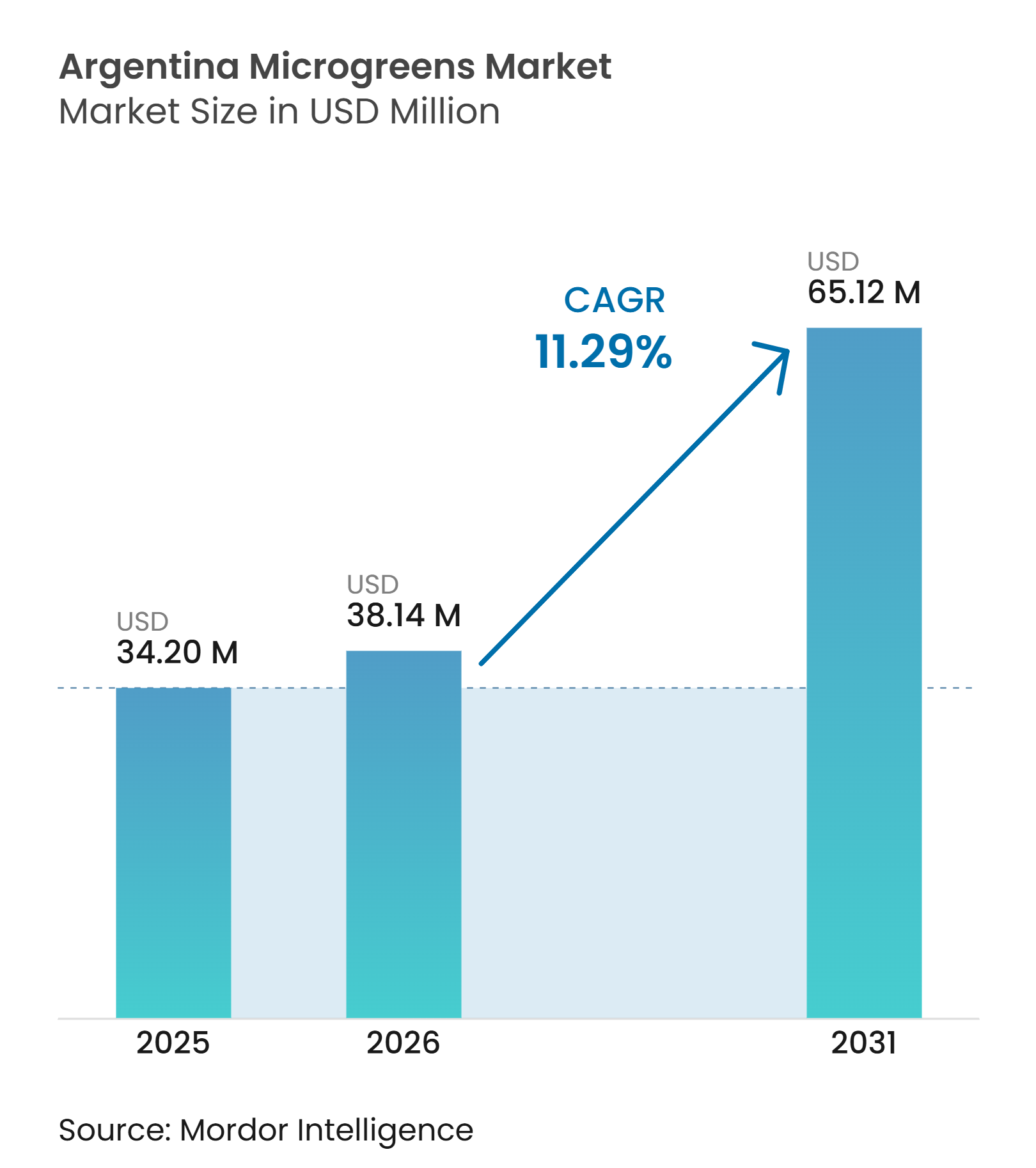
| Base Year Market Size (2025) | USD 34.20 Million |
| Market Size (2026) | USD 38.14 Million |
| Market Size (2031) | USD 65.12 Million |
| Growth Rate (2026 - 2031) | 11.29 % |
| Market Concentration | Low |
Major Players *Disclaimer: Major Players sorted in no particular order Image © Mordor Intelligence. Reuse requires attribution under CC BY 4.0. | |
Argentina Microgreens Market Analysis by Mordor Intelligence
The Argentina microgreens market size is anticipated to grow from USD 34.20 million in 2025 and USD 38.14 million in 2026 to reach USD 65.12 million by 2031, registering a CAGR of 11.29% between 2026 and 2031. Restaurant demand, urban cultivation, and health-focused food choices are supporting this expansion in major cities, where repeat orders are especially important for small farms. Controlled indoor farms can shorten delivery times and provide more consistent output than conventional produce channels. Producers are also using direct sales and digital ordering to protect freshness and retain customer relationships. The fragmented supplier base favors local operators because microgreens have a short usable life and require rapid delivery. This leaves room for producers that can meet traceability, packaging, and food-safety requirements while serving nearby buyers, then build steady demand through dependable local service.
Key Report Takeaways
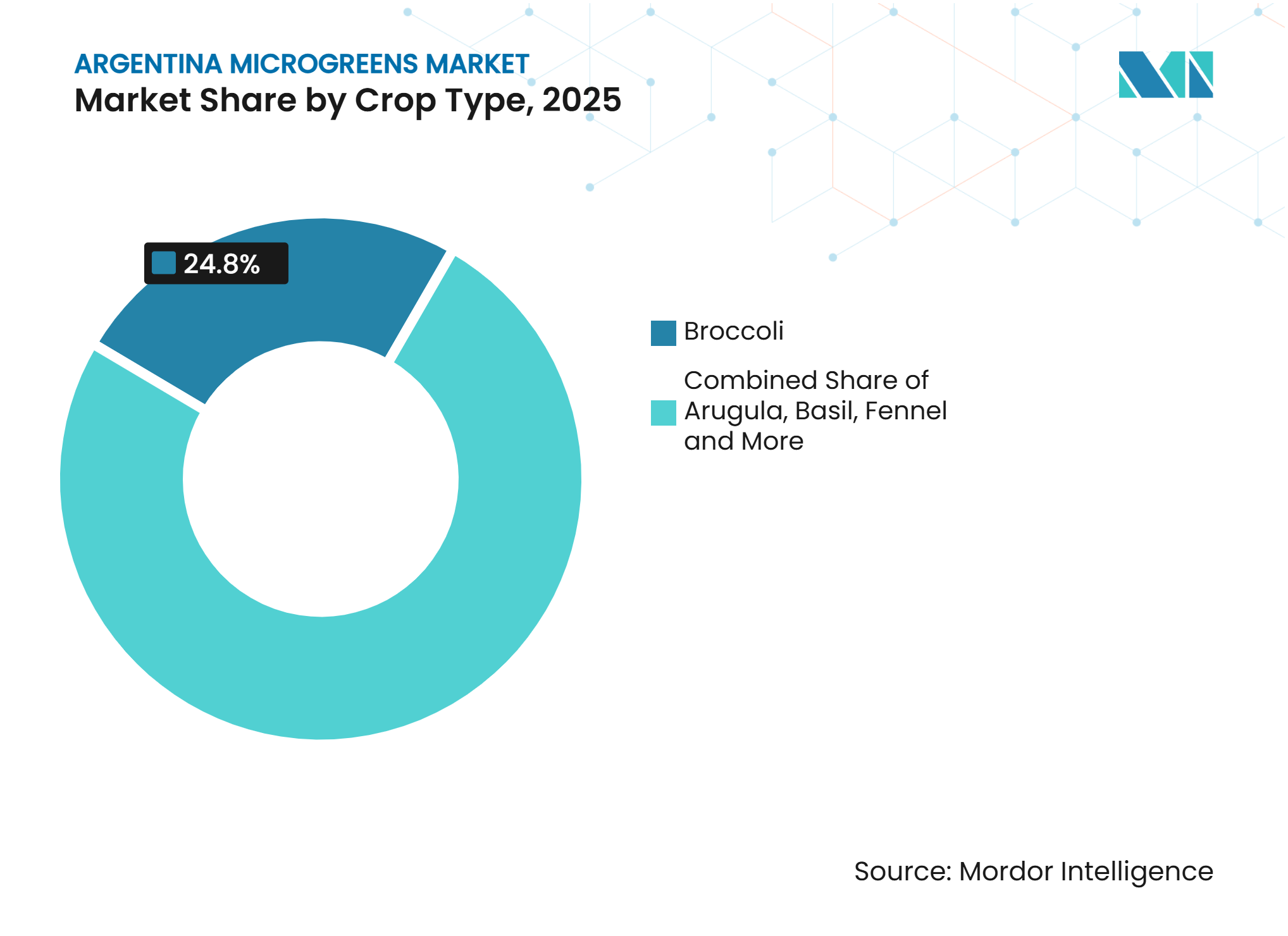
- By crop type, broccoli accounted for 24.8% of the Argentina microgreens market share in 2025, while basil is projected to grow at the fastest CAGR of 12.2% from 2026 to 2031.
- By farming method, indoor farming accounted for 43.1% of the Argentina microgreens market share in 2025, while vertical farming is anticipated to grow at a CAGR of 12.5% from 2026 to 2031.
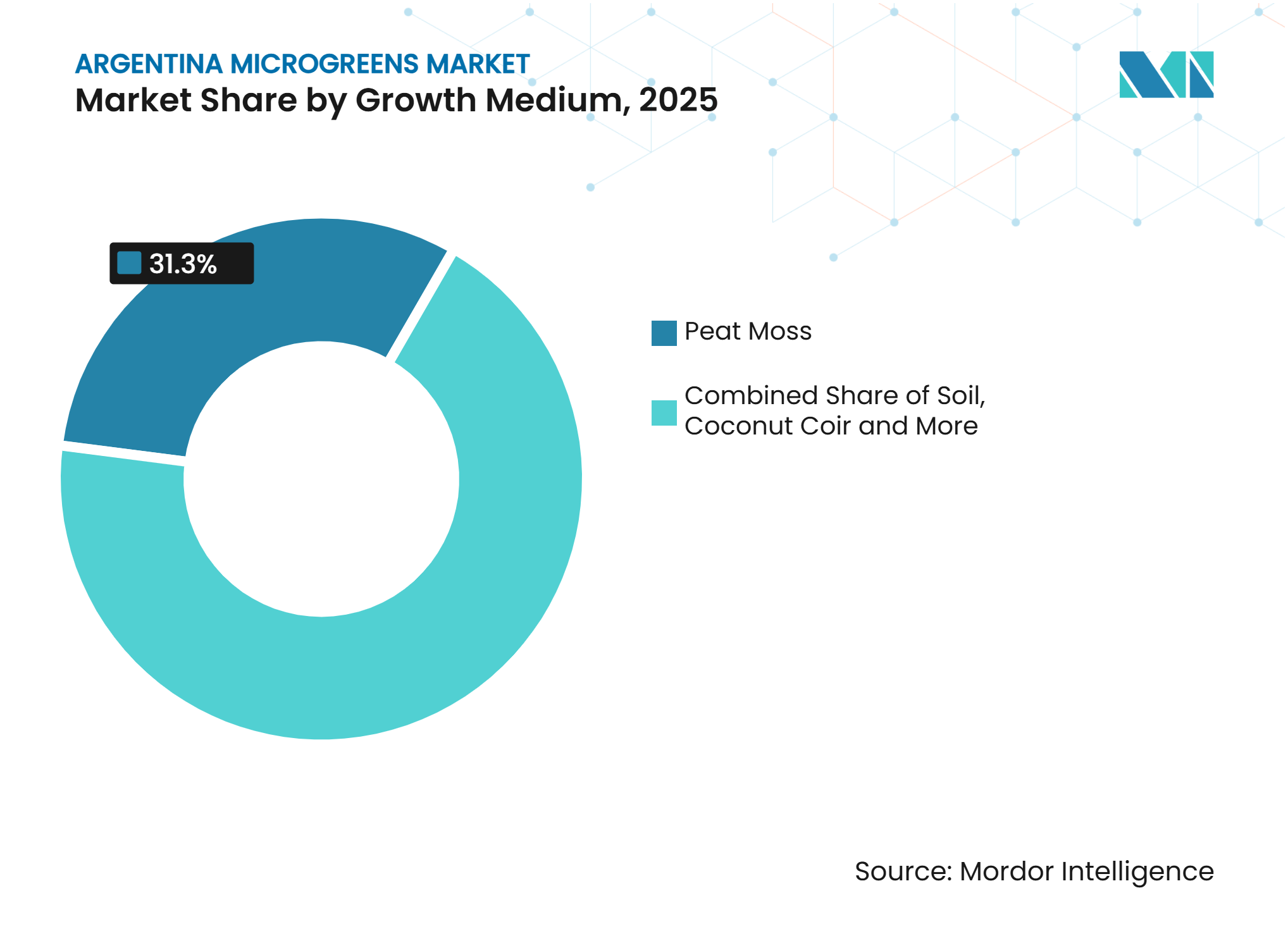
- By growth medium, peat moss accounted for 31.3% of the Argentina microgreens market size in 2025, while coconut coir is anticipated to grow at a CAGR of 11.8% from 2026 to 2031.
- By distribution channel, restaurants captured 48.1% of the Argentina microgreens market share in 2025, while online channels are projected to grow at the fastest CAGR of 12.8% from 2026 to 2031.
Note: Market size and forecast figures in this report are generated using Mordor Intelligence’s proprietary estimation framework, updated with the latest available data and insights as of January 2026.
Market Trends and Insights
Drivers Impact Analysis of Argentina Microgreens Market*
| Driver | (~) % Impact on CAGR Forecast | Geographic Relevance | Impact Timeline |
|---|---|---|---|
| Rising demand for nutrient-dense foods | +2.40% | National, strongest in Buenos Aires, Córdoba, and Rosario | Short term (≤ 2 years) |
| Expansion of urban and indoor farming | +2.10% | National, concentrated in Greater Buenos Aires and Córdoba | Medium term (2-4 years) |
| Premium culinary adoption in Buenos Aires and major cities | +1.90% | Buenos Aires Autonomous City and Buenos Aires Province, with spillover to Mendoza and Córdoba | Short term (≤ 2 years) |
| Localized production and shorter delivery distances | +1.60% | National, especially Patagonia and interior cities | Medium term (2-4 years) |
| Restaurant demand for differentiated garnishes and flavors | +1.40% | Buenos Aires Autonomous City and Buenos Aires Province, followed by Córdoba and Rosario | Short term (≤ 2 years) |
| Increasing consumer interest in functional foods | +1.20% | National, strongest among upper-income urban households | Long term (≥ 4 years) |
| Source: Mordor Intelligence | |||
Rising Demand for Nutrient-Dense Foods
Microgreens offer a concentrated nutritional profile that aligns closely with growing consumer demand for fresh, nutrient-dense foods. A 2025 study examining their nutritional properties, health benefits, production techniques, and food safety risks reported carotenoid levels 4 to 40 times higher than those in mature counterparts and identified higher mineral levels in broccoli microgreens than in mature broccoli [1]. As microgreens are commonly consumed raw, their preparation also helps preserve heat-sensitive nutrients. The 2025 study Cultivos Gourmet further documented the role of microgreens and gourmet sprouts within Argentina’s horticultural activity, highlighting their growing relevance beyond decorative foodservice applications. Together, these nutritional benefits give restaurants and specialty retailers a clearer value proposition when communicating with buyers, while supporting repeat purchases among consumers seeking functional and high-quality foods. For local producers, the strong link between freshness and nutrient retention further strengthens the case for short delivery routes and locally supplied products. The Argentina microgreens market can therefore capture demand from both foodservice customers and households that increasingly prioritize freshness, nutritional value, and overall food quality.
Expansion of Urban and Indoor Farming
Urban and indoor farming provide producers with a practical way to grow microgreens closer to consumers, particularly in densely populated Argentine cities where agricultural space is limited. The 2025 study Microgreens as the Future of Urban Horticulture and Superfoods found that controlled indoor conditions can support consistent biochemical profiles in microgreens. Managing light, temperature, and humidity also reduces exposure to weather events that can disrupt field-based production, enabling producers to maintain more predictable harvest schedules. This is particularly valuable for microgreens, which are highly perishable and benefit from rapid movement from farm to customer. Indoor operations can support year-round production while allowing growers to align harvests with recurring orders from restaurants, retail, and households. Vertical growing arrangements can further increase production capacity without requiring larger urban sites. Together, these operating advantages can help the Argentina microgreens market establish a more reliable, localized, and responsive supply base.
Premium Culinary Adoption in Major Cities
Premium restaurants in Buenos Aires and other major Argentine cities are creating a steady market for microgreens by using them to enhance color, flavor, presentation, and menu differentiation. As chefs increasingly seek distinctive ingredients, they can select microgreens by variety, color, flavor profile, and harvest stage rather than treating them simply as standard garnishes. This level of customization makes consistent quality, freshness, and reliable harvest schedules commercially important for suppliers. The 2025 Cultivos Gourmet study identified microgreens as part of Argentina’s growing gourmet horticultural activity, reinforcing their relevance within premium foodservice[2]. Restaurant buyers also provide local producers with a direct route to market, reducing dependence on intermediaries and allowing growers to better understand recurring customer requirements. These relationships enable producers to plan weekly harvest volumes around confirmed orders, improve supply consistency, and reduce unsold inventory. As premium dining continues to emphasize presentation and ingredient differentiation, culinary demand remains a key driver of the Argentina microgreens market, particularly in major urban centers.
Localized Production and Shorter Delivery Distances
Microgreens require prompt handling because their quality can deteriorate rapidly after harvest, making freshness a critical factor in their commercial value. A 2025 review on urban horticulture emphasized the importance of effective post-harvest practices for extending microgreen shelf life. Against this backdrop, local production offers a practical advantage by shortening the distance between cultivation, packing, and final delivery[3]. Reduced transportation times can help producers preserve appearance, texture, flavor, and overall product quality for restaurants, specialty retailers, and direct consumers. Local growers can also harvest closer to confirmed orders, reducing the need to maintain large packaged inventories and limiting potential product losses. This advantage becomes particularly relevant outside the Buenos Aires corridor, where access to specialized cold-chain infrastructure may be more limited. By combining nearby production with predictable delivery schedules, local operators can strengthen customer relationships and respond quickly to changing demand. These conditions support the Argentina microgreens market by making geographic proximity a practical competitive advantage rather than simply a logistical consideration.
Restraints Impact Analysis of Argentina Microgreens Market*
| Restraint | (~) % Impact on CAGR Forecast | Geographic Relevance | Impact Timeline |
|---|---|---|---|
| Short shelf life and limited cold-chain infrastructure | -1.40% | National, most acute in Patagonia and the Argentine Northwest | Short term (≤ 2 years) |
| High controlled-environment production costs | -1.60% | National, most acute for small operators outside Buenos Aires | Medium term (2-4 years) |
| Limited consumer awareness outside premium foodservice | -1.00% | National, outside Buenos Aires, Córdoba, and Rosario | Long term (≥ 4 years) |
| Fragmented food-safety and organic-certification practices | -0.80% | National, especially for producers seeking retail and institutional channels | Medium term (2-4 years) |
| Source: Mordor Intelligence | |||
Short Shelf Life and Limited Cold-Chain Infrastructure
Microgreens have a narrow post-harvest window, creating a natural constraint on how far small producers can distribute their products while maintaining quality. The 2025 review, Microgreens as the Future of Urban Horticulture and Superfoods, identified shelf-life improvement as an important post-harvest challenge, highlighting the need for appropriate handling. Temperature control is particularly important for retaining freshness during storage and transportation, yet small operators may lack dedicated refrigerated vehicles, cold storage, or specialized packing infrastructure. As a result, transportation delays can reduce freshness, appearance, and overall product quality before microgreens reach restaurants or household buyers. The challenge becomes more pronounced in remote Argentine provinces, where potential customers are geographically dispersed, and delivery distances are longer. Producers may therefore prioritize nearby neighborhoods and urban clusters, even when demand exists farther away. This limits the geographic reach of smaller suppliers, increases reliance on localized distribution networks, and ultimately restricts the scalability of the Argentina microgreens market while reinforcing its fragmented production structure.
High Controlled-Environment Production Costs
Indoor microgreens production requires investment in lighting, climate control, sanitation systems, growing racks, and food-grade handling areas, creating a relatively high fixed-cost burden for small producers. Light, temperature, and humidity are important production variables for indoor microgreens, underscoring the need for growers to maintain stable conditions to achieve consistent crop quality. These requirements make energy consumption a significant component of operating costs, influencing both margins and decisions to expand production capacity. Smaller farms with limited customer bases may struggle to spread these fixed expenses across sufficient production volumes, making equipment upgrades and operational improvements harder to justify. Some producers may consequently limit the number of varieties they cultivate or postpone capacity additions until demand becomes more predictable. Although higher facility utilization can improve production economics, achieving it depends on securing reliable and recurring customer orders. This cost pressure can therefore slow capacity expansion in the Argentina microgreens market, particularly in locations outside major urban demand centers.
*Our forecasts treat driver/restraint impacts as directional, not additive. The impact forecasts reflect baseline growth, mix effects, and variable interactions.
Argentina Microgreens Market Segment Analysis
By Crop Type:
Broccoli Holds the Leading Position While Basil Records the Fastest GrowthBroccoli accounted for 24.8% of the Argentina microgreens market in 2025, making it the leading type. Its position is supported by its relatively short 7–10-day growing cycle and established demand among restaurants and health-focused consumers. A 2025 review published through PubMed Central reported meaningful levels of magnesium, manganese, copper, and zinc in broccoli microgreens, strengthening their nutritional positioning. Meanwhile, lettuce, chicory, arugula, sunflower, radish, peas, fennel, carrots, and other varieties contribute to crop diversity and provide producers with opportunities to meet different culinary requirements. Broccoli’s dependable cultivation profile, broad nutritional appeal, and established foodservice demand, therefore, continue to anchor the overall type mix.
Basil is projected to grow at the fastest CAGR of 12.2% from 2026 to 2031, supported by increasing demand for aromatic and visually distinctive garnishes in Buenos Aires restaurants. Chefs use basil microgreens to add concentrated flavor to cold dishes, carpaccios, salads, and light sauces, creating recurring demand among premium foodservice buyers. The 2024 study, Assessment of Bioactive Compounds[4], also found strong antioxidant activity in soilless-grown microgreens, supporting their value as nutrient-rich ingredients. Although other varieties are estimated to expand from smaller bases, evolving restaurant preferences will continue encouraging producers to maintain a diverse crop portfolio across the Argentina microgreens market.



By Farming Method:
Indoor Farming Leads While Vertical Farming Expands FastestIndoor farming accounted for 43.1% of the microgreens market in Argentina in 2025, making it the leading production method. Its established position reflects the ability of urban and peri-urban growers to control temperature, lighting, and other cultivation conditions, supporting consistent year-round production. Commercial greenhouses provide a secondary option for producers with access to land and suitable climatic conditions, while other production methods account for a smaller share of output. A 2025 review published in Scientia Horticulturae supports the importance of controlling cultivation conditions to maintain microgreen quality and consistency. These operational advantages make indoor farming particularly suitable for suppliers serving nearby restaurants, specialty retailers, and direct consumers who require regular product availability.
Vertical farming is anticipated to grow at a CAGR of 12.5% from 2026 to 2031. Growth is supported by the stacked growing trays' ability to increase production within limited urban spaces, making the model particularly relevant where high rental costs and constrained floor area limit conventional expansion. Growers can also organize production cycles by tray and schedule harvests to align with recurring restaurant and retail orders, improving capacity utilization and reducing excess inventory. While greenhouse and other production methods will remain relevant, vertical farming offers the clearest growth pathway for expanding production capacity within Argentina’s major urban markets.
By Growth Medium:
Peat Moss Remains the Main Medium While Coconut Coir Grows FastestPeat moss held 31.3% of the Argentina microgreens growth-medium market in 2025, making it the leading substrate. Its position reflects its strong water-retention capacity, pH-buffering properties, and ability to support reliable seed germination across successive crop cycles. Soil maintained a secondary position, particularly among producers seeking lower-cost cultivation, while tissue paper served more specialized, hygiene-sensitive premium applications. Peat moss remains familiar and widely understood among producers, supporting its continued leadership in Argentina’s microgreens production.
Coconut coir is anticipated to record the fastest growth among growth media, expanding at an 11.8% CAGR from 2026 to 2031. Its growth is supported by strong water-storage performance and its potential to address waste, cost, and environmental concerns associated with peat-based substrates. Peat moss is estimated to remain important due to established grower familiarity, while soil and tissue paper will continue to serve specific production requirements. Coconut coir’s expansion therefore reflects a gradual shift toward alternative substrates as growers balance cultivation performance, cost, and sustainability considerations.

By Distribution Channel:
Restaurants Lead Demand While Online Channel Grows FastestRestaurants captured 48.1% of the distribution-channel share in 2025 and led the distribution channel. Foodservice buyers need regular volumes, tailored varieties, and fresh delivery. A small indoor farm can often allocate much of its weekly harvest to a single restaurant relationship, providing more predictable sales. Hypermarkets and supermarkets formed a secondary route but required stronger packaging, shelf-life management, and logistics. The 2025 Cultivos Gourmet study supports the relevance of microgreens to gourmet horticulture. Restaurants, therefore, remain the most dependable commercial base for growers.
Online channels are projected to grow at the fastest CAGR of 12.8%, from 2026 to 2031. This channel benefits from direct ordering, which can reduce the time between harvest and delivery. Digital tools allow producers to showcase their varieties and take orders from chefs or households. Brotelab offers an online-first premium microgreens model, including harvested and live substrate trays. Supermarkets and hypermarkets are anticipated to remain relevant but face greater compliance needs. Direct online sales can be scaled carefully within a local delivery radius, giving small farms a practical extension beyond restaurant accounts.
Geography Analysis
Buenos Aires Autonomous City and Buenos Aires Province remain at the center of the Argentina microgreens market, supported by a strong concentration of premium restaurants, specialty retailers, and urban consumers. The region’s dense customer base allows producers to serve regular orders for fresh specialty produce while reducing transportation times and short shelf-life risks. Brotelab and Microgreens La Plata operate within the greater Buenos Aires corridor, serving both professional kitchens and direct consumers in nearby markets. Brotelab’s online ordering model illustrates how city-based producers can combine digital sales with localized delivery. The region also provides greater access to food delivery networks, professional foodservice contacts, and established distribution channels, creating favorable conditions for both existing growers and new entrants. Buenos Aires, therefore, remains the strongest commercial base for microgreens production and demand in Argentina.
Patagonia is emerging as an important production cluster as local buyers increasingly seek fresh, locally supplied specialty produce. Hotels, restaurants, tourism facilities, and other premium buyers create opportunities for growers that can provide consistent quality and dependable delivery. Geographic isolation makes regular supply from Buenos Aires less practical, creating space for producers located closer to end customers. The regional operating model is therefore centered on serving nearby demand rather than transporting highly perishable products over long distances. Patagonia’s premium tourism base can further strengthen the local freshness proposition and encourage specialized production. Future development will depend on expanding production capacity, improving handling practices, and building reliable customer networks. Patagonia’s emergence consequently reflects the importance of localized supply in geographically dispersed markets.
Misiones, Córdoba, Santa Fe, and Mendoza form an emerging group of interior production areas, where early-stage growers primarily serve nearby restaurants, specialty buyers, and direct consumers. These provinces may not offer the same concentration of customers as Buenos Aires, but their smaller urban markets provide opportunities for producers to develop direct relationships and establish localized demand. Growers can focus on short delivery routes, selected varieties, and production schedules aligned with recurring customer requirements. Market development will depend on increasing consumer familiarity, building consistent demand, and maintaining appropriate food-safety and handling practices. The expansion of these local businesses is gradually broadening Argentina’s microgreens production base beyond its largest urban cluster. Interior provinces therefore remain important to the market’s wider geographic development and long-term supply diversification.
Competitive Landscape
Market Concentration
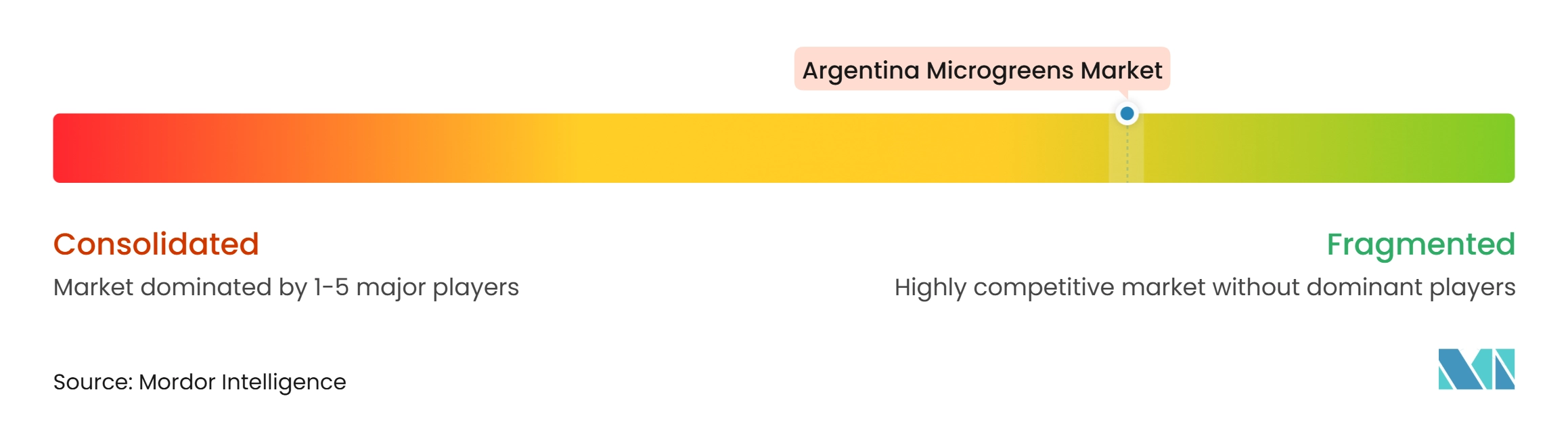
The Argentina microgreens market is highly fragmented and competitive structure. The top producers included Fractal Agricultura, Planta Viva, Brotelab, and Loop Farms. This structure reflects a product that is most efficiently cultivated and consumed close to the customer. Short shelf life limits how far producers can economically serve, allowing local businesses to retain demand within their immediate markets. The fragmented structure is therefore closely linked to the category’s freshness requirements, localized customer relationships, and limited distribution radius.
Competition centers on product variety, direct customer relationships, product consistency, and dependable delivery. Fractal Agricultura serves restaurants and cafés with a broad range of microgreens through direct ordering and localized delivery, while Brotelab uses an online-first model that allows chefs to select varieties and order premium microgreens digitally. These approaches reduce reliance on conventional wholesale channels and enable producers to respond more directly to customer preferences. Producers also compete on traceability, hygiene, and food safety practices. Argentina’s regulatory framework for fresh vegetables establishes requirements covering handling, labeling, and phytosanitary controls, increasing the importance of operational compliance for commercial suppliers. Farms that can consistently meet these requirements may be better positioned to supply organized retail and institutional customers. Competitive advantage therefore depends on operating discipline alongside cultivation capability.
Atama Alimentos has differentiated its position through local relationships in Tierra del Fuego, supplying restaurants, supermarkets, hotels, and Antarctic cruise vessels. This customer mix demonstrates how regional specialization can create a defensible local market position. Planta Viva and Finca El Sauce compete through multi-variety production targeting restaurant and direct-consumer demand, while smaller growers generally remain focused on individual cities or neighborhoods. This localized structure limits the potential for rapid national consolidation. Opportunities remain in retail-ready packaging, recurring direct-to-consumer delivery, standardized documentation, and fulfillment capabilities. Producers that strengthen these areas may gain access to larger organized buyers while expanding beyond traditional restaurant accounts.
Argentina Microgreens Industry Leaders
-
Fractal Agricultura
-
Brotelab
-
NecoGreens
-
Loopfarms
-
Planta Viva
- *Disclaimer: Major Players sorted in no particular order
Argentina Microgreens Market Companies Covered in this Report
- Atama Alimentos
- Fractal Agricultura
- Hojalá
- Verdes del Monte
- Brotelab
- NecoGreens
- Finca El Sauce
- Microvegetales SF
- Planta Viva
- Microgreens La Plata
- Loopfarms
Recent Industry Developments in Argentina Microgreens Market
- May 2025: National Service of Agri-Food Health and Quality issued Resolution 328/2025, updating Argentina’s fresh-vegetable requirements for classification, packaging, labeling, transport, and traceability. The measure supports professionalization of the microgreens supply chain and strengthens compliance requirements for domestic and export-oriented producers.
- January 2025: Argentina implemented Decree 35/2025 to streamline food import and export procedures and amend provisions of the Argentine Food Code. The decree simplified regulatory procedures for food products overseen by the National Food Institute (INAL), supporting more efficient market access and reducing administrative requirements for regulated microgreen products.
Argentina Microgreens Market Report Scope
Our study defines the Argentina microgreens market as the aggregate farm-gate value of freshly cut, vegetable, herb, and grain seedlings harvested between the cotyledon and first true-leaf stages and sold either loose or as living trays to retail, food-service, and direct-to-consumer channels.
Scope exclusions include sprout products, baby-leaf greens, powdered extracts, and sales of cultivation equipment, which are kept outside this value pool.
The microgreens market report is segmented by crop type (broccoli, lettuce and chicory, arugula, basil, fennel, carrots, sunflower, radish, peas, and other crop types), farming method (indoor farming, vertical farming, and other farming methods), growth medium (peat moss, soil, coconut coir, tissue paper, and other growth media), and distribution channel (hypermarkets and supermarkets, restaurants, online channels, and other distribution channels). The market forecasts are provided in terms of value (USD).
Segmentation Overview
| Broccoli |
| Lettuce and Chicory |
| Arugula |
| Basil |
| Fennel |
| Carrots |
| Sunflower |
| Radish |
| Peas |
| Other Types |
| Indoor Farming |
| Vertical Farming |
| Other Farming Methods |
| Peat Moss |
| Soil |
| Coconut Coir |
| Tissue Paper |
| Other Growth Media |
| Hypermarkets and Supermarkets |
| Restaurants |
| Online Channels |
| Other Distribution Channels |
| By Crop Type | Broccoli |
| Lettuce and Chicory | |
| Arugula | |
| Basil | |
| Fennel | |
| Carrots | |
| Sunflower | |
| Radish | |
| Peas | |
| Other Types | |
| By Farming Method | Indoor Farming |
| Vertical Farming | |
| Other Farming Methods | |
| By Growth Medium | Peat Moss |
| Soil | |
| Coconut Coir | |
| Tissue Paper | |
| Other Growth Media | |
| By Distribution Channel | Hypermarkets and Supermarkets |
| Restaurants | |
| Online Channels | |
| Other Distribution Channels |
Key Questions Answered in the Report
What is the forecast growth rate for microgreens in Argentina?
The Argentina microgreens market is forecast to grow at 11.29% CAGR from 2026 to 2031, reaching USD 65.12 million by 2031.
Which microgreen crop type leads sales in Argentina?
Broccoli led by crop type with a 24.8% share value in 2025.
Why are restaurants important buyers of microgreens in Argentina?
Restaurants accounted for 48.1% of distribution-channel share in 2025 because they need fresh, differentiated products, regular delivery, and reliable crop availability. Direct kitchen delivery helps growers manage the product’s short usable life.
Which farming method is growing fastest for Argentine growers?
Vertical farming is anticipated to grow at 12.5% CAGR from 2026 to 2031, supported by its ability to increase output in limited urban space. It also helps producers organize harvests around recurring local orders.