
Argentina Fixed Wireless Access Market Size and Share
Market Overview
| Study Period | 2020 - 2031 |
|---|---|
| Forecast Data Period | 2026 - 2031 |
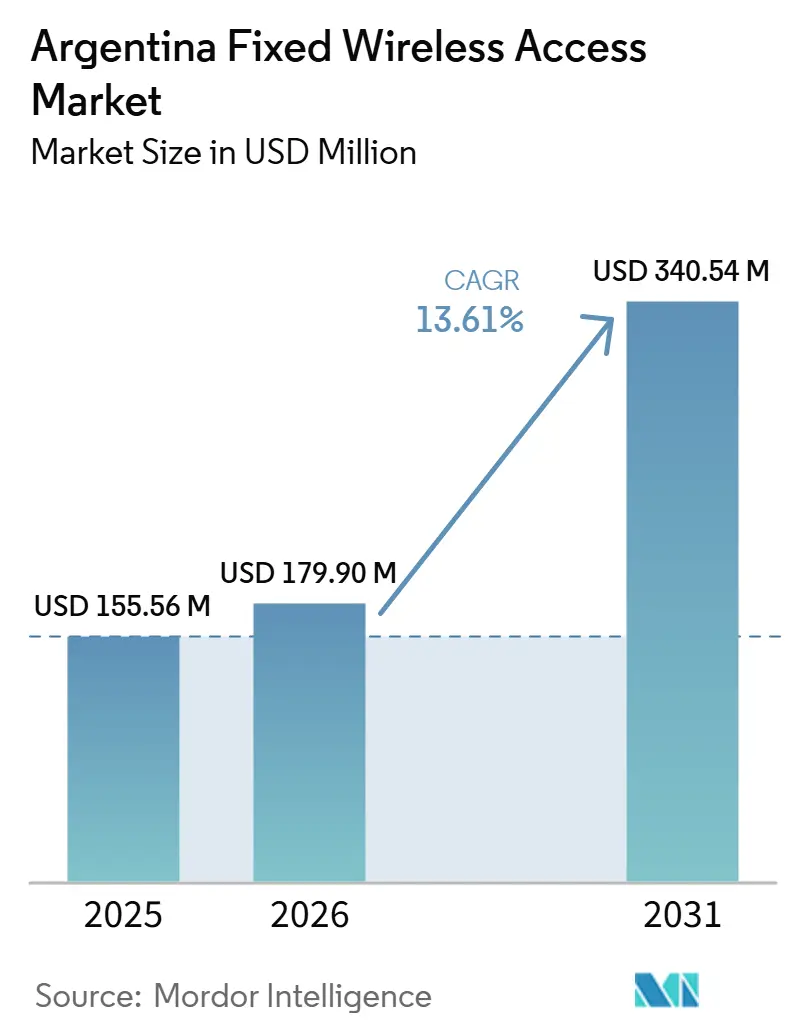
| Base Year Market Size (2025) | USD 155.56 Million |
| Market Size (2026) | USD 179.90 Million |
| Market Size (2031) | USD 340.54 Million |
| Growth Rate (2026 - 2031) | 13.61 % |
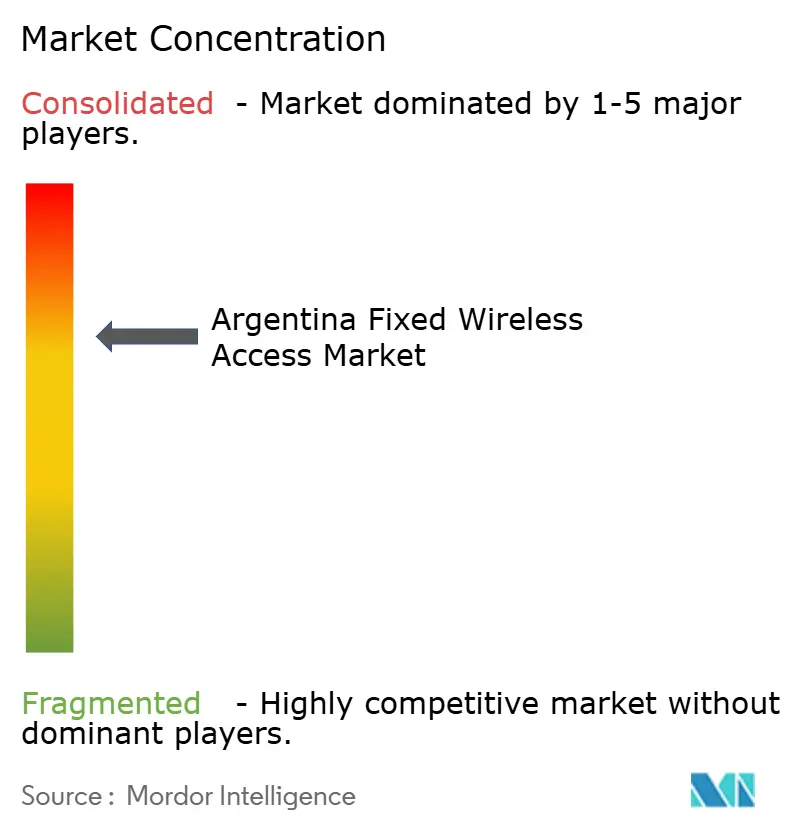
| Market Concentration | Medium |
Major Players *Disclaimer: Major Players sorted in no particular order Image © Mordor Intelligence. Reuse requires attribution under CC BY 4.0. | |
Argentina Fixed Wireless Access Market Analysis by Mordor Intelligence
The Argentina Fixed Wireless Access Market size is projected to be USD 155.56 million in 2025, USD 179.90 million in 2026, and reach USD 340.54 million by 2031, growing at a CAGR of 13.61% from 2026 to 2031. The Argentina fixed wireless access market is supported by a persistent shortage of wired last-mile coverage outside major urban centers, where extending fiber to dispersed homes remains expensive. Fixed internet connections reached 12.99 million in 2025, while rural and small-locality access gaps continued to leave many households without reliable connectivity. The rollout of 5G capacity gives operators a network layer that can also support fixed services without requiring a comparable increase in radio investment. Demand is moving beyond the Buenos Aires metropolitan area toward provincial cities and underserved regions, where existing coverage can be used to reach new households. Affordability and imported equipment costs remain important constraints because subscription income is peso-denominated while customer premises equipment costs have significant foreign-currency exposure.
Key Report Takeaways
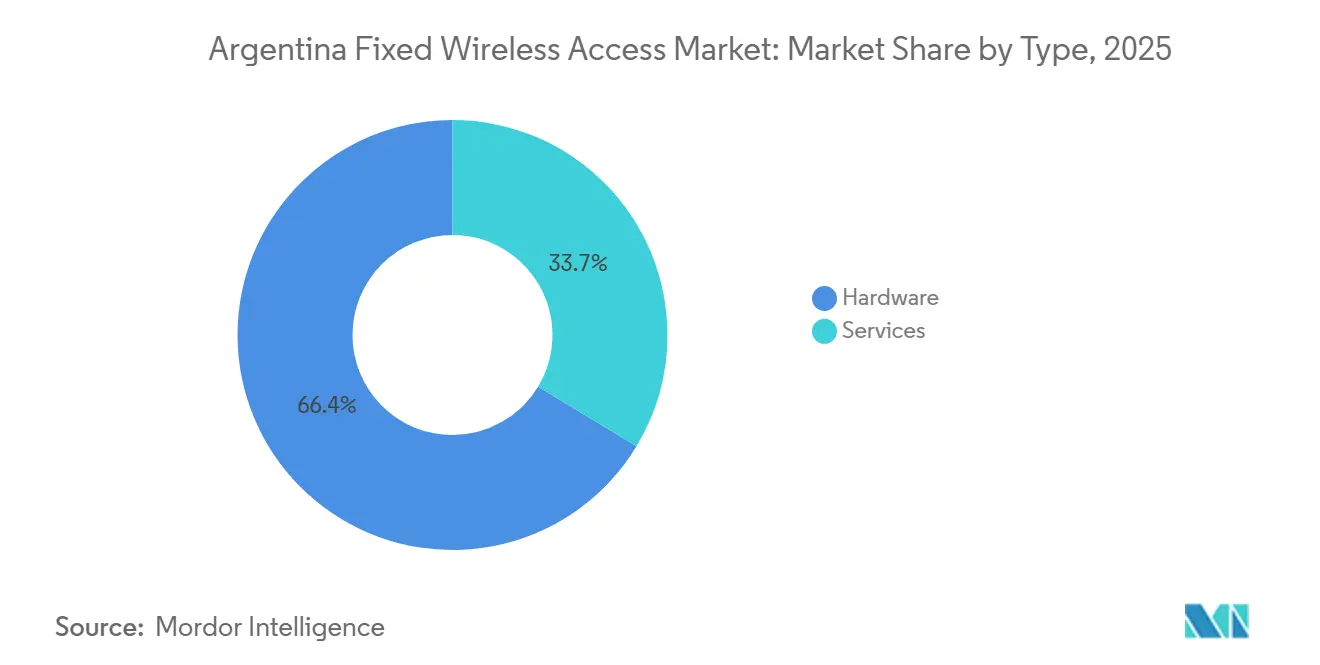
- By type, hardware held 66.35% of revenue share in the Argentina fixed wireless access market in 2025, while services are projected to expand at a 14.05% CAGR through 2031.
- By application, residential accounted for 74.22% of revenue share in the Argentina fixed wireless access market in 2025, while government and public safety are expected to grow at a 14.35% CAGR through 2031.
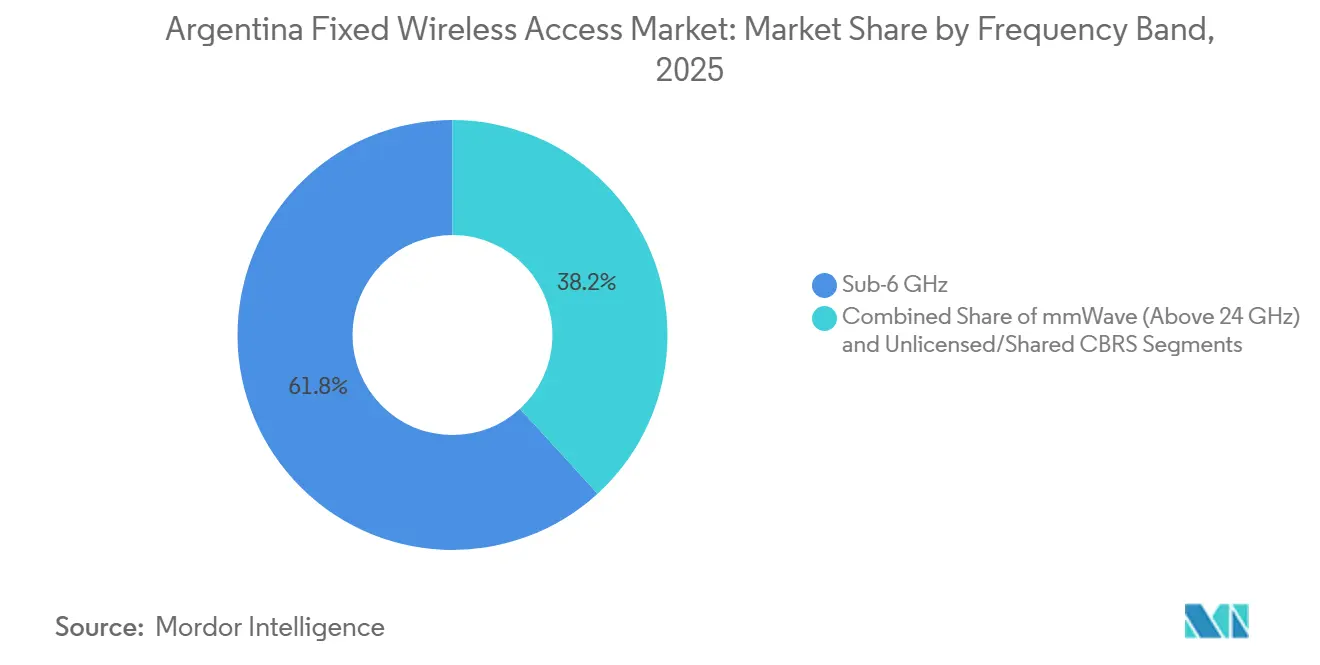
- By frequency band, sub-6 GHz held 61.79% of revenue share in the Argentina fixed wireless access market in 2025, while mmWave (above 24 GHz) is projected to expand at a 15.10% CAGR through 2031.
- By deployment mode, indoor CPE accounted for 69.32% of revenue share in the Argentina fixed wireless access market in 2025, while self-install window-mount CPE is expected to grow at a 14.80% CAGR through 2031.
Note: Market size and forecast figures in this report are generated using Mordor Intelligence’s proprietary estimation framework, updated with the latest available data and insights as of January 2026.
Argentina Fixed Wireless Access Market Trends and Insights
Drivers Impact Analysis*
| Driver | (~) % Impact on CAGR Forecast | Geographic Relevance | Impact Timeline |
|---|---|---|---|
| Fiber Gap in Semi-Urban and Rural Argentina | +3.5% | Interior and northern provinces, Patagonian corridors | Short term (≤ 2 years) |
| Cost Advantage Versus Last-Mile Fiber Buildout | +2.8% | National, with early gains in mid-sized cities and peri-urban zones | Medium term (2-4 years) |
| 5G Network Expansion Supporting FWA Capacity | +2.5% | Buenos Aires, Córdoba, Rosario, and provincial capitals | Short term (≤ 2 years) |
| Fast Provisioning for Household and SME Connectivity | +1.8% | National, concentrated in Buenos Aires and interior business districts | Short term (≤ 2 years) |
| Fixed-to-Wireless Substitution in Low-Density Provinces | +1.5% | Northern Argentina and Patagonian provinces | Medium term (2-4 years) |
| Enterprise Backup Connectivity Demand From SMEs | +1.0% | National, including Vaca Muerta, Mendoza, and Patagonia | Medium term (2-4 years) |
| Source: Mordor Intelligence | |||
Fiber Gap in Semi-Urban and Rural Argentina
Argentina’s FTTH footprint grew 26.3% year over year to 6.1 million accesses in 2025, but the gains were concentrated in urban areas. A 2025 rural connectivity assessment found that internet access was available in only 36.5% of dispersed rural households and 57.5% of households in localities with fewer than 2,000 residents. Urban household access reached 78.6%, showing the scale of the remaining coverage gap. The Argentina fixed wireless access market can serve households beyond the practical reach of fiber, rather than competing only for customers already connected to fiber. Santiago del Estero, Salta, Formosa, Chaco, Catamarca, and Corrientes recorded broadband growth above 15% in 2025, with Formosa and Corrientes exceeding 30%, suggesting unserved demand in provinces with lower established coverage. The legal framework under Argentina Digital Law (Ley 27.078) and the 2023 3.5 GHz spectrum award provided the basis for commercial 5G fixed wireless services in provincial areas.
Cost Advantage Versus Last-Mile Fiber Buildout
The cost case for wireless access strengthens in low-density localities because fiber extensions require long routes, civil works, and construction in difficult terrain. A fixed wireless connection can use capacity from an existing 4G or 5G site, which limits the additional network work required for a new subscriber. Self-install formats can further reduce activation costs by avoiding a technician visit and related scheduling requirements. This operating model is useful where subscriber volumes may not justify a dedicated fiber build. It also helps the Argentina fixed wireless access market reach small towns where a rapid connection is valued as much as the network technology itself. The advantage depends on equipment procurement remaining manageable, since rising imported CPE costs can offset the savings from lower field installation costs.
5G Network Expansion Supporting FWA Capacity
Argentina awarded 250 MHz of 3.5 GHz spectrum to 3 national mobile operators in October 2023, providing mid-band capacity for 5G services. The country had 1,460 5G base stations by the third quarter of 2025, and 67% of those sites were in Buenos Aires city and province. Each commissioned 5G radio can support mobile users and provide a potential fixed-broadband footprint. This reuse of network capacity reduces the need to build a separate access network for every fixed wireless launch. It is particularly relevant in Córdoba, Rosario, and provincial capitals, where operators can add fixed services as their 5G coverage broadens. The Argentina fixed wireless access market therefore benefits when mobile network expansion reaches areas with limited fixed-line alternatives.
Fast Provisioning for Household and SME Connectivity
Fiber activation can require coordination with civil works, permits, and technician scheduling, which can delay the time to activation. A self-install fixed wireless device can provide service within 24-48 hours after an order when the coverage and device conditions are suitable. This speed is valuable to new small and medium-sized enterprises, households relocating beyond the fiber footprint, and new developments in secondary cities. Faster activation allows operators to serve demand that may otherwise remain unaddressed during a lengthy fiber installation process. The Argentina fixed wireless access market can leverage this advantage in gated communities, suburban areas, and inner-city business districts. ENACOM Resolution 2385/2023 provides the regulatory framework for licensed 5G fixed wireless services under the Telecommunications Service of Reliable Infrastructure classification.[1]Ente Nacional de Comunicaciones, “Resolución 2385/2023, Adjudicación de Espectro 3.5 GHz,” Boletín Oficial, boletinoficial.gov.ar
Restraints Impact Analysis*
| Restraint | (~) % Impact on CAGR Forecast | Geographic Relevance | Impact Timeline |
|---|---|---|---|
| Macroeconomic Pressure on Consumer Broadband Affordability | -2.5% | National, most acute in low-income and rural households | Short term (≤ 2 years) |
| Spectrum and Site Acquisition Constraints | -1.8% | Urban and peri-urban zones, Buenos Aires City most constrained | Medium term (2-4 years) |
| Fixed-Line Price Competition in Dense Urban Areas | -1.2% | Buenos Aires City, Córdoba, Rosario, and Mendoza | Short term (≤ 2 years) |
| Import Dependence for CPE and Network Equipment | -0.9% | National, with highest exposure for emerging operators and ISPs | Medium term (2-4 years) |
| Source: Mordor Intelligence | |||
Macroeconomic Pressure on Consumer Broadband Affordability
Household spending pressures limit the number of customers who can select fixed wireless plans at prices above entry-level. Inflation eased to 31.5% in 2025 after reaching 211.4% in 2023, but lower-income households remained sensitive to recurring connectivity costs. The removal of regulated telecommunications price caps gave operators more room to adjust tariffs, while also reducing affordability for customers who had benefited from subsidized prices. Fixed wireless providers face a distinct margin issue because monthly plans are priced in pesos while much of the CPE supply chain is linked to foreign-currency costs. This exposure can increase pressure on smaller regional providers with limited financial capacity. Entry-level offers can broaden access, but recovering equipment and network investment over short customer contracts remains challenging.
Spectrum and Site Acquisition Constraints
The 250 MHz awarded in the 3.5 GHz band was divided among 3 operators, leaving each with capacity suitable for early deployment but potentially constrained in high-demand areas. Network density becomes more important as fixed wireless subscriber numbers rise in locations with heavy traffic. Site approval can add further delays, particularly in Buenos Aires City, where restrictions on aerial infrastructure require underground construction. The Argentina fixed wireless access market may therefore face higher rollout costs in dense areas, even where customer demand is strong. Resolution 1111/2025 opened the 2300-2400 MHz band for private wireless broadband systems across sectors, including mining, energy, and agriculture.[2]Ente Nacional de Comunicaciones, “Resolución 1111/2025, Habilitación de Sistemas Privados Inalámbricos de Banda Ancha,” Boletín Oficial, boletinoficial.gob.ar That measure supports industrial uses but does not directly add consumer fixed wireless capacity, while the lack of a dedicated mmWave auction limits plans for dense urban deployments.
*Our forecasts treat driver/restraint impacts as directional, not additive. The impact forecasts reflect baseline growth, mix effects, and variable interactions.
Segment Analysis
By Type: Services Revenue is Growing Faster Than Hardware
Hardware held 66.35% of the Argentina fixed wireless access market share in 2025 because early subscriber acquisition required substantial CPE purchases and investment in access equipment. Indoor gateways, outdoor units, femtocells, and picocells incur upfront costs for providers as new connections are added. The hardware position reflects a subscriber-ramp stage, where device volumes and equipment economics have a material effect on operator cash flow. Providers need devices that can operate reliably across homes, small offices, and more challenging semi-rural sites. CPE availability also influences the pace at which regional ISPs can enter the Argentina fixed wireless access market. Imported equipment costs are particularly important because they can change the economics of adding subscribers in lower-income locations.
The services segment is projected to expand at a 14.05% CAGR from 2026 to 2031, the fastest rate in the type classification. The category includes managed connectivity subscriptions, installation support, maintenance, after-sales assistance, and cloud-managed network services. As the installed CPE base grows, recurring services can contribute a steadier income stream than one-time hardware sales. Service revenue also has a lower incremental cost once a provider has established support and network-management capabilities. The shift gives operators a stronger reason to focus on service quality, reliability, and customer retention. It also makes recurring household and business contracts more important to the development of the Argentina fixed wireless access market.


By Application: Residential Demand Leads While Public Connectivity Expands
Residential accounted for 74.22% of the Argentina fixed wireless access market size in 2025, confirming that household broadband was the primary application. Demand was concentrated in gated communities, secondary cities, and peri-urban areas where residents needed an alternative to FTTH or older cable networks. Indoor devices match this segment because they are familiar to households and can connect with existing home Wi-Fi equipment. Residential customers also value the ability to start service quickly when a wired installation is unavailable or delayed. The segment remains linked to household affordability because recurring broadband expenses compete with other essential spending. Operators must balance accessible monthly plans with the cost of equipment, coverage, and customer support.
Commercial users include retail outlets, hospitality businesses, and SMEs that need dependable connectivity in interior business districts. These users can benefit when wireless service becomes available faster than a new fiber connection. Industrial demand is smaller but still relevant for private network deployments in oil and gas operations around Vaca Muerta and in mining locations in Patagonia. Resolution 1111/2025 created a regulatory path for dedicated private wireless broadband systems in mining, energy, agriculture, and ports. Government and Public Safety is projected to expand at a 14.35% CAGR through 2031, driven by requirements for connectivity at emergency response facilities, rural schools, and public offices. The universal service fund has committed USD 200 million to infrastructure rollout programs that support public connectivity objectives in areas beyond established fiber coverage.
By Frequency Band: Sub-6 GHz Provides The Current Foundation
Sub-6 GHz accounted for 61.79% of revenue in 2025 and served as the primary commercial base for 5G fixed wireless services. The 3.5 GHz spectrum awarded in 2023 is central to this position because it offers a balance between coverage and throughput. This balance suits semi-urban and peri-urban deployments, where operators need broader reach than higher frequencies can provide. It supports household activities such as streaming, videoconferencing, and remote work, as well as common SME connectivity needs. Fewer sites are generally required than for a comparable high-frequency rollout, which supports coverage-focused deployment. The role of Sub-6 GHz helps explain why the Argentina fixed wireless access market has advanced first in localities with available mid-band 5G capacity.
Unlicensed and shared bands support smaller ISPs and enterprise private networks operating outside the national licensed spectrum footprint. These networks can address local demand where a national operator lacks a strong commercial case for service. mmWave above 24 GHz is projected to expand at a 15.10% CAGR from 2026 to 2031, the fastest pace among frequency bands. Its expected role is in dense urban areas where high throughput is needed for apartment buildings and commercial towers. Those applications may require multi-gigabit capacity as subscriber density grows beyond what Sub-6 GHz can comfortably provide. Progress in this segment is moderated by the absence of a dedicated auction for 24 GHz and higher frequencies.

By Deployment Mode: Self-Install Options Change Activation Economics
Indoor CPE accounted for 69.32% of the market revenue in 2025, reflecting the residential focus of fixed wireless services in Argentina. Compact tabletop and wall-mounted gateways are the standard format for homes where the network signal can pass through typical building materials. These devices offer low installation complexity and can work with existing home Wi-Fi arrangements. Their suitability for early residential adopters has supported their broad use in urban, peri-urban, and selected secondary-city locations. Indoor CPE remains sensitive to building design and local signal conditions, which can affect customer experience. The equipment format, therefore, requires providers to match the product to realistic coverage conditions before installation.
Outdoor CPE is more commonly used in semi-rural settings and commercial locations where building materials, distance from the base station, or throughput requirements require an external high-gain antenna. It has a smaller share but serves a different set of coverage conditions from indoor units. Self-Install Window-Mount CPE is projected to grow at a 14.80% CAGR from 2026 to 2031, the fastest rate among deployment modes. The format allows a subscriber to place the device on a window, connect to power, and complete activation through a smartphone application. Eliminating a field technician visit can reduce activation costs and support expansion in smaller towns. This approach gives the Argentina fixed wireless access market a practical way to add customers without increasing field operations at the same rate.
Geography Analysis
Buenos Aires city and province contained 67% of Argentina’s 1,460 5G base stations in the third quarter of 2025, making the Buenos Aires metropolitan area the largest current fixed wireless deployment center. Operators have concentrated investment there because high population density can improve returns on spectrum and network investments. The area also has strong fiber competition, as national FTTH connections grew 26.3% to 6.1 million in 2025. Buenos Aires City’s underground construction requirements can raise the cost and time required to densify network infrastructure. Fixed wireless remains relevant in the wider conurbano for households and SMEs waiting for fiber installation. Self-install CPE can meet this demand within 24-48 hours when coverage is available.
Córdoba, Rosario, Mendoza, and Mar del Plata form an active secondary urban tier for the Argentina fixed wireless access market. These cities combine growing demand with locations where network coverage can be extended to areas not fully reached by fiber or cable. Interior deployments have included Tafí del Valle in Tucumán, Ricardone in Santa Fe, and Federación in Entre Ríos. Pehuajó, in Buenos Aires province, and Cruz Alta, in Córdoba, were targeted for deployment in 2026. These locations have existing mobile-site capacity and limited overlap with HFC or FTTH networks. Neuquén is a higher-value local opportunity because oil and gas activity around Vaca Muerta requires resilient connectivity in remote field operations.
Northern provinces, including Formosa, Chaco, Santiago del Estero, Salta, Catamarca, and Corrientes, recorded broadband growth above 15% between 2024 and 2025, while Formosa and Corrientes exceeded 30%. Dispersed populations in these provinces had internet access below 36.5%, leaving considerable room for new connections. The universal service fund’s USD 200 million commitment supports projects in these underserved areas. Cooperatives have achieved 71% connectivity in the small localities they serve, compared with a national average of 35% in localities with fewer than 2,000 inhabitants. Patagonia, which includes Neuquén, Río Negro, Chubut, Santa Cruz, and Tierra del Fuego, has low population density and difficult terrain that favors satellite and fixed wireless alternatives. These geographic conditions support a distinct role for fixed wireless where a broad fiber build is less viable.
Competitive Landscape
The Argentina fixed wireless access market has a two-tier structure with national mobile operators at the infrastructure layer and smaller ISPs and cooperatives serving local coverage needs. Telecom Argentina, operating under the Personal brand, and Claro Argentina are the 2 national operators with 5G spectrum positions that support broad fixed wireless deployment. Telecom Argentina’s acquisition of Telefónica Móviles Argentina for USD 1.2 billion combined major mobile and fixed assets, subject to regulatory divestiture requirements. The combined entity had approximately 4.2 million fixed broadband accesses, alongside Movistar’s 1.6 million accesses. Regulatory conditions requiring the disposal of 6 million mobile users, spectrum, and fixed internet assets in specified areas could create an entry route for another infrastructure competitor after 2026. Until then, the national operator layer remains concentrated, while regional providers serve locations below the commercial threshold of larger operators.
Telecom Argentina targets 300,000 fixed wireless subscribers by the end of 2026, compared with approximately 50,000 reported in the fourth quarter of 2025. Its approach relies on extending service through interior provinces where existing 4G or 5G capacity can be used without fiber overlap. Claro commercially launched 5G fixed wireless service in November 2025 in underserved areas, offering 100 Mbps with 400 GB of capacity. Nokia became Claro Argentina’s sole radio access network supplier for the first phase of its 5G rollout in August 2024.[3]Nokia, “Nokia Secures 5G Contract With Claro Argentina,” Nokia, rcrwireless.com Nokia’s IPAA+ antenna supports 700 MHz to 3.5 GHz in a compact, modular format, enabling multi-band coverage deployments. The company also deployed standalone 5G core nodes for Telecom Argentina in the Buenos Aires metropolitan area in 2025, enabling network slicing capabilities relevant to enterprise connectivity contracts.
At the equipment layer, Nokia and Ericsson supply radio access and core network infrastructure, while Huawei and ZTE have CPE supply presence through local distribution channels. Smaller providers use sub-6 GHz equipment from Cambium Networks, RADWIN, MikroTik, and Teltonika Networks to serve specific towns and private-network uses. Qualcomm Snapdragon X-series chipsets are used in fixed wireless devices from manufacturers including Samsung, WNC, Sercomm, and TP-Link. Enterprise backup connectivity is a potential service area, as many SMEs still lack resilient wireless services with automatic failover. Providers that combine managed connectivity, SD-WAN, and fixed wireless can address energy, agriculture, and financial services users who need continuity. The Argentina fixed wireless access industry therefore includes a concentrated national access layer alongside a wider equipment and local-service ecosystem.
Argentina Fixed Wireless Access Industry Leaders
Personal (Telecom Argentina S.A.)
Telefónica Móviles Argentina S.A. (Movistar Argentina)
Claro Argentina S.A.
ARSAT S.A.
Ceragon Networks Ltd.
- *Disclaimer: Major Players sorted in no particular order

Recent Industry Developments
- January 2026: Telecom Argentina (Personal) deployed Nokia standalone 5G core network nodes in AMBA, completing 100% of functional tests and migrating live traffic to the new platform. Expansion was planned to cover Mar del Plata, Tucumán, Rosario, and Córdoba in subsequent months, enabling network-slicing capabilities relevant to enterprise FWA quality-of-service contracts.
- August 2025: ENACOM issued Resolution 1111/2025, opening the 2300-2400 MHz spectrum band for private wireless broadband network (SPIBA) deployments in vertical sectors including mining, energy, agriculture, and ports. The measure established 10-year spectrum assignment tenures and aligned with ITU recommendations for LTE and 5G NR standards, creating a new regulatory pathway for industrial FWA applications outside the public mobile licensing framework.


Argentina Fixed Wireless Access Market Report Scope
The Argentina fixed wireless access (FWA) market's revenue is generated through the sale of FWA hardware, including customer premises equipment (CPE) and access units, as well as recurring subscription fees, installation and activation services, managed connectivity services, maintenance, and network support provided by fixed wireless service providers operating across Sub-6 GHz, mmWave, and CBRS frequency bands. The Argentina fixed wireless access market report is segmented by type (hardware (consumer premise equipment (CPE) and access units (femto and picocells), and services), application (residential, commercial, industrial, and government and public safety), frequency band (Sub-6 GHz, mmWave (above 24 GHz), and unlicensed/shared CBRS), and deployment mode (indoor CPE, outdoor CPE, and self-install window-mount CPE). The market forecasts are provided in value (USD).
| Hardware | Consumer Premise Equipment (CPE) |
| Access Units (Femto and Picocells) | |
| Services |
| Residential |
| Commercial |
| Industrial |
| Government and Public Safety |
| Sub-6 GHz |
| mmWave (Above 24 GHz) |
| Unlicensed/Shared CBRS |
| Indoor CPE |
| Outdoor CPE |
| Self-Install Window-Mount CPE |
| By Type | Hardware | Consumer Premise Equipment (CPE) |
| Access Units (Femto and Picocells) | ||
| Services | ||
| By Application | Residential | |
| Commercial | ||
| Industrial | ||
| Government and Public Safety | ||
| By Frequency Band | Sub-6 GHz | |
| mmWave (Above 24 GHz) | ||
| Unlicensed/Shared CBRS | ||
| By Deployment Mode | Indoor CPE | |
| Outdoor CPE | ||
| Self-Install Window-Mount CPE |


Key Questions Answered in the Report
What is the Argentina fixed wireless access market size?
The Argentina fixed wireless access market size is expected to increase from USD 155.56 million in 2025 to USD 179.9 million in 2026 and reach USD 340.54 million by 2031. The forecast reflects the continued need for last-mile broadband beyond established fixed networks.
What growth rate is forecast for fixed wireless access in Argentina?
The sector is forecast to grow at a 13.61% CAGR between 2026 and 2031, supported by rural coverage gaps and the expanding use of 5G capacity. Growth also depends on providers managing equipment costs and household affordability.
Which type led revenue in 2025?
Hardware led with 66.35% revenue share in 2025 because CPE and access equipment were needed during the early subscriber acquisition phase. Services is expected to gain importance as the installed base requires connectivity management, maintenance, and after-sales support.
Which application is expected to grow fastest?
Government and Public Safety is projected to expand at a 14.35% CAGR through 2031, supported by connectivity needs at public offices, schools, and emergency-response facilities. This application is relevant where public sites are located outside practical fiber coverage.
Why is sub-6 GHz important for fixed wireless access in Argentina?
Sub-6 GHz held 61.79% revenue share in 2025 because the 3.5 GHz band offers a useful balance between coverage and throughput for current deployments. It is suited to semi-urban and peri-urban sites where coverage reach is as important as data capacity.
Which deployment mode is expected to grow fastest?
Self-Install Window-Mount CPE is expected to grow at a 14.80% CAGR through 2031 because it can reduce activation time and avoid a technician visit. It can be especially useful for small towns where scaling field operations alongside new connections would be costly.
Page last updated on:





