
Argentina Enterprise Content Management Market Size and Share
Market Overview
| Study Period | 2020 - 2031 |
|---|---|
| Forecast Data Period | 2026 - 2031 |
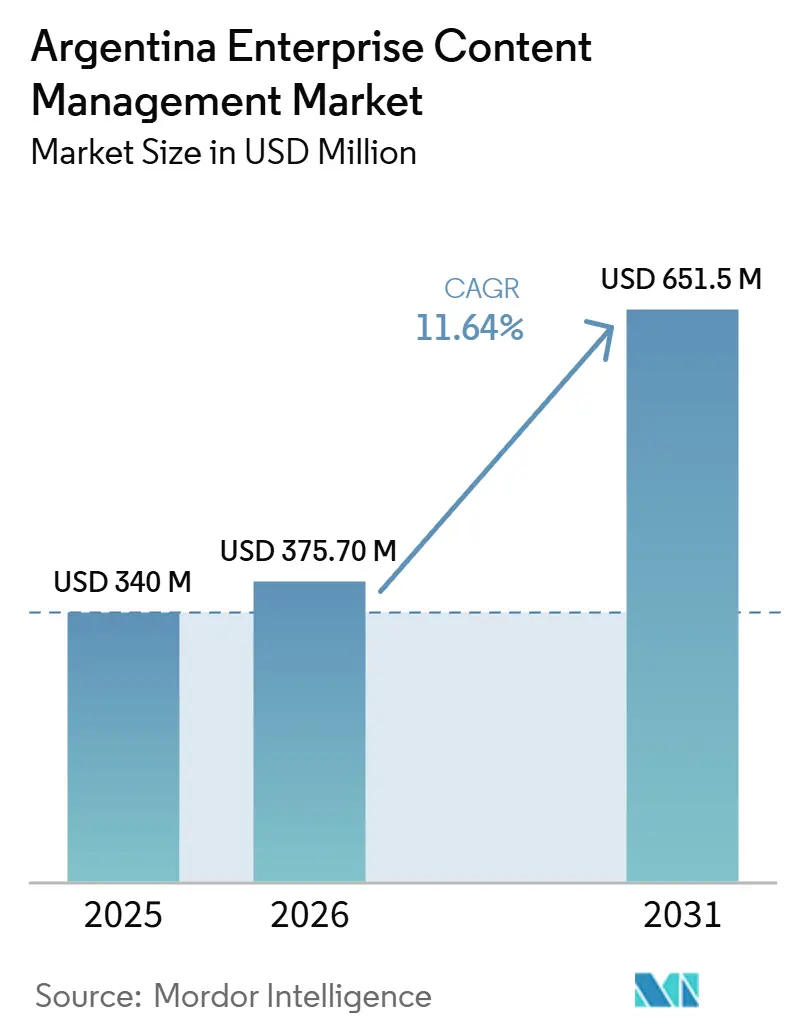
| Base Year Market Size (2025) | USD 340 Million |
| Market Size (2026) | USD 375.70 Million |
| Market Size (2031) | USD 651.5 Million |
| Growth Rate (2026 - 2031) | 11.64 % |
| Market Concentration | Medium |
Major Players *Disclaimer: Major Players sorted in no particular order Image © Mordor Intelligence. Reuse requires attribution under CC BY 4.0. | |
Argentina Enterprise Content Management Market Analysis by Mordor Intelligence
The Argentina enterprise content management market size is expected to grow from USD 340.0 million in 2025 to USD 375.7 million in 2026 and is forecast to reach USD 651.5 million by 2031 at 11.64% CAGR over 2026-2031. The Argentina enterprise content management market is being shaped by a regulatory environment that makes controlled storage, retrieval, and validation of digital records part of normal business operations rather than a discretionary technology project. Electronic signature rules, formal retention obligations for tax records, and broader acceptance of digital transactions are pushing organizations to adopt platforms that can store, authenticate, and audit content in a reliable way. Hybrid work has also changed how documents move through organizations, because approvals, reviews, and external exchanges now happen across distributed teams and locations with less tolerance for manual bottlenecks. Vendors are responding by combining content governance with workflow automation, AI-led classification, and flexible deployment options that fit both cloud-first and cautious buyers. The largest near-term opportunity in the Argentina enterprise content management market remains the widening base of SMEs and provincial organizations that are moving from isolated digitization efforts to structured content platforms.
Key Report Takeaways
- By solution type, document management held 24.37% of revenue in 2025, while workflow and business process management is projected to expand at a 12.91% CAGR through 2031.
- By deployment mode, cloud held 68.84% of the Argentina enterprise content management market size in 2025 and is projected to grow at a 12.43% CAGR through 2031.
- By enterprise size, large enterprises accounted for 57.26% of revenue in 2025, while SMEs are projected to record the highest CAGR at 12.58% through 2031.
- By end-user industry, BFSI held 20.41% of Argentina enterprise content management market share in 2025, while retail and e-commerce is projected to advance at a 13.36% CAGR through 2031.
Note: Market size and forecast figures in this report are generated using Mordor Intelligence’s proprietary estimation framework, updated with the latest available data and insights as of January 2026.
Argentina Enterprise Content Management Market Trends and Insights
Drivers Impact Analysis*
| Driver | (~) % Impact on CAGR Forecast | Geographic Relevance | Impact Timeline |
|---|---|---|---|
| Rising Regulatory Pressure for Document Traceability and Auditability | +2.8% | National, with concentrated compliance burden in Buenos Aires, Córdoba, and Rosario | Short term (≤ 2 years) |
| AI-Enabled Metadata Extraction and Intelligent Search Improving ROI | +2.4% | National, enterprise clusters in Greater Buenos Aires and technology hubs lead adoption | Medium term (2-4 years) |
| Hybrid Workflows Increasing Demand for Remote Content Access and Approval | +2.0% | National, with spillover to provincial government and interior enterprise hubs | Medium term (2-4 years) |
| Rapid Shift From Paper Archives to Searchable Digital Repositories | +1.8% | National, with early gains in BFSI and government verticals in Greater Buenos Aires | Medium term (2-4 years) |
| Cloud Migration of Legacy On-Premises Repositories Reducing IT Burden | +1.5% | National, strongest in SME clusters and regional offices beyond Buenos Aires | Long term (≥ 4 years) |
| SME Digitization of Invoices, Contracts, and HR Records Expanding Addressable Demand | +1.2% | National, with early gains in industrial and agricultural SME clusters in Buenos Aires province, Santa Fe, and Córdoba | Long term (≥ 4 years) |
| Source: Mordor Intelligence | |||
Rising Regulatory Pressure for Document Traceability snd Auditability
Argentina’s rules for digital signatures and electronic document handling continued to tighten through 2025, which raised the value of systems that can prove authenticity, retention, and audit history. Resolution SICYT 11/2025 updated key technical procedures in the national digital signature framework, which increased the need for controlled repositories that preserve valid signed records. The August 2025 publication on ENCODE S.A. also reflected regulatory adjustments tied to certified digital signature procedures, which reinforced the importance of keeping compliant document trails inside enterprise systems.[1] In regulated sectors such as banking, insurance, public administration, and healthcare, these requirements make document governance a routine compliance function instead of a periodic IT upgrade. The Argentina enterprise content management market, therefore, benefits from a demand base that is less exposed to short-term business cycles when compared with discretionary software categories.
AI-Enabled Metadata Extraction and Intelligent Search Improving ROI
The AI layer in the Argentina enterprise content management market is becoming more important because buyers want faster retrieval, better classification, and lower manual processing costs. IBM positioned Content Cortex as a unified platform that allows AI agents to classify, extract, redact, and apply legal holds across enterprise content, which supports the case for stronger automation in document-heavy operations. This matters in Argentina because companies often manage tax, supplier, legal, and customer records across multiple formats and internal systems. When metadata extraction and search improve, the same content repository becomes more useful for approvals, audits, and downstream workflows, which shortens the payback period for platform investments. That shift also helps vendors move beyond basic storage discussions and compete on measurable productivity, compliance speed, and operational accuracy. As a result, the Argentina enterprise content management market is seeing stronger alignment between AI functionality and enterprise buying decisions.
Hybrid Workflows Increasing Demand for Remote Content Access and Approval
Hybrid work has changed how organizations in Argentina create, review, approve, and store records, which keeps demand elevated for governed remote access. National electronic document management rules and the continued use of GDE frameworks in public administration support broader acceptance of digital files as operational records. The government’s approval of 19 Digital Transformation Units also expanded the institutional base for digital workflow adoption across provinces and regional clusters. This matters because public entities, suppliers, contractors, and regulated private organizations increasingly need compatible document processes instead of isolated local files. The preferred answer is often a hybrid model where sensitive records stay under tighter local control while approval flows, collaboration, and external exchanges move through more accessible digital layers. That operating pattern continues to support the Argentina enterprise content management market across both enterprise and public-sector use cases.
Rapid Shift From Paper Archives to Searchable Digital Repositories
The shift from paper archives to searchable repositories remains a structural growth driver for the Argentina enterprise content management market. The federal support structure for SME digitization includes programs that cover a large share of eligible project costs, which reduces the barrier to converting paper-heavy processes into governed digital records. YPF’s large Microsoft 365 migration also showed that major Argentine organizations are centralizing high volumes of files inside searchable digital environments instead of leaving information across disconnected folders and legacy storage layers. Once companies make that first move, they usually need better indexing, retention, permissions, and workflow control, which expands software scope after the initial repository project. This is why digitization programs often become multi-stage platform opportunities rather than one-time scanning exercises. It also explains why the Argentina enterprise content management market continues to attract investment from both infrastructure-focused and workflow-focused vendors.
Restraints Impact Analysis*
| Restraint | (~) % Impact on CAGR Forecast | Geographic Relevance | Impact Timeline |
|---|---|---|---|
| Integration Complexity With Legacy ERP, CRM, and Line-Of-Business Systems | -2.5% | National, most acute in large enterprise headquarters in Greater Buenos Aires | Medium term (2-4 years) |
| Data Sovereignty and Privacy Concerns Slowing Cloud Adoption | -1.8% | National, most severe in regulated sectors across Buenos Aires and interior provinces | Medium term (2-4 years) |
| Budget Sensitivity Among Mid-Market Buyers Delaying Platform Modernization | -1.2% | National, with strongest impact on SMEs and mid-market enterprises in interior provinces | Short term (≤ 2 years) |
| Low Process Maturity and Resistance to Change in Document-Intensive Organizations | -0.9% | National, most prevalent in traditional industries in industrial and agricultural provinces | Long term (≥ 4 years) |
| Source: Mordor Intelligence | |||
Integration Complexity With Legacy ERP, CRM, and Line-Of-Business Systems
Integration remains one of the hardest barriers in the Argentina enterprise content management market because many organizations still run mixed software environments built over long periods. Large enterprises often combine global ERP platforms, local business systems, sector tools, and custom databases, which makes clean document orchestration difficult. In those settings, ECM adoption usually depends on connectors, middleware, process redesign, and governance alignment rather than only license spending. The issue is especially important in Argentina because tax, invoicing, and compliance processes often need local adaptations that global templates do not fully address. That increases deployment time and can delay platform decisions even when the business case for better content control is clear. It also favors vendors and partners that can show local integration depth instead of only product breadth.
Data Sovereignty and Privacy Concerns Slowing Cloud Adoption
Privacy and cross-border data transfer rules continue to slow parts of the Argentina enterprise content management market, especially in regulated verticals. The active legislative debate around reforms to Argentina’s personal data protection framework through 2025 left buyers with unresolved questions about future standards for storage, transfer, and cloud architecture.[2] For organizations that handle personal, financial, or medical records, uncertainty around future compliance rules can delay full cloud commitments even when cloud economics are attractive. This is one reason hybrid deployment keeps gaining relevance, because it lets enterprises modernize workflows without moving every sensitive record into externally hosted environments. The restraint does not stop digitization, but it does lengthen sales cycles and narrow the set of acceptable architectures in some buying processes. Until the legal path becomes clearer, the Argentina enterprise content management market is likely to see continued caution around pure cloud adoption in high-compliance accounts.
*Our forecasts treat driver/restraint impacts as directional, not additive. The impact forecasts reflect baseline growth, mix effects, and variable interactions.
Segment Analysis
By Solution Type: Compliance-Led Spending Keeps Document Management In Front
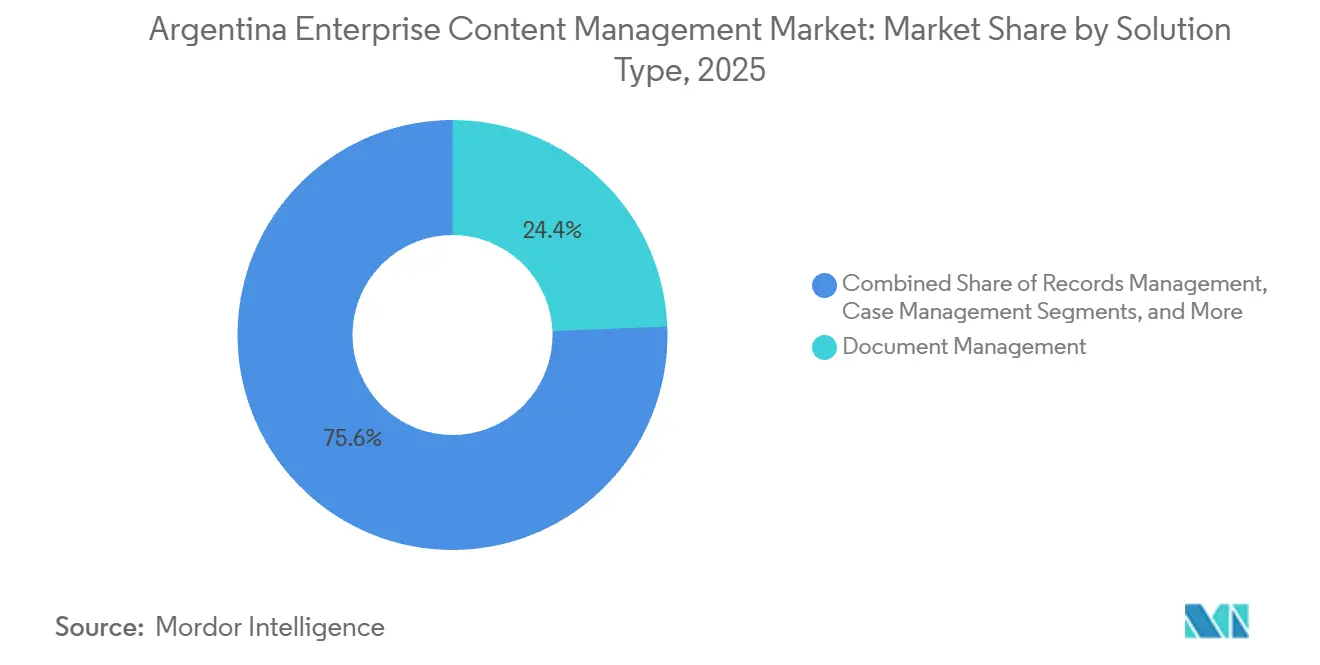
Document management held 24.37% share of the Argentina enterprise content management market size in 2025, which made it the largest solution category in the current structure. The category stays in front because retention, storage control, version history, and signed document validity remain the first requirements buyers address before expanding into broader automation. Argentina’s updated digital signature rules and electronic document governance continue to support that sequence by making compliant storage a baseline operational need. In practical terms, organizations usually need stronger control over invoices, contracts, tax records, and internal approvals before they can justify deeper workflow redesign. That pattern keeps the core repository layer commercially important across the Argentina enterprise content management market.
Workflow and business process management is projected to expand at a 12.91% CAGR through 2031, which makes it the fastest-growing solution type in this report. That growth reflects the next stage of adoption, where businesses that already digitized content now want to route, validate, and act on that content with less manual intervention. AI-ready platforms from major suppliers are reinforcing this shift by connecting classification, extraction, and decision support with operational workflows. Records management remains essential where long retention periods and audit readiness matter, while case management is gaining ground in public administration and financial services that depend on structured document handling. Web content management, digital asset management, and adjacent tools serve narrower needs, but they benefit when enterprises want a broader content stack instead of a standalone repository. Across the Argentina enterprise content management industry, the commercial pattern is clear, document management protects the revenue base, while workflow automation creates the most visible expansion path.

By Deployment Mode: Cloud Leads, While Hybrid Holds Strategic Importance
Cloud captured 68.84% of the Argentina enterprise content management market size in 2025, and it is also projected to grow at a 12.43% CAGR through 2031. The cloud lead comes from easier deployment, subscription pricing, browser-based access, and faster feature delivery for organizations that do not want long upgrade cycles. Those advantages matter in a country where distributed teams, branch operations, and growing digital workflows favor platforms that are accessible without heavy local infrastructure. Government-backed digitization support for SMEs also improves the fit of cloud services because smaller firms can adopt structured tools without large upfront hardware commitments.
On-premises deployments still matter in BFSI, healthcare, and parts of government where control over sensitive information remains a high priority under current privacy conditions. Hybrid architecture absorbs this tension by keeping selected records under tighter local control while letting collaboration, search, or AI-enabled processes run in connected cloud layers. M-Files reinforced this direction in July 2025 through its Microsoft partnership, which allowed content to be stored natively in Microsoft 365 via SharePoint Embedded while preserving document management governance. That model is especially relevant in the Argentina enterprise content management industry because buyers often want modernization without committing to a fully externalized data architecture. As a result, the Argentina enterprise content management market is likely to sustain parallel demand for cloud subscriptions, integration services, and policy-led deployment design. The deployment story is therefore not a simple replacement of one model by another, but a controlled shift toward mixed environments that satisfy both operational and legal concerns.
By Enterprise Size: Large Enterprises Control Revenue, SMEs Drive Expansion
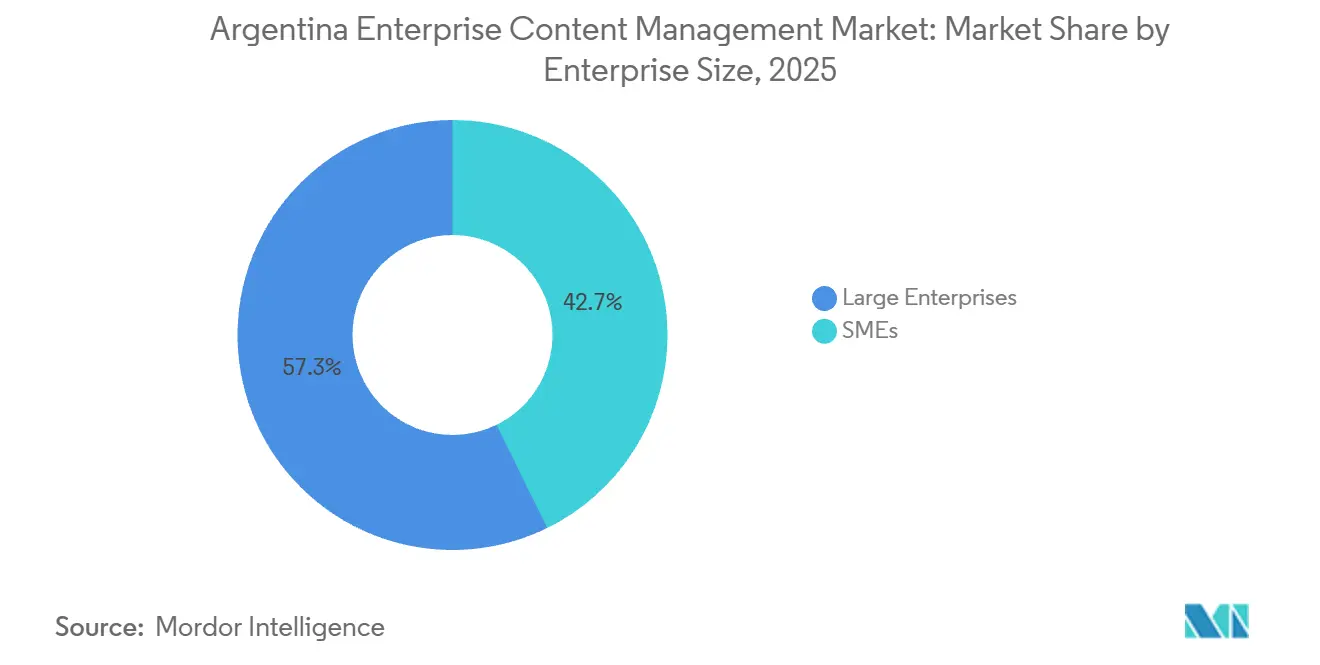
Large enterprises held 57.26% of revenue in 2025, which gave them the largest share in the Argentina enterprise content management market. Their lead reflects larger document volumes, more complex governance structures, broader compliance exposure, and greater ability to fund integrations, professional services, and change management. YPF’s migration of more than 1.5 million files and activation of over 10,000 daily users illustrate the scale at which major organizations are consolidating content environments.[3] Large institutions also tend to follow group-wide information standards, which keeps ECM spending tied to both local compliance requirements and wider enterprise platform strategies. This is why global vendors still compete most aggressively for top-tier accounts in the Argentina enterprise content management market.
SMEs are projected to expand at a 12.58% CAGR through 2031, which makes them the fastest-growing enterprise-size segment. Government programs that support digital transformation and subsidize eligible projects are widening the addressable base for first-time platform adoption among smaller firms. Law 27.440 also strengthens the case for structured document handling because SMEs participating in inter-business transactions must manage electronic invoice flows more formally. M-Files’ January 2026 partner program update supports this opportunity by expanding the indirect channel structure needed to reach mid-market and SME buyers more efficiently. The segment is therefore growing not only because smaller firms want modern tools, but because legal obligations and public support are moving them closer to structured content practices. That dynamic should keep SMEs central to volume growth across the Argentina enterprise content management market during the forecast period.
By End-User Industry: BFSI Provides Revenue Base, Retail and E-Commerce Speed up
BFSI held 20.41% of Argentina enterprise content management market share in 2025, which made it the leading end-user vertical. That position comes from steady spending on audit trails, reporting support, customer records, transaction documents, and long retention obligations. OpenText and Fiserv’s September 2025 launch of Content Next showed that global vendors continue to design purpose-built workflow and content solutions for financial institutions, which supports the importance of this vertical. Once a platform is embedded in banking workflows, switching costs rise because records, approvals, controls, and integrations are closely linked. This gives BFSI a stabilizing role in the Argentina enterprise content management market even when other verticals move at different speeds.
Retail and e-commerce is projected to grow at a 13.36% CAGR through 2031, which makes it the fastest-growing end-user segment. The shift reflects heavier use of digital product data, supplier records, customer-facing content, and fulfillment-related documents that need stronger coordination across channels. Government and public administration also remain structurally important because digital document management standards within the public sector influence how contractors, suppliers, and regional entities exchange records. Manufacturing and energy continue to generate demand from traceability, safety, maintenance, and compliance documentation that cannot be handled well through disconnected repositories. Healthcare, IT and telecommunications, education, and media-related use cases add further breadth, even if they are not the largest spending pockets today. The end-user profile, therefore, shows a mix of stable regulated demand and faster digital commerce expansion across the Argentina enterprise content management market.
Geography Analysis
Greater Buenos Aires continued to account for the majority of deployment value within the Argentina enterprise content management market, even though the report does not assign a separate numeric share to the region. The area remains the center of adoption because it contains the headquarters of large banks, national agencies, multinational subsidiaries, and major service providers that manage dense document flows. Public-sector digital document management frameworks also have strong institutional visibility in this geography, which helps normalize paperless workflows across connected private and government processes. This concentration matters because vendors often win their Argentine references, channel partners, and compliance credentials in Buenos Aires before extending into other provinces. It also means that procurement expectations set in the capital region frequently shape broader standards across the Argentina enterprise content management market.
Córdoba, Rosario, Mendoza, Santa Fe, Tucumán, and other secondary cities represent the next layer of expansion for the Argentina enterprise content management market. These locations combine industrial production, agribusiness, services, and regional administration, which creates a growing base for formal document workflows. The approval of 19 Digital Transformation Units supports this spread by giving provinces and regional clusters more institutional capacity to adopt digital tools and related process standards. In energy-heavy areas such as Neuquén, the operational need for safety records, contractor files, and compliance documentation also strengthens the role of governed repositories. The result is a geography where demand is no longer limited to headquarters locations, but is increasingly tied to regional operating sites and sector clusters.
The Argentina enterprise content management market size is being supported in interior provinces by better access to regional cloud infrastructure and broader acceptance of hybrid architectures. Buyers outside the capital often value cloud access for reach and speed, but they still want flexibility around where sensitive content is stored because privacy reforms remain unsettled. That is why the market’s spatial pattern is not a simple cloud-versus-local divide, but a gradual buildout of mixed models that fit local operating realities. Over time, this should reduce the gap between Buenos Aires and the rest of the country, while keeping compliance-sensitive design central to the Argentina enterprise content management market.
Competitive Landscape
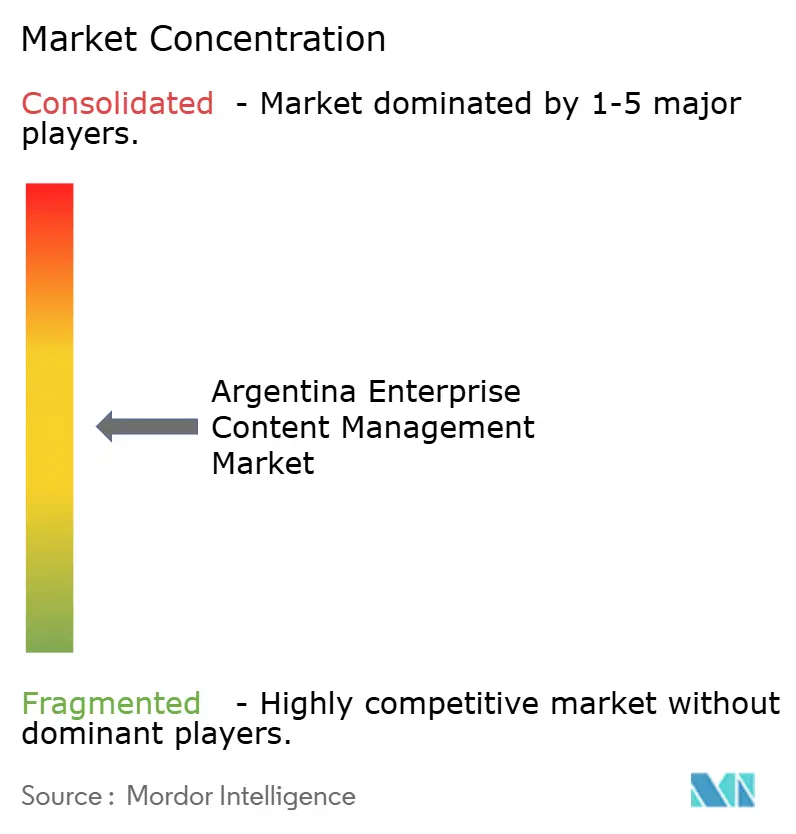
The Argentina enterprise content management market remains moderately concentrated at the top, with OpenText, Hyland, IBM, M-Files, Newgen, Microsoft, and related global platforms capturing much of the large-enterprise contract value. Their position is built on broad product portfolios, integration depth, and a stronger ability to align content governance with ERP, cloud, AI, and workflow priorities. IBM strengthened its position in 2026 by presenting Content Cortex as a unified content platform that enables AI agents to classify, extract, redact, and apply legal holds across enterprise workflows.[4] OpenText also deepened its financial-services proposition in September 2025 through Content Next with Fiserv, which targeted banks and credit unions with an AI-powered workflow and content management offer. In the Argentina enterprise content management market, those capabilities matter because buyers often compare vendors on both product features and the ability to handle local compliance expectations without excessive custom work.
M-Files has taken a particularly active route by aligning more closely with Microsoft. Its July 2025 partnership with Microsoft made it possible to store governed content natively in Microsoft 365 through SharePoint Embedded, which gave buyers a clearer hybrid path. It then deepened that relationship in March 2026 with new Microsoft 365 Copilot and Copilot Agent Builder experiences, which tied AI-assisted work more directly to governed enterprise content. Hyland also retained competitive relevance through its federated content approach, which appeals to large organizations that want portfolio flexibility instead of forced migration into a single repository stack. The common thread is that leading suppliers are no longer competing only on storage, but on how well they combine governance, AI, interoperability, and deployment flexibility.
The next battleground in the Argentina enterprise content management market sits in provincial government programs and the SME base, where simpler offers and stronger local channel reach can matter as much as global scale. That helps explain why M-Files refreshed its partner program in January 2026 to improve incentives and enablement for joint growth in mid-market and SME accounts. It also helps explain why local and specialist firms still have room when they can solve document workflow problems with a tighter implementation focus. Perceptive Software should not be treated as a separate competitive entity in this market because its product line sits within Hyland’s broader portfolio. Atlassian is also not a core ECM competitor for regulated Argentine use cases because its collaboration tools do not address the same document lifecycle and records governance needs. This mix of strong global leaders, active channel expansion, and selective local whitespace keeps the Argentina enterprise content management market competitive without making it fully fragmented.
Argentina Enterprise Content Management Industry Leaders
-
Calipso S.A.
-
OpenText Corporation
-
Microsoft Corporation
-
Hyland Software, Inc.
-
IBM Corporation
- *Disclaimer: Major Players sorted in no particular order
Recent Industry Developments
- May 2026: M-Files introduced 2026 Platform Packages with updated pricing and modular entry points, restructuring its commercial model to better reflect how organizations scale document management adoption over time.
- March 2026: M-Files deepened its strategic collaboration with Microsoft by launching new experiences for Microsoft 365 Copilot and Microsoft 365 Copilot Agent Builder. The update enabled AI agents to operate on M-Files-governed content stored natively in SharePoint Embedded, extending AI-driven document management capabilities to enterprise users and building on the July 2025 foundational partnership.
- January 2026: M-Files unveiled an enhanced partner program with new incentives, enablement resources, and joint-growth structures specifically designed to accelerate channel expansion in mid-market and SME segments, with direct implications for its South American partner network.
- October 2025: OpenText released Cloud Editions 25.4, introducing AI-in-Context capabilities that enable enterprises to discover hidden content, transform unstructured data into governed intelligence, and deploy AI agents across OpenText's content management platforms within a secure, multi-tenant SaaS environment.
Argentina Enterprise Content Management Market Report Scope
The Argentina enterprise content management market comprises software platforms and related services that enable organizations to capture, create, manage, store, secure, govern, and distribute enterprise content and business documents throughout their lifecycle. The market includes document management, records management, workflow and business process management, case management, digital asset management, web content management, and other content-centric solutions delivered through cloud, on-premises, and hybrid deployment models. Market estimates represent revenue generated from enterprise content management software licenses, subscriptions, maintenance, implementation, consulting, integration, training, and managed services within Argentina.
The Argentina Enterprise Content Management Market Report is Segmented by Solution Type (Document Management, Records Management, Workflow and Business Process Management, Case Management, Digital Asset Management, Web Content Management, and Other Solutions), Deployment Mode (On-Premises, Cloud, and Hybrid), Enterprise Size (Small and Medium Enterprises, and Large Enterprises), and End-user Industry (BFSI, Government and Public Administration, Healthcare and Lifesciences, IT and Telecommunications, Industrial Manufacturing, Retail and E-Commerce, Media and Entertainment, Education, Energy and Utilities, and Other End-user Industries). The Market Forecasts are Provided in Terms of Value (USD).
| Document Management |
| Records Management |
| Workflow and Business Process Management |
| Case Management |
| Digital Asset Management |
| Web Content Management |
| Other Solutions |
| On-Premises |
| Cloud |
| Hybrid |
| Small and Medium Enterprises |
| Large Enterprises |
| BFSI |
| Government and Public Administration |
| Healthcare and Lifesciences |
| IT and Telecommunications |
| Industrial Manufacturing |
| Retail and E-Commerce |
| Media and Entertainment |
| Education |
| Energy and Utilities |
| Other End-User Industries |
| By Solution Type | Document Management |
| Records Management | |
| Workflow and Business Process Management | |
| Case Management | |
| Digital Asset Management | |
| Web Content Management | |
| Other Solutions | |
| By Deployment Mode | On-Premises |
| Cloud | |
| Hybrid | |
| By Enterprise Size | Small and Medium Enterprises |
| Large Enterprises | |
| By End-User Industry | BFSI |
| Government and Public Administration | |
| Healthcare and Lifesciences | |
| IT and Telecommunications | |
| Industrial Manufacturing | |
| Retail and E-Commerce | |
| Media and Entertainment | |
| Education | |
| Energy and Utilities | |
| Other End-User Industries |
Key Questions Answered in the Report
What is the 2026 value and 2031 outlook for enterprise content management in Argentina?
The Argentina enterprise content management market is estimated at USD 375.7 million in 2026 and is projected to reach USD 651.5 million by 2031 at an 11.64% CAGR.
Which deployment model leads adoption in Argentina?
Cloud leads the current structure with 68.84% share in 2025, supported by easier access, subscription pricing, and reduced infrastructure burden for new adopters.
Which solution area is growing the fastest through 2031?
Workflow and business process management is projected to expand at a 12.91% CAGR, reflecting stronger demand for routing, approvals, and automation after basic repository deployment.
Why does BFSI remain the largest customer group?
BFSI led with 20.41% share in 2025 because banks and financial institutions need strong audit trails, document retention, reporting support, and controlled customer record handling.
What is driving faster uptake among SMEs?
SMEs are projected to grow at a 12.58% CAGR because government digitization support and formal electronic invoice obligations are making structured content systems more necessary and more affordable.
What is the main factor slowing pure cloud adoption?
Uncertainty around privacy and cross-border data rules is keeping some regulated buyers cautious, which is why hybrid models remain important in Argentina.