
Argentina Cartonboard Market Size and Share
Market Overview
| Study Period | 2020 - 2031 |
|---|---|
| Forecast Data Period | 2026 - 2031 |
| Base Year Market Size (2025) | USD 0.74 Billion |
| Market Size (2026) | USD 0.78 Billion |
| Market Size (2031) | USD 1.02 Billion |
| Growth Rate (2026 - 2031) | 5.51 % |
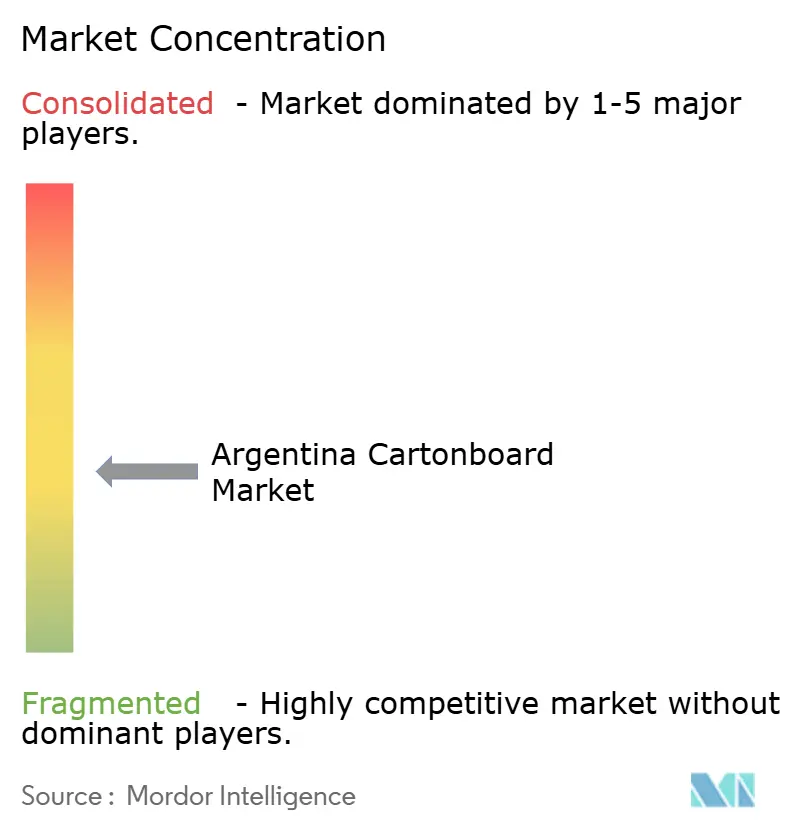
| Market Concentration | Medium |
Major Players *Disclaimer: Major Players sorted in no particular order Image © Mordor Intelligence. Reuse requires attribution under CC BY 4.0. | |
Argentina Cartonboard Market Analysis by Mordor Intelligence
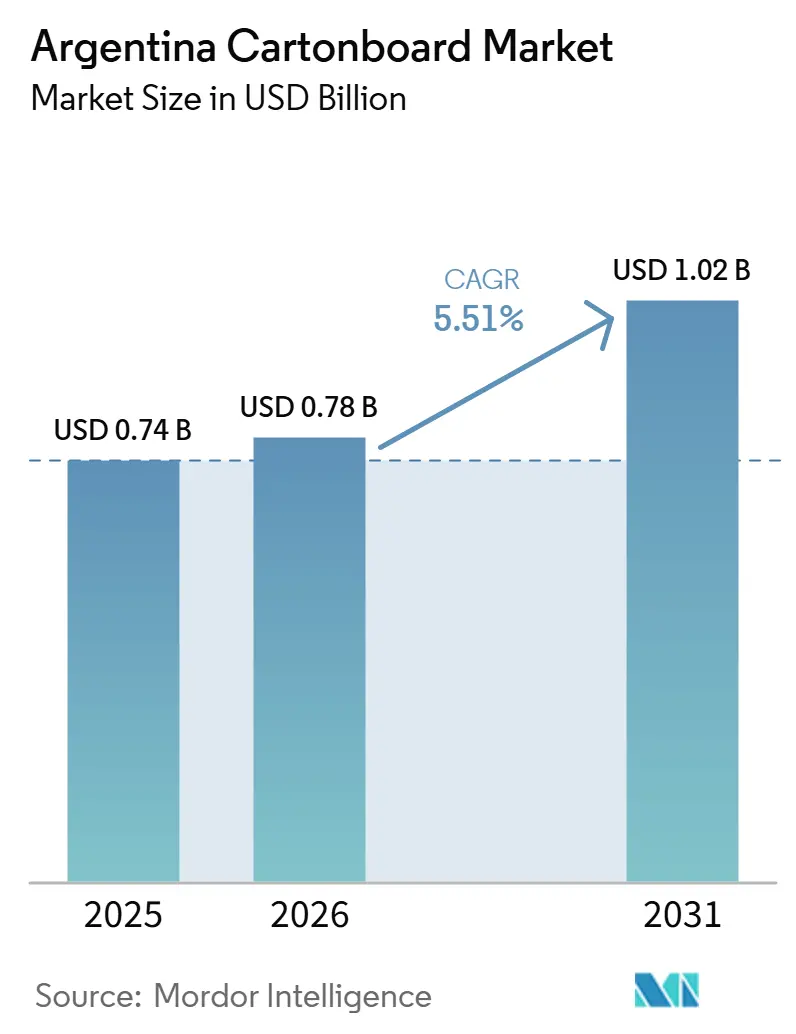
The Argentina cartonboard market size is expected to grow from USD 0.74 billion in 2025 to USD 0.78 billion in 2026 and is forecast to reach USD 1.02 billion by 2031 at 5.51% CAGR over 2026-2031. The recovery now underway follows 2 years during which weaker consumer spending and currency-linked swings in input costs held back converter investment and procurement volumes. Demand is being supported by stronger use of packaged foods, wider quick-service restaurant coverage, and tighter scrutiny of single-use plastic packaging in consumer categories. The Argentine cartonboard market also benefits from a dense base of food manufacturers, dairy processors, and pharmaceutical producers, which helps keep baseline packaging demand more stable through economic cycles. Competition remains moderate, with integrated global suppliers stronger in premium and specialty grades, while domestic converters remain important in recycled board and White-Lined Chipboard. Growth through 2031 is likely to come from both higher volumes in commodity grades and a better value mix as premium substrates replace plastics and lower-specification board in more applications.
Key Report Takeaways
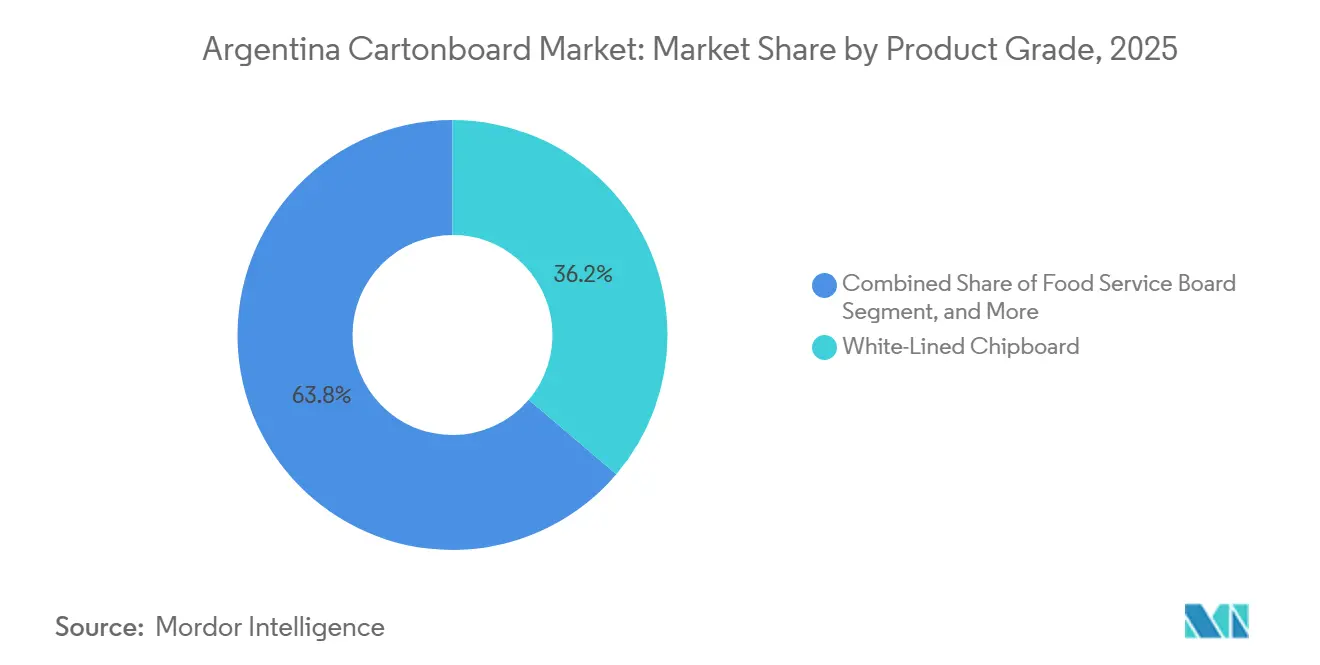
- By product grade, White-Lined Chipboard captured 36.21% of the Argentina cartonboard market share in 2025.
- By packaging format, the Argentina cartonboard market size for the Liquid Packaging segment is forecast to advance at a 6.01% CAGR through 2031.
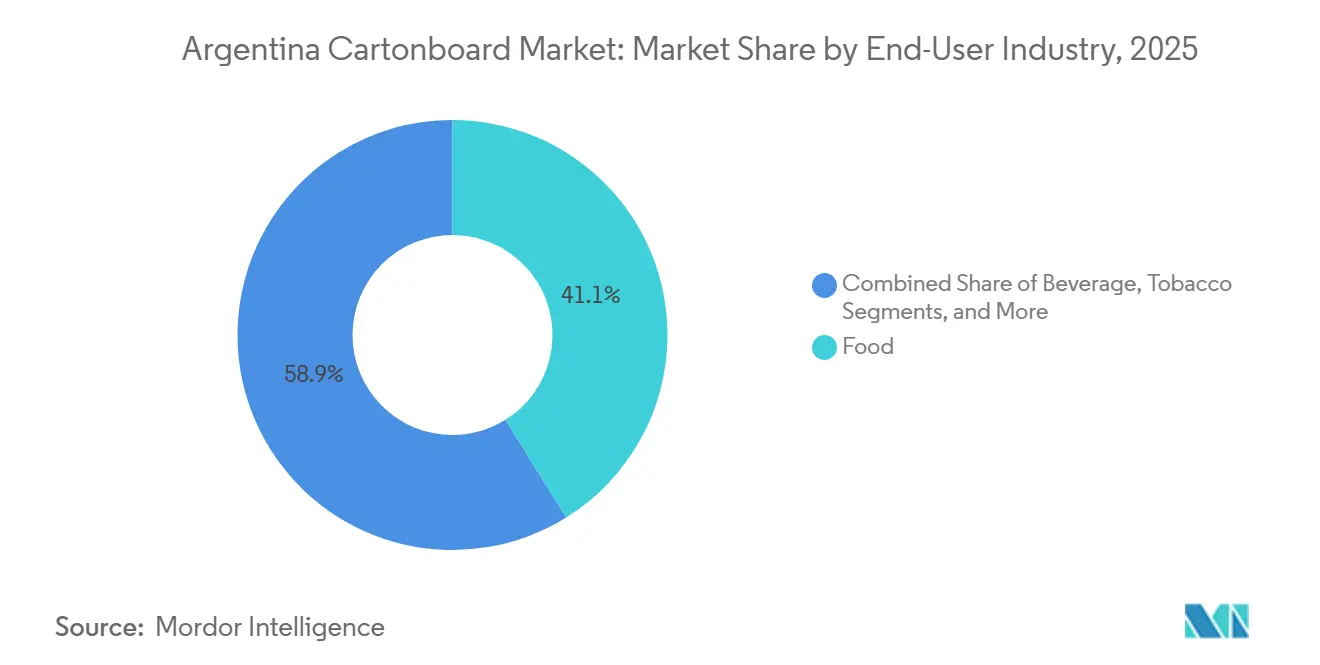
- By end-user industry, food captured 41.13% of the Argentina cartonboard market share in 2025.
Note: Market size and forecast figures in this report are generated using Mordor Intelligence’s proprietary estimation framework, updated with the latest available data and insights as of January 2026.
Argentina Cartonboard Market Trends and Insights
Drivers Impact Analysis*
| Driver | (~) % Impact on CAGR Forecast | Geographic Relevance | Impact Timeline |
|---|---|---|---|
| Rising Demand for Recyclable Retail and Food Packaging | +1.5% | National, primary gains in Buenos Aires Province and Córdoba | Medium term (2-4 years) |
| Expansion of Aseptic Liquid and Dairy Packaging Demand | +1.0% | National, led by Pampas dairy belt and Buenos Aires Province | Medium term (2-4 years) |
| Premiumization in Folded Cartons for Food, Beverage, and Personal Care | +0.8% | Buenos Aires metropolitan area, spill-over to Córdoba and Mendoza | Long term (≥ 4 years) |
| E-Commerce Friendly Lightweight Secondary Packaging Adoption | +0.6% | National, concentrated in Buenos Aires Province and greater Rosario | Short term (≤ 2 years) |
| Brand Conversion Toward Fiber Based Alternatives to Plastic Packs | +0.5% | National, early gains in Buenos Aires Province | Long term (≥ 4 years) |
| Local Converter Upgrades Supporting Short Run, High Graphic Carton Applications | +0.3% | Buenos Aires Province, Córdoba, and Rosario industrial corridors | Medium term (2-4 years) |
| Source: Mordor Intelligence | |||
Rising Demand for Recyclable Retail and Food Packaging
Argentina’s policy framework for post-consumer packaging moved closer to change in 2025, as multiple Extended Producer Responsibility bills advanced in Congress and set out producer obligations for collection and recovery systems.[1]Argentina Cámara de Diputados, “Proyecto de Ley, Gestión de Envases y Embalajes Post Consumo,” Cámara de Diputados de la Nación, www4.hcdn.gob.ar That direction is encouraging food retailers and branded manufacturers to favor cartonboard formats with clear recyclability claims before a national mandate is finalized. The shift is not limited to cost control, because packaging choice is increasingly tied to compliance planning and to brand positioning in formal retail channels. If non-recyclable packaging carries a future recovery surcharge, cartonboard becomes more competitive at the delivered cost level, even without a major shift in consumer preferences. This matters for the Argentina cartonboard market because procurement teams are already weighing future compliance exposure when they lock in packaging specifications. It also gives converters with proven recycled or recyclable board capabilities a stronger position in customer discussions.
Expansion of Aseptic Liquid and Dairy Packaging Demand
Aseptic liquid packaging remains closely tied to Argentina’s large dairy base and to steady demand for UHT milk, juices, and plant-based beverages. In April 2026, Tetra Pak and Sterilgarda Alimenti launched the first 1-liter aseptic carton with a paper-based barrier layer, backed by EUR 60 million (USD 64.8 million) in pilot plant investment and capable of reaching up to 90% renewable content when combined with plant-based polymers.[2]Tetra Pak, “Tetra Pak and Sterilgarda Alimenti Launch Industry-First 1-Litre Aseptic Carton with Paper-Based Barrier,” Tetra Pak, tetrapak.com That technology path is directly relevant to Argentine dairy and beverage brands seeking to reduce the environmental burden of liquid packaging before regulation further tightens. Demand for liquid packaging board is therefore supported by 2 forces: organic beverage volume and a gradual shift from glass and PET toward carton-based ambient distribution. The same trend keeps import dependence in place for higher-performance grades, because local producers do not yet offer the same barrier capability at scale. For the Argentine cartonboard market, this means liquid packaging demand can rise even while the supply chain remains selective and import-linked.
Premiumization in Folded Cartons for Food, Beverage, and Personal Care
Argentina’s front-of-pack labeling rules have made precision printing more important for branded carton formats. ANMAT Disposición 11362/2024 formalized updated requirements for front labeling, and these rules increase the need for stable surfaces, clean print registration, and reliable dimensional control for packaged food cartons.[3]Administración Nacional de Medicamentos, Alimentos y Tecnología Médica, “Disposición 11362/2024,” Boletín Oficial de la República Argentina, boletinoficial.gob.ar As a result, Solid Bleached Board and Folding Boxboard are gaining preference over White-Lined Chipboard in applications where brightness, ink holdout, and inspection consistency matter more. Brand owners are also investing more in embossing, metallic inks, and surface finishes because shelf impact remains a key differentiator in supermarkets and pharmacies. That combination lifts the average grade requirement inside folding cartons rather than simply adding volume. In the Argentina cartonboard market, premiumization is therefore tied to both regulation and merchandising needs. It also favors converters that can maintain tighter process control across higher-specification jobs.
E-Commerce Friendly Lightweight Secondary Packaging Adoption
Argentina’s online retail activity has reached a scale where packaging needs are increasingly shaped by delivery efficiency rather than by shelf display alone. Secondary packaging now has to protect goods through last-mile handling while limiting excess material and freight weight. That change is helping lightweight folding cartons and micro-flute cartonboard formats gain relevance in electronics accessories, health and wellness products, and direct-to-consumer food kits. It also supports digital print converters, as many online brands prefer short, branded runs that fit smaller order profiles and faster product refresh cycles. This demand is especially useful for converters that can serve jobs in the 5,000-50,000 unit range without long setup times. As e-commerce fulfillment spreads across more regions, the Argentina cartonboard market gains another route for secondary packaging demand beyond traditional supermarket channels.
Restraints Impact Analysis*
| Restraint | (~) % Impact on CAGR Forecast | Geographic Relevance | Impact Timeline |
|---|---|---|---|
| Volatile Pulp, Energy, and Imported Chemical Input Costs | -0.9% | National, disproportionately affects converters in Buenos Aires Province dependent on imported board | Short term (≤ 2 years) |
| Limited Domestic Barrier Coating and Specialty Board Capacity | -0.6% | National, most acute for pharmaceutical and cosmetics end users in Buenos Aires Province | Long term (≥ 4 years) |
| Quality Variability in Recovered Fiber Feedstock | -0.4% | National, concentrated in Buenos Aires Province and Córdoba industrial corridors | Medium term (2-4 years) |
| Pricing Pressure from Alternative Paperboard and Flexible Packaging Formats | -0.3% | National, most visible competition in Córdoba and Buenos Aires retail trade | Medium term (2-4 years) |
| Source: Mordor Intelligence | |||
Volatile Pulp, Energy, and Imported Chemical Input Costs
The cost base for cartonboard production in Argentina remains unusually exposed to imported pulp, specialty chemicals, and optical brighteners. A meaningful share of virgin bleached pulp still comes from Uruguay, Brazil, and Chile, while many specialty inputs are sourced from Europe and North America. That leaves converters highly sensitive to exchange-rate shifts and freight volatility, especially when premium board has to be imported on short notice. Energy is a second pressure point because higher industrial utility costs feed directly into papermaking and converting margins. Converters working under fixed-price supply agreements cannot always quickly pass through those increases to brand owners. In the Argentina cartonboard market, this creates the greatest strain for mid-sized local firms that do not have the same hedging tools or internal sourcing options as larger integrated operators.
Limited Domestic Barrier Coating and Specialty Board Capacity
Argentina still lacks a commercial-scale domestic supply of advanced barrier-coated liquid packaging board and solid bleached board for premium uses. That gap forces pharmaceutical, cosmetics, and aseptic beverage customers to rely on imports from European mills with higher delivered costs. Mayr-Melnhof Group’s Annual Results 2025 stated that no significant improvement in market conditions was expected in 2026, a backdrop that does little to encourage new regional specialty board capacity in the near term.[4]Mayr-Melnhof Group, “Annual Results 2025,” Mayr-Melnhof Group, mm.group The constraint is becoming more serious as PFAS-free aqueous barrier systems gain importance in food-contact applications, while local coating infrastructure remains limited. Imported specialty grades therefore hold pricing power when global capacity tightens, and local buyers need continuity. The Argentina cartonboard market will likely stay exposed to this issue until a few major brand owners are willing to back local investment with long-term volume commitments.
*Our forecasts treat driver/restraint impacts as directional, not additive. The impact forecasts reflect baseline growth, mix effects, and variable interactions.
Segment Analysis
By Product Grade: White-Lined Chipboard Anchors Volume Base, Food Service Board Sets The Growth Pace
White-Lined Chipboard held 36.21% of Argentina cartonboard market share in 2025, making it the volume base for the broadest set of everyday packaging uses. It remained the main workhorse substrate for household goods, processed food secondary packaging, and retail-ready formats that dominate supermarket channels. Its recycled fiber core and white-coated top liner keep the grade attractive in cost-sensitive applications where print quality still matters. Demand also benefited from the partial stabilization of household purchasing power through 2025, which supported recovery in private-label and mass-market packaged goods. Food Service Board is the fastest-growing grade in the Argentina cartonboard market, with a 6.36% CAGR projected through 2031. That pace is tied to food delivery platforms and quick-service restaurant expansion, both of which require grease-resistant, rigid carton-based takeaway formats.
Solid Bleached Board remains a niche, import-dependent grade, but it plays a critical role in pharmaceutical, cosmetic, and export-grade food packaging. These applications require brightness, a cleaner surface, and dependable compatibility with stricter printing and compliance standards. Solid Unbleached Board is used more where structural strength matters most, especially in heavier liquid containers and some industrial packaging formats. Folding Boxboard sits between premium and commodity needs and serves everyday food, beverage, and household uses through the country’s installed offset and flexographic lines. The Argentina cartonboard industry is therefore shifting slowly from heavy reliance on commodity White-Lined Chipboard toward a broader mix that includes more higher-specification grades. Tetra Pak’s 2026 paper-based barrier launch also strengthens the commercial case for more advanced liquid-packaging-related board performance over time.



By Packaging Format: Folding Cartons Command Value, Liquid Packaging Leads The Acceleration
Folding Cartons accounted for 57.16% of the Argentina cartonboard market size in 2025, giving this format a clear majority by value. That position reflects its use across food, pharmaceutical, personal care, and tobacco applications, which together form the core of branded consumer goods production in the country. The format’s lead is supported by its ability to combine protection, print appeal, and shelf efficiency in a single structure. It is also reinforced by tighter quality requirements in healthcare and nutraceutical packaging, where dimensional tolerances matter more than before. Liquid Packaging is advancing at a 6.01% CAGR through 2031, making it the fastest-growing packaging format in the Argentina cartonboard market. Growth is being driven by wider use of aseptic cartons in dairy, juice, and plant-based beverage applications.
Sleeve and Tray formats remain important in fresh food and produce chains where rigidity and moisture resistance shape buying decisions. Other packaging formats, including cups and foodservice containers, are also gaining ground as more operators seek fiber-based alternatives for away-from-home consumption. That shift links closely with the expansion of food delivery and quick-service dining, where portability and grease resistance are essential. It also supports grades designed for direct food contact and better end-of-life handling than several plastic alternatives. Tetra Pak’s 2026 launch showed that barrier technology in liquid cartons is moving toward stronger paper content and better recyclability credentials. Over the forecast period, substitution from plastic to paperboard should keep Folding Cartons and Liquid Packaging at the center of format development in the Argentina cartonboard market.
By End-User Industry: Food Sustains Volume Leadership, Pharmaceutical And Healthcare Drives Value Uplift
The food segment retained the largest share of the Argentina cartonboard industry at 41.13% in 2025, giving it the broadest demand base across all end users. That lead comes from the country’s strong grain and agri-food processing base, which supports cereals, pasta, biscuits, snacks, and packaged dairy products. The customer base is also widely spread across major industrial zones, which helps keep packaging demand diversified. Buenos Aires Province and Córdoba remain especially important because they host dense clusters of food manufacturers and co-packers. Pharmaceutical and healthcare packaging is projected to expand at a 6.62% CAGR through 2031, the fastest among end-user applications in the Argentina cartonboard market. That growth is tied to expanding generic drug production, rising volumes of nutraceuticals and over-the-counter health products, and stricter labeling and print-control requirements under ANMAT rules.
Beverage demand is closely linked to aseptic liquid packaging, especially across UHT milk, fruit juice, and fortified dairy categories. Major dairy cooperatives and branded beverage companies, therefore, remain important users of liquid packaging board. Tobacco is a declining volume category, yet premium cigarette packs still support per-unit value through embossed board and metallic print finishes. Cosmetics and Toiletries is a more active growth pocket, particularly in premium cartons sold through pharmacy chains and specialty beauty retail. Other end-user industries, including toys, apparel, automotive spare parts, and household goods, account for fragmented demand, mostly served by White-Lined Chipboard and recycled board. The Argentina cartonboard industry thus combines a wide, volume-oriented food base with a smaller but faster-rising premium segment in regulated healthcare applications.
Geography Analysis
Buenos Aires Province is making it the leading geography by a clear margin. The province combines a major manufacturing base with the country’s largest concentration of consumer goods production. Food manufacturers, pharmaceutical producers, and co-packers are clustered along the metropolitan and industrial corridor, providing converters with a stable customer base. That concentration helps demand remain more resilient even when the wider economy slows. Buenos Aires also remains the most important entry point for premium and specialty board distribution into the Argentine cartonboard market.
Córdoba's role is supported by one of South America’s strongest agri-food processing zones across dairy, citrus, grain, and protein categories. This gives the province a strong base for packaged food output and for packaging upgrades linked to export readiness. Demand here differs from that in Buenos Aires because export-facing SKUs require tighter compliance and stronger visual presentation for overseas buyers. The province is also becoming more central to packaging innovation activity as industry events and supplier engagement increase. The Instituto Argentino del Envase confirmed Córdoba as the host city for the inaugural Master Feria Tecno Alimentaria Envase-Alimentek 2026, underscoring its growing influence in packaging development.
The rest of Argentina, including Santa Fe, Mendoza, Tucumán, and the Patagonian provinces, still forms a meaningful demand base within the Argentina cartonboard market. Santa Fe remains relevant through its papermaking and corrugated activity, which also competes for recovered fiber feedstock used by cartonboard converters. Mendoza supports demand for premium Folding Boxboard gifting and transit formats tied to the wine business and refrigerated distribution needs. Tucumán is adding folding carton demand through sugar and citrus processing, while broader logistics access is gradually boosting cartonboard use in southern provinces that were once more freight-constrained.
Competitive Landscape
The Argentina cartonboard market is moderately fragmented, with a few integrated global operators competing alongside a larger group of domestic and regional converters. Smurfit Westrock, Graphic Packaging, and Klabin are better positioned in technology breadth, premium grades, and sustainability-focused customer programs. Domestic converters such as Cartocor, Zucamor, Graphipack, Papelera del Plata, and Papelera del Sur compete more on lead time, short-run flexibility, and customer proximity. This split means the premium end of the Argentina cartonboard market does not behave like a pure commodity space. It also limits direct price competition between many global players and local converters because their value propositions differ.
One clear opening remains in domestic solid bleached board, where commercial-scale Argentine production is still absent for pharmaceutical and cosmetics applications. That leaves an import gap that any well-capitalized producer with access to bleached pulp could target over time. Graphic Packaging stated in its 2025 Impact Report that it replaced nearly 880 million plastic packages with paperboard alternatives during 2025 and generated USD 210 million in revenue from customer packaging innovation projects, showing that paperboard substitution is already working at a commercial scale. This kind of program matters to the Argentina cartonboard market because multinational brand owners often carry packaging priorities across regions. Mayr-Melnhof also reported that its Fit-For-Future transformation program remained ahead of schedule, with a continued focus on fixed-cost reduction and export competitiveness.
Strategic positioning, therefore, moves beyond raw board access alone toward design support, process control, and sustainability execution. Suppliers that can help customers redesign packs, improve compliance performance, and shorten development cycles will have a stronger hold on premium business. Smaller domestic converters face rising capital needs for digital printing, aqueous barrier systems, and higher-quality short-run work. That pressure is likely to keep consolidation active across the Argentina cartonboard market over the forecast period.
Argentina Cartonboard Industry Leaders
Smurfit Westrock plc
International Paper Company
Mondi plc
Graphic Packaging Holding Company
Stora Enso Oyj
- *Disclaimer: Major Players sorted in no particular order

Recent Industry Developments
- June 2026: Graphic Packaging Holding Company released its 2025 Impact Report, disclosing that approximately 880 million plastic packages were replaced with paperboard alternatives during 2025, bringing its 2-year total to nearly 1.9 billion conversions. The company generated USD 210 million in revenue from customer packaging innovation projects in 2025, with approximately 96% of products sold designed to be recyclable, a commercial scale of plastic substitution with direct implications for cartonboard demand in Argentina’s FMCG sector.
- May 2026: Smurfit Westrock inaugurated its first Experience Center for Argentina and Chile in Puerto Madero, Buenos Aires, joining a global network of over 25 such facilities. The center offers co-creation capabilities including 3D packaging simulation, virtual retail shelf analysis with eye-tracking technology, and ISTA-certified supply chain testing, representing a strategic commitment to Argentina’s cartonboard conversion pipeline after more than 29 years of local operations.
- April 2026: Tetra Pak and Italian dairy company Sterilgarda Alimenti launched the industry’s first 1-liter aseptic carton featuring a paper-based barrier layer, achieving up to 90% traceable renewable content when combined with plant-based polymers, backed by EUR 60 million (USD 64.8 million) in pilot plant investment. The technology reduces reliance on aluminum foil barrier layers and directly improves the end-of-life recyclability credentials of liquid packaging board, the fastest-growing carton format in the Argentina cartonboard market.
- March 2026: Esteban Nofal’s CIMA Investments completed the mandatory public tender offer for Celulosa Argentina following its acquisition of a 45.5% controlling stake for a symbolic USD 1, assuming liabilities exceeding USD 128 million and a USD 18 million credit line to restart industrial operations. The offer attracted adherence from only 0.089% of eligible shares and formally concluded the corporate restructuring that began with the insolvency filing in September 2025.
- December 2025: Klabin S.A. published its 2025-2028 investment roadmap, projecting BRL 3.3 billion (USD 627.7 million) in capital expenditures for 2026, covering operational continuity, special projects, and Monte Alegre mill modernization. Klabin operates 23 industrial units globally, including 1 in Argentina, and expects coated board production volumes and paperboard output to grow in 2026, supporting regional supply availability for liquid packaging and folding carton grades.


Argentina Cartonboard Market Report Scope
The Argentina Cartonboard Market encompasses the production, distribution, and application of cartonboard materials for packaging. Key product grades in the market include solid bleached board, solid unbleached board, folding boxboard, white-lined chipboard, liquid packaging board, and food service board. These grades are used across various packaging formats, including folding cartons, liquid packaging, sleeves, trays, cups, and foodservice containers. Due to their recyclability, printability, and sustainable packaging attributes, these cartonboard solutions are widely used across sectors such as food, beverage, pharmaceuticals, tobacco, cosmetics, and more.
The Argentina Cartonboard Market Report is Segmented by Product Grade (Solid Bleached Board, Solid Unbleached Board, Folding Boxboard, White-Lined Chipboard, Liquid Packaging Board, and Food Service Board), Packaging Format (Folding Cartons, Liquid Packaging, Sleeve and Tray, and Other Packaging Formats), and End-User Industry (Food, Beverage, Pharma and Healthcare, Tobacco, Cosmetics and Toiletries, and Other End-User Industries). The Market Forecasts are Provided in Terms of Value (USD).
| Solid Bleached Board |
| Solid Unbleached Board |
| Folding Boxboard |
| White-Lined Chipboard |
| Liquid Packaging Board |
| Food Service Board |
| Folding Cartons |
| Liquid Packaging |
| Sleeve and Tray |
| Other Packaging Formats (Cups, Foodservice Containers) |
| Food |
| Beverage |
| Pharmaceutical and Healthcare |
| Tobacco |
| Cosmetics and Toiletries |
| Other End-User Industries (Toy, Apparel, Automotive, Household, Electrical, Foodservice) |
| By Product Grade | Solid Bleached Board |
| Solid Unbleached Board | |
| Folding Boxboard | |
| White-Lined Chipboard | |
| Liquid Packaging Board | |
| Food Service Board | |
| By Packaging Format | Folding Cartons |
| Liquid Packaging | |
| Sleeve and Tray | |
| Other Packaging Formats (Cups, Foodservice Containers) | |
| By End-User Industry | Food |
| Beverage | |
| Pharmaceutical and Healthcare | |
| Tobacco | |
| Cosmetics and Toiletries | |
| Other End-User Industries (Toy, Apparel, Automotive, Household, Electrical, Foodservice) |


Key Questions Answered in the Report
What is the Argentina cartonboard market size in 2026 and where is it headed by 2031?
The Argentina cartonboard market size is USD 0.78 billion in 2026 and is forecast to reach USD 1.02 billion by 2031 at a 5.51% CAGR.
Which product grade leads demand in Argentina cartonboard?
White-Lined Chipboard led demand with a 36.21% share in 2025 because it remains the main substrate for cost-sensitive food, household, and retail-ready packaging.
Which packaging format is growing the fastest in Argentina?
Liquid Packaging is the fastest-growing format, with a projected 6.01% CAGR through 2031, supported by aseptic cartons in dairy, juice, and plant-based beverages.
Why is pharmaceutical and healthcare packaging expanding faster than other end uses?
It is projected to grow at a 6.62% CAGR through 2031 because of generic drug production growth, more nutraceutical volumes, and stricter print and labeling compliance needs.
Which region leads cartonboard demand in the country?
Buenos Aires Province led with 39.88% of total value in 2025 because it combines major manufacturing capacity with the country's largest consumer goods production base.
What is the main supply-side challenge for cartonboard converters in Argentina?
The main challenge is the combination of imported input exposure and limited local specialty board capacity, which keeps converters vulnerable to cost volatility and premium-grade import dependence.
Page last updated on:





