
AR Head-Up Display (HUD) Software Market Size and Share
Market Overview
| Study Period | 2020 - 2031 |
|---|---|
| Market Size (2026) | USD 315.32 Million |
| Market Size (2031) | USD 832.42 Million |
| Growth Rate (2026 - 2031) | 21.43 % |
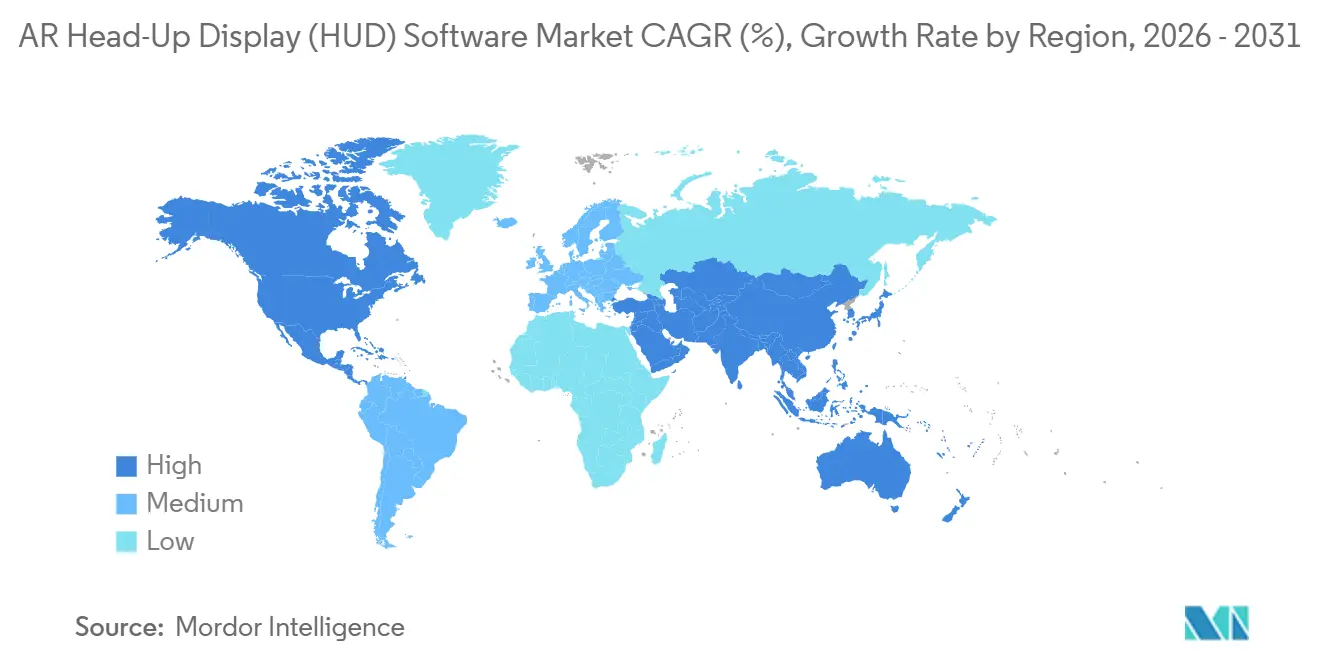
| Fastest Growing Market | Asia-Pacific |
| Largest Market | North America |
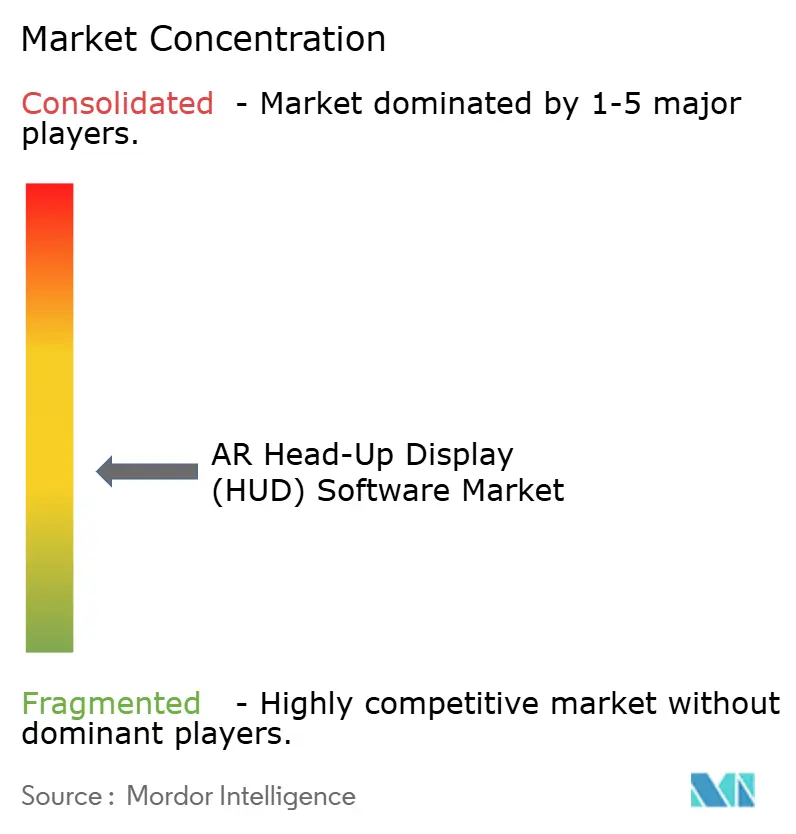
| Market Concentration | Medium |
Major Players *Disclaimer: Major Players sorted in no particular order Image © Mordor Intelligence. Reuse requires attribution under CC BY 4.0. | |
AR Head-Up Display (HUD) Software Market Analysis by Mordor Intelligence
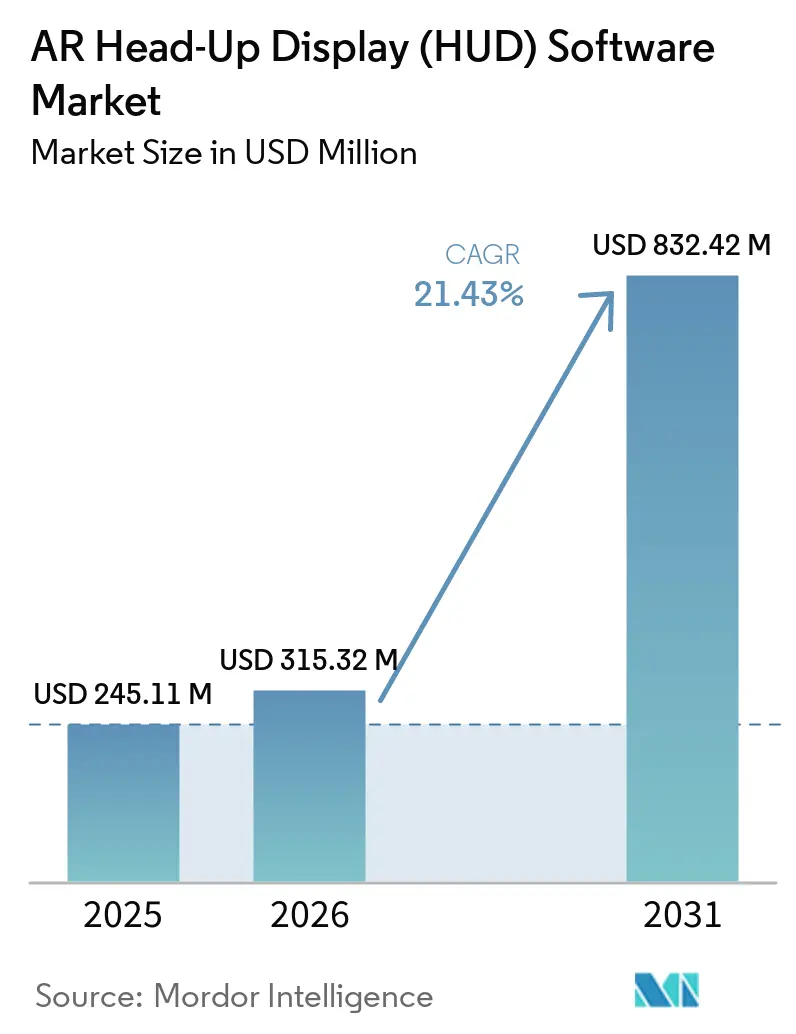
The AR head-up display (HUD) software market size is expected to increase from USD 245.11 million in 2025 to USD 315.32 million in 2026 and reach USD 832.42 million by 2031, expanding at a CAGR of 21.43% over 2026-2031. The AR head-up display (HUD) software market is moving toward software-led cockpit design as automakers compete on the quality of digital driver experiences rather than display hardware alone. Advanced driver-assistance requirements, software-defined vehicle programs, and lower computing and sensor costs are widening the use of augmented-reality windshield guidance. Over-the-air feature delivery also allows vehicle makers to add or refine functions after the sale, thereby supporting recurring licensing models. Production qualifications across several vehicle programs remain important because AR overlays must work accurately across different windshields and sensor arrangements. This favors companies that combine proven rendering, calibration, and integration capabilities with established OEM relationships.
Key Report Takeaways
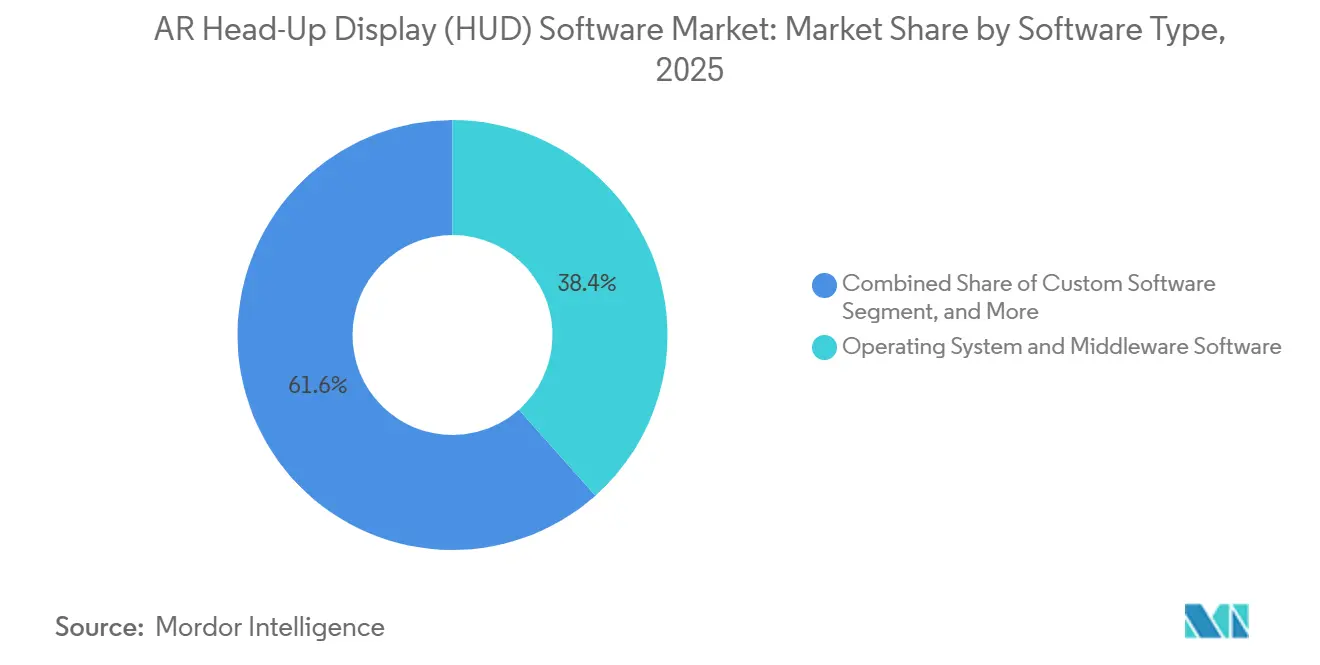
- By software type, Operating System and Middleware Software held 38.43% of the AR Head-Up Display (HUD) Software Market share in 2025, while Development, Calibration, and Testing Tools are projected to expand at a 22.31% CAGR through 2031.
- By software function, AR Rendering and Composition accounted for 24.29% of the AR Head-Up Display (HUD) Software Market size in 2025, while Over-the-Air Update and Lifecycle Management is projected to expand at a 22.02% CAGR through 2031.
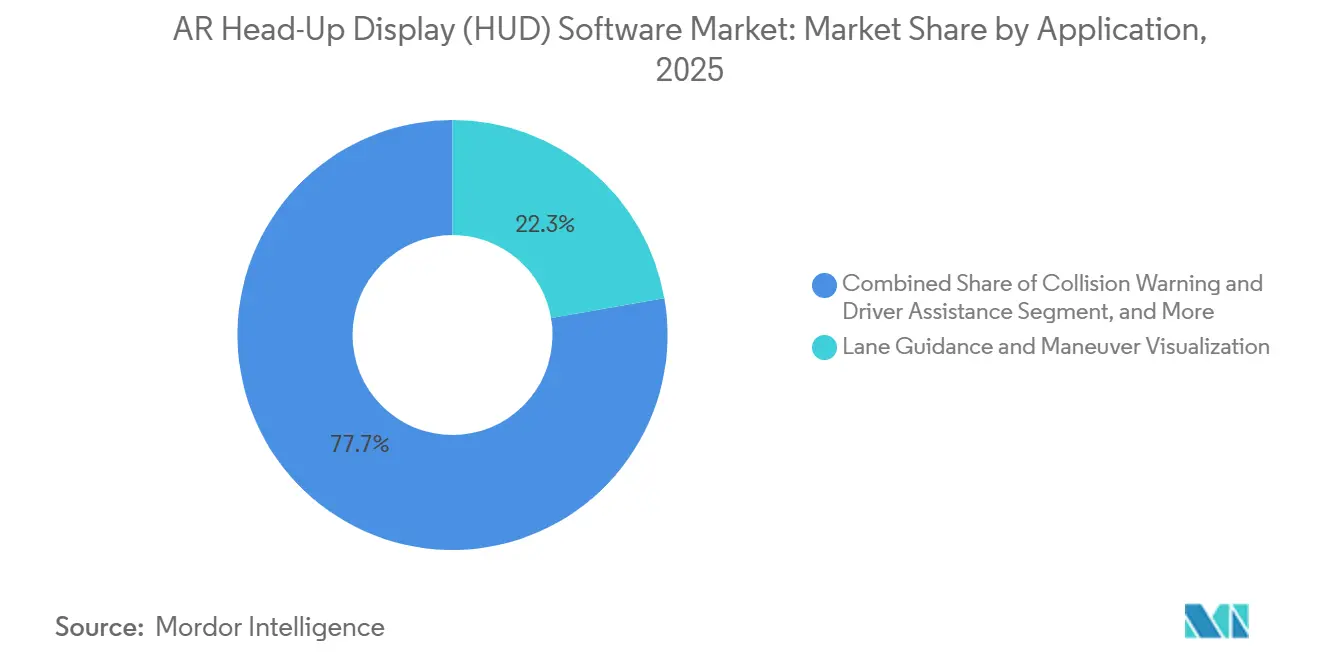
- By application, Lane Guidance and Maneuver Visualization accounted for 22.27% of revenue in 2025, while Infotainment and Contextual Commerce are projected to expand at a 22.14% CAGR through 2031.
- By vehicle type, Passenger Cars accounted for 81.86% revenue share in 2025, while Robotaxis and Autonomous Shuttles are projected to expand at a 22.47% CAGR through 2031 in the AR Head-Up Display (HUD) Software Market.
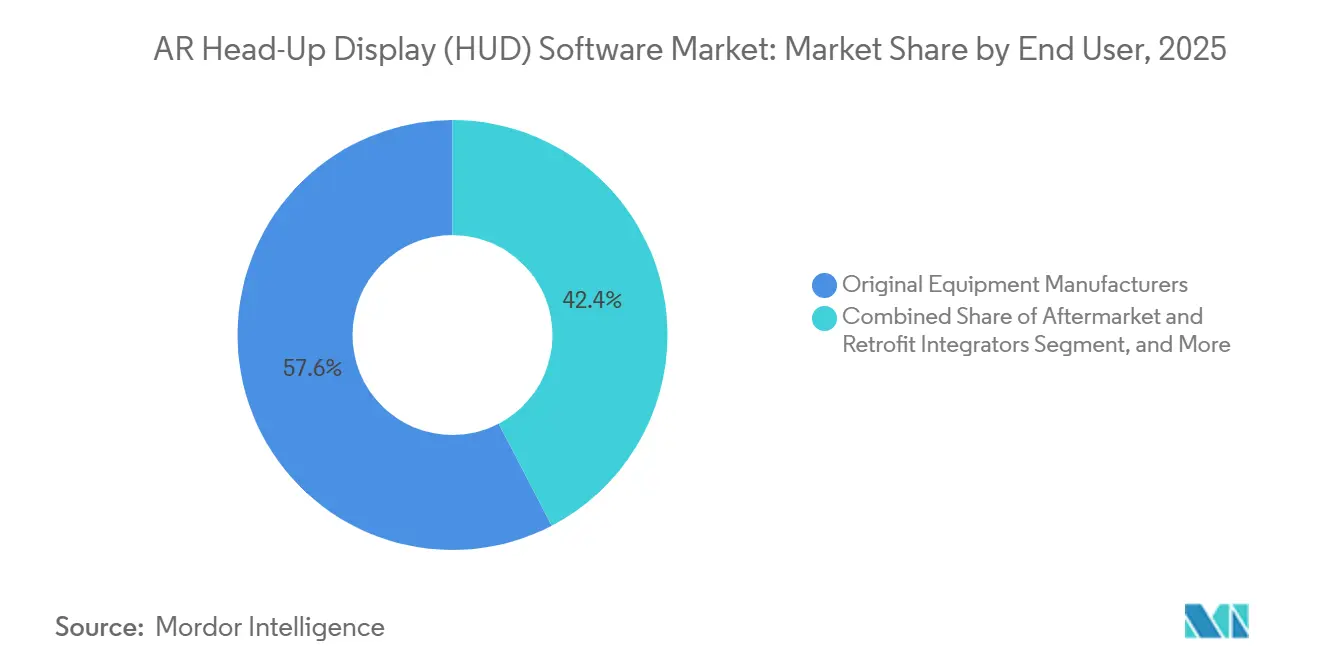
- By end user, Original Equipment Manufacturers held 57.63% revenue share in 2025, while Aftermarket and Retrofit Integrators are projected to expand at a 22.23% CAGR through 2031 in the AR Head-Up Display (HUD) Software Market.
- By geography, Asia-Pacific accounted for 34.39% of revenue in 2025, while the Middle East is projected to expand at a 22.36% CAGR through 2031.
Note: Market size and forecast figures in this report are generated using Mordor Intelligence’s proprietary estimation framework, updated with the latest available data and insights as of January 2026.
Market Trends and Insights
Drivers Impact Analysis of AR Head-Up Display (HUD) Software Market*
| Driver | (~) % Impact on CAGR Forecast | Geographic Relevance | Impact Timeline |
|---|---|---|---|
| ADAS-Linked Demand for Contextual Driver Guidance | +4.5% | Global, North America and Europe lead regulatory adoption | Medium term (2-4 years) |
| Software-Defined Vehicle Architectures Expand Deployable AR-HUD Functions | +3.7% | Global | Long term (≥ 4 years) |
| Falling Computing and Sensor Costs Enable Mid-Range Vehicle Penetration | +3.1% | Asia-Pacific, with spillover to South America and the Middle East and Africa | Medium term (2-4 years) |
| Electric Vehicle Cockpit Differentiation Through Immersive Navigation | +2.6% | Asia-Pacific, North America, and Europe | Short term (≤ 2 years) |
| Multi-Plane Rendering Improves Depth-Aware Safety Communication | +1.9% | Global | Long term (≥ 4 years) |
| China-Led Intelligent Cockpit Adoption Accelerates AR-HUD Volume | +1.5% | Asia-Pacific | Short term (≤ 2 years) |
| Source: Mordor Intelligence | |||
ADAS-Linked Demand for Contextual Driver Guidance
ADAS requirements are making contextual windshield guidance more relevant to vehicle programs that prioritize driver attention. AR HUD software can present lane, collision, and route information within the driver’s forward field of view. This requires the AR head-up display (HUD) software market to combine camera, radar, GPS, and other sensor inputs with stable real-time rendering. HARMAN stated that its Ready Vision AR HUD entered series production in European vehicles in 2026 and includes AI and machine-learning-based occlusion handling for ADAS visualization.[1] Production deployment shows that these systems have moved beyond isolated concept vehicles, although each vehicle program still needs validation. Wider deployment can standardize software platforms, but it also raises price pressure among suppliers with comparable production credentials.
Software-Defined Vehicle Architectures Expand Deployable AR-HUD Functions
Software-defined vehicle architectures separate feature upgrades from the original hardware purchase cycle. This gives the AR head-up display (HUD) software market a route to deliver new visual functions through over-the-air updates during a vehicle’s life. ISO/TS 20003:2026 sets human-machine interface requirements for over-the-air update sequences in passenger and commercial vehicles.[2] Panasonic Automotive Systems integrated an over-the-air orchestration function across the HUD, instrument cluster, and infotainment system in the Mazda CX-5 introduced in Europe in December 2025. Hyundai Motor Group stated in 2026 that Pleos Connect is intended to reach 20 million vehicles by 2030 with continued AR and AI enhancements delivered over the air. These programs make lifecycle management a core part of software value because overlays can change as driver-assistance models improve.
Falling Computing and Sensor Costs Enable Mid-Range Vehicle Penetration
Lower costs for automotive computing and sensors are allowing augmented-reality functions to enter more vehicle programs. The AR head-up display (HUD) software market benefits when display hardware becomes less differentiated because rendering quality, latency control, and ADAS integration become more important in the purchasing decision. Basemark released Rocksolid Studio 26.1 in 2026 with macOS support and production-ready AR HUD reference projects.[3] These tools can reduce integration time for vehicle makers that need an AR interface without committing to a single system-on-chip supplier. Hardware-agnostic runtimes are therefore useful for cost-sensitive programs that want flexibility across electronic architectures. The wider addressable base may support more volume, while requiring suppliers to keep development tools accessible to mid-tier OEM teams.
Electric Vehicle Cockpit Differentiation Through Immersive Navigation
Electric vehicle makers are using cockpit software to distinguish their products as powertrain differences narrow. AR HUD software can show range-aware routes, state-of-charge information, and regenerative braking feedback without adding more center-screen interactions. Basemark and Lucid Motors announced a March 2026 partnership to bring augmented-reality head-up display capability to the Lucid Gravity using the Rocksolid HMI platform. Hyundai Mobis displayed a holographic windshield concept with Zeiss at CES 2025 and targeted completion of pre-development in 2026 before planned series production in 2027. These projects increase the scope of software work because wider display formats need calibrated rendering and coherent user interfaces. Suppliers with software already approved by OEMs can benefit when vehicle programs have shorter design-validation schedules.
Restraints Impact Analysis of AR Head-Up Display (HUD) Software Market*
| Restraint | (~) % Impact on CAGR Forecast | Geographic Relevance | Impact Timeline |
|---|---|---|---|
| Real-Time Registration and Latency Validation Burden | -2.5% | Global | Medium term (2-4 years) |
| High Integration Cost Across Windshield Optics and Vehicle Compute | -2.0% | Global, particularly cost-sensitive segments | Long term (≥ 4 years) |
| Driver Distraction and Human-Factors Approval Risk | -1.4% | North America and Europe | Short term (≤ 2 years) |
| Cybersecurity and Data-Integrity Exposure in Sensor-Fused Overlays | -0.9% | Global | Long term (≥ 4 years) |
| Source: Mordor Intelligence | |||
Real-Time Registration and Latency Validation Burden
Accurate spatial overlays need very low latency between sensor input and displayed graphics. If an AR lane marker moves away from a painted road line during braking or a turn, the display can reduce trust and face safety review. The AR HUD software industry must integrate camera, radar, LiDAR, GPS, and inertial inputs while retaining consistent alignment. AUMOVIO presented a mirrorless 3D HUD concept at IAA Mobility in September 2025 that uses software-assisted image optimization to adapt to windshield curvature. The concept can reduce some vehicle-specific optical work, but sensor fusion and latency validation remain necessary for each program. This burden slows time to production for suppliers that do not already have several certified vehicle applications.
High Integration Cost Across Windshield Optics and Vehicle Compute
Windshield optics and vehicle computing create a demanding integration environment for AR display systems. The AR head-up display (HUD) software market must support holographic films, waveguide elements, and mirror-based designs that differ by vehicle model. HARMAN stated that its production AR HUD can sustain 15,000 nits under solar load using thermal glass, mirror architecture, and software pixel-compensation methods. That performance depends on coordinated hardware and software testing, which can extend development schedules. Integrated tier-1 suppliers can spread these costs across several OEM programs, while software-only providers may have fewer ways to recover them. AUMOVIO stated that its mirrorless concept reduced installation volume by up to 50%, but vehicle-level software calibration still remains necessary.
*Our forecasts treat driver/restraint impacts as directional, not additive. The impact forecasts reflect baseline growth, mix effects, and variable interactions.
AR Head-Up Display (HUD) Software Market Segment Analysis
By Software Type:
Middleware Holds the Leading Position While Testing Tools Advance FasterOperating System and Middleware Software held 38.43% of revenue in 2025, making it the largest software-type segment in the AR head-up display (HUD) software market. Every augmented-reality experience depends on a verified runtime that supports navigation overlays, ADAS visualization, and infotainment functions. BlackBerry QNX, Android Automotive OS, and proprietary Linux-based stacks compete for this role. Platform selection can lead to multiyear licensing revenue because a vehicle program normally uses the selected runtime for its production cycle. Panasonic Automotive Systems illustrated this connection when its cockpit controller coordinated HUD, cluster, and infotainment functions for Mazda’s CX-5 from December 2025. The arrangement places middleware decisions early in the vehicle-development process. Custom Software holds a smaller role but serves premium programs that need a distinctive visual identity. Its higher per-unit development cost can limit use across a wide range of vehicle variants.
Development, Calibration and Testing Tools is projected to expand at a 22.31% CAGR through 2031, the highest rate within software type. More AR functions across more vehicle models increase the need for repeatable validation tools. Basemark updated Rocksolid AR Studio in August 2025 with Gemini AI, Google Maps, and Android Automotive integration. Its 2026 release added macOS support and production-ready reference projects. These releases allow designers to test visual functions before making a final hardware choice. VESA released DisplayPort Automotive Extension v1.1 at CES 2026 with a software emulator for validating display pipelines against functional safety and security profiles. Common tools can lower the burden of qualification, especially for suppliers seeking to work across more than one OEM platform.

By Software Function:
Rendering Leads Revenue While Lifecycle Management Changes the Revenue ModelAR Rendering and Composition accounted for 24.29% of revenue in 2025 and was the largest functional segment. The AR head-up display (HUD) software market relies on rendering engines to provide stable frame rates, correct perspective, and accurate placement of visual information. Other functions have limited usefulness if the displayed image is not clear and aligned. Navigation and Wayfinding and ADAS and Safety Visualization form the next major revenue bands because production programs currently focus on safety-related display functions. Vehicle and Sensor Data Integration is often bundled into tier-1 system deliveries rather than sold as a separate software license. This bundling moderates its direct revenue contribution while keeping it central to technical performance. Multiscreen HMI Orchestration is becoming more relevant as vehicle interiors use wider and multiple display layouts.
Over-the-Air Update and Lifecycle Management is projected to expand at a 22.02% CAGR through 2031. This function changes AR software from a one-time vehicle-program component into a service that can be maintained after purchase. ISO/TS 20003:2026 provides a common framework for the driver interface during over-the-air software updates. Siemens stated in April 2026 that over-the-air updates now extend beyond infotainment to ADAS perception models and safety-system software. LG Electronics announced a May 2026 partnership with Google that supports one system-on-chip driving multiple automotive displays. This increases the importance of HMI orchestration because each display must present a consistent experience. Lifecycle management can therefore become a recurring contractual function for suppliers in the AR head-up display (HUD) software market.
By Application:
Lane Guidance Supports Current Demand While Contextual Commerce Posts the Highest CAGRLane Guidance and Maneuver Visualization held 22.27% revenue share in 2025, the largest application segment. The function fits the safety-led purchasing case because it places route instructions close to the driver’s natural sightline. Envisics supplied the Gen-2 AR HUD system for the 2026 Cadillac VISTIQ, where the system renders navigation and ADAS information across dual image planes. BMW also committed to windshield-projected driving information through Panoramic iDrive across new BMW models from late 2025. Lane guidance helps establish the AR head-up display (HUD) software market in production vehicles because its value is easier to explain than less essential display features. Collision Warning and Driver Assistance, Traffic Sign Recognition and Speed Information, and Night Vision and Adverse-Weather Assistance also support ADAS-oriented demand. Night vision has a more constrained path because it needs thermal imaging hardware in addition to display software.
Infotainment and Contextual Commerce is projected to expand at a 22.14% CAGR through 2031, the fastest application rate. The application includes location-based information and post-trip commercial interactions that can be added through connected vehicle platforms. It faces a different set of requirements from safety functions because consumer consent and data handling have a greater role. Navigation and Point-of-Interest Display continues to serve as an accessible entry application for drivers new to windshield-based information. It can remain useful in markets where digital navigation information is uneven. The AR head-up display (HUD) software market can use these applications to diversify beyond driver-assistance visualization. However, suppliers must avoid distracting presentation formats and ensure that commerce-related content does not compromise the driver-focused interface. This keeps human-factors design as important as the underlying advertising or service opportunity.
By Vehicle Type:
Passenger Cars Provide Scale While Autonomous Fleets Advance FasterPassenger Cars accounted for 81.86% of revenue in 2025, giving this vehicle category the largest position in the AR HUD software market. Premium OEM design commitments and Chinese new-energy vehicle programs support this scale. Passenger-car buyers can use AR functions for navigation, safety alerts, and a more differentiated cabin experience. Light Commercial Vehicles are adopting software for last-mile fleets where lane guidance and collision avoidance can support operating objectives. Heavy Commercial Vehicles focus more on logistics routing and fatigue-warning functions. Deployment in these vehicles is concentrated in North America and Europe, where hours-of-service requirements reinforce attention-focused cockpit technology. Basemark’s Rocksolid AR Studio 25.4 added stereoscopic rendering support for multi-focal-plane AR HUDs in August 2025. That capability can support depth perception across passenger and commercial platforms.
Robotaxis and Autonomous Shuttles is projected to expand at a 22.47% CAGR through 2031, the highest vehicle-type rate. These vehicles need occupant-facing information because there may be no driver to communicate vehicle actions. AR software can show planned maneuvers, detected hazards, and route status in a clearer visual context. This use case changes the design focus from driving guidance to passenger assurance and vehicle-intent communication. Two-Wheelers and Micromobility Vehicles form an emerging area for the AR head-up display (HUD) software industry. Their path is limited by the power and display-space constraints of helmet-mounted optics. Aftermarket display specialists are still developing products for urban riders. The faster autonomous-fleet rate shows how AR functions can extend beyond conventional driver displays as mobility models change.
By End User:
OEMs Retain Control While Retrofit Integrators Gain RelevanceOriginal Equipment Manufacturers (OEMs) held 57.63% of revenue in 2025, the leading end-user position in the AR head-up display (HUD) software market. OEMs typically negotiate software licenses during vehicle-program planning, often years before production. Their requirements set the technical, cybersecurity, and validation standards for suppliers further down the chain. Visteon and FUTURUS formed a strategic partnership in September 2025 to co-develop next-generation head-up display systems for global automakers. The partnership shows how tier-1 companies can provide a path to production for specialized AR software and optical suppliers. Tier-1 and Tier-2 Automotive Suppliers form the next major end-user category. They package middleware and rendering tools with cockpit controllers and display modules as integrated systems.
Aftermarket and Retrofit Integrators is projected to expand at a 22.23% CAGR through 2031. Fleet operators can use retrofit solutions to add AR capabilities without replacing entire vehicles. This channel is relevant where vehicle fleets are older or premium factory options remain expensive. UNECE R155 and R156 require cybersecurity and software-update management systems for new vehicle types and reinforce the importance of secure software processes in related procurement decisions. ISO/SAE 21434 provides cybersecurity engineering guidance for road vehicles. Suppliers that can show alignment with these requirements may be better positioned in fleet bids. The retrofit channel also provides a route into cost-sensitive markets where factory-installed AR HUDs are less common. Its expansion reduces the AR head-up display (HUD) software market’s reliance on OEM licensing alone.
Geography Analysis
APAC AR Head-Up Display (HUD) Software Market
Asia-Pacific accounted for 34.39% of global revenue in 2025 and held the largest regional position in the AR head-up display (HUD) software market. The region is supported by China’s new-energy vehicle production, intelligent cockpit adoption, and large passenger-car base. China’s passenger-car AR HUD installations reached 4.39 million units in 2025, with a 19.11% fitment rate. Japan and South Korea contribute through Panasonic Automotive, Denso, and Hyundai Mobis programs that supply cockpit systems globally. These suppliers also embed software runtimes developed in their home markets into vehicles sold in North America and Europe. The region’s volume supports local relationships among OEMs, software suppliers, and electronics manufacturers in the AR HUD software market. This makes Asia-Pacific central to current production deployment and future platform qualification.
North America and Europe AR Head-Up Display (HUD) Software Market
North America and Europe are established AR head-up display (HUD) software market regions where regulation and demand for premium in-vehicle experiences support higher software content. In North America, the Cadillac VISTIQ and Lucid Gravity moved into 2025-2026 production programs that demonstrate the use of AR functions in premium electric vehicles. Europe has a sustained driver-assistance requirement through the EU General Safety Regulation II. Germany leads regional procurement through BMW, Volkswagen Group, and Mercedes-Benz programs. The United Kingdom, France, and Italy remain secondary software program markets. Russia’s geopolitical conditions continue to limit access to Western AR software platforms. Regulatory attention to driver interaction also favors windshield-projected information when it can reduce the need to look across several cabin screens.
MEA and South America AR Head-Up Display (HUD) Software Market
The Middle East is projected to expand at a 22.36% CAGR through 2031, making it the fastest-growing regional segment. Saudi Arabia’s Vision 2030 mobility agenda and the UAE’s luxury-vehicle base support demand for advanced cockpit features. Most vehicles carrying AR HUD systems are imported premium models from European and Asian brands. Revenue therefore depends more on imports and option uptake than on local vehicle production. South America offers a longer-term opportunity as Brazil’s production base and connected-car adoption develop. Africa remains at an earlier stage, with South Africa as the most immediate market. Older fleets and import tariffs limit premium-vehicle penetration, which makes retrofitting a more practical near-term route in the region.
Competitive Landscape
The AR head-up display (HUD) software market is moderately fragmented, with specialized software companies competing beside integrated cockpit-system suppliers. Basemark, Envisics, WayRay, and FUTURUS focus on areas such as rendering, spatial computing, waveguide algorithms, and sensor-fusion middleware. HARMAN, Visteon, and AUMOVIO combine software capabilities with systems that OEMs can qualify as a package. This integration can reduce the number of suppliers involved in a vehicle program. The Visteon-FUTURUS partnership announced in September 2025 combines FUTURUS AR technologies with Visteon’s global OEM integration and distribution capabilities. Envisics and Basemark also benefit from design-win pipelines that place their technology in vehicle programs before series production. Those production relationships can be difficult for new entrants to replicate.
Cybersecurity and software-update compliance are increasingly part of supplier selection in the AR HUD software market. SAE International’s 2026 technical paper described cybersecurity in automotive over-the-air update systems in the context of ISO/SAE 21434 and UNECE R155 and R156. These requirements extend from OEMs to tier-1 and tier-2 suppliers. HARMAN’s Ready Vision AR HUD reached European series production in 2026 with AI and machine-learning-based occlusion handling and a configurable HUD Canvas tool. Basemark and Lucid Motors announced their AR HUD collaboration for Lucid Gravity in March 2026. These examples show that suppliers are competing through production-ready tools, tailored interfaces, and integration support rather than software features alone. The competitive position of a vendor depends heavily on whether its platform has cleared program-level validation.
Open opportunities remain in multi-plane depth management, standardized safety test tools, and retrofit solutions. VESA’s DisplayPort Automotive Extension v1.1 provides a common validation surface for automotive display pipelines. This can help independent suppliers work toward common safety and security expectations instead of only proprietary OEM specifications. Basemark and Distance Technologies announced a November 2025 collaboration for 3D lightfield AR HUD solutions targeted at automotive series production. Companies that can provide validated over-the-air frameworks may reduce integration time for OEM programs. Companies without a broad certified portfolio may face higher costs and slower customer access. No combined top-player market-share figure was provided, so a concentration score cannot be assigned using the required share-based methodology.
AR Head-Up Display (HUD) Software Industry Leaders
-
Basemark Oy
-
Neusoft Corporation
-
HARMAN International Industries, Incorporated
-
Envisics Ltd.
-
WayRay AG
- *Disclaimer: Major Players sorted in no particular order
AR Head-Up Display (HUD) Software Market Companies Covered in this Report
- Basemark Oy
- Envisics Ltd.
- WayRay AG
- CY Vision, Inc.
- DigiLens, Inc.
- Ceres Holographics Limited
- Epitone GmbH
- FUTURUS Technology Co., Ltd.
- E-Lead Electronic Co., Ltd.
- ADAYO Intelligent Equipment Co., Ltd.
- Neusoft Corporation
- OneSight Technology Co., Ltd.
- Jingwei Hirain Technologies Co., Ltd.
- Shanghai New Vision Automotive Electronics Co., Ltd.
- Zhejiang Chief Technology Co., Ltd.
- Tianma Microelectronics Co., Ltd.
- Coretronic Corporation
- Maxell, Ltd.
- Appotronics Corporation Limited
- MicroVision, Inc.
- Holographic Labs Limited
- Dispelix Oy
- Luminit LLC
- SeeReal Technologies S.A.
Recent Industry Developments in AR Head-Up Display (HUD) Software Market
- July 2026: MicroVision, Inc. launched MicroVision Semiconductor, Inc., a dedicated organization expanding custom ASIC development, mixed-signal integrated circuit design, and photonic sensing capabilities. The initiative internalizes chip development that previously relied on third-party silicon suppliers and directly supports MicroVision’s next-generation photonic integrated circuit roadmap for AR and lidar perception platforms. The new organization aligns chip design, sensing, and perception development inside one corporate structure. It also strengthens the company’s ability to tailor semiconductor work to its future AR and lidar product roadmap. The initiative brought custom ASIC development, mixed-signal integrated circuit design, and photonic sensing work closer to the company’s product-development process. This is relevant to future systems that need sensing data and display software to operate within a coordinated perception architecture.
- May 2026: MicroVision demonstrated its Tri-Lidar Architecture, combining MOVIA S short-range lidar with the newly integrated HALO long-range lidar into a unified real-time perception system. Originally introduced at IAA Mobility 2025, the architecture provides sensor-fusion inputs that AR HUD overlay software uses for accurate real-time registration. The architecture combines information from sensors with different operating ranges. This supports the real-time environmental inputs needed when vehicle displays place graphics over a moving road scene. Accurate visual registration depends on the quality and timing of these inputs because the display must reflect changing road conditions. The system therefore addresses an input requirement that is important for safety-oriented overlay functions.
- March 2026: Basemark and Lucid Motors announced a strategic partnership to bring AR HUD software to the Lucid Gravity electric SUV using the Rocksolid HMI platform. Lucid developed the AR HUD hardware, feature set, and user-interface design in-house, while Basemark engineers implemented Lucid’s specifications. Additional features are planned for future over-the-air delivery. The arrangement gives Lucid control over the vehicle-specific feature design while using Basemark’s production platform. It also shows how software partners can support an OEM-led interface strategy without replacing the OEM’s internal design role. The future over-the-air feature plan connects the initial software release with lifecycle management after vehicle delivery. This structure can allow the vehicle maker to preserve a consistent interface while adding functions over time.
- January 2026: VESA released DisplayPort Automotive Extension v1.1, an open industry standard for functional safety and security in automotive display systems. The standard incorporates ISO 26262 ASIL-D and UN R155 and ISO 21434 compliance profiles. It includes a normative software emulator that allows OEMs, silicon manufacturers, and system integrators to validate AR display pipelines without bespoke certification infrastructure. The emulator provides a common reference for checking display behavior against the defined profiles. It can reduce dependence on separate validation tools created for individual vehicle programs. A common emulator can give silicon manufacturers, OEMs, and system integrators an earlier way to examine display behavior. This supports more consistent consideration of functional safety and cybersecurity requirements across the development process.
Global AR Head-Up Display (HUD) Software Market Report Scope
The AR Head-Up Display (HUD) Software Market refers to the industry focused on the development, integration, licensing, and maintenance of software platforms and applications that enable augmented reality (AR) content to be projected and managed within head-up display systems across automotive, aerospace, defense, and other transportation sectors.
The AR Head-Up Display (HUD) Software Market Report is Segmented by Software Type (Custom Software, Operating System and Middleware Software, and Development, Calibration and Testing Tools), Software Function (AR Rendering and Composition, Navigation and Wayfinding, ADAS and Safety Visualization, Vehicle and Sensor Data Integration, Multiscreen HMI Orchestration, and Over-the-Air Update and Lifecycle Management), Application (Navigation and Point-of-Interest Display, Lane Guidance and Maneuver Visualization, Collision Warning and Driver Assistance, Traffic Sign Recognition and Speed Information, Night Vision and Adverse-Weather Assistance, and Infotainment and Contextual Commerce), Vehicle Type (Passenger Cars, Light Commercial Vehicles, Heavy Commercial Vehicles, Robotaxis and Autonomous Shuttles, and Two-Wheelers and Micromobility Vehicles), End User (Original Equipment Manufacturers, Tier-1 and Tier-2 Automotive Suppliers, and Aftermarket and Retrofit Integrators), and Geography (North America, South America, Europe, Asia-Pacific, Middle East, and Africa). The Market Forecasts are Provided in Terms of Value (USD).
Segmentation Overview
| Custom Software |
| Operating System and Middleware Software |
| Development, Calibration and Testing Tools |
| AR Rendering and Composition |
| Navigation and Wayfinding |
| ADAS and Safety Visualization |
| Vehicle and Sensor Data Integration |
| Multiscreen HMI Orchestration |
| Over-the-Air Update and Lifecycle Management |
| Navigation and Point-of-Interest Display |
| Lane Guidance and Maneuver Visualization |
| Collision Warning and Driver Assistance |
| Traffic Sign Recognition and Speed Information |
| Night Vision and Adverse-Weather Assistance |
| Infotainment and Contextual Commerce |
| Passenger Cars |
| Light Commercial Vehicles |
| Heavy Commercial Vehicles |
| Robotaxis and Autonomous Shuttles |
| Two-Wheelers and Micromobility Vehicles |
| Original Equipment Manufacturers |
| Tier-1 and Tier-2 Automotive Suppliers |
| Aftermarket and Retrofit Integrators |
| North America | United States |
| Canada | |
| Mexico | |
| South America | Brazil |
| Argentina | |
| Rest of South America | |
| Europe | United Kingdom |
| Germany | |
| France | |
| Italy | |
| Spain | |
| Russia | |
| Rest of Europe | |
| Asia-Pacific | China |
| Japan | |
| India | |
| South Korea | |
| Australia | |
| Rest of Asia-Pacific | |
| Middle East | United Arab Emirates |
| Saudi Arabia | |
| Rest of Middle East | |
| Africa | South Africa |
| Egypt | |
| Rest of Africa |
| By Software Type | Custom Software | |
| Operating System and Middleware Software | ||
| Development, Calibration and Testing Tools | ||
| By Software Function | AR Rendering and Composition | |
| Navigation and Wayfinding | ||
| ADAS and Safety Visualization | ||
| Vehicle and Sensor Data Integration | ||
| Multiscreen HMI Orchestration | ||
| Over-the-Air Update and Lifecycle Management | ||
| By Application | Navigation and Point-of-Interest Display | |
| Lane Guidance and Maneuver Visualization | ||
| Collision Warning and Driver Assistance | ||
| Traffic Sign Recognition and Speed Information | ||
| Night Vision and Adverse-Weather Assistance | ||
| Infotainment and Contextual Commerce | ||
| By Vehicle Type | Passenger Cars | |
| Light Commercial Vehicles | ||
| Heavy Commercial Vehicles | ||
| Robotaxis and Autonomous Shuttles | ||
| Two-Wheelers and Micromobility Vehicles | ||
| By End User | Original Equipment Manufacturers | |
| Tier-1 and Tier-2 Automotive Suppliers | ||
| Aftermarket and Retrofit Integrators | ||
| By Geography | North America | United States |
| Canada | ||
| Mexico | ||
| South America | Brazil | |
| Argentina | ||
| Rest of South America | ||
| Europe | United Kingdom | |
| Germany | ||
| France | ||
| Italy | ||
| Spain | ||
| Russia | ||
| Rest of Europe | ||
| Asia-Pacific | China | |
| Japan | ||
| India | ||
| South Korea | ||
| Australia | ||
| Rest of Asia-Pacific | ||
| Middle East | United Arab Emirates | |
| Saudi Arabia | ||
| Rest of Middle East | ||
| Africa | South Africa | |
| Egypt | ||
| Rest of Africa | ||
Key Questions Answered in the Report
What is the AR HUD software market size?
The AR HUD software market size is USD 315.32 million in 2026 and is projected to reach USD 832.42 million by 2031 at a 21.43% CAGR.
What is driving demand for AR HUD software?
ADAS visualization, software-defined vehicle architectures, lower hardware costs, and electric-vehicle cockpit differentiation are supporting demand.
Which software type leads AR HUD deployments?
Operating System and Middleware Software held the largest share at 38.43% in 2025 because it provides the runtime for navigation, ADAS, and infotainment functions.
Which AR HUD application is expanding fastest?
Infotainment and Contextual Commerce is projected to expand at a 22.14% CAGR through 2031.
Which vehicle category has the largest revenue share?
Passenger Cars accounted for 81.86% of revenue in 2025, supported by premium OEM programs and new-energy vehicle adoption.
Which region is expanding fastest for AR HUD software?
The Middle East is projected to expand at a 22.36% CAGR through 2031, supported by smart-mobility programs and luxury-vehicle demand.