
AR Content Streaming Market Size and Share
Market Overview
| Study Period | 2020 - 2031 |
|---|---|
| Market Size (2026) | USD 5.43 Billion |
| Market Size (2031) | USD 12.86 Billion |
| Growth Rate (2026 - 2031) | 18.84 % |
| Fastest Growing Market | Asia-Pacific |
| Largest Market | North America |
| Market Concentration | Medium |
Major Players *Disclaimer: Major Players sorted in no particular order Image © Mordor Intelligence. Reuse requires attribution under CC BY 4.0. | |
AR Content Streaming Market Analysis by Mordor Intelligence
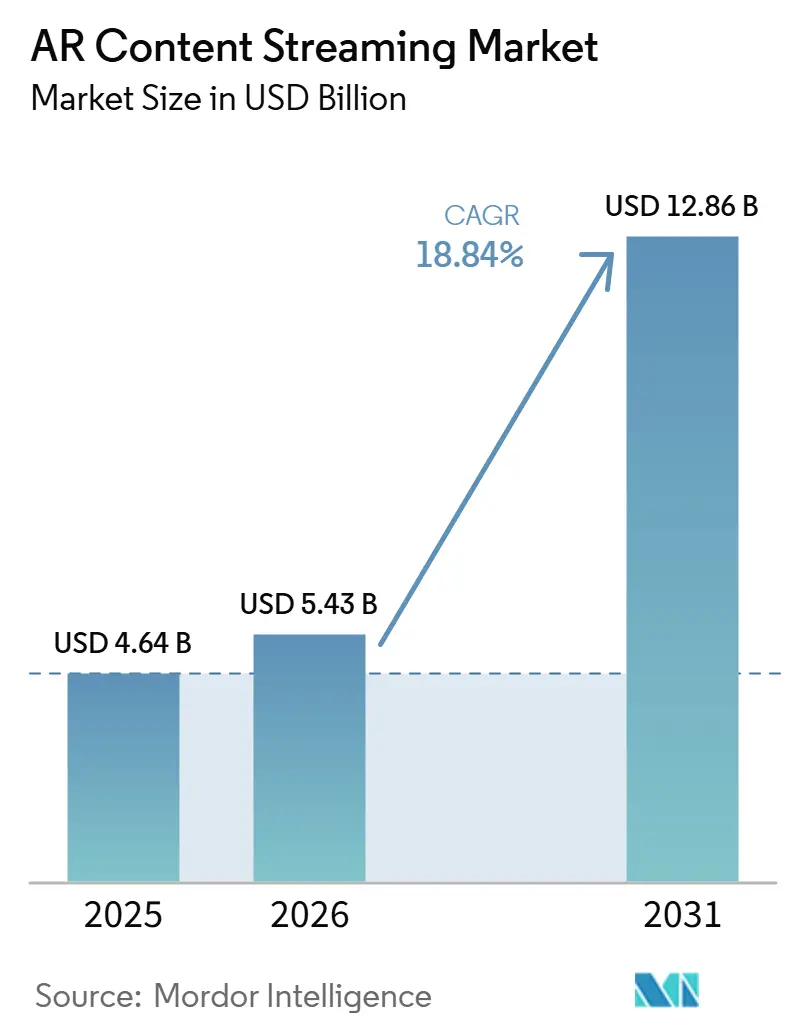
The AR content streaming market size is expected to grow from USD 4.64 billion in 2025 to USD 5.43 billion in 2026 and is forecast to reach USD 12.86 billion by 2031 at 18.84% CAGR over 2026-2031. The AR content streaming market is being shaped by 5G coverage, cloud-based rendering, and AI tools that make it easier to develop and distribute spatial content. Enterprise users are applying these capabilities to remote assistance and training, while consumers are engaging with games, social lenses, and product visualization. The combination of on-device AI and cloud rendering can reduce the processing requirements of devices for high-quality experiences. Platform companies are building geospatial data, creator tools, and delivery infrastructure that can support future commercial uses. These conditions create greater opportunities for the AR content streaming market, though device compatibility, asset costs, and data compliance continue to slow broader deployment.
Key Report Takeaways
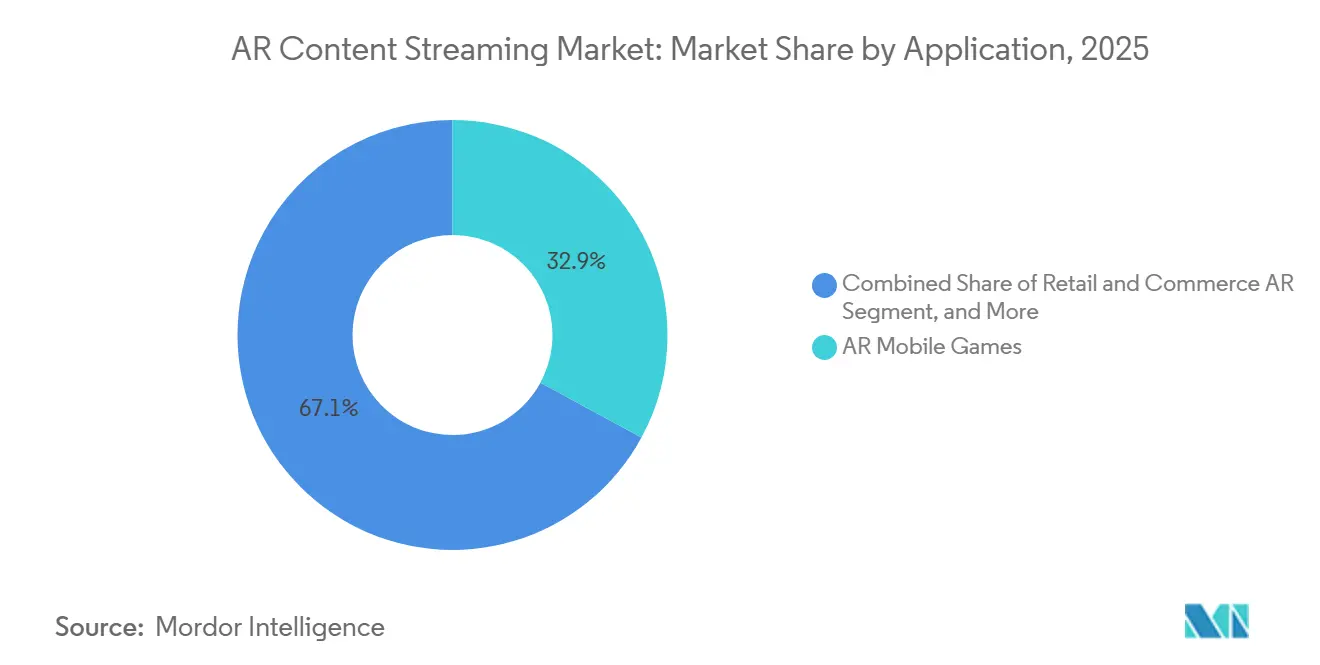
- By application, AR Mobile Games held 32.91% of the AR content streaming market share in 2025, while Social AR Filters and Sponsored Lenses are projected to expand at a 19.55% CAGR through 2031.
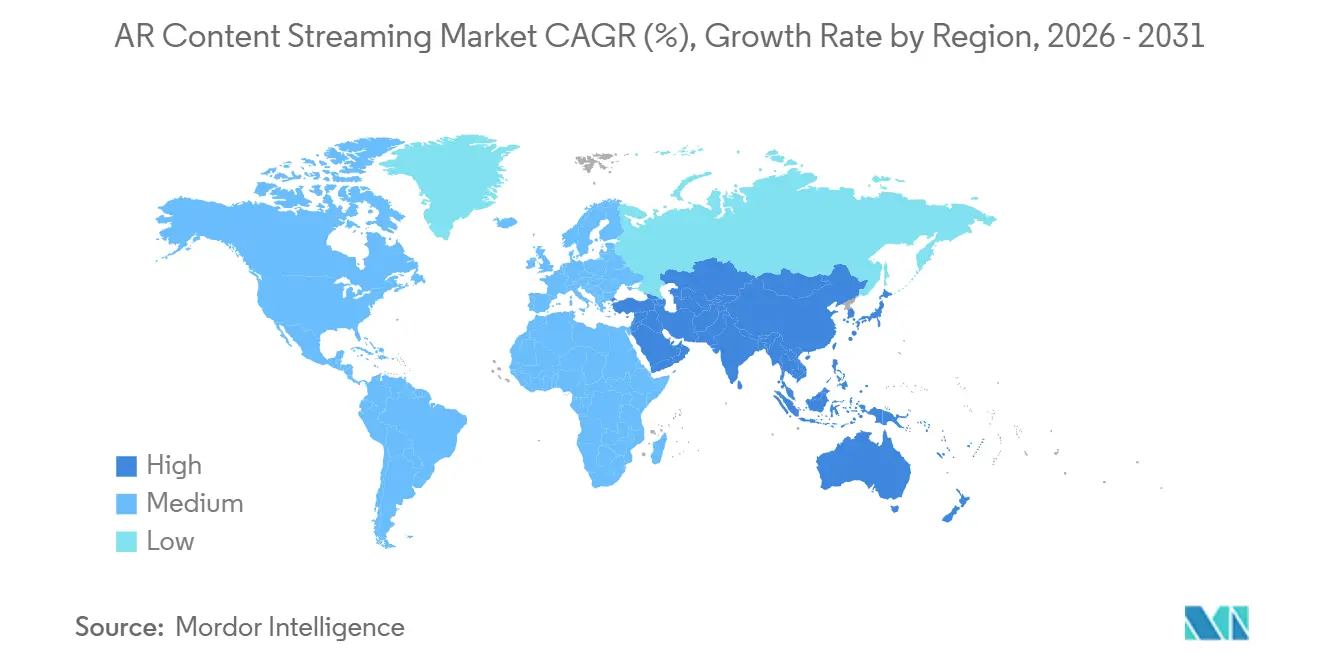
- By geography, North America held 44.16% of the augmented reality (AR) streaming market revenue in 2025, while Asia-Pacific is projected to record the highest CAGR of 19.41% through 2031.
Note: Market size and forecast figures in this report are generated using Mordor Intelligence’s proprietary estimation framework, updated with the latest available data and insights as of January 2026.
Market Trends and Insights
Drivers Impact Analysis of AR Content Streaming Market*
| Driver | (~) % Impact on CAGR Forecast | Geographic Relevance | Impact Timeline |
|---|---|---|---|
| Immersive Commerce and Brand Media Demand | +3.2% | Global, with concentration in North America, Europe, and Asia-Pacific retail corridors | Short term (≤ 2 years) |
| 5G and Edge Delivery for Low-Latency Playback | +2.8% | Asia-Pacific core, North America, and the Middle East | Medium term (2-4 years) |
| Creator-Led AR Monetization in Social and Retail Channels | +2.4% | Global, with high near-term penetration in North America and South Korea | Short term (≤ 2 years) |
| Enterprise Remote Guidance and Training | +2.1% | North America, Europe, and the GCC industrial sector | Medium term (2-4 years) |
| AI-Assisted Context-Aware Personalization | +1.8% | Global | Short term (≤ 2 years) |
| Cloud-Native Rendering and Content Orchestration | +1.6% | North America, Asia-Pacific, and Europe | Medium term (2-4 years) |
| Source: Mordor Intelligence | |||
Rising Demand for Immersive Product Narratives in Commerce and Brand Media
Commerce is becoming a direct source of demand for the AR content streaming market because product visualization can support both sales and return-management goals, changing the case for investment from brand experimentation to a practical way to improve product understanding before checkout. Snap research found that AR-enabled retail can significantly reduce returns when it provides shoppers with a clearer view of size, fit, and spatial context. This matters because the research reported that online returns were higher than those in physical retail. The WebXR Device API reached Candidate Recommendation Draft status on June 9, 2026, supporting browser-based AR and reducing the need for an application download.[1]World Wide Web Consortium, “WebXR Device API,” Candidate Recommendation Draft, June 9, 2026, World Wide Web Consortium, w3.org. In May 2026, OTB Group and Google Cloud introduced virtual try-on capabilities for Diesel, Maison Margiela, and Marni, bringing garment visualization to client advisors at scale. Spatial interactions can also provide recommendation systems with more detailed signals than a conventional click, as they capture product rotation, scale adjustments, and hesitation.
Expansion of 5G and Edge Delivery for Low-Latency AR Playback
5G millimeter-wave networks support multi-user AR streaming, where lower-bandwidth networks can struggle to maintain the required quality. In March 2026, KDDI demonstrated a live event in Japan that streamed a full-scale virtual performer to smart-glass users through 5G millimeter-wave and Mawari's distributed 3D delivery platform. Research found that edge-cloud virtualization can reduce mobile AR latency below the motion-to-photon threshold under advanced network-slicing conditions. The AR content streaming market can benefit when telecom providers package dedicated network capacity for enterprise use in South Korea and the GCC, providing a clearer link between network quality, a reliable user experience, and the value of premium delivery services. These arrangements make connectivity part of the commercial delivery model rather than a basic utility. South Korean 5G coverage milestones also support faster infrastructure deployment than demand alone would produce.
Creator-Led AR Content Monetization Across Social and Retail Channels
Branded lenses are giving creators and advertisers a way to use AR in social and retail campaigns. A 2025 study found that originality and enjoyment in branded social AR filters can support brand awareness and purchase intentions. Snap's Lens Creator Rewards and Niantic's Rewarded AR Ads connect creator activity and game-based experiences with advertiser objectives. AI tools such as Luma AI and Meshy shorten the first stage of 3D asset creation, shifting more creator effort toward campaign design and distribution. In February 2026, Snap Souq reached more than 25 million monthly active Snapchat users in Saudi Arabia during Ramadan. The campaign showed that locally relevant content can help the AR content streaming market reach users in non-English-language creator communities and develop creator tools and commercial formats that do not depend on English-language campaigns.
Enterprise Use of AR Streaming for Remote Guidance and Training
Remote guidance has become important for employers managing distributed field teams, aging workforces, and difficult operating environments. EON Reality launched Field IQ 2.0 in June 2026 with smart-glass guidance, mobile simulations, and a printed-board format that activates 3D instructions for industrial users. TeamViewer also integrated Microsoft Windows AI API Video Super Resolution into Assist AR to improve incoming video in unstable industrial networks.[2]EON Reality, “EON Reality Reinvents Hands-On Training with Field IQ 2.0,” June 15, 2026, EON Reality, eonreality.com. These uses apply to energy, manufacturing, and process operations where equipment may be offshore, hazardous, or temporarily unavailable. Each session can generate time-stamped video, annotations, and fault records that can support training and compliance documentation. This creates switching costs around accumulated knowledge records, rather than around hardware alone.
Restraints Impact Analysis of AR Content Streaming Market*
| Restraint | (~) % Impact on CAGR Forecast | Geographic Relevance | Impact Timeline |
|---|---|---|---|
| Fragmented Device Ecosystems and Compatibility Gaps | -1.8% | Global | Medium term (2-4 years) |
| High Cost of Real-Time 3D and Spatial Assets | -1.4% | Global | Short term (≤ 2 years) |
| Privacy, Biometric, and Location Data Compliance | -1.1% | North America and Europe, with spillover to data-localization markets | Medium term (2-4 years) |
| Battery, Thermal, and Network Limits for Always-On Streaming | -0.9% | Global | Long term (≥ 4 years) |
| Source: Mordor Intelligence | |||
Fragmented Device Ecosystems and Cross-Platform Compatibility Gaps
Platform fragmentation raises the cost of serving users across the augmented reality (AR) content streaming market. Different ARKit and ARCore implementations require separate asset-optimization processes, and the supplied research indicated that rendering differences can add 30%-40% to initial project estimates. WebXR provides a browser-based route, but native iPhone and iPad support remains unavailable in 2026, which requires separate Apple AR Quick Look fallback work. Android XR, visionOS, Meta's headset operating system, and established mobile frameworks each add certification and hardware-optimization requirements. Enterprise buyers also must test glasses from RealWear, Vuzix, Lenovo ThinkReality, and Magic Leap. Larger platform companies can more easily absorb these engineering requirements, which may increase their advantage over smaller specialist providers.
High Content Production Cost for Real-Time 3D and Spatial Assets
3D spatial asset creation remains a major near-term cost for the AR content streaming market, especially when a retailer needs hundreds of product models or an industrial user needs an accurate replica of proprietary equipment. The supplied research indicated that photorealistic AR-ready models can incur significant per-SKU costs, while early AI-generated models can exceed mobile frame budgets by up to 10 times and require artist optimization. Specialist agencies charge substantial fees for custom-branded AR experiences, and subsequent content updates and SKU additions increase cumulative costs over 18-24 months. Premium spatial video can involve high production costs when it includes spatial audio and volumetric elements. For industrial deployments, scans and 3D replicas of proprietary equipment can require considerable investment and must be justified through training savings.
*Our forecasts treat driver/restraint impacts as directional, not additive. The impact forecasts reflect baseline growth, mix effects, and variable interactions.
AR Content Streaming Market Segment Analysis
By Application:
Gaming Leads Revenue While Social Lenses Grow FastestAR Mobile Games held 32.91% of the AR content streaming market share in 2025, making gaming the largest application segment. Its position reflects in-app purchase models, established franchises, and location-based mechanics that can sustain spending after a game's launch. Pokémon GO had exceeded USD 9.1 billion in cumulative lifetime revenue by July 2026, which showed the revenue potential of a well-established location-based AR title. Niantic's Rewarded AR Ads also connect in-game branded experiences with physical store visits, adding advertiser funding to in-app purchasing. Social AR Filters and Sponsored Lenses are projected to grow at 19.55% CAGR through 2031, the fastest rate among applications.
Retail and Commerce AR is moving from small pilots to widespread adoption, supported by browser-based visualization and virtual try-on tools. The WebXR standardization milestone reduces a download barrier that had limited engagement for browser-native experiences. The research reported an average 94% conversion lift from 3D content on Shopify product pages and return reductions of up to 40% in AR-enabled retail. OTB Group's deployment with Google Cloud demonstrated virtual try-on across several luxury brands and showed the operational scale available to fashion groups. Enterprise AR Content and Remote-Assist Streaming are expanding through skills management, work instruction, and field support procurement, while AI-supported 2D-to-3D tools can reduce entry costs for smaller deployments.



Geography Analysis
North America AR Content Streaming Market
North America held 44.16% of the AR content streaming market share in 2025, underscoring the region's central role in the market. Apple, Meta, Google, Snap, Microsoft, and NVIDIA operate in the region alongside enterprise buyers with substantial software budgets. The United States accounts for much of the region's gaming revenue, social-lens advertising inventory, and cloud-rendering investment. Canada adds mixed-reality development activity and enterprise use in manufacturing and health care. Browser retail tools, remote assistance, social advertising measurement, and premium cloud rendering together support regional demand.
APAC AR Content Streaming Market
Asia-Pacific is projected to grow at a 19.41% CAGR from 2026 to 2031, the fastest geographic rate. The AR content streaming market in the region is supported by advanced mobile network investment in South Korea, China, and Japan, as well as smart-glass development across consumer and enterprise products, indicating strong global smart-glass delivery growth during the early part of the year, as waveguide display devices gained traction. KDDI's 2026 event demonstrated public-venue delivery of 3D content to smart glasses without device-side GPU processing. China’s near-eye display safety standards can speed domestic certification, while India and Southeast Asia can benefit as 5G coverage and AI content-production tools improve.
EMEA and South America AR Content Streaming Market
Europe was the third-largest revenue contributor in 2025, with demand centered on manufacturing, health care, and remote maintenance. Germany supports industrial workflows, including Holo-Light's AR-guided assembly and maintenance applications, while the United Kingdom and France remain active consumer markets. The EU AI Act restricts workplace emotion recognition in specified circumstances, while spatial devices that record bystanders' faces are subject to GDPR data protection requirements.[3]European Union, “Regulation (EU) 2024/1689 Establishing Rules on Artificial Intelligence,” Official Journal of the European Union, eur-lex.europa.eu. South America, the Middle East, and Africa represent distinct opportunity tiers rather than a single regional pattern. Saudi Arabia's Snap Souq campaign showed interest in commerce-related AR, while Saudi Vision 2030 and UAE smart-city investment support public and enterprise use cases. Brazil is developing AR applications in health care training and retail visualization, and Orange and Synamedia are building African streaming capacity to support future delivery needs.

Competitive Landscape
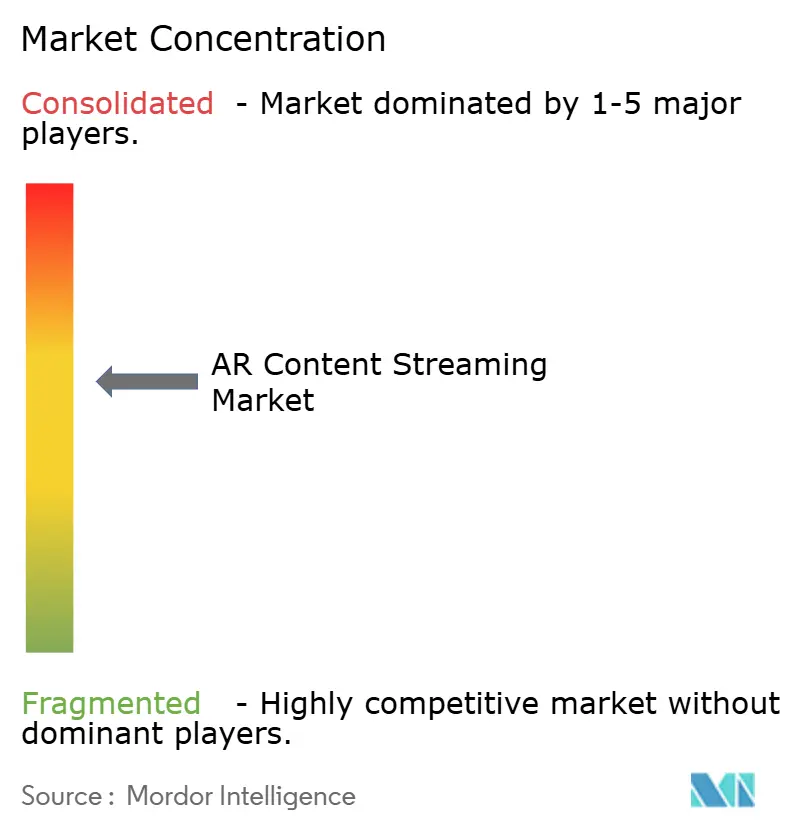
The AR content streaming market is moderately concentrated at the platform level and fragmented among content tools, enterprise workflow providers, and hardware providers, a structure that shapes competition across the market. Apple, Meta, Snap, and Google operate major distribution surfaces through visionOS, Quest, and Ray-Ban devices, Lens, and Android XR. Their standards influence how creators, tool providers, and delivery companies develop compatible products. NVIDIA CloudXR 6.0 provides a cloud-rendering layer between content and devices, with native integration with visionOS and enterprise-grade high-fidelity visualization.[4]NVIDIA, “Stream High-Fidelity Spatial Computing Content to Any Device with NVIDIA CloudXR 6.0,” NVIDIA Technical Blog, developer.nvidia.com. NVIDIA also released an XR AI developer toolkit into public beta in 2026, while Meta expanded its partnership with NVIDIA in February 2026.
At the enterprise tier, competition centers on connecting AR sessions with knowledge-management and field-service processes, which makes service workflows an important part of the AR content streaming market. PTC Vuforia, RealWear, and EON Reality use guided procedures and session information to address this need. TeamViewer differentiates through CRM links that can start AR sessions from field-service workflows. In June 2026, TeamViewer added Microsoft video super-resolution support to Assist AR for workers on poor or unstable networks. EON Reality's Field IQ 2.0 expanded its training model across smart glasses, mobile simulations, and printed-board guidance.
At the consumer and creator tier, Snap acquired spatial mapping company Illumix in June 2026 and works with Niantic Spatial on visual-positioning capabilities, supporting a distinct part of the augmented reality (AR) content streaming market. These steps support a geospatial distribution layer for city-scale branded AR experiences. Smaller providers can serve enterprises that cannot justify broad platform integrations and creators in non-English-language markets with limited monetization infrastructure. Blippar and Zappar offer content-creation tools for brands without immersive technology teams, and their integration with AI asset-generation systems can affect their position as production costs decline.
AR Content Streaming Industry Leaders
Meta Platforms Inc.
Apple Inc.
Google LLC
Microsoft Corporation
Snap Inc.
- *Disclaimer: Major Players sorted in no particular order
AR Content Streaming Market Companies Covered in this Report
- Apple Inc.
- Meta Platforms Inc.
- Google LLC
- Microsoft Corporation
- Snap Inc.
- Qualcomm Technologies Inc.
- Sony Group Corporation
- Samsung Electronics Co. Ltd.
- Unity Technologies
- Niantic Inc.
- PTC Inc.
- Magic Leap Inc.
- Vuzix Corporation
- Lenovo Group Ltd.
- Xiaomi Corporation
- HTC Corporation
- EON Reality
- Blippar Ltd.
- Zappar Ltd.
- RealWear Inc.
- Alibaba Group Holding Ltd.
- Tencent Holdings Ltd.
- NVIDIA Corporation
- Epic Games Inc.

Recent Industry Developments in AR Content Streaming Market
- July 2026: Snap launched its first consumer AR glasses, Specs, at USD 2,195 in the United States, United Kingdom, and France through its dedicated hardware subsidiary Specs Inc. The device, powered by Snapdragon XR chips under a multi-year agreement with Qualcomm Technologies, features full see-through AR display capabilities, on-device AI, and integration with OpenAI and Gemini, positioning Snap as the first major consumer AR glasses release of this generation, ahead of Meta's Orion device projected for consumer availability in 2027.
- June 2026: NVIDIA announced CloudXR 6.0 at GTC 2026, introducing a universal OpenXR-based streaming runtime with native integration into Apple visionOS through a collaboration with Apple. The platform uses privacy-protected foveated streaming to deliver 4K-equivalent spatial content at 90 FPS over standard Wi-Fi, with enterprise adopters including Foxconn, BMW Group, Rivian, and Volvo Group deploying the platform for 3D asset visualization and simulation streaming to Apple Vision Pro.
- June 2026: EON Reality launched Field IQ 2.0, a multi-modal AR training platform for industrial enterprises delivering step-by-step procedural guidance across smart glasses, mobile virtual simulations, and a Tangible AR printed-board modality that activates live 3D AI-tracked guidance when scanned. The platform entered its initial cohort of 10 anchor industrial enterprises in oil and gas, manufacturing, and process industries.
- June 2026: TeamViewer announced a partnership with Microsoft to integrate Windows AI API Video Super Resolution into its Assist AR remote guidance platform, enabling on-device AI reconstruction of incoming video in poor or unstable mobile network conditions. The enhancement targets industrial frontline field workers and was demonstrated at Microsoft Build 2026 in San Francisco.


Global AR Content Streaming Market Report Scope
The AR (Augmented Reality) Content Streaming Market refers to the global industry focused on the real-time delivery and distribution of augmented reality (AR) content over the internet and wireless networks to connected devices, enabling users to experience interactive digital overlays seamlessly integrated with the physical environment. The market encompasses cloud-based and edge-enabled streaming technologies that transmit AR assets, including 3D models, animations, visual effects, spatial data, and interactive experiences, without requiring extensive local device storage or processing. These solutions leverage technologies such as 5G, edge computing, cloud rendering, artificial intelligence (AI), and computer vision to provide low-latency, high-quality AR experiences across a variety of devices, including smartphones, tablets, AR smart glasses, and head-mounted displays.
The AR Content Streaming Market Report is Segmented by Application (AR Mobile Games, Social AR Filters and Sponsored Lenses, Retail and Commerce AR, and Enterprise AR Content and Remote-Assist Streaming) and Geography (North America, South America, Europe, Asia-Pacific, Middle East, and Africa). The Market Forecasts are Provided in Terms of Value (USD).
| AR Mobile Games |
| Social AR Filters and Sponsored Lenses |
| Retail and Commerce AR |
| Enterprise AR Content and Remote-Assist Streaming |
| North America | United States |
| Canada | |
| Mexico | |
| South America | Brazil |
| Argentina | |
| Rest of South America | |
| Europe | Germany |
| United Kingdom | |
| France | |
| Italy | |
| Spain | |
| Russia | |
| Rest of Europe | |
| Asia-Pacific | China |
| Japan | |
| India | |
| South Korea | |
| Australia | |
| Rest of Asia-Pacific | |
| Middle East | Saudi Arabia |
| United Arab Emirates | |
| Turkey | |
| Rest of Middle East | |
| Africa | South Africa |
| Egypt | |
| Rest of Africa |
| By Application | AR Mobile Games | |
| Social AR Filters and Sponsored Lenses | ||
| Retail and Commerce AR | ||
| Enterprise AR Content and Remote-Assist Streaming | ||
| By Geography | North America | United States |
| Canada | ||
| Mexico | ||
| South America | Brazil | |
| Argentina | ||
| Rest of South America | ||
| Europe | Germany | |
| United Kingdom | ||
| France | ||
| Italy | ||
| Spain | ||
| Russia | ||
| Rest of Europe | ||
| Asia-Pacific | China | |
| Japan | ||
| India | ||
| South Korea | ||
| Australia | ||
| Rest of Asia-Pacific | ||
| Middle East | Saudi Arabia | |
| United Arab Emirates | ||
| Turkey | ||
| Rest of Middle East | ||
| Africa | South Africa | |
| Egypt | ||
| Rest of Africa | ||


Key Questions Answered in the Report
What is the AR content streaming market size?
The AR content streaming market is expected to grow from USD 4.64 billion in 2025 to USD 5.43 billion in 2026 and reach USD 12.86 billion by 2031, at a forecast CAGR of 18.84% from 2026 to 2031.
What is driving demand for AR content streaming?
Demand is supported by product visualization, 5G delivery, creator monetization, enterprise training, AI-assisted content preparation, and cloud rendering that can reduce device processing needs.
Which application leads AR content streaming revenue?
AR Mobile Games led with 32.91% of revenue in 2025, supported by in-app purchases, established franchises, and location-based play that can encourage recurring user spending.
Which application is expected to grow the fastest?
Social AR Filters and Sponsored Lenses are projected to grow at 19.55% CAGR through 2031 as advertisers gain more measurable engagement and purchase-intent signals.
Which region has the largest revenue share?
North America held 44.16% of revenue in 2025, supported by platform developers, enterprise software spending, consumer activity, and established cloud-rendering infrastructure.
Which region is projected to grow fastest?
Asia-Pacific is projected to expand at 19.41% CAGR through 2031, supported by 5G investment, smart-glass development, and growing capacity for cloud-delivered spatial content.
Page last updated on:





