
Antimicrobial Sutures Market Size and Share
Market Overview
| Study Period | 2020 - 2031 |
|---|---|
| Market Size (2026) | USD 330.54 Million |
| Market Size (2031) | USD 410.27 Million |
| Growth Rate (2026 - 2031) | 4.40 % |
| Fastest Growing Market | Asia-Pacific |
| Largest Market | North America |
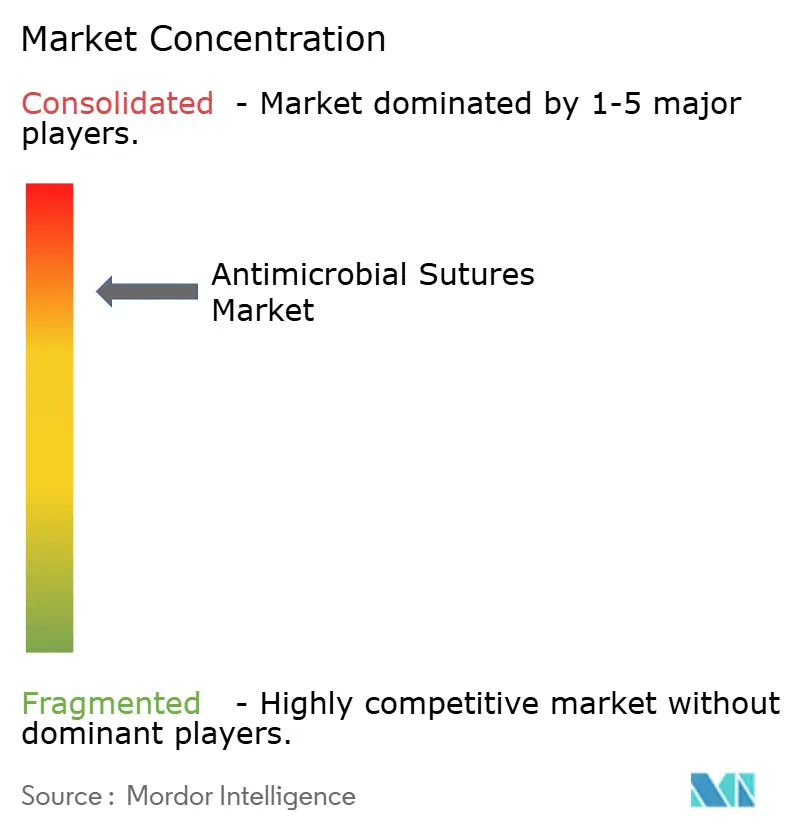
| Market Concentration | High |
Major Players *Disclaimer: Major Players sorted in no particular order Image © Mordor Intelligence. Reuse requires attribution under CC BY 4.0. | |
Antimicrobial Sutures Market Analysis by Mordor Intelligence
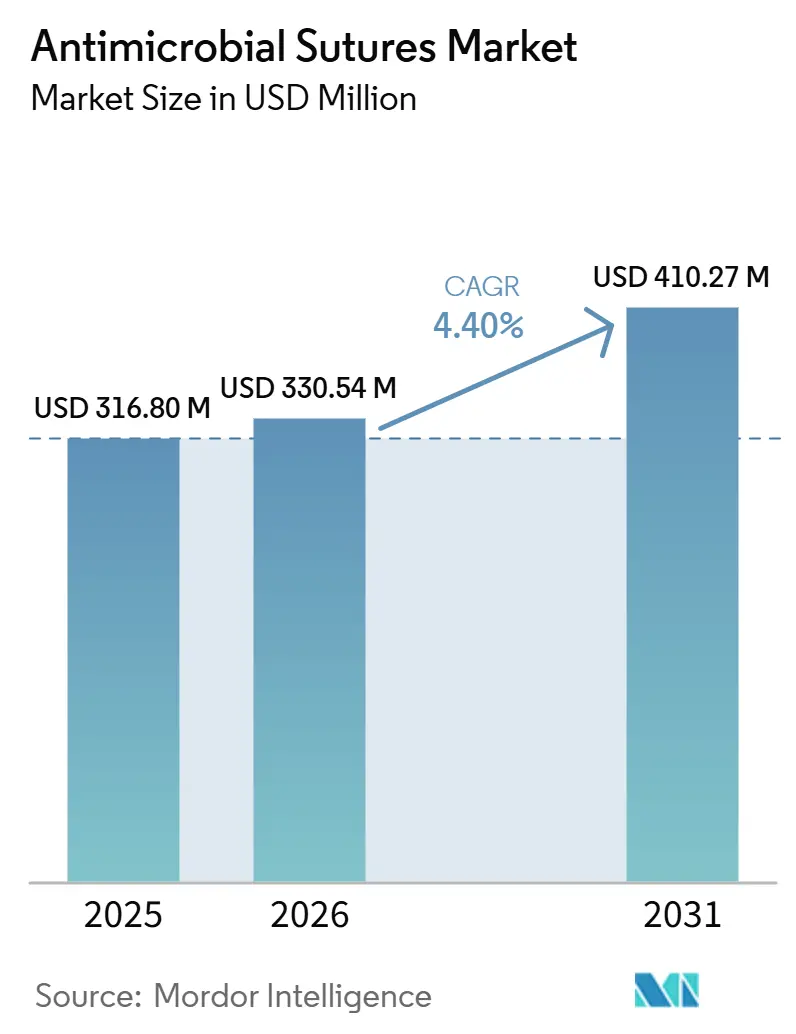
The Antimicrobial Sutures Market size is projected to be USD 316.80 million in 2025, USD 330.54 million in 2026, and reach USD 410.27 million by 2031, growing at a CAGR of 4.40% from 2026 to 2031.
The Antimicrobial sutures market is supported by the financial burden of surgical site infections, which cost the U.S. health care system USD 3.3 billion to USD 10.0 billion annually. Clinical evidence has made antimicrobial sutures a more established part of hospital quality protocols rather than a discretionary clinical choice. A 2025 review of 31 randomized trials involving 17,968 patients found that triclosan-coated sutures reduced surgical site infection incidence from 14.7% to 12.2%, with a relative risk of 0.75 and a number needed to treat of 40.[1]“Triclosan-Containing Sutures for the Prevention of Surgical Site Infection, A Systematic Review and Meta-Analysis,” JAMA Network Open, jamanetwork.com. This evidence gives procurement teams a basis for evaluating the 10% to 30% unit price premium against potential cost avoidance. The Antimicrobial sutures market also benefits as hospitals and ambulatory settings place greater emphasis on documented infection prevention and standardized closure practices.
Key Report Takeaways
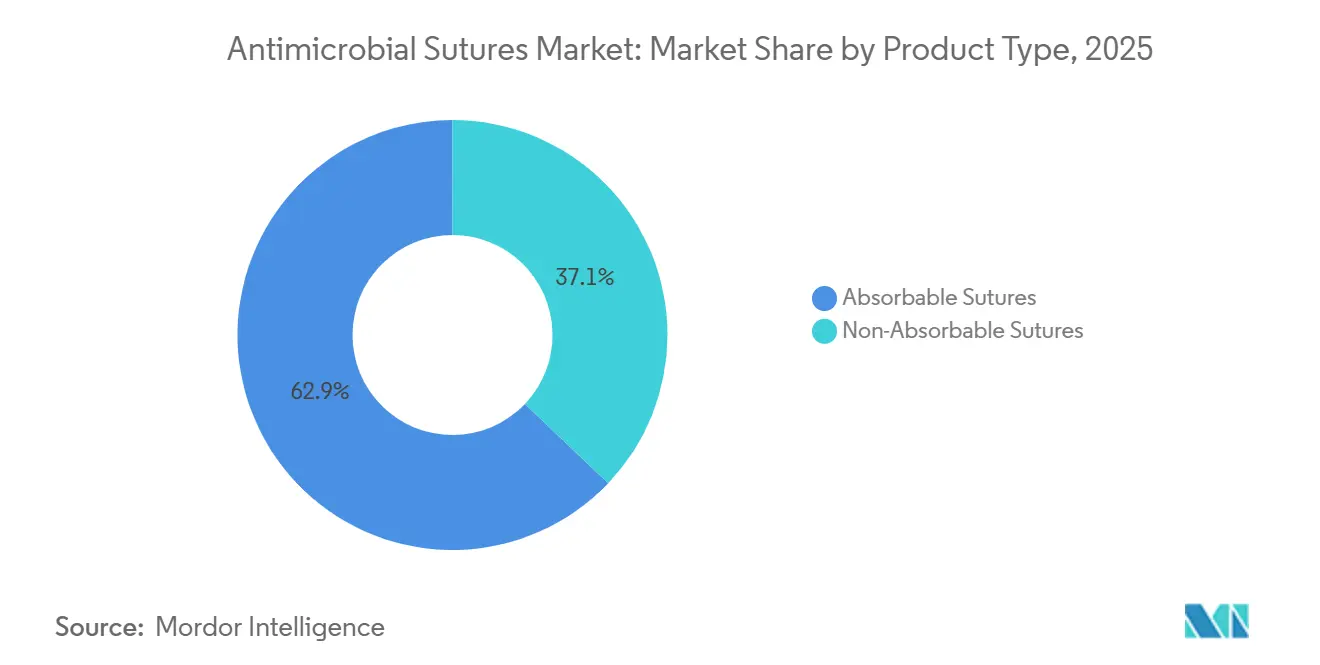
- By product type, absorbable sutures held 62.89% of Antimicrobial sutures market share in 2025 and are forecast to grow at a 5.37% CAGR through 2031.
- By antimicrobial agent, triclosan held 68.17% of the Antimicrobial sutures market share in 2025, while chlorhexidine diacetate is forecast to expand at a 5.89% CAGR through 2031.
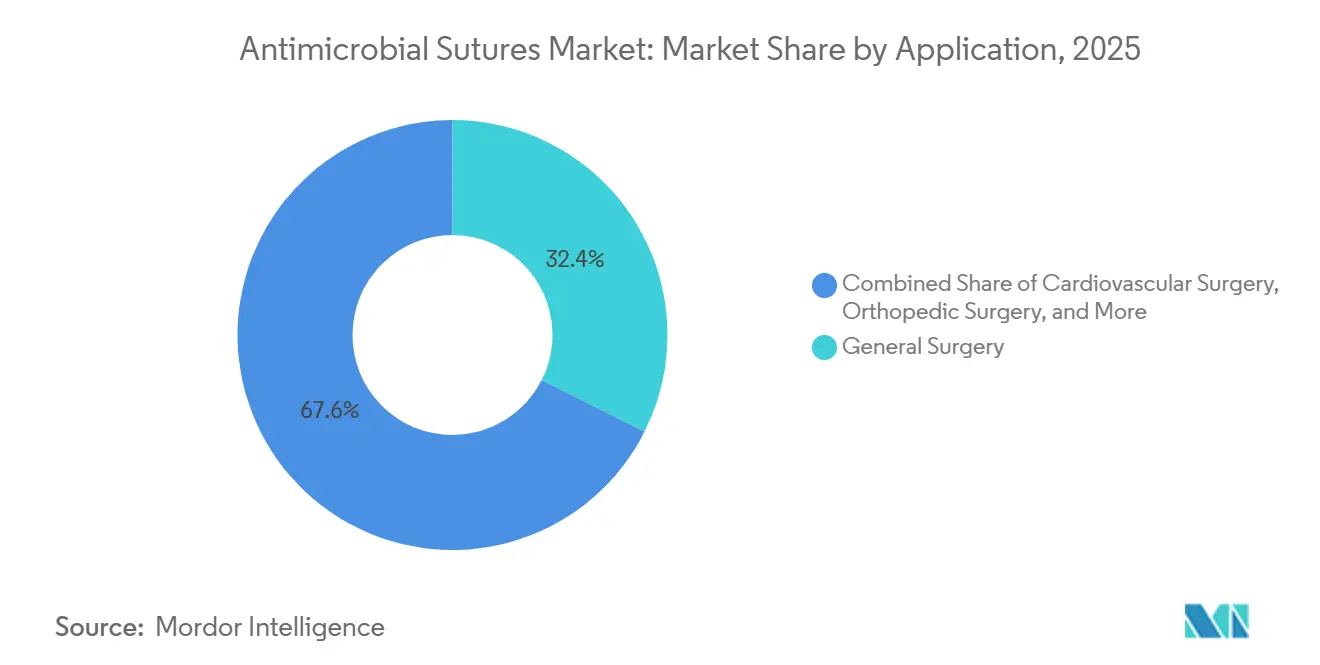
- By application, general surgery accounted for 32.41% of the Antimicrobial sutures market size in 2025, while colorectal surgery is forecast to grow at a 5.72% CAGR through 2031.
- By end user, hospitals held 58.19% of the Antimicrobial sutures market size in 2025, while ambulatory surgical centers are forecast to grow at a 6.03% CAGR through 2031.
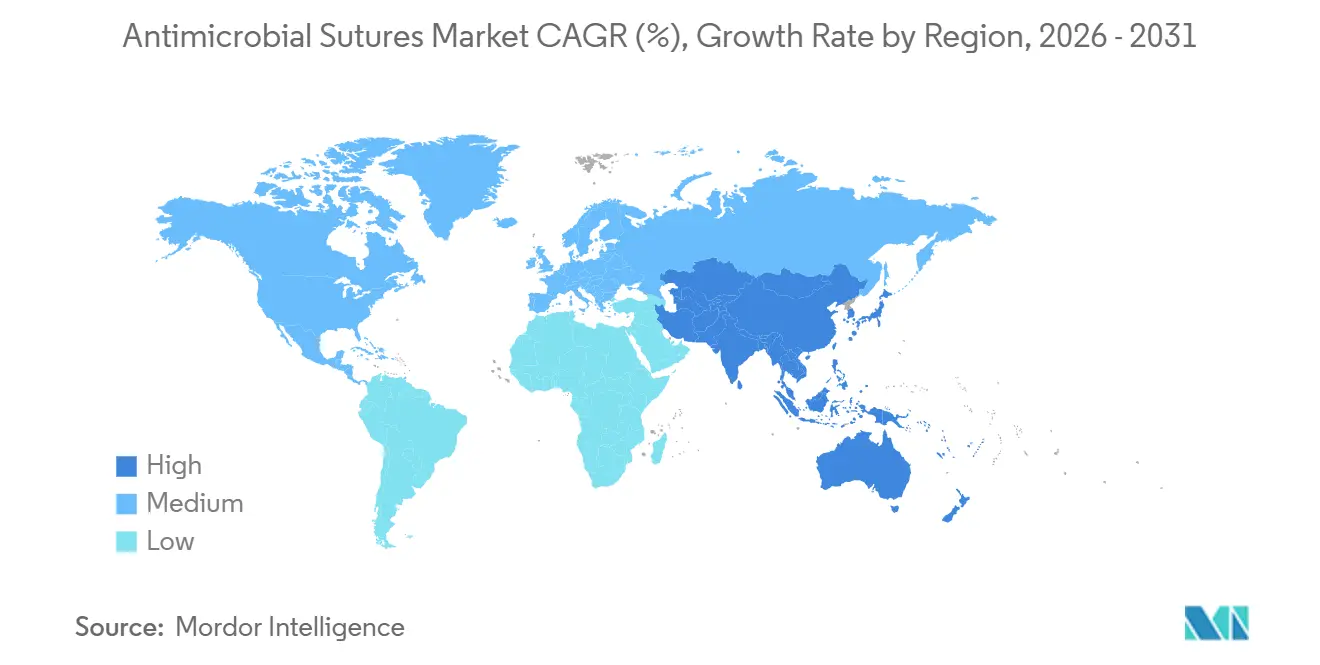
- By geography, North America accounted for 41.21% of 2025 revenue, while Asia-Pacific is forecast to expand at a 5.88% CAGR through 2031.
Note: Market size and forecast figures in this report are generated using Mordor Intelligence’s proprietary estimation framework, updated with the latest available data and insights as of January 2026.
Market Trends and Insights
Drivers Impact Analysis of Antimicrobial Sutures Market*
| Driver | (~) % Impact on CAGR Forecast | Geographic Relevance | Impact Timeline |
|---|---|---|---|
| Rising Surgical Procedure Volumes | +1.2% | Global | Medium term (2-4 years) |
| Increasing Surgical Site Infection Prevention Requirements | +1.0% | Global | Short term (≤ 2 years) |
| Guideline and Clinical Evidence Support | +0.8% | North America and Europe, with spillover to Asia-Pacific | Short term (≤ 2 years) |
| Expansion of Ambulatory and Specialty Surgery | +0.6% | North America and Asia-Pacific | Medium term (2-4 years) |
| Smart, Bioresorbable, and Drug-Eluting Innovation | +0.5% | North America, Europe, and Japan | Long term (≥ 4 years) |
| Procurement Linkage to SSI Economics | +0.4% | North America and Western Europe | Short term (≤ 2 years) |
| Source: Mordor Intelligence | |||
Rising Surgical Procedure Volumes
Ambulatory surgical procedures per Medicare fee-for-service beneficiary rose 3.5% in 2024. The supplied research expects total ambulatory surgical center volume to rise 21% between 2024 and 2034, reaching 44 million procedures each year. This shift expands the serviceable base for the Antimicrobial sutures market because infection control in outpatient facilities relies heavily on product selection. Hospitals can use broader environmental controls that are less available in many ambulatory settings. The addition of 573 procedures to the 2026 ASC Covered Procedures List broadened the range of cases that can move into these settings. Cardiac catheter ablation is among the higher-acuity procedures included in that expansion, which can increase antimicrobial suture use per case.
Increasing Surgical Site Infection Prevention Requirements
Surgical site infections account for more than 20% of health care-associated infections in the United States and affect an estimated 300,000 patients each year. The CDC guidance updated in April 2024 and the WHO 29-point prevention framework remain important references for hospitals addressing infection control obligations. Surgical site infection-related hospitalizations added USD 30,689 in hospital costs per case in a 2025 study.[2]“Clinical Outcomes and Hospital-Reported Cost Associated with Surgical Site Infections,” Infection Control & Hospital Epidemiology, doi.org. The cost burden makes prevention relevant to hospital financial management as well as clinical quality programs. This setting supports inclusion of antimicrobial sutures in formularies and standard suture selection protocols. The Antimicrobial sutures market, therefore, benefits from quality reporting and value-based purchasing, which create institutional accountability.
Guideline and Clinical Evidence Support for Antimicrobial Sutures
A 2025 Surgical Infection Society review covered 30 studies and 97,807 patients. It issued a Grade 1A recommendation for antimicrobial-coated sutures in abdominal wall closure and reported a cumulative adjusted absolute risk reduction of 3.2%.[3]Joseph D. Forrester et al., “Surgical Infection Society Guidelines for Use of Antimicrobial Agent-Coated Suture to Reduce the Risk of Surgical Site Infection After Abdominal Operation,” Surgical Infections, doi.org. A separate 2025 meta-analysis found a relative risk of 0.75 across clean, clean-contaminated, and contaminated wound classes. The benefit was therefore not limited to procedures with the highest infection risk. The two evidence reviews lower the threshold for clinical committees considering broader adoption. The same meta-analysis identified possible bacterial cross-resistance concerns from triclosan exposure, which supports interest in chlorhexidine and silver-ion alternatives.
Smart, Bioresorbable, and Drug-Eluting Suture Innovation
A June 2026 RSC Advances study reported matrix-embedded, dual-drug-eluting biodegradable sutures with sustained prophylactic activity against surgical site infections. The research indicates that a single bioresorbable construct could support infection prevention in selected contaminated-wound settings. It also points to future products that may reduce reliance on perioperative antibiotics in those settings. A 2025 B. Braun Surgical S.A. patent filing described a self-polymerizing antimicrobial thread activated by UV or near-infrared light. The platform would allow antimicrobial intensity to be tailored to wound-specific pathogen risk at closure. Such product development gives the Antimicrobial sutures market a pathway beyond established coating formulations.
Restraints Impact Analysis of Antimicrobial Sutures Market*
| Restraint | (~) % Impact on CAGR Forecast | Geographic Relevance | Impact Timeline |
|---|---|---|---|
| Competition from Staplers, Tissue Adhesives, and Closure Devices | -0.5% | Global, stronger in high-income markets | Medium term (2-4 years) |
| Suture Price Premium and Reimbursement Constraints | -0.4% | Asia-Pacific, Middle East and Africa, and South America | Short term (≤ 2 years) |
| Environmental and Regulatory Scrutiny of Triclosan and Nanoparticles | -0.3% | Europe and North America | Medium term (2-4 years) |
| Variability in Clinical Effectiveness and Coating Durability | -0.2% | Global | Long term (≥ 4 years) |
| Source: Mordor Intelligence | |||
Competition from Staplers, Tissue Adhesives, and Wound-Closure Devices
Mechanical staplers and tissue adhesives have improved and compete with sutures in more laparoscopic, robotic, and dermatological procedures. The supplied forecast expects adult ambulatory surgical utilization to grow 23% during the current decade. It also expects cardiovascular ablations and orthopedic reconstruction to grow 26% in ambulatory surgical centers. These procedures increasingly use staple-based or device-based closure methods. Minimally invasive techniques can reduce the number of tissue layers that require suturing. This reduces suture use per procedure and limits premium capture for the Antimicrobial sutures market.
Environmental and Regulatory Scrutiny of Triclosan and Nanoparticles
Triclosan is making regulatory scrutiny important for the antimicrobial sutures market. The U.S. Food and Drug Administration banned triclosan in over-the-counter consumer antiseptic wash products in 2016, while European rules have restricted its personal care use. Medical-device sutures remain separately classified and approved, but the earlier restrictions create a precedent for closer review. The U.S. Environmental Protection Agency finalized a 2025 framework for cooperation on antimicrobial resistance risks associated with antibacterial and antifungal pesticides. Silver nanoparticle coatings face separate questions regarding environmental persistence and cytotoxicity at higher concentrations. These issues can lengthen commercialization timelines for silver-nanoparticle-coated sutures in Europe.
*Our forecasts treat driver/restraint impacts as directional, not additive. The impact forecasts reflect baseline growth, mix effects, and variable interactions.
Antimicrobial Sutures Market Segment Analysis
By Product Type:
Absorbable Variants Sustain Share Through Bioresorbability AdvantageAbsorbable sutures held 62.89% of 2025 revenue and are forecast to grow at a 5.37% CAGR through 2031. This combined position reflects their fit in soft-tissue and gastrointestinal procedures. Absorbable materials avoid permanent foreign-body retention after healing. This feature is relevant in contaminated and immunocompromised wound environments. It can also reduce the baseline inflammatory response associated with retained materials. The Antimicrobial sutures market size for absorbable formats is supported by their role in procedures where removal is not practical.
Polyglactin 910 and poliglecaprone-25 are the leading polymer substrates in this segment. Their use pairs bioresorbability with antimicrobial coating options. Ethicon received clearance in 2026 for MONOCRYL Plus Antibacterial Poliglecaprone-25 and Coated VICRYL Plus Antibacterial Polyglactin 910. The supplied research notes that the latter device underwent a 268-day review, reflecting post-market surveillance expectations for updated devices. Non-absorbable sutures continue to serve cardiovascular, ophthalmic, and vascular anastomosis procedures. Polypropylene and nylon formats with silver-ion or chlorhexidine coatings have a role where long-term tensile integrity is required. Their use in orthopedic and cardiac procedures reflects the clinical consequences of infection around a permanent suture.


By Antimicrobial Agent:
Chlorhexidine Positions as a Credible Triclosan AlternativeTriclosan captured 68.17% of 2025 revenue, supported by its early entry, clinical trial base, and guideline recognition. Chlorhexidine diacetate is forecast to grow at a 5.89% CAGR through 2031, the highest rate among antimicrobial agents. The Antimicrobial sutures industry is shifting attention toward alternatives with a different regulatory profile. A 2025 trial followed 468 laparoscopic patients for 12 months and reported numerical surgical site infection reduction with chlorhexidine-coated sutures. A periodontal comparison also reported lower colony-forming units with chlorhexidine-coated sutures than with triclosan-coated sutures, at 0.011 × 10⁶ versus 4.3 × 10⁶.[4]“Comparative Evaluation of the Efficacy of Triclosan-Coated and Chlorhexidine-Coated Suture on Bacterial Load Reduction in Periodontal Flap Surgery,” Europe PMC, europepmc.org.
B. Braun's Novosyn CHD uses a polyglactin 910 suture with chlorhexidine diacetate coating. The product is active in the Middle East and Africa markets and is available across Europe. It shows how antimicrobial agent selection can differentiate products as buyers consider triclosan exposure. Silver-ion and silver-nanoparticle coatings remain an emerging area in oral surgery and orthopedic applications. An in vitro study reported activity against antibiotic-resistant strains, including Pseudomonas aeruginosa. Chitosan-based coatings, antibiotic-eluting matrices, and stimulus-responsive constructs remain at research or early clinical stages. Their progress will depend on biocompatibility evaluation and regulatory review before commercial-scale adoption.
By Application:
Colorectal Surgery Drives the Infection-Prevention PremiumGeneral surgery accounted for 32.41% of 2025 application revenue. Its leading role reflects the range of soft-tissue procedures included in the category, from hernia repair to bowel anastomosis. Colorectal surgery is forecast to grow at a 5.72% CAGR through 2031. Reported surgical site infection incidence in colorectal resection ranges from 5% to 30%. Emergency colon perforation cases can have infection rates approaching 80%.
The high infection exposure in colorectal care makes the value proposition stronger for antimicrobial closure products. A 2025 cohort study found higher total hospital costs within 60 days after colorectal resection for patients with incisional surgical site infection than for matched controls.[5]“Assessment of Hospital Costs Associated with Incisional Surgical Site Infection in Patients Undergoing Colorectal Surgery,” Infection Control & Hospital Epidemiology, doi.org. Cardiovascular surgery retains a specialized role because infections can be especially serious for patients with implanted devices. Silver-ion, non-absorbable formats are receiving attention in these procedures. Gynecological and obstetric surgery is another area of adoption, as a 2025 randomized trial assessed triclosan-coated sutures for childbirth-related perineal tear repair. Orthopedic and trauma surgery also supports demand because a 2025 review found surgical site infections generally doubled treatment costs, with the greatest burden in hip and knee arthroplasty.

By End User:
Ambulatory Surgical Centers Outpace Hospitals on GrowthHospitals held 58.19% of 2025 revenue, supported by infection-control oversight, formulary control, and reporting obligations to the National Healthcare Safety Network. Ambulatory surgical centers are forecast to grow at a 6.03% CAGR through 2031. Their growth reflects the movement of more complex procedures from hospitals to outpatient settings. The Antimicrobial sutures industry benefits as those settings place greater weight on reliable infection prevention within each procedure. The supplied research reports that 10,494 ambulatory surgical centers were operating nationally in 2026. It also reports that the Medicare-certified center count increased at a net rate of 1.5% in 1 quarter of 2025.
Ambulatory center purchasing often differs from hospital purchasing. Individual physician-owners can be more involved in product decisions than centralized hospital value analysis committees. Manufacturers, therefore, need a different channel approach to reach this customer base. Specialty clinics in oral surgery, dermatology, and reproductive health remain less penetrated but have rising procedure volumes and infection-prevention awareness. Academic and research institutions represent a smaller revenue base. They can act as early-adoption sites for novel antimicrobial platforms before wider use across affiliated hospital networks. These settings provide additional routes for the Antimicrobial sutures market beyond traditional inpatient procurement.
Geography Analysis
North America Antimicrobial Sutures Market
North America held 41.21% of 2025 revenue in the Antimicrobial sutures market. The region benefits from a system in which surgical site infection rates are measured, reported, and connected to hospital performance requirements. In the United States, the National Healthcare Safety Network provides procedure-specific infection benchmarks for hospitals and surgeons. These benchmarks create direct accountability for infection prevention and suture selection. Canada and Mexico account for smaller regional shares. Mexico has higher growth potential as private surgical capacity expands in metropolitan areas.
Europe Antimicrobial Sutures Market
Europe is the second-largest regional market, shaped by clinical documentation and post-market evidence requirements under the EU Medical Device Regulation. Germany, the United Kingdom, and France are the largest country markets in the region. Hospital group formularies support institutional purchasing in those countries. Spain and Italy are seeing faster adoption as private hospital capacity and infection-control programs expand. A 2025 study at Gemelli University Hospital in Rome reported that surgical site infection prevalence fell from 2.50% in 2023 to 1.40% in 2024. It linked that reduction to EUR 31.6 million in avoided direct health care costs, equivalent to USD 33 million.
APAC Antimicrobial Sutures Market
Asia-Pacific is forecast to grow at a 5.88% CAGR through 2031, the fastest regional rate. China, India, Japan, South Korea, and Australia each contribute different demand conditions. India has a domestic supply base that includes Healthium Medtech, Futura Surgicare, Lotus Surgicals, and Meril Life Sciences. This supply base expands access in public hospitals that place a strong emphasis on price. Japan prioritizes guideline-compliant infection prevention, while South Korea's Samyang Holdings has a regional position in absorbable formats.

Competitive Landscape
The Antimicrobial sutures market is highly concentrated, with the top 4 companies accounting for 91.90% of 2025 revenue. Johnson & Johnson's Ethicon division anchors this group. The company expanded its antimicrobial and knotless-with-antimicrobial portfolio through several U.S. regulatory clearances between November 2025 and June 2026. These actions covered MONOCRYL Plus Antibacterial Poliglecaprone-25, Coated VICRYL Plus Antibacterial, PDS Plus Antibacterial, and STRATAFIX Symmetric PDS Plus. The portfolio breadth supports Ethicon's position across absorbable and knotless closure formats.
B. Braun differentiates through the Novosyn CHD chlorhexidine diacetate platform. Its 2025 patent filing for a self-polymerizing antimicrobial thread also signals a move beyond current coating formulations. This approach responds to the need for alternatives as triclosan receives greater regulatory attention. Regional Indian suppliers, including Healthium Medtech, Futura Surgicare, Lotus Surgicals, and Meril Life Sciences, compete in price-sensitive ambulatory and public health settings. Their main presence is in Asia-Pacific, the Middle East, and Africa.
DemeTECH Corporation and Peters Surgical occupy mid-tier positions in North American and European specialty surgery markets. They compete through manufacturing quality and distribution reach. Chlorhexidine-coated non-absorbable sutures for cardiovascular and orthopedic use remain an open product area without a dominant offering. Such formats address the infection concern associated with long-term retained sutures while avoiding triclosan-related questions. The Antimicrobial sutures market also shows how knotless designs with antimicrobial coatings can support differentiated product positions as standard suture products face price pressure.
Antimicrobial Sutures Industry Leaders
B. Braun Melsungen AG
Dolphin Sutures
Healthium Medtech Limited
Johnson & Johnson
Meril Life Sciences Pvt. Ltd.
- *Disclaimer: Major Players sorted in no particular order
Antimicrobial Sutures Market Companies Covered in this Report
- Advanced MedTech Solutions Pvt. Ltd.
- Assut Europe S.p.A.
- B. Braun
- Boz Medical
- DemeTECH
- Dolphin Sutures
- Genesis MedTech Group
- Healthium Medtech Limited
- Internacional Farmacéutica, S.A. de C.V.
- Johnson & Johnson
- Katsan Medical Devices
- Lotus Surgicals Pvt. Ltd.
- Meril Life Science
- Peters Surgical
- Riverpoint Medical
- Samyang Holdings Corporation
- SMI AG
- Suture Planet
- Sutures India Pvt. Ltd
- Unilene

Recent Industry Developments in Antimicrobial Sutures Market
- April 2025: The Surgical Infection Society published a Grade 1A guideline recommending triclosan-coated sutures for incision closure following abdominal operations, based on a systematic review of 30 studies covering 97,807 patients, the most authoritative clinical endorsement issued for this product category to date.
- July 2025: The NOVOTILAC LAC trial published 12-month follow-up data across 468 laparoscopic patients, delivering the most comprehensive long-term evaluation of chlorhexidine-coated sutures in minimally invasive abdominal surgery with secondary endpoints covering quality of life and cosmetic outcomes.


Global Antimicrobial Sutures Market Report Scope
The antimicrobial sutures market refers to the global industry for surgical sutures coated or impregnated with antimicrobial agents to reduce the risk of surgical site infections (SSIs). These sutures are used to close wounds while helping limit microbial colonization at the surgical site, supporting improved infection control in postoperative care. By combining wound closure functionality with infection-prevention properties, antimicrobial sutures play an important role in high-risk surgeries and healthcare settings where reducing SSI incidence is a key clinical priority.
The antimicrobial sutures market is segmented by product type, antimicrobial agent, application, end user, and geography. By product type, it is further divided into absorbable sutures and non-absorbable sutures. By antimicrobial agent, it is segmented into triclosan, chlorhexidine diacetate, silver-ion and silver-nanoparticle coatings, chitosan-based coatings, and others. By application, the market is segmented into general surgery, cardiovascular surgery, orthopedic surgery, gynecological and obstetric surgery, colorectal surgery, and other surgical applications. By end user, the market is segmented into hospitals, ambulatory surgical centers, specialty clinics, academic and research institutions, and other end users. The geography segment is further divided into North America, Europe, Asia-Pacific, the Middle East and Africa, and South America. The report also covers the estimated market sizes and trends for 17 countries across major regions globally. The report offers the market size and forecasts in value (USD) for the above segments.
| Absorbable Sutures |
| Non-Absorbable Sutures |
| Triclosan |
| Chlorhexidine Diacetate |
| Silver-Ion and Silver-Nanoparticle Coatings |
| Chitosan-Based Coatings |
| Others |
| Synthetic Polymers |
| Natural Materials |
| Bioresorbable and Bioactive Materials |
| General Surgery |
| Cardiovascular Surgery |
| Orthopedic Surgery |
| Gynecological and Obstetric Surgery |
| Colorectal Surgery |
| Other Surgical Applications |
| Hospitals |
| Ambulatory Surgical Centers |
| Specialty Clinics |
| Academic and Research Institutions |
| Other End Users |
| North America | United States |
| Canada | |
| Mexico | |
| Europe | Germany |
| United Kingdom | |
| France | |
| Italy | |
| Spain | |
| Rest of Europe | |
| Asia-Pacific | China |
| Japan | |
| India | |
| Australia | |
| South Korea | |
| Rest of Asia-Pacific | |
| Middle East and Africa | GCC |
| South Africa | |
| Rest of Middle East and Africa | |
| South America | Brazil |
| Argentina | |
| Rest of South America |
| By Product Type | Absorbable Sutures | |
| Non-Absorbable Sutures | ||
| By Antimicrobial Agent | Triclosan | |
| Chlorhexidine Diacetate | ||
| Silver-Ion and Silver-Nanoparticle Coatings | ||
| Chitosan-Based Coatings | ||
| Others | ||
| By Material | Synthetic Polymers | |
| Natural Materials | ||
| Bioresorbable and Bioactive Materials | ||
| By Application | General Surgery | |
| Cardiovascular Surgery | ||
| Orthopedic Surgery | ||
| Gynecological and Obstetric Surgery | ||
| Colorectal Surgery | ||
| Other Surgical Applications | ||
| By End User | Hospitals | |
| Ambulatory Surgical Centers | ||
| Specialty Clinics | ||
| Academic and Research Institutions | ||
| Other End Users | ||
| By Geography | North America | United States |
| Canada | ||
| Mexico | ||
| Europe | Germany | |
| United Kingdom | ||
| France | ||
| Italy | ||
| Spain | ||
| Rest of Europe | ||
| Asia-Pacific | China | |
| Japan | ||
| India | ||
| Australia | ||
| South Korea | ||
| Rest of Asia-Pacific | ||
| Middle East and Africa | GCC | |
| South Africa | ||
| Rest of Middle East and Africa | ||
| South America | Brazil | |
| Argentina | ||
| Rest of South America | ||


Key Questions Answered in the Report
What is the projected value of antimicrobial sutures by 2031?
The Antimicrobial sutures market is forecast to reach USD 410.27 million by 2031, growing at a 4.40% CAGR from 2026.
Which product type leads antimicrobial sutures demand?
In the Antimicrobial sutures market, absorbable sutures led with 62.89% of 2025 revenue and are forecast to expand at a 5.37% CAGR through 2031.
Which antimicrobial agent is growing fastest in sutures?
In the Antimicrobial sutures market, chlorhexidine diacetate is forecast to grow at a 5.89% CAGR through 2031, while triclosan remained the largest agent segment in 2025.
Why are antimicrobial sutures used in colorectal surgery?
In the Antimicrobial sutures market, colorectal resection has reported a surgical site infection incidence of 5% to 30%, which strengthens the case for antimicrobial wound closure.
Which end user will grow fastest through 2031?
In the Antimicrobial sutures market, ambulatory surgical centers are forecast to grow at a 6.03% CAGR as procedures continue to move into outpatient care.
Which region is growing fastest for antimicrobial sutures?
In the Antimicrobial sutures market, Asia-Pacific is forecast to grow at a 5.88% CAGR through 2031, supported by expanding surgical infrastructure and domestic manufacturing capacity.
Page last updated on:





