
Anti-Frizz Products Market Size and Share
Market Overview
| Study Period | 2022 - 2032 |
|---|---|
| Market Size (2027) | USD 6.70 Billion |
| Market Size (2032) | USD 10.03 Billion |
| Growth Rate (2027 - 2032) | 8.41 % |
| Fastest Growing Market | North America |
| Largest Market | Asia-Pacific |
| Market Concentration | Low |
Major Players *Disclaimer: Major Players sorted in no particular order Image © Mordor Intelligence. Reuse requires attribution under CC BY 4.0. | |
Anti-Frizz Products Market Analysis by Mordor Intelligence
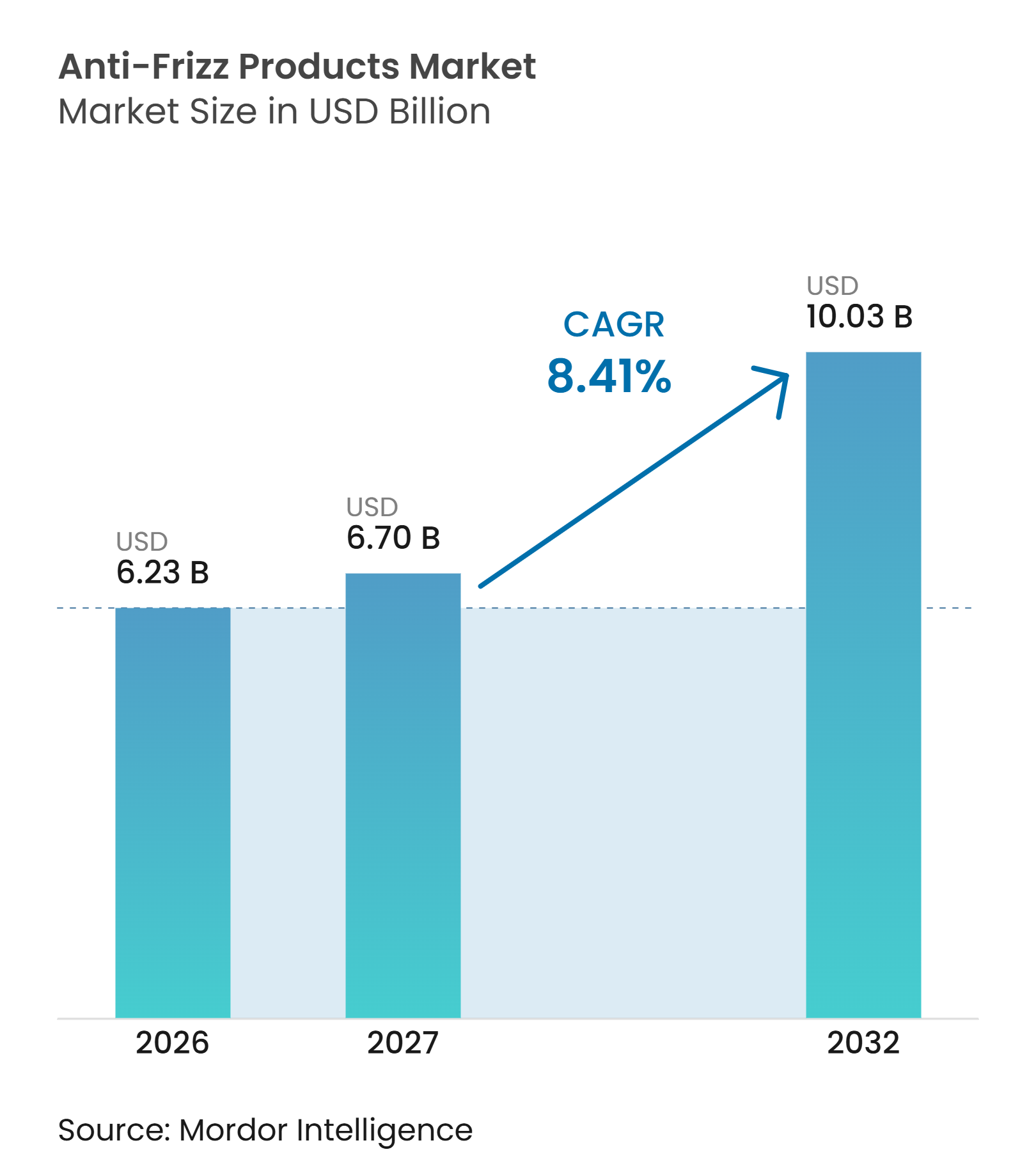
The Anti-Frizz Products Market size is expected to increase from USD 6.23 billion in 2026 to USD 6.70 billion in 2027 and reach USD 10.03 billion by 2032, growing at a CAGR of 8.41% over 2027-2032.
The anti-frizz products market size is projected to expand from USD 6.23 billion in 2026 to USD 6.70 billion in 2027, and to USD 10.03 billion by 2032, registering a CAGR of 8.41% between 2027 and 2032. Demand is moving toward haircare routines that address humidity, heat styling, and moisture retention as linked concerns. Consumers are also paying closer attention to ingredient safety, product testing, and the duration of protection under humid conditions. This raises the importance of formulation evidence and makes basic anti-frizz claims less distinctive. Brands can use leave-in formats, texture-specific products, and more transparent ingredient communication to address these needs. The anti-frizz products market remains open to specialist entrants, although larger companies are also using acquisitions to add technical haircare capabilities.
Key Report Takeaways
-
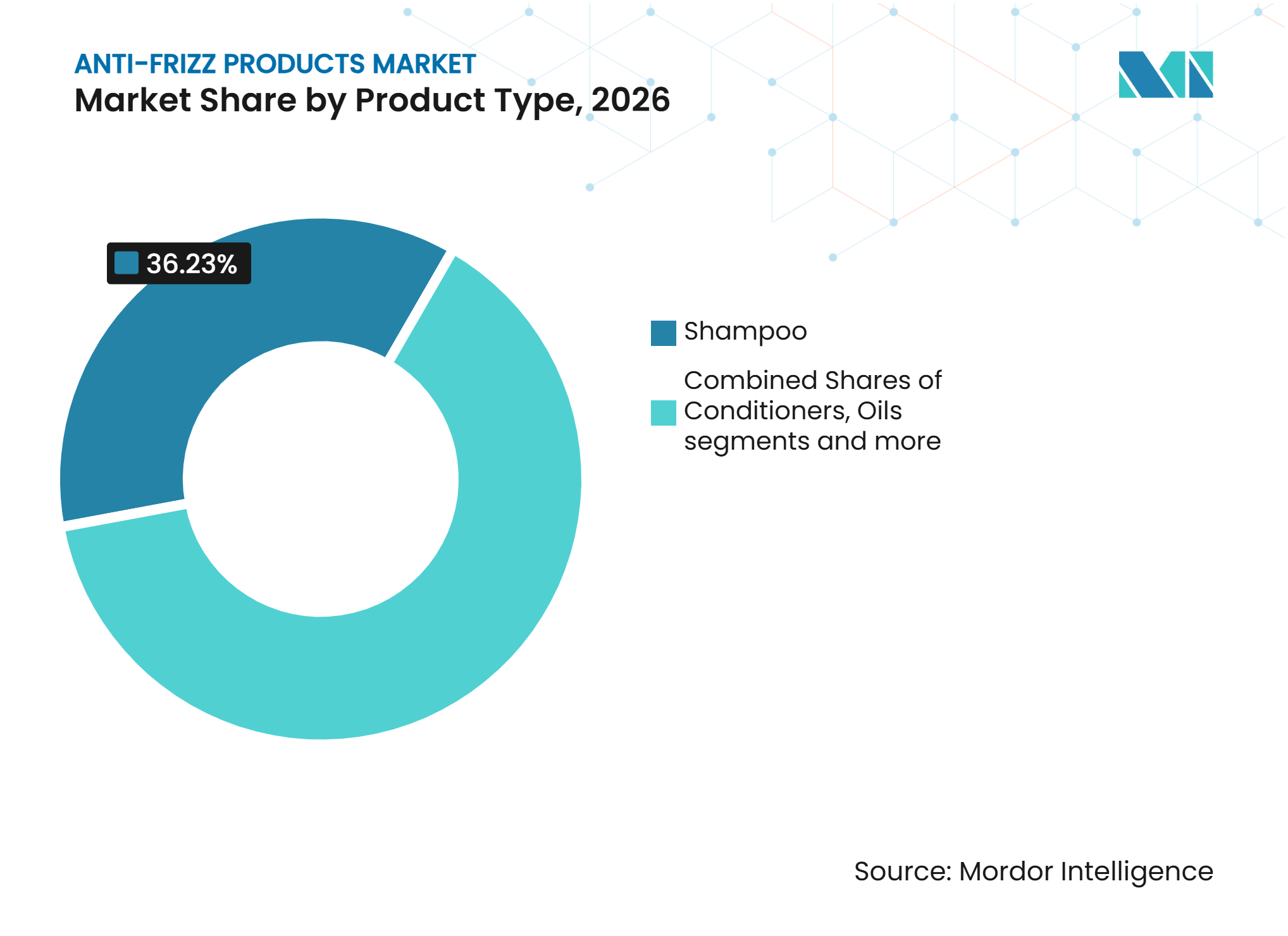
By product type, shampoos held 36.23% of the anti-frizz products market share in 2026, while conditioners are projected to grow at a 9.44% CAGR through 2032.
-
By nature, conventional formulations held 68.43% of the anti-frizz products market share in 2026, while natural and organic formulations are projected to grow at a 9.71% CAGR through 2032.
-
By end user, women held 78.35% of the anti-frizz products market share in 2026, while men are projected to grow at a 9.58% CAGR through 2032.
-
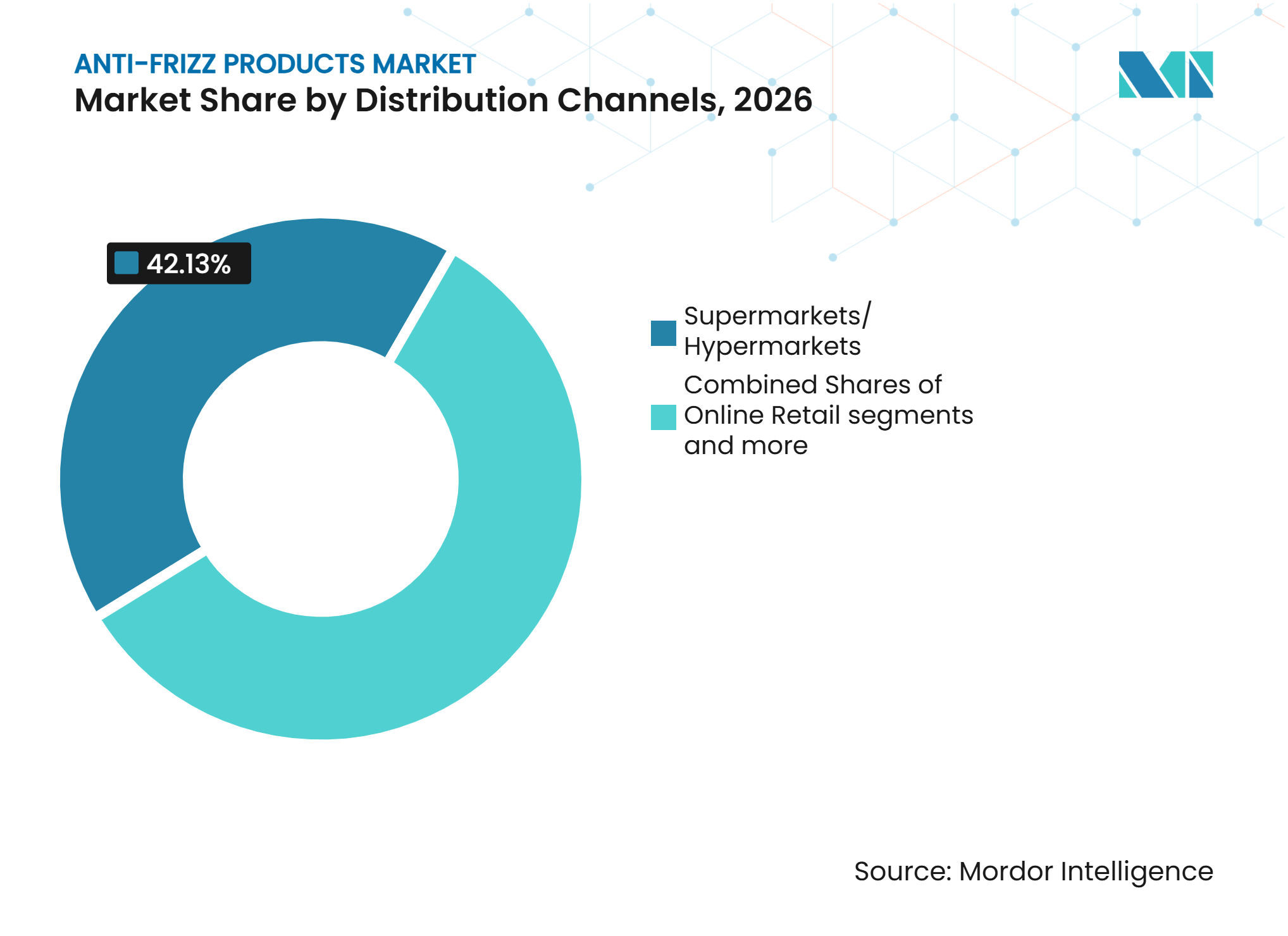
By distribution channel, supermarkets and hypermarkets held 42.13% of the anti-frizz products market share in 2026, while online retail is projected to grow at a 9.89% CAGR through 2032.
-
By geography, North America held 39.58% of the anti-frizz products market share in 2026, while Asia-Pacific is projected to grow at a 9.62% CAGR through 2032.
Note: Market numbers in this report are based on Mordor Intelligence's proprietary estimation framework, which combines nine months of actuals with Q4 projections for base year 2026.
Market Trends and Insights
Drivers Impact Analysis of Anti-Frizz Products Market*
| Driver | (~) % Impact on CAGR Forecasts | Geographic Relevance | Impact Timeline |
|---|---|---|---|
| Rising prevalence of hair dryness and frizz | +1.8% | Global, with acute intensity in South Asia, Southeast Asia, South America, and humid zones of North America | Long term (≥ 4 years) |
| Growing demand for specialized haircare products | +1.5% | North America & Europe core, spill-over to Asia-Pacific and Middle East and Africa | Medium term (2–4 years) |
| Increasing preference for natural and organic haircare ingredients | +1.3% | North America, Europe; early adoption in Asia-Pacific and South America | Medium term (2–4 years) |
| Rising adoption of leave-in haircare solutions | +1.0% | Global, led by North America and South America's textured-hair demographics | Medium term (2–4 years) |
| Growing influence of social media and beauty influencers | +0.9% | Global, with particular impact in North America, Southeast Asia, and Brazil | Short term (≤ 2 years) |
| Increasing demand for multifunctional haircare products | +0.8% | Global, strongest in time-pressed urban consumer segments across all regions | Medium term (2–4 years) |
| Source: Mordor Intelligence | |||
Rising Prevalence of Hair Dryness and Frizz
Frizz is linked to atmospheric humidity, heat exposure, and repeated chemical processing. Hair fibers can become more vulnerable when frequent blow-drying and humid air disrupt the cuticle and reduce its resistance to moisture. This pattern supports demand for products positioned for regular protection rather than occasional styling. The anti-frizz products market benefits when consumers connect heat styling with later dryness and frizz. Products that address moisture retention and heat protection can fit more easily into repeat haircare routines. The scientific literature from the NationalLibrary of Medicine in 2025 also identifies buildup and cleansing trade-offs in haircare ingredient selection, which makes clear product guidance important for consumers[1].
Growing Demand for Specialized Haircare Products
Haircare demand is separating between basic cleansing products and formulas designed for defined hair conditions. Anti-frizz products are increasingly expected to provide benefits such as bond repair, thermal protection, moisture control, or UV protection alongside surface smoothing. That expectation makes product testing and precise claims more important. L'Oréal's North America Research and Innovation Center uses controlled temperature and humidity conditions in its testing work, showing the role of measured performance in haircare development. The anti-frizz products market therefore gives an advantage to brands that can explain both the ingredient system and the conditions under which it works. European rules on intentionally added microplastics also encourage companies to review polymer-dependent formulations and related environmental claims[2].
Increasing Preference for Natural and Organic Haircare Ingredients
Natural and organic claims are becoming more closely tied to ingredient sourcing and disclosure. Consumers increasingly expect companies to explain where high-profile botanical ingredients come from and how they are sourced. This is relevant for ingredients such as argan oil, buriti oil, cupuaçu butter, and moringa. The anti-frizz products market can support brands that pair plant-based ingredients with clear efficacy evidence. A natural claim alone does not resolve concerns about performance under persistent humidity. The European Cosmetics Regulation establishes product-safety and labeling requirements that place greater importance on responsible claim substantiation.
Rising Adoption of Leave-In Haircare Solutions
Leave-in products combine frizz control with detangling, moisture retention, and heat protection in a post-wash step. This format can make anti-frizz care easier to use between wash days. It is especially relevant for consumers who need consistent moisture management for curly, coily, or textured hair. The anti-frizz products market can gain from this format because a leave-in product creates more frequent daily use than a rinse-off conditioner. Brands are also using duration claims to show performance under controlled humidity. Unilever's 2026 TRESemmé Professional relaunch included a KeraKinetic technology claim for 72-hour frizz control, reflecting this focus on measurable duration.
Restraints Impact Analysis of Anti-Frizz Products Market*
| Restraint | (~) % Impact on CAGR Forecasts | Geographic Relevance | Impact Timeline |
|---|---|---|---|
| Availability of low-cost haircare alternatives | -1.0% | Global, most acute in price-sensitive tiers of Asia-Pacific, South America, and Middle East and Africa | Long term (≥ 4 years) |
| Consumer concerns regarding synthetic ingredients | -0.8% | North America and Europe (highest awareness); growing in Asia-Pacific | Medium term (2–4 years) |
| Risk of product buildup from silicone-based formulations | -0.6% | North America, Western Europe, markets with highest clean-beauty adoption rates | Medium term (2–4 years) |
| Limited effectiveness across different hair textures | -0.5% | Global, most acute in South America, Africa, and Southeast Asia, high-diversity texture markets | Long term (≥ 4 years) |
| Source: Mordor Intelligence | |||
Availability of Low-Cost Haircare Alternatives
Private-label and value-tier products place pressure on mainstream anti-frizz brands, especially in the mid-priced range. Consumers can find simpler products that offer basic conditioning and smoothing at lower prices. The most exposed range is USD 8 to USD 15, where a mainstream brand may face a substitute with a similar headline claim. This creates a challenge for the anti-frizz products market because price comparisons are easier in online channels. Brands must therefore make clear why a formula, performance test, or multi-benefit system justifies the price. A stronger value proposition depends on proven performance rather than broad positioning language.
Consumer Concerns Regarding Synthetic Ingredients
Concerns about synthetic ingredients can increase reformulation costs and complicate product selection. Water-insoluble silicones such as dimethicone may accumulate on the hair shaft after prolonged use and can require clarifying shampoos for removal. Those cleansing products may be less suitable for delicate or textured hair when used often. Plant-derived alternatives can have higher costs, supply variation, and shorter protection periods under humidity. The European Union has also placed restrictions on D4 and D5 in certain cosmetic uses, which narrows the ingredient options available to brands serving European markets. The anti-frizz products market may favor companies that can improve water-dispersible or other lower-buildup systems without reducing efficacy.
*Our forecasts treat driver/restraint impacts as directional, not additive. The impact forecasts reflect baseline growth, mix effects, and variable interactions.
Anti-Frizz Products Market Segment Analysis
By Product Type:
Conditioners Support More Complete Haircare RoutinesShampoos held 36.23% of the anti-frizz products market share in 2026, while conditioners are forecast to expand at a 9.44% CAGR through 2032. Shampoo remains a regular purchase because it is the base cleansing step in most routines. Large consumer goods brands also give anti-frizz shampoo broad mass-market reach. Conditioner growth reflects a change in the role of the treatment step. Consumers increasingly use rinse-out conditioners, deep treatments, and leave-in formats to deliver moisture and surface smoothing. This gives conditioners more importance than a purely optional post-shampoo item.
Oils and serums support a different purchase need through lightweight application and an immediate cosmetic effect. Brands also use controlled humidity testing to show how long a formula can manage frizz. Masks, sprays, styling creams, and solid bars serve more specific use cases. Solid bars can address packaging concerns, while leave-in creams are useful for moisture management between wash days.



By Nature:
Conventional Formulas Retain Scale While Natural Claims Require ProofConventional formulas accounted for 68.43% of the anti-frizz products market size in 2026. Their position reflects established ingredient systems, broad availability, and production scale. Synthetic systems can also offer consistent performance in different humidity conditions. These advantages remain important for consumers who need predictable results at accessible prices. Conventional products have benefited from long-established formulation experience and supply relationships. Their continued scale means that any change toward natural formulations will occur alongside, rather than immediately replace, conventional products.
Natural and organic formulas are forecast to grow at a 9.71% CAGR through 2032. This growth reflects consumer interest in silicone-free and sulfate-free options, but it also places more weight on source transparency. Brands need to explain the origin, sourcing, and ecological profile of ingredients such as argan oil, buriti, cupuaçu, and moringa. The anti-frizz products market can support brands that combine this information with evidence of actual humidity performance. Ingredient concerns do not remove the need for effective cuticle protection. Companies therefore need to balance botanical positioning, stable supply, cost control, and dependable results for different hair textures.
By End User:
Women's Established Demand Sits Alongside Faster Growth Among MenWomen held 78.35% share of the anti-frizz products market in 2026, while the men's segment is forecast to advance at a 9.58% CAGR through 2032. Women's demand is supported by larger baskets, more varied routines, and higher average product use. The segment covers fine, thick, curly, coily, chemically treated, and color-processed hair. This variety makes a single undifferentiated formula less relevant. Brands can respond through product lines that explain benefits for distinct hair conditions. The anti-frizz products market continues to rely on women as its largest end-user group.
Men represent the faster-growing end-user segment because grooming routines are expanding beyond basic washing. The opportunity lies in products designed for men's common use patterns, including frequent washing and concerns around scalp oil. Men may also prefer simple routines that combine conditioning, frizz control, and styling support. This favors clear products with straightforward application instructions. Companies must avoid treating men’s needs as a repackaged version of women’s products. Product texture, fragrance, packaging, and benefit claims need to fit the intended routine.
By Distribution Channel:
Physical Retail Holds Scale While Online Retail Expands DiscoverySupermarkets and hypermarkets held a 42.13% share of the anti-frizz products market in 2026. Their position is supported by geographic reach, regular consumer traffic, and placement within broader beauty aisles. They allow shoppers to compare shampoos, conditioners, styling products, and hair tools in one location. This channel is particularly important in South America, Southeast Asia, and Africa, where specialist beauty retail and online access may be uneven. Physical stores also allow consumers to assess packaging, fragrance, and product texture before purchase. Those features continue to matter in a category that is often selected through personal sensory preferences.
Online retail is forecast to grow at a 9.89% CAGR through 2032. Digital channels help consumers find products for specific hair textures and humidity concerns through tutorials, ingredient filters, and creator recommendations. This expands access for smaller brands that do not have broad shelf space. It also increases direct comparisons between branded products and lower-priced alternatives. The anti-frizz products market can benefit when online education improves product fit and reduces trial-and-error purchases. Subscription models and direct-to-consumer communication can encourage repeat purchases. Companies still need to make product information accurate and easy to understand because consumers cannot test the product before delivery.

Geography Analysis
North America
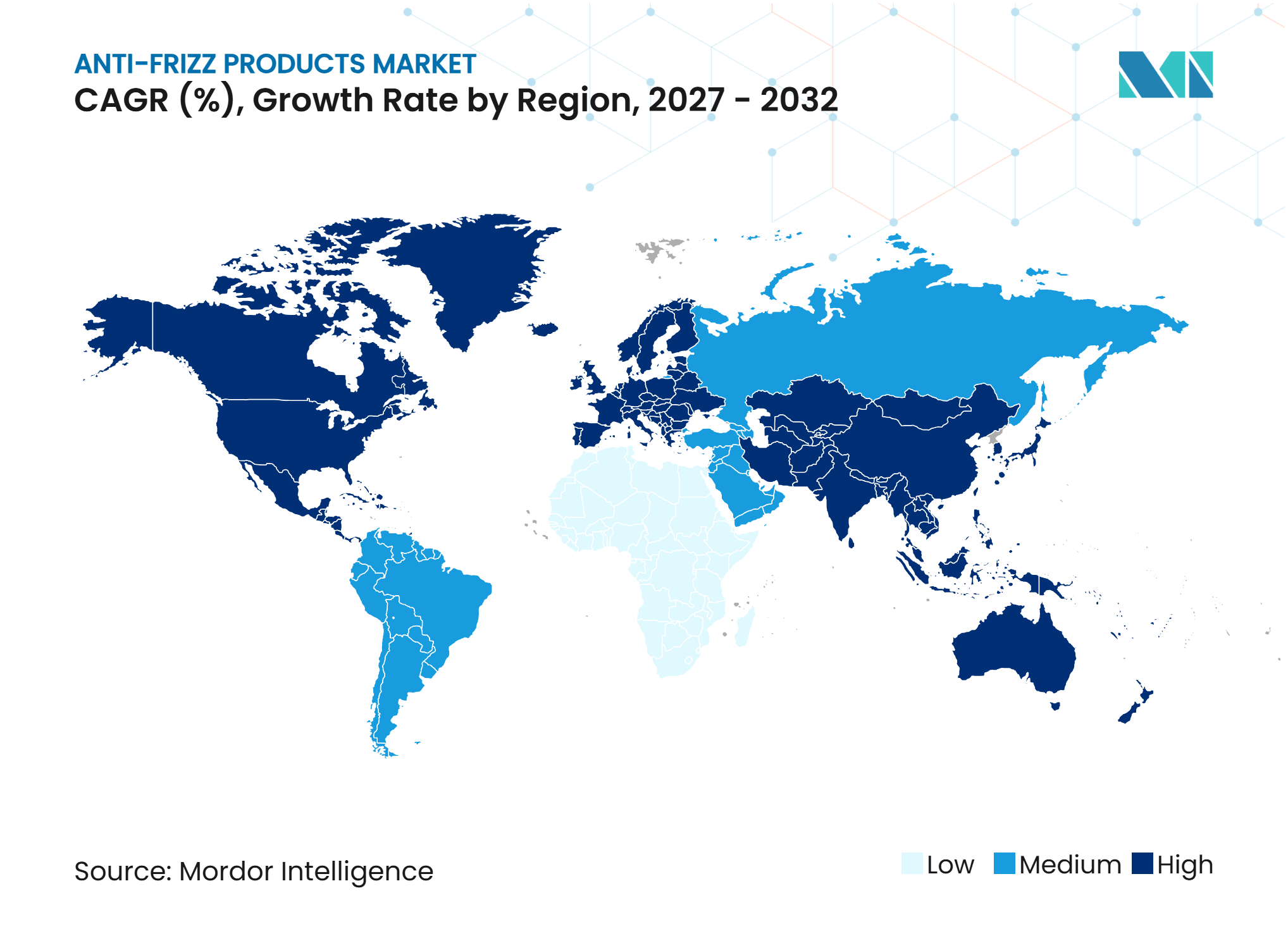
North America held 39.58% of the anti-frizz products market share in 2026. Demand reflects established haircare spending, a broad range of hair textures, and a strong connection between social content and product discovery. Humid southeastern states, dry western areas, and variable northeastern conditions create different frizz-management needs within the United States. This gives companies an incentive to communicate product use by climate and hair type. North American consumers also show interest in science-led performance claims and specialized treatment formats. L'Oréal's controlled humidity testing work illustrates how technical validation is becoming more visible in product development. Regulatory influence includes U.S. Food and Drug Administration rules on cosmetic safety and labeling, which make appropriate substantiation important for consumer trust[3].
Asia-Pacific
Asia-Pacific is projected to grow at a 9.62% CAGR through 2032. China supports product discovery through live commerce and social platforms, where professional stylists and ingredient-focused creators can turn demonstrations into purchases. India contributes demand through humid conditions, growing organized retail access, and greater interest in branded specialty haircare. South Korea and Japan add higher-value demand through product innovation and demanding efficacy expectations. Vietnam and Indonesia offer additional room for growth as organized retail and e-commerce continue to expand. The anti-frizz products market size in Asia-Pacific benefits from the combination of large consumer populations and varied climate conditions. Companies need to adapt product formats and price points to local routines rather than treat the region as a single consumer group.
Europe, South America, and Middle East and Africa
Europe is influenced by sustainability rules and consumer interest in treatment formats. European companies must consider microplastics restrictions and ingredient requirements under the EU Cosmetics Regulation when they reformulate products. South America is important for anti-frizz care because Brazil has diverse hair textures and strong use of multi-step hair routines. Product development in Brazil can provide useful evidence on formulations for curly, coily, and mixed-texture hair. The region also supports demand for leave-in products and treatment formats that work in humid conditions. In the Middle East and Africa, high humidity in Gulf states and tropical parts of West and East Africa supports demand for professional-grade serums and leave-in treatments. The United Arab Emirates and Saudi Arabia act as premium import markets, while South Africa and Nigeria are important volume markets.
Competitive Landscape
Market Concentration
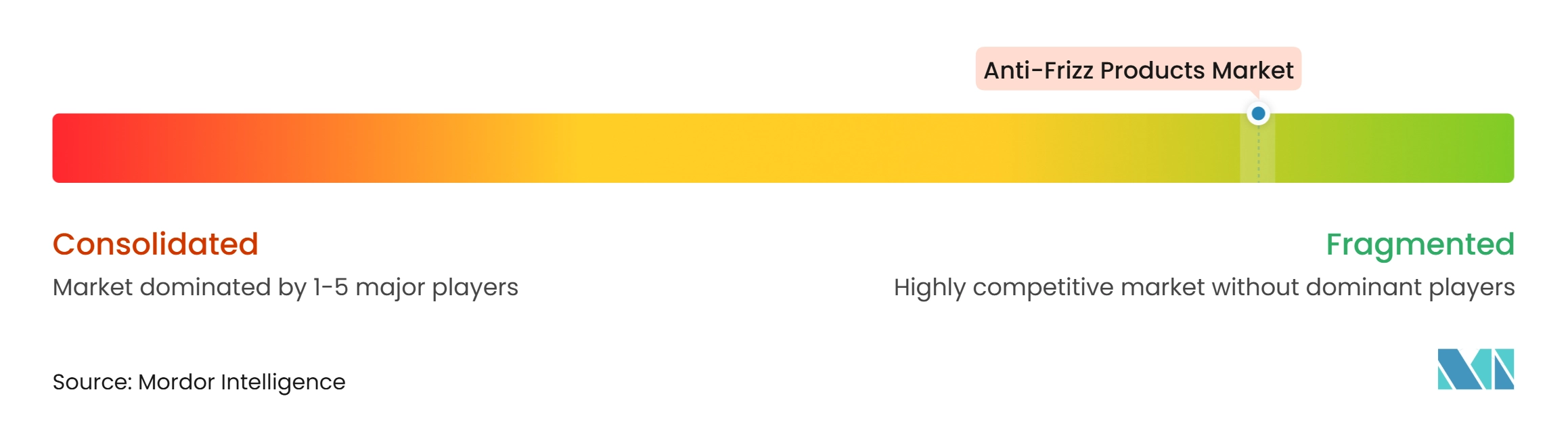
The anti-frizz products market is fragmented. Global companies such as L'Oréal S.A., Unilever Plc, and Henkel compete with professional haircare specialists and digitally native brands. The lack of a single dominant supplier leaves room for focused products and new category claims. It also raises competition on price and makes loyalty harder to maintain. Companies can strengthen their position through formula performance, retailer access, and credible technical claims. Ingredient transparency is also becoming a more visible part of competition in clean-beauty segments.
Acquisitions have become an important way for large companies to add specialized haircare capabilities. Henkel completed its acquisition of Olaplex in July 2026 for USD 1.4 billion, expanding its position in premium, science-led haircare. Henkel also completed the acquisition of Not Your Mother's in April 2026, adding a fast-growing consumer haircare and styling brand in the United States. L'Oréal signed an agreement to acquire Color Wow in June 2025 to strengthen its premium haircare portfolio. These moves show that companies value specialized anti-frizz, curl, and repair platforms that would take time to build internally.
Technology remains an important point of differentiation across the anti-frizz products market. Unilever used its 2026 TRESemmé Professional relaunch to introduce KeraKinetic, GlutaHydrator, and Lamellar Gloss technologies. Olaplex introduced No. 3+ in March 2026, combining its bond-building approach with a Damage Defense Cationic Complex in a 3-minute in-shower application. Amika used community-led promotion to build visibility during retail growth, showing how smaller brands can create momentum without relying only on traditional trade spending. Specialized formulas for 4A to 4C curl patterns and science-backed systems for men remain areas where brands can improve relevance. Companies that match product claims to specific hair needs can create a clearer reason to repurchase.
Anti-Frizz Products Industry Leaders
-
L’Oréal S.A.
-
Unilever PLC
-
Henkel AG & Co. KGaA
-
Procter & Gamble Company
-
Coty Inc.
- *Disclaimer: Major Players sorted in no particular order
Anti-Frizz Products Market Companies Covered in this Report
- L’Oréal S.A.
- Procter & Gamble Company
- Unilever PLC
- Henkel AG & Co. KGaA
- Moroccanoil Israel Ltd.
- Kao Corporation
- Coty Inc.
- The Estée Lauder Companies Inc.
- Shiseido Company, Limited
- Olaplex Holdings, Inc.
- Living Proof, Inc.
- John Paul Mitchell Systems
- Amika
- Briogeo Hair Care
- Ouidad
- Mizani
- Curlsmith
- Virtue Labs
- Pattern Beauty
- Davines Group
- The Honest Company, Inc.
Recent Industry Developments in Anti-Frizz Products Market
- October 2026: OGX, a haircare brand under Kenvue, announced the launch of its six-product Ionic Frizz Repair collection. The range included shampoo, conditioner, hair lamination mask, leave-in treatment, flyaway wand, and night repair serum. Formulated with Ionic Ceramide Technology, the products were designed to smooth frizz, strengthen damaged hair, and provide up to 72 hours of humidity-resistant smoothness.
- August 2026: Aussie launched its Ultra Smooth collection in collaboration with actress Antonia Gentry. The six-product range included shampoo, conditioner, detangling glaze, glossing shield, defining jelly, and style shield. Formulated with silk proteins and a blend of baobab, argan, jojoba, and grapeseed oils, the collection was designed to provide up to 96 hours of frizz and humidity control.
- November 2025: Indian haircare brand 2.Oh! launched its Anti-Frizz Hair Care Trio. The product range was developed to address frizz, dryness, and hair damage through a combination of haircare formulations. The collection focused on improving hair smoothness and shine while providing nourishment and protection against damage.
- September 2025: Brazilian haircare company Inoar introduced its RIVO FIO collection at Beauty Fair. The range included shampoo, conditioner, treatment mask, anti-frizz wax, oil blend, and heat-activated leave-in treatment. Formulated with niacinamide, AHA, and plant-based keratin, the collection was designed to improve hydration, strengthen hair fibres, and provide up to 72 hours of frizz control.
Global Anti-Frizz Products Market Report Scope
Anti-frizz products are hair care formulations designed to control frizz, reduce hair puffiness, smooth the hair cuticle, and improve manageability.
The anti-frizz products market report analyses the market based on product type, distribution channel, and geography. By product type, the market is segmented into serums, creams, sprays, shampoos, conditioners, hair masks, and other anti-frizz products. Based on distribution channels, the market is categorised into on-trade and off-trade channels, with off-trade further segmented into supermarkets/hypermarkets, convenience stores, online retail channels, and other distribution channels. Geographically, the report covers North America, Europe, Asia-Pacific, South America, and the Middle East and Africa. The market sizing has been done in value terms in USD for all the abovementioned segments.
Segmentation Overview
| Shampoos |
| Conditioners |
| Oils and Serums |
| Leave-In Creams |
| Others |
| Conventional |
| Natural/Organic |
| Men |
| Women |
| Supermarkets/Hypermarkets |
| Convenience Stores |
| Online Retail Channels |
| Other Distribution Channels |
| North America | United States |
| Canada | |
| Mexico | |
| Rest of North America | |
| Europe | Germany |
| United Kingdom | |
| France | |
| Italy | |
| Spain | |
| Netherlands | |
| Sweden | |
| Poland | |
| Belgium | |
| Rest of Europe | |
| Asia-Pacific | China |
| India | |
| Japan | |
| Australia | |
| South Korea | |
| Vietnam | |
| Indonesia | |
| Rest of Asia-Pacific | |
| South America | Brazil |
| Argentina | |
| Chile | |
| Peru | |
| Colombia | |
| Rest of South America | |
| Middle East and Africa | United Arab Emirates |
| Saudi Arabia | |
| South Africa | |
| Nigeria | |
| Rest of Middle East and Africa |
| Product Type | Shampoos | |
| Conditioners | ||
| Oils and Serums | ||
| Leave-In Creams | ||
| Others | ||
| Nature | Conventional | |
| Natural/Organic | ||
| End User | Men | |
| Women | ||
| Distribution Channels | Supermarkets/Hypermarkets | |
| Convenience Stores | ||
| Online Retail Channels | ||
| Other Distribution Channels | ||
| Geography | North America | United States |
| Canada | ||
| Mexico | ||
| Rest of North America | ||
| Europe | Germany | |
| United Kingdom | ||
| France | ||
| Italy | ||
| Spain | ||
| Netherlands | ||
| Sweden | ||
| Poland | ||
| Belgium | ||
| Rest of Europe | ||
| Asia-Pacific | China | |
| India | ||
| Japan | ||
| Australia | ||
| South Korea | ||
| Vietnam | ||
| Indonesia | ||
| Rest of Asia-Pacific | ||
| South America | Brazil | |
| Argentina | ||
| Chile | ||
| Peru | ||
| Colombia | ||
| Rest of South America | ||
| Middle East and Africa | United Arab Emirates | |
| Saudi Arabia | ||
| South Africa | ||
| Nigeria | ||
| Rest of Middle East and Africa | ||
Key Questions Answered in the Report
How large is the anti-frizz products market?
The market is projected to rise from USD 6.23 billion in 2026 to USD 10.03 billion by 2032 at an 8.41% CAGR.
Which anti-frizz product type is growing fastest?
Conditioners are projected to grow at a 9.44% CAGR through 2032 as consumers add more treatment and moisture-focused steps.
Which sales channel is expanding fastest for anti-frizz products?
Online retail is forecast to grow at a 9.89% CAGR through 2032 because it improves discovery for texture-specific products.
Which region is forecast to grow fastest for anti-frizz products?
Asia-Pacific is projected to expand at a 9.62% CAGR through 2032, supported by demand in China, India, South Korea, Japan, Vietnam, and Indonesia.