
Anhydrite Market Size and Share
Market Overview
| Study Period | 2021 - 2031 |
|---|---|
| Market Size (2026) | USD 1.44 Billion |
| Market Size (2031) | USD 1.86 Billion |
| Growth Rate (2026 - 2031) | 5.35 % |
| Fastest Growing Market | Asia-Pacific |
| Largest Market | Asia-Pacific |
| Market Concentration | Medium |
Major Players *Disclaimer: Major Players sorted in no particular order Image © Mordor Intelligence. Reuse requires attribution under CC BY 4.0. | |
Anhydrite Market Analysis by Mordor Intelligence
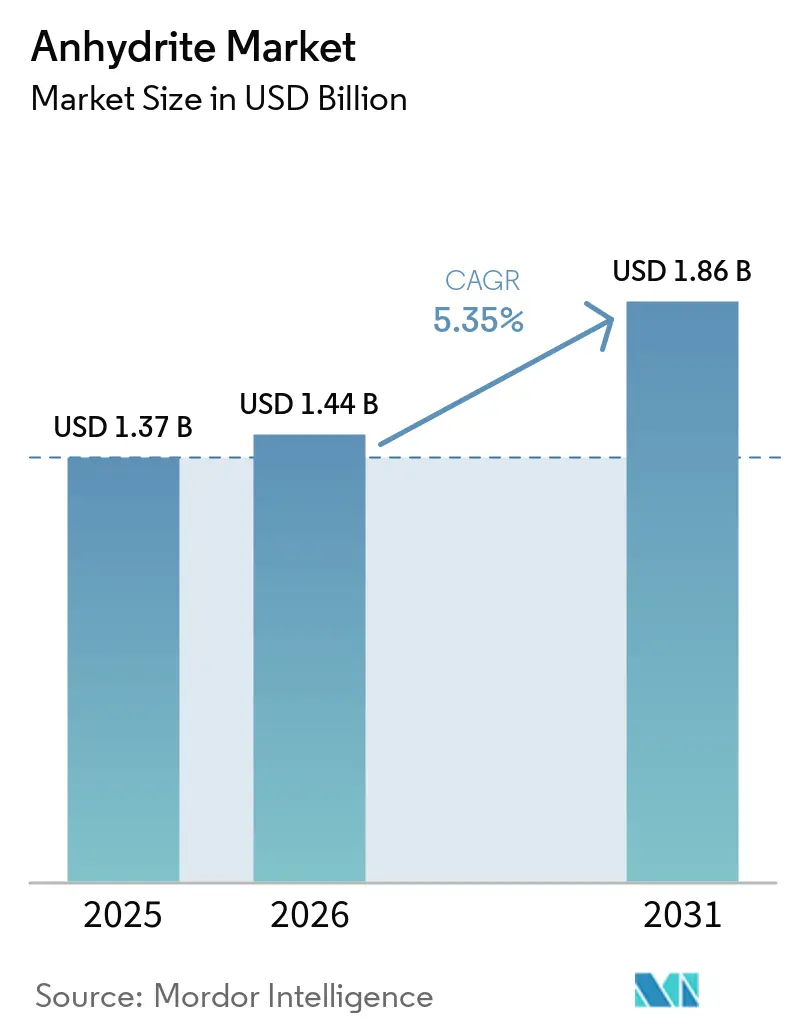
The anhydrite market size was estimated at USD 1.37 billion in 2025 and is estimated to grow from USD 1.44 billion in 2026 to USD 1.86 billion by 2031, at a CAGR of 5.35% during the forecast period (2026-2031). The anhydrite market is supported by established demand from cement production, floor screed systems, and agricultural soil treatment. Calcium sulfate screeds remain relevant for large flooring projects due to their compatibility with underfloor heating and ease of placement. Industrial recovery of sulfate-bearing by-products broadens the available supply base. Competition increasingly depends on reliable feedstock quality and consistent mineral composition. The market is also exposed to freight costs, gypsum substitution, and evolving cement formulations that may alter sulfate demand.
Key Report Takeaways
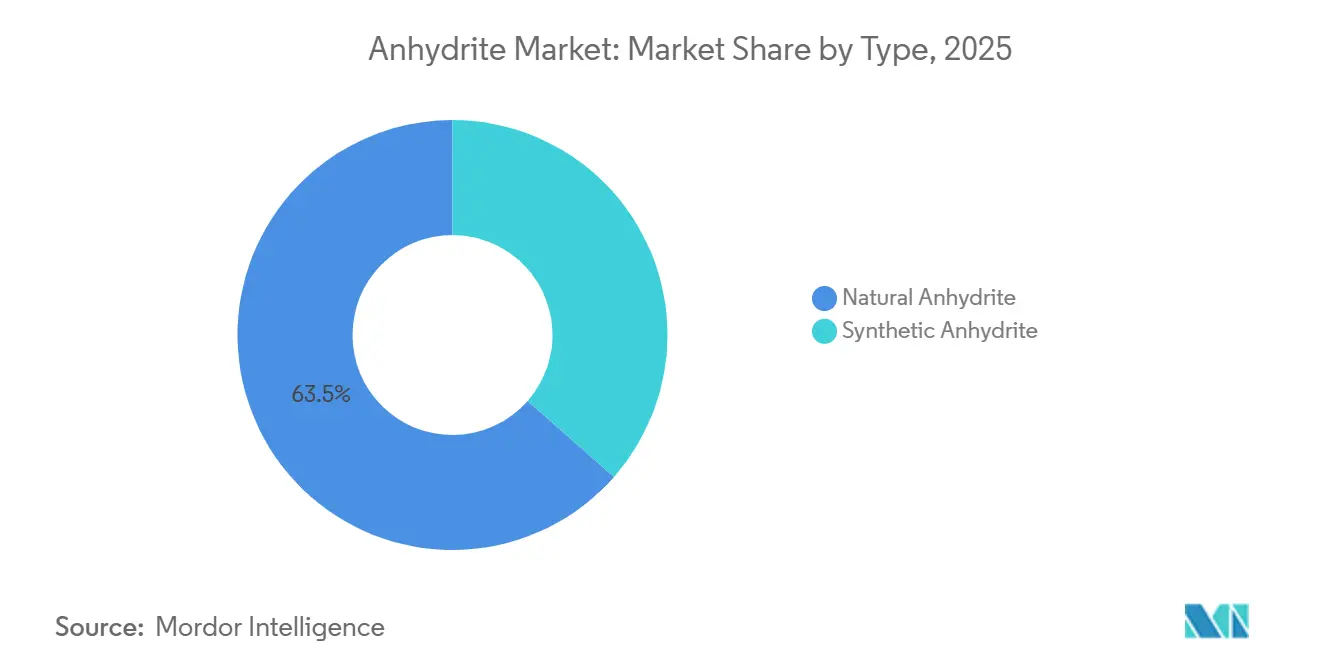
- By type, natural anhydrites held 63.53% of the anhydrite market share in 2025, while synthetic anhydrites are forecast to grow at a 6.06% CAGR through 2031.
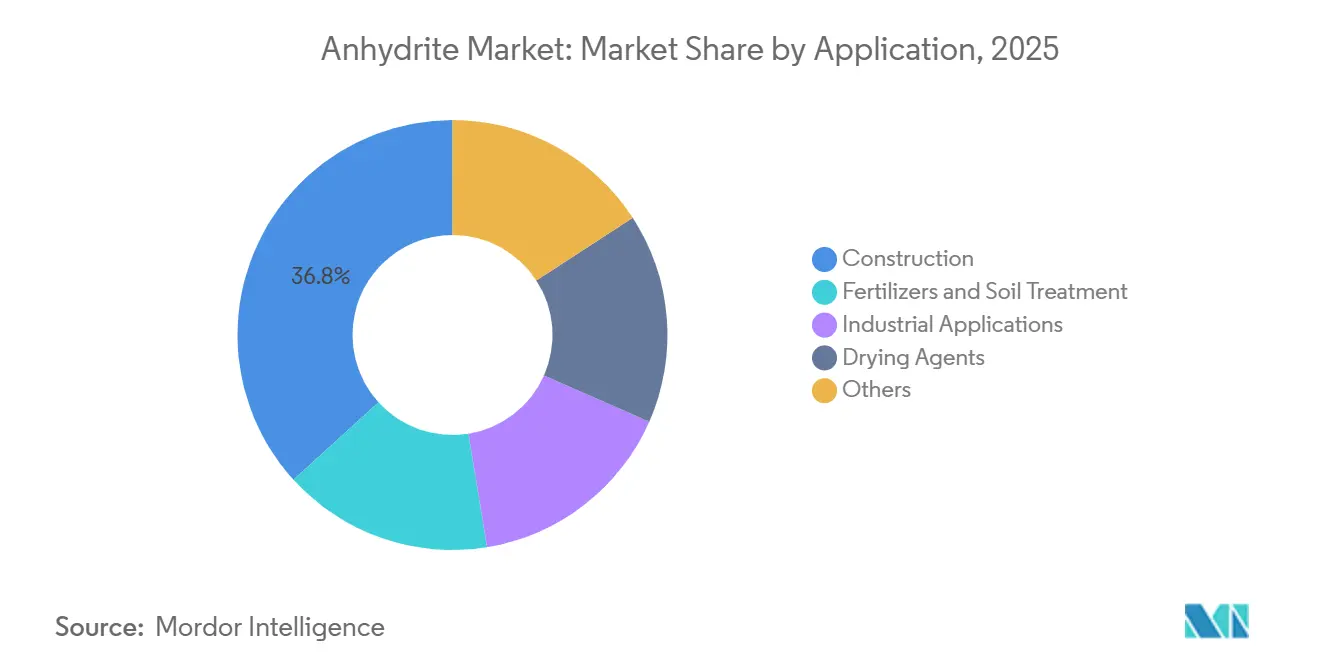
- By application, construction accounted for 36.75% of the anhydrite market share in 2025, while fertilizers and soil treatment are forecast to expand at a 6.55% CAGR through 2031.
- By geography, Asia-Pacific held 39.06% of the anhydrite market share in 2025 and is forecast to grow at a 6.43% CAGR through 2031.
Note: Market size and forecast figures in this report are generated using Mordor Intelligence’s proprietary estimation framework, updated with the latest available data and insights as of January 2026.
Market Trends and Insights
Drivers Impact Analysis of Anhydrite Market*
| Drivers | (~) % Impact on CAGR Forecast | Geographic Relevance | Impact Timeline |
|---|---|---|---|
| Expansion of Self-Leveling Floor Screeds | +1.5% | Europe, North America, Asia-Pacific (APAC) | Medium term (2-4 years) |
| Cement Set-Control and Sulfate Optimization Demand | +1.2% | Global, with APAC centered on India and China | Short term (≤ 2 years) |
| Industrial By-Product Valorization | +1.3% | APAC, Europe, and North America | Medium term (2-4 years) |
| Agricultural Calcium and Sulfur Deficiency Management | +0.9% | South Asia, Sub-Saharan Africa, and Southeast Asia | Long term (≥ 4 years) |
| Low-Carbon Binder and Circular Construction Specifications | +1.1% | Europe, North America, and APAC | Medium term (2-4 years) |
| High-Purity Anhydrite for Specialty Formulations | +0.6% | North America, Europe, Japan, and South Korea | Long term (≥ 4 years) |
| Source: Mordor Intelligence | |||
Expansion of Self-Leveling Floor Screeds
Anhydrite-based calcium sulfate screeds can be placed at rates of up to 2,000 m² per day with a small crew. This throughput is approximately 20 times that of traditional sand-and-cement screeds, supporting their use where labor costs are high or large open-plan floors are specified. The anhydrite market benefits when underfloor heating projects require materials with lower shrinkage and improved heat-transfer characteristics. LKAB Minerals offers Gypsol TS-15 for commercial flooring applications at depths as low as 15 mm. Lower application depths reduce material use per square meter of floor while maintaining the required screed performance. In January 2026, LANXESS received Environmental Product Declarations from Institut Bauen und Umwelt for CAB 30 under DIN EN 13454, supporting its use in European green-building projects[1].
Cement Set-Control and Sulfate Optimization Demand
Anhydrite II regulates early ettringite formation during clinker hydration by releasing sulfate ions. Research published in 2025 found that anhydrite could replace natural gypsum in CEM I and CEM II cements with comparable or stronger compressive-strength results at an SO₃ addition level of approximately 3.5% by weight. The anhydrite market, therefore, depends on cement mills that require mineralogically consistent sulfate sources. The U.S. Geological Survey reported world gypsum and anhydrite mine production of 160 million tons in 2025, down from 162 million tons in 2024. New clinker grinding circuits in India and China present opportunities for anhydrite suppliers to qualify their products before established gypsum suppliers secure long-term contracts.
Industrial By-Product Valorization
Synthetic anhydrite from fluorochemical production and flue-gas desulfurization expands supply options for the anhydrite market. Fluoroanhydrite can achieve a CaSO₄ content of approximately 99%, supporting premium screed and specialty applications that require consistent purity. Derivados Del Fluor supplies industrial, crushed, and micronized anhydrite grades for cement, screed, and fertilizer applications from a single fluorochemical process. CASEA produces thermal anhydrite at its Dorste facility in Germany and also works with gypsum recycling streams. This model links regional calcium sulfate supply to industrial assets rather than natural deposits alone. A 2025 Chemical Engineering Journal study reported that rapid Joule heating converted flue-gas desulfurization gypsum into calcium sulfide within 10 seconds at 600°C, indicating additional recovery pathways.
Low-Carbon Binder and Circular Construction Specifications
Calcium sulfate binders have lower manufacturing emissions per ton than Portland cement clinker. This supports the anhydrite market, where procurement requires evidence of lifecycle assessments and lower-carbon construction inputs. In January 2026, LANXESS received Environmental Product Declarations (EPDs) for CAB 30, confirming its eligibility under DIN EN 13454 and compliance with Belgian Volatile Organic Compound (VOC) requirements. Holcim recycled 8 million tons of construction and demolition materials in 2025 and has set a target of more than 20 million tons by 2030. It reported net sales of CHF 550 million (USD 680.18 million) in 2025 from products containing construction and demolition materials. Recycled gypsum that achieves certification at scale can compete with mined anhydrite in European secondary supply chains and reduce procurement costs in high-demolition areas.
Restraints Impact Analysis of Anhydrite Market*
| Restraints | (~) % Impact on CAGR Forecast | Geographic Relevance | Impact Timeline |
|---|---|---|---|
| Substitution by Gypsum and Supplementary Cementitious Materials | -1.5% | Global, with greater exposure in North America and Europe | Short term (≤ 2 years) |
| Geographic Concentration and Freight Exposure | -0.8% | Landlocked markets in the Middle East and Africa (MEA), Central Asia, and South America | Medium term (2-4 years) |
| Synthetic-Grade Variability and Qualification Requirements | -0.5% | Global, with greater exposure to the EU and North America | Medium term (2-4 years) |
| Limited Agronomic Field Validation for Anhydrite-Based Amendments | -0.4% | South Asia, Sub-Saharan Africa, and Southeast Asia | Long term (≥ 4 years) |
| Source: Mordor Intelligence | |||
Substitution by Gypsum and Supplementary Cementitious Materials
Natural gypsum and synthetic flue-gas desulfurization gypsum retain cost advantages in wallboard and plasterboard applications, where moisture resistance is manageable. Gypsum dihydrate also sets more quickly in formulations that prioritize rapid strength development. These conditions limit the anhydrite market in selected residential construction applications. Fly ash, slag, and silica fume have gained wider engineering acceptance in North American composite cement systems. Heidelberg Materials commissioned calcined clay production at its Airvault cement plant in France in May 2026, with an option to further reduce clinker content[2]. As low-clinker formulations develop, sulfate requirements may shift, reducing the use of anhydrite per metric ton of finished cement.
Geographic Concentration and Freight Exposure
High-quality natural anhydrite deposits are concentrated in Central Europe, the Arabian Peninsula, and selected locations in the Asia-Pacific. This distribution places inland markets in South America, Central Asia, and Sub-Saharan Africa at a freight disadvantage. Synthetic production also follows fluorochemical and coal-fired industrial locations rather than demand centers. As a result, the anhydrite market can face supply constraints where neither suitable deposits nor industrial recovery facilities exist. Landlocked users often rely on rail or road freight from port-connected production centers. Freight volatility can narrow producer margins and limit premiums for material that meets exact specifications.
*Our forecasts treat driver/restraint impacts as directional, not additive. The impact forecasts reflect baseline growth, mix effects, and variable interactions.
Anhydrite Market Segment Analysis
By Type:
Natural Anhydrite Provides Scale, While Synthetic Grades Support Precision ApplicationsNatural anhydrite held 63.53% of the anhydrite market share in 2025. Its position reflects the presence of established evaporite deposits in Europe, the Middle East, and Asia. The material serves as a bulk input for cement set control and floor screed binders. A single quarry can supply grades ranging from cement mill feed to micronized products for dry-mix mortars. Demand from large integrated cement operations in China supports a stable offtake. This scale advantage enables producers to utilize extraction assets across multiple end uses. The segment also benefits from a cost structure suited to high-quantity applications. Cement grinding mills use anhydrite as a sulfate source in clinker grinding. CASEA processes natural and thermal anhydrite at facilities in Germany and Spain. Its offering demonstrates how access to multiple feedstock types can reduce exposure to fluctuations in the supply of flue-gas desulfurization gypsum. The anhydrite market remains dependent on consistent quality, even in high-quantity applications. Suppliers with secure deposits can support long-term cement and screed contracts.
Synthetic anhydrite is projected to grow at a 6.06% CAGR from 2026 to 2031. The anhydrite market size for synthetic material is supported by tighter natural supply in Western Europe and demand for high-purity calcium sulfate. Fluoroanhydrite is produced during hydrofluoric acid production and can reach a CaSO₄ content near 99%. Derivados Del Fluor and Fluorsid supply materials for premium screed and specialty chemical applications. These grades can require less post-processing than inconsistent natural material. Their composition can be useful in applications with stricter performance requirements. Research published in 2024 showed that activated fluoroanhydrite binders could achieve compressive strength comparable to that of natural anhydrite. This supports its technical use in structural flooring systems. LKAB Minerals markets Anricite for self-leveling compounds, adhesives, and industrial formulations. Engineered consistency creates a differentiated tier in the anhydrite market and can support premium pricing for users who need predictable mineral behavior. Synthetic supply remains tied to the location and continuity of industrial source streams.

By Application:
Construction Holds the Largest Share, While Agriculture Records Faster GrowthConstruction accounted for 36.75% of the anhydrite market share in 2025. Its demand base includes floor screed binders and cement set regulators. New residential construction in Europe and Asia-Pacific increasingly specifies calcium sulfate screeds for underfloor heating systems. The revised EU Energy Performance of Buildings Directive supports materials that improve building thermal performance. Floor systems with improved heat transfer can meet these requirements. Construction demand, therefore, remains central to the anhydrite market. A 2026 study found that partial replacement of Portland cement with anhydrous calcium sulfate in cement-bound granular mixtures increased long-term compressive strength by up to 180%. This supports the use of calcium sulfate in lower-cement road and pavement subbases. Industrial applications, drying agents, and other uses account for the remaining application demand. Anhydrous CaSO₄ acts as a desiccant in pharmaceutical, electronics, and laboratory settings. Pharmaceutical contract manufacturing in India and Southeast Asia supports demand for these specialty uses, providing a higher-value tier within the anhydrite market.
Fertilizers and soil treatment are forecast to grow at a 6.55% CAGR from 2026 to 2031. Sulfur and calcium deficiencies in South Asian paddy belts, Sub-Saharan farms, and intensively cropped Brazilian soils support this demand. Anhydrite-based amendments add sulfur and calcium without altering soil pH, which is useful for acid-sensitive crops for which lime-based pH adjustment is unsuitable. The lower solubility of anhydrite relative to gypsum dihydrate can slow nutrient release, limiting its use where crops require sulfur quickly. Micronized synthetic anhydrite with particles below 50 microns is intended to improve dissolution performance. Field trials in Brazil and Australia are comparing agronomic results at equivalent sulfur loading rates, and their results could broaden the use of anhydrite in soil treatment during the later forecast period. The anhydrite market size in fertilizers depends on validated performance across local soils and crop cycles. Certified agronomic evidence is especially important for tropical farming regions. Products that combine fine particle size with dependable nutrient release can address the current limitation.
Geography Analysis
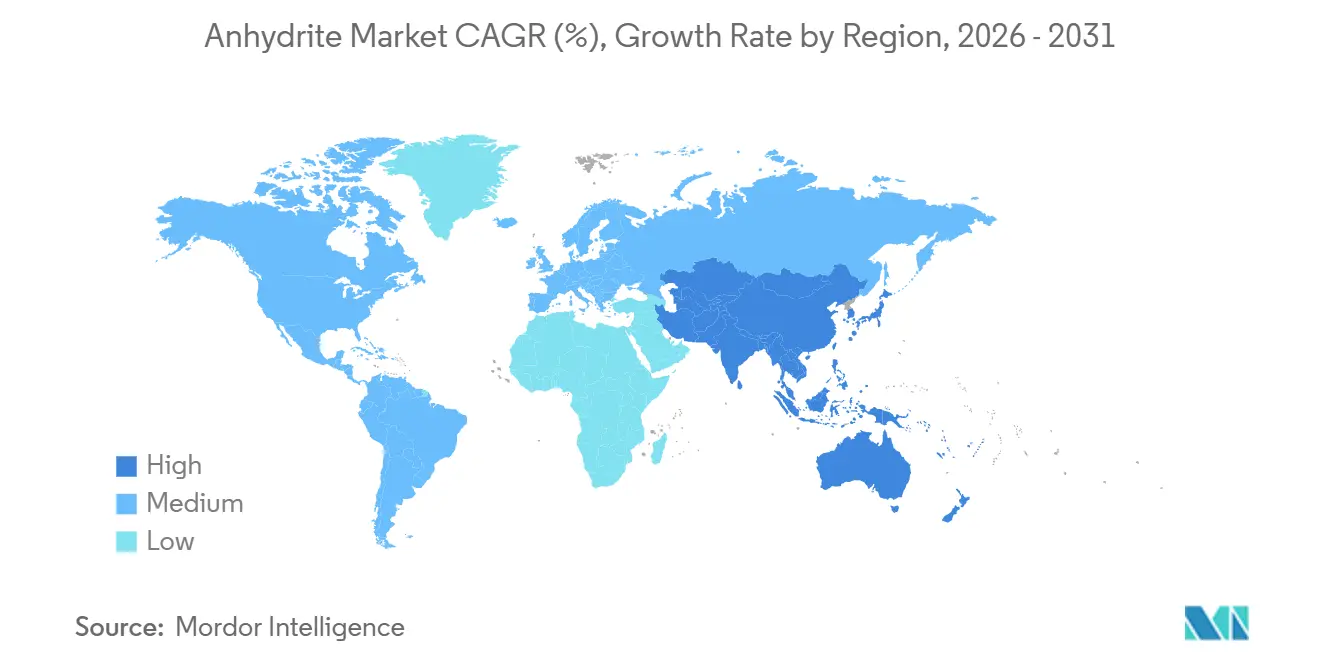
APAC Anhydrite Market
Asia-Pacific held 39.06% of the anhydrite market share in 2025 and is projected to grow at a 6.43% CAGR through 2031. China's clinker grinding capacity of 3.1 billion tons per year and India's expanding cement sector support regional demand. China's retirement of coal-fired power units may reduce the availability of flue-gas desulfurization gypsum, potentially tightening the regional calcium sulfate supply balance. Japan and South Korea sustain demand through industrial by-product use and advanced construction-material standards.
ASEAN and India Anhydrite Market
ASEAN countries, including Vietnam and Indonesia, are additional demand centers as urbanization supports cement consumption. India produces more than 600 million tons of cement annually, and its demand for anhydrite follows additions in cement capacity. A change in sulfate specifications at even some Indian grinding mills could substantially increase demand. The Asia-Pacific anhydrite market is also shaped by regional suppliers' ability to provide consistent feedstock. Infrastructure cycles in China and India make cement-related offtake an important source of demand stability.
The Americas and EMEA Anhydrite Market
Europe and North America have more developed application mixes for anhydrite. European producers operate under DIN EN 13454 and BS EN 13813 requirements for calcium sulfate screed binders. Renovation activity linked to building energy performance requirements supports demand for high-performance floor leveling. U.S. apparent gypsum consumption reached 44 million tons in 2025. South America, the Middle East, and Africa offer smaller but relevant opportunities through Brazilian soil treatment, Saudi construction, and Omani exports to South Asia and East Africa. The anhydrite market in these regions remains sensitive to local production, port access, and freight costs.
Competitive Landscape
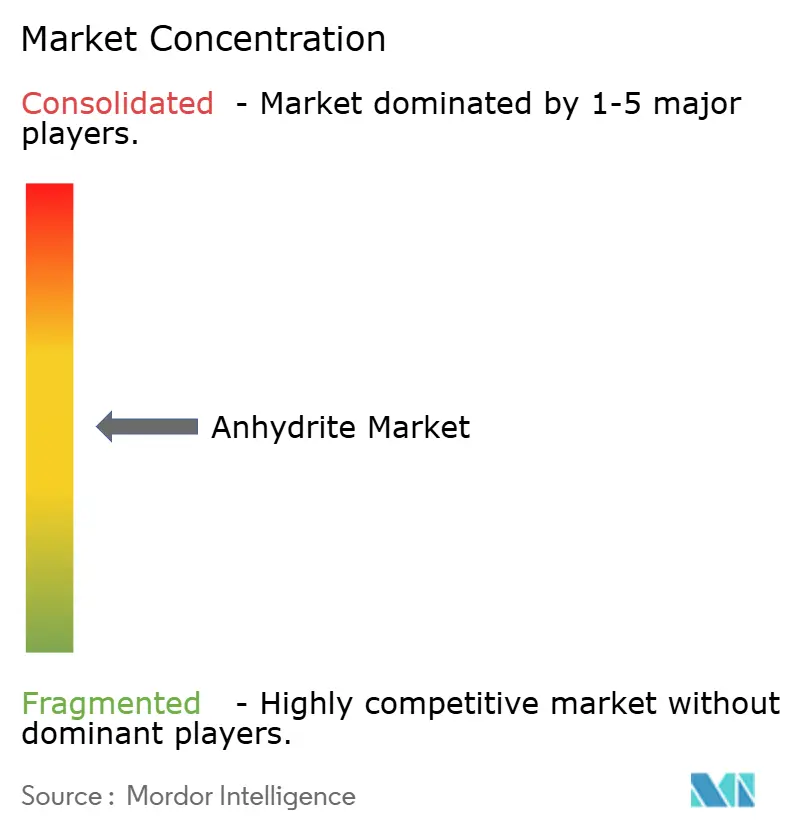
The anhydrite market is moderately fragmented. Knauf Group, Saint-Gobain, and Heidelberg Materials operate diversified building materials businesses. These companies consume anhydrite in their own systems and compete through distribution, integrated products, and sustainability credentials. Specialist suppliers include LKAB Minerals, CASEA, Derivados Del Fluor, Fluorsid, and regional producers such as Vanich Gypsum. Their position depends on reliable by-product streams, mineral purity, and technical service. The market increasingly values qualified raw materials over manufacturing scale alone.
In January 2026, Knauf confirmed plans for a gypsum recycling plant in Bavaria, developed in partnership with BSR Ingolstadt. The plant is intended to convert demolition plasterboard into recycled gypsum feedstock for Knauf's network by early 2027. This approach strengthens raw material security and expands circular supply options. In September 2025, Saint-Gobain Canada inaugurated a zero-carbon Scope 1 and 2 gypsum wallboard plant in Sainte-Catherine, Quebec, following electrification upgrades. The facility uses renewable electricity and establishes a lower-emissions reference point for suppliers. Heidelberg Materials' Airvault calcined clay project reflects a competing effort to reduce clinker use in cement.
Key competitive strategies focus on recycled or by-product feedstocks, verified lower-carbon credentials, and expansion into higher-demand growth areas. Process development also targets lower energy use in flue-gas desulfurization gypsum conversion. Surface treatment work aims to improve anhydrite adhesion in coatings and plastics applications. Certified micronized grades for tropical agriculture remain an open area of competition. Smaller specialists also supply high-purity synthetic anhydrite for pharmaceutical desiccants and electronics.
Anhydrite Industry Leaders
-
Knauf Group
-
Saint-Gobain
-
Fluorsid
-
HOLCIM
-
Heidelberg Materials AG
- *Disclaimer: Major Players sorted in no particular order
Anhydrite Market Companies Covered in this Report
- Buzzi S.p.A.
- Derivados Del Fluor
- Etex Group
- Fluorsid
- Georgia-Pacific LLC
- Heidelberg Materials AG
- HOLCIM
- Knauf Group
- LKAB Minerals
- REMONDIS SE & Co. KG
- Saint-Gobain
- Siniat
- USG Corporation
- Vanich Gypsum Co., Ltd.
- ZKG International
Recent Industry Developments in Anhydrite Market
- June 2026: Knauf Gips Romania confirmed that the structural framework at its EUR 88 million (USD 102.09 million) anhydrite plasterboard plant in Huedin, Cluj County, is 65% complete, with roof installation underway. The facility is scheduled to be operational by the end of 2027 and will produce 30 million m² of gypsum boards annually, sourcing raw materials from the Leghia Dumbrava gypsum quarries, located approximately 15 km away.
- September 2025: Saint-Gobain Canada inaugurated North America's first zero-carbon Scope 1 and 2 anhydrite gypsum wallboard plant at its CertainTeed facility in Sainte-Catherine, Quebec, following major electrification upgrades that enabled 100% renewable electricity operation.
Global Anhydrite Market Report Scope
Anhydrite is a rock-forming mineral composed of anhydrous calcium sulfate (CaSO₄), typically found in sedimentary basins where ancient lakes or seas evaporated. It appears as a white, grey, or pale blue mineral that is chemically identical to gypsum, except that it lacks water in its crystal structure.
The anhydrite market is segmented by type, application, and geography. By type, the market is segmented into natural anhydrite and synthetic anhydrite. By application, the market is segmented into construction, fertilizers and soil treatment, industrial applications, drying agents, and others. The report also covers market size and forecasts for anhydrite across 15 countries in major regions. The market sizes and forecasts are provided in terms of value (USD).
Segmentation Overview
| Natural Anhydrite |
| Synthetic Anhydrite |
| Construction |
| Fertilizers and Soil Treatment |
| Industrial Applications |
| Drying Agents |
| Others |
| Asia-Pacific | China |
| India | |
| Japan | |
| South Korea | |
| ASEAN Countries | |
| Rest of Asia-Pacific | |
| North America | United States |
| Canada | |
| Mexico | |
| Europe | Germany |
| United Kingdom | |
| France | |
| Italy | |
| NORDIC Countries | |
| Rest of Europe | |
| South America | Brazil |
| Argentina | |
| Rest of South America | |
| Middle East and Africa | Saudi Arabia |
| South Africa | |
| Rest of Middle East and Africa |
| By Type | Natural Anhydrite | |
| Synthetic Anhydrite | ||
| By Application | Construction | |
| Fertilizers and Soil Treatment | ||
| Industrial Applications | ||
| Drying Agents | ||
| Others | ||
| By Geography | Asia-Pacific | China |
| India | ||
| Japan | ||
| South Korea | ||
| ASEAN Countries | ||
| Rest of Asia-Pacific | ||
| North America | United States | |
| Canada | ||
| Mexico | ||
| Europe | Germany | |
| United Kingdom | ||
| France | ||
| Italy | ||
| NORDIC Countries | ||
| Rest of Europe | ||
| South America | Brazil | |
| Argentina | ||
| Rest of South America | ||
| Middle East and Africa | Saudi Arabia | |
| South Africa | ||
| Rest of Middle East and Africa | ||
Key Questions Answered in the Report
What is current market size of Anhydrite Market?
The anhydrite market size was estimated at USD 1.37 billion in 2025 and is estimated to grow from USD 1.44 billion in 2026 to USD 1.86 billion by 2031, at a CAGR of 5.35% during the forecast period (2026-2031).
Which type of anhydrite is growing fastest?
Synthetic anhydrite is the fastest-growing type, with a projected 6.06% CAGR from 2026 to 2031. Its growth is linked to consistent purity and the recovery of industrial by-products.
Which application has the highest demand for anhydrite?
Construction held the largest application share at 36.75% in 2025. Floor screeds and cement set regulation are the principal uses.
Why is anhydrite used in cement?
Anhydrite supplies sulfate ions that help regulate cement setting during clinker hydration. Consistent mineral composition is important for cement grinding operations.