
Angiostomy Cannula Market Size and Share
Market Overview
| Study Period | 2020 - 2031 |
|---|---|
| Market Size (2026) | USD 231.71 Million |
| Market Size (2031) | USD 332.80 Million |
| Growth Rate (2026 - 2031) | 7.51 % |
| Fastest Growing Market | Asia-Pacific |
| Largest Market | North America |
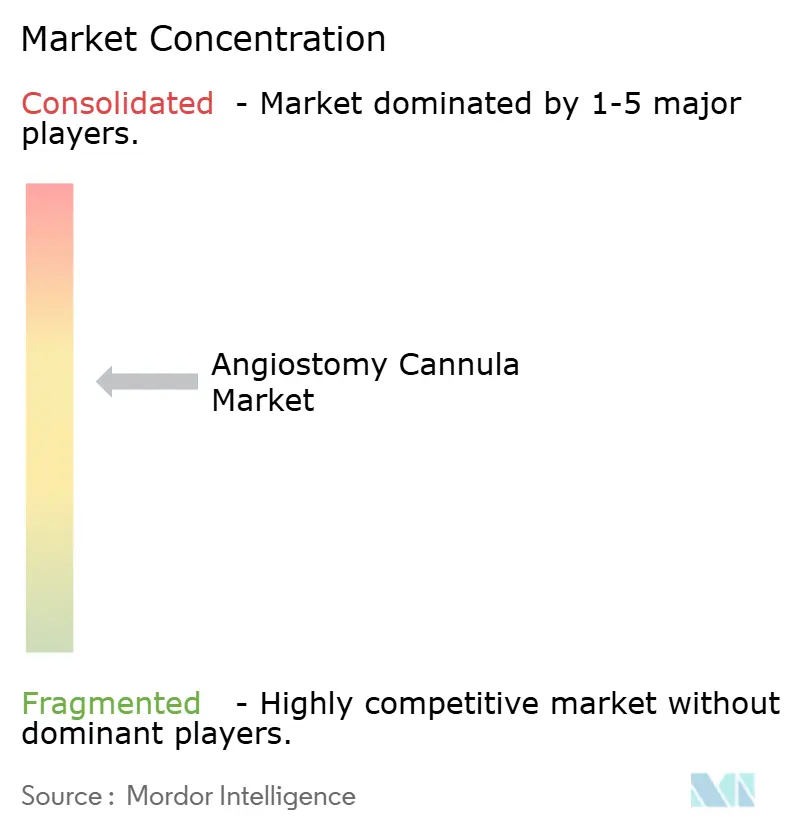
| Market Concentration | Medium |
Major Players *Disclaimer: Major Players sorted in no particular order Image © Mordor Intelligence. Reuse requires attribution under CC BY 4.0. | |
Angiostomy Cannula Market Analysis by Mordor Intelligence
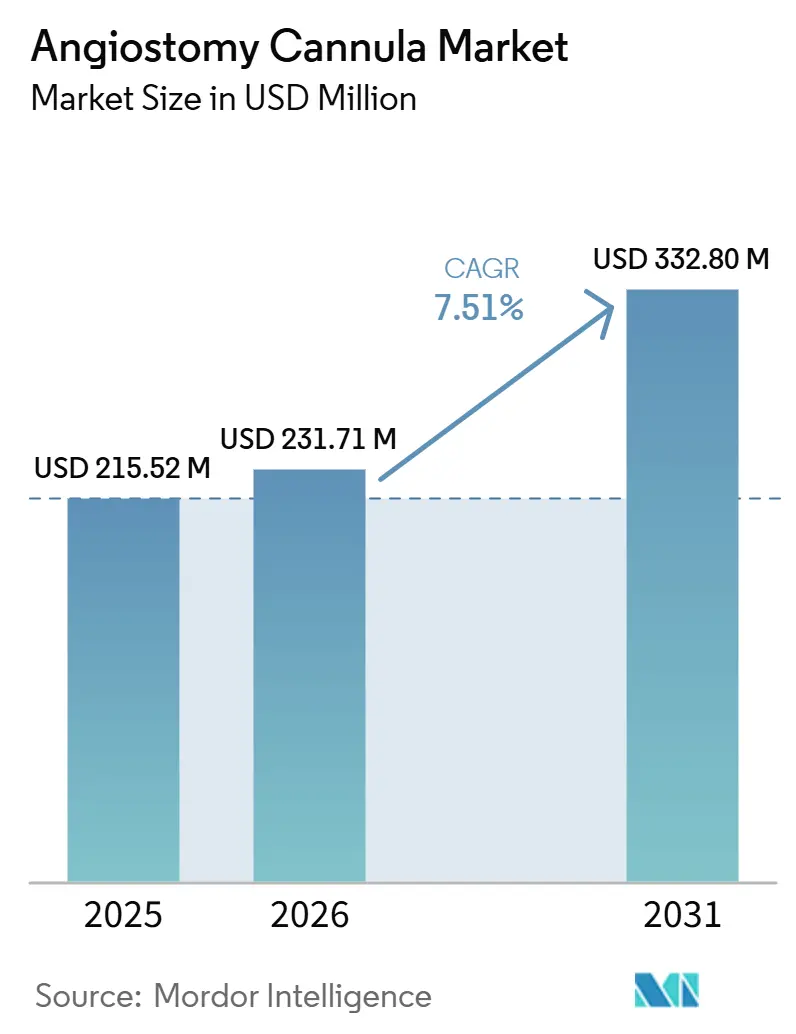
The Angiostomy Cannula Market size is expected to grow from USD 215.52 million in 2025 to USD 231.71 million in 2026 and is forecast to reach USD 332.80 million by 2031 at 7.51% CAGR over 2026-2031.
Growing cardiovascular disease burden supports continued demand for cardiac surgery, extracorporeal membrane oxygenation, and other procedures that require these devices. Demand is shifting toward acute care procedures, including cardiogenic shock, pulmonary embolism, and multiorgan failure, where device performance and clinical workflow carry greater weight. This shift favors specialized cannulas that can support high flow, atraumatic access, and tighter controls on reuse. Manufacturers are responding through integrated extracorporeal systems, percutaneous access designs, and materials intended to limit blood-contact complications. The angiostomy cannula market also has an opening in outpatient care as lower-acuity cardiovascular procedures move to ambulatory surgical centers under expanding reimbursement coverage.
Key Report Takeaways
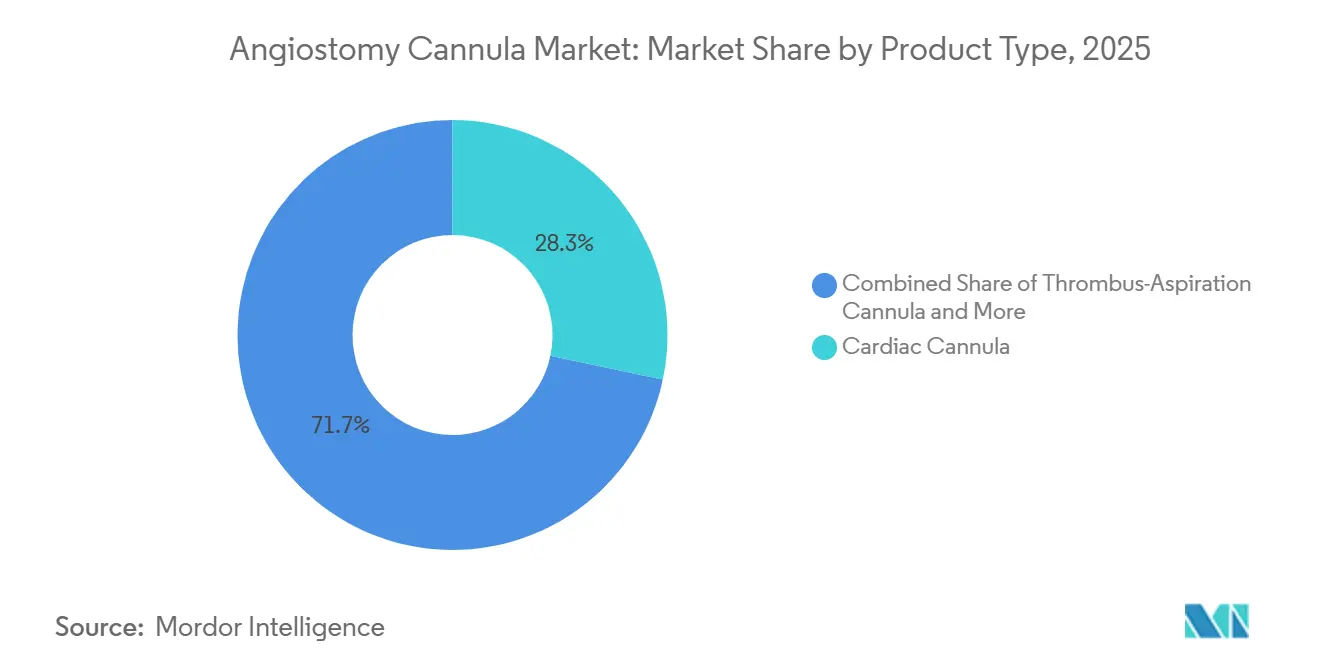
- By product type, cardiac cannulas held 28.31% of the angiostomy cannula market share in 2025, while thrombus-aspiration cannulas are projected to grow at a 9.58% CAGR through 2031.
- By cannulation site, aortic and arterial sites accounted for 42.24% of the angiostomy cannula market size in 2025, while femoral vascular sites are forecast to advance at an 8.22% CAGR through 2031.
- By material, polyvinyl chloride held 48.14% revenue share in 2025, while polyurethane is expected to register the highest CAGR of 8.82% through 2031.
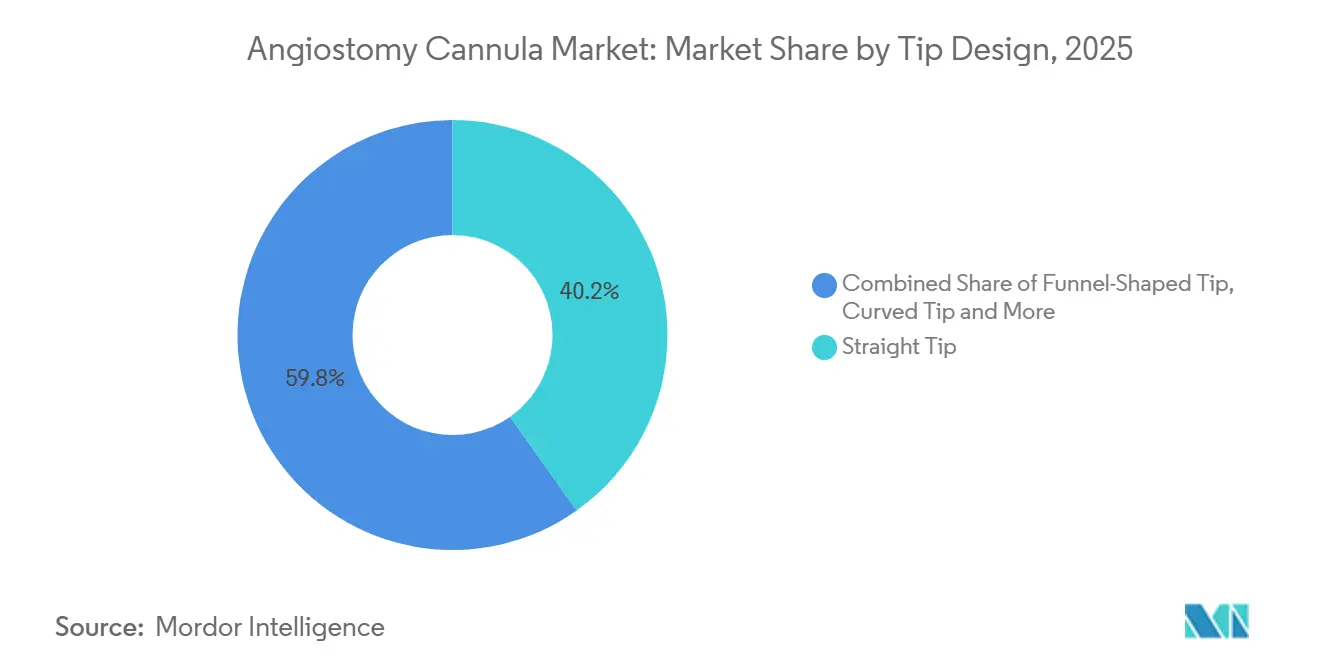
- By tip design, straight-tip cannulas accounted for 40.21% revenue share in 2025, while funnel-shaped tips are forecast to expand at an 8.85% CAGR through 2031.
- By application, cardiopulmonary bypass surgery held 28.62% revenue share in 2025, while percutaneous thrombus and embolus removal is projected to grow at a 10.25% CAGR through 2031.
- By end user, hospitals accounted for 60.65% revenue share in 2025, while ambulatory surgical centers are forecast to grow at an 8.95% CAGR through 2031.
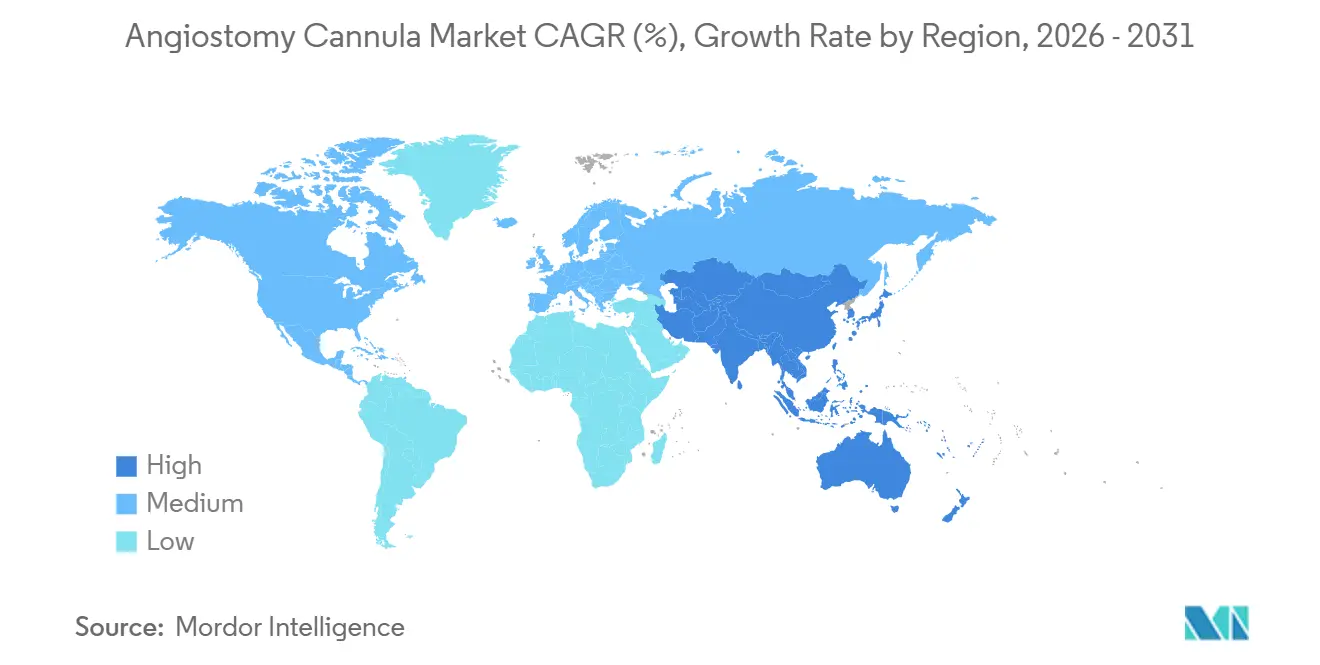
- By geography, North America held 45.61% revenue share in 2025, while Asia-Pacific is projected to record a 9.25% CAGR through 2031.
Note: Market size and forecast figures in this report are generated using Mordor Intelligence’s proprietary estimation framework, updated with the latest available data and insights as of January 2026.
Market Trends and Insights
Drivers Impact Analysis of Angiostomy Cannula Market*
| Driver | (~) % Impact on CAGR Forecast | Geographic Relevance | Impact Timeline |
|---|---|---|---|
| Rising Cardiovascular and Critical-Care Procedure Volumes | +1.8% | Global, especially North America, Europe, and APAC core | Medium term (2-4 years) |
| Expansion of ECMO and Extracorporeal Circulation Capability | +1.2% | North America and EU, rapid growth in APAC | Medium term (2-4 years) |
| Shift Toward Minimally Invasive and Percutaneous Cannulation | +1.1% | Global, early gains in Western Europe and North America | Short term (≤ 2 years) |
| Biocompatible, Kink-Resistant, and Low-Trauma Cannula Innovation | +0.9% | Global, concentrated in North America, Germany, and Japan | Long term (≥ 4 years) |
| Aging Population and Higher Chronic Disease Burden | +1.4% | Global, accelerated in Japan, Italy, GCC, and South Korea | Long term (≥ 4 years) |
| Cannula-Circuit Integration for Blood Conservation and Thrombus Removal | +0.7% | North America and EU, with spillover to GCC and APAC core | Medium term (2-4 years) |
| Source: Mordor Intelligence | |||
Rising Cardiovascular and Critical-Care Procedure Volumes
Cardiovascular disease remains a leading cause of death and disability worldwide, sustaining the clinical need for cardiac and critical-care procedures. The growing chronic disease burden also raises demand for surgical and circulatory support among older patients. Procedure demand differs by country because hospital capacity, clinical workforce availability, and public funding vary widely. Premium configurations remain more relevant in high-income systems, while cost-conscious, compliant products have a wider role in emerging care settings. The angiostomy cannula market benefits when manufacturers can offer both product tiers without compromising the clinical requirements of each setting. Aging populations in Japan, Italy, GCC countries, and South Korea reinforce the longer-term need for cardiac care capacity.
Expansion of ECMO and Extracorporeal Circulation Capability
Each additional ECMO program creates recurring demand for cannulas used across patient episodes rather than demand tied only to elective surgery. Venoarterial ECMO for cardiogenic shock requires large-bore arterial cannulas that can manage high flow and arterial pressure. A clinical report on preclosed femoral access documented the feasibility of fully percutaneous venoarterial ECMO in refractory cardiogenic shock[1]“Complete Percutaneous Angio-Guided Approach Using Preclosing for Venoarterial Extracorporeal Membrane Oxygenation in Patients with Refractory Cardiogenic Shock,” Critical Care, ccforum.biomedcentral.com. This clinical direction supports designs with reinforced shafts, reliable flow characteristics, and access features suited to urgent use. Cannula-circuit integration also supports blood conservation and thrombus removal, which can increase the value of a device beyond its role as a standalone consumable. The angiostomy cannula market therefore has a stronger link to intensive care program expansion than to elective procedure growth alone.
Shift Toward Minimally Invasive and Percutaneous Cannulation
Percutaneous femoral cannulation is increasingly used instead of surgical cut-down in minimally invasive cardiac procedures. The PROMISE registry reported that percutaneous cannulation with vascular closure devices was feasible and safe in minimally invasive heart valve surgery. A 2024 systematic review found that surgical femoral cannulation had more access-site complications, including wound complications and lymphatic fistula, than the percutaneous approach. These findings affect hospital purchasing criteria for dilators, flexible shafts, and clear ultrasound visibility. The angiostomy cannula market is likely to favor products designed for ultrasound-guided placement and dependable percutaneous access. Low-profile tips and kink-resistant structures are particularly relevant when procedures are performed with smaller incisions and shorter operating room time.
Biocompatible, Kink-Resistant, and Low-Trauma Cannula Innovation
Blood-contacting material development is extending beyond established heparin coatings toward approaches that address thrombosis, oxidative stress, and infection risk. A 2025 materials study reported improved anticoagulant and antioxidant properties for heparin, chitosan, and gallic-acid-crosslinked polyurethane composites. A review of ECMO cannula materials identified nitric oxide-releasing biomimetic surfaces as a potential route to limit platelet activation. These developments could support reduced-anticoagulation protocols in selected ECMO and cardiopulmonary bypass settings. Devices that reduce trauma while retaining resistance to kinking can address clinical safety and procedural reliability at the same time. In the angiostomy cannula market, material performance can therefore influence both clinical evaluation and premium product positioning.
Restraints Impact Analysis of Angiostomy Cannula Market*
| Restraint | (~) % Impact on CAGR Forecast | Geographic Relevance | Impact Timeline |
|---|---|---|---|
| Cannulation-Related Vascular Trauma and Thrombotic Risk | -0.8% | Global, with highest clinical impact in lower-volume and resource-constrained centers | Short term (≤ 2 years) |
| Shortage of Specialist Perfusion and Cannulation Personnel | -0.6% | North America and EU, most severe in rural and smaller hospitals | Long term (≥ 4 years) |
| Procedure Cost, Reimbursement, and Procurement Constraints | -0.7% | APAC, Middle East and Africa, and South America, systemic in China through volume-based procurement | Medium term (2-4 years) |
| Fragmented Nomenclature and Inconsistent Product Classification | -0.4% | Global, most acute in multijurisdictional procurement markets | Long term (≥ 4 years) |
| Source: Mordor Intelligence | |||
Cannulation-Related Vascular Trauma and Thrombotic Risk
Vascular access complications can limit procedure uptake and influence the specifications hospitals use when selecting cannulas. A 2025 prospective study reported a 79.5% incidence of internal jugular vein thrombosis after cannulation for cardiopulmonary bypass, although all thrombi in that cohort were asymptomatic and nonocclusive[2]“Prospective Evaluation of Thrombotic Complications After Internal Jugular Vein Cannulation for External Bypass,” Journal of Cardiothoracic and Vascular Anesthesia, doi.org. This risk increases interest in biocompatible coatings and shaft markings that support real-time imaging. Updated American Society of Echocardiography guidance recommends ultrasound guidance for central vascular access procedures. Centers with integrated imaging can manage access risk more consistently than lower-resource facilities. Cost, reimbursement, and procurement constraints can further slow adoption where hospitals cannot fund the imaging, training, or specialized products that lower this risk.
Shortage of Specialist Perfusion and Cannulation Personnel
The angiostomy cannula market faces a capacity constraint because device availability alone cannot replace certified perfusionists and cannulation specialists. Canada had approximately 375 certified perfusionists, nearly 40 vacancies, and more than 60 anticipated retirements within 5 years, according to reporting on the Canadian Society of Clinical Perfusion. Fewer than 25 accredited perfusion training programs in the United States are expected to constrain the supply of new specialists as cardiac surgery and ECMO programs expand. A 2026 study identified ECMO program growth as the leading source of new perfusionist demand for 31.6% of surveyed professionals. Hospitals may favor pressure-guided placement and integrated circuits that lower some procedural complexity, but they do not eliminate the need for trained teams. Differences in device nomenclature and classification across jurisdictions add another obstacle, extending authorization and procurement cycles for newer designs.
*Our forecasts treat driver/restraint impacts as directional, not additive. The impact forecasts reflect baseline growth, mix effects, and variable interactions.
Angiostomy Cannula Market Segment Analysis
By Product Type:
Thrombus-Aspiration Cannulas Redefining Portfolio PrioritiesCardiac cannulas accounted for 28.31% of the angiostomy cannula market in 2025, reflecting the sustained procedure volume of cardiopulmonary bypass, valve repair, and ECMO. Venous and arterial cannulas serve the large procedural base in open-heart surgery. Cardioplegia cannulas support myocardial protection through aortic root delivery and coronary sinus retrograde perfusion. Vascular cannulas contribute volume in peripheral bypass and revascularization settings.
Thrombus-aspiration cannulas are projected to grow at a 9.58% CAGR from 2026 to 2031, the fastest rate among product types. This growth reflects wider interest in catheter-based clot removal for cardiac and pulmonary care. The angiostomy cannula industry is expanding its product focus from conventional surgical use toward devices suited to interventional treatment pathways. The breadth of a supplier’s portfolio will matter as hospitals seek products for both established surgery and specialized aspiration procedures.



By Cannulation Site:
Femoral Access Emerging as the Percutaneous StandardAortic and arterial sites commanded 42.24% of the angiostomy cannula market share in 2025 because central arterial cannulation remains standard in many open-heart procedures. Coronary ostia and coronary sinus sites serve the specialized requirements of cardioplegia delivery. Right atrium, superior vena cava, and inferior vena cava cannulation support standard venous drainage arrangements. Jugular and central venous sites are also relevant to venovenous ECMO for respiratory failure.
Femoral vascular sites are expected to expand at an 8.22% CAGR through 2031 as cardiac surgery adopts more percutaneous and minimally invasive approaches. Research on totally endoscopic cardiac surgery supports Seldinger-guided femorofemoral cannulation, which requires large-bore, thin-walled venous devices with high-flow capacity. Ultrasound guidance can support the shift away from surgical cut-down methods. The angiostomy cannula market can gain from designs that combine high flow with reliable femoral access and safe placement.
By Material:
Polyurethane Challenging PVC's Established DominancePolyvinyl chloride accounted for 48.14% of the angiostomy cannula market size in 2025, supported by manufacturing scale, cost efficiency, and established use across clinical settings. Its broad compliance with ISO 10993-1 requirements remains important for access to major markets. Silicone retains a role in coronary sinus and cardioplegia applications that need softness and conformability. Stainless steel remains relevant to rigid aortic root designs that must withstand sustained arterial pressure differences.
Polyurethane is forecast to grow at an 8.82% CAGR from 2026 to 2031, making it the fastest-growing material segment. The material’s appeal rests on the potential to improve blood compatibility while maintaining mechanical performance. The 2025 polyurethane composite study addressed anticoagulant activity and antioxidant capacity, both relevant to prior concerns about thrombogenicity. Materials that support reduced blood-contact complications could reshape procurement decisions as hospitals evaluate clinical outcomes alongside device cost.
By Tip Design:
Funnel-Shaped and Specialty Tips Gain Clinical TractionStraight-tip cannulas held 40.21% of the tip design segment in 2025 because they remain well suited to standard arterial and venous cardiopulmonary bypass applications. Angled and beveled tips serve aortic root and coronary ostia procedures where insertion geometry can limit mechanical trauma. Curved tips can offer practical advantages in endoscopic and minimally invasive procedures. These formats support clinicians when the operating field restricts conventional insertion angles.
Funnel-shaped tips are projected to grow at an 8.85% CAGR through 2031 because a wider inlet can support clot capture during aspiration procedures. Angled funnel-shaped formats can support access through more complex vessel paths during pulmonary embolism treatment. Balloon and self-expanding designs also address endovascular procedures that require controlled radial deployment. The angiostomy cannula market is thus rewarding tip designs that can reduce procedure complexity while protecting vessel walls during placement.
By Application:
Percutaneous Thrombus Removal Posting the Highest Growth RateCardiopulmonary bypass surgery accounted for 28.62% of the angiostomy cannula market size in 2025, supported by its essential role in complex valve reconstruction and coronary revascularization. ECMO is another major application as care programs expand and institutions improve circuit management practices. Vascular surgery, revascularization, cardioplegia delivery, and myocardial protection provide stable demand linked to surgical infrastructure. Their demand generally tracks procedure activity more closely than rapid product innovation.
Percutaneous thrombus and embolus removal is forecast to grow at a 10.25% CAGR from 2026 to 2031, the highest rate across the listed segment types. This growth follows stronger interest in mechanical thrombectomy for acute pulmonary and cardiac care. AngioDynamics has continued to advance its AlphaVac and AngioVac platforms for cardiovascular applications. As reimbursement expands across geographies, interventional treatment pathways may create substitution pressure for suppliers focused only on traditional surgical cannulas.
By End User:
ASCs Establishing a Structural New Cannula Consumption ChannelHospitals commanded 60.65% of the end-user segment in 2025 because cardiac procedures often require perfusion teams, intensive care units, and advanced imaging. Cardiac centers remain high-volume settings for cardiopulmonary bypass and ECMO. Specialty clinics serve narrower interventional and percutaneous applications. These established care locations will continue to handle complex and long-duration procedures.
Ambulatory surgical centers are projected to grow at an 8.95% CAGR from 2026 to 2031. The CMS 2026 final rule added 86 cardiovascular procedure codes to the ambulatory surgical center covered procedure list, including cardiac catheter ablation codes. MedPAC reported that cardiology was among the fastest-growing ambulatory surgical center specialties from 2023 to 2024[3]Medicare Payment Advisory Commission, “Ambulatory Surgical Center Services: Status Report,” March 2026 Report to Congress, medpac.gov. The angiostomy cannula market can find incremental demand in these settings as lower-complexity procedures shift outside hospital outpatient departments.
Geography Analysis
North America Angiostomy Cannula Market
North America held 45.61% of the global angiostomy cannula market in 2025, supported by dense ECMO program infrastructure and established payment pathways for cardiac surgery. The United States remains important because its hospitals and ambulatory surgical centers use a broad range of cardiac and vascular procedures. The 2026 expansion of cardiovascular procedure coverage in ambulatory surgical centers can support a gradual movement of lower-acuity procedures into outpatient settings. Canada adds procedural demand, but the shortage of perfusionists can restrict cardiac surgery throughput even when devices are available. This workforce constraint increases the value of products and systems that support efficient clinical workflows.
Europe Angiostomy Cannula Market
Europe is the second-largest regional market, with Germany, France, and the United Kingdom supporting demand through national cardiac surgery programs. The EU Medical Device Regulation has increased clinical evidence requirements for cardiovascular devices and can lengthen authorization cycles. These requirements favor manufacturers that already have established certifications and clinical documentation. Eastern European cardiac centers and Scandinavian ECMO programs offer incremental consumption potential. Near-term procedure recovery can remain uneven where hospital capacity constraints and patient hesitancy persist.
APAC, MEA and South America Angiostomy Cannula Market
Asia-Pacific is projected to record the highest regional CAGR of 9.25% from 2026 to 2031. China’s procurement approach lowers device prices and can broaden access to cardiovascular treatment, placing pressure on suppliers to manage price and volume together. India is expanding cardiac surgery capability through private hospitals in Tier 2 and Tier 3 cities. Japan’s older population creates sustained institutional demand for cardiac care, while South Korea’s high-volume cardiac centers offer a concentrated procurement base. Clinical acceptance of ultrasound-guided femoral access supports demand for percutaneous-optimized designs across the region. Middle East and Africa, led by GCC investment in tertiary cardiac capacity, and South America, led by Brazil and Argentina, provide developing opportunities as hospital networks and medical tourism expand.

Competitive Landscape
The angiostomy cannula market is moderately consolidated in premium cardiac surgery products, where Medtronic, LivaNova, and Edwards Lifesciences have broad portfolios in North America and Western Europe. These companies compete through integrated cardiac surgery offerings, clinical familiarity, and the ability to meet demanding regulatory requirements. The market is more fragmented in mid-tier hospital procurement, where manufacturers in China, India, and Brazil compete more strongly on price. Wider ISO 10993 biocompatibility compliance among regional suppliers narrows a quality barrier that previously favored multinational companies. This structure requires global suppliers to defend premium positions while competing in more price-sensitive settings.
Platform integration is becoming more important than competition based only on a single cannula. AngioDynamics combines vacuum-assisted venous access with an extracorporeal filtration circuit through its AngioVac system. This model allows suppliers to participate in procedure-level spending rather than device-unit spending alone. Patent activity around nitric oxide-releasing coatings, Seldinger-compatible geometries, and sensor-integrated shafts can create differentiation that cost-focused competitors may find difficult to replicate. The need for testing and clinical validation remains a meaningful barrier for companies seeking to copy these features.
The angiostomy cannula market also has open space in patient-specific configurations for pediatric and congenital cardiac surgery. Larger suppliers can use their distribution reach and regulatory experience to advance specialized designs, while regional manufacturers can focus on cost-efficient standard products. The competitive balance will depend on how effectively companies match products to both high-acuity hospital care and outpatient procedural settings.
Angiostomy Cannula Industry Leaders
Medtronic
LivaNova PLC
Getinge AB
Edwards Lifesciences Corporation
Terumo Corporation
- *Disclaimer: Major Players sorted in no particular order
Angiostomy Cannula Market Companies Covered in this Report
- Andocor n.v.
- AngioDynamics
- B. Braun
- Beckton Dickinson
- Braile Biomedica
- Cardinal Health
- Changzhou Kangxin Medical Instruments Co., Ltd.
- Cook Group
- Edward Lifesciences
- Eurosets S.r.l.
- Freelife Medical GmbH
- Getinge
- LivaNova
- Medical Materials, Inc.
- Medtronic
- Merit Medical Systems
- Nipro
- Teleflex
- Terumo
- Vygon

Recent Industry Developments in Angiostomy Cannula Market
- April 2026: Medtronic, Inc. received FDA 510(k) clearance (K260195) for the Elongated One-Piece Arterial (EOPA) 3D Arterial Cannulae through the Special 510(k) pathway, with a 91-day review cycle.
- March 2026: LivaNova USA, Inc. obtained FDA 510(k) clearance (K250937) for Venous Return Cannulae following a 348-day review, an unusually long evaluation period that suggested the FDA Cardiovascular Panel conducted a complex predicate equivalence assessment.
- January 2026: Sorin Group Italia S.R.L. (LivaNova Group) received FDA 510(k) clearance (K253671) for Dual Stage Venous Cannulae within 70 days of submission.


Global Angiostomy Cannula Market Report Scope
As per the scope of the report, An angiostomy cannula is a medical device used to create a temporary or permanent opening (fistula) into a blood vessel or other passage within the body to facilitate drainage, access, or infusion.
The angiostomy cannula market is segmented by product type into cardiac cannula, vascular cannula, venous cannula, arterial cannula, cardioplegia cannula, thrombus aspiration cannula, and other product types; by cannulation site into aortic and arterial sites, femoral vascular sites, jugular and central venous sites, right atrium, superior vena cava, and inferior vena cava, coronary ostia and coronary sinus, and other cannulation sites; by material into polyvinyl chloride, polyurethane, silicone, stainless steel, and other materials; by tip design into straight tip, angled tip, curved tip, beveled tip, funnel-shaped tip, and balloon and self-expanding tip; by application into cardiopulmonary bypass surgery, extracorporeal membrane oxygenation, percutaneous thrombus and embolus removal, cardioplegia delivery and myocardial protection, vascular surgery and revascularization, and other applications; by end user into hospitals, cardiac centers, ambulatory surgical centers, specialty clinics, and other end users; and by geography into North America, Europe, Asia-Pacific, Middle East and Africa, and South America. The market report also covers the estimated market sizes and trends for 17 countries across major regions globally. For each segment, the market size and forecast are provided in terms of value (USD).
| Cardiac Cannula |
| Vascular Cannula |
| Venous Cannula |
| Arterial Cannula |
| Cardioplegia Cannula |
| Thrombus-Aspiration Cannula |
| Other Product Types |
| Aortic and Arterial Sites |
| Femoral Vascular Sites |
| Jugular and Central Venous Sites |
| Right Atrium, Superior Vena Cava, and Inferior Vena Cava |
| Coronary Ostia and Coronary Sinus |
| Other Cannulation Sites |
| Polyvinyl Chloride |
| Polyurethane |
| Silicone |
| Stainless Steel |
| Other Materials |
| Straight Tip |
| Angled Tip |
| Curved Tip |
| Beveled Tip |
| Funnel-Shaped Tip |
| Balloon and Self-Expanding Tip |
| Cardiopulmonary Bypass Surgery |
| Extracorporeal Membrane Oxygenation |
| Percutaneous Thrombus and Embolus Removal |
| Cardioplegia Delivery and Myocardial Protection |
| Vascular Surgery and Revascularization |
| Other Applications |
| Hospitals |
| Cardiac Centers |
| Ambulatory Surgical Centers |
| Specialty Clinics |
| Other End Users |
| North America | United States |
| Canada | |
| Mexico | |
| Europe | Germany |
| United Kingdom | |
| France | |
| Italy | |
| Spain | |
| Rest of Europe | |
| Asia-Pacific | China |
| Japan | |
| India | |
| Australia | |
| South Korea | |
| Rest of Asia-Pacific | |
| Middle East and Africa | GCC |
| South Africa | |
| Rest of Middle East and Africa | |
| South America | Brazil |
| Argentina | |
| Rest of South America |
| By Product Type | Cardiac Cannula | |
| Vascular Cannula | ||
| Venous Cannula | ||
| Arterial Cannula | ||
| Cardioplegia Cannula | ||
| Thrombus-Aspiration Cannula | ||
| Other Product Types | ||
| By Cannulation Site | Aortic and Arterial Sites | |
| Femoral Vascular Sites | ||
| Jugular and Central Venous Sites | ||
| Right Atrium, Superior Vena Cava, and Inferior Vena Cava | ||
| Coronary Ostia and Coronary Sinus | ||
| Other Cannulation Sites | ||
| By Material | Polyvinyl Chloride | |
| Polyurethane | ||
| Silicone | ||
| Stainless Steel | ||
| Other Materials | ||
| By Tip Design | Straight Tip | |
| Angled Tip | ||
| Curved Tip | ||
| Beveled Tip | ||
| Funnel-Shaped Tip | ||
| Balloon and Self-Expanding Tip | ||
| By Application | Cardiopulmonary Bypass Surgery | |
| Extracorporeal Membrane Oxygenation | ||
| Percutaneous Thrombus and Embolus Removal | ||
| Cardioplegia Delivery and Myocardial Protection | ||
| Vascular Surgery and Revascularization | ||
| Other Applications | ||
| By End User | Hospitals | |
| Cardiac Centers | ||
| Ambulatory Surgical Centers | ||
| Specialty Clinics | ||
| Other End Users | ||
| By Geography | North America | United States |
| Canada | ||
| Mexico | ||
| Europe | Germany | |
| United Kingdom | ||
| France | ||
| Italy | ||
| Spain | ||
| Rest of Europe | ||
| Asia-Pacific | China | |
| Japan | ||
| India | ||
| Australia | ||
| South Korea | ||
| Rest of Asia-Pacific | ||
| Middle East and Africa | GCC | |
| South Africa | ||
| Rest of Middle East and Africa | ||
| South America | Brazil | |
| Argentina | ||
| Rest of South America | ||


Key Questions Answered in the Report
What is the projected value of the angiostomy cannula market by 2031?
The angiostomy cannula market is projected to reach USD 332.80 million by 2031, from USD 231.71 million in 2026, at a 7.51% CAGR.
Which angiostomy cannula application is growing fastest?
Percutaneous thrombus and embolus removal is forecast to grow at a 10.25% CAGR through 2031, the highest rate among the listed applications.
Which material is expected to gain the most use in angiostomy cannulas?
Polyurethane is projected to grow at an 8.82% CAGR through 2031, supported by interest in improved blood-contact performance.
Why are femoral access cannulas gaining importance?
Femoral vascular sites are forecast to grow at an 8.22% CAGR through 2031 as percutaneous and minimally invasive cardiac procedures become more common.
Which region has the largest demand for angiostomy cannulas?
North America led with 45.61% share in 2025, supported by its ECMO infrastructure and established cardiac care payment pathways.
How are ambulatory surgical centers affecting angiostomy cannula demand?
Ambulatory surgical centers are projected to grow at an 8.95% CAGR through 2031 as covered cardiovascular procedures expand outside hospital outpatient departments.
Page last updated on:





