
Anesthesia Decision Support Software Market Size and Share
Market Overview
| Study Period | 2020 - 2031 |
|---|---|
| Market Size (2026) | USD 176.94 Million |
| Market Size (2031) | USD 338.90 Million |
| Growth Rate (2026 - 2031) | 13.88 % |
| Fastest Growing Market | Asia-Pacific |
| Largest Market | North America |
| Market Concentration | Medium |
Major Players *Disclaimer: Major Players sorted in no particular order Image © Mordor Intelligence. Reuse requires attribution under CC BY 4.0. | |
Anesthesia Decision Support Software Market Analysis by Mordor Intelligence
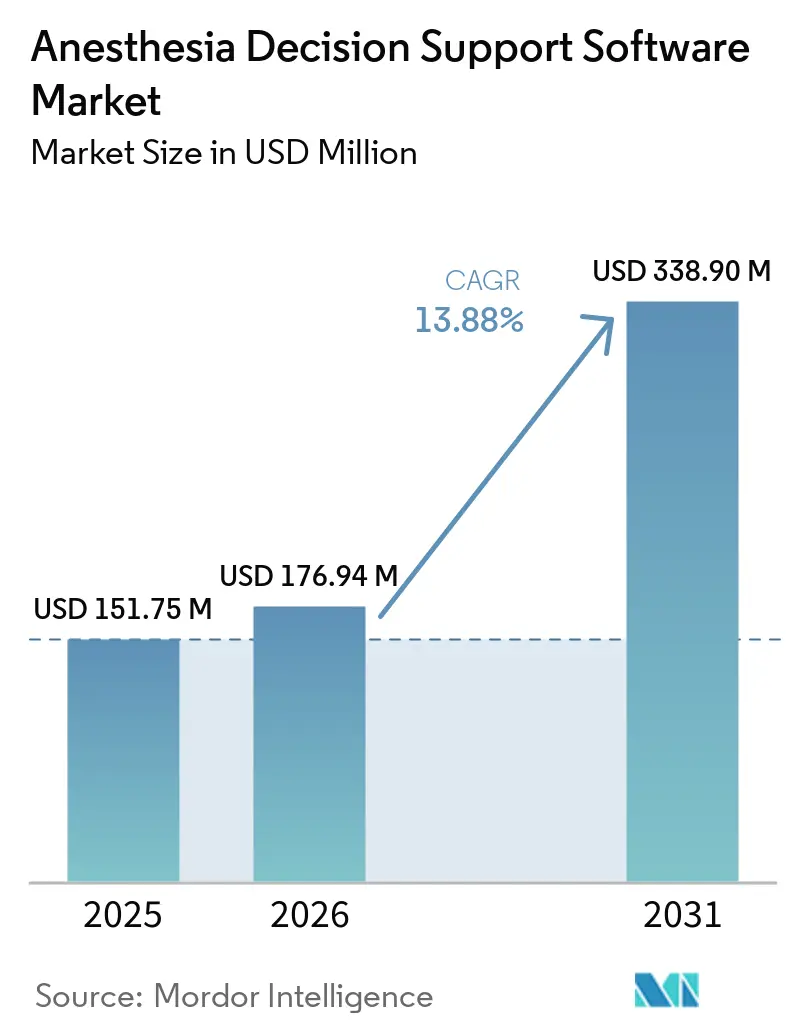
The Anesthesia Decision Support Software Market size was valued at USD 151.75 million in 2025 and is estimated to grow from USD 176.94 million in 2026 to reach USD 338.90 million by 2031, at a CAGR of 13.88% during the forecast period (2026-2031).
The anesthesia decision support software market is being shaped by the need to capture anesthesia records accurately across increasingly complex procedures. Structured documentation, clinical support, and data exchange are becoming closely linked because a single case can involve monitoring devices, drug records, scheduling systems, billing records, and the electronic health record. The leading vendors can use installed electronic health record bases, while specialist suppliers compete through anesthesia-focused workflows and flexible integration. Demand is also moving beyond the operating room as ambulatory facilities and nonoperating room settings need simpler documentation and faster implementation. The largest opportunity remains for tools that reduce manual documentation without interrupting the anesthesiologist’s clinical work.
Key Report Takeaways
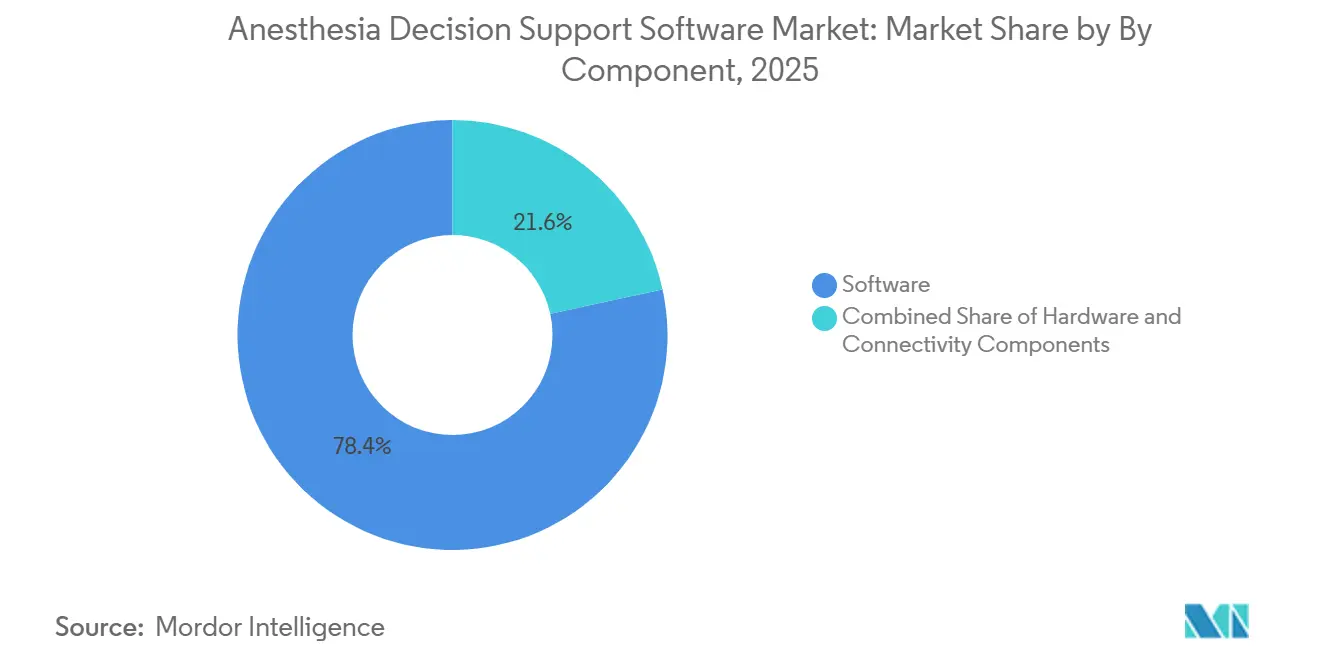
By component, software held 78.4% of the anesthesia decision support software market share in 2025 and is projected to grow at a 15.8% CAGR through 2031.
By application, intraoperative monitoring, drug management, and decision support accounted for 48.6% of the anesthesia decision support software market size in 2025, while postoperative recovery, handoff, and follow-up is expected to grow at a 14.9% CAGR through 2031.
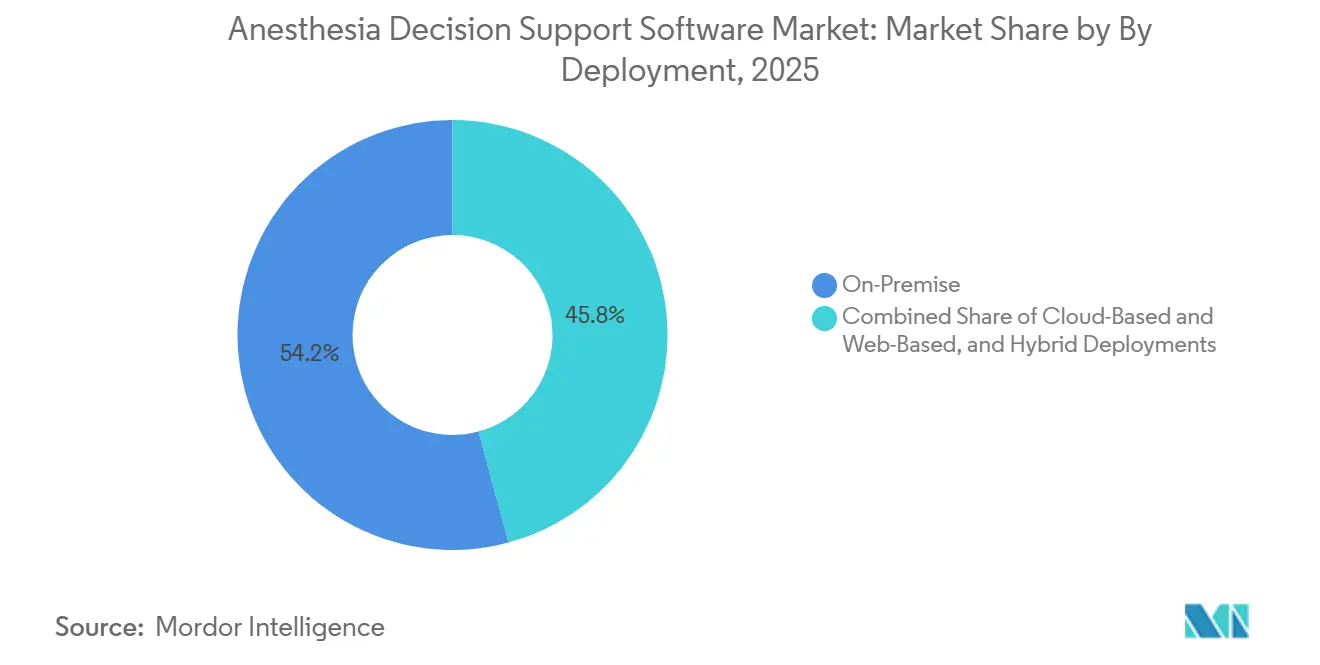
By deployment, on-premise systems retained 54.2% of the 2025 revenue base, while cloud-based and web-based systems are forecast to expand at a 14.8% CAGR through 2031.
By workflow capability, automated anesthesia documentation held 34.7% in 2025, while clinical decision support and predictive risk is forecast to grow at a 14.4% CAGR through 2031.
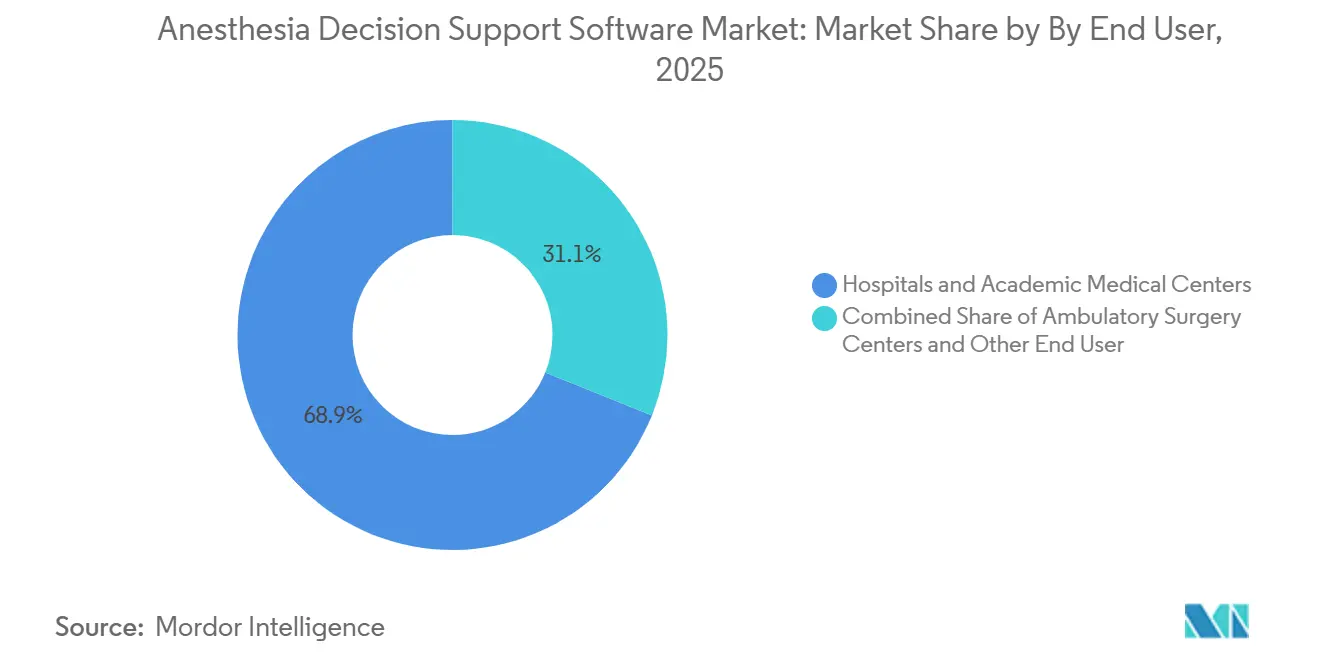
By end user, hospitals and academic medical centers held 68.9% in 2025, while ambulatory surgery centers are projected to grow at a 14.3% CAGR through 2031.
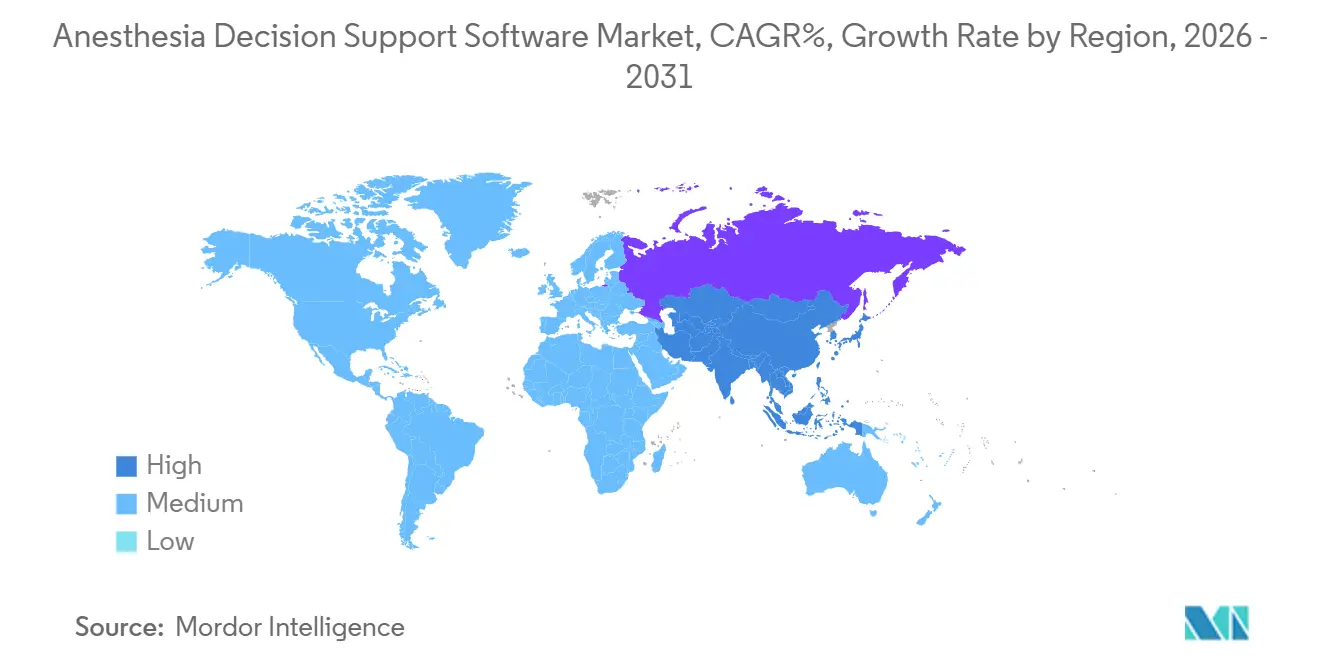
By geography, North America held 39.7% in 2025, while Asia-Pacific is forecast to grow at a 14.6% CAGR through 2031.
Note: Market size and forecast figures in this report are generated using Mordor Intelligence’s proprietary estimation framework, updated with the latest available data and insights as of January 2026.
Market Trends and Insights
Drivers Impact Analysis of Anesthesia Decision Support Software Market*
| Driver | (~) % Impact on CAGR Forecast | Geographic Relevance | Impact Timeline |
|---|---|---|---|
| Rising Surgical Volumes and Perioperative Documentation Requirements | +2.8% | Global | Short term (≤ 2 years) |
| Cloud Migration and Mobile Documentation in Operating Rooms and ASCs | +2.2% | North America and Europe | Medium term (2-4 years) |
| Interoperability Across EHRs, Devices, Scheduling, Pharmacy, and Billing | +1.9% | Global | Medium term (2-4 years) |
| Real-Time Decision Support for Drug Titration and Protocol Compliance | +1.7% | North America and Europe | Medium term (2-4 years) |
| Expansion of Ambulatory and Nonoperating Room Anesthesia | +1.5% | North America, core Asia-Pacific, and spillover to the Middle East and Africa | Short term (≤ 2 years) |
| Demand for Quality, Revenue, and Operating Room Productivity Analytics | +1.3% | North America and Europe | Medium term (2-4 years) |
| Source: Mordor Intelligence | |||
Rising Surgical Volumes and Perioperative Documentation Requirements
The anesthesia decision support software market is supported by the growing volume and diversity of surgical procedures. The Lancet Commission[1] reported that global surgical systems handle at least 160 million operations annually, and the need for surgery rises as populations age and more conditions can be treated with minimally invasive methods. Each procedure creates an anesthesia record that must document medication administration, vital signs, airway events, and clinical decisions. Paper records make this task slower and create gaps when information must be reviewed later. More complex procedures also increase the need for real-time checks of drug interactions and patient risks. This makes structured anesthesia documentation important to facilities that want complete clinical and financial records.
Cloud Migration and Mobile Documentation in Operating Rooms and ASCs
Cloud migration is widening access to anesthesia information management systems for outpatient facilities and regional providers. Provation[2] introduced iPro Lite in January 2026 as a mobile-first solution for outpatient anesthesia settings with wireless physiological data streaming, automated charge capture, and electronic health record integration. This approach reduces the technical burden for facilities that do not want to maintain extensive local infrastructure. Continuous updates can also help providers keep documentation and data-sharing functions current. Some hospitals still prefer local or hybrid systems for workflows where data transfer speed is important during active anesthesia care. The anesthesia decision support software market, therefore, supports both cloud tools for simpler settings and hybrid models for large hospitals.
Interoperability Across EHRs, Devices, Scheduling, Pharmacy, and Billing
Interoperability has become a central purchasing requirement because anesthesia data is used across clinical, operational, and financial systems. Surgical Information Systems and Provation joined the MEDITECH Alliance Accelerator Program in 2024 and achieved bidirectional integration with MEDITECH Expanse. This type of connection allows data to move through preoperative, intraoperative, and postoperative workflows without repeated manual entry. It also helps reconcile medication records with pharmacy documentation and supports complete billing records. Providers with older monitors and legacy interfaces can face a more difficult integration process. Vendors that connect devices, the electronic health record, scheduling, pharmacy, and billing systems are better placed to address this problem.
Real-Time Decision Support for Drug Titration and Protocol Compliance
Real-time clinical decision support is moving from basic alerts toward tools that can support dosing and risk assessment during anesthesia. A 2026 multicenter study found 73.3% concordance between an AI-assisted decision support system and anesthesiologist decisions across anesthesia maintenance phases, with the highest agreement for propofol administration. Separate research reported an AUROC of 0.93 for a transformer model designed to predict intraoperative hypotension. These findings support the use of predictive tools where clinicians can review the recommendation in context. Systems can also populate quality measures and support protocol reporting. Their value depends on accurate alerts and practical configuration because irrelevant warnings can reduce clinician trust.
Restraints Impact Analysis of Anesthesia Decision Support Software Market*
| Restraint | (~) % Impact on CAGR Forecast | Geographic Relevance | Impact Timeline |
|---|---|---|---|
| High Implementation, Integration, and Change-Management Costs | -1.2% | Global | Short term (≤ 2 years) |
| Data-Format Fragmentation Across Legacy Devices and Hospital Systems | -0.9% | Global | Medium term (2-4 years) |
| Clinician Alert Fatigue and Workflow Intrusion From Poorly Calibrated Decision Support | -0.7% | North America and Europe | Medium term (2-4 years) |
| Limited Local Training Data and Validation for Underrepresented Populations | -0.5% | Core Asia-Pacific, and spillover to the Middle East, Africa, and South America | Long term (≥ 4 years) |
| Source: Mordor Intelligence | |||
High Implementation, Integration, and Change-Management Costs
Implementation cost remains a material barrier for independent hospitals and critical-access providers with limited information technology budgets. Enterprise systems often require interfaces for physiological monitors, anesthesia machines, pharmacy systems, and existing electronic health records. These requirements can make the integration work more costly than the software license in complex multisite projects. Clinical teams also need training and a transition period while paper or legacy procedures are replaced. This can create a temporary decline in productivity before the documentation benefits are realized. Modular deployment and subscription pricing can reduce the initial burden, but the anesthesia decision support software market still faces a slower adoption path in budget-constrained hospitals.
Clinician Alert Fatigue and Workflow Intrusion From Poorly Calibrated Decision Support
Alert fatigue can undermine clinical decision support when systems produce too many warnings with limited relevance. Clinicians may override repeated alerts for familiar drug combinations or thresholds that do not reflect a patient’s baseline condition. A 2025 review identified preprocedural optimization, safety-focused workflow management, and AI modeling as important approaches to improving efficiency in nonoperating room anesthesia. Poorly configured alerts can add work rather than support decisions. Platforms with severity tiers, clinician-configurable thresholds, and alert analytics can better fit local practice patterns. Configuration quality is therefore important both at deployment and during routine use.
*Our forecasts treat driver/restraint impacts as directional, not additive. The impact forecasts reflect baseline growth, mix effects, and variable interactions.
Anesthesia Decision Support Software Market Segment Analysis
By Component:
Software Leads Procurement DecisionsSoftware accounted for 78.4% of the anesthesia decision support software market in 2025 and is projected to grow at a 15.8% CAGR through 2031. This position in the anesthesia decision support software market reflects a change in how facilities buy perioperative technology. Providers can retain existing monitors and anesthesia equipment while adding a software layer for records, reporting, and decision support. Cloud-native products and mobile documentation applications reinforce this approach. The software model also gives vendors recurring revenue that does not depend on a hardware replacement cycle.
Hardware and connectivity components remain necessary in new facilities and in settings with older analog monitors. Bedside aggregators, device interfaces, and network gateways help turn device information into usable records. These components matter where local equipment cannot directly connect to an anesthesia information management system. Vendors can extend the useful life of installed equipment by providing software updates and compatible interfaces. This approach gives budget-sensitive buyers in the anesthesia decision support software market a path to digital documentation without replacing all clinical equipment at once.

By Application:
Intraoperative Workflows Hold the Largest BaseIntraoperative monitoring, drug management, and decision support held 48.6% of the 2025 revenue base. The active surgical phase produces a large volume of time-sensitive information, including drug boluses, vital sign changes, airway interventions, and protocol checks. These records must be captured accurately and linked to the patient record. The size of this workflow helps explain why intraoperative functions remain central to product design. It also gives vendors a foundation for adding reporting, billing, and quality functions.
Postoperative recovery, handoff, and follow-up are forecast to grow at a 14.9% CAGR through 2031. A 2025 study found that a semi-automated post-anesthesia care unit discharge assessment tool reduced post-anesthesia care unit length of stay and received favorable feedback from nursing staff. This supports the operational value of consistent postoperative assessment and discharge documentation. Preoperative coordination also remains important in the anesthesia decision support software market because missing information can cause avoidable cancellations. Qventus reported that its Perioperative Care Coordination solution reduced surgery cancellations by up to 40% through automation of pre-admission work.
By Deployment:
On-Premise Systems Remain ImportantOn-premise deployment represented 54.2% of the anesthesia decision support software market size in 2025. Large academic medical centers, integrated delivery networks, and government systems often retain local infrastructure because they need extensive customization and control over clinical data. Local systems can also support workflows where very low data-transfer delays matter. This is especially relevant for closed-loop intraoperative applications that use continuous device information. As a result, on-premise systems remain a practical choice for complex enterprise environments.
Cloud-based and web-based systems are expected to grow at a 14.8% CAGR through 2031. Ambulatory surgery centers and outpatient providers often prefer these options because they can limit initial capital spending and simplify deployment. The Centers for Medicare & Medicaid Services approved 537 procedures for the ambulatory surgery center setting in 2026, broadening the procedure base served by outpatient anesthesia teams. Hybrid deployment is also gaining relevance for hospitals that keep intraoperative functions on local systems while shifting reporting and analytics to cloud infrastructure. Vendors in the anesthesia decision support software market that support both models can serve large hospitals and smaller outpatient facilities under one operating model.
By Workflow Capability:
Documentation Supports a Growing Analytics LayerAutomated anesthesia documentation held 34.7% of the 2025 workflow capability base. Documentation is the starting point for more complete case records, charge capture, compliance checks, and performance review. It reduces the dependence on memory-based entries and gives clinical teams a common record. It also creates the underlying data needed for risk prediction and operational analysis. For these reasons, documentation remains a core requirement across the anesthesia decision support software market.
Clinical decision support and predictive risk is projected to grow at a 14.4% CAGR through 2031. These tools can flag possible intraoperative hypotension, predicted blood loss, or postoperative nausea and vomiting risks before they become evident in the record. Medaxion launched Anesthesia Manager in September 2025 with a data set of 15 million cases, more than 900 locations, and more than 500 data pipelines. Medication, controlled-substance, and billing functions remain commercially important because anesthesia billing uses base units, time units, qualifying circumstances, and modifiers. Quality and performance analytics can then connect these data to benchmarking and outcome reporting.
By End User:
Hospitals Retain Scale While ASCs Grow FasterHospitals and academic medical centers held 68.9% of the anesthesia decision support software market in 2025. Their scale, broad procedural mix, and existing electronic health record infrastructure support demand for integrated systems. Academic centers also provide environments where clinical decision support tools can be validated and adapted. These settings often need configurable platforms for research, specialized procedures, and complex patient populations. This keeps hospitals central to enterprise demand in the anesthesia decision support software market.
Ambulatory surgery centers are projected to grow at a 14.3% CAGR through 2031. The 2026 expansion in procedures approved for the ambulatory surgery center setting supports a broader outpatient anesthesia workload. The American Society of Anesthesiologists and American Hospital Association[3] stated in 2024 that nonoperating room anesthesia cases are expected to exceed 50% of anesthesia procedures in the next decade, compared with 28% in 2010 . Specialty and pain management clinics in the anesthesia decision support software market often prefer preconfigured software because procedures and drug protocols are more predictable. Dental clinics and office-based procedure centers remain less digitized, with paper records and manual charge capture still common.
Geography Analysis
North America Anesthesia Decision Support Software Market
North America held 39.7% of the 2025 revenue base. The region combines high electronic health record use with payment models that reward complete quality documentation. Epic, Oracle Health, and MEDITECH have an installed-base advantage because their perioperative functions are included in broader enterprise contracts. The expected increase in nonoperating room anesthesia expands the addressable documentation base across the United States. The anesthesia decision support software market also has demand in Canada through provincial modernization programs and in Mexico through private hospital networks in large metropolitan areas.
Europe Anesthesia Decision Support Software Market
Europe has a fragmented provider landscape, but Germany, the United Kingdom, and France support the region’s largest installed bases. Getinge and Philips[4]announced a commercial alliance in October 2025 that combined Getinge Flow Family anesthesia delivery systems with Philips IntelliVue monitoring technology. The alliance gives hospitals a single procurement and support arrangement for connected anesthesia and monitoring equipment. Germany’s university hospitals provide an important setting for clinical validation of AI-based decision support. The anesthesia decision support software market can benefit as health information technology investment drives replacement of older tools that lack modern data exchange capabilities.
APAC Anesthesia Decision Support Software Market
Asia-Pacific is forecast to grow at a 14.6% CAGR through 2031, the fastest regional rate. Japan has local products such as Nihon Kohden AsisTIVA for total intravenous anesthesia syringe pump control and Fujifilm Prescient OR for perioperative information management. ARI completed a patent filing in 2025 for an AI anesthesia prediction algorithm developed with Yokohama City University and Totsuka Kyoritsu Hospital. Dräger introduced the Atlan A100 anesthesia workstation in India in April 2025, showing continued product activity in the subcontinent. China, Japan, and India are increasing healthcare digitization investment, while many tertiary facilities still rely on paper anesthesia records.
Competitive Landscape
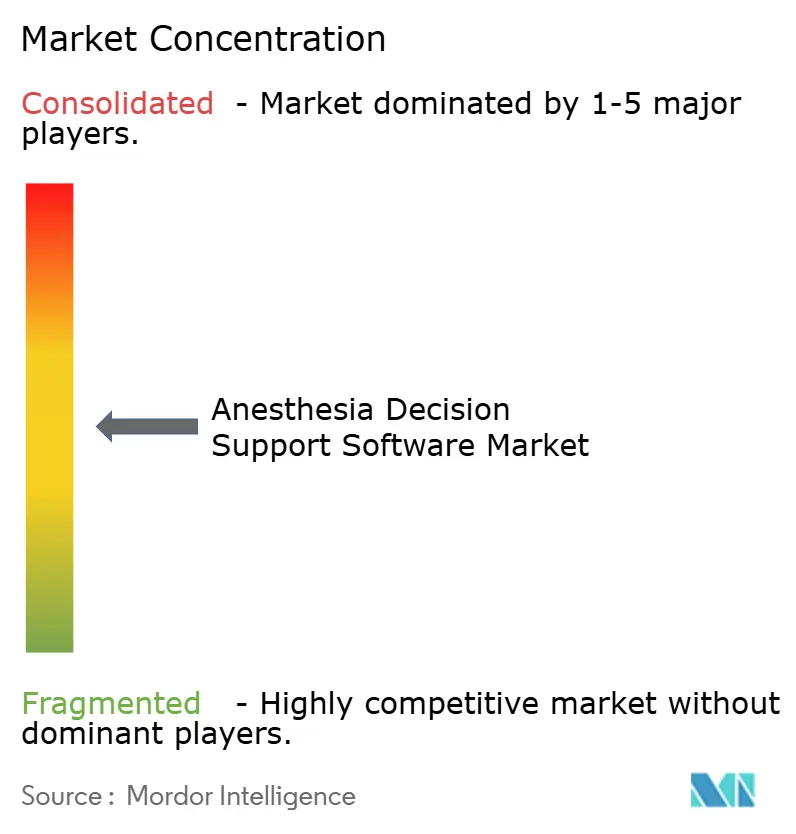
The anesthesia decision support software market has moderate concentration. Epic, Oracle Health, and MEDITECH benefit from existing electronic health record contracts and bundled perioperative modules. Independent anesthesia information management system specialists compete through workflow configuration and device integration. The installed-base advantage limits opportunities at hospitals already committed to a large electronic health record supplier. It also makes certified integration important for specialists seeking to serve those hospitals.
Surgical Information Systems and Provation joined the MEDITECH Alliance Accelerator Program in 2024, creating certified bidirectional data flows with MEDITECH Expanse. This move helps independent suppliers participate in hospitals that use the MEDITECH platform. The anesthesia decision support software market is also adding analytics functions, as shown by Medaxion’s September 2025 launch of Anesthesia Manager for case-level operational decisions. Caresyntax raised USD 180 million in August 2024 to support AI and edge-to-cloud development, including a stated acquisition strategy for surgical AI, video analytics, and data capture tools. These actions show that data scale, interoperability, and analytics are becoming key competitive capabilities.
Oracle Health announced a collaboration with Theator in June 2026 to provide AI-powered surgical intelligence that converts surgical video and electronic health record data into structured operative reports. This illustrates how adjacent technology suppliers can enter perioperative workflows through documentation and video analysis. The anesthesia decision support software market retains opportunities in nonoperating room documentation, AI-enabled postoperative handoffs, and billing automation for independent anesthesia practices. Regulatory distinctions between medical device software and administrative decision support can add compliance work for suppliers.
Anesthesia Decision Support Software Industry Leaders
-
GE HealthCare Technologies Inc.
-
Koninklijke Philips N.V.
-
Oracle Corporation
-
Epic Systems Corporation
- *Disclaimer: Major Players sorted in no particular order
Anesthesia Decision Support Software Market Companies Covered in this Report
- Dragerwerk
- GE HealthCare Technologies Inc.
- Koninklijke Philips
- Surgical Information Systems, LLC
- Oracle
- Getinge
- Provation Software, Inc.
- iMDsoft
- Picis Clinical Solutions, Inc.
- Plexus Technology Group, LLC
- Coronis Health
- Veradigm
- Fukuda Denshi Co., Ltd.
- Meditech
- Epic Systems
- PerfectServe, Inc.
- Caresyntax Inc.
- Qventus, Inc.
- AnesthesiaOS
- Anesthesia Touch
Recent Industry Developments in Anesthesia Decision Support Software Market
- June 2026: Oracle Health announced a collaboration with Theator to deliver AI-powered surgical intelligence solutions to Oracle Health customers in the U.S. Theator's platform captures surgical video, uses AI to cross-reference EHR data, and generates structured operative reports, validated across 600,000+ procedures at institutions including Mayo Clinic, flowing directly into Oracle Health's clinical and financial systems, addressing the documented 72.8% accuracy gap in memory-based operative reports.
- June 2026: Surgical Information Systems launched SIS Scribe, an AI-powered transcription tool enabling physicians to dictate, review, and sign operative notes immediately post-case from a mobile device, with completed notes available to billing teams within minutes. The product is available to both existing SIS clients and non-SIS facilities across the U.S., extending SIS's addressable market beyond its core ASC management platform.
- May 2026: SIS showcased its full portfolio at ASCA 2026, introducing SIS Office Anesthesia, a module simplifying anesthesia-specific billing charge setup for ASCs, and the Enterprise Edition of SIS Complete for multi-centre operational unification, marking the company's 30th year serving over 2,900 ASCs with a platform documenting over 11 million cases.
- January 2026: Provation launched iPro Lite, a mobile-first anesthesia information management solution for ASCs and outpatient anesthesia groups, with wireless physiological data streaming, automated charge capture, and EHR integration requiring minimal setup, explicitly targeting the replacement of paper-based workflows that persist disproportionately in outpatient surgical settings
Global Anesthesia Decision Support Software Market Report Scope
Segmentation Overview
| Software |
| Hardware and Connectivity Components |
| Preoperative Assessment and Risk Stratification |
| Intraoperative Monitoring, Drug Management, and Decision Support |
| Postoperative Recovery, Handoff, and Follow-Up |
| Cloud-Based and Web-Based |
| On-Premise |
| Hybrid |
| Automated Anesthesia Documentation |
| Medication, Controlled-Substance, and Billing Management |
| Clinical Decision Support and Predictive Risk |
| Quality, Compliance, and Performance Analytics |
| Hospitals and Academic Medical Centers |
| Ambulatory Surgery Centers |
| Specialty Clinics and Pain Management Clinics |
| Dental Clinics and Office-Based Procedure Centers |
| Research Institutes and Other Care Settings |
| North America | United States |
| Canada | |
| Mexico | |
| Europe | Germany |
| United Kingdom | |
| France | |
| Italy | |
| Spain | |
| Rest of Europe | |
| Asia-Pacific | China |
| Japan | |
| India | |
| South Korea | |
| Australia | |
| Rest of Asia-Pacific | |
| Middle East and Africa | GCC |
| South Africa | |
| Rest of Middle East and Africa | |
| South America | Brazil |
| Argentina | |
| Rest of South America |
| By Component | Software | |
| Hardware and Connectivity Components | ||
| By Application | Preoperative Assessment and Risk Stratification | |
| Intraoperative Monitoring, Drug Management, and Decision Support | ||
| Postoperative Recovery, Handoff, and Follow-Up | ||
| By Deployment | Cloud-Based and Web-Based | |
| On-Premise | ||
| Hybrid | ||
| By Workflow Capability | Automated Anesthesia Documentation | |
| Medication, Controlled-Substance, and Billing Management | ||
| Clinical Decision Support and Predictive Risk | ||
| Quality, Compliance, and Performance Analytics | ||
| By End User | Hospitals and Academic Medical Centers | |
| Ambulatory Surgery Centers | ||
| Specialty Clinics and Pain Management Clinics | ||
| Dental Clinics and Office-Based Procedure Centers | ||
| Research Institutes and Other Care Settings | ||
| By Geography | North America | United States |
| Canada | ||
| Mexico | ||
| Europe | Germany | |
| United Kingdom | ||
| France | ||
| Italy | ||
| Spain | ||
| Rest of Europe | ||
| Asia-Pacific | China | |
| Japan | ||
| India | ||
| South Korea | ||
| Australia | ||
| Rest of Asia-Pacific | ||
| Middle East and Africa | GCC | |
| South Africa | ||
| Rest of Middle East and Africa | ||
| South America | Brazil | |
| Argentina | ||
| Rest of South America | ||
Key Questions Answered in the Report
What is the projected value of anesthesia decision support software by 2031?
The anesthesia decision support software market is projected to reach USD 338.9 million by 2031, growing at a 13.9% CAGR from 2026.
Which component leads anesthesia decision support software adoption?
Software led with 78.4% in 2025 and is also the fastest-growing component at a 15.8% CAGR through 2031.
What is driving demand for anesthesia documentation tools?
Rising procedure volumes, structured record requirements, device integration, and the need to reduce manual documentation support demand.
Which application is growing fastest in anesthesia software?
Postoperative recovery, handoff, and follow-up is forecast to grow at a 14.9% CAGR through 2031.
Why are ambulatory surgery centers important for anesthesia technology suppliers?
Ambulatory surgery centers are the fastest-growing end user at a 14.3% CAGR, supported by a wider set of procedures approved for outpatient care in 2026.
Which region is expected to grow fastest for anesthesia decision support software?
Asia-Pacific is expected to grow at a 14.6% CAGR through 2031, supported by healthcare digitization investment and continued use of paper anesthesia records in many facilities.