
Amyl Nitrite Market Size and Share
Market Overview
| Study Period | 2021 - 2031 |
|---|---|
| Market Size (2026) | USD 172.87 Million |
| Market Size (2031) | USD 224.23 Million |
| Growth Rate (2026 - 2031) | 5.34 % |
| Fastest Growing Market | Asia-Pacific |
| Largest Market | Asia-Pacific |
| Market Concentration | Medium |
Major Players *Disclaimer: Major Players sorted in no particular order Image © Mordor Intelligence. Reuse requires attribution under CC BY 4.0. | |
Amyl Nitrite Market Analysis by Mordor Intelligence
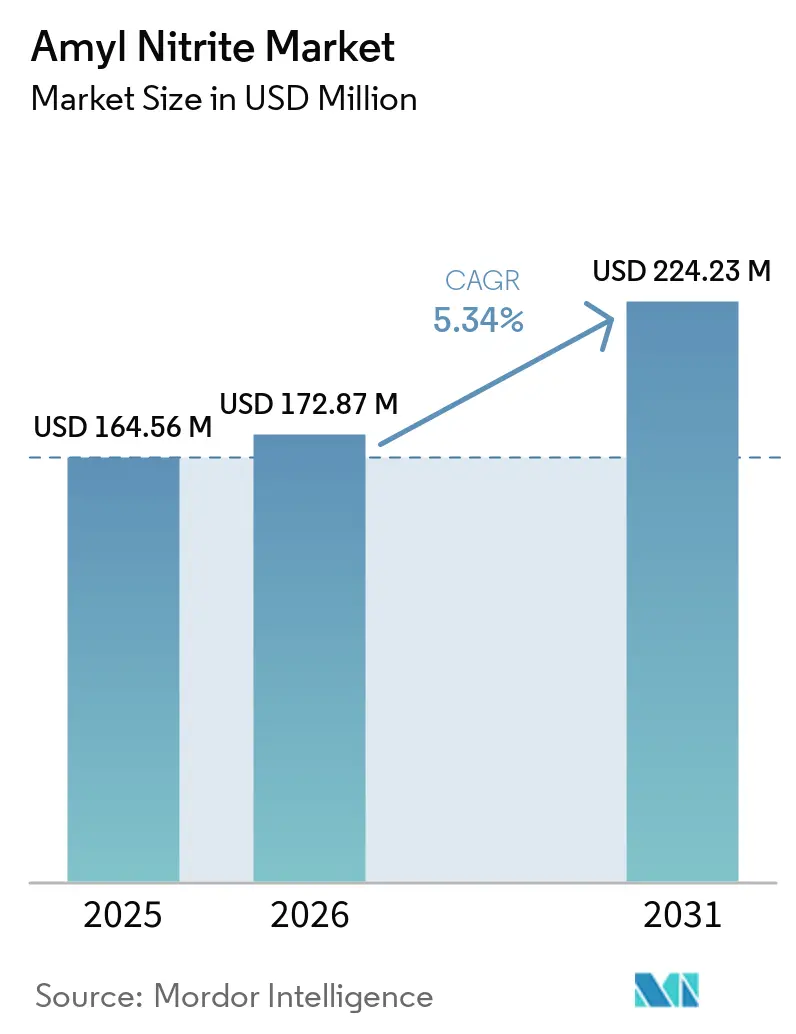
The Amyl Nitrite market size was estimated at USD 164.56 million in 2025 and is estimated to grow from USD 172.87 million in 2026 to USD 224.23 million by 2031, at a CAGR of 5.34% during the forecast period (2026-2031). The amyl nitrite market serves three distinct demand groups: hospitals and emergency medical services, pharmaceutical and fine-chemical manufacturers, and research laboratories. Each group follows its own ordering cycle, regulatory requirements, and product-quality expectations. Medical users require certified, high-purity material, while synthesis and laboratory buyers focus on reproducible reagent performance and supporting analytical documentation. The rapid vasodilatory effect of inhaled amyl nitrite supports its use in selected emergency protocols, particularly when intravenous access is unavailable. Regulatory control of consumer-facing channels narrows non-medical distribution, but also favors suppliers that meet prescription, labeling, stability, and batch-release requirements. Improved heat stability could reduce cold-chain constraints and expand access to tropical and resource-limited settings. Suppliers balance clinical compliance, chemical quality, and distribution reliability across multiple end-use channels.
Key Report Takeaways
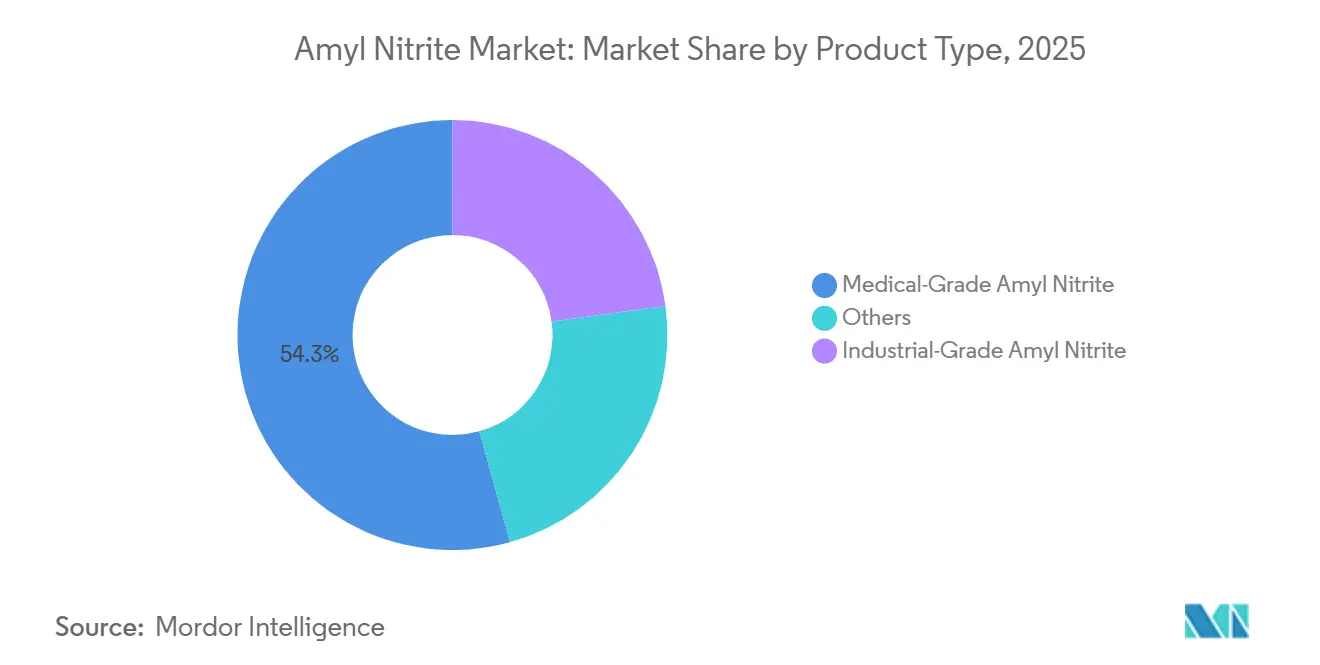
- By product type, medical-grade amyl nitrite held 54.31% of revenue in 2025 and is forecast to grow at a 6.45% CAGR through 2031.
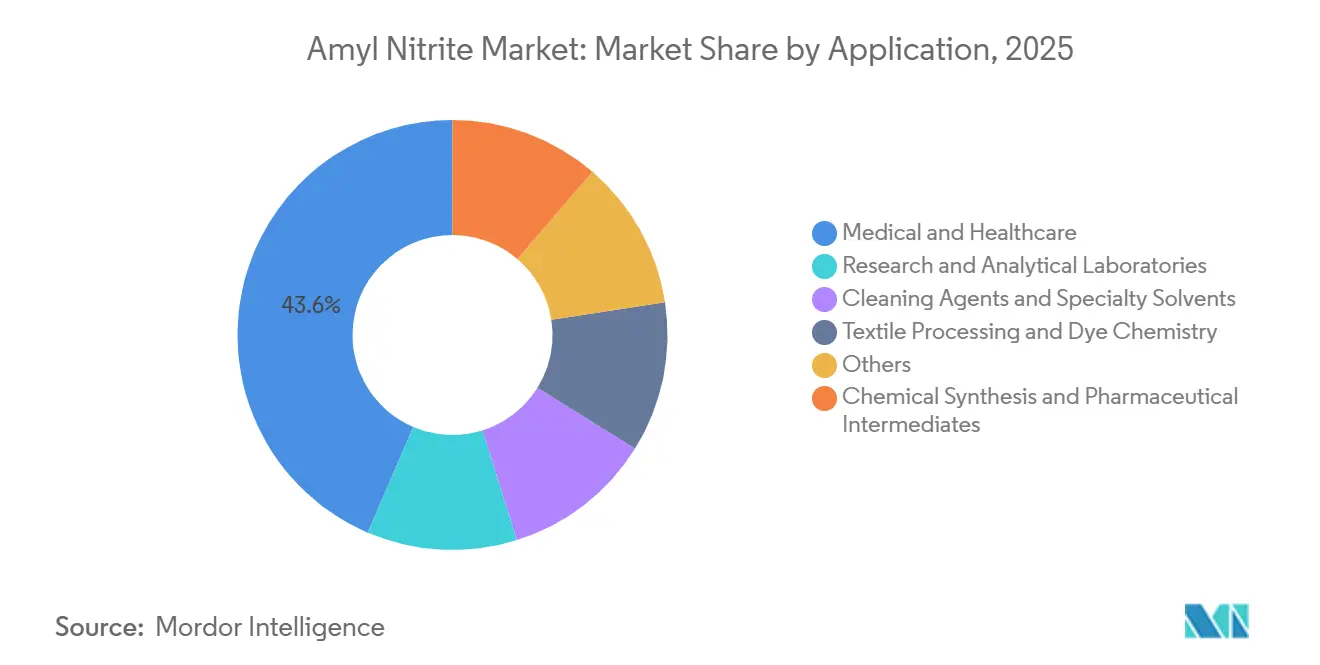
- By application, medical and healthcare accounted for 43.56% of the Amyl Nitrite market share in 2025 and are forecast to expand at a 6.72% CAGR through 2031.
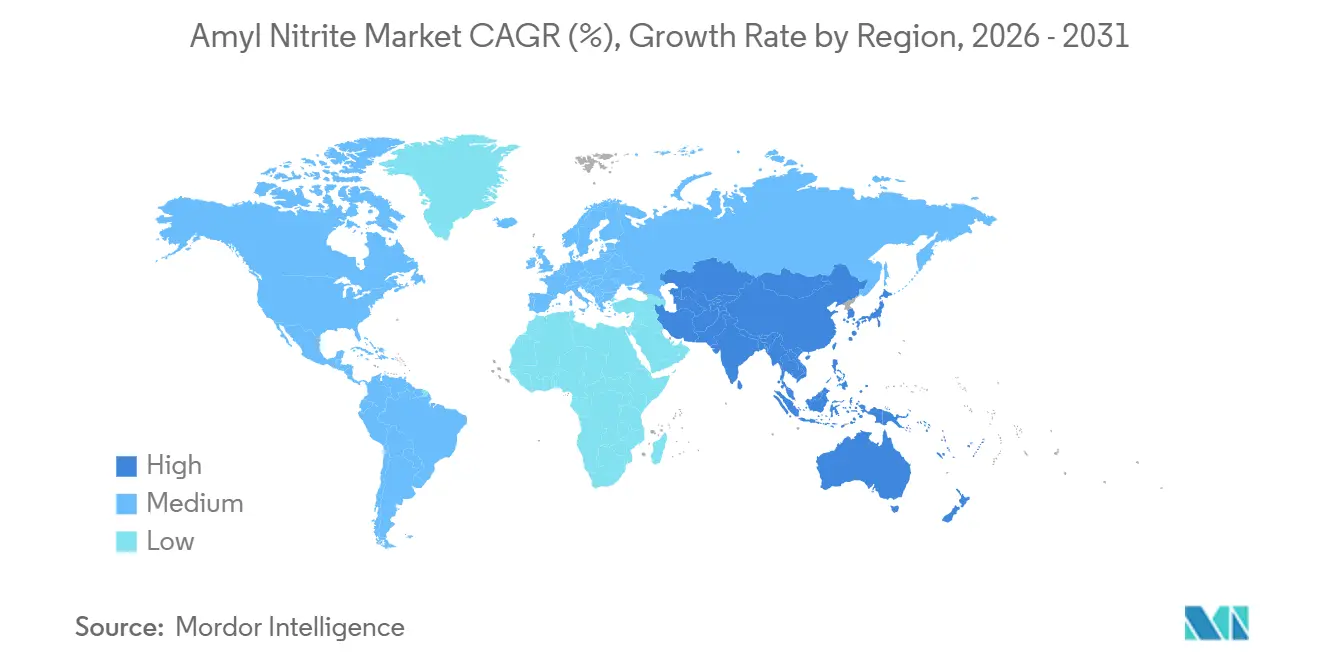
- By geography, Asia-Pacific accounted for 32.73% of the Amyl Nitrite market share in 2025 and is forecast to grow at a 6.23% CAGR through 2031.
Note: Market size and forecast figures in this report are generated using Mordor Intelligence’s proprietary estimation framework, updated with the latest available data and insights as of January 2026.
Market Trends and Insights
Drivers Impact Analysis of Amyl Nitrite Market*
| Drivers | (~) % Impact on CAGR Forecast | Geographic Relevance | Impact Timeline |
|---|---|---|---|
| Cardiovascular Emergency and Angina Management Demand | +1.5% | Global | Short term (≤ 2 years) |
| Pharmaceutical and Fine-Chemical Synthesis Requirements | +1.2% | Global, core in Asia-Pacific and Europe | Medium term (2-4 years) |
| Stabilized High-Purity Formulations for Sensitive Applications | +0.9% | North America and Europe core, and Asia-Pacific is growing | Long term (≥ 4 years) |
| Expansion of Research and Analytical Laboratory Procurement | +0.8% | Global, led by Asia-Pacific and Europe | Medium term (2-4 years) |
| Regulated Digital Procurement for Specialty Chemicals | +0.5% | Global | Short term (≤ 2 years) |
| Source: Mordor Intelligence | |||
Cardiovascular Emergency and Angina Management Demand
Cardiovascular diseases cause 18 million deaths each year worldwide, sustaining hospital demand for vasodilatory agents and emergency antidote portfolios[1]. Inhaled amyl nitrite produces a vasodilatory effect within 30 seconds and can be administered without intravenous access. This characteristic supports its use in selected pre-hospital and emergency-care settings, even though sublingual nitroglycerin addresses most outpatient angina needs. Hospital systems procure amyl nitrite, along with sodium nitrite and sodium thiosulfate, as part of structured antidote portfolios that support multi-year supply arrangements with certified producers. These arrangements emphasize supply continuity, lot documentation, and the ability to meet hospital purchasing specifications. The hydroxocobalamin shortage reported from November 2024 led some trauma centers to reconsider nitrite-based backup protocols for cyanide exposure. This shift supports the amyl nitrite market by adding preparedness purchases where the preferred first-line antidote is unavailable, reinforcing the need for contingency stock.
Pharmaceutical and Fine-Chemical Synthesis Requirements
The amyl nitrite market also benefits from use in pharmaceutical and fine-chemical synthesis. Amyl nitrite acts as a nitrosating reagent in diazotization of aromatic amines and in Sandmeyer-type transformations. A 2025 flow-chemistry study found that isoamyl nitrite was safer than tert-butyl nitrite for continuous-flow diazotization as it reduced handling of hazardous intermediates. Manufacturers in China, Germany, India, and the United States use this profile to produce active pharmaceutical ingredients and specialty chemicals. Continuous-flow equipment requires consistent reagent quality, as poor consistency reduces reaction yields and disrupts repeatable production. Suppliers that provide reliable purity information are better suited for tightly managed production environments. This demand base provides the amyl nitrite market with some insulation from hospital purchasing cycles, as synthesis orders follow different production schedules.
Stabilized High-Purity Formulations for Sensitive Applications
Storage performance limits the reliable supply of medical-grade amyl nitrite in hot climates without refrigerated logistics. A 2024 patent application described stabilized isoamyl nitrite compositions using vitamin K isomers and reported 96% purity retention after 6 months at 40°C with 10% vitamin K1 by weight, compared with 75% for an unstabilized control. If adopted at commercial scale, the formulation could extend usable shelf life beyond the 2-year limit associated with current cold-chain-compliant products. This would improve the economics of medical inventory in Southeast Asia, sub-Saharan Africa, and the Middle East, and reduce stock losses for distributors holding emergency supplies. Producers with nitrogen-blanketed packaging, contamination control, and verified batch release can serve hospitals that require documented purity.
Expansion of Research and Analytical Laboratory Procurement
Research, academic, government, and contract laboratories purchase reagent-grade and high-purity amyl nitrite for synthesis and analytical work. These users require small-quantity orders with clear specifications and dependable availability. Thermo Fisher Scientific committed USD 2 billion to United States manufacturing investment from April 2025, including USD 500 million for research and development capacity. Laboratory buyers require gas chromatography purity data, nuclear magnetic resonance data, and elemental analysis, which support sales of documented reagent-grade material. Labviva introduced its HarperChem procurement platform in June 2025 for purchasing life sciences chemicals. Digital procurement systems make verified catalog listings easier to find and compare, increasing the value of accurate product records. These buyers are less driven by commodity pricing than industrial purchasers, making catalog visibility and complete analytical information as important as the underlying reagent price.
Restraints Impact Analysis of Amyl Nitrite Market*
| Restraints | (~) % Impact on CAGR Forecast | Geographic Relevance | Impact Timeline |
|---|---|---|---|
| Prescription, Consumer Safety, and Recreational Use Restrictions | -0.8% | North America and Europe | Short term (≤ 2 years) |
| Flammability, Volatility, Toxicity, and Storage Requirements | -0.5% | Global | Long term (≥ 4 years) |
| Substitution by Hydroxocobalamin and Intravenous Cyanide Antidotes | -0.6% | North America and Europe | Short term (≤ 2 years) |
| Source: Mordor Intelligence | |||
Prescription, Consumer Safety, and Recreational Use Restrictions
Regulation restricts the non-medical use of amyl nitrite in major consumer markets. The FDA classifies amyl nitrite as a prescription drug in the United States, limiting lawful consumer distribution. This classification separates medical supplies from products marketed through informal consumer channels. In 2024, the United Kingdom's Advisory Council on the Misuse of Drugs recommended an exemption for alkyl nitrites from the Psychoactive Substances Act 2016, along with age controls, import quantity limits, and complementary regulation[2]. These measures preserve the possibility of medical supply while limiting consumer-facing expansion. Pharmaceutical-grade suppliers must meet labeling, purity documentation, and stability testing requirements. Compliance increases the time and cost associated with entering regulated medical channels. The result is a smaller accessible market base, but a stronger position for established producers that already meet compliance requirements. This pattern limits consumer demand while supporting qualified suppliers with established regulatory processes.
Substitution by Hydroxocobalamin and Intravenous Cyanide Antidotes
Hydroxocobalamin has replaced amyl nitrite in many hospital cyanide antidote protocols due to its more favorable safety profile. Unlike amyl nitrite and sodium nitrite, hydroxocobalamin does not induce methemoglobinemia, which can worsen cyanide poisoning in some patients. This clinical distinction affects first-line antidote selection at hospitals and emergency facilities. Intravenous sodium nitrite and sodium thiosulfate provide a second substitution route for institutions that prefer an intravenous regimen. Suppliers primarily dependent on demand for antidote kits face pressure as hydroxocobalamin supply normalizes. The current shortage has supported short-term backup procurement, but does not change the longer-term clinical preference for hydroxocobalamin. A broader mix of synthesis, research, and medical customers provides a more resilient position in the amyl nitrite market, reducing reliance on a single clinical use vulnerable to replacement by newer or preferred therapies.
*Our forecasts treat driver/restraint impacts as directional, not additive. The impact forecasts reflect baseline growth, mix effects, and variable interactions.
Amyl Nitrite Market Segment Analysis
By Product Type:
Medical-Grade Formulations Support Value Through Certified QualityMedical-grade amyl nitrite held 54.31% of product revenue in 2025, and this segment is forecast to grow at a 6.45% CAGR through 2031. Hospitals require material that meets United States Pharmacopeia-National Formulary or European Pharmacopoeia standards. These requirements cover purity, stability, documentation, and controlled batch release. Hospital purchasing teams also require evidence that the product remains within specification throughout its intended storage period. Industrial-grade material cannot replace a certified product in a hospital formulary on the basis of cost alone. This distinction supports a pricing floor for qualified manufacturers and concentrates medical purchasing among suppliers that can consistently provide quality records. The price premium, therefore, reflects the cost of compliance and the practical limits on product substitution in clinical settings.
The 2024 stabilized-formulation patent reflects continued efforts to address the storage limitations of medical ampules. A commercially viable formulation could improve the supply of certified material in locations where reliable refrigeration is difficult and reduce inventory risk for facilities that maintain emergency materials. Industrial-grade amyl nitrite serves as a chemical feedstock, a dye chemistry reagent, and a specialty solvent. The growth of flow-based chemical production is increasing demand for consistent reagent specifications in these applications. Buyers may request higher-quality material when reactor systems depend on reliable reaction behavior. The other product category includes laboratory reference standards, experimental formulations, and homeopathic preparations. Across all product types, closer attention to impurity profiles and quality systems differentiates high-specification suppliers from commodity producers, keeping product categories distinct even where their underlying chemical functionality overlaps.

By Application:
Medical and Healthcare Leads, While Synthesis Adds BalanceMedical and healthcare accounted for 43.56% of revenue in 2025 and are forecast to record the fastest application growth at a 6.72% CAGR through 2031. Demand comes from emergency departments, emergency medical service kits, cyanide poisoning preparedness, and specialized diagnostic uses such as cardiac stress testing. These settings require prompt product availability and established handling procedures. The hydroxocobalamin shortage that began in November 2024 prompted institutions to review backup antidote plans. Under appropriate protocols, amyl nitrite inhalants can be stocked alongside sodium thiosulfate as a preparedness option. The medical channel, therefore, combines steady institutional demand with periodic purchases driven by the availability of antidotes. Certified medical supplies remain important in these applications because they require traceability and documented quality. Hospitals also need suppliers capable of supporting orderly replenishment when stock policies or emergency plans are updated.
Chemical synthesis and pharmaceutical intermediates represent the other major application area for amyl nitrite. The compound supports nitrosation, diazotization, and Sandmeyer-type coupling steps used in the production of active pharmaceutical ingredients and fine chemicals, tying demand to manufacturing programs rather than emergency-care purchasing alone. The 2025 study on continuous flow chemistry supports its role in the safer handling of reactive intermediates. Research and analytical laboratories use the compound as a reagent, reference standard, and input for custom organic chemistry procedures. Supply of cleaning agents and specialty solvents remains constrained in North America and Europe due to consumer regulations limiting distribution. Textile processing and dye chemistry represent a smaller application area, primarily through the formation of diazonium salts, which are used in the production of reactive and disperse dyes.
Geography Analysis
APAC Amyl Nitrite Market
Asia-Pacific accounted for 32.73% of global revenue in 2025, the largest regional share, and is forecast to grow at a 6.23% CAGR through 2031. The region combines large-scale chemical production with growing hospital and pharmaceutical demand. China supplies domestic pharmaceutical and industrial users while supporting regional manufacturing networks. India's pharmaceutical manufacturing base uses nitrite compounds as intermediates in the synthesis of active pharmaceutical ingredients, closely linking regional producers and buyers through chemical and pharmaceutical supply chains. Japan and South Korea are mature, higher-value markets where hospital procurement follows established emergency medicine protocols. This mix of production and end-use activity supports the region's large share of the Amyl Nitrite market.
North America and Europe Amyl Nitrite Market
North America and Europe are established markets where strict regulation limits consumer availability but supports premium pricing for hospital and research applications. In the United States, prescription requirements shape medical-grade procurement and distributor compliance. Healthcare and laboratory buyers in these regions place particular value on clear quality and regulatory documentation. The CYANOKIT shortage, which began in November 2024, prompted some Level 1 trauma centers to evaluate backup nitrite-based preparations. Canada and Mexico contribute through pharmaceutical distribution and generic drug manufacturing. Germany, the United Kingdom, and France are key European demand centers for pharmaceutical and research channels. Regulatory requirements in these markets can limit entry but also favor certified suppliers with consistent compliance records.
MEA and South America Amyl Nitrite Market
South America, the Middle East, and Africa represent moderate current demand with longer-term growth opportunities in the Amyl Nitrite market. Brazil supports regional purchasing through healthcare system modernization, while Argentina contributes through pharmaceutical manufacturing. Saudi Arabia is a major healthcare procurement center in the Middle East, and South Africa serves as a distribution gateway for parts of sub-Saharan Africa. Demand can be constrained where distributors cannot maintain product quality through high-temperature storage and transport. Limited refrigerated logistics can shorten the useful life of standard ampules, making stabilized formulations particularly relevant in these regions. Improved shelf stability could make regional inventory planning more practical for hospitals and distributors, and reduce the gap between clinical demand and the reliable supply of certified products.
Competitive Landscape
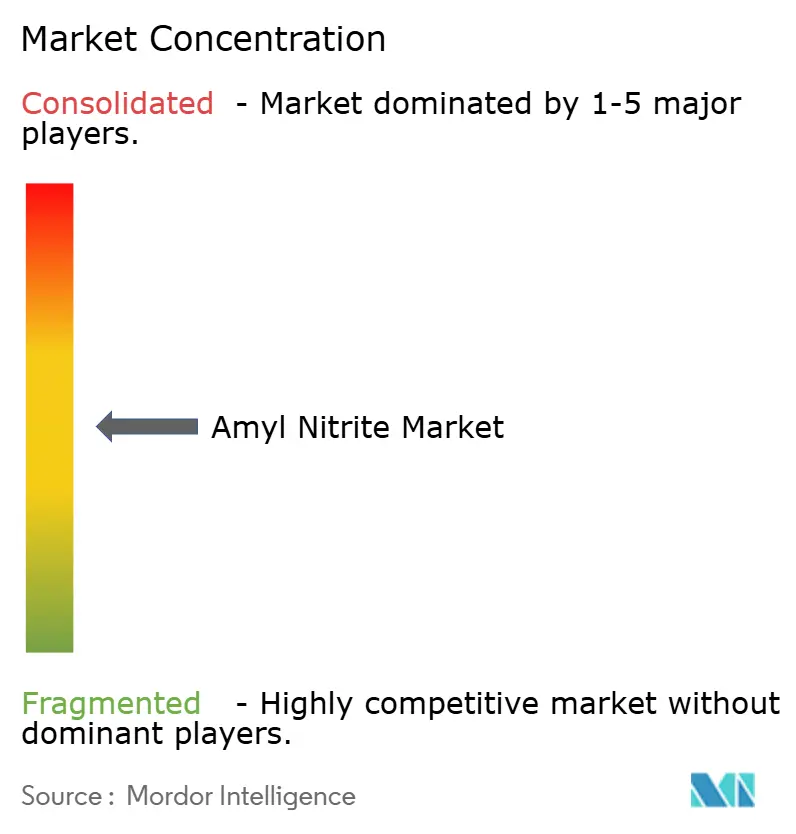
The amyl nitrite market is moderately fragmented. Multinational life sciences companies serve premium hospital and research customers, while specialized fine-chemical and pharmaceutical producers serve narrower or lower-specification channels. Merck KGaA, through MilliporeSigma, and Thermo Fisher Scientific are active in premium laboratory and hospital channels. Their distribution networks, certification capabilities, batch records, and regulatory support are difficult for smaller suppliers to match. Large suppliers can use these capabilities to serve customers who need documented material across multiple sites or countries. Chinese producers such as Hangzhou Leap Chem, Hebei Chuanghai Biotechnology, and Hefei TNJ Chemical compete in industrial and lower-specification reagent grades, benefiting from lower-cost supply structures and proximity to chemical feedstock networks. Quality documentation and customer requirements remain central to competitive positioning.
In June 2026, Merck KGaA agreed to acquire Bio-Techne for USD 11.3 billion, expanding its life sciences portfolio and strengthening its presence in research chemical distribution. The transaction adds more than 6,000 proteins and 425,000 antibodies to the company's research portfolio, broadening its access to research customers who also purchase specialty chemical reagents. Thermo Fisher Scientific has committed USD 2 billion to United States manufacturing investment over four years, starting in April 2025, including USD 500 million for research and development capacity. This investment highlights localized supply and manufacturing capacity as competitive factors for premium specialty chemicals. James Alexander Corporation in the United States, Valsynthese SA in France, and Anax Laboratories in India maintain focused pharmaceutical-grade positions. Their regulatory filings and quality certifications create barriers for new suppliers in medical channels, allowing these companies to compete through specialized quality systems rather than through the scale of a multinational distributor. A potential gap remains for stabilized, cold-chain-independent medical-grade products suited to tropical and resource-limited markets.
Amyl Nitrite Industry Leaders
-
Merck KGaA
-
Thermo Fisher Scientific Inc.
-
Tokyo Chemical Industry Co., Ltd.
-
James Alexander Corporation
-
Spectrum Chemical
- *Disclaimer: Major Players sorted in no particular order
Amyl Nitrite Market Companies Covered in this Report
- Anax Laboratories
- Capot Chemical Co., Ltd.
- Hangzhou Leap Chem Co., Ltd.
- Hebei Chuanghai Biotechnology Co., Ltd
- Hefei TNJ Chemical Industry Co., Ltd.
- James Alexander Corporation
- Merck KGaA
- Muby Chemicals
- Otto Chemie Pvt. Ltd.
- Santa Cruz Biotechnology Inc.
- Spectrum Chemical
- Thermo Fisher Scientific Inc.
- Tokyo Chemical Industry Co., Ltd.
- Toronto Research Chemicals Inc.
- Valsynthese SA
Recent Industry Developments in Amyl Nitrite Market
- June 2026: Merck KGaA agreed to acquire Bio-Techne for approximately USD 11.3 billion, its largest life sciences acquisition since the purchase of Sigma-Aldrich in 2015. The deal adds over 6,000 proteins and 425,000 antibodies to Merck's research chemical portfolio, strengthening its position across specialty chemical distribution channels, including nitrite-based laboratory compounds.
- August 2025: Thermo Fisher Scientific opened a 375,000-square-foot carbon-neutral manufacturing facility in Mebane, North Carolina, capable of producing at least 40 million laboratory consumables per week. The facility supports the resilience of the US laboratory chemicals supply chain, with direct implications for specialty reagent procurement, including high-purity amyl nitrite.
Global Amyl Nitrite Market Report Scope
Amyl nitrite is a clear, yellowish liquid chemical that dilates blood vessels and produces a rapid, short-lived effect when inhaled. It acts as a muscle relaxant and has historically been prescribed to treat angina (chest pain caused by reduced blood flow to the heart).
The amyl nitrite market is segmented by product type, application, and geography. By product type, the market is segmented into medical-grade amyl nitrite, industrial-grade amyl nitrite, and others. By application, the market is segmented into medical and healthcare, chemical synthesis and pharmaceutical intermediates, research and analytical laboratories, cleaning agents and specialty solvents, textile processing and dye chemistry, and others. The report also covers market size and forecasts for amyl nitrite across 15 countries in major regions. The market sizes and forecasts are provided in terms of value (USD).
Segmentation Overview
| Medical-Grade Amyl Nitrite |
| Industrial-Grade Amyl Nitrite |
| Others |
| Medical and Healthcare |
| Chemical Synthesis and Pharmaceutical Intermediates |
| Research and Analytical Laboratories |
| Cleaning Agents and Specialty Solvents |
| Textile Processing and Dye Chemistry |
| Others |
| Asia-Pacific | China |
| India | |
| Japan | |
| South Korea | |
| Rest of Asia-Pacific | |
| North America | United States |
| Canada | |
| Mexico | |
| Europe | Germany |
| United Kingdom | |
| France | |
| Italy | |
| Rest of Europe | |
| South America | Brazil |
| Argentina | |
| Rest of South America | |
| Middle East and Africa | Saudi Arabia |
| South Africa | |
| Rest of Middle East and Africa |
| By Product Type | Medical-Grade Amyl Nitrite | |
| Industrial-Grade Amyl Nitrite | ||
| Others | ||
| By Application | Medical and Healthcare | |
| Chemical Synthesis and Pharmaceutical Intermediates | ||
| Research and Analytical Laboratories | ||
| Cleaning Agents and Specialty Solvents | ||
| Textile Processing and Dye Chemistry | ||
| Others | ||
| By Geography | Asia-Pacific | China |
| India | ||
| Japan | ||
| South Korea | ||
| Rest of Asia-Pacific | ||
| North America | United States | |
| Canada | ||
| Mexico | ||
| Europe | Germany | |
| United Kingdom | ||
| France | ||
| Italy | ||
| Rest of Europe | ||
| South America | Brazil | |
| Argentina | ||
| Rest of South America | ||
| Middle East and Africa | Saudi Arabia | |
| South Africa | ||
| Rest of Middle East and Africa | ||
Key Questions Answered in the Report
What is current market size of Amyl Nitrite Market?
The Amyl Nitrite market size was estimated at USD 164.56 million in 2025 and is estimated to grow from USD 172.87 million in 2026 to USD 224.23 million by 2031, at a CAGR of 5.34% during the forecast period (2026-2031).
Which product category leads to global revenue?
Medical-grade amyl nitrite led with 54.31% of product revenue in 2025 and is forecast to grow at a 6.45% CAGR through 2031.
Which application has the fastest expected growth?
Medical and healthcare are forecast to grow at a 6.72% CAGR through 2031 after accounting for 43.56% of revenue in 2025.
Which region has the largest demand base?
Asia-Pacific held 32.73% of global revenue in 2025 and is forecast to grow at a 6.23% CAGR through 2031.