
Aminophenol Market Size and Share
Market Overview
| Study Period | 2022 - 2032 |
|---|---|
| Market Size (2027) | USD 1.84 Billion |
| Market Size (2032) | USD 2.28 Billion |
| Growth Rate (2027 - 2032) | 4.43 % |
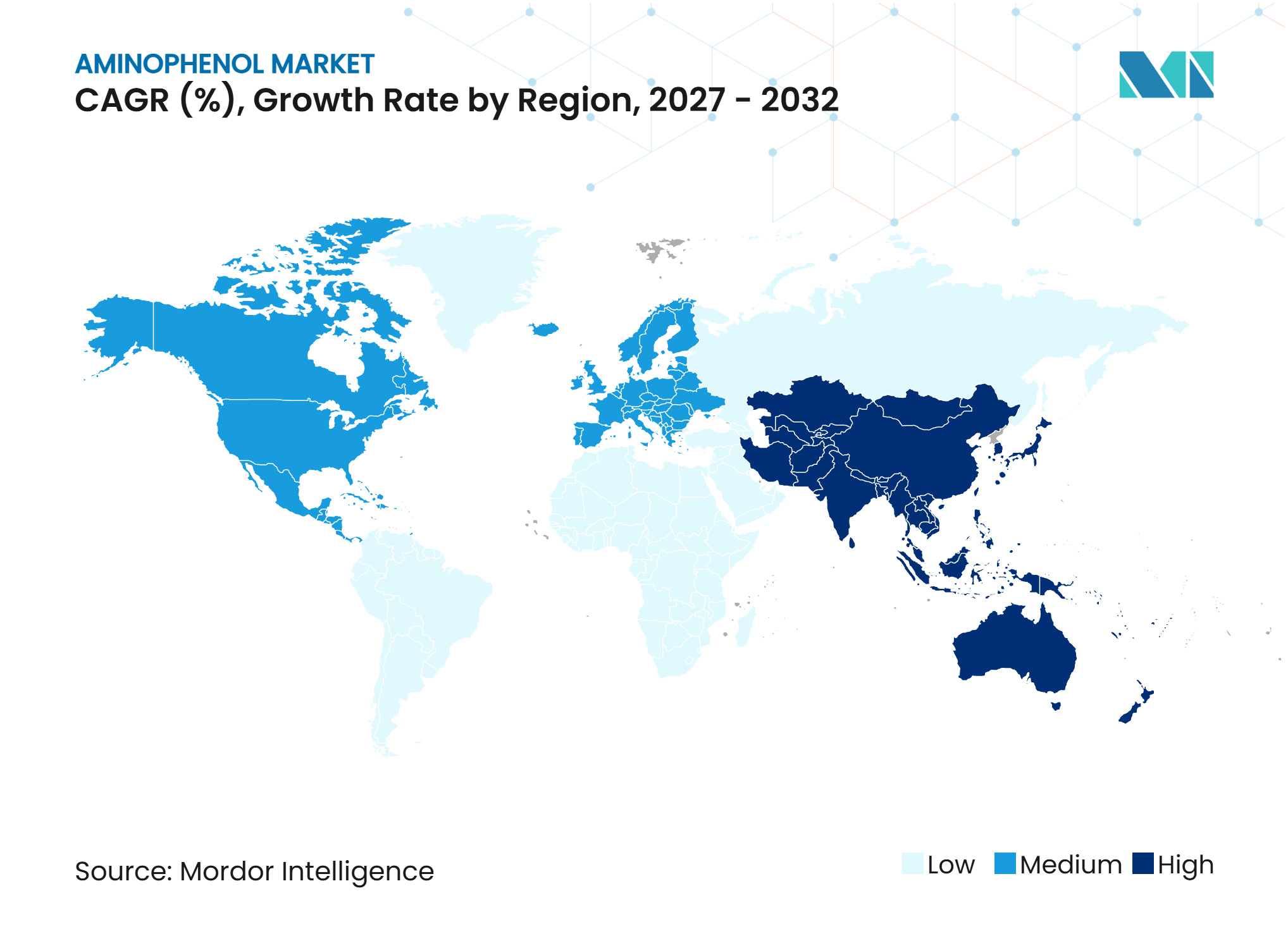
| Fastest Growing Market | Asia-Pacific |
| Largest Market | Asia-Pacific |
| Market Concentration | Medium |
Major Players *Disclaimer: Major Players sorted in no particular order Image © Mordor Intelligence. Reuse requires attribution under CC BY 4.0. | |
Aminophenol Market Analysis by Mordor Intelligence
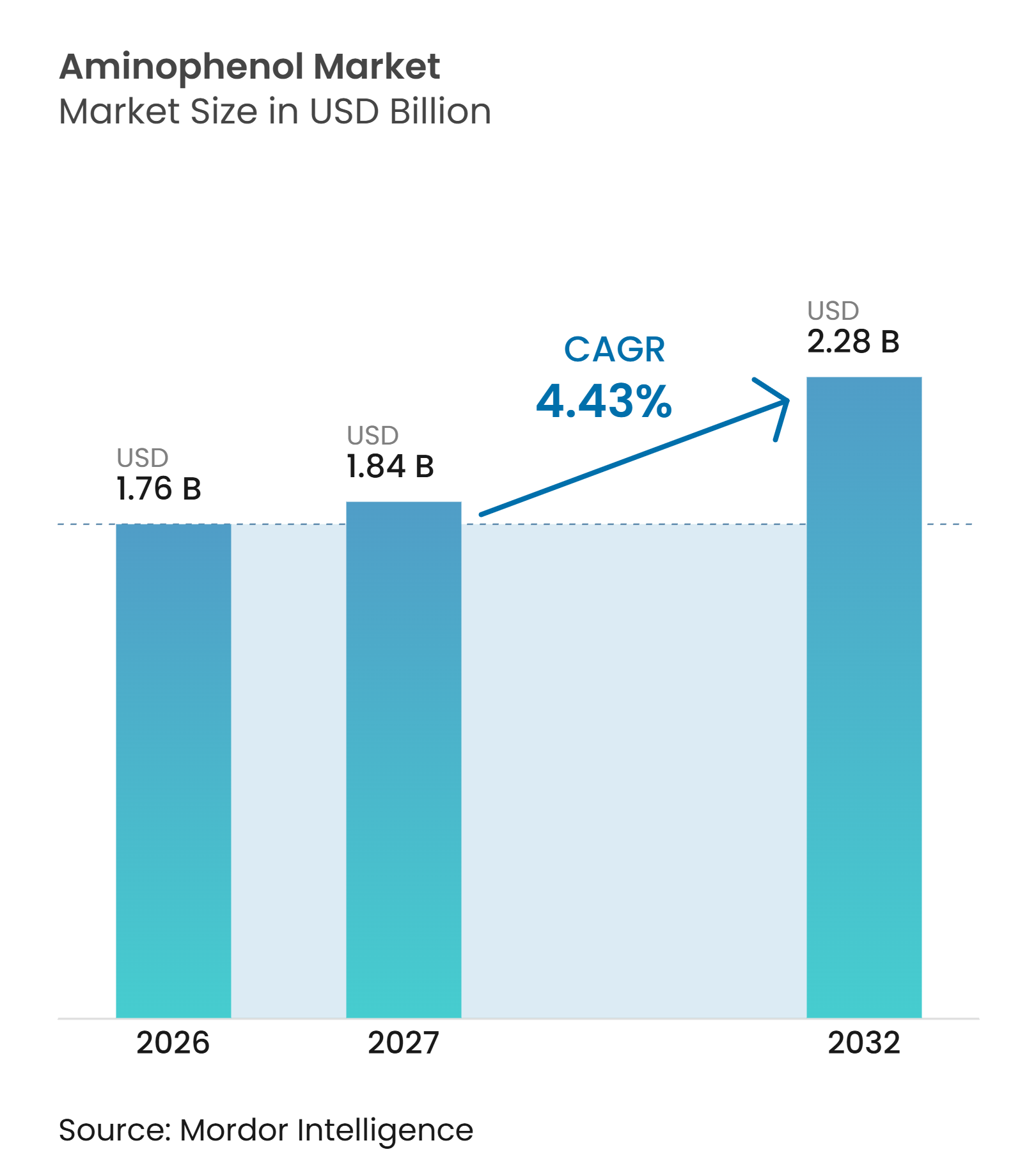
The Aminophenol Market size was valued at USD 1.76 billion in 2026 and is estimated to grow from USD 1.84 billion in 2027 to reach USD 2.28 billion by 2032, at a CAGR of 4.43% during the forecast period (2027-2032). Demand remains closely linked to pharmaceutical synthesis because p-aminophenol is a direct feedstock for paracetamol and acetaminophen. Generic-drug production in Asia-Pacific, personal care formulations, and higher sourcing standards are supporting the aminophenol market. Producers with integrated access to nitrobenzene, phenol, and downstream pharmaceutical ingredients can manage input costs and documentation requirements more effectively. Supply concentration in China remains a procurement concern, while capacity additions in India and France are creating alternative supply options. The aminophenol market is, therefore, becoming more focused on purity, traceability, and consistent supply rather than only price.
Key Report Takeaways
- By type, p-aminophenol held 58.12% of the aminophenol market share in 2026, while m-aminophenol is forecast to advance at a 4.87% CAGR through 2032.
- By application, synthesis precursors held 47.56% of the aminophenol market share in 2026, while dye intermediates are forecast to advance at a 5.13% CAGR through 2032.
- By end-use industry, pharmaceuticals held 51.34% of the aminophenol market share in 2026 and are forecast to advance at a 5.61% CAGR through 2032.
- By geography, Asia-Pacific held 39.28% of the aminophenol market share in 2026 and is forecast to advance at a 5.45% CAGR through 2032.
Note: Market numbers in this report are based on Mordor Intelligence's proprietary estimation framework, which combines nine months of actuals with Q4 projections for base year 2026.
Market Trends and Insights
Drivers Impact Analysis of Aminophenol Market*
| Driver | (~) % Impact on CAGR Forecast | Geographic Relevance | Impact Timeline |
|---|---|---|---|
| Paracetamol and Acetaminophen Intermediate Demand | +2.0% | Global, concentrated in China, India, and Europe | Short term (≤ 2 years) |
| Expansion of Pharmaceutical Manufacturing in Asia-Pacific | +1.2% | APAC core, spillover to MEA | Medium term (2-4 years) |
| Rising Use in Oxidative Hair Dyes and Specialty Colorants | +0.8% | Global, highest intensity in South Asia, Southeast Asia, and Western Europe | Medium term (2-4 years) |
| Growth in High-Purity API and Specialty Chemical Sourcing | +0.5% | North America, Europe, and regulated markets globally | Long term (≥ 4 years) |
| Seasonal Cold-and-Flu Procurement Cycles | +0.3% | Global, peaks in Northern Hemisphere winter | Short term (≤ 2 years) |
| Source: Mordor Intelligence | |||
Paracetamol and Acetaminophen Intermediate Demand
Demand for p-aminophenol remains the main driver in the aminophenol market because it is used to make paracetamol and acetaminophen. The established commercial route to paracetamol requires p-aminophenol, which ties upstream demand to the production plans of drug manufacturers. Farmson Basic Drugs Private Limited has stated that its integrated operations cover p-aminophenol, paracetamol active pharmaceutical ingredients, and downstream products. Its November 2025 acetic anhydride unit supported further backward integration at its Nandesari site. This structure helps suppliers reduce dependence on external inputs when paracetamol demand rises. It also makes production efficiency more important when finished-drug prices weaken.
Expansion of Pharmaceutical Manufacturing in Asia-Pacific
Pharmaceutical manufacturing expansion in Asia-Pacific is increasing demand in the aminophenol market. India’s Production Linked Incentive Scheme supports domestic manufacturing of key starting materials, drug intermediates, and active pharmaceutical ingredients. Granules India Limited’s Bonthapally facility received a Voluntary Action Indicated classification after a 2025 inspection by the U.S. Food and Drug Administration. Such inspections matter because regulated customers require suppliers to meet defined manufacturing standards. The expansion of compliant paracetamol capacity creates additional demand for pharmaceutical-grade p-aminophenol. World Health Organization (WHO) Good Manufacturing Practices (GMP) and U.S. Food and Drug Administration requirements continue to shape approved sourcing decisions.
Rising Use in Oxidative Hair Dyes and Specialty Colorants
M-aminophenol is used as a coupler and color developer in permanent hair dye formulations. Safety reviews and evolving European requirements are placing greater attention on the impurity profile and labeling of aminophenol-based ingredients in the aminophenol market. The European Chemicals Agency evaluation process provides a formal mechanism for examining substances that may require additional risk-management action[1]. These requirements can limit the use of material without adequate safety records. They can also favor suppliers that can provide compliant grades and complete product documentation. Research on allergens in hair dyes has identified aminophenol ingredients in products marketed as free from para-phenylenediamine, which indicates continued formulation relevance.
Seasonal Cold-and-Flu Procurement Cycles
Cold-and-flu seasons can increase paracetamol purchasing by pharmaceutical manufacturers. These buying cycles often affect inventory planning for p-aminophenol and other intermediates. Manufacturers with annual supply agreements can plan production with more certainty than buyers using short-term purchases. Seasonal procurement can also raise the value of dependable transport and inventory management. This factor is most relevant in markets with strong winter demand for over-the-counter pain and fever medicines. It supports demand planning across the aminophenol market without changing the underlying pharmaceutical dependence.
Restraints Impact Analysis of Aminophenol Market*
| Restraint | (~) % Impact on CAGR Forecast | Geographic Relevance | Impact Timeline |
|---|---|---|---|
| China-Centric Supply Exposure | -0.2% | Global, most acute in North America and Europe | Short term (≤ 2 years) |
| Environmental and Purity Compliance Burden | -0.2% | China and India primarily; spill-over to global trade | Medium term (2-4 years) |
| Feedstock and Energy Cost Pass-Through Volatility | -0.1% | Global; feedstock-import-dependent regions most exposed | Short term (≤ 2 years) |
| Source: Mordor Intelligence | |||
China-Centric Supply Exposure
Aminophenol supply remains exposed to China because large p-aminophenol capacity is concentrated there. This concentration can create procurement risks when export requirements, environmental reviews, or operating disruptions affect major plants. China introduced export-license controls for specified precursor chemicals shipped to the United States, Mexico, and Canada in November 2025[2]. The policy did not name aminophenol, but it increased attention on controls affecting chemical supply chains. India is increasing local output through policy-supported projects, yet new capacity will take time to reduce dependence on Chinese material. The aminophenol market will remain sensitive to the reliability of Chinese supply during the forecast period.
Environmental and Purity Compliance Burden
Aminophenol manufacturing requires wastewater treatment, emissions controls, and consistent impurity management. These requirements can increase capital spending and delay new capacity during environmental reviews in the aminophenol market. Environmental approval records in Jilin show that an aminophenol project required defined plans for waste gas, wastewater, and solid waste management. Larger integrated facilities can spread these compliance costs across higher production volumes. Smaller producers may face a more difficult path to qualifying for pharmaceutical and cosmetics applications. China’s discharge standards and India’s Central Pollution Control Board requirements, therefore, influence capacity and supplier selection.
*Our forecasts treat driver/restraint impacts as directional, not additive. The impact forecasts reflect baseline growth, mix effects, and variable interactions.
Aminophenol Market Segment Analysis
By Type:
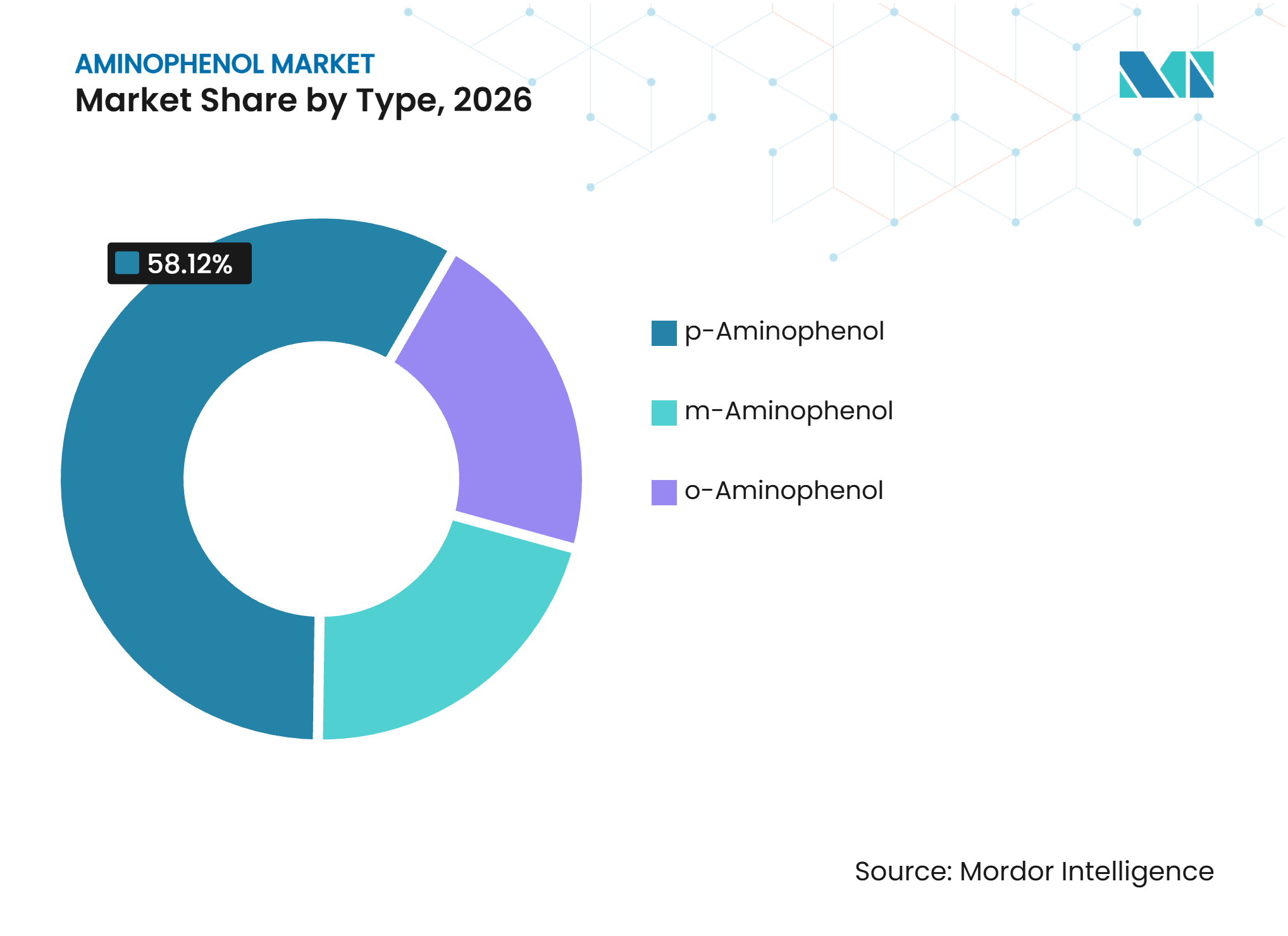
p-Aminophenol Holds the Largest Share, While m-Aminophenol Gains Groundp-aminophenol held 58.12% of the aminophenol market share in 2026 because it is a direct precursor for paracetamol. Its established role in pharmaceutical production gives the segment a stable demand base. Chinese producers have substantial p-aminophenol output, while Indian suppliers are expanding to serve domestic and export pharmaceutical supply chains. Farmson Basic Drugs Private Limited has described an integrated route from p-aminophenol to paracetamol active pharmaceutical ingredients. The segment also benefits from buyers seeking material with reliable purity and traceability. High-quality documentation is important for manufacturers supplying regulated medicine markets.
m-aminophenol is projected to grow at a 4.87% CAGR through 2032. It is used in hair colorants, dye chemistry, and specialty pharmaceutical synthesis. The aminophenol market size for m-aminophenol is supported by the need for controlled quality in cosmetics applications. European chemical evaluation and cosmetics compliance rules are increasing scrutiny of safety documentation. This can limit suppliers that cannot meet labeling and safety requirements. o-aminophenol remains a smaller specialty material used in stabilizers, rubber chemicals, and heterocyclic chemistry.



By Application:
Synthesis Precursors Anchor Demand, While Dye Intermediates ExpandSynthesis precursors held 47.56% of the aminophenol market share in 2026. The segment is anchored by the production of paracetamol and other pharmaceutical intermediates. Manufacturers increasingly assess the quality systems and process records of upstream suppliers. The International Council for Harmonisation guideline Q11 sets expectations for the development and manufacture of drug substances. These expectations encourage buyers to prefer suppliers with documented controls over raw materials and impurities. This strengthens the position of integrated producers that can provide complete technical records.
Dye intermediates are projected to advance at a 5.13% CAGR through 2032. Hair dyes and textile colorants use aminophenol derivatives for color development and coupling chemistry. The European Union has continued to update rules on substances used in cosmetics, which affects formulation choices for hair color products. Suppliers that meet safety, labeling, and impurity requirements can serve regulated markets more effectively. Fluorescent stabilizers are a smaller application area with strict isomer-purity needs. Other uses in antioxidants, photographic developers, agrochemicals, and petroleum additives broaden demand beyond pharmaceuticals.
By End-Use Industry:
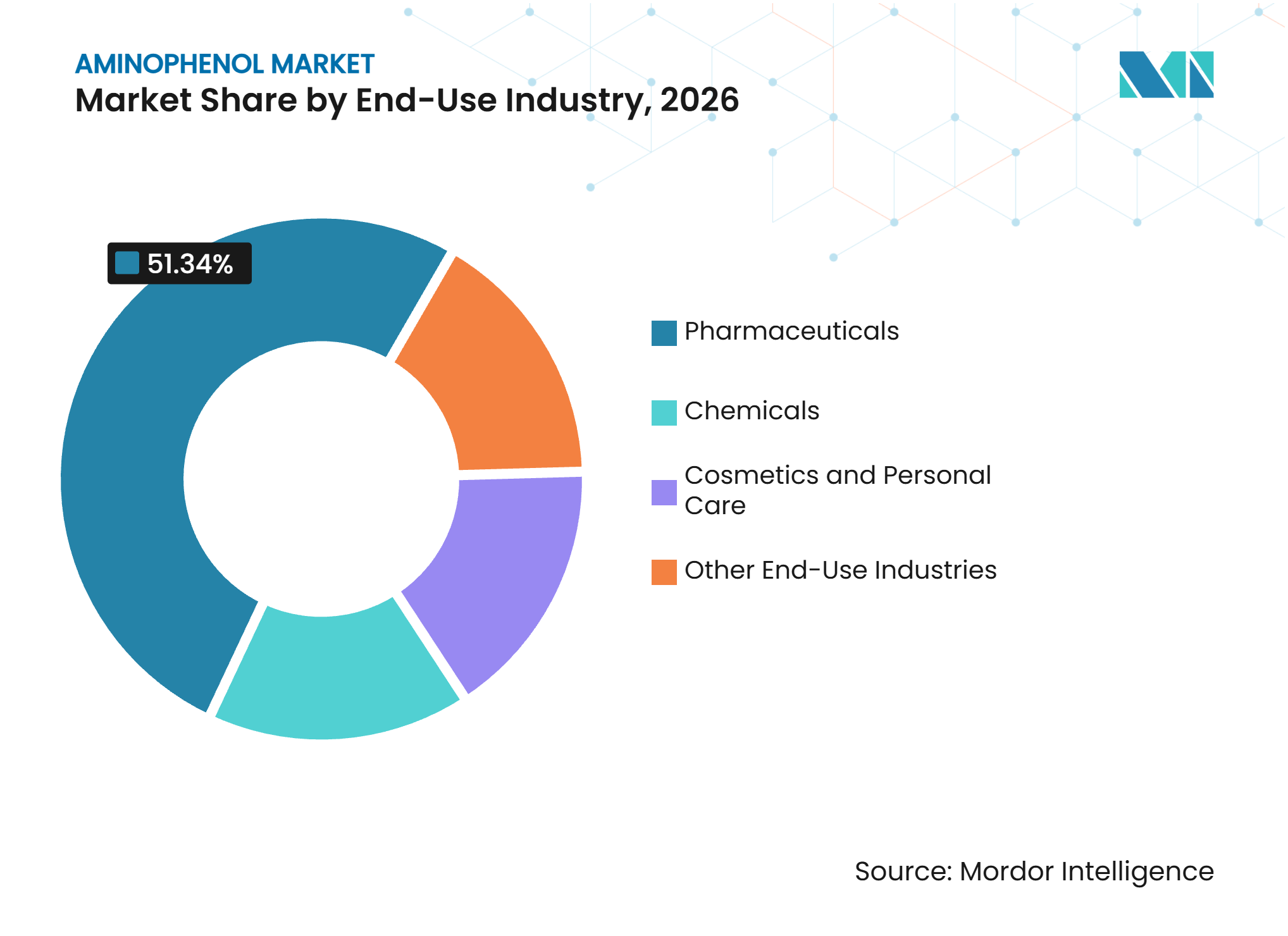
Pharmaceuticals Drive Revenue and GrowthPharmaceuticals held 51.34% of the aminophenol market share in 2026 and are projected to advance at a 5.61% CAGR through 2032. Paracetamol remains the central demand link between aminophenol suppliers and the pharmaceutical sector. Seqens is progressing with its French paracetamol project at Roussillon, where commercial production is expected after the development phase. This project is intended to support a more resilient European medicine supply. Good Manufacturing Practice requirements restrict procurement to suppliers that can meet pharmaceutical quality standards. Such requirements make quality assurance an important competitive factor.
Chemicals represent a broad end-use area for rubber antioxidants, polymer stabilizers, and agrochemical intermediates. Demand in these uses follows manufacturing activity, particularly in Asian production centers. Cosmetics and personal care require suppliers to manage specific safety and regulatory expectations. The aminophenol market size in these uses is shaped by formulation rules as well as consumer demand for hair color products. The Cosmetic Ingredient Review process continues to assess cosmetic ingredients against available safety data. Other end uses, including photographic chemicals and petroleum additives, provide a diversified demand base.

Geography Analysis
Asia-Pacific
Asia-Pacific held 39.28% of the aminophenol market share in 2026 and is projected to advance at a 5.45% CAGR through 2032. China remains a major production center for p-aminophenol and related chemical intermediates, while India is expanding pharmaceutical intermediate capacity. Ningbo Customs reported growth in basic organic chemical exports during the first 9 months of 2025, with the European Union, India, and ASEAN among key destinations. India’s Production Linked Incentive program is supporting domestic drug-intermediate manufacturing. U.S. Food and Drug Administration inspection outcomes are also important for Indian plants that supply regulated export markets. The region’s scale, integrated manufacturing base, and growing compliance capabilities continue to support regional leadership.
Europe
Europe is increasing its focus on supply resilience for essential medicines and their upstream ingredients. Seqens is developing a domestic paracetamol production facility in Roussillon under France 2030, which can support demand in the aminophenol market for documented European or audited p-aminophenol supply. The European Medicines Agency and Registration, Evaluation, Authorisation and Restriction of Chemicals (REACH)compliance framework influence sourcing decisions through quality, safety, and traceability requirements. Seqens also partnered with Brenntag in December 2025 to commercialize non-Good Manufacturing Practice pharmaceutical intermediates in Europe. This adds distribution coverage for smaller customers. European buyers are likely to value suppliers that can combine reliable documentation with resilient logistics.
North America, South America, and Middle East and Africa
North America has strong consumption of paracetamol-based medicines but limited domestic p-aminophenol production. China’s 2025 export-license policy has prompted buyers to review alternative sources from India and Europe. BASF announced an investment to expand aminic antioxidant capacity in Puebla, Mexico, with completion planned for 2026. South America remains more dependent on imported aminophenol and finished paracetamol products than on local upstream capacity. The Middle East and Africa offer early-stage demand opportunities as pharmaceutical manufacturing develops in selected countries. Across these regions, supplier qualification, import logistics, and product documentation will shape the aminophenol market more strongly than local commodity production.
Competitive Landscape
Market Concentration
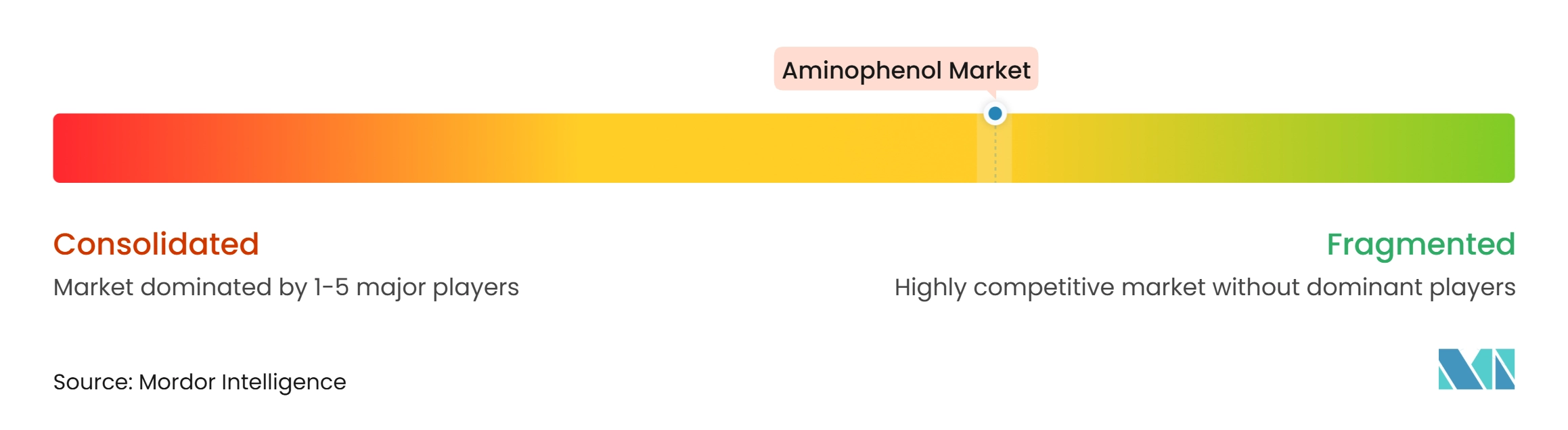
The aminophenol market is moderately concentrated, with the top five players including Taixing Yangzi Pharm Chemical Industry Co., Ltd., Anhui Bayi Chemical Industry Co., Ltd., Liaoning Shixing Pharmaceutical and Chemical Co., Ltd., Seqens, and Sadhana Nitro Chem Ltd. Large Chinese producers compete through feedstock integration, scale, and established production assets. Indian companies are expanding integrated pharmaceutical-intermediate operations to improve supply security. Farmson Basic Drugs Private Limited completed an acetic anhydride facility in 2025, extending its integrated paracetamol value chain. Pharmaceutical-grade material is differentiated by quality records, regulatory documentation, and supplier approval status. This raises the importance of long-term customer qualification.
Aarti Industries Ltd. reported FY2025 growth and continued capital investment in specialty chemical operations. Atul Ltd. operates life science chemical activities that include pharmaceutical and agrochemical intermediates. BASF is expanding aminic antioxidant capacity in Mexico, strengthening its broader amine-chemistry position. Seqens is pursuing the Roussillon paracetamol project and is expanding its European distribution reach through Brenntag. These moves show how companies are using integration, capacity investment, and distribution partnerships to improve their positions in the aminophenol market. Suppliers of high-purity m-aminophenol and o-aminophenol can also address specialized applications where compliance records are important.
CDH Fine Chemicals, Glentham Life Sciences Limited, and Loba Chemie Pvt. Ltd. primarily participate as catalog and reagent suppliers rather than confirmed large-scale aminophenol manufacturers. Eastman Chemical Company has a broad chemical portfolio that includes amine-related activities. The competitive position of these companies depends on product grade, plant compliance, and customer approvals.
Aminophenol Industry Leaders
-
Taixing Yangzi Pharm Chemical Industry Co., Ltd.
-
Anhui Bayi Chemical Industry Co., Ltd.
-
Liaoning Shixing Pharmaceutical and Chemical Co., Ltd.
-
Seqens
-
Sadhana Nitro Chem Ltd.
- *Disclaimer: Major Players sorted in no particular order
Aminophenol Market Companies Covered in this Report
- Aarti Industries Ltd.
- Anhui Bayi Chemical Industry Co., Ltd.
- Atul Ltd.
- BASF
- CDH Fine Chemicals
- Eastman Chemical Company
- EMCO Dyestuff Pvt. Ltd.
- Farmson Basic Drugs Private Limited
- Glentham Life Sciences Limited.
- Granules India Limited
- Hebei Xingyu Chemical Co., Ltd.
- Jay Organics Pvt. Ltd.
- Liaoning Shixing Pharmaceutical and Chemical Co., Ltd.
- Loba Chemie Pvt. Ltd.
- Sadhana Nitro Chem Ltd.
- Seqens
- Taixing Yangzi Pharm Chemical Co., Ltd.
Recent Industry Developments in Aminophenol Market
- June 2026: Granules Pharmaceuticals Inc. (GPI), a subsidiary of Granules India Limited, received an Establishment Inspection Report (EIR) from the U.S. Food and Drug Administration (FDA) for its manufacturing facility in Chantilly, Virginia. The development supports the aminophenol market by strengthening regulatory compliance and manufacturing capabilities within the pharmaceutical supply chain for paracetamol and related intermediates.
- November 2025: Farmson Basic Drugs Private Limited inaugurated Unit-VI, a dedicated acetic anhydride manufacturing facility at Nandesari, Vadodara, Gujarat, representing an investment of INR 300 crore (approximately USD 35 million). The facility completes Farmson's backward integration from p-aminophenol through paracetamol active pharmaceutical ingredients (APIs) to direct-compression granules, supporting the aminophenol market through stronger raw material integration and supply-chain capabilities.
Global Aminophenol Market Report Scope
Aminophenol is an aromatic organic compound containing both amino and hydroxyl functional groups attached to a benzene ring. Its chemical reactivity makes it an important intermediate in the synthesis of pharmaceutical compounds, dyes, and other specialty chemicals.
The Aminophenol Market is segmented by type, application, end-use industry, and geography. By type, the market is segmented into p-aminophenol, m-aminophenol, and o-aminophenol. By application, the market is segmented into synthesis precursors, dye intermediates, fluorescent stabilizers, and other applications. By end-use industry, the market is segmented into pharmaceuticals, chemicals, cosmetics and personal care, and other end-use industries. The report also covers the market size and forecasts for aminophenol across 15 countries. For each segment, the market sizing and forecasts have been done on the basis of value (USD).
Segmentation Overview
| p-Aminophenol |
| m-Aminophenol |
| o-Aminophenol |
| Synthesis Precursors |
| Dye Intermediates |
| Fluorescent Stabilizers |
| Other Applications |
| Pharmaceuticals |
| Chemicals |
| Cosmetics and Personal Care |
| Other End-Use Industries |
| Asia-Pacific | China |
| India | |
| Japan | |
| South Korea | |
| ASEAN Countries | |
| Rest of Asia-Pacific | |
| North America | United States |
| Canada | |
| Mexico | |
| Europe | Germany |
| United Kingdom | |
| France | |
| Italy | |
| NORDIC Countries | |
| Rest of Europe | |
| South America | Brazil |
| Argentina | |
| Rest of South America | |
| Middle East and Africa | Saudi Arabia |
| South Africa | |
| Rest of Middle East and Africa |
| By Type | p-Aminophenol | |
| m-Aminophenol | ||
| o-Aminophenol | ||
| By Application | Synthesis Precursors | |
| Dye Intermediates | ||
| Fluorescent Stabilizers | ||
| Other Applications | ||
| By End-Use Industry | Pharmaceuticals | |
| Chemicals | ||
| Cosmetics and Personal Care | ||
| Other End-Use Industries | ||
| By Geography | Asia-Pacific | China |
| India | ||
| Japan | ||
| South Korea | ||
| ASEAN Countries | ||
| Rest of Asia-Pacific | ||
| North America | United States | |
| Canada | ||
| Mexico | ||
| Europe | Germany | |
| United Kingdom | ||
| France | ||
| Italy | ||
| NORDIC Countries | ||
| Rest of Europe | ||
| South America | Brazil | |
| Argentina | ||
| Rest of South America | ||
| Middle East and Africa | Saudi Arabia | |
| South Africa | ||
| Rest of Middle East and Africa | ||
Key Questions Answered in the Report
What is the size of the aminophenol market?
The aminophenol market size was valued at USD 1.76 billion in 2026 and is estimated to grow from USD 1.84 billion in 2027 to reach USD 2.28 billion by 2032, at a CAGR of 4.43% during the forecast period (2027-2032).
What is driving demand for aminophenol?
Pharmaceutical manufacturing is the central demand driver because p-aminophenol is a direct precursor for paracetamol and acetaminophen.
Which type held the largest share in 2026?
P-aminophenol held 58.12% of the market share in 2026, supported by its established use in paracetamol manufacturing.
Which application is projected to advance fastest through 2032?
Dye Intermediates are projected to advance at a 5.13% CAGR through 2032, supported by demand from hair colorants and specialty colorants.