
Aluminum Phosphide Market Size and Share
Market Overview
| Study Period | 2022 - 2032 |
|---|---|
| Market Size (2027) | USD 709.95 Million |
| Market Size (2032) | USD 897.48 Million |
| Growth Rate (2027 - 2032) | 4.80 % |
| Fastest Growing Market | Asia-Pacific |
| Largest Market | Asia-Pacific |
| Market Concentration | Medium |
Major Players *Disclaimer: Major Players sorted in no particular order Image © Mordor Intelligence. Reuse requires attribution under CC BY 4.0. | |
Aluminum Phosphide Market Analysis by Mordor Intelligence
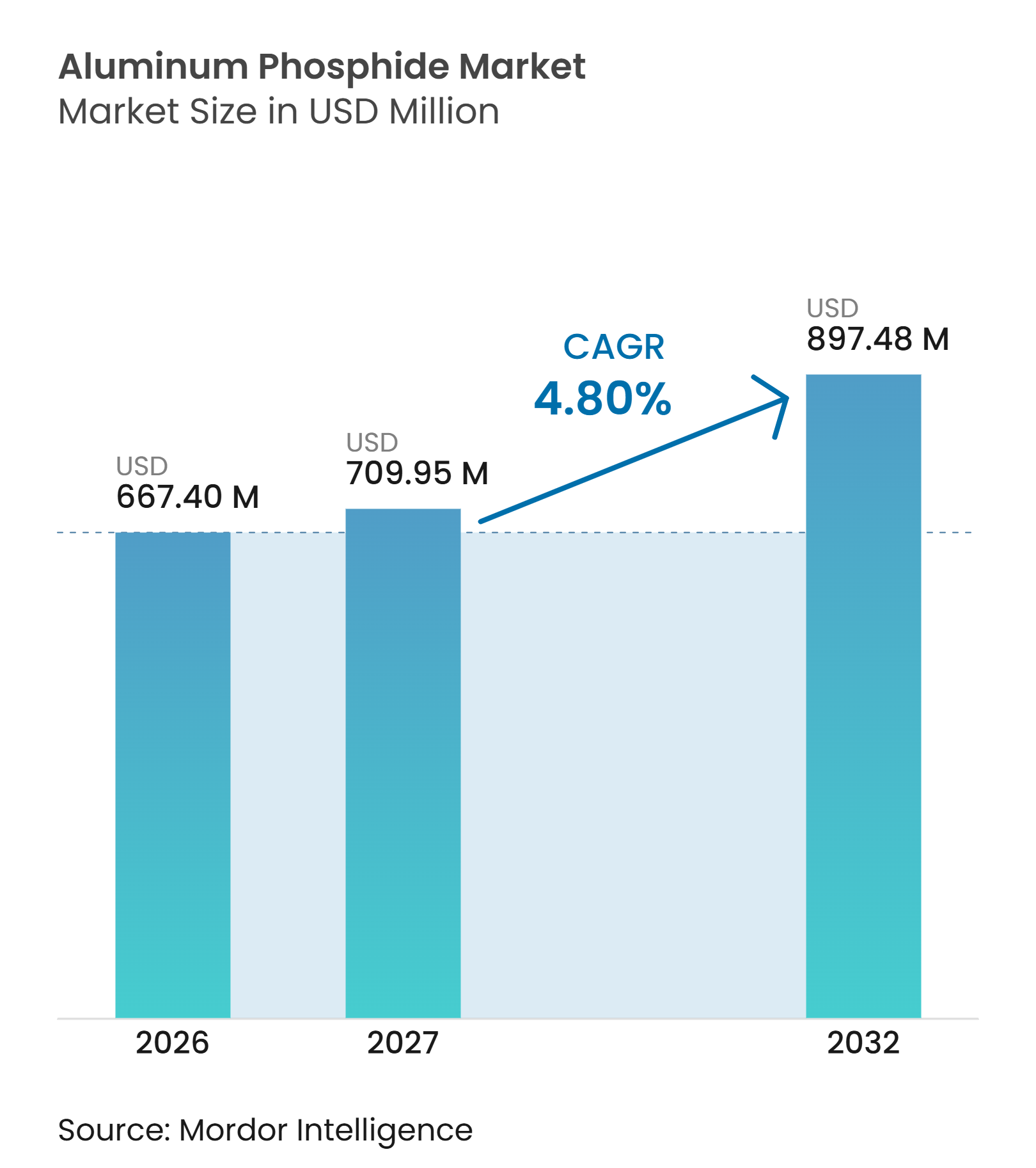
The aluminum phosphide market size was valued at USD 667.40 million in 2026 and is forecast to grow from USD 709.95 million in 2027 to USD 897.48 million by 2032, at a CAGR of 4.80% from 2027 to 2032. The market is supported by food security needs, as stored grain must be protected against insects across public reserves, commercial supply chains, and export-related storage. Trade regulations also require documented phytosanitary treatment for many commodity shipments, particularly when consignments move between markets with regulated pest controls. These requirements make fumigation a recurring operational need for storage operators, exporters, service providers, and other organizations managing large volumes of susceptible agricultural goods. Digital monitoring and pre-packed delivery formats are shifting supplier competition toward safer handling, documented applications, and traceable records that customers can present during audits or release procedures. Phosphine resistance, authorization reviews, alternative storage methods, and feedstock exposure remain key constraints on the market, as each can increase operating complexity or reduce customer flexibility.
Key Report Takeaways
- By form, tablets accounted for 53.4% of the aluminum phosphide market share in 2026, while pellets are forecast to grow at a CAGR of 5.1% from 2027 to 2032.
- By application, stored grain protection accounted for 67.8% of the aluminum phosphide market size in 2026, while stored commodity fumigation is forecast to grow at a CAGR of 6.5% from 2027 to 2032.
- By end user, grain elevators and bulk handlers accounted for 34.0% of the market share in 2026, while agricultural exporters are forecast to grow at a CAGR of 6.1% from 2027 to 2032.
- By geography, Asia-Pacific accounted for 44.1% of the market share in 2026 and is forecast to grow at a CAGR of 6.8% from 2027 to 2032.
Note: Market numbers in this report are based on Mordor Intelligence's proprietary estimation framework, which combines nine months of actuals with Q4 projections for base year 2026.
Market Trends and Insights
Drivers Impact Analysis of Aluminum Phosphide Market*
| Driver | (~) % Impact on CAGR Forecast | Geographic Relevance | Impact Timeline |
|---|---|---|---|
| Growth in Cross-Border Grain Trade and Phytosanitary Requirements | +1.0% | Global, with emphasis on North America, South America, and Asia-Pacific export corridors | Medium term (2-4 years) |
| Expansion of Grain Storage Infrastructure and Public Food Reserves | +0.9% | Asia-Pacific, Africa, Middle East, and South America | Medium term (2-4 years) |
| Persistent Post-Harvest Losses in Stored Agricultural Commodities | +0.8% | Global, especially sub-Saharan Africa, South Asia, and South America | Long term (≥ 4 years) |
| Cost Advantages of Aluminum Phosphide Over Cylinderized Phosphine | +0.8% | Global, strongest in India, China, Brazil, and Mexico | Short term (≤ 2 years) |
| Increasing Adoption of Digital Fumigation Monitoring | +0.5% | North America and Europe, with adoption in Australia and advanced Asia-Pacific markets | Medium term (2-4 years) |
| Advancements in Fumigant Delivery Systems | +0.4% | North America, Europe, Australia, India, and Brazil | Medium term (2-4 years) |
| Source: Mordor Intelligence | |||
Growth in Cross-Border Grain Trade and Phytosanitary Requirements
International grain trade operates under phytosanitary treatment rules administered by national plant protection organizations. In July 2025, the revised ISPM 43 clarified the authorization requirements for export fumigation service providers, reinforcing the importance of compliant treatment procedures[1]. Exporters must often document phosphine fumigation when shipping to destinations that apply quarantine controls for regulated pests. Aluminum phosphide tablets and pellets support these applications by providing defined product units that facilitate treatment records, dose verification, and provider documentation. Shipments that fail inspections due to live insects may require treatment before export, creating additional demand for fumigation products and services within the same trade cycle[2]. The July 2025 update to ISPM 28 retained the international framework for phytosanitary treatments of regulated pests. These requirements support demand for aluminum phosphide in eligible agricultural commodity fumigation applications, as documented treatment procedures and effective pest control help exporters meet destination-market requirements, avoid shipment delays, and reduce the risk of additional treatment costs.
Expansion of Grain Storage Infrastructure and Public Food Reserves
Expansion of public grain reserves increases the volume of agricultural commodities requiring pest management during storage, while investments in silos, warehouses, and bulk-storage facilities expand the capacity available for planned fumigation and professional inspection. Public food-reserve programs may hold grain for extended periods, increasing the importance of consistent pest-control procedures to maintain stored-grain quality. Public storage operators may engage licensed fumigation service providers under recurring contracts, with defined operating procedures and applicator qualification requirements. These procurement practices can support recurring demand for aluminum phosphide among suppliers serving public and commercial grain-storage facilities. Modern storage infrastructure also places greater emphasis on documented treatment procedures and gas monitoring before facilities are cleared for re-entry. Consequently, investment in grain-storage infrastructure and public food reserves can support demand for aluminum phosphide in agricultural fumigation applications beyond individual farm-level purchases.
Persistent Post-Harvest Losses in Stored Agricultural Commodities
Post-harvest losses strengthen the economic case for preventive fumigation across grain supply chains, where insect infestations can reduce saleable inventory and the value of harvested crops. The Food and Agriculture Organization of the United Nations (FAO) reported that 13.3% of food was lost globally between the post-harvest and wholesale stages, while losses in least-developed countries reached 19.9%[3]. Inadequate storage conditions can expose cereals, pulses, and oilseeds to insect damage before they reach processors, traders, or consumers. Rising agricultural output without corresponding investment in storage infrastructure can increase the volume of commodities vulnerable to deterioration between harvest and distribution. Aluminum phosphide offers a fumigation option for eligible stored commodities without requiring the purchase of large, fixed fumigation installations, making it accessible to commercial storage facilities and smaller operators through established professional service channels. Its use within integrated stored-product pest-management practices can support demand for fumigation when storage conditions and pest pressures necessitate treatment.
Cost Advantages of Aluminum Phosphide Over Cylindrical Phosphine
Aluminum phosphide releases phosphine gas through a moisture-activated reaction at the treatment site, whereas cylindrical phosphine is supplied in pressurized containers. Depending on the application and operating requirements, aluminum phosphide can avoid certain costs associated with cylinder purchases, specialized gas-handling equipment, and the transportation and return of pressurized containers. Cylindrical systems may also involve equipment maintenance and handling requirements that contribute to total fumigation costs. UPL markets QuickPhos products in tablet, pellet, bag, and powder formats for post-harvest fumigation. The company also provides stewardship guidance focused on good fumigation practices and responsible product use. These potential cost advantages can support demand for aluminum phosphide among distributors, cooperatives, and agricultural storage operators in price-sensitive markets, where purchasing decisions consider product costs, equipment requirements, labor, logistics, monitoring, and maintenance.
Restraints Impact Analysis of Aluminum Phosphide Market*
| Restraint | (~) % Impact on CAGR Forecast | Geographic Relevance | Impact Timeline |
|---|---|---|---|
| Regulatory Restrictions and Certified-Applicator Requirements | -0.8% | North America and Europe, with effects in Australia, Canada, and the United Kingdom | Short term (≤ 2 years) |
| Increasing Phosphine Resistance in Stored-Product Insects | -0.7% | Global, with major exposure in the United States, Australia, India, China, and Brazil | Long term (≥ 4 years) |
| Growth of Hermetic Storage and Other Alternatives | -0.5% | Europe, North America, Japan, Australia, and emerging use in sub-Saharan Africa | Medium term (2-4 years) |
| Yellow-Phosphorus Supply Volatility and Formulation Costs | -0.4% | China, India, Brazil, and export markets | Medium term (2-4 years) |
| Source: Mordor Intelligence | |||
Regulatory Restrictions and Certified-Applicator Requirements
The use of aluminum phosphide is subject to stringent regulatory controls in many jurisdictions, as improper handling or exposure to phosphine gas can pose serious health and safety risks. In the United States, the Environmental Protection Agency (EPA) requires certification for applicators using restricted-use pesticide products, including aluminum phosphide products. California issued an updated phosphine exposure mitigation status memorandum in August 2026. In Germany, the use of aluminum phosphide requires appropriate professional expertise, and phosphine concentration monitoring is required before re-entry into treated spaces. Belgium also updated the storage conditions for several aluminum phosphide products in July 2025. These regulatory and safety requirements can increase training, monitoring, documentation, and service costs while limiting the availability of qualified fumigation providers. The resulting compliance burden may constrain adoption among smaller agricultural storage operators that lack in-house technical expertise or access to specialized fumigation services.
Increasing Phosphine Resistance in Stored-Product Insects
Phosphine resistance complicates effective fumigation in agricultural storage systems that rely on chemical treatments to control stored-product pests. A 2025 study published in the journal Insects identified phosphine resistance in populations of Rhyzopertha dominica and Tribolium castaneum across the United States and Canada. The research linked resistance levels in both species to the frequency of an allele associated with strong resistance. A study published in Pest Management Science in 2025 found that combining phosphine with high nitrogen concentrations and carbon dioxide under hypoxic conditions resulted in complete mortality of adults and progeny in several highly phosphine-resistant stored-product insect species. Such approaches may require more complex treatment protocols, extended planning, and additional monitoring compared with conventional fumigation procedures. Phosphine resistance can constrain the aluminum phosphide market by reducing treatment reliability, increasing pest-management costs, and requiring operators to adopt more demanding control measures to achieve effective results.
*Our forecasts treat driver/restraint impacts as directional, not additive. The impact forecasts reflect baseline growth, mix effects, and variable interactions.
Aluminum Phosphide Market Segment Analysis
By Form:
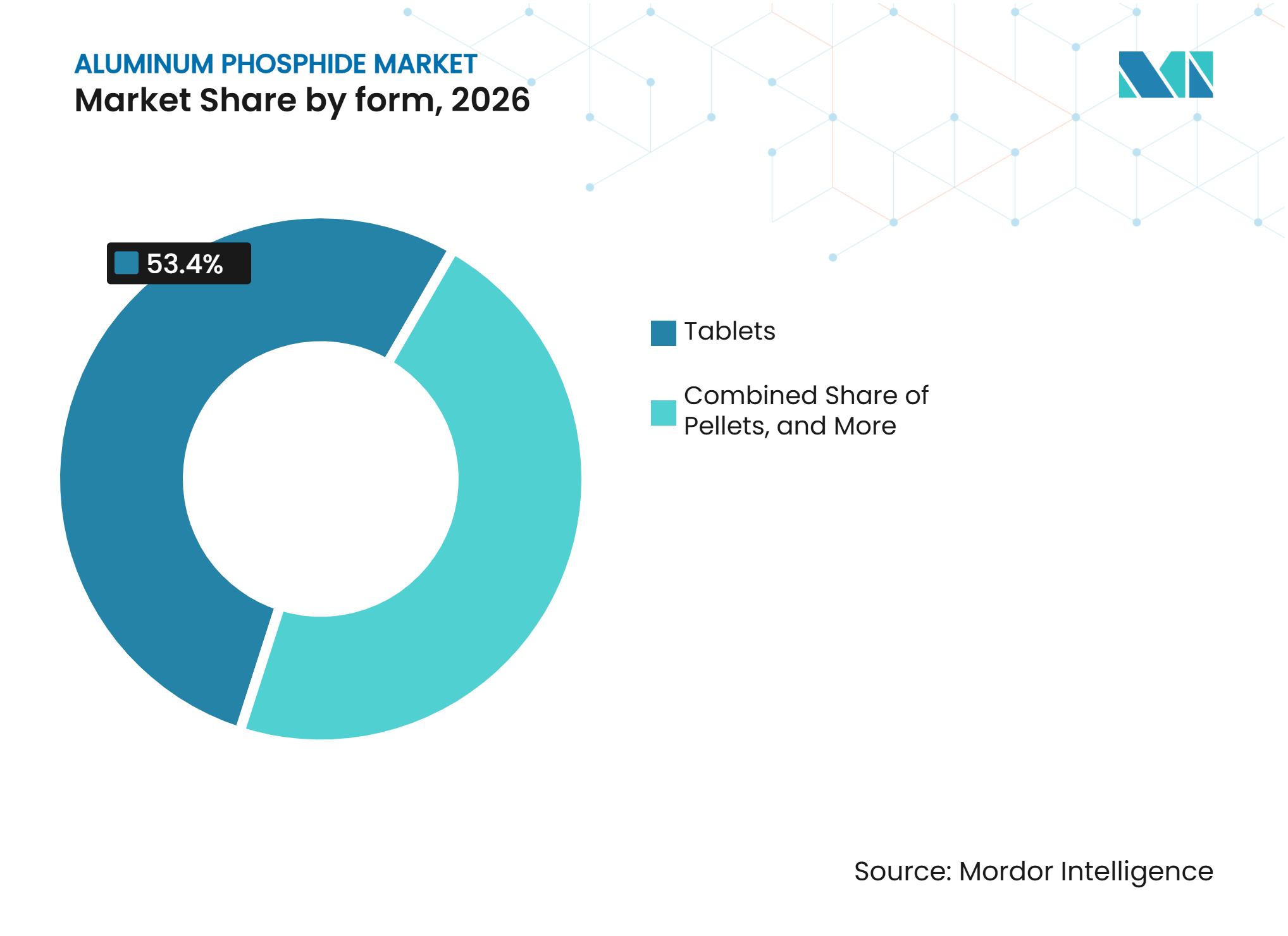
Tablets Sustain Majority Share as Pellets Lead Volume GrowthTablets accounted for 53.4% of the aluminum phosphide market in 2026. Their standardized format supports single-unit dose verification during fumigation management plans and post-treatment record reviews. This feature is useful where export certificates require auditable evidence of treatment. Grain elevators and port fumigation sites also use tablets for controlled application across large volumes of stored grain. The tablet segment is supported by professional applicator protocols, familiar handling practices, and broad acceptance in established storage markets.
Pellets are forecast to grow at a CAGR of 5.1% from 2027 to 2032. Modern grain silos can use mechanized dispensing systems that favor small-diameter formats for repetitive placement. Conveyor-fed and auger-integrated systems can support consistent distribution across large facilities when structured operating procedures are in place. Powder retains specialized use in surface treatment and rodent-burrow control, where tablet placement is less practical. Gas-permeable bags are gaining interest where operators want to reduce direct handler contact and simplify controlled placement. These trends reflect how the aluminum phosphide market is adapting delivery formats to modern storage workflows without displacing the established tablet base.



By Application:
Stored Grain Protection Leads, While Stored Commodity Fumigation Records Faster GrowthStored grain protection accounted for 67.8% of the aluminum phosphide market in 2026. It serves national grain reserves, commercial elevators, and on-farm facilities storing wheat, maize, rice, sorghum, and pulses. The segment depends on recurring treatment schedules, qualified applicators, and widespread familiarity with phosphine protocols. Its scale reflects the volume of grain held across domestic supply chains, public food programs, and export channels. Long-standing use in cereal-trading nations supports stable demand from operators that require dependable treatment procedures.
Stored commodity fumigation is forecast to expand at a CAGR of 6.5% from 2027 to 2032. Demand is linked to tobacco, cocoa, coffee, dried fruit, and processed cereal products requiring documented treatment for destination-market access. The aluminum phosphide market benefits when phytosanitary rules require evidence that these products were treated before shipment. Some exporters are moving from temperature treatment or vacuum packaging toward documented chemical fumigation processes. Burrowing rodent control remains a smaller application in South American soybean areas and Asian paddy regions with periodic field-edge losses. Its low unit cost supports periodic use at storage perimeters where rodent activity threatens the handling of stored commodities.
By End User:
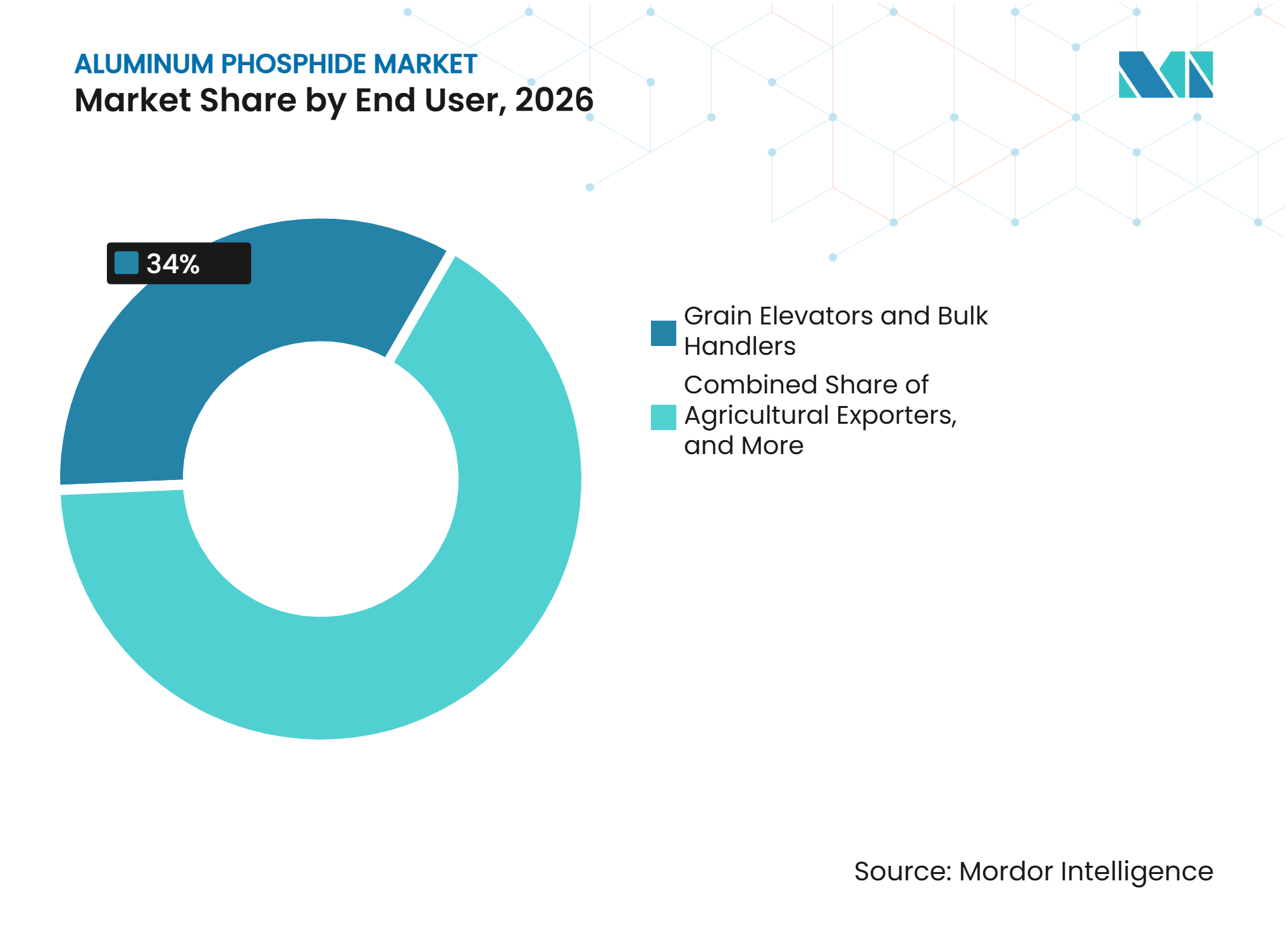
Grain Elevators and Bulk Handlers Lead Volume While Agricultural Exporters Grow FastestGrain elevators and bulk handlers accounted for 34% of the market in 2026. Their high throughput supports frequent treatment schedules, professional service contracts, and formal release procedures for treated storage areas. Centralized facilities manage large volumes of stored commodities for domestic use, food programs, and export supply chains. Their procurement processes often assess product stewardship, applicator training, and record-management support from fumigant suppliers. These requirements can favor suppliers with technical service capacity and established support for regulated professional use.
Agricultural exporters are forecast to grow at a CAGR of 6.1% from 2027 to 2032. Fumigation is increasingly treated as a required logistics cost rather than a discretionary pre-shipment step for export consignments. This shift can make recurring demand more consistent for suppliers to the aluminum phosphide market. On-farm storage operators and agricultural warehouses serve a broad base of storage locations. Seed companies have a smaller but more demanding need for precise treatment procedures. Fumigation service providers remain an important procurement channel for customers without in-house certified applicators and monitoring capability.

Geography Analysis
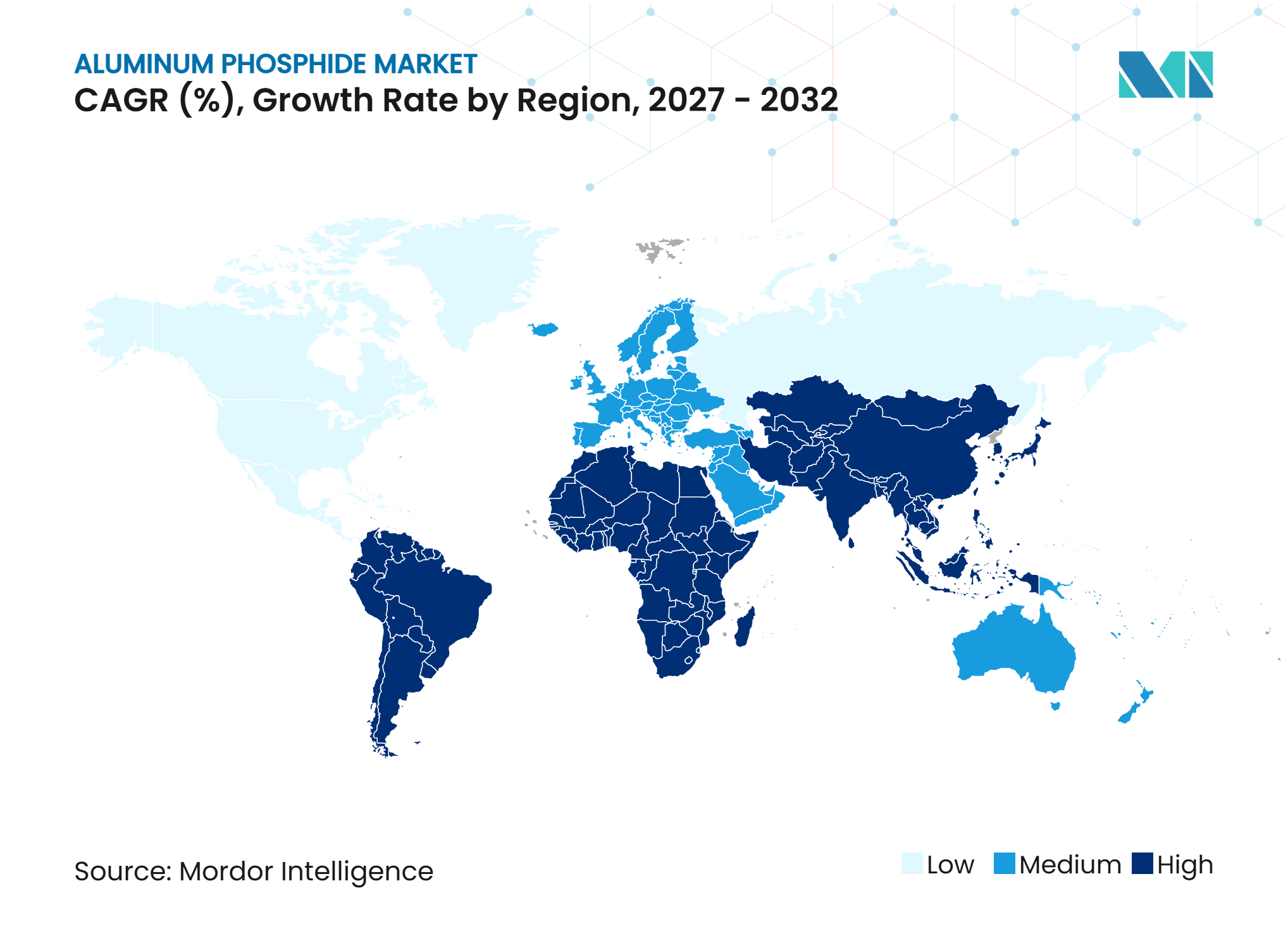
Asia-Pacific accounted for 44.1% of the aluminum phosphide market share in 2026, supported by extensive grain production, large volumes of stored commodities, and demand for post-harvest pest management in major agricultural economies such as China and India. The region is forecast to grow at a CAGR of 6.8% from 2027 to 2032, driven by the need to protect stored cereals, pulses, and oilseeds across agricultural storage and distribution networks. In Australia, the share of growers using pressure-tested, gas-tight storage increased from 34% to 58% in a 2025 survey, reflecting the adoption of improved grain storage practices.
North America has mature grain-storage networks, established applicator certification systems, and widely used professional fumigation services. The United States, Canada, and Mexico support demand by handling and storing wheat, corn, canola, soybeans, and other agricultural commodities. Europe has established fumigation practices and high operating standards, although regulatory reviews create uncertainty for distributors planning procurement and supply arrangements. The European Commission extended the approval period for aluminum phosphide that releases phosphine for product types 14, 18, and 20 until July 31, 2027.
South America benefits from grain production and export activity in Brazil and Argentina, supporting demand for agricultural fumigation. Africa's market is influenced by the need to reduce post-harvest losses and improve agricultural storage practices. FAO data indicate substantial food losses between post-harvest and wholesale stages in sub-Saharan Africa, highlighting challenges across agricultural supply chains. Demand across these regions depends on storage infrastructure, pest-management practices, regulatory requirements, and the availability of qualified fumigation services.
Competitive Landscape
Market Concentration
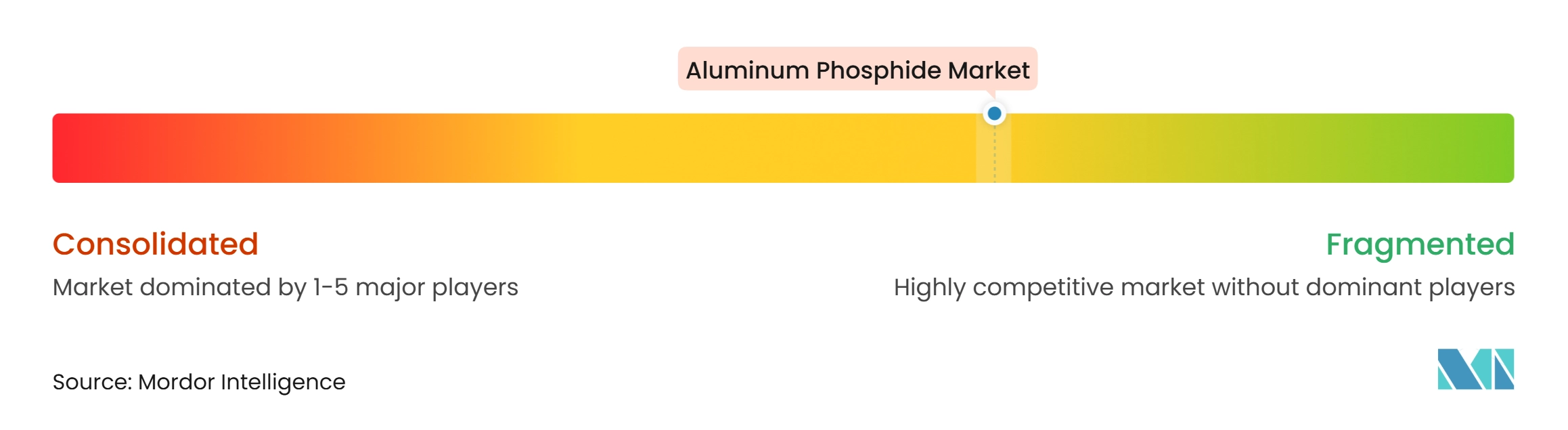
The aluminum phosphide market was moderately fragmented in 2026. UPL Limited, Detia Freyberg GmbH, and Sandhya Organic Chemicals Private Limited are among the key suppliers in the market. Competition is based on formulation quality, product stewardship, applicator training, distribution coverage, and support for customers operating under restricted-use conditions. Suppliers also differentiate themselves through technical guidance, fumigation safety support, and compliance services for institutional buyers.
UPL offers QuickPhos tablets, pellets, bags, and powder, along with support for proper fumigation practices. Detia Freyberg published a 2025 peer-reviewed study on phosphane exposure during good-practice metal phosphide fumigation. This work supports its technical standing with regulators and institutional buyers that need credible information on fumigation safety practices. China changed aluminum phosphide registration rules in March 2025, limiting formulated-product licenses to producers with technical-grade active-ingredient licenses. The change raised barriers for smaller formulators and concentrated access among technically credentialed manufacturers, while Indian suppliers compete through domestic distribution reach and price-competitive formulations.
Service gaps remain in bundled product supply, certified applicator access, gas monitoring, and digital compliance records for storage operators. Resistance-aware dosing and rotation services are also becoming increasingly important for customers experiencing poorer treatment performance. Digital sensor networks can shift purchasing decisions toward suppliers with service capabilities rather than distribution alone. Suppliers that invest in training and monitoring may be better placed to serve institutional buyers with formal safety and documentation requirements.
Aluminum Phosphide Industry Leaders
-
UPL Limited
-
Detia Freyberg GmbH
-
Sandhya Organic Chemicals Private Limited
-
Sumitomo Chemical Company, Limited.
-
Shandong Shengpeng Technology Co., Ltd.
- *Disclaimer: Major Players sorted in no particular order
Aluminum Phosphide Market Companies Covered in this Report
- UPL Limited
- Detia Freyberg GmbH
- Sandhya Organic Chemicals Private Limited
- Sumitomo Chemical Company, Limited.
- Shenyang Fengshou Pesticide Co., Ltd.
- Shandong Shengpeng Technology Co., Ltd.
- Jiangsu Shuangling Chemical Group Co., Ltd.
- Shenyang Harvest Agrochemical Co., Ltd.
- National Fumigants Pty Ltd.
- Ikeda Kogyo Co., Ltd.
- Jining Shengcheng Chemical Experimental Co., Ltd.
- Shandong Lvqiao Biological Technology Co., Ltd.
- Dayang Chem (Hangzhou) Co., Ltd.
- Henan Enge Biotech Co., Ltd.
- FUMITECH Industrial Co., Ltd.
Recent Industry Developments in Aluminum Phosphide Market
- October 2026: The Indian Council of Agricultural Research (ICAR) and the Food Corporation of India (FCI) signed a memorandum of understanding to evaluate alternative fumigation methods for stored wheat and rice. The two-year Phase I project will evaluate alternative approaches to stored-grain pest management, including nitrogen-based and carbon dioxide-based treatments. The initiative addresses challenges associated with phosphine resistance and the operational requirements of conventional fumigation.
- September 2025: Arbuda Agrochemicals Limited proposed establishing a new aluminum phosphide manufacturing line at its Talod facility in Gujarat, India, with an estimated investment of INR 1,170.64 lakh (approximately USD 1.32 million). The project was included in the company's Draft Red Herring Prospectus as part of its planned manufacturing expansion.
- May 2025: UPL highlighted its aluminum phosphide fumigant portfolio for stored-grain and commodity pest management, alongside its Global Stewardship Program on Good Fumigation Practices. The program emphasizes responsible fumigation practices and post-harvest loss management.
Global Aluminum Phosphide Market Report Scope
The aluminum phosphide market comprises the production and sale of aluminum phosphide-based fumigants used to control insect pests in stored agricultural commodities and other eligible stored products, as well as burrowing rodents in approved applications. These products release phosphine gas when exposed to moisture, enabling pest control in treated storage facilities, commodity consignments, and designated burrows, subject to applicable regulatory requirements.
The Aluminum Phosphide Market is Segmented by Form (Tablets, Pellets, Powder, and Other Forms), by Application (Stored Grain Protection, Stored Commodity Fumigation, and Burrowing Rodent Control), by End User (On-Farm Storage Operators, Grain Elevators and Bulk Handlers, Agricultural Warehouses, Seed Companies, Agricultural Exporters, and Fumigation Service Providers), and by Geography (North America, South America, Europe, Asia-Pacific, Middle East, and Africa). The Market Forecasts are Provided in Terms of Value (USD).
Segmentation Overview
| Tablets |
| Pellets |
| Powder |
| Other Forms |
| Stored Grain Protection |
| Stored Commodity Fumigation |
| Burrowing Rodent Control |
| On-Farm Storage Operators |
| Grain Elevators and Bulk Handlers |
| Agricultural Warehouses |
| Seed Companies |
| Agricultural Exporters |
| Fumigation Service Providers |
| North America | United States |
| Canada | |
| Mexico | |
| Rest of North America | |
| South America | Brazil |
| Argentina | |
| Rest of South America | |
| Europe | Germany |
| France | |
| United Kingdom | |
| Russia | |
| Italy | |
| Rest of Europe | |
| Asia-Pacific | China |
| India | |
| Japan | |
| South Korea | |
| Australia | |
| Rest of Asia-Pacific | |
| Middle East | Saudi Arabia |
| United Arab Emirates | |
| Turkey | |
| Rest of Middle East | |
| Africa | South Africa |
| Egypt | |
| Nigeria | |
| Rest of Africa |
| By Form | Tablets | |
| Pellets | ||
| Powder | ||
| Other Forms | ||
| By Application | Stored Grain Protection | |
| Stored Commodity Fumigation | ||
| Burrowing Rodent Control | ||
| By End User | On-Farm Storage Operators | |
| Grain Elevators and Bulk Handlers | ||
| Agricultural Warehouses | ||
| Seed Companies | ||
| Agricultural Exporters | ||
| Fumigation Service Providers | ||
| By Geography | North America | United States |
| Canada | ||
| Mexico | ||
| Rest of North America | ||
| South America | Brazil | |
| Argentina | ||
| Rest of South America | ||
| Europe | Germany | |
| France | ||
| United Kingdom | ||
| Russia | ||
| Italy | ||
| Rest of Europe | ||
| Asia-Pacific | China | |
| India | ||
| Japan | ||
| South Korea | ||
| Australia | ||
| Rest of Asia-Pacific | ||
| Middle East | Saudi Arabia | |
| United Arab Emirates | ||
| Turkey | ||
| Rest of Middle East | ||
| Africa | South Africa | |
| Egypt | ||
| Nigeria | ||
| Rest of Africa | ||
Key Questions Answered in the Report
What was the value of the aluminum phosphide market in 2026?
The aluminum phosphide market size was valued at USD 667.40 million in 2026.
What is the forecast value of the aluminum phosphide market by 2032?
The aluminum phosphide market is forecast to grow from USD 709.95 million in 2027 to USD 897.48 million by 2032, at a CAGR of 4.80% from 2027 to 2032.
Which form accounted for the largest market share in 2026?
Tablets accounted for 53.4% of the aluminum phosphide market share in 2026. Their standardized format supports consistent application planning and treatment recordkeeping.
Which application is forecast to grow fastest from 2027 to 2032?
Stored commodity fumigation is forecast to grow at a CAGR of 6.5% from 2027 to 2032.
What are the main constraints on the aluminum phosphide market?
Regulatory restrictions, certified-applicator requirements, and phosphine resistance can increase compliance costs and treatment complexity. Alternative storage methods may also affect demand where operators can implement and maintain these systems.