
Alternate Fuel and Raw Materials (AFR) Firing Systems Market Size and Share
Market Overview
| Study Period | 2021 - 2031 |
|---|---|
| Market Size (2026) | USD 0.71 Billion |
| Market Size (2031) | USD 1.11 Billion |
| Growth Rate (2026 - 2031) | 9.35 % |
| Fastest Growing Market | Asia-Pacific |
| Largest Market | Europe |
| Market Concentration | Medium |
Major Players *Disclaimer: Major Players sorted in no particular order Image © Mordor Intelligence. Reuse requires attribution under CC BY 4.0. | |
Alternate Fuel and Raw Materials (AFR) Firing Systems Market Analysis by Mordor Intelligence
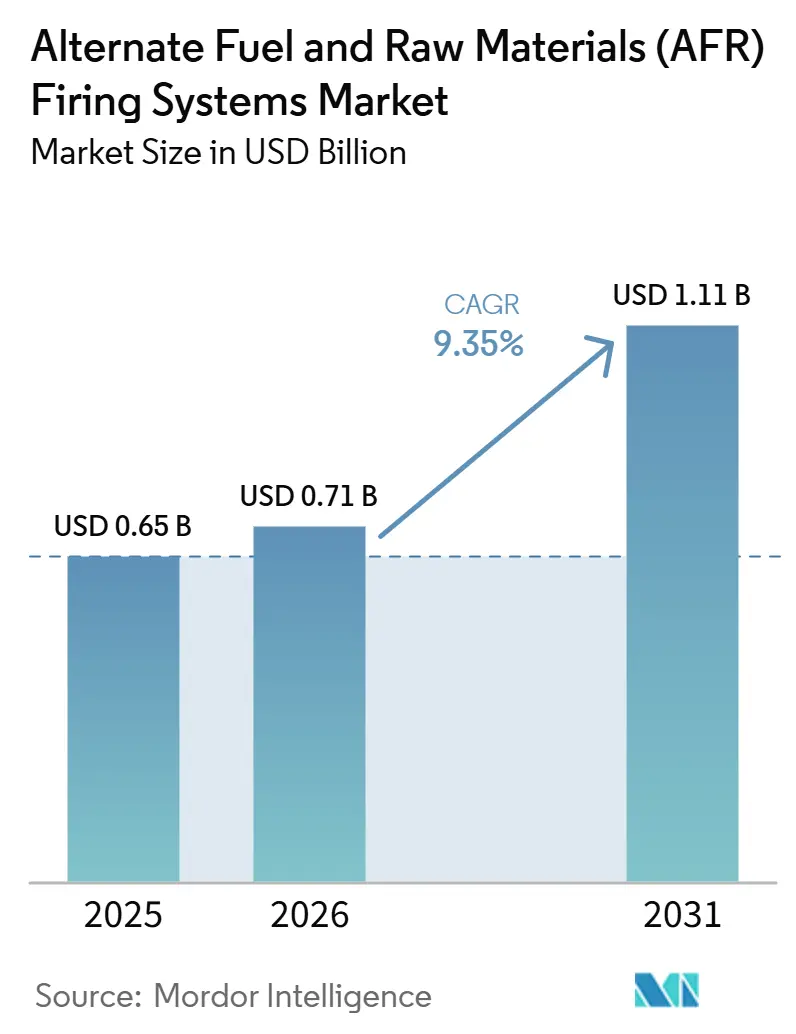
The Alternate Fuel and Raw Materials Firing Systems Market size was valued at USD 0.65 billion in 2025 and is estimated to grow from USD 0.71 billion in 2026 to reach USD 1.11 billion by 2031, at a CAGR of 9.35% during the forecast period (2026-2031). The AFR firing systems market is expanding as cement and other heat-intensive operators shift from occasional waste use to planned fuel-substitution programs. Procurement decisions now give greater weight to fuel consistency, feeding equipment, and combustion control. Carbon cost exposure, landfill rules, and dependence on imported coal or petcoke are reinforcing the case for dedicated systems. Suppliers are responding by combining firing equipment with monitoring, process control, and services that help plants operate with variable fuels. The AFR firing systems market also depends on long-term access to suitable waste streams, since hardware alone cannot resolve supply, quality, or logistics constraints.
Key Report Takeaways
- By AFR system type, solid co-processing systems held 74.3% of the AFR firing systems market share in 2025, while the same category is forecast to grow at a 10.2% CAGR through 2031.
- By waste and fuel stream, municipal solid waste accounted for 39.2% of the AFR firing systems market share in 2025, while biomass and agricultural waste are projected to expand at a 9.8% CAGR through 2031.
- By kiln point of injection, precalciner firing systems held 60.5% of the AFR firing systems market share in 2025 and are forecast to grow at an 11.1% CAGR through 2031.
- By end-user industry, cement accounted for 88.1% of the AFR firing systems market share in 2025, while other industrial kilns and furnaces are projected to advance at a 10.3% CAGR through 2031.
- By deployment model, brownfield retrofit configurations held 59.3% of the AFR firing systems market share in 2025 and are forecast to grow at a 9.9% CAGR through 2031.
- By geography, Europe for 41.5% of the AFR firing systems market share in 2025, while Asia-Pacific is projected to advance at a 10.8% CAGR through 2031.
Note: Market size and forecast figures in this report are generated using Mordor Intelligence’s proprietary estimation framework, updated with the latest available data and insights as of January 2026.
Market Trends and Insights
Drivers Impact Analysis of Alternate Fuel and Raw Materials (AFR) Firing Systems Market*
| Driver | (~) % Impact on CAGR Forecast | Geographic Relevance | Impact Timeline |
|---|---|---|---|
| Industrial Decarbonization and Carbon-Cost Avoidance | +2.40% | Global, concentrated in the EU and CBAM-exposed export economies | Short term (≤ 2 years) |
| Landfill Diversion and Circular-Economy Mandates | +1.70% | Global, with regulatory acceleration in South Asia and the EU | Medium term (2-4 years) |
| Local-Fuel Economics Versus Coal and Petcoke | +1.50% | Global, strongest where domestic waste streams are available and carbon pricing is absent | Medium term (2-4 years) |
| High-TSR Retrofit Demand in Existing Kilns | +1.40% | Europe, Asia-Pacific, Middle East, and Africa | Medium term (2-4 years) |
| Digital Combustion Control for Variable Fuels | +1.10% | Global, led by digitally mature cement groups in Europe and North America | Medium term (2-4 years) |
| Waste-Stream Traceability as a Procurement Requirement | +0.70% | EU and North America, with spillover into Asia-Pacific | Long term (≥ 4 years) |
| Source: Mordor Intelligence | |||
Industrial Decarbonization and Carbon-Cost Avoidance
Carbon pricing has become a direct operating consideration for cement producers, and AFR systems offer a practical route to reduce fossil fuel use. The supplied evidence states that EU ETS auction prices reached EUR 75 per tonne of CO2 in the first quarter of 2026. Plants operating at high thermal substitution can reduce the emissions associated with coal-based clinker production. A life-cycle assessment covering South Africa and Ethiopia found that 20% RDF substitution reduced global warming potential by 3.3% to 4.2%, with a higher reduction when avoided landfill methane was included. These operating outcomes make AFR equipment relevant to carbon management, fuel procurement, and plant-level emissions reporting. The AFR firing systems market benefits when producers link thermal substitution targets to financing and wider decarbonization commitments.
Landfill Diversion and Circular-Economy Mandates
Landfill restrictions are changing the commercial value of waste-derived fuels. The Global Cement and Concrete Association, the International Solid Waste Association, and the Mission Possible Partnership called in 2026 for co-processing to receive clear recognition in waste policy frameworks [1]Global Cement and Concrete Association, “Cement Industry Co-Processing Should Be More Widely Adopted for Global Sustainable Waste Management,” Global Cement and Concrete Association, gccassociation.org. The same policy discussion included recognition of co-processing under a dedicated Basel Convention code. Such rules can improve certainty for waste processors, cement plants, and local authorities that manage municipal material. The result is a more stable basis for RDF supply, gate-fee arrangements, and pre-processing investment. The AFR firing systems market gains when waste policy treats cement kilns as a controlled recovery route rather than a secondary disposal option.
Local-Fuel Economics Versus Coal and Petcoke
Local waste-derived fuel can reduce exposure to imported coal and petcoke. This is important in markets where conventional fuel purchases are tied to international price movements and transport costs. Waste generators may also pay gate fees to avoid landfill disposal, which can improve the economics of accepting suitable material. The cost case remains dependent on sorting, drying, storage, and transport, because poor material can create operational losses that offset fuel savings. Operators therefore evaluate the full fuel chain rather than comparing only the calorific value of a waste stream with coal. The AFR firing systems market is supported where system design is matched with dependable local supply and clear fuel-quality specifications.
High-TSR Retrofit Demand in Existing Kilns
Existing kiln lines are an important source of demand because many operators prefer to upgrade assets rather than build new capacity. KHD reported that its Pyrorotor technology had reached 23 installations across 6 countries by March 2026. The company also reported 2 new orders in the first quarter of 2026. Retrofit projects can raise substitution rates while preserving the main kiln, cooler, and plant infrastructure. Their value depends on practical installation planning, including feeding equipment, the calciner, controls, and shutdown schedules. The AFR firing systems market, therefore, favors vendors that can support brownfield engineering and sustain performance after commissioning.
Restraints Impact Analysis of Alternate Fuel and Raw Materials (AFR) Firing Systems Market*
| Restraint | (~) % Impact on CAGR Forecast | Geographic Relevance | Impact Timeline |
|---|---|---|---|
| Fuel Quality Variability and Moisture Volatility | -0.90% | Global, most acute in South Asia, Sub-Saharan Africa, and Southeast Asia | Short term (≤ 2 years) |
| High Retrofit CAPEX and Long Shutdown Windows | -0.70% | Global, especially where carbon pricing and gate-fee incentives are absent | Medium term (2-4 years) |
| Permitting, Emissions Liability, and Community Opposition | -0.50% | Europe and North America, with secondary exposure in MENA and South Asia | Medium term (2-4 years) |
| Competition for High-Calorific Waste Streams | -0.50% | Europe and North America, with emerging pressure in South Korea and Japan | Long term (≥ 4 years) |
| Source: Mordor Intelligence | |||
Fuel Quality Variability and Moisture Volatility
Fuel variability remains the most immediate operating constraint for high substitution rates. A 2025 study in Waste and Biomass Valorization found that waste-derived fuel composition affects the environmental and technical performance of cement production. Direct co-processing requires sufficient calorific value and controlled moisture and chlorine levels. Unsegregated municipal solid waste can lead to material build-up, corrosion, and unplanned maintenance when those requirements are not met. Fuller Technologies states that its FUELFLEX Pyrolyzer converts solid alternative fuels into reactive gases and char before calciner injection [2]Fuller Technologies, “FUELFLEX Pyrolyzer,” Fuller Technologies, fuller-technologies.com. This approach can improve fuel flexibility, but it also adds equipment, capital needs, and operating complexity.
High Retrofit CAPEX and Long Shutdown Windows
Brownfield integration can require substantial capital spending before fuel handling and pre-processing costs are considered. Precalciner reactor upgrades may need shutdown windows of 4 to 8 weeks at plants that have high utilization. MIT Concrete Sustainability Hub identified economic, regulatory, and social barriers as major limits on wider alternative fuel use in U.S. cement production. Plants must also schedule AFR work against routine maintenance, cooler upgrades, and emissions-control investments. Modular layouts can reduce the amount of work undertaken within the preheater tower during a shutdown. Even so, the AFR firing systems market remains constrained where project payback does not meet internal investment thresholds.
*Our forecasts treat driver/restraint impacts as directional, not additive. The impact forecasts reflect baseline growth, mix effects, and variable interactions.
Alternate Fuel and Raw Materials (AFR) Firing Systems Market Segment Analysis
By AFR System Type:
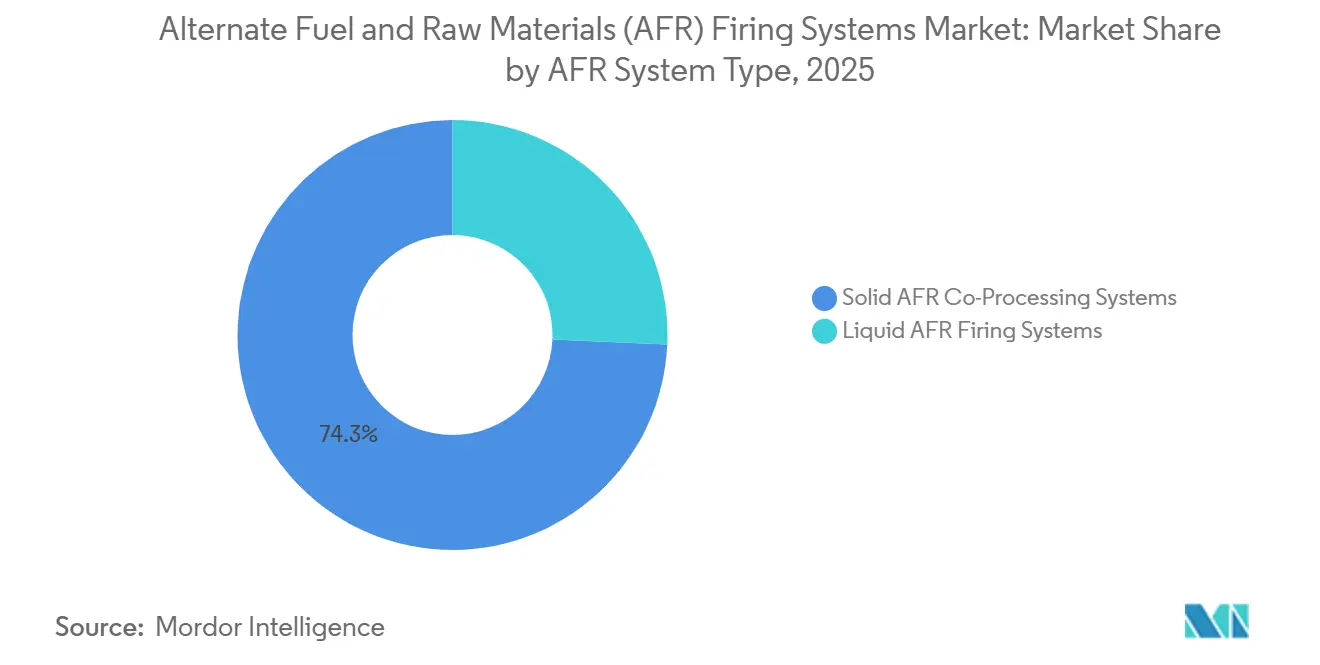
Solid Co-Processing Configurations Drive Hardware InvestmentSolid co-processing systems accounted for 74.3% of the AFR firing systems market share in 2025 and are forecast to grow at a 10.2% CAGR through 2031. Their position reflects the wide availability of municipal solid waste, refuse-derived fuel, tyre-derived fuel, and biomass. These materials can offer volume, local sourcing, and gate-fee advantages that liquid residues do not always provide. Solid systems also fit the fuel mix used by many cement plants that are working toward higher thermal substitution rates. Moving-hearth furnaces, step-combustors, and pyrolysis units have expanded the range of solid fuels that can be introduced without disrupting kiln chemistry. The AFR firing systems market size for solid systems is supported by equipment that can manage drying, particle size, feed consistency, and controlled combustion. Mature European installations showed that solid-fuel configurations can support thermal substitution rates above 50%, while individual plants in Poland exceeded 75% in 2025, according to the supplied draft. These results make solid systems relevant to both retrofit programs and new plant specifications. Their growth also reflects the need to recover energy from waste while returning mineral ash into clinker production. The category remains exposed to feedstock competition and inconsistent municipal waste sorting.
Modern solid systems can also provide benefits beyond fuel replacement. Pyrolysis-stage equipment produces reactive gases before calciner injection and can create a reducing environment. Fuller Technologies identifies its FUELFLEX Pyrolyzer as a solution for processing solid alternative fuels before calciner use. This operating approach can help manage thermal NOx formation and reduce reliance on ammonia injection for SNCR compliance. It also places greater importance on process controls, fuel sampling, and operator capability. Liquid AFR firing systems still serve plants with access to waste solvents and liquid industrial residues. Their dosing accuracy and handling characteristics can suit selected applications. However, liquid systems face a narrower supply base than solid configurations. The segment mix will remain shaped by local waste availability and the investment needed to prepare solid material for kiln use. Vendors with both combustion equipment and fuel-preparation expertise are better placed to address these conditions. The AFR firing systems industry continues to favor solutions that balance fuel flexibility with stable clinker quality.



By Waste/Fuel Stream:
Municipal Solid Waste Anchors Volume While Biomass Attracts InvestmentMunicipal solid waste held 39.2% of the AFR firing systems market share by input category in 2025. Its importance comes from large urban volumes, established collection systems, and the potential for gate-fee income. The GCCA stated that cement-kiln co-processing can recover energy while recycling mineral ash into the clinker process without residual waste. This characteristic distinguishes co-processing from routes that leave ash for separate disposal. MSW use still depends on sorting and pre-processing because raw municipal waste does not consistently meet kiln fuel requirements. Moisture, chlorine, and particle-size variation can limit direct use. Plants, therefore, need feeding systems designed around the quality of the available local stream. The AFR firing systems market depends on this upstream preparation as much as on the firing equipment itself. Municipal material is particularly relevant where landfill capacity is constrained, and local authorities support recovery projects. Its scale makes it a central feedstock for solid co-processing configurations.
Biomass and agricultural waste are forecast to grow at a 9.8% CAGR through 2031. Rice husks, sugarcane bagasse, and coconut shells provide examples of streams identified in the supplied draft. These fuels are relevant in cement regions with agricultural activity and suitable collection networks. Their use can reduce the share of fossil heat when reliable volumes are available. Biomass is not a uniform fuel class, and moisture content, seasonal availability, and transport costs can affect plant economics. Industrial waste and other streams also remain part of the fuel portfolio because they can offer high calorific value. The supplied draft cited tyre-derived fuel at 26 to 33 MJ/kg, subject to control of sulfur, zinc, and steel residues. Such materials can support energy-intensive kiln duty, but they also face demand from other industrial users. The AFR firing systems market is therefore moving toward diversified fuel portfolios rather than dependence on a single stream. Long-term supply agreements and quality controls are becoming important operating differentiators.
By Kiln Point of Injection:
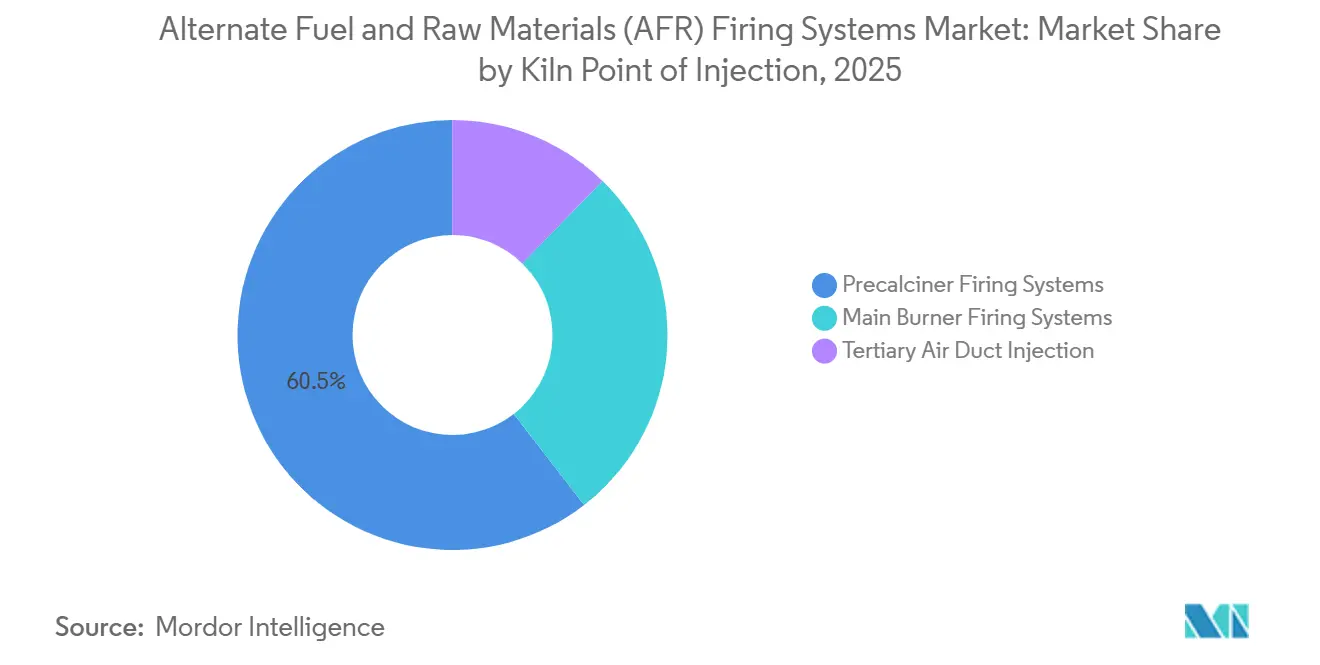
Precalciner Alternative Fuel Firing Anchors Technology PreferencePrecalciner systems held 60.5% of the AFR firing systems market share by injection point in 2025 and are forecast to expand at an 11.1% CAGR through 2031. The precalciner offers an operating range of 800 to 900°C that can accommodate coarser and wetter fuels before they reach the main burning zone. This configuration allows drying, pyrolysis, and combustion to be managed in stages. It can reduce the direct effect of fuel variability on clinker quality when properly designed. Precalciner systems are therefore suited to plants that want to process more complex solid alternative fuels. A 2026 paper in ACS Energy & Fuels reported results from a stair-step precalciner system in China [3]ACS Energy and Fuels Authors, “Co-Combustion of Pulverized Coal and Biomass-Derived Syngas in an RSP Precalciner,” ACS Energy and Fuels, acs.org. The demonstration achieved 20% to 25% substitution on a 5,000-TPD line. It also raised raw meal decomposition from 89.1% to 94.9%, reduced fossil carbon emissions by 14.8%, and recorded outlet NOx of 310 ppm. These data support the technical rationale for precalciner-based fuel integration. The AFR firing systems market has consequently placed substantial engineering emphasis on the calciner stage.
The shared focus on the precalciner has made performance comparison easier for buyers. KHD Pyrorotor, thyssenkrupp Polysius prepol SC, Fives FCB Preca-Max and In-Line Preca, and Fuller technologies are all positioned around this integration point in the supplied draft. Buyers can compare fuel flexibility, NOx output, installation footprint, and data from operating plants. This creates pressure on vendors to differentiate through controls, service support, and demonstrated operating results. Main burner systems remain useful for fine solid fuels and high-calorific liquid residues. Tertiary air duct injection also serves in-line calciner arrangements. Neither alternative is forecast to grow as quickly as the precalciner segment in the supplied material. The choice of injection point depends on fuel form, kiln design, emissions requirements, and expected substitution level. The AFR firing systems industry is increasingly treating the injection point as a whole-plant engineering decision. This favors providers that can integrate mechanical systems with process control and commissioning support.
By End-User Industry:
Cement Dominates as Adjacent Sectors Begin the Technology CurveCement accounted for 88.1% of the AFR firing systems market share in 2025. Cement kilns have a long record of co-processing because they operate at high temperatures and can incorporate mineral ash in clinker. The sector also has established technical practices for feeding, combustion, emissions monitoring, and fuel testing. Cement producers face direct pressure to reduce fossil fuel use, manage carbon costs, and secure reliable heat. These conditions support continued investment in AFR systems for precalciners, main burners, and related material-handling equipment. The segment’s scale means that developments in cement strongly influence supplier technology priorities. Existing installations provide reference cases that can reduce technical uncertainty for new buyers. The AFR firing systems market size remains closely linked to retrofit demand from cement plants. The sector also gives suppliers a base for developing monitoring tools and service models. Cement will remain the largest end-use category under the forecast presented in the supplied draft.
Other industrial kilns and furnaces are forecast to grow at a 10.3% CAGR through 2031. This group includes lime, pulp and paper, and waste-to-energy applications. The EU CINEA-backed LK2BM project is developing rotary lime kiln retrofit solutions that use forestry-residue biomass [4]European Climate, Infrastructure and Environment Executive Agency, “LK2BM: Upgraded Lime Kilns for Cleaner Industrial Processes,” European Commission, cinea.ec.europa.eu. Pulp and paper sites can have biomass side streams available on-site, which can reduce transport needs for fuel supply. However, operating conditions differ from those in cement kilns. Lime kilns generally operate at lower temperatures and require configurations designed for their own process limits. Waste-to-energy plants also have narrower flue-gas operating windows and different combustion needs. These differences limit the direct transfer of cement-focused AFR designs. Suppliers that adapt equipment to lower-temperature operations can address these adjacent applications. The AFR firing systems industry has an opportunity in these sectors, but it will require application-specific engineering rather than simple replication of cement hardware.
By Deployment Model:
Brownfield Retrofit Leads as Modular Hardware Expands the PipelineBrownfield retrofit configurations held 59.3% of the AFR firing systems market share in 2025 and are forecast to expand at a 9.9% CAGR through 2031. This reflects a preference for improving operating assets rather than committing to new cement capacity in mature regions. Retrofits allow plants to increase thermal substitution by adding fuel feeding, calciner equipment, controls, and storage infrastructure. They can also address emissions performance and fuel flexibility without replacing the main kiln line. The AFR firing systems market is supported by this capital discipline because a large installed base needs practical decarbonization options. Brownfield projects are complex, as equipment must fit existing towers, ducts, utilities, and operating schedules. Their value depends on clear planning for shutdown duration and commissioning. The supplied draft cited a KHD order in Türkiye as its 23rd Pyrorotor installation, showing that vendors continue to add retrofit references. Existing plant constraints make field experience an important part of supplier selection. Brownfield investment will remain an important route to wider AFR use.
Greenfield installations remain relevant where cement capacity is being added in Southeast Asia, Sub-Saharan Africa, and parts of the Middle East. A new plant can incorporate fuel handling, storage, and a suitable calciner arrangement at the design stage. This can avoid some of the space and shutdown limits associated with retrofits. Turnkey projects are also relevant when plant owners lack the internal resources to coordinate several engineering firms. They combine design, supply, installation, and commissioning under one delivery structure. Modular reactor designs can support both greenfield and brownfield work by shifting some construction outside the preheater tower. The supplied draft described configurations linked by a hot-material transport chute as a way to reduce tower work. These layouts may help plants use shorter maintenance windows more effectively. The AFR firing systems market benefits when suppliers can offer flexible construction approaches rather than one fixed configuration. Deployment choices will continue to reflect local capacity growth, plant age, fuel availability, and the owner’s engineering capability.
Geography Analysis
Europe Alternate Fuel and Raw Materials (AFR) Firing Systems Market
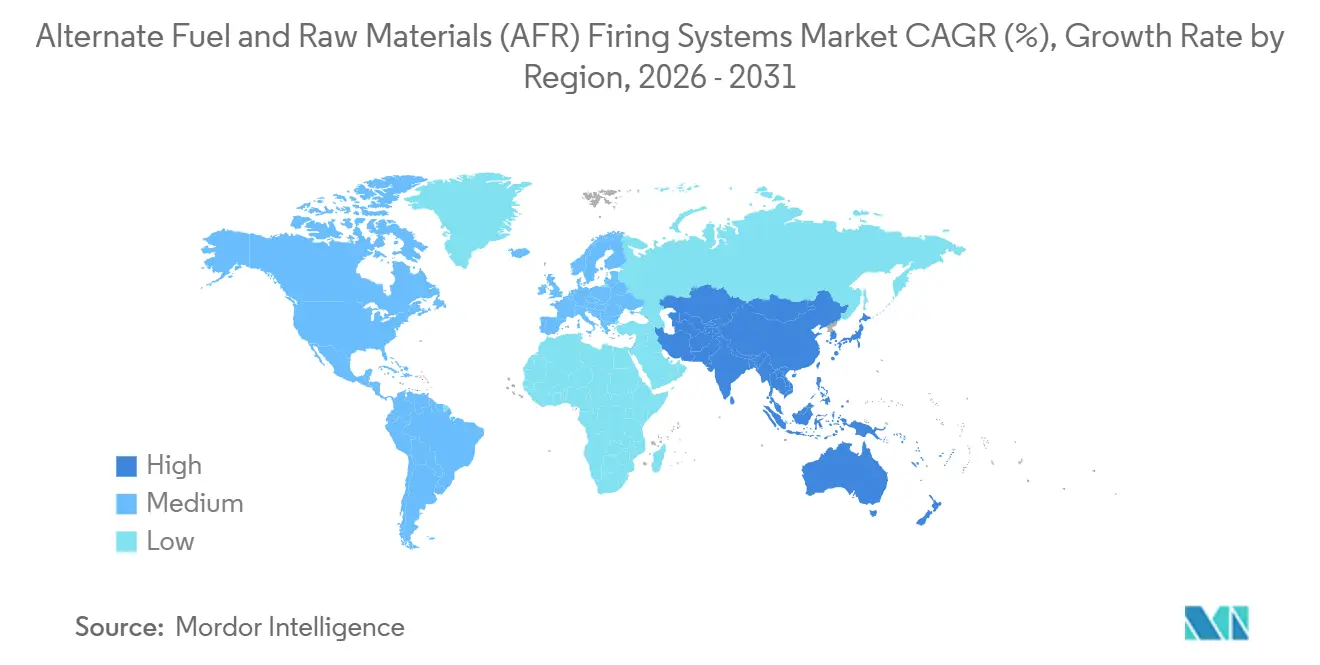
Europe held 41.5% of the AFR firing systems market share in 2025. The region has a mature co-processing base supported by carbon pricing, waste policy, and established alternative-fuel suppliers. The supplied draft reported that average thermal substitution in European cement plants exceeded 50% in 2025. It also cited rates above 75% at individual plants in Poland and near-100% at selected facilities in Spain. The GCCA has published guidance on reporting carbon emissions from waste in the cement sector, supporting consistent emissions accounting. This reporting need raises the value of process monitoring and reliable fuel records. Germany, France, Italy, and the United Kingdom provide a large installed base, while Central and Eastern Europe continues to offer retrofit activity.
APAC Alternate Fuel and Raw Materials (AFR) Firing Systems Market
Asia-Pacific is projected to be the fastest-growing regional segment, at a 10.8% CAGR from 2026 to 2031. China and India are important demand centers because of their large cement sectors and growing need for waste management solutions. KHD reported commissioning its second Pyrorotor system in China in December 2025 at Conch Group’s Baoshan plant. The system processed high-moisture biomass and municipal waste at 18 tonnes per hour while maintaining kiln stability. India is also expanding attention to RDF use under the policy framework referenced in the supplied material. The AFR firing systems market size in Asia-Pacific is supported by urban waste volumes, the need to lower imported fuel exposure, and capacity additions in several countries. Regional demand will vary with local collection systems, permits, and the ability to prepare material to consistent fuel specifications.
The Americas and EMEA Alternate Fuel and Raw Materials (AFR) Firing Systems Market
North American cement plants operated at 15% to 16% thermal substitution in 2025, compared with European averages above 50% in the supplied material. MIT Concrete Sustainability Hub linked the slower scale-up in the United States to economic, regulatory, and social barriers. South America has demonstrated more active investment, particularly in Brazil, according to the supplied draft. Middle East and Africa present a longer-term opportunity because of greenfield construction, urbanizing waste streams, and reliance on imported coal and petcoke. These markets require local fuel logistics, pre-processing capacity, and solutions designed for specific kiln layouts. Geographic growth in the AFR firing systems market will depend on the interaction between waste policy, fuel supply, plant economics, and supplier service coverage.

Competitive Landscape
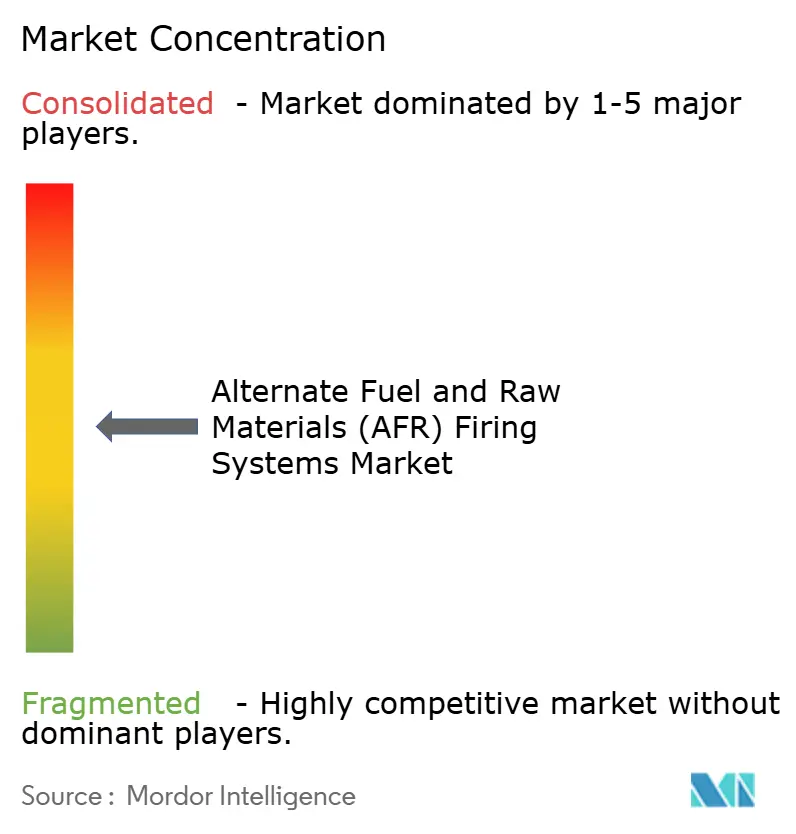
The AFR firing systems market is moderately concentrated at the technology-provider level. The supplied draft identifies KHD Humboldt Wedag, Fuller Technologies, thyssenkrupp Polysius, Fives, and FCT Combustion as established suppliers with proprietary equipment and operating references. Their positions depend on reactor design, integration knowledge, and the ability to demonstrate stable kiln performance. KHD reported 23 Pyrorotor installations across 6 countries by March 2026. That reference base provides evidence of installation experience in several operating environments. Fuller Technologies positions its FUELFLEX Pyrolyzer around the conversion of solid alternative fuel before calciner injection. These products compete on fuel flexibility, emissions behavior, integration needs, and service capability. The market is not defined only by burner design, because fuel handling and controls affect the final operating result.
Suppliers are increasingly combining mechanical equipment with data systems and process control. This approach responds to fuel variability and the need to document combustion outcomes. A 2025 study in the International Journal of Advanced Manufacturing Technology reported that kiln expert systems increased calciner alternative-fuel substitution from 31.8% to 49.1% over 5 years without new capital hardware. The finding supports the importance of operating software alongside equipment investment. It also creates an opening for suppliers that offer controls, data management, and optimization services. Buyers increasingly compare vendors on their ability to help plants sustain substitution rates after start-up. Long-term service agreements may therefore become as important as the initial equipment supply. The AFR firing systems market remains competitive where suppliers can combine combustion performance with operational support. This favors vendors with installation references and a practical understanding of plant-specific fuel conditions.
Adjacent applications remain a potential area for competitive differentiation. Lime kilns and pulp-and-paper facilities require changes to architectures developed for cement processes. Their lower operating temperatures and distinct material characteristics limit simple transfer of cement systems. Suppliers that create end-user-specific solutions could develop positions in these less-served applications. Smaller firms mentioned in the supplied material, including Dynamis and Satarem, target specialized fuel mixes and regional applications. Their role is more focused than that of full-range global equipment providers. Competitive outcomes will depend on the ability to manage fuel preparation, combustion stability, emissions controls, and construction constraints. The AFR firing systems market continues to reward credible operating data rather than equipment claims alone. Large suppliers retain advantages from their engineering resources, installed base, and service networks.
Alternate Fuel and Raw Materials (AFR) Firing Systems Industry Leaders
Fives Group
FLSmidth and Co. A/S
KHD Humboldt Wedag International AG
thyssenkrupp Polysius GmbH
PH1 Engineering Solutions Pvt. Ltd.
- *Disclaimer: Major Players sorted in no particular order
Alternate Fuel and Raw Materials (AFR) Firing Systems Market Companies Covered in this Report
- Dynamis Ltd.
- FCT Combustion Pty Ltd.
- Fives Group
- FLSmidth & Co. A/S (FLS)
- Fuller Technologies, Inc.
- Greco Combustion Systems, Inc.
- KHD Humboldt Wedag International AG
- PH1 Engineering Solutions Pvt. Ltd.
- Satarem S.A.
- Sinoma International Engineering Co., Ltd.
- thyssenkrupp Polysius GmbH
- Unitherm Cemcon Feuerungsanlagen GmbH

Recent Industry Developments in Alternate Fuel and Raw Materials (AFR) Firing Systems Market
- July 2026: Coolbrook and ABB entered the industrial delivery phase of their partnership to deploy Coolbrook's RotoDynamic Heater™ at Adani Cement's Boyareddypalli Integrated Cement Plant in Andhra Pradesh, India. The system, which provides high-temperature electric heat to dry and enhance the calorific value of alternative fuels, marks the first industrial-scale deployment of this technology in global cement operations and is projected to reduce approximately 60,000 tonnes of CO₂ annually. ABB is supplying the full electrification package, including drives, motors, switchgear, and its ABB Ability™ System 800xA® distributed control system.
- March 2026: KHD Humboldt Wedag commissioned its second Pyrorotor® alternative fuel system in China on a 5,000-TPD production line at Conch Group's Baoshan cement plant in Yunnan Province. During commissioning, the system processed high-moisture biomass and municipal waste at 18 tonnes per hour while maintaining full kiln stability and recording no material build-up at the kiln inlet.
- February 2026: KHD signed an order to supply a Pyrorotor® alternative fuel system to Batisöke Söke Çimento Sanayii T.A.Ş. in Türkiye, becoming the second Pyrorotor installation in the country and the 23rd globally, across six countries. The latest-generation system enables calciner thermal substitution rates above 90% with no fuel preprocessing, supporting the plant's net-zero transition goals.


Global Alternate Fuel and Raw Materials (AFR) Firing Systems Market Report Scope
An Alternate Fuel and Raw Materials (AFR) Firing System is an integrated combustion, handling, dosing, and injection system used primarily in cement plants to replace conventional fossil fuels (such as coal, petcoke, and natural gas) with alternative fuels and, in some cases, to introduce alternative raw materials into the cement manufacturing process. The objective of an AFR firing system is to increase the Thermal Substitution Rate (TSR) while maintaining clinker quality, kiln stability, emissions compliance, and operational safety.
The AFR Firing Systems Market is segmented by AFR system type, waste/fuel stream, kiln injection point, end-user, deployment, and geography. By AFR system type, the market is segmented into liquid AFR firing systems and solid AFR co-processing systems. By waste/fuel stream, the market is segmented into municipal solid waste (MSW), biomass and agricultural waste, industrial waste, and other waste/fuel streams. By kiln injection point, the market is segmented into precalciner, main burner, and tertiary air duct systems. By end-user, the market is segmented into the cement industry, lime industry, waste-to-energy (WtE) plants, pulp and paper industry, and other industrial kilns and furnaces. By deployment, the market is segmented into greenfield installations, brownfield retrofits, and turnkey projects. The report also covers the market size and forecasts for the global AFR firing systems market across 26 countries in key regions. For each segment, the market sizing and forecasts have been provided on the basis of value (USD).
| Liquid AFR Firing Systems |
| Solid AFR Co-Processing Systems |
| Municipal Solid Waste |
| Biomass & Agricultural Waste |
| Industrial Waste |
| Others |
| Precalciner Firing Systems |
| Main Burner Firing Systems |
| Tertiary Air Duct Injection |
| Cement Industry |
| Lime Industry |
| Waste-to-Energy Plants |
| Pulp & Paper Industry |
| Other Industrial Kilns and Furnaces |
| Greenfield Installations |
| Brownfield Retrofit |
| Turnkey Projects |
| North America | United States |
| Canada | |
| Mexico | |
| Europe | Germany |
| France | |
| Italy | |
| Spain | |
| United Kingdom | |
| Poland | |
| Russia | |
| Rest of Europe | |
| Asia-Pacific | China |
| India | |
| Japan | |
| South Korea | |
| Australia | |
| Indonesia | |
| Vietnam | |
| Thailand | |
| Rest of Asia-Pacific | |
| South America | Brazil |
| Argentina | |
| Chile | |
| Rest of South America | |
| Middle East and Africa | Saudi Arabia |
| United Arab Emirates | |
| Egypt | |
| South Africa | |
| Morocco | |
| Rest of Middle East and Africa |
| By AFR System Type | Liquid AFR Firing Systems | |
| Solid AFR Co-Processing Systems | ||
| By Waste/Fuel Stream (AFR Input Category) | Municipal Solid Waste | |
| Biomass & Agricultural Waste | ||
| Industrial Waste | ||
| Others | ||
| By Kiln Point of Injection | Precalciner Firing Systems | |
| Main Burner Firing Systems | ||
| Tertiary Air Duct Injection | ||
| By End-User Industry | Cement Industry | |
| Lime Industry | ||
| Waste-to-Energy Plants | ||
| Pulp & Paper Industry | ||
| Other Industrial Kilns and Furnaces | ||
| By Deployment Model | Greenfield Installations | |
| Brownfield Retrofit | ||
| Turnkey Projects | ||
| By Geography | North America | United States |
| Canada | ||
| Mexico | ||
| Europe | Germany | |
| France | ||
| Italy | ||
| Spain | ||
| United Kingdom | ||
| Poland | ||
| Russia | ||
| Rest of Europe | ||
| Asia-Pacific | China | |
| India | ||
| Japan | ||
| South Korea | ||
| Australia | ||
| Indonesia | ||
| Vietnam | ||
| Thailand | ||
| Rest of Asia-Pacific | ||
| South America | Brazil | |
| Argentina | ||
| Chile | ||
| Rest of South America | ||
| Middle East and Africa | Saudi Arabia | |
| United Arab Emirates | ||
| Egypt | ||
| South Africa | ||
| Morocco | ||
| Rest of Middle East and Africa | ||


Key Questions Answered in the Report
What is the size of alternate fuel and raw materials (AFR) firing systems market?
The alternate fuel and raw materials (AFR) firing systems market stands at USD 0.71 billion in 2026 and is projected to reach USD 1.11 billion by 2031.
Which AFR system type leads the sector?
Solid co-processing systems led with 74.3% share in 2025 and are projected to grow at a 10.2% CAGR through 2031.
Why are precalciner systems important for alternative fuels?
Precalciner systems held 60.5% share in 2025 and allow staged drying, pyrolysis, and combustion of coarser or wetter fuels.
Which end-user has the largest demand for AFR equipment?
Cement accounted for 88.1% share in 2025 because cement kilns have established co-processing practices and high-temperature operating conditions.
What limits wider use of alternative fuels in kilns?
Fuel quality, moisture, chlorine, retrofit cost, shutdown requirements, permitting, and competition for high-calorific waste streams remain major constraints. These factors make stable supply agreements, effective pre-processing, and practical shutdown planning essential for sustained plant performance.
Which region is growing fastest through 2031?
Asia-Pacific is forecast to grow at a 10.8% CAGR, supported by large cement markets, urban waste volumes, and expanding AFR infrastructure. Local fuel preparation, collection systems, and permitting will determine how much of this potential is converted into operating projects.
Page last updated on:





