
Algae Oil Market Size and Share
Market Overview
| Study Period | 2021 - 2031 |
|---|---|
| Market Size (2026) | USD 2.45 Billion |
| Market Size (2031) | USD 2.97 Billion |
| Growth Rate (2026 - 2031) | 3.88 % |
| Fastest Growing Market | Asia-Pacific |
| Largest Market | North America |
| Market Concentration | Medium |
Major Players *Disclaimer: Major Players sorted in no particular order Image © Mordor Intelligence. Reuse requires attribution under CC BY 4.0. | |
Algae Oil Market Analysis by Mordor Intelligence
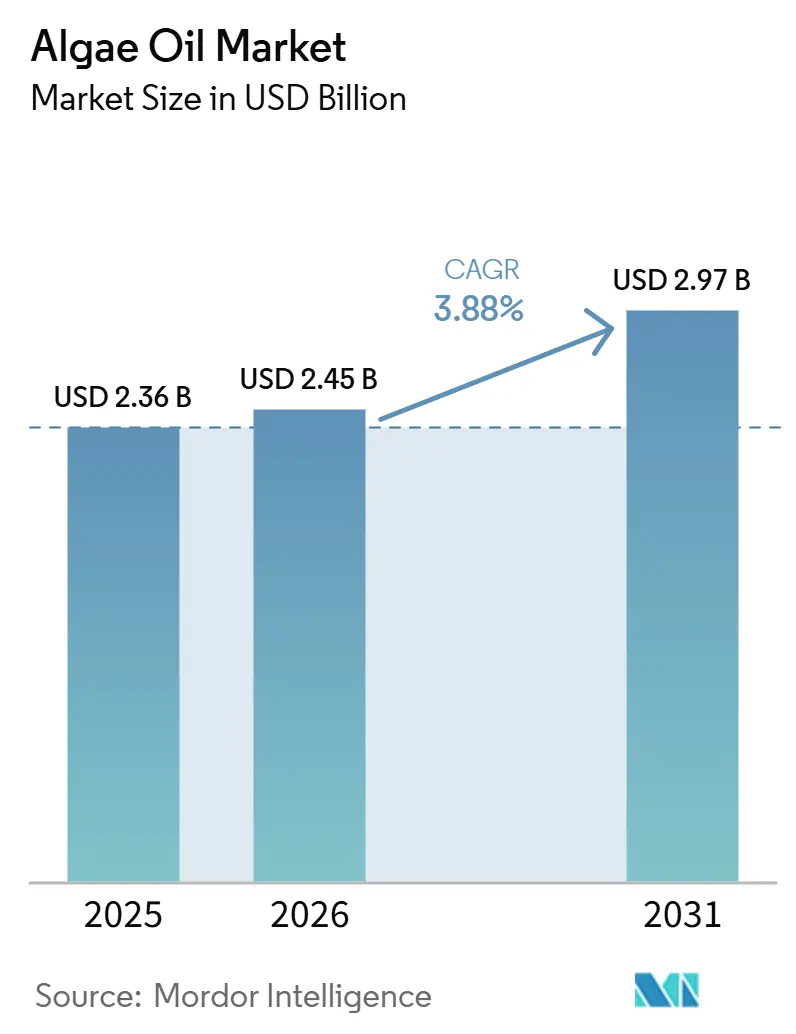
The algae oil market size was valued at USD 2.36 billion in 2025 and estimated to grow from USD 2.45 billion in 2026 to reach USD 2.97 billion by 2031, at a CAGR of 3.88% during the forecast period (2026-2031). The algae oil market is moving toward products that meet stricter requirements for purity, traceability, and stable fatty-acid content, especially in nutrition applications. Demand is shifting from marine-sourced omega-3 ingredients toward controlled fermentation to reduce exposure to supply disruptions and contamination concerns associated with wild-caught inputs. Regulatory acceptance in North America, Europe, and parts of Asia-Pacific is widening the range of food, supplement, and feed applications that can use algae-derived DHA and EPA. Producers are also linking algae cultivation with renewable energy and industrial feedstock streams, which can lower operating costs and support customer sustainability requirements. The algae oil market, therefore, has a clear divide between high-volume fuel uses and smaller, higher-value nutrition uses, where compliance and product performance carry more weight than the lowest purchase price.
Key Report Takeaways
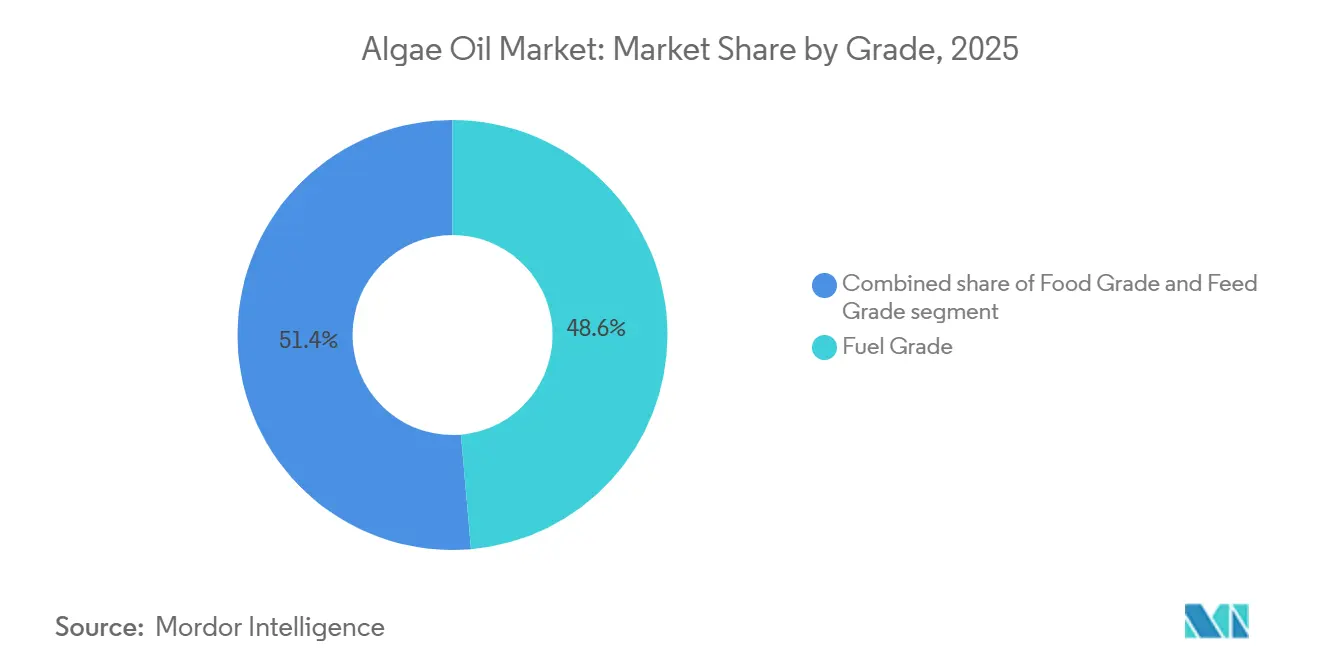
- By grade, fuel-grade algae oil accounted for 48.63% of the market revenue in 2025, while food-grade algae oil is projected to grow at a CAGR of 4.46% through 2031.
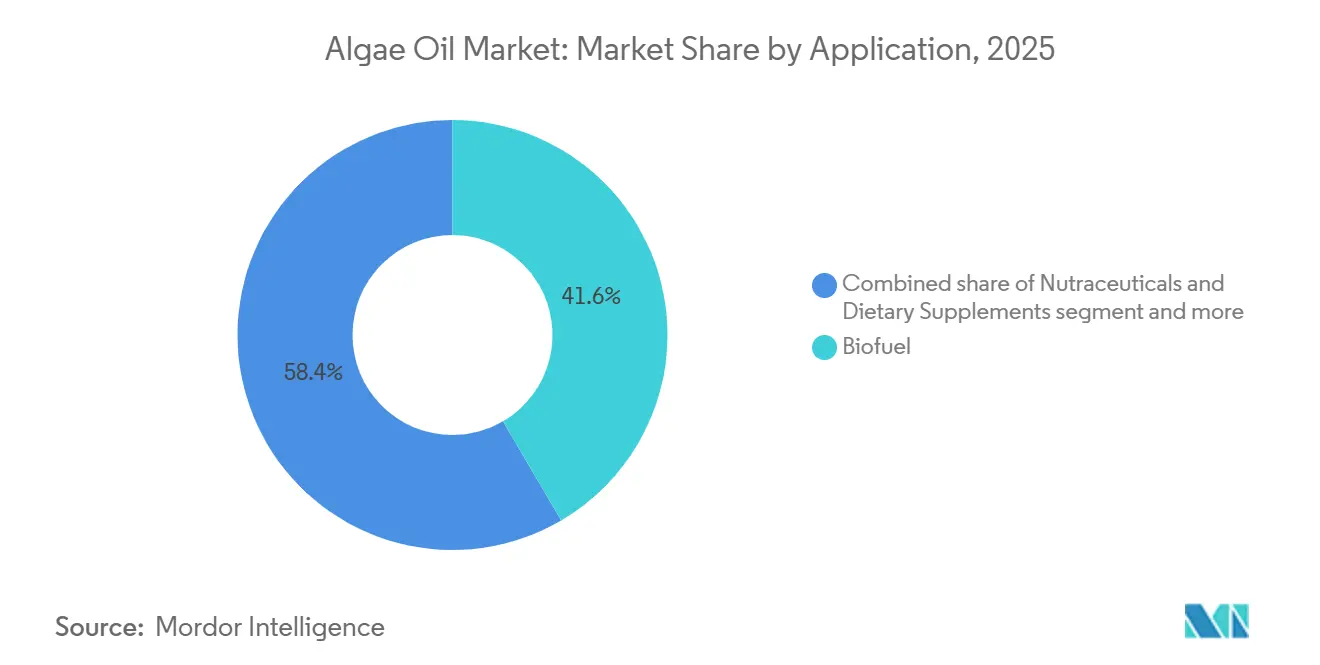
- By application, biofuel accounted for 41.56% of the algae oil market revenue in 2025, while nutraceuticals and dietary supplements are forecast to grow at a CAGR of 5.45% through 2031.
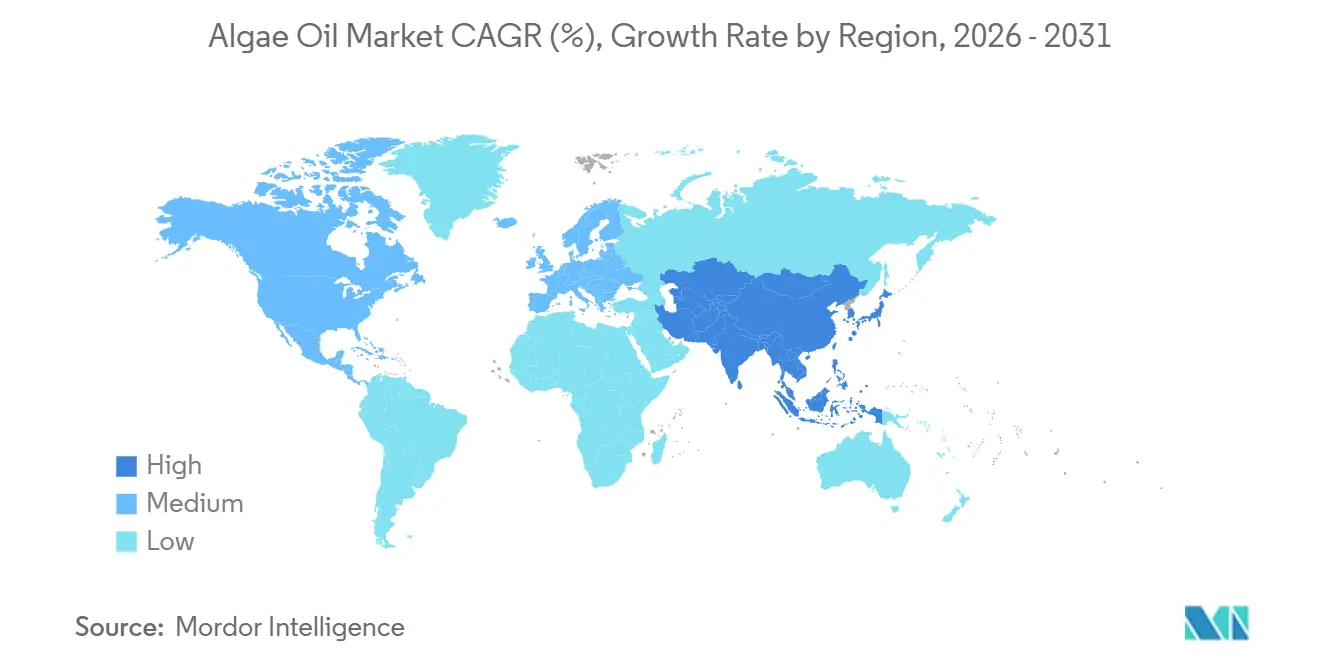
- By geography, North America accounted for 37.08% of the market revenue in 2025, while Asia-Pacific is expected to register the fastest regional CAGR of 4.59% through 2031.
Note: Market size and forecast figures in this report are generated using Mordor Intelligence’s proprietary estimation framework, updated with the latest available data and insights as of January 2026.
Market Trends and Insights
Drivers Impact Analysis of Algae Oil Market*
| Driver | (~) % Impact on CAGR Forecast | Geographic Relevance | Impact Timeline |
|---|---|---|---|
| Demand for Plant-Based Omega-3 Alternatives | +1.2% | Global, with stronger demand in North America and Europe and earlier adoption in Asia-Pacific | Medium term (2-4 years) |
| Functional Food and Nutraceutical Use | +0.8% | Global, with faster adoption in North America, Europe, China, India, and Japan | Medium term (2-4 years) |
| Sustainability Pressure on Marine Ingredients | +0.7% | Global, particularly relevant to North Atlantic salmon farming and EU food manufacturing | Medium term (2-4 years) |
| Regulatory Acceptance of Algae-Derived DHA and EPA | +0.5% | Global, with regulatory spillover from North America and Europe into Asia-Pacific and South America | Short term (≤ 2 years) |
| Closed-System Fermentation Improvements | +0.4% | North America and Europe, with expansion into Asia-Pacific | Long term (≥ 4 years) |
| Waste-Carbon and Circular Biorefinery Integration | +0.3% | Europe and Asia-Pacific, with emerging activity in South America | Long term (≥ 4 years) |
| Source: Mordor Intelligence | |||
Rising Demand for Plant-Based Omega-3 Alternatives
The algae oil market benefits from consumers and formulators seeking DHA and EPA without relying on wild-caught fish. Vegan and vegetarian supplement users are an important part of this demand, but the shift also includes buyers who want more predictable supply chains and clearer ingredient traceability. The U.S. Food and Drug Administration filed GRN 1236 for algal oil containing at least 40% DHA from Aurantiochytrium limacinum H Sc-011 in February 2025, supporting use in food categories that already use menhaden oil[1]Source: U.S. Food and Drug Administration, “GRAS Notice No. 1236, Algal Oil From Aurantiochytrium limacinum H Sc-011,” U.S. Food and Drug Administration, fda.gov.. The Center for Feed Innovation stated that algal oil can be competitive when fish-oil prices are high and projected algae-based EPA and DHA supply for aquaculture to rise from 20,000 MT in 2025 to 36,000 MT by 2030. This demand supports premium product positioning because algae-derived omega-3 ingredients can be presented as both non-animal and consistently specified. It also gives established producers more room to compete on formulation quality rather than only on commodity oil pricing.
Expansion of Algae Oil Use in Functional Foods and Nutraceuticals
Nutraceuticals, dietary supplements, infant nutrition, and fortified foods provide the algae oil market with access to applications with stricter specifications and higher per-kilogram value. The European Food Safety Authority assessed the safety of Schizochytrium sp. oil rich in DHA and EPA for specified novel-food uses, illustrating the importance of detailed compositional and exposure evidence in Europe. Japan has also identified bio-manufactured oils as a relevant area for its bioeconomy work, including surveys of microbial oil production pathways. In practical terms, infant formula, clinical nutrition, and pharmaceutical applications require dependable flavor, low contaminant levels, and repeatable fatty-acid profiles. Those requirements favor closed fermentation systems over open cultivation, where production conditions are harder to control. The algae oil market can consequently grow faster in specialized food and nutrition products than in broad, price-sensitive oil applications.
Sustainability Pressure on Fish Oil and Marine Ingredients
Aquaculture feed, which consumes a significant share of the global fish oil supply, is facing existential pressure to reduce its reliance on marine ingredients as MSC (Marine Stewardship Council) certification requirements tighten and salmon farmers commit to publicly disclosed Scope 3 emission targets. Algal oil's value proposition extends beyond carbon reduction: the CFI 2025 report confirmed through large-scale feeding trials that algal oil can fully replace fish oil in aquaculture diets without compromising fish growth, omega-3 retention, or product quality. Corbion's June 2026 updated life cycle assessment, conducted under ISO 14040/44 and ISO 14067 standards and independently verified, reported that its algae-derived omega-3 DHA solutions now carry 40-50% lower climate change impact per kilogram of omega-3 DHA compared to the average fish oil dataset, with 18-23% improvement versus Corbion's own 2021 baseline. The facility driving these gains is Corbion's commercial-scale operation in Orindiúva, Brazil, which operates on renewable energy generated from co-located sugarcane waste, an arrangement that integrates circular economy principles directly into production economics. The strategic implication for feed integrators is that algal oil is transitioning from a sustainability narrative to a measurable Scope 3 accounting tool, a distinction that will matter increasingly as the EU's Corporate Sustainability Reporting Directive creates legal disclosure obligations for supply-chain emission intensity.
Regulatory Acceptance and Production Technology Improvements
Regulatory approvals are reducing one of the main barriers to the wider use of algae-derived DHA and EPA in food and nutrition products. The UK Food Standards Agency and Food Standards Scotland published a positive safety assessment in 2024 for an extension of the conditions of use for Schizochytrium sp. oil rich in DHA and EPA. Codex's work on a proposed standard for microbial omega-3 oils can also help align definitions, composition requirements, and labeling rules across markets. At the production level, closed bioreactors give operators tighter control over pH, temperature, nutrients, and contamination risk than open systems do. Research on fermentation-based production of high-oleic microalgal oil reported average oil titers of 136.5 g/L and a coefficient of variation of 4.3% across commercial-scale runs. The algae oil market gains when these technical improvements produce consistent batches that can qualify for infant formula, clinical nutrition, and other regulated uses.
Restraints Impact Analysis of Algae Oil Market*
| Restraint | (~) % Impact on CAGR Forecast | Geographic Relevance | Impact Timeline |
|---|---|---|---|
| Cultivation, Harvesting, and Extraction Costs | -1.0% | Global, especially price-sensitive markets in Asia-Pacific and South America | Medium term (2-4 years) |
| Energy Intensity of Drying and Lipid Recovery | -0.7% | Global, with greater pressure in the EU and Japan where electricity costs are high | Long term (≥ 4 years) |
| Competition From Fish Oil and Conventional Vegetable Oils | -0.8% | Global, particularly in animal feed, aquaculture, and biofuel applications | Medium term (2-4 years) |
| Strain Yield Variability and Batch-Consistency Risk | -0.5% | Global, with higher impact in regulated markets including the EU, United States, and Japan | Long term (≥ 4 years) |
| Source: Mordor Intelligence | |||
High Cultivation, Harvesting, and Extraction Costs
Algae oil remains at a substantial cost disadvantage relative to incumbent lipid sources in bulk commodity applications, and this gap is unlikely to close within the current forecast window without technological step-changes. Published analyses indicate that farming and harvesting account for 50-65% of algae oil production cost, with oil extraction, pre-esterification, and purification adding a further 25-40%, according to MDPI Applied Sciences, 2025. Supercritical CO₂ extraction, which delivers the highest lipid purity, carries pilot-unit CAPEX exceeding USD 5 million and is constrained in throughput, while mechanical disruption methods (bead milling, homogenization) that are scalable to industrial volumes incur specific energy inputs exceeding 1 kWh per kilogram of biomass. The economic challenge is compounded by the fact that algae biodiesel, when assessed across energy return on investment metrics, has historically struggled to exceed minimum feasibility thresholds without co-product revenue, a finding reiterated by the U.S. Department of Energy's National Renewable Energy Laboratory (NREL) in its 2025 techno-economic analysis of combined algae processing pathways. The practical market consequence is that algae oil's cost-of-production gap limits its addressable biofuel market to scenarios where regulatory mandates, rather than market price alone, drive procurement, and focuses near-term commercial viability on high-value DHA/EPA fractions, where price parity with fish oil is achievable on a per-gram-of-omega-3 basis.
Energy Intensity of Drying and Lipid Recovery
Drying and lipid recovery impose a major operating burden because algal biomass contains substantial water before it can be converted into market-ready oil. Concentrating cultivation broth, removing moisture, and recovering lipids require heat and electricity, which can increase both costs and emissions where renewable energy is unavailable. A 2025 RSC Advances study on saline microalgae cultivation in the United States found that energy consumption and greenhouse gas emissions varied across scenarios for protein and biofuel co-production[2]Source: Royal Society of Chemistry, “Saline Microalgae Cultivation for the Coproduction of Biofuel and Protein in the United States,” RSC Advances, rsc.org. . This restraint is more severe for facilities operating in areas with costly electricity and no nearby waste heat, renewable power, or agricultural residues. Lower-energy harvesting methods could help, but they still need to demonstrate reliable industrial performance. Until these systems mature, the algae oil market will face pressure in applications where fish oil, soy oil, palm oil, or canola oil are bought largely on price.
*Our forecasts treat driver/restraint impacts as directional, not additive. The impact forecasts reflect baseline growth, mix effects, and variable interactions.
Algae Oil Market Segment Analysis
By Grade:
Fuel Grade Maintains Volume While Food Grade Supports Value GrowthFuel grade accounted for 48.63% of revenue in 2025, making it the largest grade in the algae oil market by value that year. Demand in this grade is supported by renewable fuel policies in North America and Europe, although margins remain tied to compliance requirements rather than to free-market oil economics. The European Union requires a combined 5.5% share of advanced biofuels in transport by 2030, while Germany's greenhouse gas reduction quota rose from 10.6% in 2025 to 12.1% in 2026. These rules help sustain demand for fuel-grade products even when algae-derived inputs are more expensive than conventional alternatives. The grade provides producers with scale, but it does not offer the same pricing protection as nutrition-focused oils. Its longer-term outlook also depends on transport fuel policy and the development of sustainable aviation fuel pathways.
Food grade is projected to expand at a 4.46% CAGR through 2031, faster than the overall algae oil market. Infant formula, fortified beverages, dairy alternatives, and specialized food products require stable flavor, purity, and fatty-acid content, which supports demand for controlled fermentation output. The UK Food Standards Agency assessment on extended uses of Schizochytrium sp. oil demonstrates that approved food applications can broaden as producers provide the required safety documentation. Feed grade provides a middle ground because it serves aquaculture and companion-animal nutrition, where volumes can be meaningful but fish-oil prices influence purchasing decisions. The Centre for Feed Innovation stated that commercial salmon feeds could substitute 25% of their EPA and DHA fish-oil supply with algal oil within 5 years if supply capacity grows accordingly[3]Source: Centre for Feed Innovation, “Algal Oil 2025 State of the Industry Report,” EU Maritime Forum, maritime-forum.ec.europa.eu. . Across grades, food and feed products offer the algae oil industry more durable margin opportunities than fuel products.



By Application:
Biofuel Leads Revenue While Nutraceuticals Grow FasterBiofuel accounted for 41.56% of 2025 revenue, which made it the largest application within the algae oil market. Its scale reflects the role of renewable-fuel mandates in the United States, Canada, and European markets rather than a straightforward cost advantage over vegetable oils. EU rules continue to support advanced biofuel feedstocks through measures that update eligible pathways and reduce reliance on first-generation crops. Algae oil may become more relevant to sustainable aviation fuel if demand for road transport becomes less attractive in major markets. That opportunity is still dependent on supportive policies, large-scale processing, and reliable low-carbon feedstock systems. Biofuel will therefore retain a material role, but it will remain exposed to energy costs and changes in transport policy.
Nutraceuticals and dietary supplements are forecast to grow at a 5.45% CAGR through 2031, the fastest application rate among algae oil market segments. Demand is supported by plant-based omega-3 positioning, established use of DHA in cognitive and vision-related nutrition, and the growth of formats such as softgels, gummies, and fortified drinks. The food and beverage application is also expanding as manufacturers explore algae oil for infant nutrition and other fortified products. Pharmaceutical uses are smaller but important because their quality requirements often set the reference point for traceability and batch control across the sector. Animal feed and aquaculture are becoming more strategic as buyers look for alternatives to marine ingredients that can perform in formulated diets. Beauty and personal care remains an emerging specialty use, where oxidative stability and skin compatibility can support value-added product development.
Geography Analysis
North America Algae Oil Market
North America accounted for 37.08% of global revenue in 2025, giving it the leading regional revenue position. The United States combines mature fermentation capacity, a large supplement customer base, and a regulatory system that has established several pathways for algae-derived ingredients. FDA filings and GRAS notices help food manufacturers evaluate how new algal oils can be used in specific food categories, although each product still requires evidence appropriate to its composition and intended use. The region has a higher revenue-per-ton profile than markets focused mainly on bulk fuel uses because nutraceuticals and premium aquaculture ingredients carry greater value. U.S. renewable-fuel rules also support biofuel demand, although commercial viability continues to depend on credit values and processing economics. Canada supports dietary supplements and fortified foods, while Mexico benefits from its proximity to North American supply and distribution networks.
Europe Algae Oil Market
Europe is the second-largest regional market, supported by rigorous novel-food procedures, sustainability requirements, and demand from aquaculture and advanced biofuels. Germany, the Netherlands, and France are important centers for different parts of the algae oil market, including renewable fuels, ingredient logistics, aquaculture feed, and fermentation-based product development. The European Commission has expanded the list of eligible feedstocks for advanced biofuels under Directive (EU) 2018/2001, which supports pathways that can avoid some land-use concerns associated with crop-based fuels. The United Kingdom also has an active novel-food review process, and the positive 2024 safety assessment for specified uses of Schizochytrium sp. oil creates a clearer route for food manufacturers. European buyers are likely to place a strong emphasis on product documentation, carbon performance, and supply-chain transparency. Those requirements create barriers for smaller suppliers, but they give qualified producers access to applications that are less driven by short-term commodity pricing.
APAC, South America and MEA Algae Oil Market
Asia-Pacific is forecast to grow at a 4.59% CAGR through 2031, the fastest rate among geographic areas in the algae oil market. China is important because its nutrition, animal-feed, and aquaculture sectors offer scale, while tighter traceability requirements can favor suppliers that have validated production systems. Japan supports bio-manufacturing research and has examined oil-sector opportunities in its national bio-manufacturing work. India extended support for advanced biofuel projects under the amended PM JI-VAN Yojana, which keeps attention on new feedstock and conversion routes through fiscal year 2028-2029. South Korea's regulated supplement sector and Australia's aquaculture sector add depth to regional demand. South America remains centered on Brazil's role in fermentation and supplements, while Middle East and Africa demand is at an earlier stage and remains concentrated in imported premium products and research activity.

Competitive Landscape
The algae oil market is moderately consolidated, with DSM-Firmenich, Corbion, Veramaris, Fermentalg, and Polaris leading. Leading suppliers compete through proprietary strains, fermentation capability, regulatory records, and relationships with large feed, food, and nutrition customers. DSM-Firmenich has a dual position through its own nutrition operations and its connection with Veramaris, which focuses on EPA and DHA oils for aquaculture and pet nutrition. In August 2025, DSM-Firmenich Animal Nutrition and Health inaugurated a manufacturing facility in Jadcherla, Hyderabad, supporting its regional feed-additive presence in India. This type of regional manufacturing investment can help suppliers better serve Asia-Pacific customers by providing stronger local technical support and distribution. Large producers have an advantage because the evidence needed for regulatory clearance and premium customer qualification can be expensive to generate and maintain.
Product development is increasingly focused on EPA-rich and balanced EPA-DHA oils rather than DHA-only products. In April 2026, DSM-Firmenich presented Veramaris O3 Max Pure, a microalgal oil with a natural 3:2 EPA-DHA ratio intended as a fish-oil replacement in pet-food formulations. In the same month, Fermentalg launched OMEGA ΩRIGINS™ EPA/DHA, which contains 40% EPA and 20% DHA and is available in multiple EPA-DHA ratios for supplements, functional foods, beverages, and pet nutrition. These launches show that producers are responding to customers who want more control over fatty-acid profiles in finished formulations. The competitive focus is moving toward oils that can replace fish oil with fewer changes to product design. Suppliers that can demonstrate consistent taste, stability, and technical performance are better placed to win repeat business in feed and food applications.
Mid-sized companies such as Algarithm, TomAlgae, and A4F Algae for Future can compete by concentrating on aquaculture, cosmetic ingredients, specialty lipids, and regional food-fortification opportunities. They are less likely to match the fermentation scale of larger companies, but specialized applications can offer a practical route to commercial relevance. Compliance remains central to competitive position because premium buyers often require GMP systems, validated quality controls, and relevant food or feed approvals. The Codex process for microbial omega-3 oils may eventually improve consistency in international product definitions and labeling, but producers will still need market-specific documentation. Intellectual property around strains, fermentation conditions, and downstream processing adds another barrier for new entrants. The algae oil market is therefore competitive, but the strongest positions are likely to remain with companies that pair technical control with regulatory depth and established customer access.
Algae Oil Industry Leaders
DSM-Firmenich AG
Corbion N.V.
Veramaris V.O.F.
Fermentalg SA
Polaris SA
- *Disclaimer: Major Players sorted in no particular order

Algae Oil Market Companies Covered in this Report
- DSM-Firmenich AG
- Corbion N.V.
- Veramaris V.O.F.
- BASF SE
- Cargill, Incorporated
- Archer-Daniels-Midland Company
- Fermentalg SA
- Polaris SA
- Algarithm Ingredients Inc.
- Lonza Group AG
- Cellana Inc.
- Cyanotech Corporation
- Pond Technologies Inc.
- Renewable Algal Energy LLC
- Algae Floating Systems Inc.
- Algae Production Systems
- Alltech, Inc.
- Inventure Renewables Inc.
- TomAlgae C.V.B.A.
- A4F Algae for Future

Recent Industry Developments in Algae Oil Market
- April 2026: DSM-Firmenich unveiled Veramaris O3 Max Pure at Petfood Forum 2026 in Kansas City, the world's first microalgal oil to deliver a natural 3:2 EPA:DHA ratio, identical to that of high-quality fish oil. Produced via closed-system microalgae fermentation, the non-GMO, vegan ingredient is designed to seamlessly replace fish oil in pet food formulations.
- April 2026: Fermentalg launched OMEGA ΩRIGINS™ EPA/DHA, achieving 40% EPA and 20% DHA concentrations through a patent-pending fermentation process adjustment, without any chemical concentration step. The product targets dietary supplements, functional food and beverage, and pet nutrition markets and is available in four EPA:DHA ratios to support formulator flexibility.
- February 2025: The FDA filed GRN 1236 from Shaanxi Healthful Bioengineering Co., Ltd., covering algal oil (≥40% DHA) from Aurantiochytrium limacinum H Sc-011, expanding the pool of GRAS-approved algal DHA sources for use across the same food categories as menhaden oil.


Global Algae Oil Market Report Scope
Algae oil is a renewable oil extracted from microalgae, valued for its high content of omega fatty acids and its applications across food, nutrition, personal care, feed, and biofuel industries. The algae oil market is segmented by grade, application, and geography. By grade, the market includes food-grade, feed-grade, and fuel-grade algal oil. Based on application, the market covers food and beverage, nutraceuticals and dietary supplements, pharmaceuticals, animal feed and aquaculture, beauty and personal care, and biofuels. By geography, the report covers North America, Europe, Asia-Pacific, South America, and the Middle East and Africa, with market size and forecasts provided for each region. For each segment, market sizing and forecasts have been done on the basis of value (USD million) and volume (Liters).
| Food Grade |
| Feed Grade |
| Fuel Grade |
| Food and Beverage |
| Nutraceuticals and Dietary Supplements |
| Pharmaceuticals |
| Animal Feed and Aquaculture |
| Beauty and Personal Care |
| Biofules |
| North America | United States |
| Canada | |
| Mexico | |
| Rest of North America | |
| Europe | Germany |
| United Kingdom | |
| Italy | |
| France | |
| Spain | |
| Netherlands | |
| Rest of Europe | |
| Asia-Pacific | China |
| India | |
| Japan | |
| Australia | |
| South Korea | |
| Rest of Asia-Pacific | |
| South America | Brazil |
| Argentina | |
| Rest of South America | |
| Middle East and Africa | South Africa |
| United Arab Emirates | |
| Rest of Middle East and Africa |
| By Grade | Food Grade | |
| Feed Grade | ||
| Fuel Grade | ||
| By Application | Food and Beverage | |
| Nutraceuticals and Dietary Supplements | ||
| Pharmaceuticals | ||
| Animal Feed and Aquaculture | ||
| Beauty and Personal Care | ||
| Biofules | ||
| By Geography | North America | United States |
| Canada | ||
| Mexico | ||
| Rest of North America | ||
| Europe | Germany | |
| United Kingdom | ||
| Italy | ||
| France | ||
| Spain | ||
| Netherlands | ||
| Rest of Europe | ||
| Asia-Pacific | China | |
| India | ||
| Japan | ||
| Australia | ||
| South Korea | ||
| Rest of Asia-Pacific | ||
| South America | Brazil | |
| Argentina | ||
| Rest of South America | ||
| Middle East and Africa | South Africa | |
| United Arab Emirates | ||
| Rest of Middle East and Africa | ||


Key Questions Answered in the Report
How large is the algae oil market in 2026?
The algae oil market was estimated at USD 2.45 billion in 2026 and is forecast to reach USD 2.97 billion by 2031.
Which algae oil application is growing the fastest?
Nutraceuticals and dietary supplements are projected to grow at a 5.45% CAGR through 2031.
What is driving demand for algae oil?
Demand is supported by plant-based omega-3 products, expanding food and supplement uses, and efforts to reduce reliance on fish-derived ingredients.
Which region leads algae oil demand?
North America held 37.08% of revenue in 2025, while Asia-Pacific is expected to grow the fastest at a 4.59% CAGR through 2031.
Page last updated on:





