
Alcohol Starch Sugar Enzymes Market Size and Share
Market Overview
| Study Period | 2021 - 2031 |
|---|---|
| Market Size (2026) | USD 2.14 Billion |
| Market Size (2031) | USD 2.76 Billion |
| Growth Rate (2026 - 2031) | 5.22 % |
| Fastest Growing Market | Asia-Pacific |
| Largest Market | Asia-Pacific |
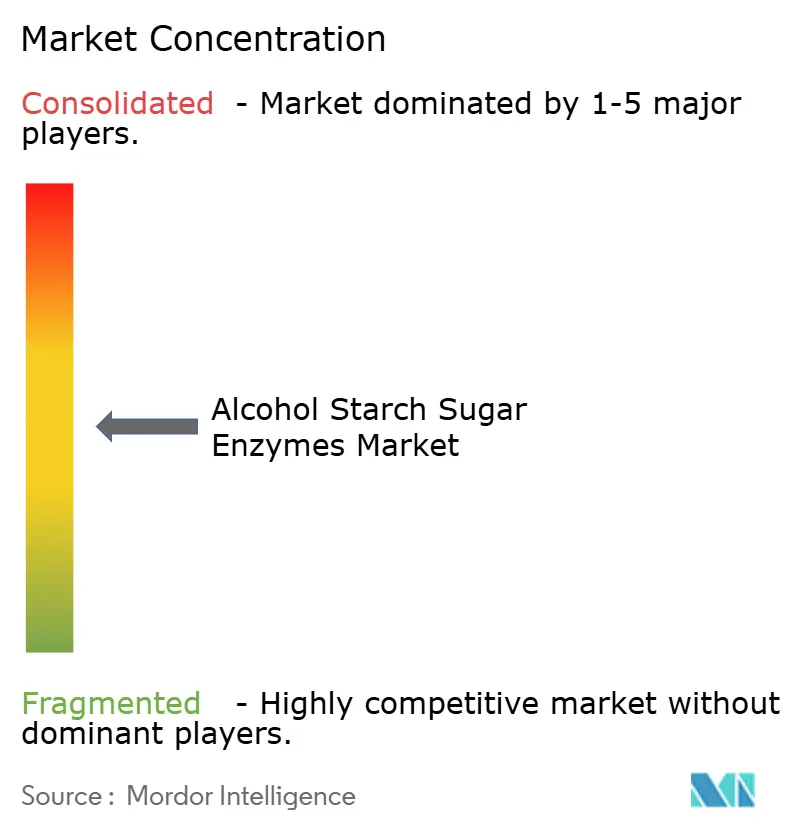
| Market Concentration | Medium |
Major Players *Disclaimer: Major Players sorted in no particular order Image © Mordor Intelligence. Reuse requires attribution under CC BY 4.0. | |
Alcohol Starch Sugar Enzymes Market Analysis by Mordor Intelligence
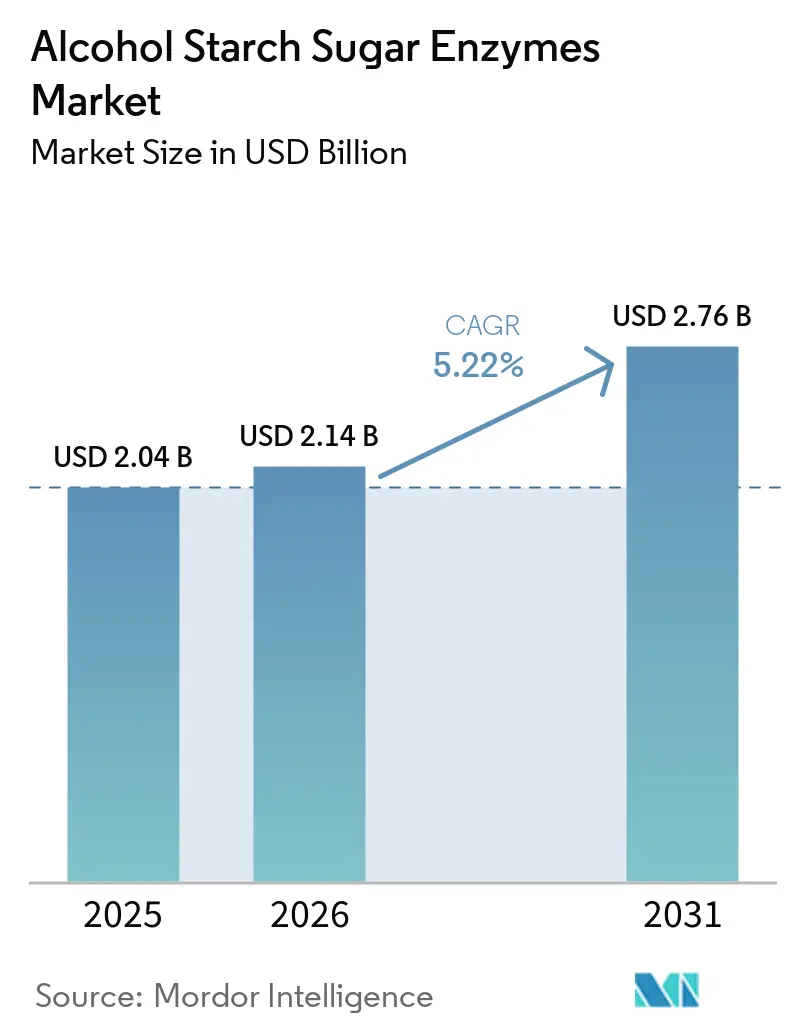
The alcohol starch sugar enzymes market size is projected to grow from USD 2.04 billion in 2025 to USD 2.14 billion in 2026, and to USD 2.76 billion by 2031, registering a CAGR of 5.22% during the 2026–2031 forecast period. Wider bioethanol blending programs, increased adoption of enzymes for starch and sugar conversion, and the need to improve fermentation yields supported the alcohol, starch, and sugar enzymes market. Grain-based ethanol plants required alpha-amylase and glucoamylase processing steps that molasses-based production did not require, directly linking feedstock selection to enzyme demand. Processing facilities also increasingly adopted specialized enzyme blends as they expanded production into functional sugars and higher-value sweeteners. Bioethanol applications provided relatively stable demand compared with beverage alcohol applications, where beer and spirits volumes weakened during 2025. However, the alcohol starch sugar enzymes market remained exposed to corn and sugarcane supply conditions, as lower feedstock availability could reduce ethanol plant utilization rates and, in turn, enzyme purchases.
Key Report Takeaways
- By type, amylase held 47.13% of the alcohol starch sugar enzymes market share in 2025, while cellulase is forecast to grow at a 6.07% CAGR through 2031.
- By form, liquid formulations held 62.64% of the alcohol starch sugar enzymes market share in 2025, while powder formulations are forecast to grow at a 6.54% CAGR through 2031.
- By source, microbial enzymes held 75.07% of the alcohol starch sugar enzymes market share in 2025, while animal-derived enzymes are forecast to grow at a 6.11% CAGR through 2031.
- By end-use application, alcohol production held 58.21% of the alcohol starch sugar enzymes market share in 2025, while starch processing is forecast to grow at a 6.43% CAGR through 2031.
- By geography, Asia-Pacific held 33.86% of the alcohol starch sugar enzymes market share in 2025 and is forecast to grow at a 6.82% CAGR through 2031.
Note: Market size and forecast figures in this report are generated using Mordor Intelligence’s proprietary estimation framework, updated with the latest available data and insights as of January 2026.
Market Trends and Insights
Drivers Impact Analysis of Alcohol Starch Sugar Enzymes Market*
| Driver | (%) Impact on CAGR Forecast | Geographic Relevance | Impact Timeline |
|---|---|---|---|
| Expanding bioethanol production and blending mandates | +1.2% | Global; highest intensity in Asia-Pacific (India, Vietnam, Indonesia), South America (Brazil) | Short term (≤ 2 years) |
| Growing demand for enzymes in starch and sugar processing | +0.8% | Global; APAC core, spill-over to North America | Medium term (2-4 years) |
| Rising production of beer, spirits, and other alcoholic beverages | +0.5% | Asia-Pacific (India, Vietnam); offsetting declines in Europe and North America | Medium term (2-4 years) |
| Increasing adoption of enzyme-based processing for higher production efficiency | +0.7% | Global; concentrated in North America and Europe where energy costs drive optimization | Short term (≤ 2 years) |
| Preference for sustainable and bio-based industrial processes | +0.5% | North America and Europe, with growing spill-over to Asia-Pacific | Long term (≥ 4 years) |
| Advancements in enzyme engineering and microbial biotechnology | + 0.6% | Global | Long term (≥ 4 years) |
| Source: Mordor Intelligence | |||
Expanding Bioethanol Production and Blending Mandates
The continued expansion of bioethanol production, supported by government-mandated fuel-blending programs in major markets, is increasing demand for enzymes for alcohol, starch and sugar. Amylase and glucoamylase are particularly important in ethanol manufacturing, as they facilitate starch liquefaction and saccharification, improving the conversion of feedstocks into fermentable sugars. According to the United States Department of Agriculture (USDA), India’s ethanol production reached 10.5 billion liters in calendar year 2025, representing a 46% increase over 2024 and underscoring the country’s rapidly expanding biofuel production capacity[1]. India’s E20 blending target, Brazil’s E30 mandate, and Vietnam’s E10 rollout are also prompting ethanol producers to expand capacity and improve process efficiency. As ethanol output rises, producers require larger volumes of enzymes to support efficient starch conversion, fermentation, and overall production performance, creating a relatively stable and sustained demand base for enzyme suppliers.
Growing Demand for Enzymes in Starch and Sugar Processing
Rising global sugar production is driving demand for enzymes that support sugar and starch conversion processes. According to the Organization for Economic Co-operation and Development (OECD), global sugar production is projected to increase from 178 million tonnes during the base period to 205 million tonnes by 2034. Asia is expected to account for 63% of this growth, while Latin America is projected to contribute 24%, underscoring the importance of these regions in the expansion of global sugar production[2]. As production volumes increase, sugar processors are likely to require higher volumes of enzymes, including amylase, glucoamylase, and glucose isomerase, to optimize starch hydrolysis, improve sugar conversion rates, and enhance overall processing efficiency. This trend is expected to create significant demand for enzyme solutions, particularly in the rapidly expanding sugar-processing industries in Asia and Latin America.
Rising Production of Beer, Spirits, and Other Alcoholic Beverages
Increasing consumption of alcoholic beverages, especially beer, is driving demand for fermentation enzymes used in brewing and alcohol production. These enzymes play an important role in converting raw materials into fermentable sugars, improving fermentation efficiency, and ensuring consistent product quality. According to a survey published in PubMed Central in January 2026, beer was the most commonly consumed alcoholic beverage among men in India, with 43% of respondents reporting beer consumption[3]. This trend underscores the continued significance of beer within the country’s alcoholic beverage landscape. Furthermore, rising alcoholic beverage consumption across emerging markets, particularly in the Asia-Pacific and Africa, is expanding opportunities for enzyme suppliers serving the brewing and fermentation industries. Growing demand from the brewing industry, alongside increased bioethanol production, is expected to support the broader use of enzymes that enhance fermentation performance, improve process efficiency, and maintain product consistency.
Increasing Adoption of Enzyme-Based Processing for Higher Production Efficiency
The growing use of enzyme-based processing technologies is enabling alcohol, starch, and sugar producers to improve conversion efficiency, minimize raw material losses, and reduce overall production costs. These technologies support more effective processing of complex feedstocks by accelerating the breakdown of starches and other carbohydrates into fermentable sugars. Multi-enzyme formulations are particularly valuable because they combine activities such as glucoamylase, amylase, cellulase, and trehalase to address several stages of the production process. This integrated approach helps producers achieve more efficient starch liquefaction and saccharification, improve sugar yields, and maintain consistent product quality. For example, Novonesis’s Saczyme Yield formulation combines multiple enzyme activities for grain-based ethanol production, helping improve process performance and ethanol yield. As producers increasingly automate their operations, demand is also rising for enzyme formulations that provide accurate dosing, reliable process performance, and compatibility with existing production systems.
Restraints Impact Analysis of Alcohol Starch Sugar Enzymes Market*
| Restraint | (~) (%) Impact on CAGR Forecast | Geographic Relevance | Impact Timeline |
|---|---|---|---|
| High cost of industrial enzymes and enzyme-based processing | -0.7% | Global; most acute in price-sensitive Asia-Pacific smaller-scale operations | Short term (≤ 2 years) |
| Strict regulatory requirements for enzyme use in food and beverage applications | -0.5% | North America and Europe (FDA GRAS, EU Regulation 1332/2008, EFSA evaluations), with compliance spill-over to export markets | Medium term (2-4 years) |
| Availability of alternative chemical and conventional processing technologies | -0.4% | Emerging Asia and South America, where acid-hydrolysis infrastructure is entrenched | Long term (≥ 4 years) |
| Fluctuations in raw material and fermentation input costs | -0.4% | Global | Short term (≤ 2 years) |
| Source: Mordor Intelligence | |||
High Cost of Industrial Enzymes and Enzyme-Based Processing
The high cost of industrial enzymes and associated enzyme-based processing systems can restrain their adoption, especially among small and mid-sized alcohol, starch, and sugar processors. Enzyme procurement, storage, handling, and dosing requirements can increase overall production costs, particularly when plants operate below optimal capacity. Under these conditions, processors may view investments in premium or advanced enzyme solutions as less financially viable, despite their potential benefits in terms of improved yields, process efficiency, and product quality. This constraint is particularly pronounced in emerging markets, where processors often operate with narrower margins, limited capital availability, and greater sensitivity to input costs. To address these challenges, enzyme manufacturers are developing higher-activity formulations that require lower application doses, along with simplified dosing systems that reduce operational complexity. These innovations aim to improve the cost-effectiveness of enzyme-based processing and enhance its economic value for a broader range of end users.
Strict Regulatory Requirements for Enzyme Use in Food And Beverage Applications
Stringent regulatory requirements for food and beverage enzymes can increase the time, cost, and complexity of product development, approval, and commercialization. In the European Union, food enzymes must undergo safety assessments and authorization procedures before they can be marketed for specific applications. Similarly, in the United States, enzyme products may need to meet Food and Drug Administration requirements, including the Generally Recognized as Safe process where applicable. These compliance processes often require extensive toxicological data, detailed technical documentation, and application-specific safety assessments, which can delay market entry and raise development costs. Such regulatory demands can be particularly challenging for smaller enzyme developers with limited financial and regulatory resources. In contrast, established suppliers are better positioned to manage compliance requirements due to their broader regulatory expertise, established safety documentation, and experience obtaining approvals across multiple markets.
*Our forecasts treat driver/restraint impacts as directional, not additive. The impact forecasts reflect baseline growth, mix effects, and variable interactions.
Alcohol Starch Sugar Enzymes Market Segment Analysis
By Type:
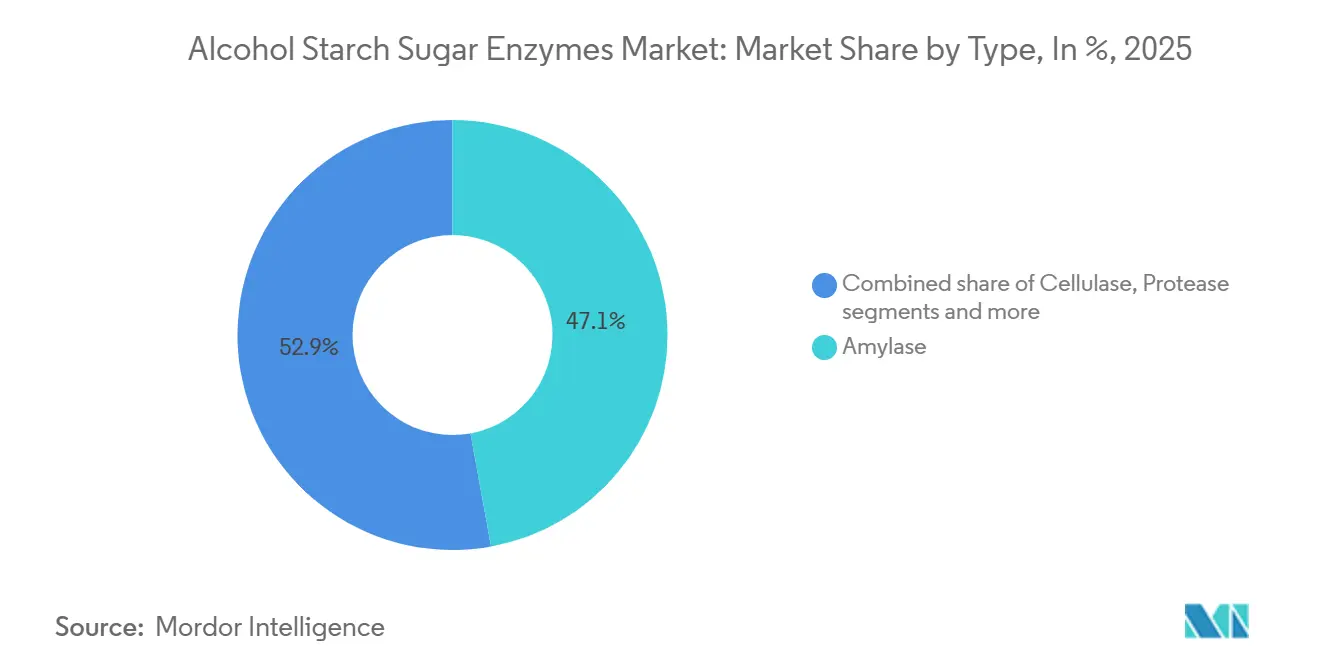
Amylase Leads Current Demand While Cellulase Grows FasterAmylase dominated the alcohol starch sugar enzymes market by type, accounting for 47.13% of the market share in 2025. The enzyme plays a critical role in starch liquefaction and hydrolysis, making it essential for alcohol, starch, and sugar processing applications. It converts complex starch molecules into simpler sugars, which are subsequently used in fermentation and other downstream processing stages. The growing demand for higher starch-conversion efficiency, improved process yields, and reduced production time continues to drive amylase adoption across processing facilities. Its broad applicability across grain-based ethanol production, brewing, and sweetener manufacturing further strengthens its leading market position.
Cellulase is projected to be the fastest-growing enzyme type, registering a 6.07% CAGR through 2031. Increasing use of cellulose-rich feedstocks is driving demand for cellulase in biomass conversion and fermentation processes. The enzyme breaks down cellulose into fermentable sugars, enabling the efficient use of agricultural residues and other lignocellulosic materials. Its ability to improve feedstock utilization and support cost-effective downstream production is expanding its use in industrial applications. Rising investments in biofuels and the growing preference for renewable feedstocks are expected to further accelerate growth in the cellulase segment.

By Form:
Liquid Holds the Largest Position and Powder Gains GroundLiquid formulations dominated the alcohol starch sugar enzymes market by form, accounting for 62.64% of the market share in 2025. Their ease of handling, rapid dispersion, and compatibility with automated dosing systems support their extensive use in industrial operations. Manufacturers can directly add liquid enzymes to processing streams, enabling accurate dosing and reducing preparation time. These formulations also support consistent enzyme activity during alcohol production, starch conversion, and sugar processing. Their operational convenience and broad application base continue to reinforce the segment’s leading position.
Powder formulations are projected to be the fastest-growing form segment, registering a 6.54% CAGR through 2031. Their extended shelf life, improved storage stability, and ease of transportation make them suitable for manufacturers seeking flexible enzyme solutions. Powder enzymes can be stored and distributed efficiently, particularly in regions where cold-chain infrastructure is limited. They also provide formulation flexibility and can help reduce logistics and storage costs. Growing demand for cost-effective, stable, and easily manageable enzyme products is expected to drive segment growth.
By Source:
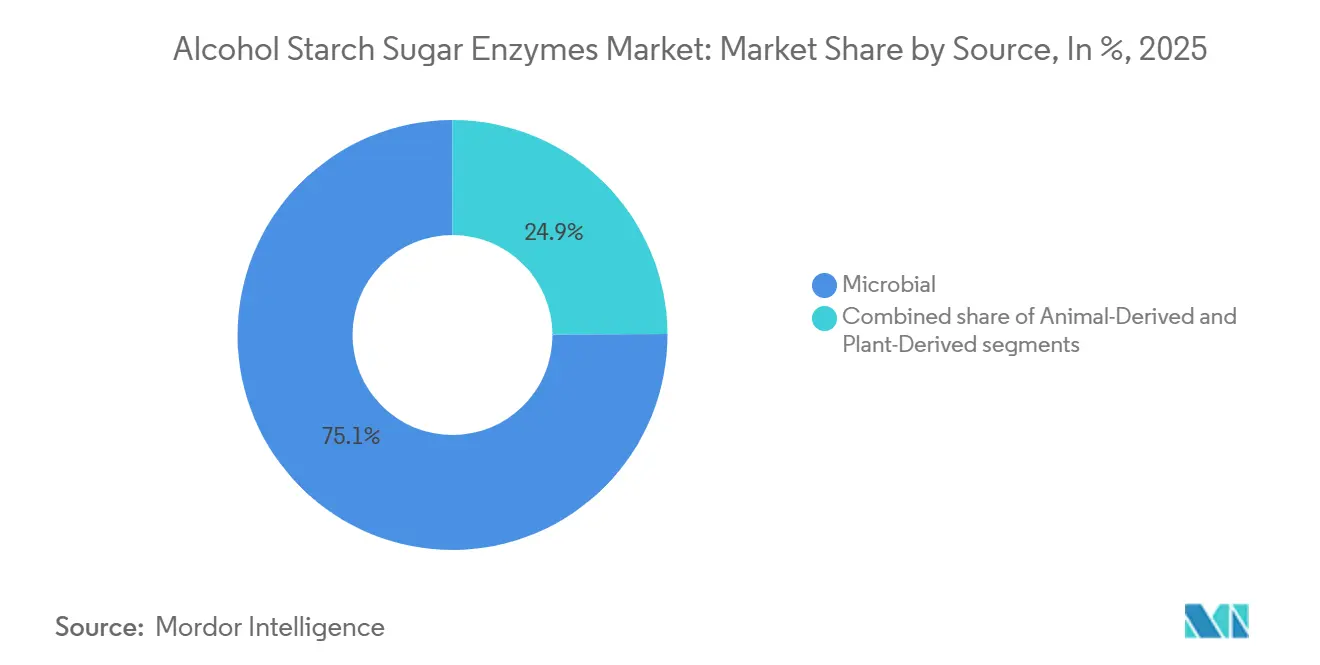
Microbial Enzymes Dominate While Animal-Derived Products Grow FasterMicrobial sources dominated the alcohol starch sugar enzymes market by source, accounting for 75.07% of the market share in 2025. Their high production efficiency, scalability, and capacity to provide consistent enzyme yields make them well-suited for large-scale industrial applications. Manufacturers widely use microbial enzymes in alcohol fermentation, starch liquefaction and saccharification, and sugar processing operations. Their versatility, cost-effectiveness, and compatibility with diverse processing conditions continue to support their dominant market position.
Animal-derived enzymes are projected to be the fastest-growing source segment, registering a 6.11% CAGR through 2031. Growing demand for specialized enzyme solutions in specific processing applications is expected to drive segment expansion. These enzymes offer distinct catalytic properties that can improve process performance and enable targeted product formulations. The increasing emphasis on high-performance, application-specific enzymatic solutions is likely to create additional growth opportunities for animal-derived enzymes.
By End-Use Application:
Alcohol Production Leads While Starch Processing Expands FasterAlcohol production accounted for the largest share of the alcohol starch sugar enzymes market by end-use application, at 58.21% in 2025. Producers use enzymes to convert starch into fermentable sugars, thereby improving the efficiency of fermentation processes. These enzymes support higher ethanol yields, reduce processing time, and help maintain consistent product quality. The growing demand for bioethanol and alcoholic beverages, along with cost-efficient production methods, continues to drive enzyme adoption in this segment. Ongoing efforts to optimize fermentation operations and reduce raw material losses further reinforce alcohol production's market leadership.
Starch processing is expected to be the fastest-growing end-use application segment, registering a CAGR of 6.43% through 2031. The segment's growth is driven by rising demand for efficient processes for starch liquefaction, hydrolysis, saccharification, and conversion. Enzymes enable manufacturers to improve starch utilization, increase production yields, and achieve greater consistency in processed starch products. The expanding use of starch derivatives in food, animal feed, and industrial applications is also increasing the need for specialized enzyme solutions. As manufacturers focus on improving processing efficiency and product functionality, demand for enzymes in starch processing is expected to rise further.
Geography Analysis
APAC Alcohol Starch Sugar Enzymes Market
Asia-Pacific accounted for 33.86% of the alcohol starch sugar enzymes market in 2025 and is projected to register a 6.82% CAGR through 2031, making it the fastest-growing regional market. The region benefits from expanding ethanol production, increasing starch-processing capacity, and the growing adoption of enzyme-based conversion technologies. India’s expanding bioethanol industry and rising grain-based ethanol production are contributing significantly to regional demand for enzymes. Growing food, beverage, and fermentation activities across China, India, and Southeast Asia are also increasing the use of enzymes to improve production efficiency and yields.
North America and Europe Alcohol Starch Sugar Enzymes Market
North America and Europe remain established markets for alcohol starch sugar enzymes, supported by mature ethanol, food-processing, starch, and sugar industries. Manufacturers in these regions widely use enzymes for starch conversion, sweetener production, fermentation, and biofuel applications. Demand is further supported by the continued focus on improving process efficiency, product consistency, and resource utilization across industrial operations. Ongoing investments in sustainable processing technologies are expected to maintain demand for specialized enzyme solutions in both regions.
LATAM and MEA Alcohol Starch Sugar Enzymes Market
Latin America is gaining importance in the alcohol starch sugar enzymes market, supported by expanding ethanol production and increasing use of corn and other agricultural feedstocks. The Middle East and Africa represent comparatively smaller but emerging markets, where developing food-processing, beverage, and industrial biotechnology activities support gradual enzyme adoption. Regional growth through 2031 is expected to remain closely linked to investments in biofuels, agricultural processing, and industrial biotechnology infrastructure. While Asia-Pacific is likely to maintain its growth advantage, Latin America and the Middle East & Africa offer additional opportunities as local production and processing capacities expand.
Competitive Landscape
The alcohol, starch sugar enzymes market is moderately consolidated, with major participants including Novonesis A/S, International Flavors & Fragrances Inc. (IFF), DSM-Firmenich AG, Associated British Foods plc (AB Enzymes), and Advanced Enzyme Technologies Limited. These companies hold strong market positions through diversified enzyme portfolios, established customer networks, and extensive global manufacturing capabilities. They compete across high-volume enzyme categories, including amylase and glucoamylase, which are widely used in starch conversion, alcohol production, and sweetener applications. Specialized suppliers also compete by offering tailored enzyme solutions for specific processing requirements. This structure gives large players scale advantages while creating opportunities for regional and niche manufacturers.
Strategic acquisitions and production-capacity expansions continue to influence the competitive environment and reinforce the market positions of leading suppliers. Novonesis is set to acquire DSM-Firmenich’s stake in the Feed Enzyme Alliance in June 2025, strengthening its technology assets and customer relationships. The company also expanded its regional manufacturing footprint through the acquisition of Plumino Precision Fermentation Thailand in April 2026. Such initiatives highlight the increasing focus on expanding technology capabilities, production capacity, and regional access. Companies are using these strategies to improve supply reliability and address growing demand across key end-use industries.
Technological expertise and formulation capabilities remain important competitive differentiators in the alcohol, starch and sugar enzymes market. Protein engineering and advanced microbial expression systems allow suppliers to develop enzymes with higher specificity, improved stability, and enhanced processing efficiency. Companies are increasingly developing customized and multi-enzyme formulations to meet customer-specific production requirements and differentiate their offerings from standardized products. Regional manufacturers in Asia-Pacific and Latin America continue to create price pressure in commodity enzyme categories. In response, established global suppliers are focusing on value-added, application-specific solutions to protect margins and strengthen long-term customer relationships.
Alcohol Starch Sugar Enzymes Industry Leaders
-
International Flavors & Fragrances Inc. (IFF)
-
Novonesis A/S
-
DSM-Firmenich AG
-
Associated British Foods plc (AB Enzymes)
-
Advanced Enzyme Technologies Limited
- *Disclaimer: Major Players sorted in no particular order
Alcohol Starch Sugar Enzymes Market Companies Covered in this Report
- Novonesis A/S
- International Flavors & Fragrances Inc. (IFF)
- DSM-Firmenich AG
- Associated British Foods plc (AB Enzymes)
- Advanced Enzyme Technologies Limited
- Amano Enzyme Inc.
- Codexis, Inc.
- Dyadic International, Inc.
- Lesaffre
- Roquette Frères
- The Soufflet Group
- BASF SE
- Kerry Group plc
- Lallemand Inc.
- AEB Group
- Angel Yeast Co., Ltd.
- Biocatalysts Ltd.
- WeissBioTech GmbH
- Enzyme Development Corporation
- Aumgene Biosciences
Recent Industry Developments in Alcohol Starch Sugar Enzymes Market
- October 2025: BASF and IFF formed a strategic partnership to develop advanced enzyme technologies and biobased polymers that enhance performance and resource efficiency.
- July 2025: Lallemand acquired Solyve, an enzyme specialist that used solid-state fermentation to produce enzymes for winemaking, juice, vegetable processing, and plant-based foods. The acquisition strengthened Lallemand Bio-Ingredients’s enzyme portfolio and capabilities.
- June 2025: Novonesis launched Innova Eclipse-L yeast and its companion enzyme, Innova Total A6, for ethanol plants operating with longer fermentation times. The solutions aimed to improve fermentation stability, ethanol yield, and overall production efficiency.
- March 2024: Kerry launched Biobake Fresh Rich, a starch-acting enzyme system for high-sugar baked goods such as muffins, pancakes, and pound cakes. The solution helped maintain softness, freshness, and moisture over a longer shelf life, thereby reducing food waste.
Global Alcohol Starch Sugar Enzymes Market Report Scope
The alcohol starch sugar enzymes market comprises sales of enzymes used to facilitate and optimize biochemical processes in alcohol production, starch conversion, and sugar processing. Based on type, the market is classified into amylase, glucoamylase, cellulase, protease, lipase, and others; based on form, into powder and liquid; based on source, into microbial, plant-derived, and animal-derived; and based on end-use application, into alcohol production, starch processing, and sugar processing. Geographically, the market is segmented into North America, Europe, Asia-Pacific, South America, and the Middle East and Africa. The market forecasts are provided in terms of value (USD).
Segmentation Overview
| Amylase |
| Glucoamylase |
| Cellulase |
| Protease |
| Lipase |
| Others |
| Powder |
| Liquid |
| Microbial |
| Plant-Derived |
| Animal-Derived |
| Alcohol Production |
| Starch Processing |
| Sugar Processing |
| North America | United States |
| Canada | |
| Mexico | |
| Rest of North America | |
| Europe | Germany |
| United Kingdom | |
| Italy | |
| France | |
| Spain | |
| Rest of Europe | |
| Asia-Pacific | China |
| Japan | |
| India | |
| Australia | |
| Rest of Asia-Pacific | |
| South America | Brazil |
| Argentina | |
| Rest of South America | |
| Middle East and Africa | South Africa |
| Saudi Arabia | |
| Rest of Middle East and Africa |
| By Type | Amylase | |
| Glucoamylase | ||
| Cellulase | ||
| Protease | ||
| Lipase | ||
| Others | ||
| By Form | Powder | |
| Liquid | ||
| By Source | Microbial | |
| Plant-Derived | ||
| Animal-Derived | ||
| By End-Use Application | Alcohol Production | |
| Starch Processing | ||
| Sugar Processing | ||
| By Geography | North America | United States |
| Canada | ||
| Mexico | ||
| Rest of North America | ||
| Europe | Germany | |
| United Kingdom | ||
| Italy | ||
| France | ||
| Spain | ||
| Rest of Europe | ||
| Asia-Pacific | China | |
| Japan | ||
| India | ||
| Australia | ||
| Rest of Asia-Pacific | ||
| South America | Brazil | |
| Argentina | ||
| Rest of South America | ||
| Middle East and Africa | South Africa | |
| Saudi Arabia | ||
| Rest of Middle East and Africa | ||
Key Questions Answered in the Report
How large is the global alcohol starch sugar enzymes market?
The sector stands at USD 2.14 billion in 2026 and is forecast to reach USD 2.76 billion by 2031 at a 5.22% CAGR.
Which enzyme type has the largest role in alcohol and starch processing?
Amylase led by type with a 47.13% share in 2025 because it is required for starch liquefaction.
Which formulation is expanding fastest?
Powder formulations are forecast to grow at a 6.54% CAGR through 2031 because of storage and transport advantages.
Why is Asia-Pacific important for enzyme suppliers?
Asia-Pacific held 33.86% of global value in 2025, supported by India’s ethanol program and wider Southeast Asian bioethanol activity.