
Aircraft Hangar Infrastructure Market Size and Share
Market Overview
| Study Period | 2020 - 2032 |
|---|---|
| Market Size (2027) | USD 0.92 Billion |
| Market Size (2032) | USD 1.15 Billion |
| Growth Rate (2027 - 2032) | 4.56 % |
| Fastest Growing Market | Asia-Pacific |
| Largest Market | North America |
| Market Concentration | Low |
Major Players *Disclaimer: Major Players sorted in no particular order Image © Mordor Intelligence. Reuse requires attribution under CC BY 4.0. | |
Aircraft Hangar Infrastructure Market Analysis by Mordor Intelligence
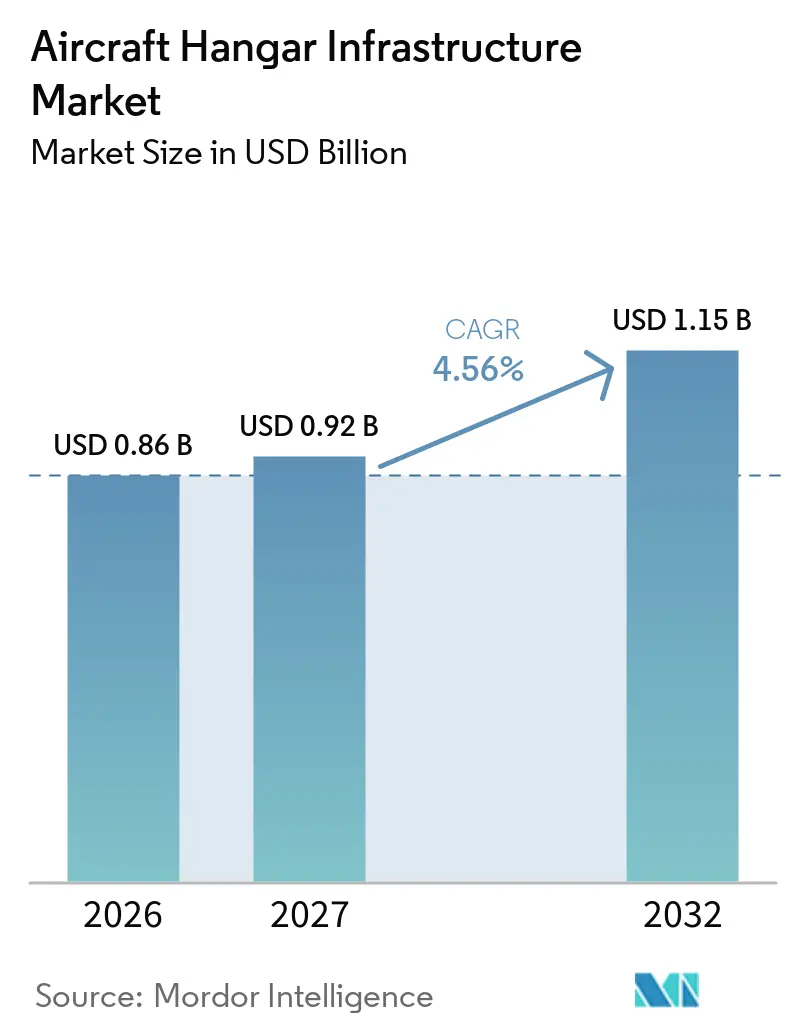
The aircraft hangar infrastructure market size was valued at USD 0.86 billion in 2026 and is forecast to grow from USD 0.92 billion in 2027 to reach USD 1.15 billion by 2032, at a 4.56% CAGR during the forecast period (2027-2032). Committed maintenance contracts, airport projects, and defense programs support demand across separate aviation spending cycles. Aircraft deliveries remain constrained, so operators must keep existing fleets productive for longer and maintain dependable access to maintenance bays. Greenfield airport development in Asia-Pacific and the Middle East creates opportunities to include hangars in airport master plans rather than add them later. Military aviation and unmanned aircraft programs provide a separate source of demand for fixed and deployable structures. The aircraft hangar infrastructure market also faces high construction costs, land constraints, and extended approval processes that can defer project revenue.
Key Report Takeaways
- By hangar type, fixed hangars held 56.78% of the aircraft hangar infrastructure market share in 2026, while portable hangars are forecast to grow at a 6.45% CAGR through 2032.
- By construction type, brownfield construction held 57.21% market share in 2026, while greenfield construction is forecast to expand at a 6.33% CAGR through 2032.
- By aviation type, commercial aviation held 48.78% of revenue in 2026, while unmanned aerial systems (UAS) are forecast to grow at a 7.15% CAGR through 2032.
- By application, MRO held 46.75% of revenue in 2026, while assembly is forecast to grow at a 5.86% CAGR through 2032.
- By geography, North America held 38.62% of revenue in 2026, while Asia-Pacific is forecast to expand at a 6.78% CAGR through 2032.
Note: Market numbers in this report are based on Mordor Intelligence's proprietary estimation framework, which combines nine months of actuals with Q4 projections for base year 2026.
Market Trends and Insights
Drivers Impact Analysis of Aircraft Hangar Infrastructure Market*
| Driver | (~) % Impact on CAGR Forecast | Geographic Relevance | Impact Timeline |
|---|---|---|---|
| Rising aircraft fleet and air traffic | +1.20% | Global, concentrated in Asia-Pacific, the Middle East, and North America | Medium term (2-4 years) |
| MRO capacity expansion and ageing aircraft | +1.10% | Global, particularly North America, Europe, and Middle East MRO hubs | Short term (≤ 2 years) |
| Airport modernisation and greenfield development | +0.90% | Asia-Pacific, with spillover to the Middle East and Africa | Medium term (2-4 years) |
| Defense aviation and deployable infrastructure spending | +0.60% | North America, Europe, and the Indo-Pacific | Medium term (2-4 years) |
| General aviation hangar shortages and long waitlists | +0.40% | North America, with emerging demand in Europe | Short term (≤ 2 years) |
| Dedicated facilities for electric, hydrogen, and AAM aircraft | +0.50% | North America, Europe, and early-stage Asia-Pacific | Long term (≥ 4 years) |
| Source: Mordor Intelligence | |||
Rising Aircraft Fleet and Air Traffic Intensify Hangar Demand
Aircraft fleet activity raises demand for parking, inspection, and maintenance space across the aircraft hangar infrastructure market. Delayed deliveries do not eliminate the operational need for airlines, as carriers continue to use older aircraft while awaiting replacements. Those aircraft require scheduled inspections and heavier maintenance visits, increasing the time spent in maintenance bays. Growing traffic in India, Southeast Asia, and Gulf hubs also increases the need for on-airport maintenance access as airlines add routes. Airports with limited apron space must coordinate aircraft movement, parking, and repair activity more closely. The aircraft hangar infrastructure market benefits when airlines and maintenance providers treat available bay capacity as an operating requirement rather than optional real estate.
MRO Capacity Expansion and Aging Aircraft Drive Permanent Bay Construction
MRO providers need permanent, certified bays to service commercial fleets, which supports fixed hangar development. Older aircraft tend to require more extensive work during major checks, placing pressure on the available line and base maintenance network. IATA identifies the Middle East, Indian subcontinent, and Southeast Asia as important areas for future maintenance growth, where capacity planning is becoming more urgent. IndiGo signed an agreement for an MRO facility at Bengaluru International Airport with 4 hangars. The aircraft hangar infrastructure market benefits from projects that integrate maintenance operations, tooling, and aircraft access at a single airport site. Permanent infrastructure remains important because commercial work requires controlled environments, fire protection, and sufficient clearance.
Airport Modernization and Greenfield Development Create Infrastructure Co-Investment Cycles
Asia-Pacific and Middle Eastern airports expect USD 240 billion in infrastructure investment from 2025 to 2035, including USD 104 billion for greenfield projects.[1] New airports can reserve maintenance and operational land before terminal activity makes the site constrained. This approach gives airlines a clearer path to establish local maintenance support when they open new stations. The aircraft hangar infrastructure market can therefore benefit from airport capital programs even when the primary investment is a terminal or runway. Deutsche Aircraft began work on its D328eco final assembly line at Leipzig/Halle Airport, which includes a commissioning hangar. Such projects show that production facilities and airport development can create linked demand for specialized buildings.
Defense Aviation and Deployable Infrastructure Spending Support Dual-Stream Demand
Defense procurement provides demand that is independent of commercial airline traffic or passenger cycles. NAVFAC Southwest awarded a USD 107 million contract for an MQ-25 Stingray hangar at Naval Base Ventura County in April 2025. Such contracts require secure maintenance areas, specialist workshops, crew spaces, and dedicated apron access. The aircraft hangar infrastructure market has scope for suppliers that can provide both permanent military facilities and temporary structures for deployed operations. This combination broadens the available project base and reduces dependence on one aviation customer group. It also favors firms with proven capabilities in security, logistics, and specialized engineering. These requirements make project execution and qualification particularly demanding for new entrants.
Restraints Impact Analysis of Aircraft Hangar Infrastructure Market*
| Restraint | (~) % Impact on CAGR Forecast | Geographic Relevance | Impact Timeline |
|---|---|---|---|
| High capital and site-development costs | -1.00% | Global, particularly constrained hub airports in North America and Europe | Medium term (2-4 years) |
| Funding, permitting, and airport-approval delays | -0.50% | North America, Europe, and fast-growing Asian markets | Short term (≤ 2 years) |
| Fragmented demand and uncertain lease economics | -0.30% | North American general aviation and secondary airports globally | Medium term (2-4 years) |
| Stringent fire-safety and environmental compliance requirements | -0.40% | Global, including jurisdictions using NFPA 409 and IEC standards | Long term (≥ 4 years) |
| Source: Mordor Intelligence | |||
High Capital and Site-Development Costs Create Threshold Effects
Hangar construction requires a major investment in foundations, clear-span structures, drainage, fire suppression, doors, aprons, and utility connections. Miami-Dade County approved a development lease requiring a minimum commitment of USD 15 million for a general aviation hangar facility at Miami-Opa Locka Executive Airport.[2] These costs can be difficult for smaller airport operators or independent aviation firms to finance. The aircraft hangar infrastructure market is consequently weighted toward well-capitalized airlines, defense contractors, and large maintenance providers. Standardized construction systems can reduce delivery time, but they do not eliminate the cost of airside works and regulatory compliance.
Funding, Permitting, and Airport-Approval Delays Extend Project Lead Times
Airport projects commonly require coordination among airport authorities, planning bodies, environmental reviewers, and aviation regulators. This process can delay construction after a project announcement, especially at capacity-constrained airports. FAA construction standards influence the development process for federally supported airport work and establish expectations for planning and specifications. Hangar sponsors must also align the project with airport layout plans, safety zones, utility capacity, and lease rules. The aircraft hangar infrastructure market can lose near-term revenue when approvals take longer than expected. Delays are particularly important in high-growth markets where land acquisition, public consultation, and interagency review can introduce further uncertainty for developers, lenders, airport owners, their financing partners, and project tenants.
*Our forecasts treat driver/restraint impacts as directional, not additive. The impact forecasts reflect baseline growth, mix effects, and variable interactions.
Aircraft Hangar Infrastructure Market Segment Analysis
By Hangar Type:
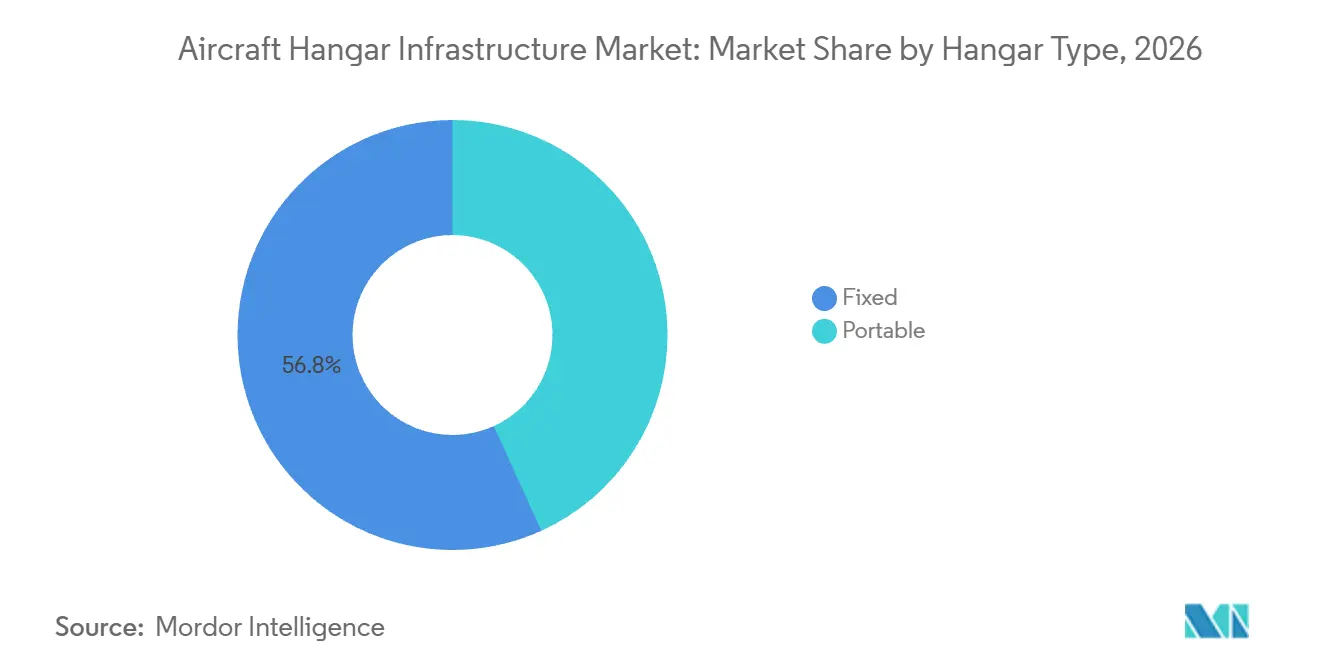
Fixed Infrastructure Anchors Revenue, While Portable Formats Gain MomentumFixed hangars held 56.78% of the aircraft hangar infrastructure market share in 2026 because commercial MRO operations, assembly lines, and permanent military facilities require durable buildings. Climate control, fire suppression, certified clearance heights, and secure workshops favor permanent structures. The aircraft hangar infrastructure industry relies on fixed formats in which an operator performs regulated maintenance or high-value production. These buildings also support longer leases and investment in equipment, tooling, and staff. FAA guidance and NFPA 409 requirements make compliance planning central to facilities that handle aircraft maintenance. Fixed structures are expected to remain important because their capability is difficult to replace with temporary alternatives.
Portable hangars are forecast to grow at a 6.45% CAGR through 2032, supported by military expeditionary needs and limited general aviation capacity. The Boeing Company partnered with Aviatema Equipment in August 2025 to distribute inflatable maintenance shelters to support military aircraft. The systems can be deployed more quickly than a conventional building and can support activities where a permanent structure is not viable. They also allow operators to respond to temporary maintenance requirements or base changes. Portable formats cannot address every certification or climate-control requirement, particularly for intensive commercial maintenance. The aircraft hangar infrastructure market nevertheless gains a wider customer base when suppliers can offer both fixed and portable facilities, with suitable logistics support and trained installation teams.
By Construction Type:
Brownfield Retrofit Leads, While Greenfield Pipelines AccelerateBrownfield development accounted for 57.21% of the market share in 2026 because established airports can upgrade or expand existing airside facilities. Operators often prefer a retrofit because it uses available access, utilities, and operational land. This route is particularly relevant in mature aviation markets where new airport sites are limited. The aircraft hangar infrastructure market size for brownfield work is supported by operators seeking capacity without full land acquisition. EasyJet maintenance capacity received support from a contract to refurbish 3 former hangars at London Luton Airport in 2025. Refurbishment can still require major investment when the facility needs new systems, doors, aprons, fire protection, upgraded electrical connections, or improved interior workflow.
Greenfield construction is forecast to grow at a 6.33% CAGR through 2032 as new airport programs add operational infrastructure from the beginning. ACI Asia-Pacific identifies USD 104 billion in greenfield airport investment across Asia-Pacific and the Middle East from 2025 to 2035. A new airport can allocate space for maintenance hangars before passenger terminals and cargo facilities fill the site. This process can improve vehicle access, aircraft circulation, and utility planning. The market benefits when hangar capacity is integrated into the airport operating model. Greenfield projects also create opportunities for suppliers to standardize layouts across multiple facilities within an airport development program and related logistics zones.
By Aviation Type:
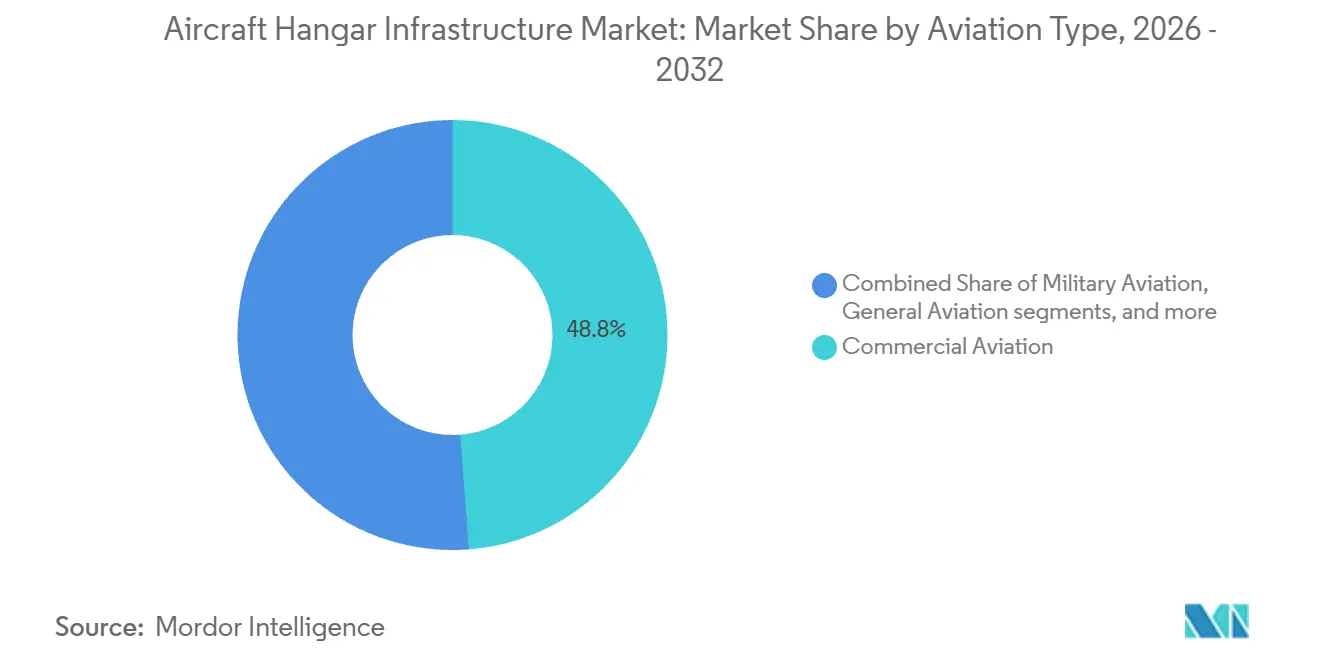
Commercial Aviation Anchors Volume, While UAS Changes Design StandardsCommercial aviation accounted for 48.78% of the aircraft hangar infrastructure market share in 2026, reflecting large airline fleets and the need for scheduled maintenance. Narrowbody aircraft remain important because they support a significant share of airline route networks and require dedicated maintenance capacity. Widebody hangars are fewer in number but generally require substantial clear spans, reinforced aprons, and specialized doors. Commercial facilities must also meet clear safety, access, and operational requirements. The aircraft hangar infrastructure industry serves airline-owned facilities and independent providers that require consistent access for aircraft turnaround and maintenance. Large airport maintenance projects can therefore remain viable even when overall passenger growth is uneven, because aircraft must undergo mandatory work throughout their operating lives, regardless of seasonal changes or network adjustments worldwide.
Unmanned aerial systems (UAS) are forecast to grow at a 7.15% CAGR through 2032, driven by military and commercial drone programs that require purpose-designed support infrastructure. Their facilities can require varied bay sizes, secure control areas, electromagnetic considerations, and adaptable access arrangements. NAVFAC Southwest’s 2025 MQ-25 project illustrates the need for infrastructure that combines aircraft maintenance, crew areas, and mission support functions. UAS operations can differ from conventional aviation because equipment, airframes, and control systems evolve quickly. The aircraft hangar infrastructure market offers room for buildings that can be adapted as mission requirements change. Flexible configuration will be important where sites support mixed manned and unmanned operations, including safe testing, training, secure data handling, and equipment storage.

By Application:
MRO Commands the Largest Share, While Assembly Gains From New ProgramsMRO held 46.75% of the aircraft hangar infrastructure market share in 2026 because maintenance cannot be deferred indefinitely without affecting aircraft availability. MRO facilities need bay capacity, workshops, parts areas, ground equipment, and direct access to the airfield. Airlines and independent providers both use these facilities to manage planned checks and unscheduled repairs. The industry benefits when maintenance capacity is planned near the aircraft fleets it serves. IATA has identified maintenance cost and capacity pressures as important issues for the aviation sector. This makes permanent hangars a core operating asset rather than a secondary airport building for operators, airlines, and specialist providers.
Assembly is forecast to grow at a 5.86% CAGR through 2032 as aircraft manufacturers and suppliers expand production capacity. Airbus inaugurated its second A320 final assembly line in Mobile, Alabama, in October 2025 and added more than a million square feet of double-bay assembly hangars. Airbus also opened an automated production hangar at Augsburg for A321XLR rear center tank assembly.[3] Assembly buildings differ from MRO sites because manufacturers prioritize production flow, component movement, and process control. The aircraft hangar infrastructure market can benefit from both final assembly and specialist component production programs, especially as manufacturers localize their supply chains and increase production capacity for future aircraft programs.
Geography Analysis
North America: Dense Infrastructure and Defense Spending Define Market Leadership
North America held 38.62% of the aircraft hangar infrastructure market share in 2026, supported by a substantial general aviation base, airline maintenance activity, and defense construction. The region combines local demand for storage with large, specialized projects at commercial hubs and military installations. United Airlines began construction on an MRO hangar complex at Orlando International Airport in 2025. Federal aviation work also supports the broader project pipeline, as AECOM received a USD 270 million FAA architecture and engineering contract in December 2025. FAA design guidance and NFPA 409 remain important compliance factors for US projects. The aircraft hangar infrastructure market in North America must balance these large programs with persistent shortages at smaller airports.
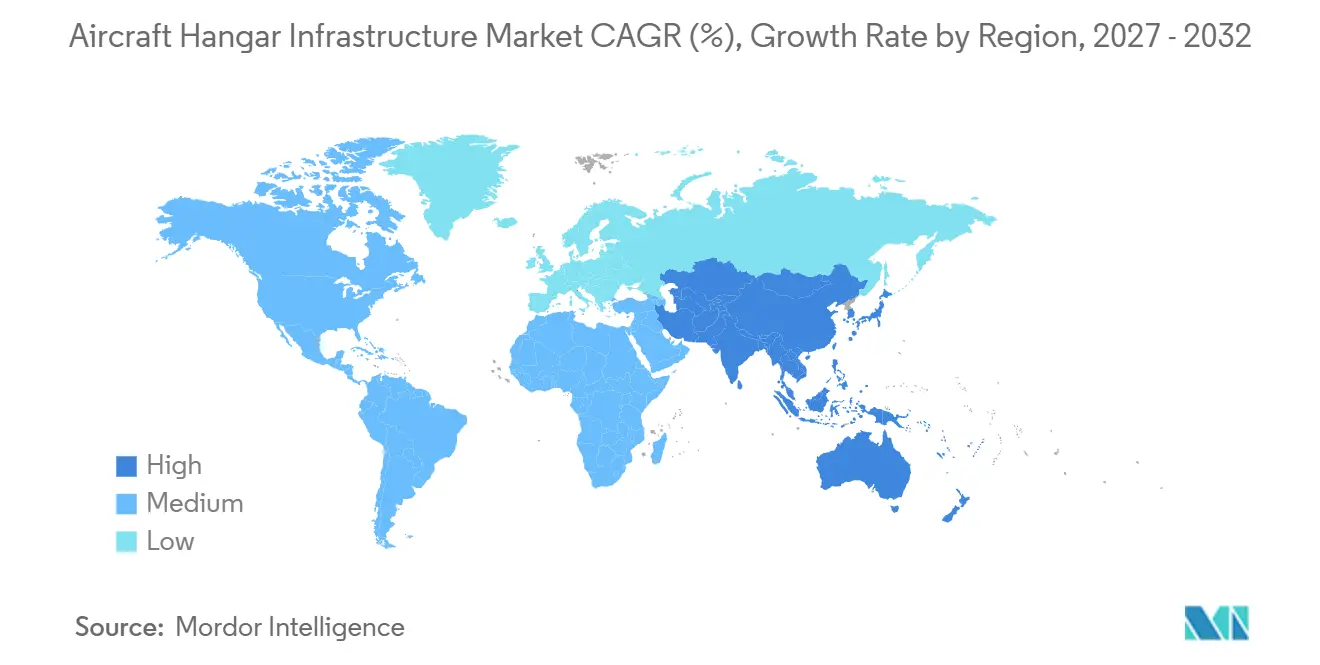
Asia-Pacific: Greenfield Investment and MRO Localization Drive the Fastest Regional Growth
Asia-Pacific is forecast to expand at a 6.78% CAGR through 2032, the highest regional rate in the aircraft hangar infrastructure market. Airport construction, fleet growth, and policy support for local maintenance capacity are reinforcing each other. ACI Asia-Pacific expects USD 240 billion in airport infrastructure investment across Asia-Pacific and the Middle East between 2025 and 2035. IndiGo’s Bengaluru project includes 4 hangars and shows how airlines can secure dedicated capacity at a major hub. SF Airlines and ST Engineering opened the H1 Hangar at Ezhou Huahu International Airport in August 2025. These developments bring maintenance capability closer to regional fleet operations.
Europe, South America, and Middle East and Africa: Regional Demand Patterns Converge Around Infrastructure Gaps
Europe sustains demand through fleet renewal, environmental upgrades, and a concentration of maintenance activity at larger facilities. Ryanair began building a EUR 40 million (USD 44.73 million) aircraft maintenance facility at Dublin Airport in January 2025, designed to reduce heating energy use by up to 35% through gas absorption heat pump technology. The Middle East and Africa combine airport expansion with demand for widebody maintenance capacity. South America has potential for more local maintenance infrastructure as regional aviation activity develops. Eastern Europe also shows defense-related demand, as DUNA Polska signed a contract for 9 UAV hangars and related infrastructure at Mirosławiec. The aircraft hangar infrastructure market spans these different needs, with energy performance and defense resilience becoming more relevant in procurement.
Competitive Landscape
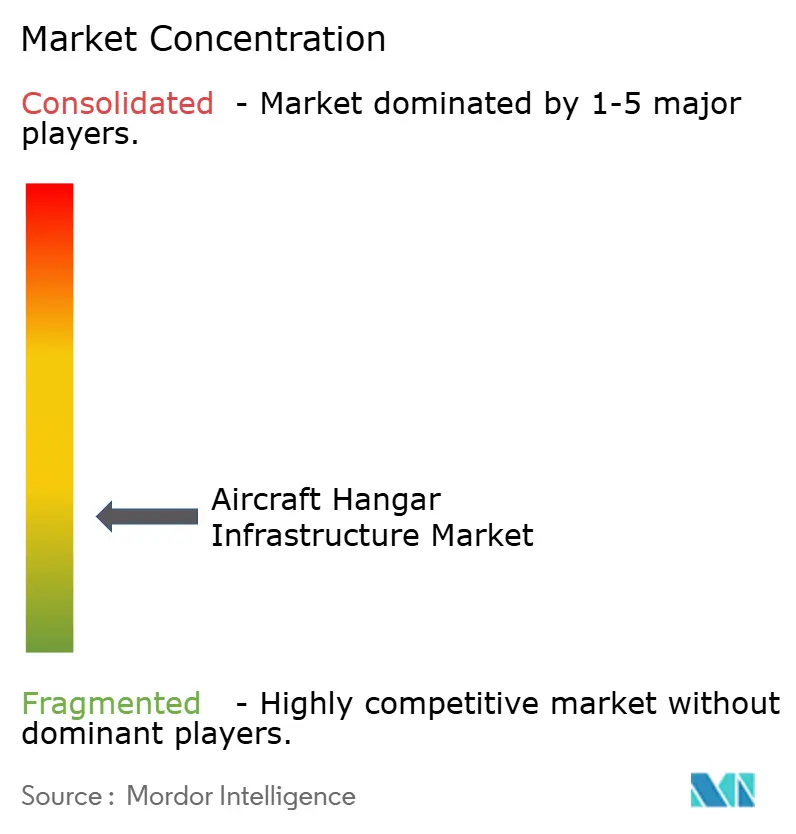
The aircraft hangar infrastructure market is fragmented because project requirements vary by facility type, customer, location, and aviation use. Large design and construction firms compete for complex airport, defense, and manufacturing programs. Fabric and modular structure suppliers compete where fast deployment and lower site disruption matter. Component firms focus on specialist doors, enclosures, and systems that must meet airside requirements. AECOM’s FAA contract demonstrates the advantage of companies able to support multi-site public aviation programs. Boeing’s 2025 partnership on inflatable maintenance shelters also shows how established aviation companies can extend portable support options, offering customers an alternative for temporary operational needs, field maintenance, and time-sensitive deployments at remote sites.
Competition increasingly depends on documented technical capability rather than price alone. Suppliers must show that a proposed building can meet clearance, fire safety, operational, and security requirements. FAA airport construction guidance and NFPA 409 influence qualification requirements for many US projects. NFPA Nucor Building Systems presents steel hangar systems for aviation applications, reflecting the role of specialist structural suppliers in the category. Digital design and fabrication coordination can also help firms manage complex layouts, door requirements, and project sequencing. This reduces execution risk for customers developing high-value operational facilities and improves coordination among contractors.
Opportunities remain in facilities that serve new aircraft categories and mixed aviation uses. IATA guidance on battery- and hydrogen-powered aircraft highlights the need for aerodrome operators to plan infrastructure and safety systems for evolving technology. UAS facilities also require flexible layouts because operators may combine manufacturing, testing, maintenance, and control functions at a single site. Deutsche Aircraft’s Leipzig/Halle project and Airbus’s manufacturing expansions show how aircraft production programs can create demand for specialized hangar capacity. These projects also demonstrate that manufacturing facilities require carefully sequenced production, testing, and logistics areas with clear access routes.
Aircraft Hangar Infrastructure Industry Leaders
-
AECOM
-
Hensel Phelps
-
Rubb, Inc.
-
BlueScope Steel North America Corporation
-
John Reid & Sons (Strucsteel) Limited
- *Disclaimer: Major Players sorted in no particular order
Aircraft Hangar Infrastructure Market Companies Covered in this Report
- AECOM
- ClearSpan Fabric Structures Inc. (ESAPCO)
- Rubb, Inc.
- GAPTEK
- Hensel Phelps
- Centrex
- HTS TENTIQ GmbH
- John Reid & Sons (Strucsteel) Limited
- Alaska Structures (AKS Industries, Inc.)
- BlueScope Steel North America Corporation
- Big Top Manufacturing, Inc.
- Sprung Instant Structures Ltd.
- Erect-A-Tube, Inc.
- Banyan Steel Arch Systems
- Fulfab, Inc.
- The Korte Company
- Pfeifer Holding GmbH
Recent Industry Developments in Aircraft Hangar Infrastructure Market
- October 2026: Conti Federal Services LLC was awarded a USD 109.9 million firm-fixed-price contract by the US Army Corps of Engineers (USACE) Los Angeles District to construct a new MC-130J aircraft hangar and aircraft maintenance unit at Davis-Monthan Air Force Base (AFB), Arizona.
- June 2026: High Flying Hangars signed a lease agreement for the development of a new hangar project at Manassas Regional Airport (KHEF) in Prince William County, Virginia.
- April 2025: NAVFAC Southwest awarded Clark Construction a USD 107 million contract for a new MQ-25 Stingray unmanned aerial refueling aircraft hangar at Naval Base Ventura County, Point Mugu. The facility includes maintenance shops, crew spaces, a warfare center control station, and an aircraft parking apron, with completion scheduled by the end of 2027.
Global Aircraft Hangar Infrastructure Market Report Scope
The aircraft hangar infrastructure market comprises specialized aviation facilities and associated infrastructure designed to support aircraft storage, MRO, assembly, and other operational requirements across commercial, military, and general aviation, as well as unmanned aerial systems (UAS). The scope includes hangar infrastructure supplied for new airport developments, MRO facility expansions, military airbase modernizations, and general aviation infrastructure development, including associated structural systems, hangar doors, and supporting facilities.
The aircraft hangar infrastructure market is segmented by hangar type, construction type, aviation type, application, and geography. By hangar type, the market is segmented into fixed and portable hangars. By construction type, the market is segmented into brownfield and greenfield. By aviation type, the market is segmented into commercial aviation, military aviation, general aviation, and unmanned aerial systems (UAS). By application, the market is segmented into maintenance, repair and overhaul (MRO), assembly, storage, and others. The report also covers market sizes and forecasts for the aircraft hangar infrastructure market in major countries across the regions. For each segment, the market size is provided in terms of value (USD).
Segmentation Overview
| Fixed |
| Portable |
| Brownfield |
| Greenfield |
| Commercial Aviation | Narrowbody |
| Widebody | |
| Regional Jets | |
| Military Aviation | Combat |
| Transport | |
| Special Mission | |
| Helicopters | |
| General Aviation | Business Jets |
| Commercial Helicopters | |
| Unmanned Aerial Systems (UAS) |
| MRO |
| Assembly |
| Storage |
| Others |
| North America | United States | |
| Canada | ||
| Mexico | ||
| Europe | United Kingdom | |
| France | ||
| Germany | ||
| Italy | ||
| Spain | ||
| Russia | ||
| Rest of Europe | ||
| Asia-Pacific | China | |
| India | ||
| Japan | ||
| South Korea | ||
| Australia | ||
| Rest of Asia-Pacific | ||
| South America | Brazil | |
| Argentina | ||
| Rest of South America | ||
| Middle East and Africa | Middle East | United Arab Emirates |
| Saudi Arabia | ||
| Rest of Middle East | ||
| Africa | South Africa | |
| Rest of Africa | ||
| By Hangar Type | Fixed | ||
| Portable | |||
| By Construction Type | Brownfield | ||
| Greenfield | |||
| By Aviation Type | Commercial Aviation | Narrowbody | |
| Widebody | |||
| Regional Jets | |||
| Military Aviation | Combat | ||
| Transport | |||
| Special Mission | |||
| Helicopters | |||
| General Aviation | Business Jets | ||
| Commercial Helicopters | |||
| Unmanned Aerial Systems (UAS) | |||
| By Application | MRO | ||
| Assembly | |||
| Storage | |||
| Others | |||
| By Geography | North America | United States | |
| Canada | |||
| Mexico | |||
| Europe | United Kingdom | ||
| France | |||
| Germany | |||
| Italy | |||
| Spain | |||
| Russia | |||
| Rest of Europe | |||
| Asia-Pacific | China | ||
| India | |||
| Japan | |||
| South Korea | |||
| Australia | |||
| Rest of Asia-Pacific | |||
| South America | Brazil | ||
| Argentina | |||
| Rest of South America | |||
| Middle East and Africa | Middle East | United Arab Emirates | |
| Saudi Arabia | |||
| Rest of Middle East | |||
| Africa | South Africa | ||
| Rest of Africa | |||
Key Questions Answered in the Report
What is the forecast growth rate for aircraft hangar infrastructure?
The aircraft hangar infrastructure market is forecast to grow at a 4.56% CAGR from 2027 to 2032, reaching USD 1.15 billion by 2032.
Which hangar format has the largest revenue share?
Fixed hangars held 56.78% of revenue in 2026 because MRO, assembly, and permanent defense facilities need controlled and certified infrastructure.
Why is Asia-Pacific the fastest-growing regional area?
Asia-Pacific is forecast to grow at a 6.78% CAGR through 2032, supported by airport construction, fleet expansion, and local MRO investment.
What application holds the largest revenue share?
MRO held 46.75% of revenue in 2026 because operators need dependable facilities for planned maintenance and repairs.
What restricts new hangar construction?
High capital costs, airport approvals, lease economics, and fire-safety compliance can delay or limit construction projects.
How are unmanned aircraft affecting hangar demand?
UAS operations are the fastest-growing aviation segment and require adaptable facilities for maintenance, control functions, and changing airframe configurations.