
Air-to-Water Heat Pump Market Size and Share
Market Overview
| Study Period | 2021 - 2032 |
|---|---|
| Market Size (2027) | USD 19.28 Billion |
| Market Size (2032) | USD 27.31 Billion |
| Growth Rate (2027 - 2032) | 7.21 % |
| Fastest Growing Market | Asia-Pacific |
| Largest Market | Europe |
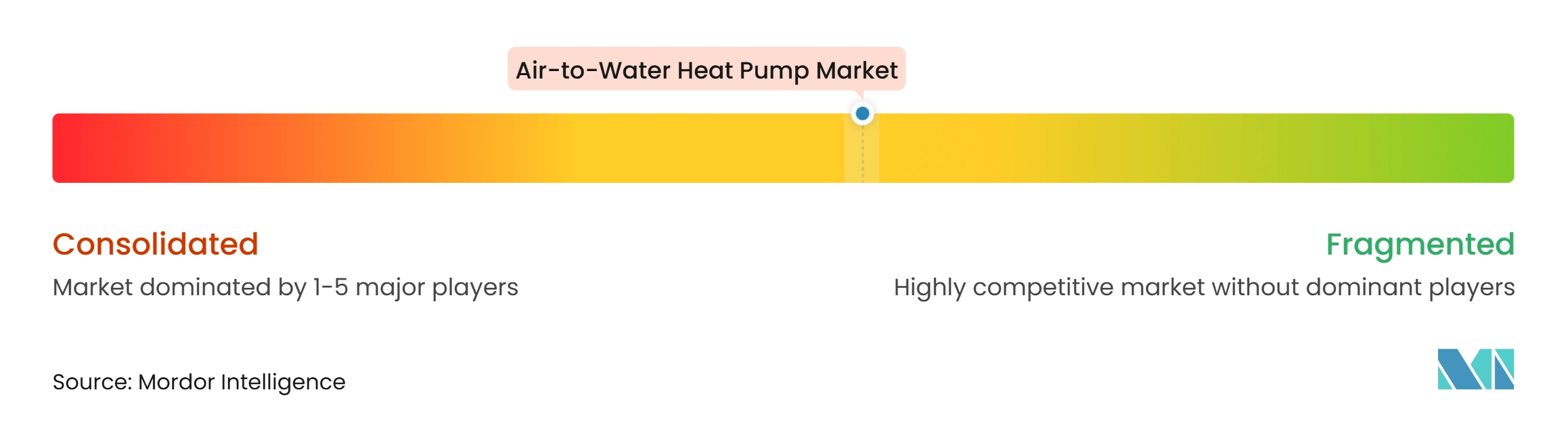
| Market Concentration | Medium |
Major Players *Disclaimer: Major Players sorted in no particular order Image © Mordor Intelligence. Reuse requires attribution under CC BY 4.0. | |
Air-to-Water Heat Pump Market Analysis by Mordor Intelligence
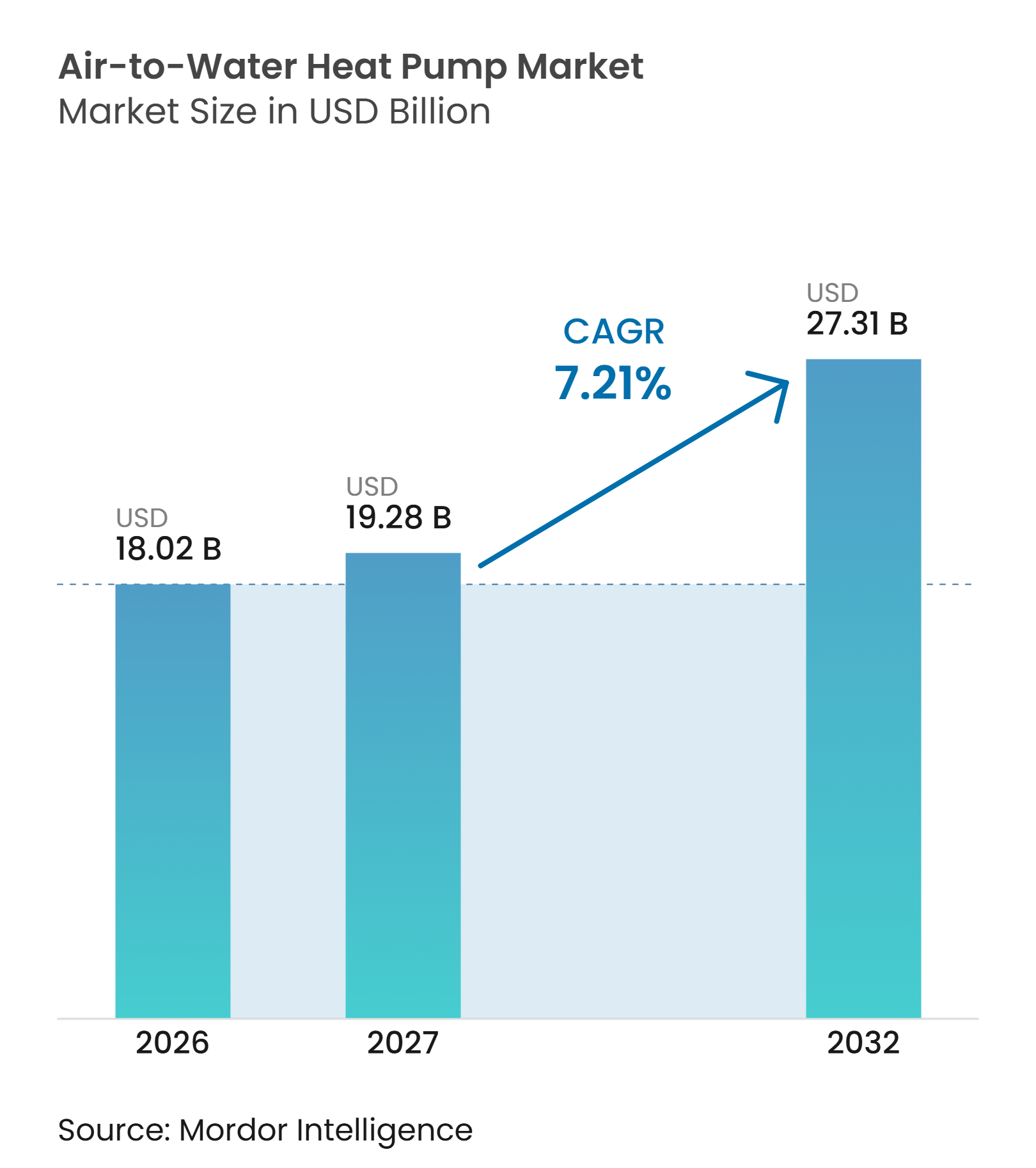
The Air-to-Water Heat Pump Market size is projected to be USD 18.02 billion in 2026, USD 19.28 billion in 2027, and reach USD 27.31 billion by 2032, growing at a CAGR of 7.21% from 2027 to 2032.
The air-to-water heat pump market is supported by the replacement of fossil-fuel heating systems and by building electrification policies in major markets. European policy is increasingly built around durable funding, regulatory requirements, and carbon pricing rather than short-term incentives alone. Product development is moving toward R290 refrigerant systems that can serve existing radiators, commercial buildings, and higher-temperature applications. This shift gives manufacturers opportunities in retrofits, hybrid systems, and district heating projects. Competition is widening as European suppliers invest in local production while Chinese suppliers increase price pressure in smaller capacity classes.
Key Report Takeaways
- By system configuration, monobloc systems held 58.04% of the air-to-water heat pump market share in 2026, while hybrid heat pump systems are projected to expand at a 7.81% CAGR through 2032.
- By capacity, up-to-10 kW units accounted for 52.11% of the market in 2026, while above-20 kW systems are expected to expand at a 7.79% CAGR through 2032.
- By application, space heating and cooling accounted for 61.87% of the air-to-water heat pump market share in 2026, while district heating is projected to expand at an 8.01% CAGR through 2032.
- By end user, residential users held 72.38% of the market in 2026, while industrial users are expected to expand at a 7.98% CAGR through 2032.
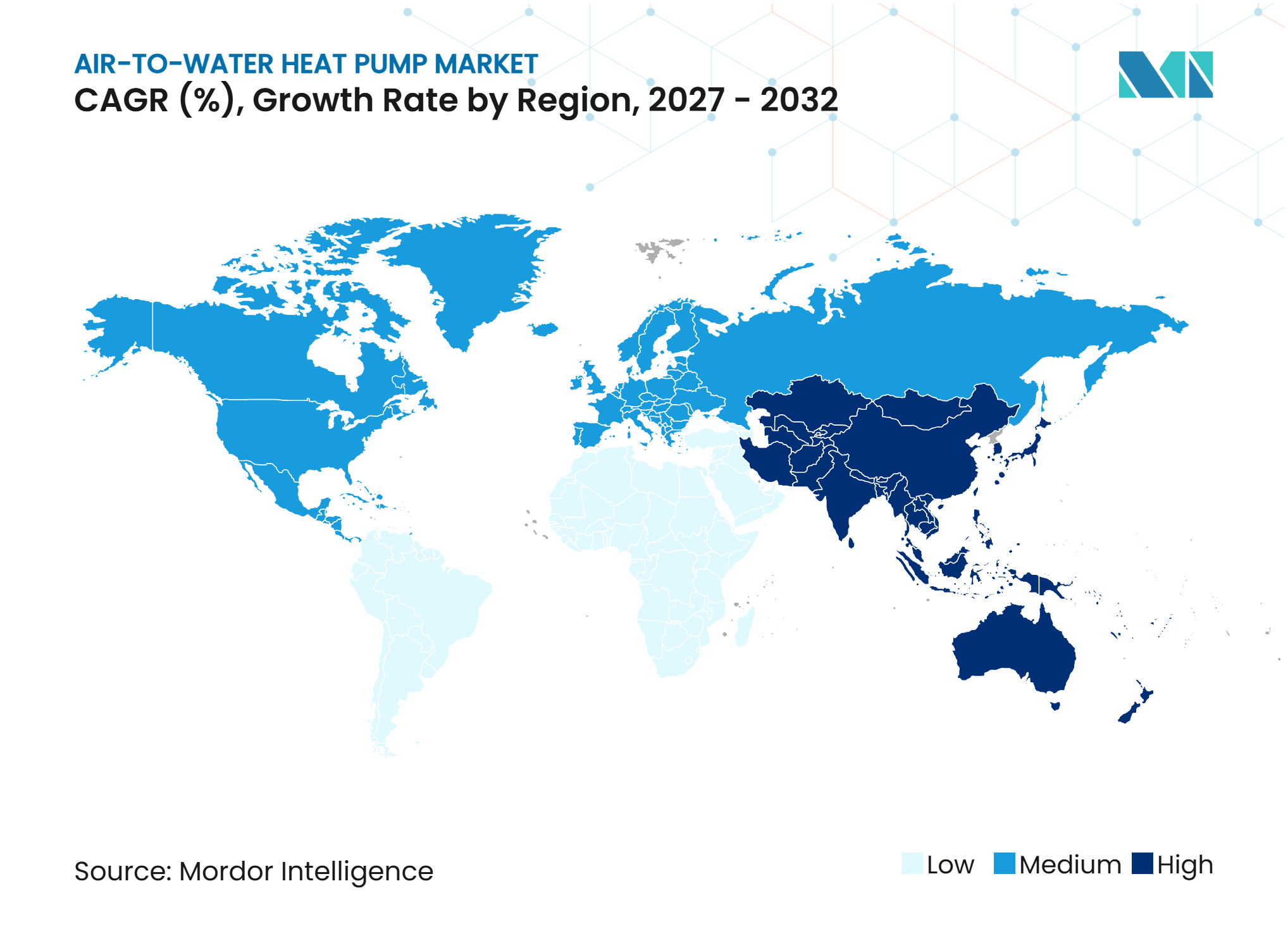
- By geography, Europe held 44.62% of the market in 2026, while Asia-Pacific is projected to expand at an 8.16% CAGR through 2032.
Note: Market numbers in this report are based on Mordor Intelligence's proprietary estimation framework, which combines nine months of actuals with Q4 projections for base year 2026.
Market Trends and Insights
Drivers Impact Analysis of Air-to-Water Heat Pump Market*
| Driver | (~) % Impact on CAGR Forecast | Geographic Relevance | Impact Timeline |
|---|---|---|---|
| Fossil-Fuel Heating Replacement and Building Electrification | +2.5% | Global, strongest in the EU, Japan, China, and North America | Long term (≥ 4 years) |
| Government Incentives and Carbon-Reduction Mandates | +2.0% | EU core, with expansion to South Korea and Australia | Medium term (2-4 years) |
| Hydronic Retrofit Compatibility and Multi-Service Functionality | +0.9% | Central and Northern Europe and Japan | Medium term (2-4 years) |
| Low-GWP Refrigerant Transition and High-Temperature Performance | +0.7% | Global, with the greatest compliance urgency in the EU | Short term (≤ 2 years) |
| Heat-Pump Manufacturing Scale and Component Cost Declines | +0.5% | Global, particularly EU manufacturing hubs and China-based supply chains | Long term (≥ 4 years) |
| Digital Controls, Thermal Storage, and Grid-Interactive Operation | +0.3% | EU, Nordic countries, Japan, and grid-constrained urban markets | Medium term (2-4 years) |
| Source: Mordor Intelligence | |||
Fossil-Fuel Heating Replacement and Building Electrification
The removal of financial incentives for stand-alone fossil-fuel boilers in EU member states from January 2025 supports the shift toward electrified heating. Germany sold 299,000 heat pumps in 2025, a 55% increase from the prior year, and heat pumps captured 48% of the country’s heating system sales. The Building Modernization Act introduced a rising climate-friendly heat requirement for gas boilers installed in existing German buildings after July 2026. A heat pump delivering 30% of a boiler’s output can meet that compliance route under DIN EN 14825, which supports hybrid installations. China also introduced equipment-replacement support and an action plan focused on compressor efficiency and lower-GWP refrigerants in 2025. The different policy approaches widen the air-to-water heat pump market beyond a single national incentive model.
Government Incentives and Carbon-Reduction Mandates
Public funding continues to influence purchase decisions in the air-to-water heat pump market, particularly for household retrofits. Germany’s BEG program approved 307,843 heat pump grants between January and September 2026, representing 92% of heating approvals under the program.[1] France recorded 101,330 air-water heat pump sales in the first half of 2026, a 14.7% increase after two years of demand weakness. The revised MaPrimeRénov’ approach directs the single-measure renovation route primarily toward air-water and geothermal systems. The EU ETS2 mechanism will apply carbon pricing to building fuels from 2027, reducing the cost advantage of gas without relying on annual grant budgets. The Netherlands is also moving toward smart energy management and dynamic-tariff capability as an eligibility condition, which makes digital readiness a product requirement.
Hydronic Retrofit Compatibility and Multi-Service Functionality
Hydronic compatibility helps the air-to-water heat pump market address older building stock across Central and Northern Europe and Japan. These systems can connect to floor heating, lower-temperature radiators, and fan coil units without replacing the full distribution network. Vaillant’s aroTHERM plus delivers a flow temperature of 75°C, allowing its use with higher-temperature heating systems in existing homes. France recorded 101,330 air-water heat pump sales in the first half of 2026, a 14.7% increase after two years of demand weakness. The revised MaPrimeRénov’ approach directs the single-measure renovation route primarily toward air-water and geothermal systems. The EU ETS2 mechanism will apply carbon pricing to building fuels from 2027, reducing the cost advantage of gas without relying on annual grant budgets. The Netherlands is also moving toward smart energy management and dynamic-tariff capability as an eligibility condition, which makes digital readiness a product requirement.
Hydronic Retrofit Compatibility and Multi-Service Functionality
Hydronic compatibility helps the air-to-water heat pump market address older building stock across Central and Northern Europe and Japan. These systems can connect to floor heating, lower-temperature radiators, and fan coil units without replacing the full distribution network. Vaillant’s aroTHERM plus delivers a flow temperature of 75°C, allowing its use with higher-temperature heating systems in existing homes. MHI Thermal Systems also launched R290 models designed to provide 75°C flow temperatures at outdoor conditions as low as -25°C. Combined space heating, domestic hot water, and cooling can reduce equipment duplication and simplify installation planning. Japan’s heat pump technology center identifies multi-service applications as central to its high-case path for carbon neutrality.
Low-GWP Refrigerant Transition and High-Temperature Performance
R290 systems are becoming a key competitive focus as the EU tightens restrictions on fluorinated refrigerants. Regulation EU 2024/573 sets a phased transition away from high-GWP refrigerants in specified product categories. Panasonic is expanding its Pilsen facility and aims to reach capacity for 1.4 million R290 units annually by 2030. Its AQUA-G EVO range covers 60 kW to 110 kW commercial applications and can provide 75°C hot water at -2°C ambient temperature. Carrier launched the 61AQ R290 high-temperature heat pump in 2025, with 40 kW to 140 kW monobloc models and modular arrangements that reach 560 kW. High-temperature operation expands the air-to-water heat pump market into buildings and processes that previously depended on combustion equipment.
Restraints Impact Analysis of Air-to-Water Heat Pump Market*
| Restraint | (~) % Impact on CAGR Forecast | Geographic Relevance | Impact Timeline |
|---|---|---|---|
| High Upfront Equipment, Installation, and Electrical-Upgrade Costs | -1.8% | Global, with the highest exposure in price-sensitive residential retrofits and rural North America | Long term (≥ 4 years) |
| Shortage of Hydronic Design, Refrigeration, and Commissioning Skills | -1.4% | EU, North America, and Australia, with acute gaps in the United Kingdom, Germany, and France | Medium term (2-4 years) |
| Electricity-to-Gas Price Ratios and Subsidy-Policy Volatility | -0.8% | EU-wide, particularly where electricity costs exceed three times gas costs | Medium term (2-4 years) |
| Grid Connection Constraints and Cold-Weather Peak-Load Risk | -0.4% | Northern Europe, mountainous Asia-Pacific, and rural North America | Long term (≥ 4 years) |
| Source: Mordor Intelligence | |||
High Upfront Equipment, Installation, and Electrical-Upgrade Costs
Upfront cost remains a central obstacle for residential buyers in the air-to-water heat pump market. Equipment, installation, electrical-panel work, and radiator changes can make a retrofit materially more expensive than a boiler replacement. The European Commission’s Electrification Action Plan promotes social leasing models that spread the cost over monthly payments. It also encourages lower VAT treatment for heat pumps than for gas boilers, while noting that only Belgium, France, Ireland, and the United Kingdom applied reduced VAT at the time of publication. German sector analysis indicates that a move from percentage-based support to flat-rate subsidies could reduce installations by up to 40%. Leasing and heat-pump-as-a-service offerings may reduce the initial barrier, but their availability remains uneven.
Shortage of Hydronic Design, Refrigeration, and Commissioning Skills
Installer availability limits deployment even when products and funding are available. The European Commission estimates that the EU needs at least 750,000 additional installers to meet its 2030 climate targets, and at least 50% of the existing workforce requires retraining. Baxi’s 2026 survey found that only 5% of UK heating installers were actively fitting air-source heat pumps, while inadequate customer demand was the most frequently cited barrier. Delayed projects and inconsistent system design can weaken consumer confidence and constrain repeat demand. The SKILLSAFE EU guidelines give installers a common framework for the safe handling of flammable refrigerants such as R290.[2] Workforce development is therefore necessary for manufacturers seeking to expand natural-refrigerant product sales.
*Our forecasts treat driver/restraint impacts as directional, not additive. The impact forecasts reflect baseline growth, mix effects, and variable interactions.
Air-to-Water Heat Pump Market Segment Analysis
By System Configuration:
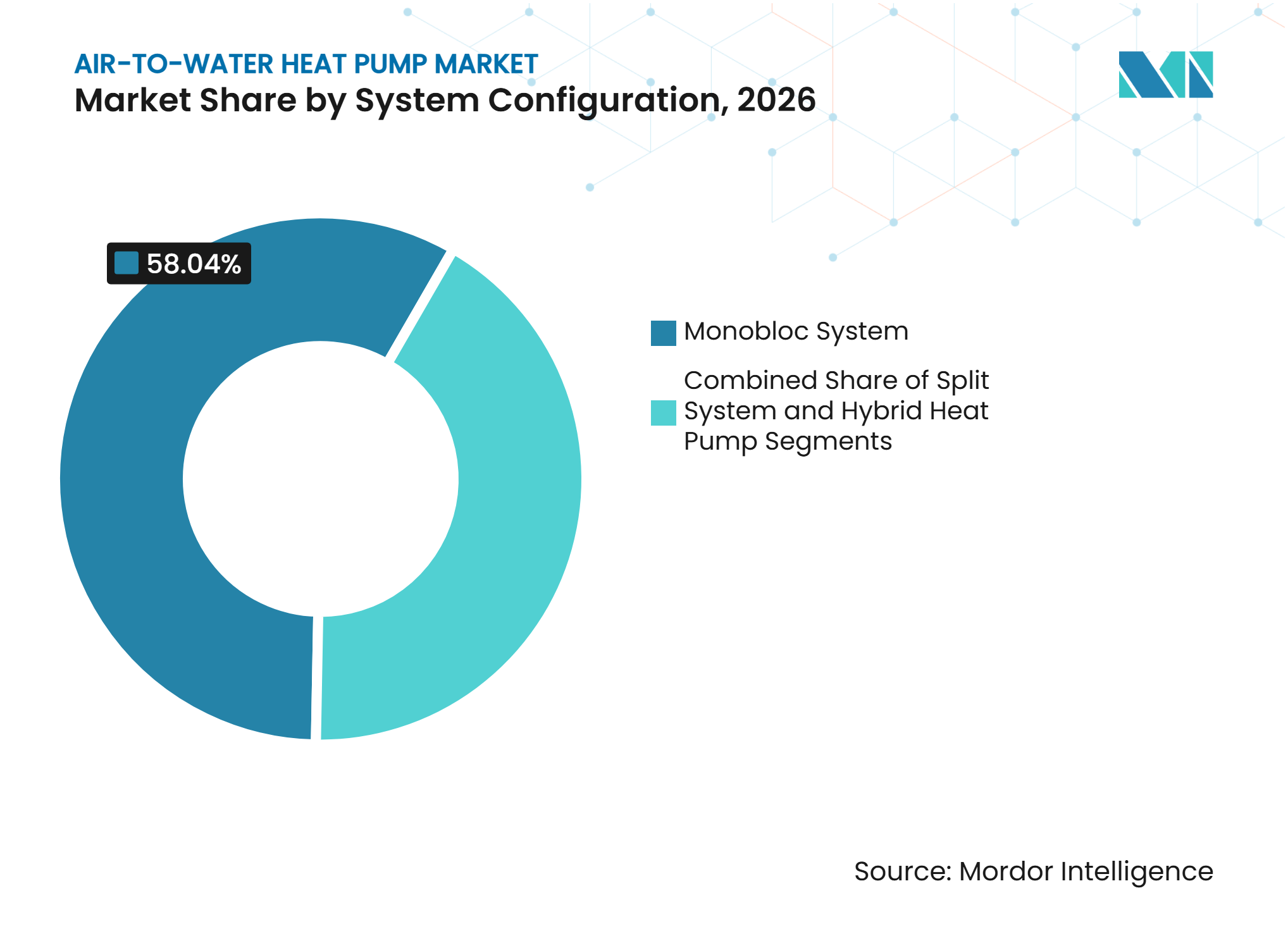
Monobloc Units Lead, Hybrid Systems AccelerateMonobloc systems held 58.04% of the air-to-water heat pump market share in 2026. Their sealed refrigerant circuits require water-side connections at the building, which can shorten installation work and reduce the refrigeration skills required on site. MHI Thermal Systems introduced its Hydrolution EZY monobloc range with R290 refrigerant in 2025. The models provide 75°C water flow under outdoor conditions from -25°C to 43°C. Viessmann’s Vitocal 200-A ie integrates important hydraulic components in the outdoor unit, which further reduces installation effort.
Hybrid heat pumps are projected to expand at a 7.81% CAGR through 2032. Germany’s Building Modernisation Act establishes a compliance route for gas boiler and heat pump combinations under DIN EN 14825. This allows owners to add a heat pump without immediately removing a functioning boiler. The arrangement reduces the perceived risk of a full conversion for households with older heating systems. It also lets property owners spread their capital spending over more than 1 investment cycle. These conditions give hybrids a more policy-supported role in the air-to-water heat pump market than a simple equipment replacement alone.



By Capacity:
Small Residential Units Dominate, Larger Systems Gain GroundUp-to-10 kW equipment accounted for 52.11% of the air-to-water heat pump market size in 2026. This position reflects the large residential base in Europe and Japan’s established Eco Cute water-heating category. Cumulative Japanese heat pump water-heater shipments exceeded 10 million units by March 2025. The 10-20 kW range serves smaller commercial sites and multi-family buildings. Qvantum’s 50 kW QA50, launched for United Kingdom residential and light-commercial developments, shows the demand emerging above traditional household capacity levels.
Above-20 kW systems are expected to expand at a 7.79% CAGR through 2032. District heating, industrial processes, and large multi-family buildings are the main sources of demand. Panasonic’s AQUA-G EVO can be connected in cascades reaching 880 kW. Carrier’s modular AquaSnap platform reaches 560 kW and provides water temperatures up to 75°C. Larger systems also support managed-service structures that shift equipment spending from owners to service providers. This financing model can extend the air-to-water heat pump market to institutions and commercial buyers that prefer operating payments.
By Application:
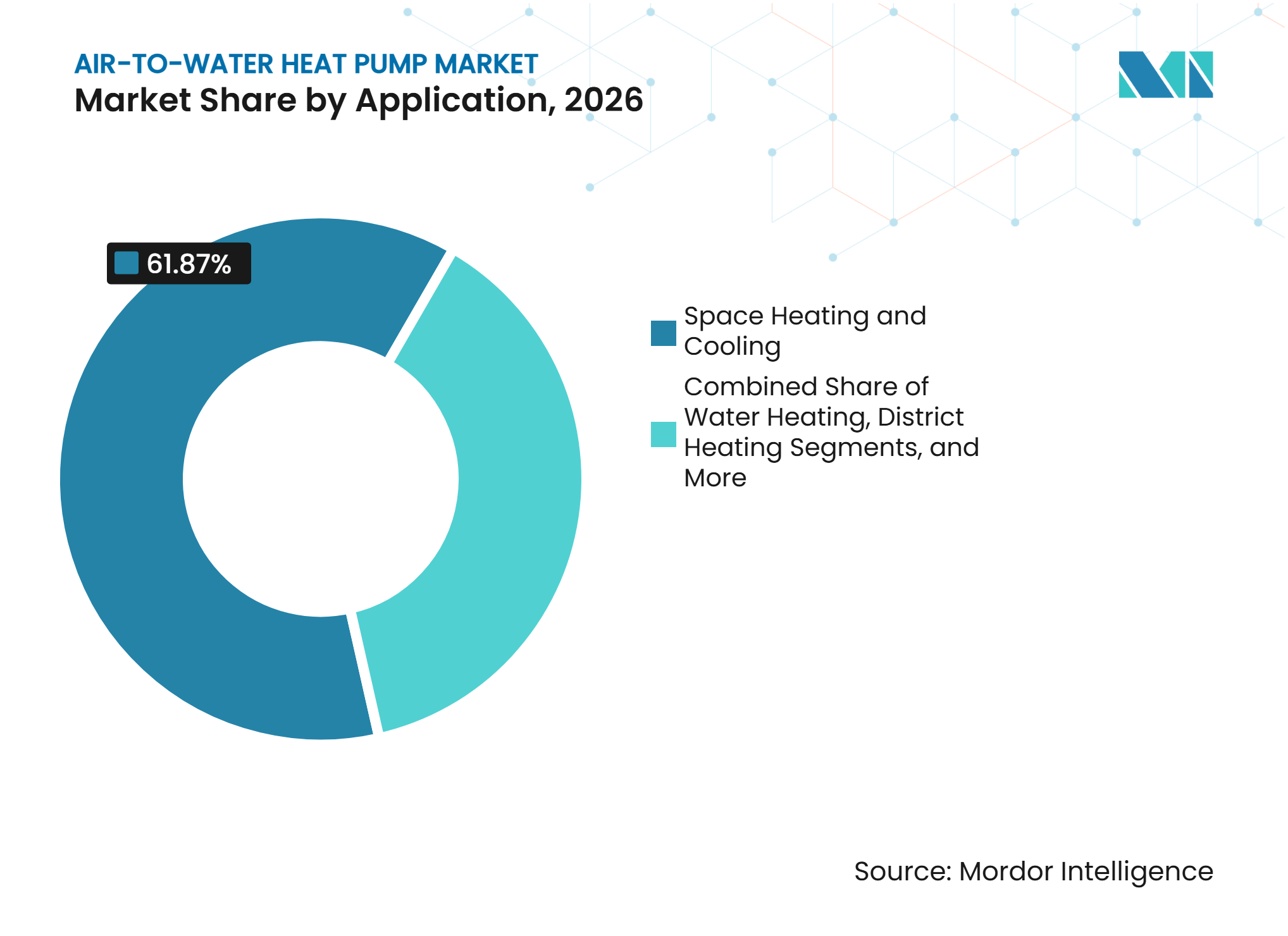
Space Heating Holds Volume, District Heating Moves FasterSpace heating and cooling held 61.87% of the air-to-water heat pump market share in 2026. Boiler replacement remains the principal use case in residential and commercial hydronic buildings. Water heating remains important in Japan, where Eco Cute systems serve domestic hot water and supplementary space conditioning. Japan’s 7th Basic Energy Plan identifies heat pump deployment across residential, commercial, and industrial uses. Process heating is also becoming more viable as R290 systems reach the water temperatures needed by food processing, pharmaceutical, and industrial washing operations.
District heating is projected to expand at an 8.01% CAGR through 2032. Helen began operating its 14 MW Salmisaari plant in Helsinki in December 2025, with annual renewable district heat production of 60 GWh. Fortum started heat production at 2 large Finnish sites in May 2026, using 40 air-to-water units and 72 water-to-water units for up to 180 MW of district heating. Planned data center waste-heat integration could provide 40% of the area’s 2 TWh annual district-heating demand. Such projects connect digital infrastructure with low-carbon urban heat systems. The scale of these projects can alter procurement patterns in the air-to-water heat pump market.

By End User:
Residential Demand Anchors Volume, Industrial Use ExpandsResidential users held 72.38% of the air-to-water heat pump market size in 2026. Household retrofit incentives and Japan’s replacement cycle underpin this position. Heat pumps became Germany’s best-selling heating system in 2025, with 299,000 units sold and a 48% share of the country’s heating-system sales. Commercial users include retail, hospitality, and office buildings that need heating, cooling, and domestic hot water. France’s revised renovation support gives air-water systems a stronger position in qualifying renovations.
Industrial users are expected to expand at a 7.98% CAGR through 2032. R290 systems can deliver 75°C to 80°C supply water, which makes them more suitable for process heat in food, pharmaceutical, and chemical facilities. Institutions such as hospitals, schools, and public buildings also benefit from green public procurement and long-term public financing. Japan’s fiscal 2025 supplementary budget allocated JPY 57 billion (USD 380 million) for high-efficiency equipment, including industrial heat pumps.[3] Industrial deployment is less dependent on household subsidy cycles because energy costs, process needs, and decarbonization plans influence the decision. This broadens the air-to-water heat pump market beyond its residential base.
Geography Analysis
Europe: Policy and Hydronic Infrastructure Sustain Leadership
Europe held 44.62% of the air-to-water heat pump market share in 2026. Its hydronic heating base and fossil-fuel phase-out rules support replacement demand, while Germany issued 307,843 heat pump approvals from January to September 2026. France recorded a 14.7% increase in air-water heat pump sales to 101,330 units in the first half of 2026. Austria provides up to EUR 7,500 (USD 8,400) for qualifying 2026 installations, subject to a GWP limit of 150 and EHPA quality-seal compliance. These rules are moving demand toward natural-refrigerant products and documented performance standards, although electricity and gas price ratios still vary across the region.
Asia-Pacific: Clean Heating and Manufacturing Support Faster Expansion
Asia-Pacific is projected to expand at an 8.16% CAGR through 2032. China’s clean-heating programs, Japan’s replacement cycle, and demand in South Korea, India, and ASEAN provide a wider adoption base. Japan’s 7th Basic Energy Plan and the GX2040 Vision include heat pump promotion, while the country’s high-case assessment projects 63.78 million tonnes of greenhouse gas reductions from heat pump deployment by 2050. India’s Bureau of Energy Efficiency has introduced star-rating frameworks that give hotels, hospitals, and large residential projects a clearer procurement reference. Cold-climate manufacturing capability in South Korea adds another supply base for the Asia-Pacific air-to-water heat pump market.
Other Regions: Targeted Commercial Opportunities Shape Demand
North America is developing through targeted launches and changing public support, including Viessmann’s January 2025 Vitocal 100-AW launch and Lochinvar’s May 2025 Centrus AWHP launch.[4] NIBE reported weaker United States demand after the removal of residential tax support, although the effect was less severe than expected. South America has early interest in water heating and commercial HVAC combinations, but hydronic infrastructure remains limited. Turkey, Saudi Arabia, the UAE, South Africa, and Nigeria offer selective commercial, cold-storage, food-processing, and hospitality applications, while Turkey’s alignment with EU F-Gas timelines supports product consistency with European platforms.
Competitive Landscape
Market Concentration
Daikin Industries, Mitsubishi Electric, and Panasonic lead European residential shipment volumes, while NIBE Industrier AB, Vaillant, and STIEBEL ELTRON compete with European-made R290 products, installer networks, and warranty support. NIBE reported SEK 40,841 million (USD 4,160.40 million) in consolidated net sales for 2025 and a 13% operating margin in its Climate Solutions business area. Daikin reported an emerging recovery in several European countries, though Chinese suppliers continued to pressure prices below 15 kW. Product performance, installation support, and price remain key competitive factors in the air-to-water heat pump market. Chinese suppliers, including Guangdong PHNIX and SPRSUN, are also expanding European channels through distributors and local assembly strategies.
European R290 manufacturing investment is a central competitive response. Panasonic has committed EUR 320 million (USD 358 million) to Pilsen and plans annual capacity for 1.4 million R290 units by 2030, while Atlantic opened a EUR 110 million (USD 123 million) facility with capacity for 150,000 units in October 2026. These investments place production close to European demand centers and respond to refrigerant requirements. Panasonic’s AQUA-G EVO uses compressor injection technology that limits heating-capacity loss at -10°C ambient to 15%, compared with 38% for conventional systems. The air-to-water heat pump market increasingly favors suppliers that combine compliant refrigerants, cold-weather performance, and regional production.
District-network integration remains less developed. Qvantum launched the QA50 for ambient-loop multi-residential and light-commercial projects in October 2026. Projects by Helen and Fortum show how thermal storage and waste heat can support urban systems. Suppliers with credible references in fifth-generation ambient-loop systems may access larger, longer-term projects, but the air-to-water heat pump market remains moderately fragmented, and the supplied evidence does not quantify combined top-player share.
Air-to-Water Heat Pump Industry Leaders
-
Daikin Industries, Ltd.
-
Mitsubishi Electric Corporation
-
Panasonic Corporation
-
Vaillant GmbH
-
Thermia AB
- *Disclaimer: Major Players sorted in no particular order
Air-to-Water Heat Pump Market Companies Covered in this Report
- Daikin Industries, Ltd.
- Mitsubishi Electric Corporation
- Panasonic Corporation
- NIBE Industrier AB
- Vaillant GmbH
- STIEBEL ELTRON GmbH & Co. KG
- OCHSNER Wärmepumpen GmbH
- Hoval Aktiengesellschaft
- ait-deutschland GmbH
- BDR Thermea Group
- Glen Dimplex Group
- Thermia AB
- Kensa Heat Pumps Ltd.
- Clade Engineering Systems Ltd.
- Chiltrix, Inc.
- Bosch Home Comfort (Bosch Thermotechnology)
- Sanden Holdings Corporation
- Zhejiang AMA & Hien Technology Co., Ltd.
- Guangdong PHNIX Eco-energy Solution Co., Ltd.
- Guangzhou SPRSUN New Energy Technology Development Co., Ltd.
- Power World Machinery Equipment Co., Ltd.
- Templari S.r.l.
- PZP HEATING a.s.
Recent Industry Developments in Air-to-Water Heat Pump Market
- November 2026: HeatGrid Ireland received planning permission for Ireland's first large-scale district heating system in Galway, to be powered by air-to-water heat pumps with 890,000-liter storage tanks, serving hospitals, factories, hotels, and university campuses across 7.8 km of insulated underground piping, with operational commissioning targeted for 2029.
- October 2026: Atlantic opened a new 39,000 sq. m heat pump manufacturing facility in Châlon-sur-Saône, France, backed by a EUR 110 million (USD 123 million) investment providing capacity for 150,000 air-to-water units per year and employing 300 people, strengthening European supply chains.
- October 2026: Qvantum launched the QA50, a 50 kW air-to-water heat pump for multi-residential and light commercial United Kingdom developments, designed to pair with the Qvantum QG water-to-water apartment unit to deliver ambient-loop heating, hot water, and cooling for entire residential schemes.
- July 2026: Germany's Building Modernisation Act took effect on July 29, 2026, rescinding the 65% renewable energy mandate but introducing a rising green-heat share requirement for newly installed gas boilers, with a hybrid heat pump configuration providing full legal compliance under DIN EN 14825, reorienting the German retrofit market toward hybrid configurations.
Global Air-to-Water Heat Pump Market Report Scope
An air-to-water heat pump refers to an electrically driven thermal energy device that extracts low-grade heat from ambient outdoor air and transfers it into a closed-loop water (hydronic) circuit to provide space heating, space cooling, and domestic hot water. It encompasses the commercialization of monobloc and split-system heat pumps designed to supply hydronic space heating, space cooling, and domestic hot water across residential, commercial, and industrial buildings.
The Air-To-Water Heat Pump Market Report is segmented by System Configuration (Split System, Monobloc System, and Hybrid Heat Pump), Capacity (Up to 10 kW, 10-20 kW, and Above 20 kW), Application (Space Heating and Cooling, Water Heating, District Heating, and Process and Industrial Heating), End User (Residential, Commercial, Institutional, and Industrial), and Geography (North America, South America, Europe, Asia-Pacific, Middle East, and Africa). The Market Forecasts are Provided in Terms of Value (USD).
Segmentation Overview
| Split System |
| Monobloc System |
| Hybrid Heat Pump |
| Up to 10 kW |
| 10-20 kW |
| Above 20 kW |
| Space Heating and Cooling |
| Water Heating |
| District Heatging |
| Process and Industrial Heating |
| Residential |
| Commercial |
| Institutional |
| Industrial |
| North America | United States |
| Canada | |
| Mexico | |
| South America | Brazil |
| Argentina | |
| Rest of South America | |
| Europe | Germany |
| France | |
| Italy | |
| United Kingdom | |
| Russia | |
| Rest of Europe | |
| Asia-Pacific | China |
| Japan | |
| South Korea | |
| India | |
| ASEAN | |
| Rest of Asia-Pacific | |
| Middle East | Saudi Arabia |
| United Arab Emirates | |
| Turkey | |
| Rest of Middle East | |
| Africa | South Africa |
| Nigeria | |
| Rest of Africa |
| By System Configuration | Split System | |
| Monobloc System | ||
| Hybrid Heat Pump | ||
| By Capacity | Up to 10 kW | |
| 10-20 kW | ||
| Above 20 kW | ||
| By Application | Space Heating and Cooling | |
| Water Heating | ||
| District Heatging | ||
| Process and Industrial Heating | ||
| By End User | Residential | |
| Commercial | ||
| Institutional | ||
| Industrial | ||
| By Geography | North America | United States |
| Canada | ||
| Mexico | ||
| South America | Brazil | |
| Argentina | ||
| Rest of South America | ||
| Europe | Germany | |
| France | ||
| Italy | ||
| United Kingdom | ||
| Russia | ||
| Rest of Europe | ||
| Asia-Pacific | China | |
| Japan | ||
| South Korea | ||
| India | ||
| ASEAN | ||
| Rest of Asia-Pacific | ||
| Middle East | Saudi Arabia | |
| United Arab Emirates | ||
| Turkey | ||
| Rest of Middle East | ||
| Africa | South Africa | |
| Nigeria | ||
| Rest of Africa | ||
Key Questions Answered in the Report
What is the size of the air-to-water heat pump market?
The market is projected to increase from USD 18.02 billion in 2026 and USD 19.28 billion in 2027 to USD 27.31 billion by 2032, at a 7.21% CAGR.
What is driving demand for air-to-water heat pumps?
Fossil-fuel replacement rules, public incentives, hydronic retrofit compatibility, and R290 product development are supporting adoption.
Which system configuration leads demand?
Monobloc systems held 58.04% share in 2026 because their sealed refrigerant circuits can simplify installation.
Which application is expanding fastest?
District heating is projected to expand at an 8.01% CAGR through 2032, supported by large urban projects in Finland.
Which region is expected to expand fastest?
Asia-Pacific is projected to expand at an 8.16% CAGR through 2032, supported by clean-heating programs and regional manufacturing.
What is the principal barrier to adoption?
Upfront equipment, installation, and electrical-upgrade costs remain a significant barrier, alongside a shortage of trained installers.