
AI Training Data Lineage Software Market Size and Share
Market Overview
| Study Period | 2020 - 2031 |
|---|---|
| Market Size (2026) | USD 3.48 Billion |
| Market Size (2031) | USD 10.84 Billion |
| Growth Rate (2026 - 2031) | 25.51 % |
| Fastest Growing Market | Asia-Pacific |
| Largest Market | North America |
| Market Concentration | Low |
Major Players *Disclaimer: Major Players sorted in no particular order Image © Mordor Intelligence. Reuse requires attribution under CC BY 4.0. | |
AI Training Data Lineage Software Market Analysis by Mordor Intelligence
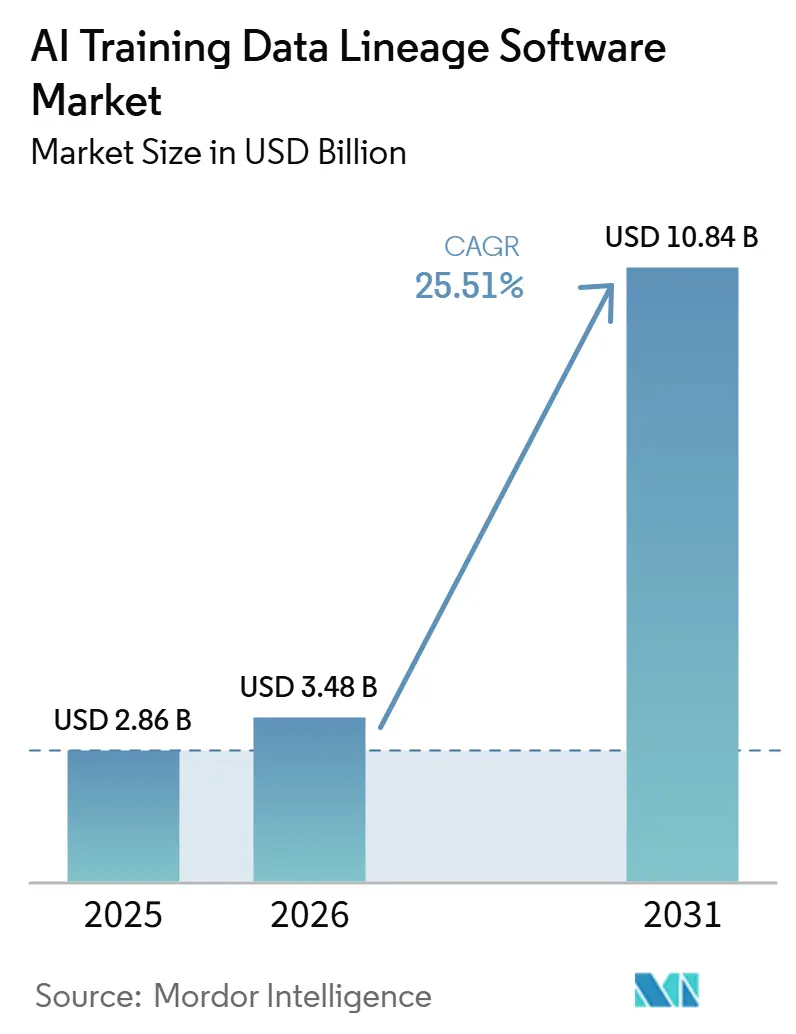
The AI Training Data Lineage Software Market size is projected to expand from USD 2.86 billion in 2025, USD 3.48 billion in 2026 to USD 10.84 billion by 2031, registering a CAGR of 25.51% between 2026 and 2031. Growth reflects the need for organizations to document how training data was collected, changed, labeled, and used in AI systems. Compliance requirements are making traceable records a procurement priority, especially for systems used in regulated settings. Cloud adoption supports broader use of lineage tools, while hybrid environments remain important where sensitive data cannot leave local systems. Vendors are responding with automated metadata capture, broader pipeline coverage, and features that support audit work. The field remains fragmented because buyers range from large governance teams to smaller AI groups with focused technical needs.
Key Report Takeaways
- By component, software held 74.18% of the AI Training Data Lineage Software Market share in 2025, while services are projected to expand at a 28.41% CAGR through 2031.
- By deployment model, cloud accounted for 71.24% of revenue in 2025, while hybrid deployment is projected to expand at a 27.69% CAGR through 2031.
- By enterprise size, large enterprises accounted for 64.83% of revenue in the AI Training Data Lineage Software Market in 2025, while SMEs are projected to expand at a 29.24% CAGR through 2031.
- By application, data governance and metadata management accounted for 26.74% of revenue in 2025, while data quality and data drift analysis are projected to expand at a 30.18% CAGR through 2031.
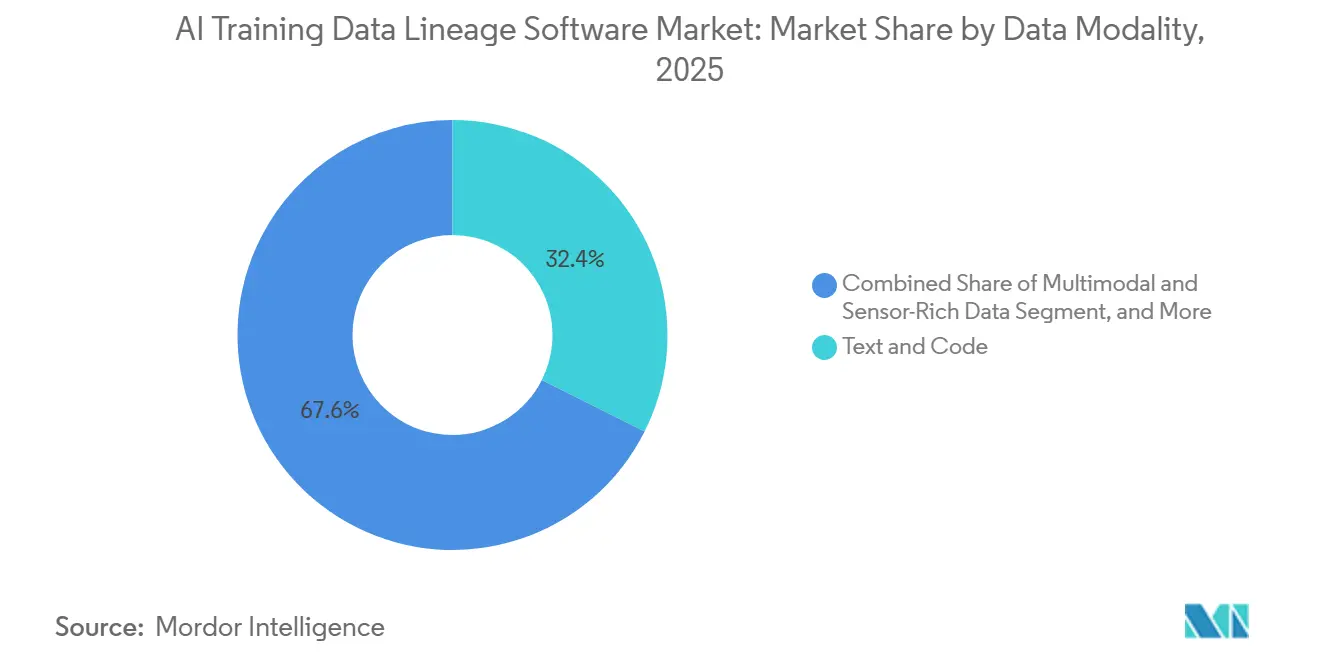
- By data modality, text and code accounted for 32.41% of revenue in the AI Training Data Lineage Software Market 2025, while multimodal and sensor-rich data is projected to expand at a 31.82% CAGR through 2031.
- By end user, IT and telecommunications accounted for 24.36% of revenue in 2025, while healthcare and life sciences are projected to expand at a 28.93% CAGR through 2031.
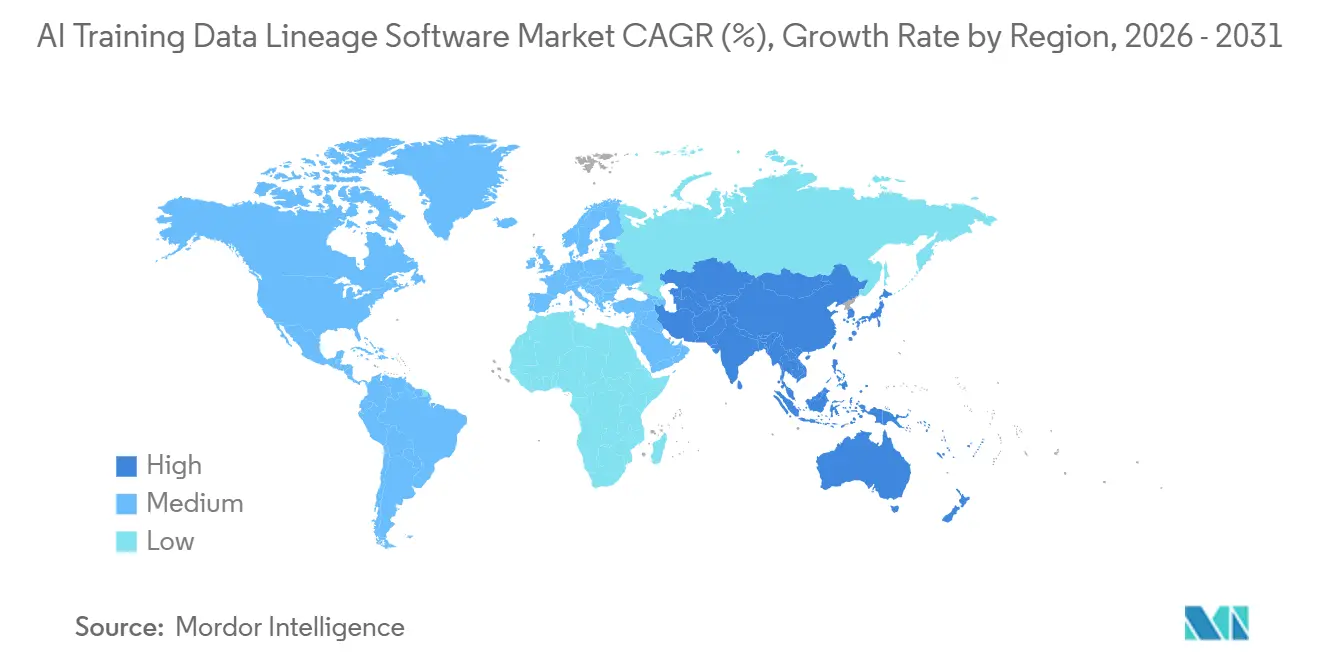
- By geography, North America accounted for 34.62% of revenue in the AI Training Data Lineage Software Market 2025, while Asia-Pacific is projected to expand at a 29.74% CAGR through 2031.
Note: Market size and forecast figures in this report are generated using Mordor Intelligence’s proprietary estimation framework, updated with the latest available data and insights as of January 2026.
Global AI Training Data Lineage Software Market Trends and Insights
Drivers Impact Analysis*
| Driver | (~) % Impact on CAGR Forecast | Geographic Relevance | Impact Timeline |
|---|---|---|---|
| Rising Regulatory Demand for Traceable AI Training Data | +4.2% | Global, with concentrated compliance urgency in the EU, North America, and core Asia-Pacific markets | Short term (≤ 2 years) |
| Growth of Multimodal and Agentic AI Pipelines | +3.8% | Global, strongest in North America and East Asia | Medium term (2-4 years) |
| Expansion of Cloud and Hybrid AI Infrastructure | +3.2% | Global, with expansion into Middle East and Africa and South America | Medium term (2-4 years) |
| Data Quality as a Model Performance Differentiator | +2.6% | Global, with high adoption in North America and Western Europe | Medium term (2-4 years) |
| Synthetic and Simulation Data Provenance | +1.9% | North America and the EU, with emerging use in South Korea and Japan | Long term (≥ 4 years) |
| Lineage-Aware Data Contracts for Agentic AI | +1.4% | North America, Western Europe, and Singapore | Long term (≥ 4 years) |
| Source: Mordor Intelligence | |||
Rising Regulatory Demand for Traceable AI Training Data
The EU AI Act has shifted the provenance of training data from a recommended practice to a compliance obligation for high-risk systems. Article 10 requires governance measures covering data origin, collection methods, processing, labeling, and bias examination for training, validation, and testing datasets.[1]European Union, “Regulation (EU) 2024/1689 of the European Parliament and of the Council,” EUR-Lex, eur-lex.europa.eu. EUR-LEX Article 53 also requires general-purpose AI providers to prepare training content documentation under an EU AI Office template. These requirements encourage buyers to capture provenance during development instead of trying to assemble records during an audit. The same need extends beyond Europe, as U.S. state rules and sector-specific obligations increase attention to transparency in training data. The AI Training Data Lineage Software Market therefore benefits when compliance and technical teams need a single, usable record of data handling.
Growth of Multimodal and Agentic AI Pipelines
Robotics, autonomous vehicles, and industrial automation generate sensor data that is more complex than conventional tabular data. These workflows combine video, LiDAR, telemetry, and other inputs that must remain connected to their transformations and labels. Encord reported that data volumes on its multimodal platform increased from 1 petabyte to 5 petabytes over 1 year, with physical AI customer revenue increasing 10-fold. Agentic systems pose a related challenge because autonomous agents can read, write, and modify data without human intervention at each step. LakeFS introduced its Agentic AI offering in June 2026 with isolated data branches, controlled merges, and records that link agent identity and execution details to data actions. This raises demand for tools that record work at the level of each agent run as well as at the dataset level.
Expansion of Cloud and Hybrid AI Infrastructure
Cloud systems support large AI training workloads and generate data events that lineage tools can capture. Many organizations still operate mixed environments where data starts on local infrastructure, moves through cloud pipelines, and is checked near the point of use. This arrangement is common in manufacturing, defense, healthcare, and other settings with security or location limits. Collibra added OpenLineage support for AWS Glue and Apache Airflow in June 2025, extending tracking across commonly used orchestration environments. The AI Training Data Lineage Software Market can gain from architectures that connect cloud, hybrid, and local systems without forcing buyers to rebuild their records. Open standards are also useful because enterprises often have more than 1 cloud provider and several legacy tools.
Data Quality as a Model Performance Differentiator
Organizations are treating data quality as an ongoing part of AI operations rather than a final check before deployment. The 2026 State of Data Integrity and AI Readiness report found that 94% of organizations had initiated programs to improve data quality for AI training or inference, with 55% actively carrying them out.[2]Drexel University LeBow College of Business and Precisely, “2026 State of Data Integrity and AI Readiness,” Drexel University, lebow.drexel.edu. The same report found that 51% of data and analytics leaders named data quality as their leading data integrity priority for 2026. Buyers increasingly need to identify which transformation or dataset version introduced a change in model results. Lineage linked to quality measurements can help teams find drift before it affects a production system. This shifts product expectations from static catalog records toward records that connect versions, checks, and model outcomes.
Restraints Impact Analysis*
| Restraint | (~) % Impact on CAGR Forecast | Geographic Relevance | Impact Timeline |
|---|---|---|---|
| High Integration Complexity Across Fragmented Toolchains | -2.8% | Global, most acute in North America and Western Europe | Medium term (2-4 years) |
| Privacy, Sovereignty, and Consent Constraints | -2.3% | The EU, core Asia-Pacific markets, and North America | Medium term (2-4 years) |
| Shortage of Data Governance and MLOps Skills | -1.8% | Global, most severe in South and Southeast Asia and emerging Asia-Pacific economies | Long term (≥ 4 years) |
| Provenance Gaps in Synthetic and Web-Sourced Data | -1.4% | Global, with heightened legal risk in the EU and the U.S. | Long term (≥ 4 years) |
| Source: Mordor Intelligence | |||
High Integration Complexity Across Fragmented Toolchains
AI training environments often include data lakes, orchestration tools, feature stores, experiment tracking software, and model registries. Connecting these systems into a single, traceable record can require custom work, especially when firms use older or specialized applications. The 2025 ISG study reported that 38% of enterprises believed the cost of harmonizing data management outweighed the likely benefit. The study also found that 43% had created a consistent data structure across their organizations. Existing deployments can require additional work when vendors retire older collectors or change how a platform connects to customer systems. Collibra stated that its legacy CLI lineage harvester would reach end of life on July 31, 2026, requiring self-hosted customers to move to its Edge-based architecture.
Privacy, Sovereignty, and Consent Constraints
Data residency, consent terms, and sector-specific privacy obligations can prevent a single global record from being managed in one location. These limits matter when training data crosses national borders or includes health, financial, or personal information. The U.S. Copyright Office stated in its 2025 report that the legal position of generative AI training can depend on the source material and the uses made of it.[3]U.S. Copyright Office, “Copyright and Artificial Intelligence Part 3: Generative AI Training,” U.S. Copyright Office, copyright.gov. Synthetic datasets can add another layer, as their provenance may include the sources used to train the model that generated them. The AI Training Data Lineage Software Market must therefore address both technical traceability and the access rules that determine who can view sensitive records. Organizations also need practitioners who can translate privacy obligations into workable data controls.
*Our forecasts treat driver/restraint impacts as directional, not additive. The impact forecasts reflect baseline growth, mix effects, and variable interactions.
Segment Analysis
By Component: Software Holds the Largest Position While Services Expand Quickly
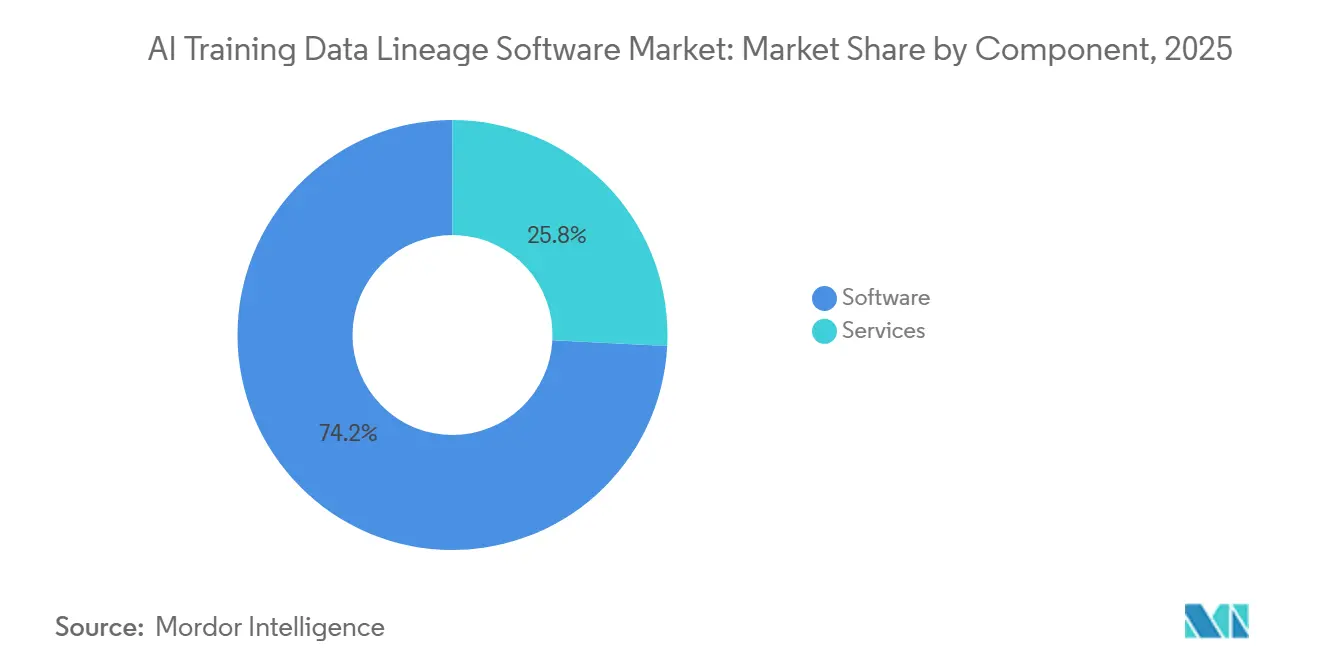
Software held 74.18% of the AI Training Data Lineage Software Market share in 2025, making the AI Training Data Lineage Software Market primarily platform-led at this stage. Buyers favor platforms that bring lineage, metadata management, audit records, and compliance functions into existing AI development environments. The category includes provenance tools, catalog products, pipeline monitoring systems, and governance applications. Organizations increasingly prefer fewer connections between separate systems when they need traceability across the full lifecycle. This preference supports platforms that can connect technical metadata with policy information. It also reflects the need to preserve the path from raw material through preparation, labeling, testing, approval, and later review without moving records between separate applications.
Services are projected to grow at a 28.41% CAGR from 2026 to 2031. Implementation work remains necessary because enterprise environments contain custom SQL, proprietary data processes, and varied access rules. Service providers help configure connections, map existing records, and support operational adoption across business and technical teams. Collibra's OpenLineage support for AWS Glue and Apache Airflow reduced connector work by enabling open integration.[4]Collibra, “End-to-End Data Visibility for Collibra Platform Self-Hosted Customers with Collibra Data Lineage,” Collibra, collibra.com. Even so, tailored implementation work is likely to remain important where buyers need coverage across multiple clouds and older systems.


By Deployment Model: Cloud Leads While Hybrid Supports Sensitive Workloads
Cloud deployment accounted for 71.24% of the AI Training Data Lineage Software Market share in 2025, underscoring the strong link between the AI Training Data Lineage Software Market and hosted training environments. Cloud-based training pipelines create metadata events that a hosted platform can capture with limited delay. This model can simplify updates and support centralized administration for organizations with distributed teams. Collibra and Atlan have moved lineage collection toward cloud-connected edge architectures as enterprise use has expanded. Cloud deployment is especially suited to AI groups that already use hyperscaler services for training and data storage. It gives distributed teams a shared view of pipeline activity, while platform updates can be applied without each customer having to maintain a separate local installation.
Hybrid deployment is projected to expand at a 27.69% CAGR from 2026 to 2031. Banking, defense, and healthcare organizations often need records across cloud systems and air-gapped or local environments. Collibra released Data Lineage for self-hosted deployments in 2026 for customers who need end-to-end visibility in such settings. Local deployment also remains relevant where national rules limit cloud processing of training data. Vendors that maintain consistent records across these locations can reduce the need for duplicate governance work.
By Enterprise Size: Large Enterprises Lead While SMEs Gain Access
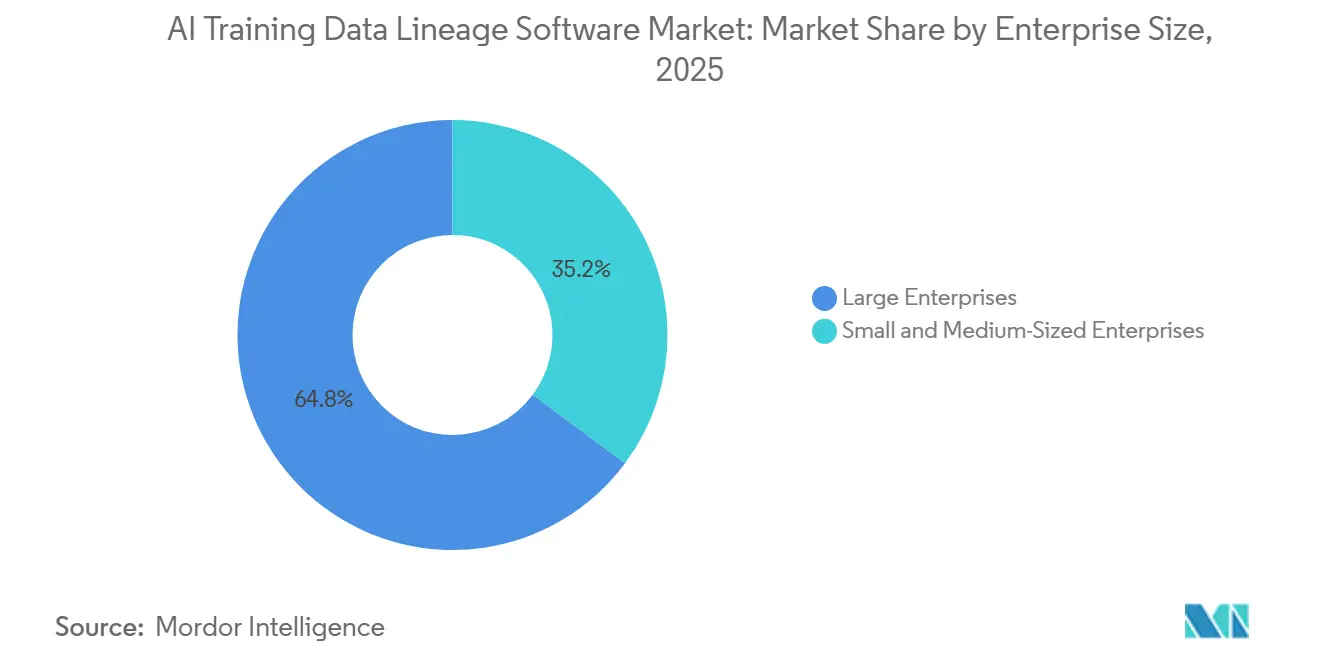
Large enterprises accounted for 64.83% of the AI Training Data Lineage Software Market share in 2025, providing a substantial base for AI Training Data Lineage Software in complex enterprise deployments. Their AI programs usually handle greater data volumes and operate across more internal systems. They also face higher exposure to audit and compliance requirements, which supports formal lineage programs. Large buyers use these tools for experiment reproducibility, dataset versioning, audit documentation, and production monitoring. They commonly purchase integrated platforms rather than isolated features. This approach lets risk, legal, data, and engineering groups work from related records, which is important when a model draws on many internal sources and passes through several approval stages.
SMEs are projected to expand at a 29.24% CAGR from 2026 to 2031. Usage-based pricing and cloud delivery can lower the entry cost for mid-market AI teams. The Drexel University report found that 48% of organizations had not implemented programs to govern data used for AI. This group represents a potential customer base as fine-tuning and other AI work become more common beyond the largest firms. Simpler setup and automated metadata capture can be important for smaller teams that lack dedicated governance staff.
By Application: Governance Is Largest While Drift Analysis Grows Fastest
Data governance and metadata management accounted for 26.74% of the AI Training Data Lineage Software Market share in 2025, underscoring their central role in the AI Training Data Lineage Software Market. Many organizations first acquire lineage capabilities as part of a broader program to manage data ownership, policy, and access. Model development, dataset versioning, compliance review, and data quality functions address other stages of the AI lifecycle. These capabilities are often adopted in sequence as a program becomes more mature. Regulatory audit needs are increasing attention to technical documentation and reproducible records. A complete record can show what data entered a training run, which checks were applied, who approved its use, and whether a later change affected the result.
Data quality and data drift analysis are projected to expand at a 30.18% CAGR from 2026 to 2031. Teams need to determine whether a data transformation or version change affected the distribution of training data. The Journal of Big Data reported that multi-granular provenance management can capture records at both dataset and individual-record levels for reproducibility and root-cause analysis. This level of detail can help locate a source of deterioration when model results change. It also supports the move from periodic data checks toward continuous monitoring linked to lineage records.
By Data Modality: Text and Code Lead While Sensor Data Accelerates
Text and code accounted for 32.41% of the AI Training Data Lineage Software Market share in 2025, reflecting the current workload mix of the AI Training Data Lineage Software Market. Large language model workflows create extensive demand for records of source data, processing, and versioning. Text data is often easier to connect with established catalog and lineage tools than unstructured sensor streams. Image, video, audio, speech, and structured data each have different source systems and labeling requirements. This variety encourages vendors to expand their ability to manage multiple data types. The records must connect source files, annotation instructions, labeling results, transformations, and evaluation inputs, even when those items are stored in different systems or have different retention rules.
Multimodal and sensor-rich data is projected to expand at a 31.82% CAGR from 2026 to 2031. Automotive, aerospace, and industrial robotics use point clouds, video, telemetry, and other time-sensitive inputs. These files need timestamps, version controls, and links to the steps used in sensor fusion. Encord introduced a multi-file comparison interface for text, image, video, and audio evaluation in February 2026. Sophelio introduced its Data Fusion Labeler in February 2026 to prepare multimodal sensor data with end-to-end provenance capture.

By End User: IT and Telecommunication Lead While Healthcare Speeds Up
IT and telecommunication held 24.36% of the AI Training Data Lineage Software Market share in 2025, making it an important demand base for the AI Training Data Lineage Software Market. This sector has a high concentration of AI engineering teams and established investment in data platforms. Its organizations often adopt governance tools early because they operate complex digital services and large data estates. Other demand groups include BFSI, automotive and transportation, retail and e-commerce, manufacturing, education, government, and energy. Each group faces different requirements based on its data sources and the effects of model errors. Buyers also differ in how often they update models, how much documentation they retain, and whether a human reviewer must approve a change before the system is used.
The healthcare and life sciences industry is projected to expand at a 28.93% CAGR from 2026 to 2031. The January 2025 draft guidance addresses lifecycle management and marketing submissions for AI-enabled device software functions. Clinical and medical-device use cases require clear records because errors can affect patient care. The sector also faces privacy requirements that make traceability and controlled access closely connected. lakeFS listed NASA and the U.S. Department of Energy among the organizations using its enterprise data capabilities, highlighting similarly stringent audit requirements in public-sector work.
Geography Analysis
North America held 34.62% of the AI Training Data Lineage Software Market share in 2025. The region has a large concentration of AI-focused businesses, cloud providers, and enterprise buyers with established governance programs. The United States drives much of the demand through healthcare, financial services, public-sector programs, and large technology firms. The 2025 draft guidance increased the need for lifecycle documentation for AI-enabled medical devices, while state-level requirements also emphasize responsible use and documentation. Canada and Mexico are developing from a smaller base, with financial services and public-sector uses contributing to demand.
Asia-Pacific is projected to expand at a 29.74% CAGR from 2026 to 2031. China, India, Japan, South Korea, and Southeast Asian countries are expanding AI training activity alongside data-protection rules. Japan's automotive and robotics sectors create demand for tools that can record sensor-fusion data and perform labeling work, and Encord identified Woven by Toyota as a physical AI user with data curation capabilities. China and South Korea also have large domestic AI development programs, and the region's differing legal requirements increase the value of flexible controls for consent, location, safety, and accountability.
Europe holds a significant position because the EU AI Act requires detailed data governance for high-risk AI systems. France, Germany, and the United Kingdom are important national markets, while Germany's industrial sector supports demand related to automation. South America remains smaller in revenue, although Brazil's LGPD provides a related basis for data-processing documentation, while the Middle East and Africa are emerging, with Saudi Arabia and the UAE investing in AI and data infrastructure. South Africa and Nigeria show early demand for financial services applications. The AI Training Data Lineage Software Market offers broader regional opportunities where local data rules and AI investment mature together.

Competitive Landscape
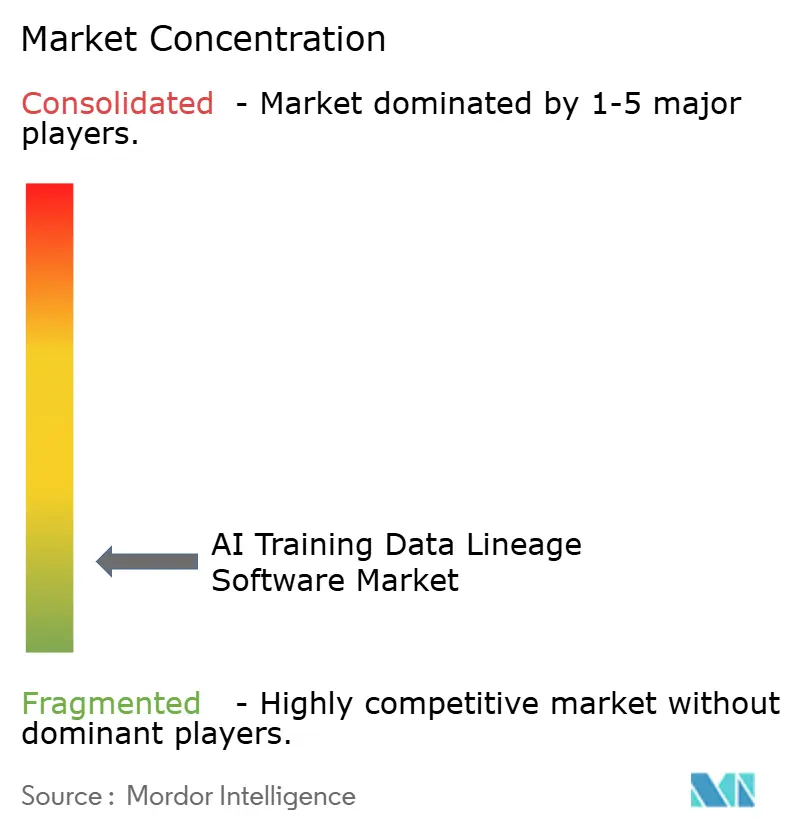
The AI Training Data Lineage Software Market is fragmented, with broad governance vendors and specialist AI data providers serving different buyer needs. Collibra, Alation, and Informatica provide catalog, policy, and lineage capabilities for large enterprise programs. lakeFS, Snorkel AI, and Encord focus more closely on version control, data development, reproducibility, and training-data preparation, reflecting the different needs of compliance teams, data engineers, and machine learning teams. No company was reported to hold a dominant share, so competition depends on fit with the customer's existing tools and technical requirements.
Collibra acquired Raito in June 2025 to extend data access governance across Snowflake and Databricks environments. It acquired Deasy Labs in July 2025 to add discovery and enrichment for unstructured data, including documents, transcripts, and email archives. In its June 2026 release, Collibra added column-level lineage for Sigma analytics assets. These moves extend governance from structured business data to unstructured content and detailed analytics records, which can appeal to enterprises that want a single control point for multiple data assets.
Agentic AI is an open product area because conventional catalog tools were designed around human-managed data changes. lakeFS addressed this area in June 2026 with branch-level isolation, policy-controlled merges, and audit records for agent work. Other vendors are differentiating through OpenLineage compatibility, automated metadata generation, and tools that reduce manual tagging. Snorkel AI raised USD 100 million in Series D financing in May 2025 at a USD 1.3 billion valuation, bringing its total funding to USD 237 million. Data contracts can increase adoption by defining expected schemas and quality responsibilities between data producers and users, especially where decentralized teams need automated rules rather than manual review of every data change.
AI Training Data Lineage Software Industry Leaders
lakeFS Ltd.
Pachyderm, Inc.
Atlan Pte. Ltd.
Acryl Data, Inc.
Relyance AI, Inc.
- *Disclaimer: Major Players sorted in no particular order

Recent Industry Developments
- July 2026: Collibra added column-level lineage for Sigma analytics assets in its June 2026 platform release, enabling data flow tracing between Warehouse Columns, DataModel Columns, and Element Columns within Sigma workspaces. The capability strengthened end-to-end traceability across business intelligence and AI workflows, supporting audit trail completeness for enterprise AI governance programs.
- June 2026: lakeFS launched lakeFS for Agentic AI, a governed data control plane providing autonomous AI agents with isolated, reproducible, and audit-trailed data access at enterprise scale. Each agent received a zero-copy data branch with branch-scoped credentials, policy-gated merges, and a unified audit trail linking agent identity to every data action. The solution extended production capabilities to organizations including Arm, Bosch, Lockheed Martin, NASA, Volvo, and the U.S. Department of Energy.
- February 2026: Encord, Inc. raised USD 60 million in Series C funding led by Wellington Management, with participation from Y Combinator, CRV, N47, and Crane Venture Partners, bringing total funding to USD 110 million at a USD 550 million post-round valuation. Encord reported a 5x increase in platform data volumes from 1 petabyte to 5 petabytes and a 10x increase in physical AI customer revenue over the prior year.
- February 2026: Encord released January and February 2026 product updates, introducing a multimodal multi-file comparison interface for GenAI evaluation workflows spanning text, image, video, and audio, along with SDK support for Active Collections and scalable prediction upload workflows, extending training data lineage to complex cross-modal evaluation pipelines.


Global AI Training Data Lineage Software Market Report Scope
The AI training data lineage software market refers to the ecosystem of software solutions and services that track, visualize, and manage the complete lifecycle, origins, and transformations of datasets used in artificial intelligence and machine learning models. Unlike traditional data lineage tools, this market focuses specifically on the complexities of AI pipelines, including data preprocessing, feature engineering, and model training stages. The market encompasses tools for data provenance tracking, metadata and catalog management, pipeline observability, and AI governance. By supporting diverse data modalities such as text, image, video, audio, and multimodal data, these solutions enable organizations to ensure experiment reproducibility, manage dataset versioning, detect data quality issues and data drift, and maintain strict regulatory compliance and AI auditability. Deployed across cloud, hybrid, or on-premises environments, these platforms cater to organizations of all sizes across various industries, empowering data science teams to build trustworthy, transparent, and highly governed AI models while mitigating the risks associated with biased or poorly tracked training data.
The AI Training Data Lineage Software Market Report is Segmented by Component (Software, [Data Lineage and Provenance Software, Metadata and Catalog Management Software, Data Transformation and Pipeline Observability Software, and Governance, Audit and Compliance Software], and Services), Deployment Model (Cloud, Hybrid, and On-Premises), Enterprise Size (Large Enterprises, and Small and Medium-Sized Enterprises), Application (Model Development and Experiment Reproducibility, Dataset Versioning and Release Management, Data Governance and Metadata Management, Regulatory Compliance and AI Audit, and Data Quality and Data Drift Analysis), Data Modality (Text and Code, Image and Video, Audio and Speech, Multimodal and Sensor-Rich Data, and Structured and Tabular Data), End User (IT and Telecommunication, BFSI, Automotive and Transportation, Healthcare and Life Sciences, Retail and E-Commerce, Industrial Manufacturing, Education and Research Institutions, Government and Administration, Energy and Utilities, and Other End Users), and Geography (North America, South America, Europe, Asia-Pacific, and Middle East and Africa). The Market Forecasts are Provided in Terms of Value (USD).
| Software | Data Lineage and Provenance Software |
| Metadata and Catalog Management Software | |
| Data Transformation and Pipeline Observability Software | |
| Governance, Audit and Compliance Software | |
| Services |
| Cloud |
| Hybrid |
| On-Premises |
| Large Enterprises |
| Small and Medium-Sized Enterprises |
| Model Development and Experiment Reproducibility |
| Dataset Versioning and Release Management |
| Data Governance and Metadata Management |
| Regulatory Compliance and AI Audit |
| Data Quality and Data Drift Analysis |
| Text and Code |
| Image and Video |
| Audio and Speech |
| Multimodal and Sensor-Rich Data |
| Structured and Tabular Data |
| IT and Telecommunication |
| BFSI |
| Automotive and Transportation |
| Healthcare and Life Sciences |
| Retail and E-Commerce |
| Industrial Manufacturing |
| Education and Research Institutions |
| Government and Administration |
| Energy and Utilities |
| Other End Users |
| North America | United States | |
| Canada | ||
| Mexico | ||
| South America | Brazil | |
| Argentina | ||
| Rest of South America | ||
| Europe | Germany | |
| United Kingdom | ||
| France | ||
| Russia | ||
| Spain | ||
| Rest of Europe | ||
| Asia-Pacific | China | |
| Japan | ||
| India | ||
| South Korea | ||
| Southeast Asia | ||
| Rest of Asia-Pacific | ||
| Middle East and Africa | Middle East | Saudi Arabia |
| United Arab Emirates | ||
| Rest of Middle East | ||
| Africa | South Africa | |
| Nigeria | ||
| Rest of Africa | ||
| By Component | Software | Data Lineage and Provenance Software | |
| Metadata and Catalog Management Software | |||
| Data Transformation and Pipeline Observability Software | |||
| Governance, Audit and Compliance Software | |||
| Services | |||
| By Deployment Model | Cloud | ||
| Hybrid | |||
| On-Premises | |||
| By Enterprise Size | Large Enterprises | ||
| Small and Medium-Sized Enterprises | |||
| By Application | Model Development and Experiment Reproducibility | ||
| Dataset Versioning and Release Management | |||
| Data Governance and Metadata Management | |||
| Regulatory Compliance and AI Audit | |||
| Data Quality and Data Drift Analysis | |||
| By Data Modality | Text and Code | ||
| Image and Video | |||
| Audio and Speech | |||
| Multimodal and Sensor-Rich Data | |||
| Structured and Tabular Data | |||
| By End User | IT and Telecommunication | ||
| BFSI | |||
| Automotive and Transportation | |||
| Healthcare and Life Sciences | |||
| Retail and E-Commerce | |||
| Industrial Manufacturing | |||
| Education and Research Institutions | |||
| Government and Administration | |||
| Energy and Utilities | |||
| Other End Users | |||
| By Geography | North America | United States | |
| Canada | |||
| Mexico | |||
| South America | Brazil | ||
| Argentina | |||
| Rest of South America | |||
| Europe | Germany | ||
| United Kingdom | |||
| France | |||
| Russia | |||
| Spain | |||
| Rest of Europe | |||
| Asia-Pacific | China | ||
| Japan | |||
| India | |||
| South Korea | |||
| Southeast Asia | |||
| Rest of Asia-Pacific | |||
| Middle East and Africa | Middle East | Saudi Arabia | |
| United Arab Emirates | |||
| Rest of Middle East | |||
| Africa | South Africa | ||
| Nigeria | |||
| Rest of Africa | |||


Key Questions Answered in the Report
What is the size of the AI Training Data Lineage Software Market?
The AI Training Data Lineage Software Market was valued at USD 2.86 billion in 2025 and is forecast to reach USD 10.84 billion by 2031 at a 25.51% CAGR.
What is driving demand for training data lineage tools?
Compliance obligations, hybrid AI environments, data quality monitoring, and the growing use of multimodal and agentic workflows are supporting demand.
Which deployment model is growing fastest?
Hybrid deployment is projected to expand at a 27.69% CAGR through 2031 because regulated users need records across cloud and local systems.
Which application is expected to grow fastest?
Data quality and data drift analysis is projected to expand at a 30.18% CAGR through 2031 as teams link dataset changes to model performance.
Which end-user group is expected to grow fastest?
Healthcare and life sciences is projected to expand at a 28.93% CAGR through 2031, supported by lifecycle documentation needs for AI-enabled medical devices.
Which region is expected to expand fastest?
Asia-Pacific is projected to expand at a 29.74% CAGR through 2031 as regional AI programs and data-protection requirements develop.
Page last updated on:


 Your data is secure and never sold or shared.


