
AI Recommendation Engine For OTT Market Size and Share
Market Overview
| Study Period | 2021 - 2031 |
|---|---|
| Market Size (2026) | USD 2.92 Billion |
| Market Size (2031) | USD 7.83 Billion |
| Growth Rate (2026 - 2031) | 21.81 % |
| Fastest Growing Market | Asia-Pacific |
| Largest Market | North America |
| Market Concentration | Medium |
Major Players *Disclaimer: Major Players sorted in no particular order Image © Mordor Intelligence. Reuse requires attribution under CC BY 4.0. | |
AI Recommendation Engine For OTT Market Analysis by Mordor Intelligence
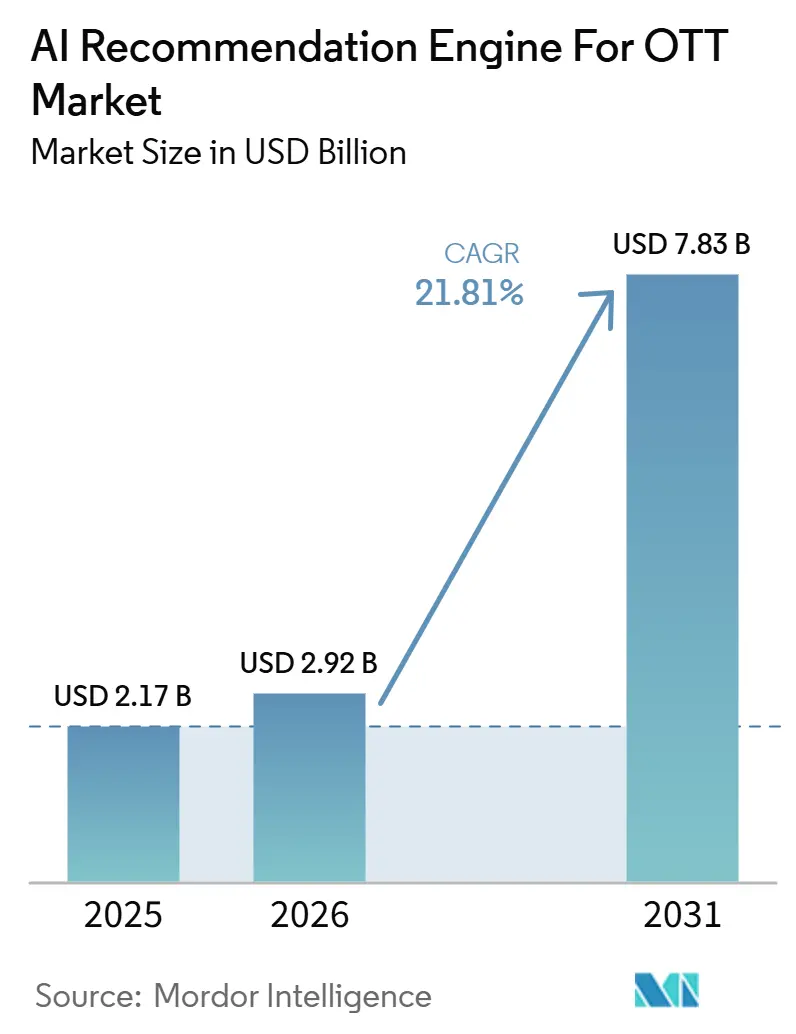
The AI recommendation engine for OTT market size is projected to expand from USD 2.17 billion in 2025 and USD 2.92 billion in 2026 to USD 7.83 billion by 2031, registering a CAGR of 21.81% between 2026 to 2031. Growth reflects broader use across streaming platforms, broadcaster-owned digital services, and digital media publishers. Subscription video on demand and hybrid monetization models are increasing the need to match viewers with relevant content quickly. Recommendation quality now affects subscriber retention and lifetime value, rather than serving as a secondary user experience feature. Providers are also connecting discovery tools with advertising, commerce, search, and conversational interfaces. Data controls, infrastructure cost, and the need for compatible systems across many viewing surfaces will shape which suppliers can benefit from this growth, especially where operators must maintain separate training environments across jurisdictions.
Key Report Takeaways
- By technology, machine learning held 33.37% of the AI recommendation engine for OTT market share in 2025, while generative AI is projected to expand at a 22.53% CAGR through 2031.
- By application, content recommendation accounted for 30.35% of the AI recommendation engine for OTT market size in 2025, while advertising and promotional recommendation is expected to grow at a 22.19% CAGR through 2031.
- By end user, streaming platforms held 43.47% revenue share in 2025, while digital media publishers and content agencies are projected to advance at a 22.48% CAGR through 2031 in the AI recommendation engine for OTT market.
- By geography, North America held 40.44% revenue share in 2025, while Asia-Pacific is projected to record a 22.64% CAGR through 2031.
Note: Market size and forecast figures in this report are generated using Mordor Intelligence’s proprietary estimation framework, updated with the latest available data and insights as of January 2026.
Global AI Recommendation Engine For OTT Market Trends and Insights
Drivers Impact Analysis*
| Driver | (~) % Impact on CAGR Forecast | Geographic Relevance | Impact Timeline |
|---|---|---|---|
| Rising Demand for Real-Time Personalization in Streaming and Commerce | +6.0% | Global | Short term (≤ 2 years) |
| Retail Media Networks Need Higher Conversion and Basket Size | +4.5% | North America, Europe, Asia-Pacific | Medium term (2-4 years) |
| Headless and Composable Commerce Require Modular Recommendation Layers | +3.2% | Global | Medium term (2-4 years) |
| Zero-Party Data Strategies Improve Privacy-Ready Personalization | +2.5% | North America, Europe | Short term (≤ 2 years) |
| Vendor Bundling With CDP, CRM, and Marketing Automation Stacks | +2.0% | Global | Medium term (2-4 years) |
| Explainable AI Becomes a Procurement Requirement for Merchandising Teams | +1.5% | Europe, with spillover to North America | Long term (≥ 4 years) |
| Source: Mordor Intelligence | |||
Rising Demand for Real-Time Personalization in Streaming and Commerce
Viewer discovery latency can affect whether a subscriber starts watching and continues to use a service, making fast and relevant page assembly an important operating issue in the AI recommendation engine for OTT market. Netflix published GenPage in June 2026, describing a single generative transformer that replaced a multistage recommendation process. Its online tests showed a 20% reduction in end-to-end serving latency and statistically significant gains on the core engagement measure.[1]Netflix Technology Blog, “GenPage: Towards End-to-End Generative Homepage Construction at Netflix,” Netflix Technology Blog, netflixtechblog.com The publication reported that richer prompt representation improved model quality by 6.9%, compared with a 1.3% improvement from expanding the model from 120 million to 900 million parameters. This suggests that data representation can be more important than model scale for real-time personalization, because a richer view of intent can improve ranking before a platform adds expensive compute capacity. TubiFM likewise combined item, carousel, and search ranking in 1 model, while reducing p99 serving latency from 500 milliseconds to 200 milliseconds.
Retail Media Networks Need Higher Conversion and Basket Size
Retail media is bringing transaction signals closer to OTT advertising recommendation systems, adding a commercial data source to the AI (Artificial Intelligence) recommendation engine for OTT market. Purchase-confirmed data can provide stronger evidence of outcomes than a clickstream signal alone. This makes it more useful for models that select an advertising audience or decide which promotional offer to show. The arrangement illustrates how streaming operators can combine advertising inventory with retail audience data. In the artificial intelligence recommendation engine for OTT market, suppliers that can ingest permitted retail intent signals may support better advertising targeting and subscription commerce use cases, particularly when brands want to connect exposure with verified purchase outcomes.
Headless and Composable Commerce Require Modular Recommendation Layers
Headless architecture separates the presentation layer from the backend engine, changing how the artificial intelligence recommendation engine for OTT market is deployed across digital properties. This structure requires recommendation capabilities to be accessible through application programming interfaces rather than embedded in a single content management system. Bloomreach introduced Loomi Connect in January 2026, making its discovery intelligence available through the Model Context Protocol for use in ChatGPT and other conversational interfaces. Coveo introduced Conversational Product Discovery in March 2026 to support natural-language discovery in established search interfaces while retaining merchandising rules.[2]Coveo Solutions Inc., “Coveo Redefines Ecommerce Discovery With Search-Native Conversational AI,” Coveo Investor Relations, ir.coveo.com OTT operators therefore need recommendation services that can work across apps, connected televisions, browsers, and conversational interfaces. Suppliers with modular and event-driven services are better aligned with this requirement than suppliers tied to proprietary front ends, since media groups can add new viewing surfaces without rebuilding their central discovery logic.
Zero-Party Data Strategies Improve Privacy-Ready Personalization
Zero-party data comes directly from viewers through choices such as preference surveys, genre ratings, and mood prompts, giving the artificial intelligence recommendation engine for OTT market a direct signal from the user. It can improve cold-start recommendations because the model receives a stated preference rather than inferring one from limited behavior. Braze reported that 99% of surveyed marketing executives said privacy concerns had affected their advanced personalization plans in 2025. Preference collection can also act as an early discovery interaction, particularly when a new subscriber has little viewing history. JioHotstar used a ChatGPT-powered conversational discovery interface that turned real-time mood and intent statements into recommendation inputs.[3]Fortune India, “How JioHotstar Is Turning Streaming Into a Conversational AI Commerce Engine,” Fortune India, fortuneindia.com Platforms that collect and refresh these signals during the customer relationship can build a more complete preference record than platforms that rely only on initial onboarding, while giving viewers clearer opportunities to state and update their choices.
Restraints Impact Analysis*
| Restraint | (~) % Impact on CAGR Forecast | Geographic Relevance | Impact Timeline |
|---|---|---|---|
| High Cost of Feature Stores and Real-Time Infrastructure | -3.2% | Global | Short term (≤ 2 years) |
| Third-Party Cookie Deprecation Limits Cross-Site Signal Quality | -2.1% | North America, Europe | Short term (≤ 2 years) |
| Data Localization Rules Fragment Model Training and Deployment | -1.6% | Asia-Pacific, Europe, with spillover to the Middle East and Africa | Medium term (2-4 years) |
| Algorithmic Bias Raises Governance and Audit Burdens | -1.2% | Europe and national markets | Long term (≥ 4 years) |
| Source: Mordor Intelligence | |||
High Cost of Feature Stores and Real-Time Infrastructure
Real-time recommendation requires fast retrieval of current features alongside offline model training, a cost issue that can slow broader artificial intelligence recommendation engine for OTT market adoption. This can create a substantial operating burden for smaller broadcasters and publishers. ShareChat described scaling a feature store from 1 million to 1 billion features per second, while processing more than 2 billion events each day and reading more than 30 billion rows daily. The company also identified a need to reduce infrastructure costs by 10 times without reducing p99 latency. Managed feature stores can reduce the internal engineering burden, but request-driven charges grow with traffic volume. The artificial intelligence recommendation engine for OTT market therefore faces a higher adoption hurdle among organizations that do not have large machine-learning platform teams or the budget of leading subscription video services, even where the commercial case for stronger discovery is clear.
Third-Party Cookie Deprecation Limits Cross-Site Signal Quality
The loss of third-party cookie signals reduces visibility into behavior beyond an operator’s own service, narrowing a data input used by the AI recommendation engine for OTT market. This is especially relevant when a new user has little on-platform history. Streaming providers also face limits on sharing viewing information with outside parties, which narrows the set of signals available for cross-platform personalization. These constraints are shifting vendor design toward contextual inference, on-device processing, and zero-party data. Each approach requires engineering investment and may offer less behavioral context than broad cross-site tracking. The AI recommendation engine industry must therefore balance recommendation accuracy with data minimization and privacy controls, while ensuring that cold-start users still receive useful choices and that models can operate with less external context.
*Our forecasts treat driver/restraint impacts as directional, not additive. The impact forecasts reflect baseline growth, mix effects, and variable interactions.
Segment Analysis
By Technology: Generative AI Reshapes The Recommendation Stack
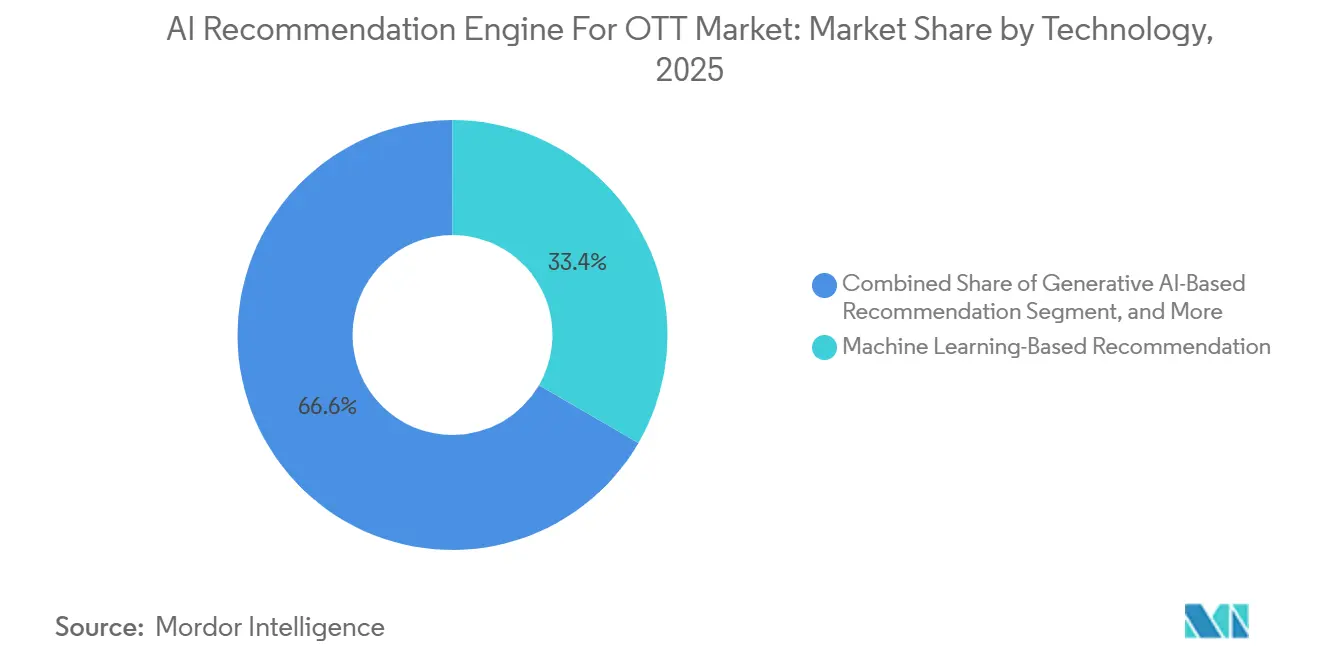
Generative AI is projected to be the fastest-growing technology segment at a 22.53% CAGR from 2026 to 2031 within the AI recommendation engine for OTT market. Machine learning held 33.37% of technology revenue in 2025, supported by the large installed base of collaborative filtering, gradient-boosted ranking, and two-tower retrieval systems. Generative methods extend them by processing viewing histories, natural-language requests, and conversational preferences in a common sequence, which can reduce the need to maintain separate systems for homepage, search, and carousel ranking. Netflix’s GenPage treats the homepage as a generated token sequence through a decoder-only transformer.
Natural-language processing recommendation is also growing as viewers use descriptive requests rather than simple title or keyword searches. Netflix began testing an OpenAI-powered search experience in Australia and New Zealand in April 2025 to support mood-based and conversational discovery. Computer vision recommendation can support ranking through visual attributes, mood signals, and thumbnail analysis, which is useful when archival catalogs have limited text metadata. In the AI recommendation engine for OTT market, this mix allows suppliers to select methods that fit the maturity of each operator’s data and catalog, rather than requiring every customer to deploy a large generative model from the outset. Generative tools are likely to be added to existing stacks instead of immediately replacing all established ranking systems.



By Application: Advertising And Promotional Recommendation Drives Monetization Intelligence
Content recommendation accounted for 30.35% of application revenue in 2025, making it the largest application in the AI recommendation engine for OTT market size and the principal viewer-facing use of the AI recommendation engine for OTT market. Advertising and promotional recommendation is projected to expand at the highest application CAGR of 22.19% through 2031. Netflix reported that the targeting channel in its personalization system was nearly 7 times larger than the exposure channel in its counterfactual analysis. The finding places value on selecting the most relevant viewer for a title or advertising unit, not only increasing the chance that a unit is displayed. Better targeting can support more effective advertising delivery and a clearer monetization case for personalization investment, because a relevant placement can be more valuable than broad exposure that reaches viewers with little interest.
Search and content discovery personalization is becoming more important as catalogs become larger and users face more choices. TubiFM showed how a unified model can serve item, carousel, and search ranking while reducing p99 latency to 200 milliseconds. Commerce and subscription recommendation includes cross-selling subscription tiers, merchandise, and related offers around content. JioHotstar connected food ordering and fashion commerce to sports and entertainment streaming sessions in 2025 and 2026. Other applications include notification and re-engagement recommendations, which use behavior to decide the timing and content of messages, creating a lower-complexity but high-volume use case that can share model inputs with the main viewing experience.
By End User: Digital Media Publishers Build Algorithmic Discovery Infrastructure
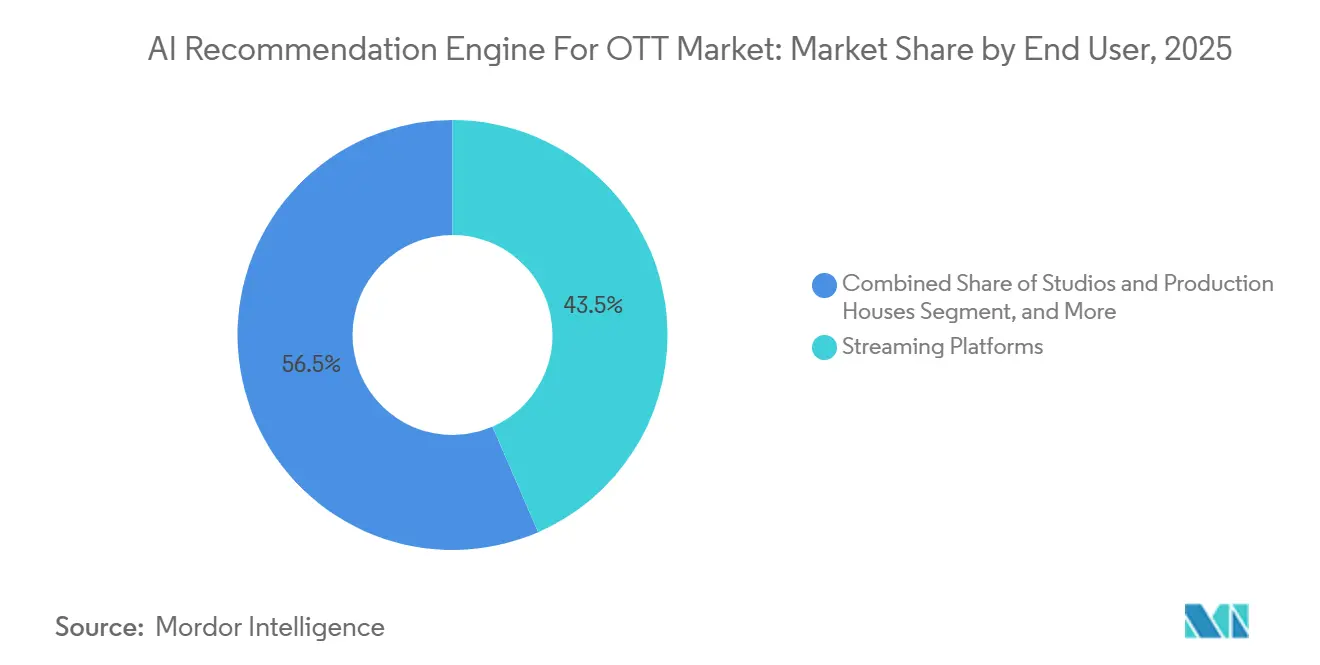
Streaming platforms held 43.47% of end-user revenue in 2025, reflecting their early investment in data systems and personalized discovery within the AI recommendation engine for OTT market. Digital media publishers and content agencies are projected to grow fastest at a 22.48% CAGR from 2026 to 2031. Publishers are seeking context-aware recommendation tools to improve time on site and reduce dependence on outside audience signals. ZDF documented a contextual multi-armed bandit system that balances new content exploration against known user preferences and responds to time-of-day and engagement signals. The faster publisher segment shows that sophisticated discovery systems are moving beyond the largest commercial subscription services, as publishers seek direct ways to improve audience engagement and advertising yield within their own digital properties.
Broadcasters and television networks are increasing investment as linear television audiences decline and digital viewing becomes more important. TF1 introduced Synchro in 2025 as an AI-powered group recommendation engine developed by an internal team of 50 engineers and data scientists. Group viewing needs models that balance household behavior with the preferences of individual viewers. Studios and production houses can use search, abandonment, completion, and rewatching signals to inform acquisition and commissioning decisions. Digital media publishers also need systems that can support transparency, audit records, and explainability when required, especially when procurement teams need to examine how user data and automated ranking decisions are handled.
Geography Analysis
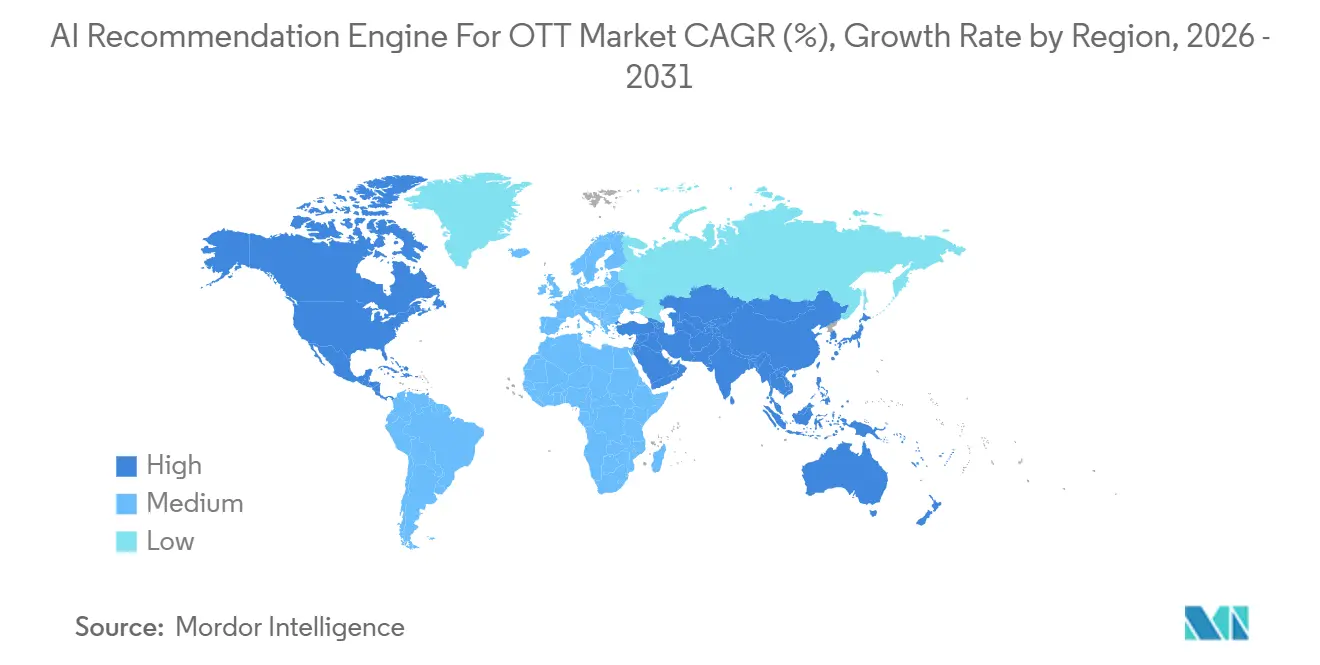
North America held 40.44% of the AI recommendation engine for OTT market share in 2025, supported by conditions that continue to shape the broader AI recommendation engine for OTT market. The region benefits from high subscription video spending, broad programmatic connected television activity, and a large base of technology suppliers. Retail media and streaming systems are becoming more closely connected in North America. Bilingual personalization can be important because local viewing patterns do not necessarily match those of the United States, requiring catalog metadata, language settings, and user preferences to work together in the recommendation process.
Asia-Pacific is projected to grow at a 22.64% CAGR from 2026 to 2031, the highest regional rate in the AI recommendation engine for OTT market. The region has large mobile-first populations and rapidly expanding vernacular-language content libraries. JioHotstar’s conversational discovery system served more than 200 million users and combined live-sports recommendations, mood-based discovery, and commerce functions. Data localization requirements in China require operators to plan their training and deployment environments carefully, which can limit the reuse of a single global model and increase the cost of maintaining local infrastructure. South Korea has demand for multilingual aggregation as recommendation-optimized content is distributed globally.
Europe held a substantial share of revenue in 2025, with Germany, the United Kingdom, and France serving as leading markets for subscriber volume and advertising spending in the AI recommendation engine for OTT market. European procurement decisions are shaped by requirements for transparency, explainability, and auditable controls. The European Commission published a template for public summaries of training content for general-purpose AI models in 2025. South America offers growth potential through Brazil and Argentina, where Portuguese- and Spanish-language content investment supports OTT activity. Africa remains at an earlier stage, with bandwidth and data infrastructure constraints limiting broad deployment of real-time systems, although South Africa, Egypt, and Nigeria remain early OTT penetration markets with emerging demand.

Competitive Landscape
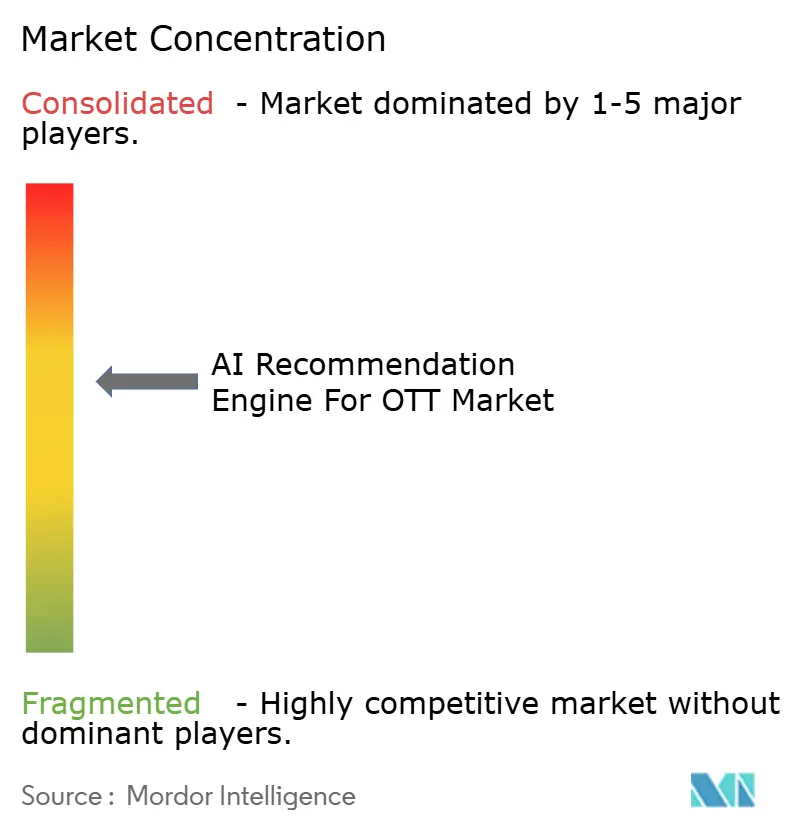
The AI recommendation engine for OTT market is moderately concentrated in foundational platform infrastructure and fragmented among application and vertical solution providers, creating different competitive conditions across the AI recommendation engine for OTT market. AWS, Google, and Microsoft provide compute, vector database, and managed machine-learning services that support many OTT recommendation systems. Bloomreach, Coveo, Algolia, Dynamic Yield, Taboola, and Outbrain compete through recommendation quality, editorial controls, and integration with customer data and marketing systems. Bloomreach introduced Loomi Connect in January 2026 to make its search and personalization intelligence accessible through the Model Context Protocol. It also raises the integration expectations facing suppliers that offer a narrow recommendation function, since customers increasingly expect search, discovery, and recommendation to operate through connected interfaces.
Dynamic Yield’s recognized personalization position reflects the importance of combining data assets with decisioning tools. Coveo launched Conversational Product Discovery in March 2026, embedding natural-language discovery into existing search experiences while preserving traditional search performance and rules. Algolia introduced Recommendation Analytics in April 2026 to give teams click, conversion, and revenue attribution at the recommendation-strategy level. Such measurement tools matter because media operators need to connect recommendation decisions to engagement and commercial outcomes, including clicks, conversions, revenue attribution, and the results of different merchandising approaches.
The AI recommendation engine for OTT market also has an open opportunity in live-event personalization, where content choices must respond quickly to changing scores, viewer reactions, and social signals, and where the relevance of a recommendation can change during a single event. Patent activity around transformer, variational autoencoder, and generative adversarial network approaches indicates continued work on sequence-based preference modeling, although deployment capabilities remain as important as intellectual property. Suppliers serving European broadcasters and publishers also need explainability and human oversight features as standard procurement requirements. Taboola extended its partnership with OPPO and realme in July 2026, bringing Taboola News to additional devices in India and Thailand. These moves show that distribution reach, modular deployment, and governance support are all relevant competitive factors.
AI Recommendation Engine For OTT Industry Leaders
Amazon Web Services, Inc.
Google LLC
Salesforce, Inc.
Adobe Inc.
Microsoft Corporation
- *Disclaimer: Major Players sorted in no particular order

Recent Industry Developments
- July 2026: Taboola deepened its commercial partnership with OPPO and subsidiary realme, extending Taboola News content recommendations to millions of additional devices across India and Thailand. The expansion builds on an existing multi-country deployment covering the UK, Philippines, Singapore, and Argentina, significantly extending Taboola's OTT-adjacent content recommendation reach into 2 of Asia-Pacific's largest mobile-first markets.
- June 2026: Netflix published its GenPage research, describing an end-to-end generative model that constructs personalized homepages as token sequences using a single decoder-only transformer. Online A/B testing demonstrated statistically significant engagement gains against a mature production recommender and a 20% reduction in end-to-end serving latency, representing an architecture shift for large-scale OTT personalization. The work showed how a unified model can bring page construction and personalization closer together in a production streaming environment.
- June 2026: Bloomreach announced enhancements to its Loomi conversational agent, introducing an agentic architecture with multi-step reasoning, real-time review integration, and complex query handling governed by brand-specific merchandising rules, targeting digital media and commerce platforms requiring AI-native content and product discovery.
- April 2026: Bloomreach launched Loomi AI for Shopify, enabling digital media publishers and merchants to deploy AI-powered personalization, recommendations, and search across customer touchpoints from 1 application without engineering support, extending composable recommendation infrastructure to Shopify-hosted OTT and media commerce operators. The release focused on making these capabilities available in a packaged application for organizations with limited internal engineering resources.


Global AI Recommendation Engine For OTT Market Report Scope
The Global AI Recommendation Engine for OTT Market refers to the worldwide industry focused on the development, deployment, and commercialization of artificial intelligence-powered recommendation systems that analyze user behavior, viewing history, preferences, demographics, contextual data, and real-time engagement patterns to deliver personalized content suggestions across over-the-top (OTT) streaming platforms.
The AI Recommendation Engine for OTT Market is Segmented by Technology (Machine Learning-Based Recommendation, Natural Language Processing-Based Recommendation, Computer Vision-Based Recommendation, Generative AI-Based Recommendation, and Hybrid and Other AI Technologies), Application (Content Recommendation, Advertising and Promotional Recommendation, Search and Content Discovery Personalization, Commerce and Subscription Recommendation, and Other Applications), End User (Streaming Platforms, Broadcasters and Television Networks, Studios and Production Houses, Digital Media Publishers and Content Agencies, and Other End Users), and Geography (North America, South America, Europe, Asia-Pacific, Middle East, and Africa). The Market Forecasts are Provided in Terms of Value (USD).
| Machine Learning-Based Recommendation |
| Natural Language Processing-Based Recommendation |
| Computer Vision-Based Recommendation |
| Generative AI-Based Recommendation |
| Hybrid and Other AI Technologies |
| Content Recommendation |
| Advertising and Promotional Recommendation |
| Search and Content Discovery Personalization |
| Commerce and Subscription Recommendation |
| Other Applications |
| Streaming Platforms |
| Broadcasters and Television Networks |
| Studios and Production Houses |
| Digital Media Publishers and Content Agencies |
| Other End Users |
| North America | United States |
| Canada | |
| Mexico | |
| South America | Brazil |
| Argentina | |
| Chile | |
| Rest of South America | |
| Europe | Germany |
| United Kingdom | |
| France | |
| Italy | |
| Spain | |
| Rest of Europe | |
| Asia-Pacific | China |
| Japan | |
| India | |
| South Korea | |
| Australia | |
| Rest of Asia-Pacific | |
| Middle East | Saudi Arabia |
| United Arab Emirates | |
| Qatar | |
| Rest of Middle East | |
| Africa | South Africa |
| Egypt | |
| Nigeria | |
| Rest of Africa |
| By Technology | Machine Learning-Based Recommendation | |
| Natural Language Processing-Based Recommendation | ||
| Computer Vision-Based Recommendation | ||
| Generative AI-Based Recommendation | ||
| Hybrid and Other AI Technologies | ||
| By Application | Content Recommendation | |
| Advertising and Promotional Recommendation | ||
| Search and Content Discovery Personalization | ||
| Commerce and Subscription Recommendation | ||
| Other Applications | ||
| By End User | Streaming Platforms | |
| Broadcasters and Television Networks | ||
| Studios and Production Houses | ||
| Digital Media Publishers and Content Agencies | ||
| Other End Users | ||
| By Geography | North America | United States |
| Canada | ||
| Mexico | ||
| South America | Brazil | |
| Argentina | ||
| Chile | ||
| Rest of South America | ||
| Europe | Germany | |
| United Kingdom | ||
| France | ||
| Italy | ||
| Spain | ||
| Rest of Europe | ||
| Asia-Pacific | China | |
| Japan | ||
| India | ||
| South Korea | ||
| Australia | ||
| Rest of Asia-Pacific | ||
| Middle East | Saudi Arabia | |
| United Arab Emirates | ||
| Qatar | ||
| Rest of Middle East | ||
| Africa | South Africa | |
| Egypt | ||
| Nigeria | ||
| Rest of Africa | ||


Key Questions Answered in the Report
What is the size of the AI recommendation engine for OTT market?
The AI recommendation engine for OTT market was USD 2.92 billion in 2026 and is forecast to reach USD 7.83 billion by 2031, at a 21.81% CAGR. Streaming platforms, broadcasters, and digital media publishers are adopting these systems across discovery, advertising, and commerce. The forecast reflects the widening use of personalized content selection, promotional decisioning, search support, and customer engagement tools across the digital video ecosystem.
What is driving adoption of AI recommendation engines for OTT services?
Streaming services are using faster personalization to support discovery, engagement, retention, advertising relevance, and commerce opportunities. Providers also need systems that work across applications, connected televisions, browsers, and conversational interfaces.
Which technology is growing fastest in AI recommendation for OTT?
Generative AI is projected to grow at a 22.53% CAGR from 2026 to 2031, while machine learning remained the largest technology category in 2025 with a 33.37% market share. Many operators are expected to extend existing ranking stacks with generative capabilities rather than replace them immediately.
Which OTT recommendation application has the highest growth outlook?
Advertising and promotional recommendation is expected to record the highest application CAGR at 22.19% through 2031. More precise selection of viewers can support monetization beyond simple increases in advertising exposure.
Which region is expected to grow fastest for OTT recommendation systems?
Asia-Pacific is projected to lead regional growth at a 22.64% CAGR through 2031, supported by mobile-first audiences and expanding local-language content. Operators must still account for local data handling requirements and multilingual discovery needs.
Why do privacy rules matter for OTT recommendation systems?
Privacy rules limit the use and sharing of behavioral signals, increasing the importance of consented data, contextual methods, explainability, and auditable controls. These requirements can increase implementation work, but they can also support clearer user choice and stronger governance. Organizations need to plan data collection, model operation, access controls, and documentation together instead of treating privacy as a late implementation task.
Page last updated on:





