
AI-Powered Sleep Technologies Market Size and Share
Market Overview
| Study Period | 2020 - 2031 |
|---|---|
| Market Size (2026) | USD 6.91 Billion |
| Market Size (2031) | USD 17.46 Billion |
| Growth Rate (2026 - 2031) | 20.35 % |
| Fastest Growing Market | Asia-Pacific |
| Largest Market | North America |
| Market Concentration | Medium |
Major Players *Disclaimer: Major Players sorted in no particular order Image © Mordor Intelligence. Reuse requires attribution under CC BY 4.0. | |
AI-Powered Sleep Technologies Market Analysis by Mordor Intelligence
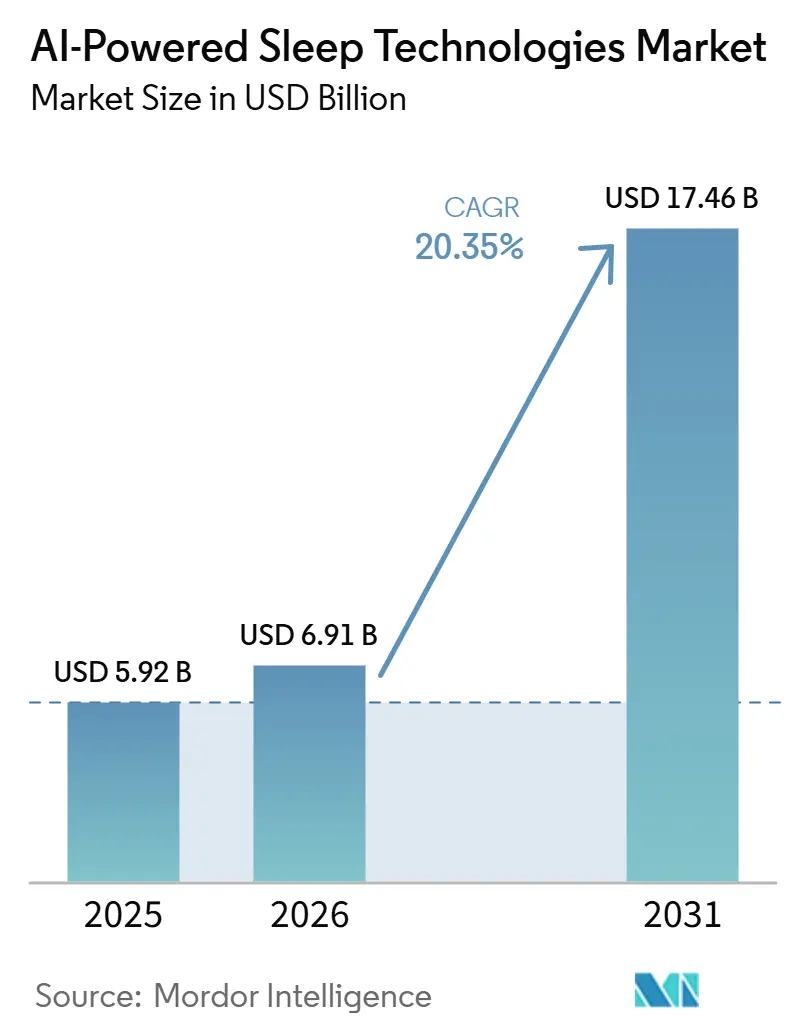
The AI-powered sleep technologies market is expected to grow from USD 5.92 billion in 2025 to USD 6.91 billion in 2026 and is forecasted to reach USD 17.46 billion by 2031 at 20.35% CAGR over 2026-2031. The AI-powered sleep technologies market is moving away from episodic lab testing and toward continuous management across clinical and home settings. The addressable need remains large because 83.7 million adults in the United States had obstructive sleep apnea in 2024, and many remained unscreened for treatment. The AI-powered sleep technologies market also extends beyond apnea because a 2025 meta-analysis placed global insomnia disorder prevalence at 13.9% by DSM criteria. Clinical and payer interest is rising as digital cognitive behavioral therapy for insomnia showed annual savings of USD 2,083 per patient and a 42% reduction versus standard pharmacological care. The AI-powered sleep technologies market is, therefore, rewarding companies that can pair regulatory readiness, clinical validation, and secure overnight biometric data handling with consumer-friendly delivery.
Key Report Takeaways
- By product type, AI-enabled sleep trackers led with 42.83% revenue share in 2025, while sleep apps and digital sleep platforms are forecasted to expand at 20.63% CAGR through 2031.
- By technology, machine learning and sensor fusion held 38.57% revenue share in 2025, while AI-guided behavioral therapy is projected to grow at 21.84% CAGR through 2031.
- By application, sleep monitoring and scoring accounted for 36.9% of the AI-powered sleep technologies market in 2025, while sleep apnea and snoring detection are expected to advance at 22.57% CAGR through 2031.
- By end-user, hospitals captured 34.74% revenue share in 2025, while home care settings are projected to grow at 21.26% CAGR through 2031.
- By geography, North America held 41.28% of global revenue in 2025, while Asia-Pacific is forecasted to expand at 23.86% CAGR through 2031.
Note: Market size and forecast figures in this report are generated using Mordor Intelligence’s proprietary estimation framework, updated with the latest available data and insights as of January 2026.
Global AI-Powered Sleep Technologies Market Trends and Insights
Drivers Impact Analysis*
| Driver | (~) % Impact on CAGR Forecast | Geographic Relevance | Impact Timeline |
|---|---|---|---|
| Rising Demand for Personalized Sleep Optimization | +4.2% | Global | Short term (≤ 2 years) |
| Shift From Passive Monitoring to Closed-Loop Sleep Intervention | +3.8% | North America, Europe, APAC | Medium term (2-4 years) |
| Growth of At-Home Sleep Diagnostics and Remote Monitoring | +3.5% | North America, Europe, APAC Core | Short term (≤ 2 years) |
| Sleep Data Interoperability with Digital Health Ecosystems | +2.8% | North America and EU | Medium term (2-4 years) |
| Reimbursement Pathways for AI-Assisted Sleep Screening | +2.2% | North America, EU, APAC | Medium term (2-4 years) |
| Increasing Prevalence of Sleep Disorders and Associated Chronic Diseases | +1.8% | North America, Western Europe | Medium term (2-4 years) |
| Source: Mordor Intelligence | |||
Rising Demand for Personalized Sleep Optimization
The AI-powered sleep technologies market is gaining from a clear shift in user expectations toward individualized guidance rather than static score reporting. Users increasingly want recommendations that reflect their physiology, daily behavior, and multi-week sleep patterns instead of generic sleep hygiene prompts. Devices and platforms that combine sleep staging, heart rate variability, skin temperature, and recovery signals are making that personalization more practical in daily use. Eight Sleep stated that its Autopilot platform makes millions of nightly biometric adjustments per user, and the company is extending that model with an AI Sleep Agent designed to simulate and optimize recovery outcomes.[1]Eight Sleep, “Eight Sleep Secures $100 Million to Accelerate AI-Powered Sleep Optimization, Expand Into Medical, and Grow Global Footprint,” Business Wire, businesswire.com In the AI-powered sleep technologies market, this moves competitive value toward platforms that can maintain longer user engagement through adaptive coaching and measurable outcomes.
Shift From Passive Monitoring to Closed-Loop Sleep Intervention
The AI-powered sleep technologies market is no longer centered only on collecting overnight data and presenting it the next morning. Closed-loop systems are starting to detect physiological changes during sleep and respond with direct environmental or therapeutic adjustments. This matters because intervention creates a more durable value proposition than passive monitoring alone, especially when the system can respond during the sleep window instead of after it. Eight Sleep linked its real-time biometric analysis to automated temperature changes and expanded its roadmap toward AI-led sleep apnea and menopausal sleep applications. As a result, the AI-powered sleep technologies market is steadily shifting from sensor ownership toward intervention quality and algorithm responsiveness.
Growth of At-Home Sleep Diagnostics and Remote Monitoring
The AI-powered sleep technologies market is benefiting from the growing acceptance of home-based testing as a viable alternative to in-lab sleep studies. PranaQ received FDA 510(k) clearance in February 2025 for TipTraQ, an AI-enabled home sleep apnea test that was validated against gold-standard polysomnography. A 2025 multicenter validation study also found that the Onera patch-based polysomnography system performed comparably to traditional in-lab polysomnography across sleep staging and AHI metrics.[2]Daniel Aeschbach, “Clinical Validation of a Wireless Patch-Based Polysomnography System,” Journal of Clinical Sleep Medicine, link.springer.com These developments reduce the practical barriers tied to overnight lab access, staffing intensity, and patient inconvenience. In the AI-powered sleep technologies market, companies that control the home diagnostic entry point can build stronger links to downstream therapy initiation, adherence tracking, and long-term monitoring.
Sleep Data Interoperability with Digital Health Ecosystems
The AI-powered sleep technologies market is also gaining from the push to connect wearable and home-generated sleep data with clinical systems. Interoperability makes sleep metrics more useful because providers can review them inside established workflows rather than across disconnected apps. A 2025 study in Frontiers in Digital Health showed technically viable, GDPR-compliant HL7 FHIR integration of Garmin wearable sleep metrics into a standardized clinical repository.[3]Stanislav Ostrovskiy, “Streamlining Wearable Data Integration for EHDS: A Case Study on Advancing Healthcare Interoperability Using Garmin Devices and FHIR,” Frontiers in Digital Health, frontiersin.org That kind of integration supports care continuity and helps turn consumer-generated sleep data into clinically reviewable information. The AI-powered sleep technologies market stands to benefit as platforms that integrate cleanly with electronic records become easier for providers to adopt at scale.
Restraints Impact Analysis*
| Restraint | (~) % Impact on CAGR Forecast | Geographic Relevance | Impact Timeline |
|---|---|---|---|
| Consumer Trust Gaps Around Algorithmic Sleep Scoring | -1.5% | Global | Medium term (2-4 years) |
| Fragmented Clinical Validation Standards Across Device Classes | -1.2% | Global, with focus on US and EU | Medium term (2-4 years) |
| Data Privacy Constraints for Overnight Biometric Monitoring | -0.9% | EU, APAC, North America | Short term (≤ 2 years) |
| High Cost of Advanced AI-Enabled Sleep Monitoring Devices and Platforms | -0.8% | MEA, South America, emerging APAC | Short term (≤ 2 years) to Medium term (2-4 years) |
| Source: Mordor Intelligence | |||
Consumer Trust Gaps Around Algorithmic Sleep Scoring
The AI-powered sleep technologies market still faces a trust problem because many scoring systems remain proprietary and difficult for clinicians to interpret. A 2025 study in Scientific Reports found that clinical adoption remains limited when clinicians cannot adequately assess algorithmic bias and decision opacity. Those concerns become more serious when scoring quality may vary across skin tone, BMI, and comorbidity subgroups. A 2026 review in Sleep and Breathing outlined an explainable AI framework for sleep-disordered breathing diagnostics, but also noted that the trade-off between interpretability and accuracy remains unresolved at the clinical scale. Until clinicians gain clearer visibility into how algorithms reach outputs, the AI-powered sleep technologies market will keep facing slower uptake in higher-acuity care settings.
Fragmented Clinical Validation Standards Across Device Classes
The AI-powered sleep technologies market is also constrained by uneven validation standards across wearables, patch systems, ambient sensors, and software-only tools. Different device classes measure different biosignals, use different comparators, and operate under different regulatory expectations, which makes cross-category performance claims hard to interpret. The Onera patch-based system showed comparable performance to in-lab polysomnography in a 2025 multicenter study, but that does not automatically resolve how other modalities should be judged in routine care. In the AI-powered sleep technologies market, this fragmentation raises evidence costs and slows broader comparability across product types.
*Our forecasts treat driver/restraint impacts as directional, not additive. The impact forecasts reflect baseline growth, mix effects, and variable interactions.
Segment Analysis
By Product Type: Diagnostic Trackers Lead, Software Platforms Define the Growth Frontier
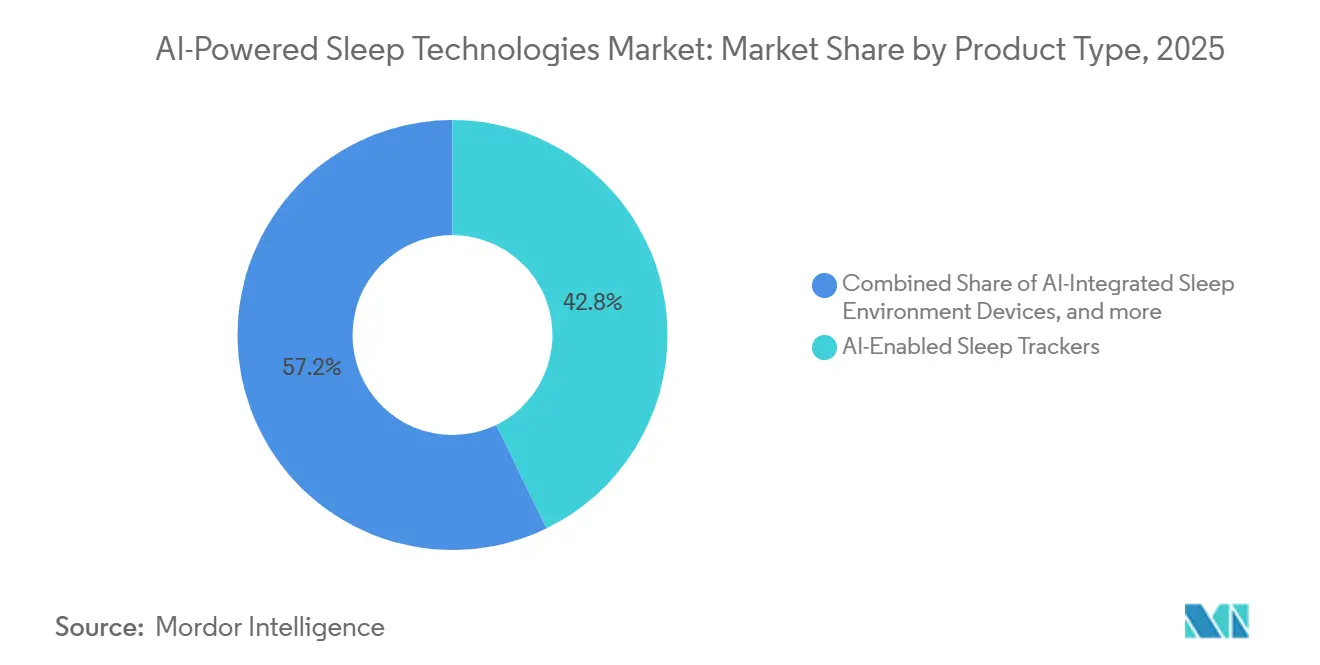
AI-enabled sleep trackers held 42.83% of the AI-powered sleep technologies market share in 2025, while sleep apps and digital sleep platforms are projected to grow at 20.63% through 2031. The leading position of trackers reflects the maturity of wrist-worn wearables, rings, and under-mattress sensing formats that already fit into daily routines with limited friction. These devices remain the main front door into the AI-powered sleep technologies market because they combine broad reach, recurring data capture, and a clear consumer wellness use case.
Software-led products are gaining ground because the economics of digital delivery are more attractive than hardware-only expansion. A 2025 meta-analysis in npj Digital Medicine confirmed the efficacy of fully automated digital cognitive behavioral therapy for insomnia, which supports wider institutional confidence in app-based care. That evidence helps explain why the AI-powered sleep technologies market is gradually shifting toward products that can monetize long-term engagement through subscriptions, clinical programs, and data-enabled coaching.



By Technology: Sensor Fusion Anchors Market Share, Behavioral AI Accelerates Fastest
Machine learning and sensor fusion held 38.57% of revenue in 2025, while AI-guided behavioral therapy is expected to grow at 21.84% through 2031. Sensor fusion remains central to the AI-powered sleep technologies market because mainstream sleep devices still rely on photoplethysmography, accelerometry, and related multi-signal processing to convert raw physiological inputs into usable overnight profiles. That technical base is now well established across wearables and home monitoring tools, which helps explain its current revenue leadership.
Radar, audio, and thermal approaches fit well with that goal because they can monitor without adding a device to the body. Cloud and edge AI integration supports all of these modalities by balancing lower-latency processing with continuous model updates across larger data sets. In the AI-powered sleep technologies market, that creates a broader technology race where value depends less on any single sensor and more on how effectively signals are combined, interpreted, and translated into action.
By Application: Sleep Apnea Detection Drives the Clinical Stakes of the Market
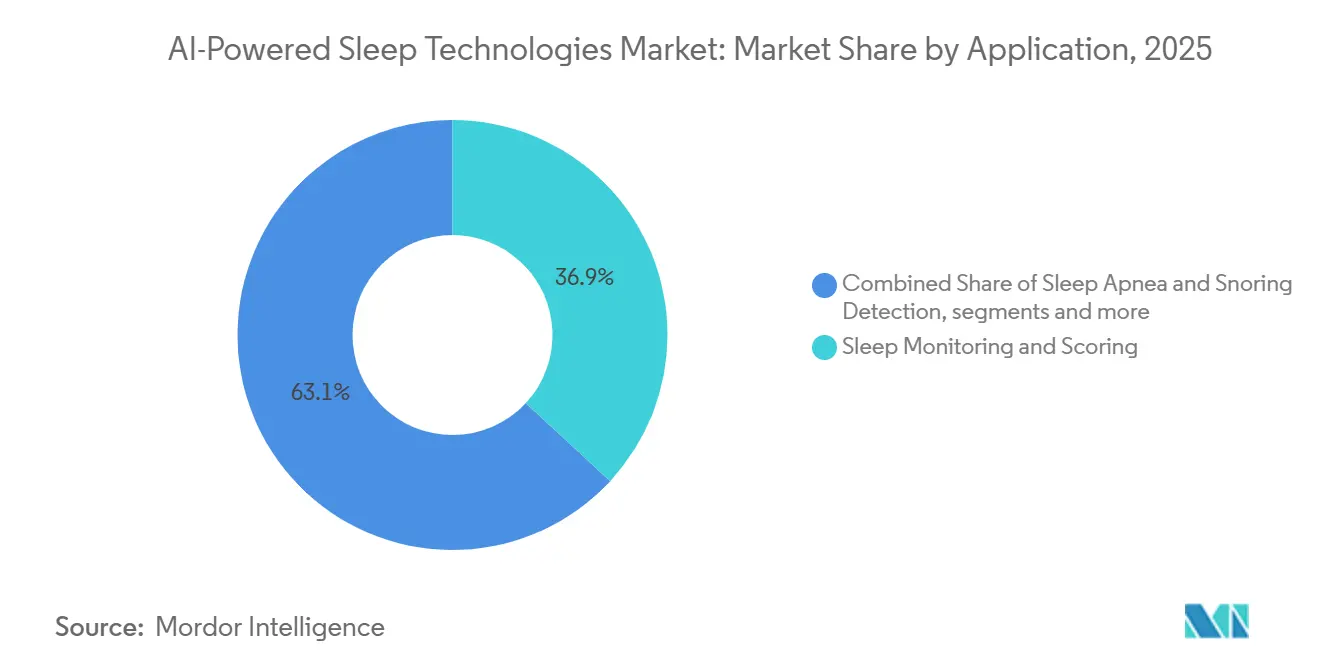
Sleep monitoring and scoring accounted for 36.92% of the AI-powered sleep technologies market in 2025, while sleep apnea and snoring detection are forecasted to grow at 22.57% through 2031. Monitoring still leads because it remains the core use case that supports both consumer tracking and institutional diagnostic workflows. The AI-powered sleep technologies market is now seeing stronger clinical weight move toward apnea detection as regulatory clearances expand the reachable screening population in consumer and home settings.
Sleep optimization and coaching are also changing because platforms are becoming active responders instead of passive dashboards. Eight Sleep reported that its Health Check feature monitors cardiovascular and respiratory patterns with up to 99% claimed accuracy and can trigger real-time environmental adjustments. This is pushing the AI-powered sleep technologies market toward applications that can show measurable clinical benefit rather than only engagement metrics.
By End-User: Clinical Settings Anchor Volume, Home Care Reshapes the Demand Curve
Hospitals accounted for 34.74% of end-user revenue in 2025, while Home Care Settings are expected to grow at 21.26% through 2031. Hospitals remain central to the AI-powered sleep technologies market because they concentrate high-acuity diagnostics, polysomnography interpretation, and clinical-grade respiratory therapy support. Sleep clinics and centers also remain important because they are under pressure to shorten scoring workflows and reduce labor intensity without weakening clinical confidence.
Home care settings are anticipated to be the fastest growth engine, because it aligns with patient convenience and payer pressure to manage costs outside the lab. The AI-powered sleep technologies market is seeing this shift reinforced by a larger supply of at-home diagnostic devices and software-guided follow-up tools. Taken together, these patterns show an end-user mix that still relies on clinical settings for revenue scale while moving new adoption toward lower-friction monitoring and therapy delivery at home.
Geography Analysis
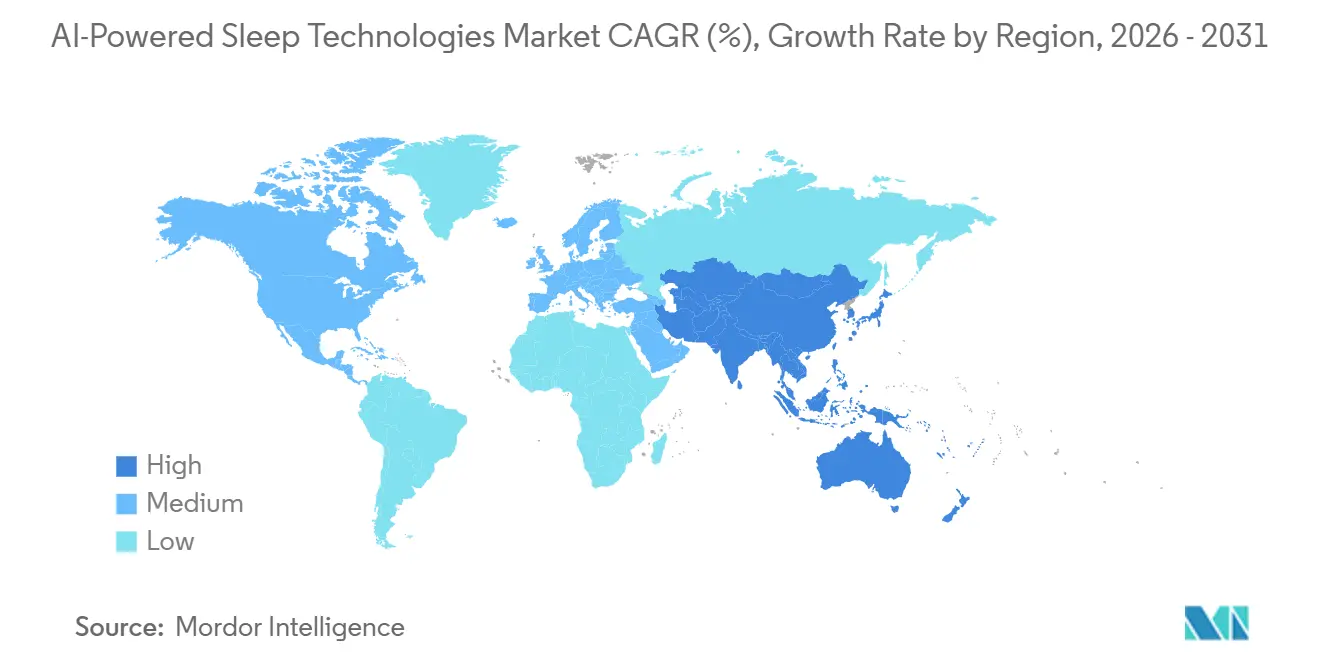
North America held 41.28% of the AI-powered sleep technologies market share in 2025. The region leads because it combines a high burden of diagnosed and undiagnosed sleep disorders with strong clinical infrastructure and a more active regulatory path for AI-enabled sleep tools. Respiratory Medicine estimated 83.7 million U.S. adults had obstructive sleep apnea in 2024, which gives the region a very large screening and management base.
Europe remains important to the AI-powered sleep technologies market because adoption is increasingly tied to clinical validation and data governance. The region has strong provider infrastructure, but products that want a clinical role face a higher burden around evidence quality, interoperability, and privacy-ready data handling. The technical path is improving, as Frontiers in Digital Health documented GDPR-compliant HL7 FHIR integration of Garmin wearable sleep data into a standardized repository, which supports more practical clinical use of consumer-generated information. This means the European AI-powered sleep technologies market is likely to favor companies that can translate consumer-grade monitoring into compliant clinical workflows.
Asia-Pacific is projected to be the fastest-growing region in the AI-powered sleep technologies market, with a projected CAGR of 23.86% through 2031. China is supporting the category through policy direction, as national planning and healthy living initiatives now give sleep health a clearer place inside broader prevention and brain science priorities. These signals matter because they strengthen both consumer demand and institutional acceptance across the region. Middle East and Africa, especially the GCC, and parts of South America, remain earlier-stage opportunities where premium products are entering through global wearable ecosystems first. In those markets, the AI-powered sleep technologies market is likely to expand more gradually until pricing, reimbursement, and care infrastructure become more supportive.

Competitive Landscape
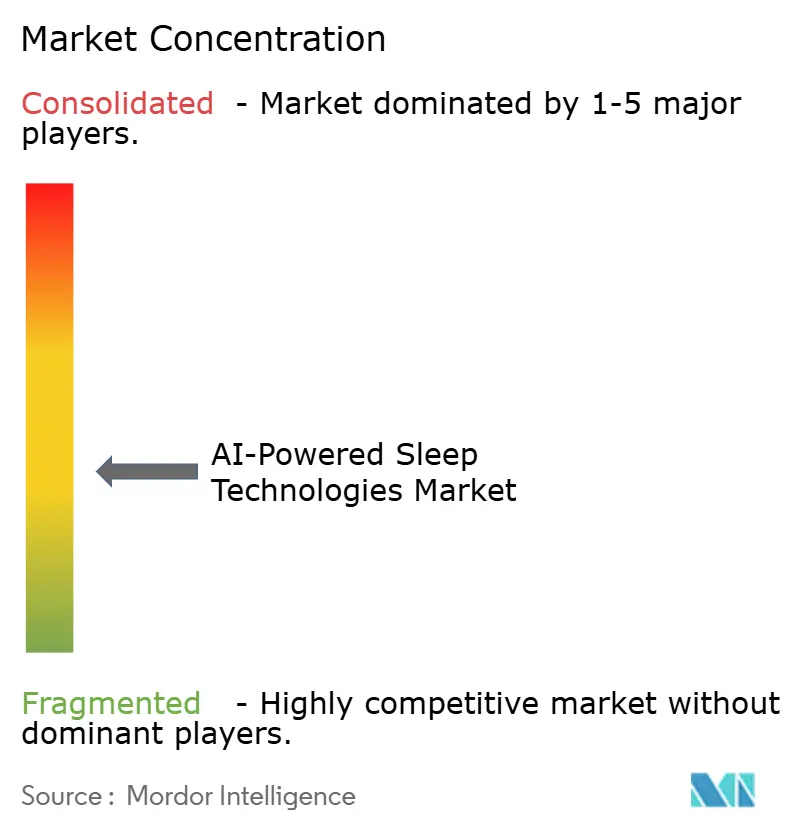
The AI-powered sleep technologies market remains fragmented because competition is spread across medical device specialists, consumer electronics brands, and pure-play sleep technology firms. No single company controls the full spectrum from regulated diagnostics to behavior therapy and connected sleep environments. Consumer device companies are approaching the AI-powered sleep technologies market through ecosystem integration, health notification features, and habitual daily use, with Samsung’s FDA-authorized sleep apnea feature standing out as a current example.
Pure-play innovators are competing by moving from monitoring into intervention and disease-specific applications. Eight Sleep said in 2025 that it would use new funding to accelerate AI-powered sleep optimization, expand into medical use cases, and grow its global footprint, which shows how direct-to-consumer players are trying to cross into clinically meaningful care. These moves show that the AI-powered sleep technologies market is rewarding firms that choose a clearer lane rather than trying to cover every layer of the category at once.
Clinical workflow software is another important field within the AI-powered sleep technologies market. EnsoData’s FDA 510(k) clearance for AI-powered sleep diagnosis using pulse oximetry devices illustrates how value can be created by reducing manual scoring effort inside established care settings. Companies that build stronger evidence across comorbid populations, such as cardiovascular and metabolic patients, are likely to improve their positioning as sleep health becomes more integrated with broader chronic care. The same is true for firms that can support multimodal data fusion without weakening privacy protection or interpretability. Over the next few years, the AI-powered sleep technologies market is likely to see stronger separation between platforms that can prove clinical utility and those that remain limited to consumer engagement. That makes validation quality, regulatory fluency, and longitudinal data depth the main competitive filters rather than hardware specifications alone.
AI-Powered Sleep Technologies Industry Leaders
ResMed Inc.
Apple Inc.
Google LLC
Oura Health Oy
Samsung Electronics Co., Ltd.
- *Disclaimer: Major Players sorted in no particular order

Recent Industry Developments
- July 2026: ResMed announced the sale of its MatrixCare long-term care software subsidiary for USD 490 million in cash, a strategic divestiture signaling the company's intention to concentrate resources on core sleep health and respiratory care technology platforms.
- May 2026: Sunrise received FDA clearance for its new rechargeable at-home sleep test, marking a major advancement in home sleep testing technology.
- April 2026: The US FDA issued a final order under 21 CFR 868.2376 classifying mandibular movement-based sleep apnea testing devices as Class II with Special Controls, formalizing the regulatory framework for this AI-augmented contactless sensing modality effective April 22, 2026.


Global AI-Powered Sleep Technologies Market Report Scope
According to the report’s scope, the AI-powered sleep technologies market comprises artificial intelligence-enabled devices, software, and digital platforms that monitor, analyze, and optimize sleep patterns, detect sleep disorders, and deliver personalized insights and interventions to improve sleep health and overall well-being.
The AI-powered sleep technologies market is segmented into product type, technology, application, end-user, and geography. By product type, the market is segmented into AI-enabled sleep trackers, AI-integrated sleep environment devices, AI-driven sleep therapeutics and interventions, and sleep apps and digital sleep platforms. By technology, the market is segmented into machine learning and sensor fusion, radar, audio, and thermal sensing, AI-guided behavioral therapy, and cloud and edge AI integration. By application, the market is segmented into sleep monitoring and scoring, sleep apnea and snoring detection, sleep optimization and coaching, and digital sleep therapy. By end-user, the market is segmented into home care settings, hospitals, sleep clinics and centers, and corporate wellness and research programs. By geography, the market is segmented into North America, Europe, Asia-Pacific, the Middle East and Africa, and South America. The report also covers the estimated market sizes and trends for 17 countries across major regions globally. The report offers values (USD) for all the above segments.
| AI-Enabled Sleep Trackers |
| AI-Integrated Sleep Environment Devices |
| AI-Driven Sleep Therapeutics and Interventions |
| Sleep Apps and Digital Sleep Platforms |
| Machine Learning and Sensor Fusion |
| Radar, Audio, and Thermal Sensing |
| AI-Guided Behavioral Therapy |
| Cloud and Edge AI Integration |
| Sleep Monitoring and Scoring |
| Sleep Apnea and Snoring Detection |
| Sleep Optimization and Coaching |
| Digital Sleep Therapy |
| Home Care Settings |
| Hospitals |
| Sleep Clinics and Centers |
| Corporate Wellness and Research Programs |
| North America | United States |
| Canada | |
| Mexico | |
| Europe | Germany |
| United Kingdom | |
| France | |
| Italy | |
| Spain | |
| Rest of Europe | |
| Asia-Pacific | China |
| Japan | |
| India | |
| Australia | |
| South Korea | |
| Rest of Asia-Pacific | |
| Middle East and Africa | GCC |
| South Africa | |
| Rest of Middle East and Africa | |
| South America | Brazil |
| Argentina | |
| Rest of South America |
| By Product Type | AI-Enabled Sleep Trackers | |
| AI-Integrated Sleep Environment Devices | ||
| AI-Driven Sleep Therapeutics and Interventions | ||
| Sleep Apps and Digital Sleep Platforms | ||
| By Technology | Machine Learning and Sensor Fusion | |
| Radar, Audio, and Thermal Sensing | ||
| AI-Guided Behavioral Therapy | ||
| Cloud and Edge AI Integration | ||
| By Application | Sleep Monitoring and Scoring | |
| Sleep Apnea and Snoring Detection | ||
| Sleep Optimization and Coaching | ||
| Digital Sleep Therapy | ||
| By End-User | Home Care Settings | |
| Hospitals | ||
| Sleep Clinics and Centers | ||
| Corporate Wellness and Research Programs | ||
| By Geography | North America | United States |
| Canada | ||
| Mexico | ||
| Europe | Germany | |
| United Kingdom | ||
| France | ||
| Italy | ||
| Spain | ||
| Rest of Europe | ||
| Asia-Pacific | China | |
| Japan | ||
| India | ||
| Australia | ||
| South Korea | ||
| Rest of Asia-Pacific | ||
| Middle East and Africa | GCC | |
| South Africa | ||
| Rest of Middle East and Africa | ||
| South America | Brazil | |
| Argentina | ||
| Rest of South America | ||


Key Questions Answered in the Report
What is the current outlook for the AI-powered sleep technologies market?
The market is projected to grow from USD 5.92 billion in 2025 to USD 6.91 billion in 2026 to USD 17.46 billion by 2031, which reflects a 20.35% CAGR over the forecast period.
Which product category currently leads revenue?
AI-enabled sleep trackers led in 2025 with 42.83% revenue share, supported by strong adoption of wearables, rings, and under-mattress systems.
Which application is growing the fastest?
Sleep apnea and snoring detection is expected to be the fastest-growing application, with a projected 22.57% CAGR through 2031 as at-home testing and regulated screening features expand.
Which region is expanding the fastest?
Asia-Pacific is forecasted to grow at 23.86% CAGR through 2031, supported by policy attention in China and favorable cost-effectiveness evidence for digital insomnia treatment in South Korea.
Page last updated on:





