
AI-Powered Embryo Selection Market Size and Share
Market Overview
| Study Period | 2020 - 2031 |
|---|---|
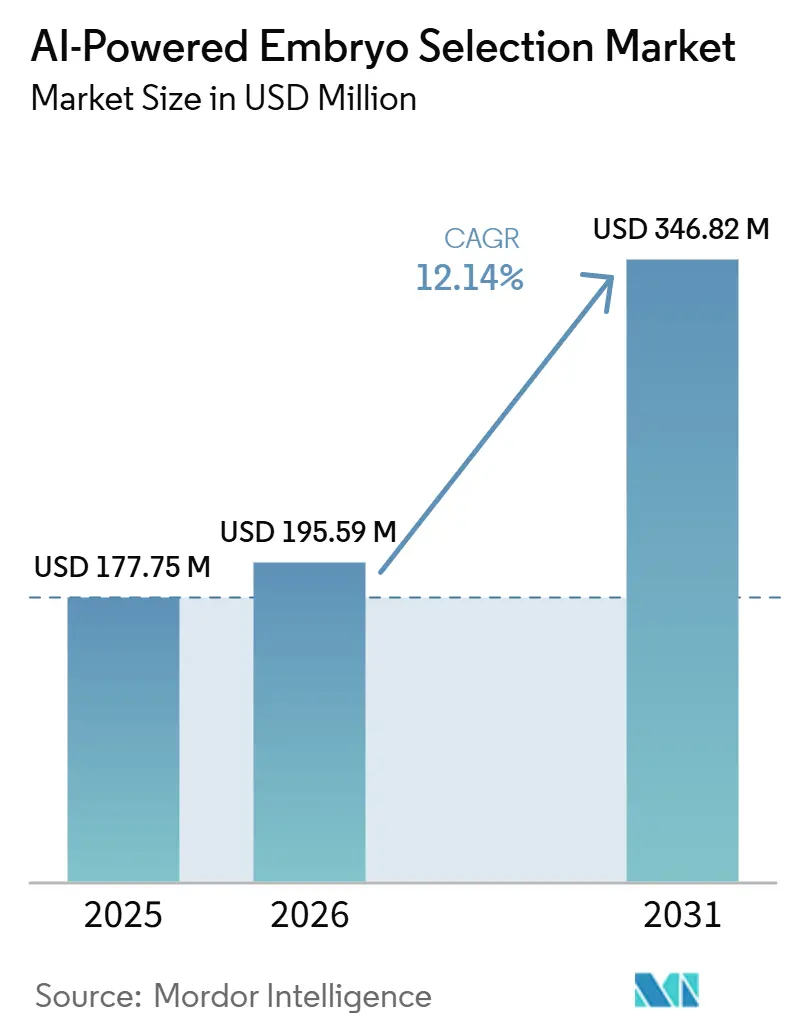
| Market Size (2026) | USD 195.59 Million |
| Market Size (2031) | USD 346.82 Million |
| Growth Rate (2026 - 2031) | 12.14 % |
| Fastest Growing Market | Asia-Pacific |
| Largest Market | North America |
| Market Concentration | Medium |
Major Players *Disclaimer: Major Players sorted in no particular order Image © Mordor Intelligence. Reuse requires attribution under CC BY 4.0. | |
AI-Powered Embryo Selection Market Analysis by Mordor Intelligence
The AI-powered embryo selection market is expected to grow from USD 177.75 million in 2025 to USD 195.59 million in 2026 and is forecasted to reach USD 346.82 million by 2031 at 12.14% CAGR over 2026-2031. The AI-powered embryo selection market is growing because infertility remains widespread across income groups, and clinics are under more pressure to improve consistency in embryo ranking as patient expectations rise for each treatment cycle. The AI-powered embryo selection market is also benefiting from a clear shift away from purely manual grading, because professional bodies now recognize the value of more objective and repeatable laboratory assessment tools in IVF settings. Recent regulatory progress, including Alife Health’s FDA clearance in 2026, has made procurement decisions more decisive for larger clinic networks that prefer compliant tools over pre-clearance products. The AI-powered embryo selection market still shows a gap between strong academic model performance and real commercial adoption, because buyers continue to favor platforms with clearance status, workflow fit, and integration support over purely superior predictive results. This leaves room for vendors that can combine validated clinical performance, open integration, and multi-jurisdiction compliance into one offer across the AI-powered embryo selection market.
Key Report Takeaways
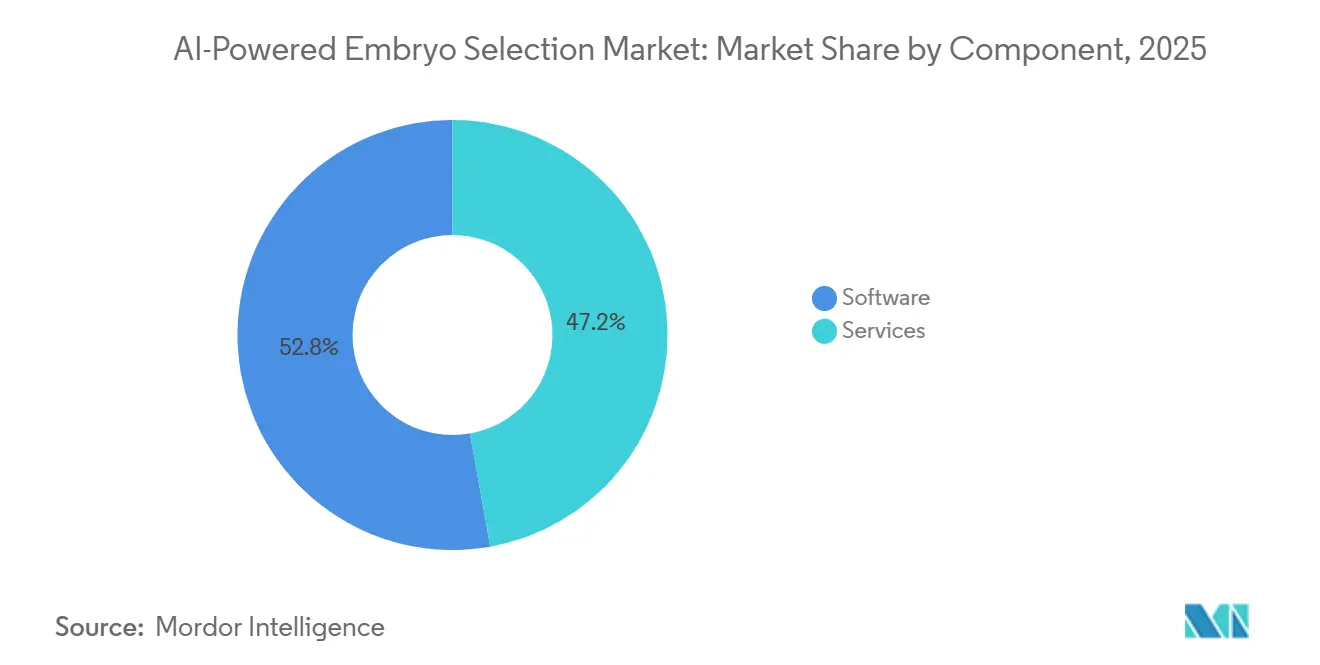
- By component, software led with 52.83% share in 2025, and software is also projected to expand at 12.62% CAGR through 2031.
- By deployment mode, cloud-based deployment held 53.27% share in 2025 and is forecasted to grow at 13.18% CAGR through 2031.
- By technology, deep learning accounted for 41.16% share in 2025, while predictive analytics is expected to advance at 13.74% CAGR through 2031.
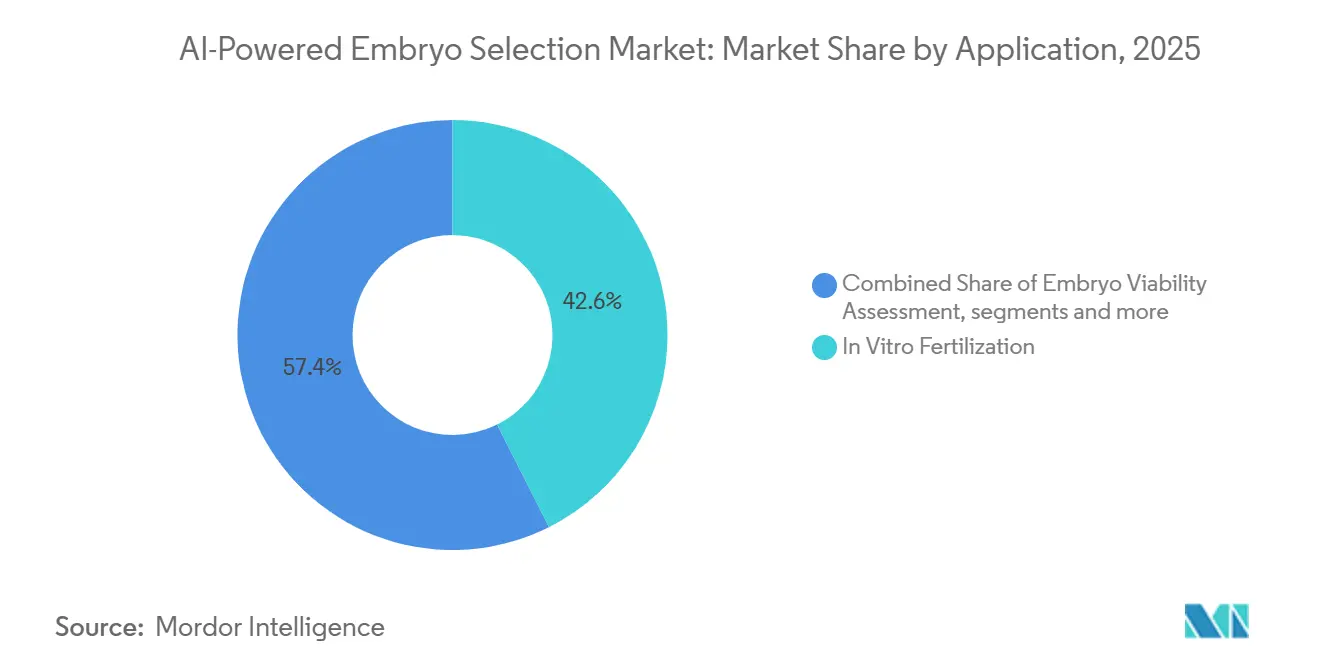
- By application, in vitro fertilization accounted for 42.61% of the AI-powered embryo selection market in 2025, while embryo monitoring and time-lapse analysis are projected to grow at 14.03% CAGR through 2031.
- By end-user, fertility clinics and IVF centers held 49.42% share in 2025, while hospitals and specialty care centers are forecasted to expand at 14.57% CAGR through 2031.
- By geography, North America held 45.74% of the AI-powered embryo selection market share in 2025, while Asia-Pacific is projected to expand at 15.31% CAGR through 2031.
Note: Market size and forecast figures in this report are generated using Mordor Intelligence’s proprietary estimation framework, updated with the latest available data and insights as of January 2026.
Global AI-Powered Embryo Selection Market Trends and Insights
Drivers Impact Analysis*
| Driver | (~) % Impact on CAGR Forecast | Geographic Relevance | Impact Timeline |
|---|---|---|---|
| Rising Infertility and Delayed Parenthood | +2.5% | Global, with intensity in South Asia, East Asia, and Western Europe | Medium term (2-4 years) |
| Need to Reduce Subjectivity in Embryo Grading | +2.0% | Global, particularly North America, EU, and Australia | Short term (≤ 2 years) |
| Higher IVF Success Expectations from Clinics and Patients | +1.5% | North America and Western Europe | Short term (≤ 2 years) |
| Growing Adoption of Time-Lapse Imaging Workflows | +2.2% | APAC core, spill-over to MEA | Medium term (2-4 years) |
| Expansion of Data-Rich Digital Fertility Ecosystems | +1.7% | North America and EU | Long term (≥ 4 years) |
| Increasing Integration of AI Into IVF Laboratory Decision-Making | +1.3% | Global | Medium term (2-4 years) |
| Source: Mordor Intelligence | |||
Rising Infertility and Delayed Parenthood
The AI-powered embryo selection market draws its core demand from the wide reach of infertility across adult populations, because the issue affects 17.5% of adults globally and shows little meaningful variation between higher-income and lower-income regions.[1]World Health Organization, “1 in 6 People Globally Affected by Infertility: WHO,” WHO News Release, who.int That demand base is becoming more complex, because a 2025 study showed that global male infertility cases rose by 74.7% between 1990 and 2021, which pushes clinics toward more detailed assessment protocols instead of simpler, single-factor evaluation paths.[2]“Global, Regional, and National Burden and Trends of Reproductive-Aged Male and Female Infertility from 1990–2021,” Frontiers in Endocrinology, frontiersin.org The AI-powered embryo selection market also benefits from the growing weight of delayed parenthood, since later treatment entry often comes with tighter cycle economics and stronger pressure to avoid avoidable embryo selection errors. This creates a large and recurring clinical pool for the AI-powered embryo selection market, especially where patients are already paying heavily for each IVF attempt and want more disciplined ranking support. It also means clinics have stronger reasons to pay for tools that improve consistency when they serve older patients or patients coming into repeated transfer cycles.
Need to Reduce Subjectivity in Embryo Grading
The AI-powered embryo selection market is gaining traction because manual embryo grading still shows clear reproducibility limits in daily laboratory practice. Alife Health cited a 34.6% disagreement rate among specialists choosing the top embryo from a cohort, and the disagreement rose to 44% when 3 or more embryos were available for review.[3]Alife Health, “Alife Health Receives FDA Clearance for AI-Powered Embryo Assessment,” Alife Health, alifehealth.com This matters commercially because clinics are no longer viewing embryo ranking as a purely individual judgment task, especially when different staff members may reach different conclusions on the same image set. The American Society for Reproductive Medicine stated in 2024 that AI systems can support more objective and more consistent evaluation inside the IVF laboratory, which gives the AI-powered embryo selection market a stronger clinical legitimacy base. As a result, the AI-powered embryo selection market is increasingly tied not only to outcome expectations, but also to auditability, repeatability, and clearer process control across multi-site fertility networks.
Growing Adoption of Time-Lapse Imaging Workflows
The AI-powered embryo selection market depends heavily on time-lapse imaging because continuous embryo image capture provides the structured developmental record that commercial scoring models use most effectively. Once a clinic adopts time-lapse systems, the next purchase decision often shifts from hardware alone to software layers that can interpret large image sequences more consistently than manual review. This is important for the AI-powered embryo selection market because the data burden from repeated image capture grows quickly, and that encourages cloud processing, subscription contracts, and ongoing model updates instead of one-time equipment spending. In practice, time-lapse adoption is helping move the AI-powered embryo selection market toward recurring software revenue built around installed imaging infrastructure rather than isolated device sales.
Expansion of Data-Rich Digital Fertility Ecosystems
The AI-powered embryo selection market is moving deeper into data-led competition because model quality depends on the size, diversity, and clinical linkage of training datasets. Vitrolife stated that iDAScore was trained on more than 180,000 time-lapse sequences with known clinical outcomes, which shows the scale advantage that larger installed-base vendors already hold. A 2025 review in MDPI Information also noted that many deployed algorithms were trained mainly on European populations, which raises generalizability concerns when those tools are used across South Asia, East Asia, or Sub-Saharan Africa. This keeps the AI-powered embryo selection market focused on dataset quality, multicenter validation, and broader population coverage, because future winners will need both scale and transferability.
Restraints Impact Analysis*
| Restraint | (~) % Impact on CAGR Forecast | Geographic Relevance | Impact Timeline |
|---|---|---|---|
| High Validation Burden for Clinical Deployment | -1.1% | North America, EU, Australia | Short term (≤ 2 years) |
| Limited Multicenter Training Data and Interoperability Gaps | -0.8% | Global | Medium term (2-4 years) |
| Ethical Concerns Around Algorithmic Transparency and Bias | -0.7% | North America, EU, especially Germany under Embryonenschutzgesetz | Long term (≥ 4 years) |
| Uneven Reimbursement and Capital Budget Priorities in Fertility Care | -1.0% | MEA, South America, Southeast Asia | Medium term (2-4 years) |
| Source: Mordor Intelligence | |||
High Validation Burden for Clinical Deployment
The AI-powered embryo selection market faces a meaningful slowdown due to the cost and duration of clinical validation. In Europe, the EU AI Act classifies embryo selection software as high-risk AI, which means vendors must support explainability, risk controls, and post-market oversight alongside medical device obligations. These requirements extend development timelines and redirect spending toward documentation, validation, and monitoring instead of faster product iteration. This favors companies with established trial networks, existing compliance teams, and enough funding to manage multi-country submissions without pausing commercial execution. As a result, the AI-powered embryo selection market gives smaller vendors less room to compete quickly, even when their technical models perform well in early studies.
Uneven Reimbursement and Capital Budget Priorities in Fertility Care
The AI-powered embryo selection market is also constrained by the uneven way fertility treatment is funded across countries, because AI-related software fees are still less likely to be reimbursed than the underlying IVF procedure. ESHRE noted that France reimburses 100% of up to 4 IVF cycles for eligible women, Belgium covers up to 6 cycles with near-full reimbursement, and Germany covers 50% of costs for up to 3 cycles for qualifying married couples. Even in those systems, explicit reimbursement for AI embryo selection software was not established, which keeps procurement dependent on clinic budgets rather than public payment pathways. This gap matters most in volume markets where clinics must balance laboratory upgrades against margin pressure from reimbursement limits. It also means private-pay systems are often better positioned to adopt premium embryo selection tools sooner than publicly funded systems with tighter capital controls.
*Our forecasts treat driver/restraint impacts as directional, not additive. The impact forecasts reflect baseline growth, mix effects, and variable interactions.
Segment Analysis
By Component: Software Subscription Economics Displace Hardware-Bundled Models
Software dominated the AI-powered embryo selection market in 2025, capturing 52.83% of revenue, and is expected to grow at the fastest CAGR of 12.62%, indicating strong value creation opportunities in this segment. Clinics have increasingly favored per-cycle or subscription pricing because it lowers the initial hurdle compared with buying new imaging hardware for every site. In this structure, adoption is tied more closely to laboratory throughput and clinical workflow use than to one-time procurement events.
The services layer remains important because integration, training, validation support, and workflow setup still affect whether a tool is used consistently after purchase. Over time, the winning component strategies in the AI-powered embryo selection market will likely remain those that combine recurring software revenue with enough service depth to keep clinics active after deployment.


By Deployment Mode: Cloud Infrastructure Scales as Per-Cycle Data Volume Grows
Cloud-based deployment held 53.27% share in 2025 and is projected to expand at 13.18% CAGR through 2031, making it the leading deployment path in the AI-powered embryo selection market. That lead reflects the practical demands of time-lapse image storage, remote access, model updates, and cross-site workflow management. High-throughput IVF centers generate large image archives, and cloud architecture lets those sites avoid repeated local hardware expansion while keeping access available across laboratory teams. It also fits vendor economics, because cloud deployment supports centralized updates and more consistent model version control across many clinic locations.
On-premises deployment still remains relevant in settings where patient data rules, local governance preferences, or internal IT policies make external hosting harder to approve. Large networks are more likely to use cloud for coordination, analytics, and updates, while some clinics will preserve local deployment for control and governance reasons. The long-term result is a mixed deployment structure where the AI-powered embryo selection market supports both centralized scale and local compliance needs instead of forcing one uniform model.
By Technology: Deep Learning Anchors Scoring Accuracy, Predictive Analytics Redefines the Value Horizon
Deep learning accounted for 41.16% of technology revenue in 2025, which reflects its central role in reading time-lapse embryo images at a commercial scale. A 2025 scoping review in Frontiers in Reproductive Health found that deep learning models applied to time-lapse imaging consistently improved implantation outcome prediction beyond morphology alone. Deep learning also supports adjacent functions across fertility laboratories, including sperm selection, oocyte assessment, and related imaging workflows. In the current AI-powered embryo selection industry, this keeps deep learning at the center of product design even when companies present broader analytics roadmaps.
Predictive analytics and data integration are forecasted to grow at 13.74% CAGR through 2031, because the market is moving from binary viability signals toward broader probability-based success forecasting. The 2026 npj Digital Medicine trial emulation also showed that newer foundational models can improve predictive intensity beyond established tools, which suggests that technical competition in the AI-powered embryo selection market will remain active. At the same time, Europe’s explainability demands are pushing vendors to make predictive outputs clearer and easier to defend, so the AI-powered embryo selection market is rewarding not only accuracy but also interpretability.
By Application: IVF Anchors Revenue While Embryo Monitoring Generates the AI Data Stack
In vitro fertilization held 42.61% share in 2025, which made IVF the largest application base within the AI-powered embryo selection market. That position is logical because embryo selection decisions sit directly inside IVF laboratory workflows, and clinics measure their value against transfer outcomes, cycle efficiency, and patient expectations. Embryo monitoring and time-lapse analysis are projected to grow at 14.03% CAGR through 2031, because it serves both as a standalone monitoring function and as the core image pipeline for later AI scoring. The AI-powered embryo selection market, therefore, keeps IVF at the center of revenue while time-lapse activity expands the information base that makes advanced scoring possible.
Embryo viability assessment is also gaining support from non-invasive ploidy work, which may reduce dependence on more invasive and more expensive testing in selected use cases. Cryopreservation and frozen embryo transfer workflows create a different challenge, because post-thaw assessment often has less real-time developmental data than fresh-cycle monitoring. This is why the AI-powered embryo selection market is likely to keep rewarding applications that both improve present workflow decisions and expand the data foundation for the next generation of models.

By End-User: Fertility Clinics Set the Standard, Hospitals Scale Through Oncofertility
Fertility clinics and IVF centers held 49.42% share in 2025, confirming that the main buying and usage base of the AI-powered embryo selection market still sits inside dedicated reproductive care sites. These centers handle embryo ranking directly, track cycle-level outcomes closely, and often move faster than broader hospital systems when a tool shows clear workflow value. Hospitals and specialty care centers are projected to grow at 14.57% CAGR through 2031, which shows that demand is spreading beyond standalone fertility providers. In the AI-powered embryo selection market, that expansion is tied to settings where reproductive decisions must be made under tighter timelines or with less concentrated embryology depth.
Oncofertility is one reason hospitals are becoming more relevant, because cancer-related fertility preservation can require rapid embryo banking decisions in environments that are not built around a large IVF-only workflow. In those settings, AI tools can function more as workflow support than as optional premium add-ons. As a result, the AI-powered embryo selection market depends on clinics for current revenue, hospitals for the next wave of operational expansion, and academic centers for the evidence base that keeps the category moving forward.
Geography Analysis
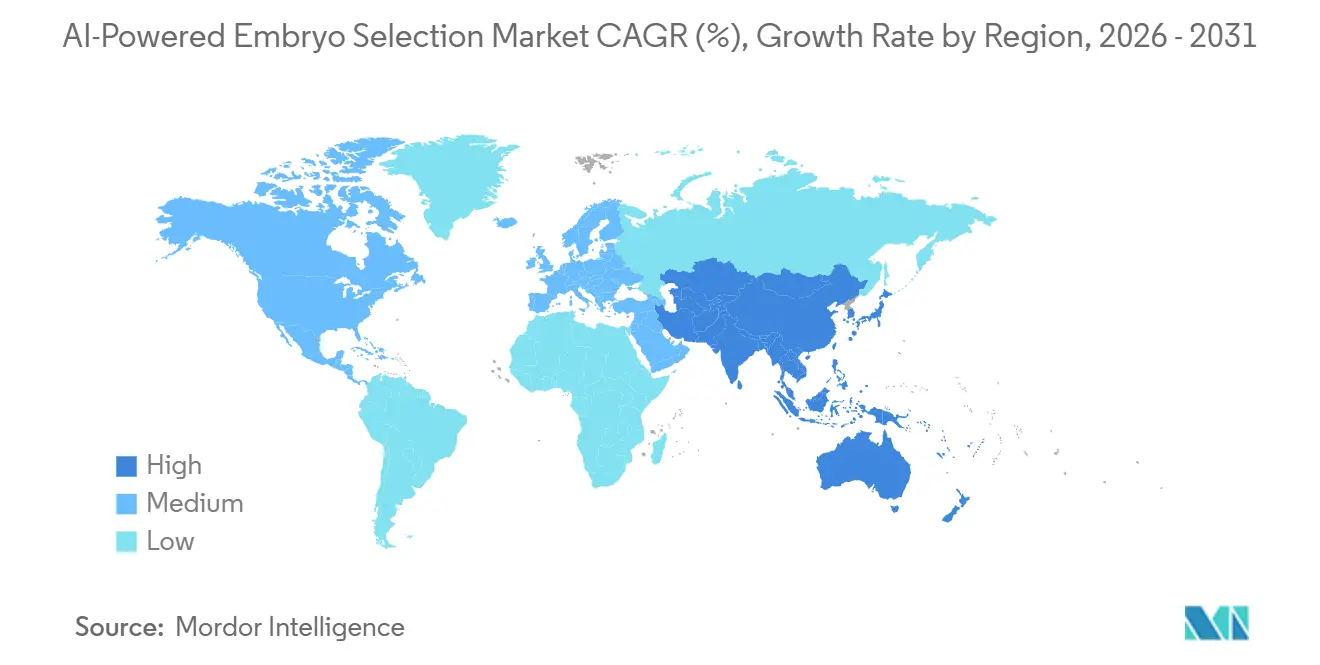
North America held 45.74% of the AI-powered embryo selection market share in 2025, and that leadership reflected the region’s concentration of regulated products, advanced IVF networks, and venture-backed fertility technology activity. The AI-powered embryo selection market is more mature in North America because U.S. procurement committees place clear value on FDA status when they assess whether a tool is ready for routine clinical use. Private-pay fertility economics also support adoption, since out-of-pocket IVF cycles in the United States can range from USD 12,000 to USD 25,000 and leave room for premium add-on software within a patient-funded treatment model. This makes the AI-powered embryo selection market more commercially responsive in North America than in systems where reimbursement decides most technology spending.
Asia-Pacific is projected to be the fastest-growing regional slice of the AI-powered embryo selection market, with 15.31% CAGR projected through 2031. The region’s growth path is tied to a mix of high infertility burden, improving access to ART, and large addressable patient pools that can support software licensing over time. The AI-powered embryo selection market is especially well-positioned in Asia-Pacific, where treatment access is expanding, and clinics are seeking better cycle economics without adding invasive steps to every case. India stands out because a large number of infertile couple base to a growing IVF ecosystem, even though the rewritten analysis retains only the population-side evidence supported by UNFPA.
Europe remains structurally important to the AI-powered embryo selection market because it combines high IVF activity with demanding compliance standards that influence product design well beyond the region itself. The EU AI Act has made explainability, bias controls, and post-market monitoring more central for high-risk reproductive AI, which raises the bar for commercial entry while also pushing vendors toward more defensible model behavior. Germany’s stricter reproductive framework limits adoption more than in markets such as France, Belgium, or Spain, where broader use of AI-assisted selection fits more easily into clinical practice patterns. Middle East and Africa, along with South America, remain earlier-stage opportunities in the AI-powered embryo selection market, where private-pay centers will likely move ahead of publicly constrained systems as capital budgeting and reimbursement continue to shape adoption speed.

Competitive Landscape
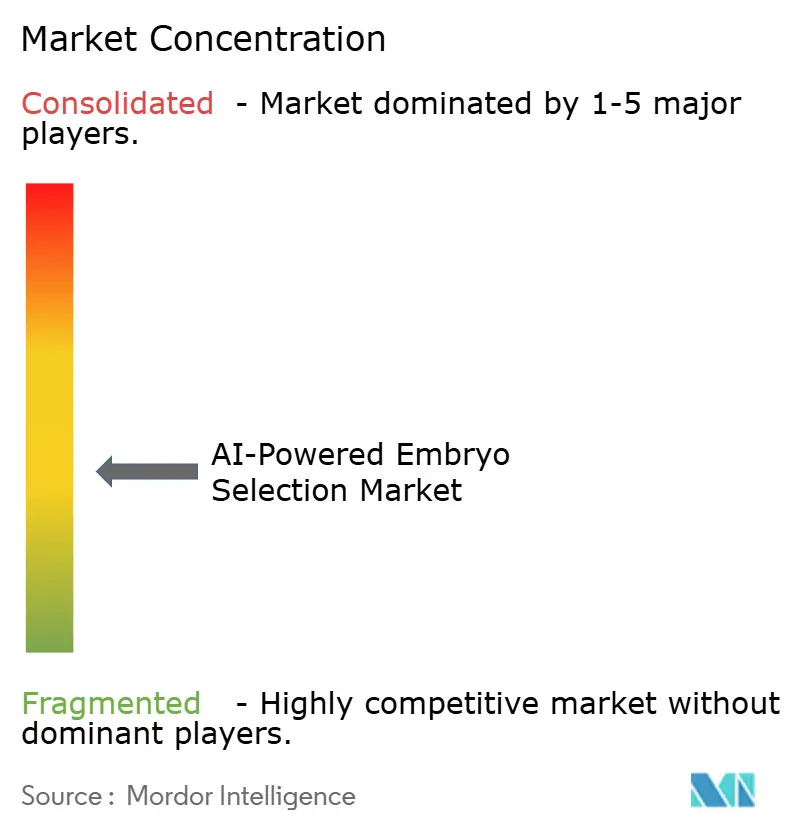
The AI-powered embryo selection market shows moderate fragmentation, with competition split between hardware-linked platform companies and software-led specialists. Vitrolife holds a strong position because it combines the EmbryoScope platform with iDAScore, and the company stated that iDAScore was trained on more than 180,000 time-lapse sequences with known outcomes. That installed base matters because clinics that already use integrated imaging systems face practical switching costs once scoring, image review, and embryology routines are linked to a single workflow. This gives hardware-linked incumbents a durable edge even when newer models show strong technical results in academic comparisons.
CooperSurgical competes from a broader reproductive workflow angle, using its PGTai platform to connect embryo grading, sperm selection, and preimplantation genetic testing within one operating stack. That strategy gives the company relevance in the AI-powered embryo selection market even when buyers want more than a standalone embryo scoring tool. The AI-powered embryo selection market is, therefore, rewarding companies that can reduce implementation burden while still meeting the higher evidence and compliance expectations now shaping buyer behavior.
A second important pattern is that strong academic performance does not automatically create commercial leadership in the AI-powered embryo selection market. This means the next competitive tier will likely be defined by companies that can combine validated prediction, regulatory acceptance, and open workflow fit rather than excelling on only one dimension. It also means the AI-powered embryo selection market remains open enough for challengers to gain ground, but only if they can turn technical quality into trusted clinical deployment at scale.
AI-Powered Embryo Selection Industry Leaders
Vitrolife AB
CooperSurgical, Inc.
Merck KGaA
Fairtility Ltd.
Hamilton Thorne Ltd.
- *Disclaimer: Major Players sorted in no particular order

Recent Industry Developments
- June 2026: Taiwan Fertility Centers deployed iDAScore v2.0 and published clinical results demonstrating a 24% improvement in chromosomally normal embryo identification accuracy compared to standard morphological grading, providing the first documented real-world validation of next-generation AI scoring in the East Asian patient population.
- May 2026: Alife Health received FDA 510(k) clearance for Embryo Predict (K250781), supported by a prospective, randomized, 440-patient, 7-clinic trial that demonstrated a 72.9% clinical pregnancy rate versus 68% for standard evaluation; Embryo Predict integrates with existing lab microscopes without requiring new hardware.
- May 2026: SEHA's Corniche Fertility Center (Abu Dhabi, UAE), a subsidiary of PureHealth, the largest healthcare group in the Middle East, deployed Vitrolife's iDAScore AI via its EmbryoScope time-lapse system, marking the first implementation of this AI embryo selection technology within the PureHealth network.


Global AI-Powered Embryo Selection Market Report Scope
According to the report’s scope, the AI-powered embryo selection market comprises artificial intelligence-based software and imaging solutions that analyze embryo quality and developmental potential during IVF, helping embryologists improve embryo selection accuracy, increase implantation success rates, and support data-driven fertility treatment decisions.
The AI-powered embryo selection market is segmented into component, deployment mode, technology, application, end-user, and geography. By component, the market is segmented into software and services. By deployment mode, the market is segmented into cloud-based and on-premises. By technology, the market is segmented into deep learning, machine learning, computer vision and image analytics, predictive analytics and data integration, and other technologies. By application, the market is segmented into in vitro fertilization, embryo viability assessment, embryo monitoring and morphokinetic analysis, cryopreservation and embryo storage, and research and clinical trials. By end-user, the market is segmented into fertility clinics and IVF centers, hospitals and specialty reproductive centers, and research institutes and universities. By geography, the market is segmented into North America, Europe, Asia-Pacific, the Middle East and Africa, and South America. The report also covers the estimated market sizes and trends for 17 countries across major regions globally. The report offers values (USD) for all the above segments.
| Software |
| Services |
| Cloud-Based |
| On-Premises |
| Deep Learning |
| Machine Learning |
| Computer Vision and Image Analytics |
| Predictive Analytics and Data Integration |
| Other Technologies |
| In Vitro Fertilization |
| Embryo Viability Assessment |
| Embryo Monitoring and Morphokinetic Analysis |
| Cryopreservation and Embryo Storage |
| Research and Clinical Trials |
| Fertility Clinics and IVF Centers |
| Hospitals and Specialty Reproductive Centers |
| Research Institutes and Universities |
| North America | United States |
| Canada | |
| Mexico | |
| Europe | Germany |
| United Kingdom | |
| France | |
| Italy | |
| Spain | |
| Rest of Europe | |
| Asia-Pacific | China |
| Japan | |
| India | |
| Australia | |
| South Korea | |
| Rest of Asia-Pacific | |
| Middle East and Africa | GCC |
| South Africa | |
| Rest of Middle East and Africa | |
| South America | Brazil |
| Argentina | |
| Rest of South America |
| By Component | Software | |
| Services | ||
| By Deployment Mode | Cloud-Based | |
| On-Premises | ||
| By Technology | Deep Learning | |
| Machine Learning | ||
| Computer Vision and Image Analytics | ||
| Predictive Analytics and Data Integration | ||
| Other Technologies | ||
| By Application | In Vitro Fertilization | |
| Embryo Viability Assessment | ||
| Embryo Monitoring and Morphokinetic Analysis | ||
| Cryopreservation and Embryo Storage | ||
| Research and Clinical Trials | ||
| By End-User | Fertility Clinics and IVF Centers | |
| Hospitals and Specialty Reproductive Centers | ||
| Research Institutes and Universities | ||
| By Geography | North America | United States |
| Canada | ||
| Mexico | ||
| Europe | Germany | |
| United Kingdom | ||
| France | ||
| Italy | ||
| Spain | ||
| Rest of Europe | ||
| Asia-Pacific | China | |
| Japan | ||
| India | ||
| Australia | ||
| South Korea | ||
| Rest of Asia-Pacific | ||
| Middle East and Africa | GCC | |
| South Africa | ||
| Rest of Middle East and Africa | ||
| South America | Brazil | |
| Argentina | ||
| Rest of South America | ||


Key Questions Answered in the Report
What is the 2026 value of the AI-powered embryo selection market?
The AI-powered embryo selection market is expected to increase from USD 177.75 million in 2025 to USD 195.59 million by 2026 and to reach USD 346.82 million by 2031 at a 12.14% CAGR.
Which component leads revenue in this space?
Software led with 52.83% share in 2025, helped by subscription models that lower entry costs and fit clinic workflow better than hardware-heavy purchases.
Which deployment model is growing fastest?
Cloud-based deployment led with 53.27% share in 2025 and is projected to grow at 13.18% CAGR through 2031 because image storage and model updates scale better in that setup.
Which region is expanding the fastest?
Asia-Pacific is projected to be the fastest-growing region with a projected 15.31% CAGR through 2031, supported by a large infertility burden and wider ART access.
Page last updated on:





