
AI Portfolio and Pipeline Management Software Market Size and Share
Market Overview
| Study Period | 2020 - 2031 |
|---|---|
| Market Size (2026) | USD 0.65 Billion |
| Market Size (2031) | USD 1.74 Billion |
| Growth Rate (2026 - 2031) | 21.69 % |
| Fastest Growing Market | Asia-Pacific |
| Largest Market | North America |
| Market Concentration | Low |
Major Players *Disclaimer: Major Players sorted in no particular order Image © Mordor Intelligence. Reuse requires attribution under CC BY 4.0. | |
AI Portfolio and Pipeline Management Software Market Analysis by Mordor Intelligence
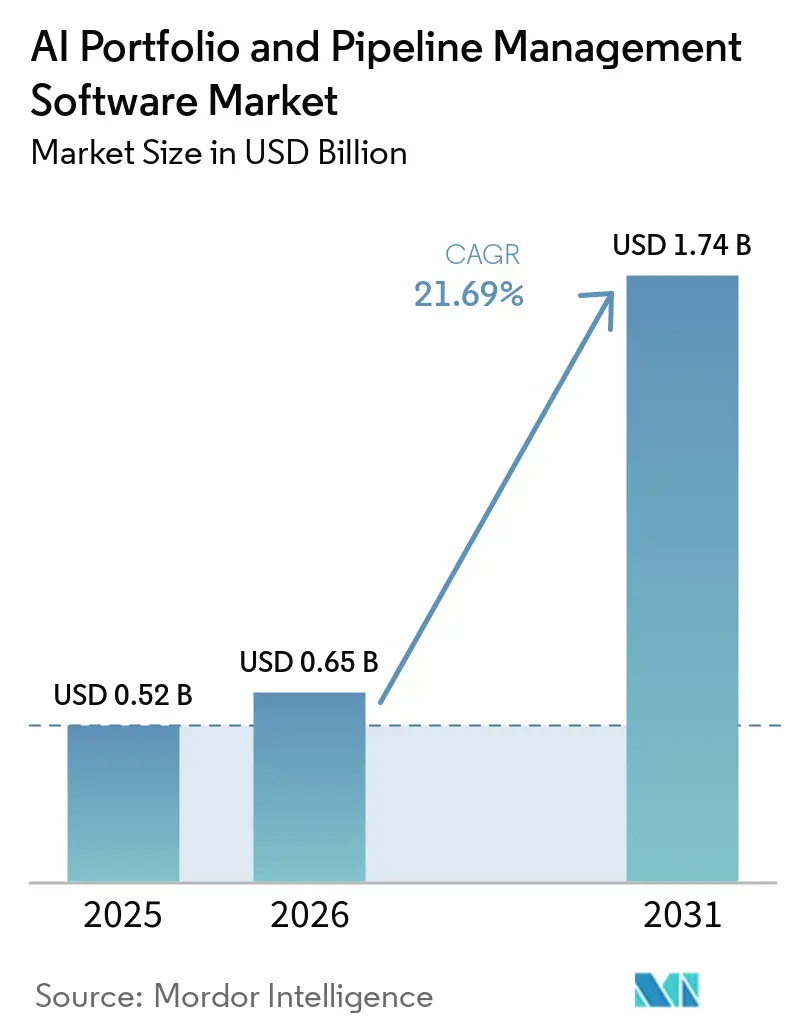
The AI portfolio and pipeline management software market size is projected to expand from USD 0.52 billion in 2025 to USD 0.65 billion in 2026, and to USD 1.74 billion by 2031, registering a CAGR of 21.69% between 2026 and 2031. The AI portfolio and pipeline management software market covers platforms that link deal sourcing, due diligence, portfolio monitoring, risk analysis, investor reporting, and corporate portfolio decisions. Private capital firms face growing pressure to replace spreadsheet-led processes because multi-vintage funds and portfolio company data are difficult to manage with manual workflows. Demand also reflects higher limited-partner expectations for timely reporting and continuing visibility into portfolio performance. Cloud delivery, governed data environments, and explainable outputs are becoming central purchasing requirements as firms connect more investment workflows. The AI portfolio and pipeline management market is also shaped by procurement concerns around confidentiality, data quality, legacy integrations, and the ability to trace recommendations to source records.
Key Report Takeaways
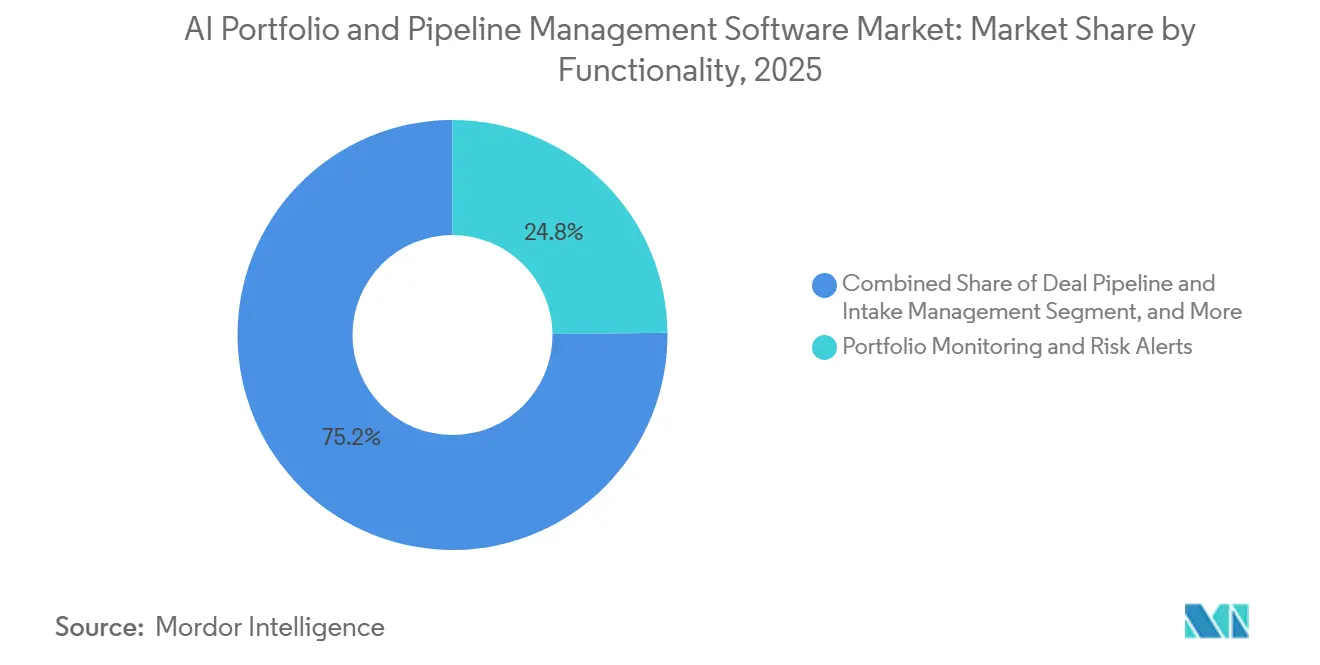
- By functionality, portfolio monitoring and risk alerts held 24.83% of the AI portfolio and pipeline management software market share in 2025, while AI due diligence and document intelligence recorded the highest projected CAGR at 22.89% through 2031.
- By deployment, cloud SaaS held 79.62% of the AI portfolio and pipeline management software market share in 2025 and is projected to grow at a 22.09% CAGR through 2031.
- By end user, private equity firms held 33.54% of the AI portfolio and pipeline management software market share in 2025, while family offices recorded the highest projected CAGR at 22.81% through 2031.
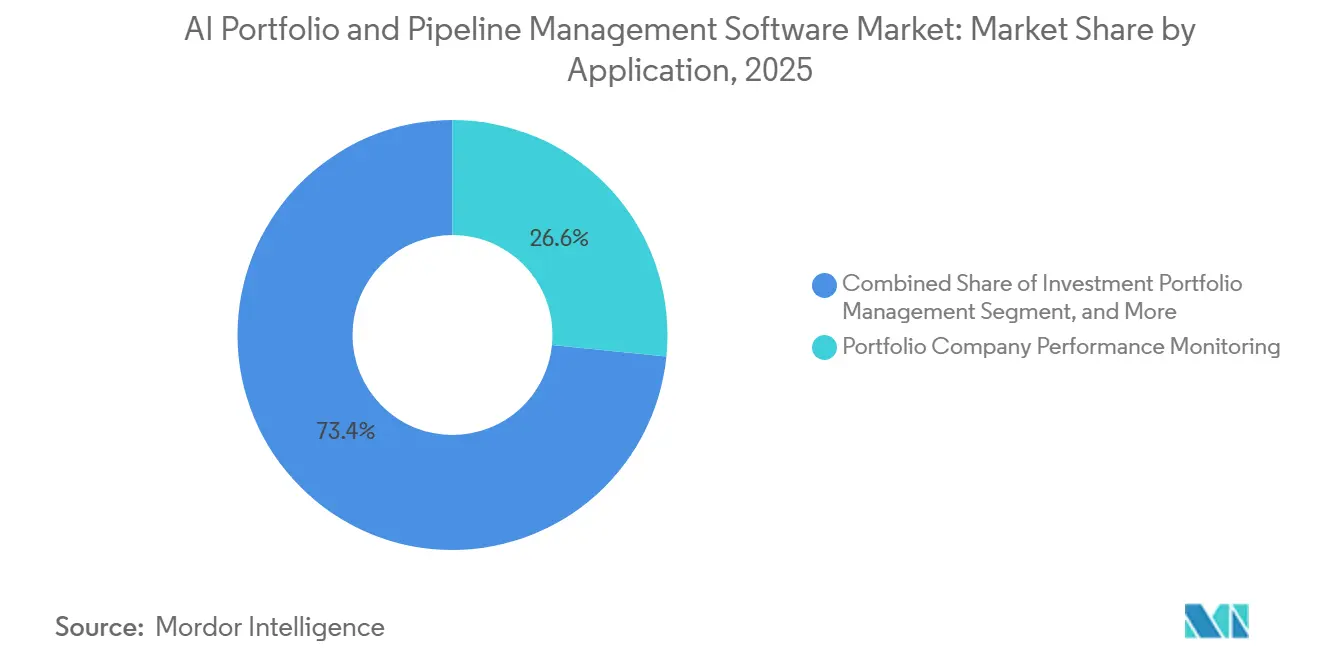
- By application, portfolio company performance monitoring held 26.59% of the AI portfolio and pipeline management software market share in 2025, while deal sourcing and pipeline management recorded the highest projected CAGR at 22.78% through 2031.
- By portfolio type, private equity and venture capital portfolios held 46.71% of the AI portfolio and pipeline management software market share in 2025, while real estate and infrastructure portfolios recorded the highest projected CAGR at 22.56% through 2031.
- By geography, North America held 44.13% of the AI portfolio and pipeline management software market share in 2025, while Asia-Pacific recorded the highest projected CAGR at 22.62% through 2031.
Note: Market size and forecast figures in this report are generated using Mordor Intelligence’s proprietary estimation framework, updated with the latest available data and insights as of January 2026.
Market Trends and Insights
Drivers Impact Analysis of AI Portfolio and Pipeline Management Software Market*
| Driver | (~) % Impact on CAGR Forecast | Geographic Relevance | Impact Timeline |
|---|---|---|---|
| Rising Demand for Explainable AI in Portfolio Decisions | +4.5% | Global, most acute in Europe and North America | Short term (≤ 2 years) |
| Automation of Deal Intake and Investment-Committee Preparation | +4.2% | Global, concentrated in North America and Europe | Short term (≤ 2 years) |
| Escalating Portfolio Data Fragmentation | +3.8% | Global, most acute in Asia-Pacific and emerging markets | Medium term (2-4 years) |
| Cloud-Native and API-First Workflow Adoption | +3.5% | Global, accelerating in Asia-Pacific and the Middle East | Medium term (2-4 years) |
| Expansion of Continuous Portfolio Monitoring | +2.5% | North America and Europe primary, with spillover to Asia-Pacific | Medium term (2-4 years) |
| Faster Detection of Portfolio Risk and Underperformance | +2.5% | Global | Short term (≤ 2 years) |
| Source: Mordor Intelligence | |||
Rising Demand for Explainable AI in Portfolio Decisions
Regulatory and fiduciary expectations are limiting the use of opaque AI in investment management. The European Securities and Markets Authority stated that investment firms remain responsible for AI-supported investment services, including the systems and controls surrounding their use.[1] This requirement favors platforms that retain audit trails, reveal the basis for outputs, and allow investment professionals to review recommendations before use. BNP Paribas Asset Management demonstrated that portfolio optimization outputs can be linked to tactical views and constraints, thereby supporting greater transparency and customization. For the AI portfolio and pipeline management software market, explainability is therefore becoming part of the product design rather than an optional compliance feature. Vendors that connect recommendations to underlying data can better address the requirements of regulated firms and their investment committees.
Automation of Deal Intake and Investment-Committee Preparation
Deal teams need to process financial, operational, commercial, and legal information without extending the time required for investment review. AI-enabled document tools can classify, extract, and compare records from large virtual data rooms, which reduces manual preparation work. This capability makes it easier to produce standardized deal summaries, risk reviews, and materials for investment committees. The AI portfolio and pipeline management software market benefits when these tools give users verifiable outputs that link back to the original documents. Buyers are likely to scrutinize how a system identifies evidence because unsupported summaries can delay approval and increase review effort. Platforms that combine document intelligence with source tracking can serve both speed and internal control requirements.
Escalating Portfolio Data Fragmentation
Portfolio companies often submit operating and financial information via spreadsheets, PDFs, and fund administrator portals, each using different formats and definitions. These differences slow reconciliation and can weaken the reliability of cross-portfolio analysis. Impax Asset Management selected ICS ATHENA in 2025 to bring multi-source investment data into a governed environment, illustrating the importance of data management before broader AI use. The AI portfolio and pipeline management software market is responding by offering data aggregation, normalization, and validation capabilities to support downstream analytics. This approach can strengthen vendor relationships, as the same provider may manage data ingestion and provide monitoring tools. It also raises barriers for narrow point products that cannot integrate with the wider data environment.
Cloud-Native and API-First Workflow Adoption
Cloud-native systems can lower the cost of integrating investment, compliance, portfolio monitoring, and investor reporting tools. FINBOURNE Technology integrated Anthropic Claude via the Model Context Protocol in June 2025, demonstrating how permission-aware AI agents can work with live investment data within governance controls.[2] API-based connections help smaller investment managers access workflows that previously required customized technology projects. Cloud SaaS held a major share of deployment demand in 2025 and is projected to grow through 2031 in the AI portfolio and pipeline management software market. The continued strength of cloud SaaS indicates that new users are entering the installed base rather than merely replacing one deployment model with another. Providers that offer clear permissions, data controls, and flexible integrations are better positioned to meet this demand.
Restraints Impact Analysis of AI Portfolio and Pipeline Management Software Market*
| Restraint | (~) % Impact on CAGR Forecast | Geographic Relevance | Impact Timeline |
|---|---|---|---|
| Confidentiality and Model-Governance Exposure | -2.8% | Global, most acute in Europe and North America | Short term (≤ 2 years) |
| Inconsistent Portfolio-Company Data Quality | -2.4% | Global, most acute in Asia-Pacific and emerging markets | Medium term (2-4 years) |
| High Switching Costs from Legacy Workflows | -1.9% | North America and Europe primarily | Medium term (2-4 years) |
| Limited Explainability in High-Stakes Investment Decisions | -1.5% | Global | Long term (≥ 4 years) |
| Source: Mordor Intelligence | |||
Confidentiality and Model-Governance Exposure
Investment managers work with confidential portfolio-company data, investor records, and commercially sensitive deal information. This creates procurement concerns when a model processes information that may be shared across cloud services or third-party tools. ESMA guidance requires firms to remain accountable for AI-supported activity, placing greater attention on data controls and governance documentation. Many buyers now expect data isolation, access controls, audit logs, and evidence of model governance before approving a platform. These requirements can lengthen sales cycles, particularly for younger vendors without established compliance practices. The AI portfolio and pipeline management software market may consequently develop at different speeds, with larger institutions better able to manage the required oversight than smaller firms.
Inconsistent Portfolio-Company Data Quality
Portfolio-company data may use different definitions for revenue, EBITDA adjustments, headcount, and other operating metrics. These inconsistencies can produce unreliable comparisons even when an AI system successfully extracts the information. RBC Wealth Management reported in 2025 that manual processes and reliance on spreadsheets were leading operational risks for family-office leaders, while adoption of automated reporting was increasing. Providers are addressing this issue through validation workflows and structured templates, but broad automation still depends on reporting discipline at each portfolio company. The constraint is especially relevant for early-stage venture portfolios, where reporting practices may be less consistent. In the AI portfolio and pipeline management software market, data quality remains a limit on the value users can obtain from cross-portfolio monitoring.
*Our forecasts treat driver/restraint impacts as directional, not additive. The impact forecasts reflect baseline growth, mix effects, and variable interactions.
AI Portfolio and Pipeline Management Software Market Segment Analysis
By Functionality:
Portfolio Monitoring Anchors Demand While AI Due Diligence AcceleratesPortfolio monitoring and risk alerts held 24.83% of the AI portfolio and pipeline management software market size in 2025. Investment managers use these systems to watch financial health, covenant headroom, operating KPIs, and changes in portfolio-company performance. Continuous oversight is replacing reliance on quarterly reporting in many private-capital workflows. Allvue Systems launched Portfolio Intelligence on OneVue in July 2026 with AI-supported KPI monitoring, covenant tracking, peer benchmarking, and private-credit benchmarks based on deal-level data. Portfolio data aggregation and deal intake tools support this function by reducing manual reconciliation before analysis begins. Investment-committee workflow tools also address a related need by standardizing the materials used in review meetings.
AI due diligence and document intelligence is projected to grow at a 22.89% CAGR through 2031, the highest rate among functionality segments. The segment supports analysis of virtual data rooms that may contain thousands of documents. Users can identify terms, compare information across files, and prepare structured materials for deal evaluation. The AI portfolio and pipeline management software market increasingly favors products that span multiple stages of the investment process. Integrated products can reduce the number of systems firms must connect to and monitor. This creates pressure on single-workflow providers unless they can offer distinctive data access, documentary evidence, or specialized analytical capabilities.

By Deployment:
Cloud SaaS Commands the Market While On-Premises Retains Structural RelevanceCloud SaaS held 79.62% of the AI portfolio and pipeline management software market share in 2025 and is projected to expand at a 22.09% CAGR through 2031. Investment managers use cloud delivery to avoid local infrastructure costs and to make data and workflows available across distributed teams. Cloud platforms also support the API connections needed to join monitoring, fund administration, compliance, and limited-partner reporting. SEI introduced an enhanced unified platform in June 2026 that combined the SEI Data Cloud with SEI Scope to provide AI-enabled portfolio analytics and automation for investment managers. This product direction reflects a preference for governed data accessed through cloud-delivered applications. The deployment model is important because it determines how easily a firm can add new data sources and users.
On-premises deployment retained a minority share because some firms face data residency requirements or handle highly sensitive information. These users may be reluctant to place all records in a shared cloud environment. Cross-border managers can face additional complexity when data must remain in particular jurisdictions. Hybrid configurations may address this concern by keeping selected data classes within local environments while allowing controlled cloud analytics. The AI portfolio and pipeline management market can therefore support multiple deployment paths even as cloud SaaS expands. Providers that make deployment options modular may have an advantage with global firms that need both scalability and data sovereignty.
By End User:
Private Equity Anchors Demand While Family Offices Emerge as the High-Growth CohortPrivate equity firms held 33.54% of the AI portfolio and pipeline management software market size in 2025. Their multi-fund and multi-vintage structures require coordinated deal tracking, portfolio monitoring, and limited-partner reporting across many companies. Venture capital funds emphasize deal flow and portfolio-company dashboards, while institutional asset managers place greater weight on compliance-integrated reporting across asset classes. Dynamo Software released Dynamo v3.0 in October 2025, combining deal sourcing, research management, investor communication, and portfolio monitoring into a single AI-enhanced interface. This type of integrated platform responds to buyers who want fewer separate applications and less integration work. Investment banks and other end users also require systems that can support distinct workflow and reporting needs.
Family offices are projected to grow at a 22.81% CAGR through 2031, the fastest rate among end users. Goldman Sachs reported in 2025 that 51% of global family offices were already using AI in their investment processes. RBC Wealth Management reported that adoption of automated investment reporting systems among family offices reached 69% in 2025, compared with 46% in 2024. These figures indicate a shift from informal, spreadsheet-led practices toward more formal operating processes. The AI portfolio and pipeline management software market offers providers a path to serve this group through cloud delivery and modular features. Family offices may become a more contested customer group as their reporting and governance requirements grow.
By Application:
Performance Monitoring Leads While Deal Sourcing Captures Fastest GrowthPortfolio company performance monitoring accounted for 26.59% of the AI portfolio and pipeline management software market size in 2025. The application supports exit timing, capital allocation, and limited-partner reporting across the fund lifecycle. Monitoring requirements also cover ESG and operational KPIs when large pension funds and sovereign wealth funds request them as investment conditions. The application is strengthened when platforms can bring financial and operating records into a common view. This allows users to spot performance changes without waiting for periodic reports. The AI portfolio and pipeline management software market uses this application as a core link between data collection and investment decisions.
Deal sourcing and pipeline management are projected to grow at a 22.78% CAGR through 2031. AI-enabled tools can screen inbound opportunities against investment criteria and prioritize them before extensive analyst review. Fundraising and limited-partner relationship management tools also help smaller funds and family offices manage data rooms and investor communications. Standard Metrics launched a portfolio-wide AI Analyst in January 2026 that analyzes platform data to support portfolio reviews, limited-partner reporting, and ad hoc analysis for venture capital and private equity firms. Deal-sourcing tools can be more defensible when they include proprietary deal networks or data partnerships. Data breadth and data quality can be difficult for competitors to reproduce through software features alone.
By Portfolio Type:
Private Equity and Venture Capital Portfolios Lead While Real Estate and Infrastructure Gain MomentumPrivate equity and venture capital portfolios held 46.71% of the AI portfolio and pipeline management software market size in 2025. These portfolios involve capital calls, waterfall calculations, portfolio-company metric tracking, and reporting across funds with different vintages. Public-market and multi-asset portfolios require real-time position analysis and compliance with investment mandates. Corporate project and product portfolios focus more on resource allocation, strategic initiatives, and R&D programs. Clearwater Analytics reported in November 2025 that its CWAN GenAI platform supported more than 800 AI agents across more than USD 10 trillion in institutional assets. This shows the use of agent-based functions in institutional investment operations beyond private markets.
Real estate and infrastructure portfolios are projected to grow at a 22.56% CAGR through 2031. The segment is supported by the digitalization of commercial real estate investment workflows and the development of tools tailored for property operators. MRI Software launched MRI Agora Intelligence and MRI Agora Orchestrator in June 2026 to provide portfolio signals, recommended actions, workflow execution, governance, and audit trails for institutional real-estate users. RealPage introduced the Lumina AI Suite in August 2026 to connect property operations, portfolio analytics, institutional intelligence, and open-model access across real-estate asset classes. The AI portfolio and pipeline management software market also includes niche demand from sovereign wealth fund overlays and insurance-linked structures. These users require controls that reflect their own governance and reporting structures.
Geography Analysis
North America AI Portfolio and Pipeline Management Software Market
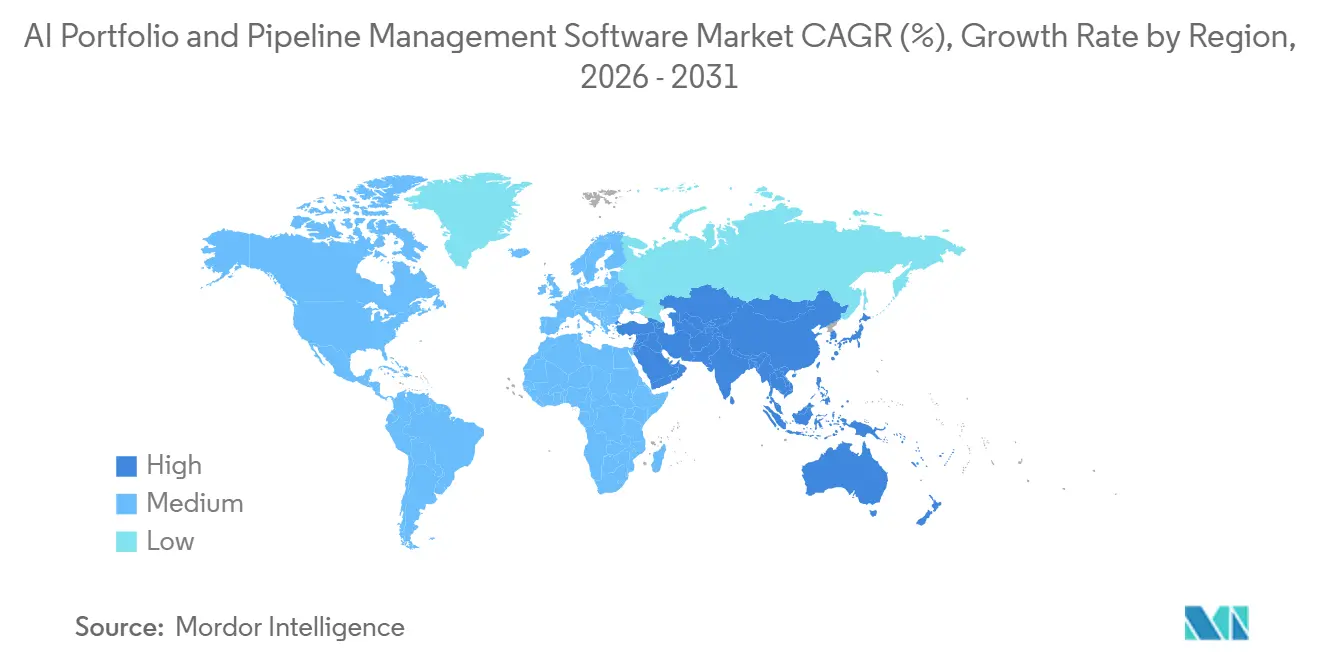
North America held 44.13% of the AI portfolio and pipeline management software market share in 2025. The region has a dense base of alternative asset managers and mature demand for compliant, auditable investment technology. Regulatory accountability for AI-supported investment services raises the importance of clear governance and supervision. This environment can favor providers with evidence of data controls and traceable outputs. North American procurement decisions also influence global platform strategies because many large providers and investors operate in the region.
APAC AI Portfolio and Pipeline Management Software Market
Asia-Pacific is projected to grow at a 22.62% CAGR through 2031, the fastest regional rate in the AI portfolio and pipeline management software market. The region includes a broad mix of developed financial centers and markets where private-capital processes are becoming more formal. Investment firms are adopting AI first for data analysis and automation, leaving room for wider use in portfolio and pipeline workflows. Data availability and inconsistent reporting can limit implementation in some markets. Demand is supported by growing private-market activity and institutional efforts to improve investment operations. Providers that can accommodate local data, language, and regulatory requirements may be better placed to serve this diverse region.
EMEA and South America AI Portfolio and Pipeline Management Software Market
Europe remains significant because MiFID II and the EU AI Act, enacted in 2024, place accountability and transparency at the center of technology procurement. The United Kingdom, Germany, and France are important markets for purchases of compliance-led investment platforms. South America is centered on Brazil and Argentina, where private equity and venture capital activity are creating institutional demand for portfolio and pipeline tools. The Middle East, particularly Saudi Arabia and the UAE, is experiencing emerging demand as sovereign wealth funds and family offices accelerate technology adoption through national development and AI programs. Africa remains at an earlier stage, with South Africa and Nigeria acting as primary adoption centers through private-equity growth. The AI portfolio and pipeline management software market can expand in these regions when providers combine scalable delivery with controls appropriate to local institutions.
Competitive Landscape
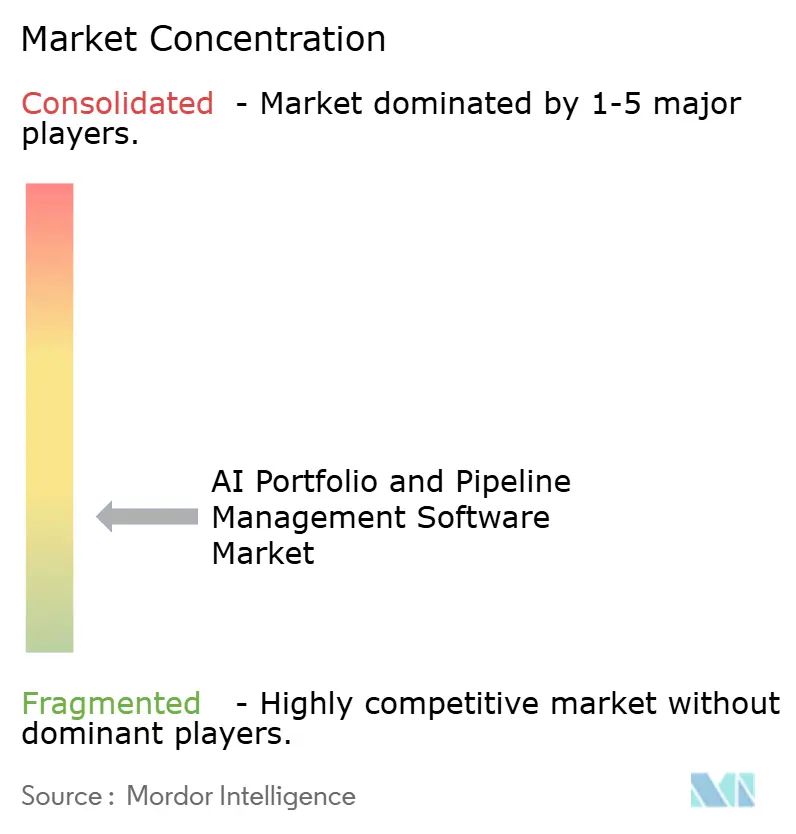
The AI portfolio and pipeline management software market is fragmented, with no single provider holding a dominant position across all workflow categories. Competition includes large investment operations platforms, specialized alternatives software providers, and AI-native firms focused on document analysis, deal scoring, or portfolio benchmarking. Established vendors are adding agentic functions to broader platforms, enabling users to work across sourcing, diligence, monitoring, and reporting in a single controlled environment. Allvue Systems launched an agentic AI platform for alternatives in 2025 and partnered with RSM in May 2026 to build an agentic operating model for capital calls on the Nexius data platform.[3] The partnership included governance standards developed in live fund environments. These moves show how workflow automation and governance are being offered together.
SimCorp announced Agent Launchpad in April 2026, allowing investment managers to use agents from SimCorp and selected third parties within a shared governance framework on SimCorp One. This approach positions agent ecosystems as part of a platform’s wider operating model rather than as separate tools. Arcesium introduced Arcesium Intelligence in May 2026 with more than 100 preconfigured agents and domain-specific skills for investment operations and data management. SEI also expanded its data and AI platform capabilities in June 2026, reflecting continued investment by established providers. The AI portfolio and pipeline management software market rewards vendors that can operate across multiple workflows while meeting client governance requirements. Point solutions may still compete where they offer superior evidence handling, data access, or specialized analytics.
The main opportunity is among managers with USD 500 million to USD 5 billion in assets under management. These firms can be too complex for spreadsheets but may not have the budgets or technical resources for large enterprise systems. Cloud delivery and modular pricing can lower the barrier for this group. Real-estate-focused providers can build on existing property-management relationships to deliver institutional portfolio analytics. Deal-sourcing providers can also create durable positions when proprietary deal-flow networks strengthen their technology. In the AI portfolio and pipeline management market, documented model governance, source-linked outputs, and immutable audit logs are becoming central sales requirements for firms that serve registered advisers and MiFID II-regulated managers.
AI Portfolio and Pipeline Management Software Industry Leaders
-
BlackRock, Inc.
-
Planview, Inc.
-
Allvue Systems, LLC
-
Dynamo Software, Inc.
-
Planisware SA
- *Disclaimer: Major Players sorted in no particular order
AI Portfolio and Pipeline Management Software Market Companies Covered in this Report
- Allvue Systems, LLC
- Acuity PPM, LLC
- Babele S.r.l.
- BlackRock, Inc.
- cplace GmbH
- Chronograph, Inc.
- Completix, Inc.
- Dynamo Software, Inc.
- Knoh AI, Inc.
- Planisware SA
- Planview, Inc.
- DiligenceVault, Inc.
- ProSymmetry, Inc.
- Sciforma Corporation
- Standard Metrics, Inc.
- Triskell Software SAS
- UMT360, Inc.
- Visible, Inc.
- OnePlan Business Solutions, Inc.
- Perspect Technologies, Inc.
- Kiplot, Inc.
- Cerri.com AG
- Meisterplan GmbH
- Rowspace, Inc.
Recent Industry Developments in AI Portfolio and Pipeline Management Software Market
- August 2026: Realpage introduced the Lumina AI Suite, a unified governed intelligence platform connecting property operations, portfolio analytics, institutional intelligence, and open model access across all real estate asset classes; the launch signals consolidation of institutional real estate portfolio management onto intelligence-first architectures.
- July 2026: Allvue Systems launched Portfolio Intelligence and Deal Analytics on OneVue, delivering AI-powered KPI monitoring, covenant tracking, peer benchmarking, and the first private credit benchmarks built from actual deal-level data rather than public market proxies, addressing a persistent data gap for private credit teams.
- June 2026: MRI Software launched MRI Agora Intelligence and MRI Agora Orchestrator, delivering proactive portfolio signals, recommended actions, and real estate-specific agentic workflow execution with full governance and audit trails for institutional real estate operators.
- June 2026: Planview introduced the Outcome Intelligence Graph and new agentic AI capabilities at Planview Connect 2026, connecting every portfolio decision to the resources and outcomes behind it within a governance framework designed for human-agent collaboration.
Global AI Portfolio and Pipeline Management Software Market Report Scope
The AI Portfolio and Pipeline Management Software Market represents the annual revenue generated from software platforms that use artificial intelligence, machine learning, automation, data aggregation, and analytics to support the management, monitoring, evaluation, and decision-making of investment, corporate, and other structured portfolios, as well as the associated deal, project, and product pipelines.
The AI Portfolio and Pipeline Management Software Market Report is Segmented by Functionality (Portfolio Monitoring and Risk Alerts, AI Due Diligence and Document Intelligence, Portfolio Data Aggregation and Normalization, Deal Pipeline and Intake Management, Investment-Committee Workflow and Decision Support, and Other Functionalities), Deployment (Cloud SaaS and On-Premises), End User (Private Equity Firms, Venture Capital Funds, Institutional Asset Managers, Investment Banks, Family Offices, and Other End Users), Application (Portfolio Company Performance Monitoring, Deal Sourcing and Pipeline Management, Investment Portfolio Management, Project and Product Portfolio Management, Fundraising and LP Relationship Management, and Investment Operations and Compliance), Portfolio Type (Private Equity and Venture Capital Portfolios, Public Markets and Multi-Asset Portfolios, Corporate Project and Product Portfolios, Real Estate and Infrastructure Portfolios, and Other Portfolio Types), and Geography (North America, Europe, Asia-Pacific, South America, and Middle East and Africa). The Market Forecasts are Provided in Terms of Value (USD).
Segmentation Overview
| Portfolio Data Aggregation and Normalization |
| Deal Pipeline and Intake Management |
| AI Due Diligence and Document Intelligence |
| Portfolio Monitoring and Risk Alerts |
| Investment-Committee Workflow and Decision Support |
| Other Functionalities |
| Cloud SaaS |
| On-Premises |
| Private Equity Firms |
| Venture Capital Funds |
| Family Offices |
| Institutional Asset Managers |
| Investment Banks |
| Others End Users |
| Investment Portfolio Management |
| Project and Product Portfolio Management |
| Deal Sourcing and Pipeline Management |
| Portfolio Company Performance Monitoring |
| Fundraising and LP Relationship Management |
| Investment Operations and Compliance |
| Private Equity and Venture Capital Portfolios |
| Public Markets and Multi-Asset Portfolios |
| Real Estate and Infrastructure Portfolios |
| Corporate Project and Product Portfolios |
| Other Portfolio Types |
| North America | United States |
| Canada | |
| Mexico | |
| South America | Brazil |
| Argentina | |
| Rest of South America | |
| Europe | United Kingdom |
| Germany | |
| France | |
| Italy | |
| Spain | |
| Russia | |
| Rest of Europe | |
| Asia-Pacific | China |
| India | |
| Japan | |
| South Korea | |
| Australia | |
| Rest of Asia-Pacific | |
| Middle East | Saudi Arabia |
| United Arab Emirates | |
| Israel | |
| Turkey | |
| Rest of Middle East | |
| Africa | South Africa |
| Nigeria | |
| Rest of Africa |
| By Functionality | Portfolio Data Aggregation and Normalization | |
| Deal Pipeline and Intake Management | ||
| AI Due Diligence and Document Intelligence | ||
| Portfolio Monitoring and Risk Alerts | ||
| Investment-Committee Workflow and Decision Support | ||
| Other Functionalities | ||
| By Deployment | Cloud SaaS | |
| On-Premises | ||
| By End User | Private Equity Firms | |
| Venture Capital Funds | ||
| Family Offices | ||
| Institutional Asset Managers | ||
| Investment Banks | ||
| Others End Users | ||
| By Application | Investment Portfolio Management | |
| Project and Product Portfolio Management | ||
| Deal Sourcing and Pipeline Management | ||
| Portfolio Company Performance Monitoring | ||
| Fundraising and LP Relationship Management | ||
| Investment Operations and Compliance | ||
| By Portfolio Type | Private Equity and Venture Capital Portfolios | |
| Public Markets and Multi-Asset Portfolios | ||
| Real Estate and Infrastructure Portfolios | ||
| Corporate Project and Product Portfolios | ||
| Other Portfolio Types | ||
| By Geography | North America | United States |
| Canada | ||
| Mexico | ||
| South America | Brazil | |
| Argentina | ||
| Rest of South America | ||
| Europe | United Kingdom | |
| Germany | ||
| France | ||
| Italy | ||
| Spain | ||
| Russia | ||
| Rest of Europe | ||
| Asia-Pacific | China | |
| India | ||
| Japan | ||
| South Korea | ||
| Australia | ||
| Rest of Asia-Pacific | ||
| Middle East | Saudi Arabia | |
| United Arab Emirates | ||
| Israel | ||
| Turkey | ||
| Rest of Middle East | ||
| Africa | South Africa | |
| Nigeria | ||
| Rest of Africa | ||
Key Questions Answered in the Report
What is the projected value of AI portfolio and pipeline management software by 2031?
The sector is projected to reach USD 1.74 billion by 2031, growing from USD 0.65 billion in 2026 at a CAGR of 21.69%.
Which deployment model leads adoption?
Cloud SaaS held 79.62% of deployment demand in 2025 and is projected to grow at a 22.09% CAGR through 2031.
Which functionality is growing fastest?
AI due diligence and document intelligence is projected to record the highest functionality CAGR at 22.89% through 2031.
Why do investment managers need these platforms?
They help connect deal intake, document review, portfolio monitoring, risk analysis, and investor reporting while reducing dependence on fragmented spreadsheets and manual reconciliation.
Which end user is expanding fastest?
Family offices are projected to grow at a 22.81% CAGR through 2031 as they formalize investment processes and adopt automated reporting.
What limits adoption of AI portfolio tools?
Confidentiality and model-governance concerns, inconsistent portfolio-company data, switching costs from legacy workflows, and limited explainability can slow procurement and deployment.