
AI Policy Management Software Market Size and Share
Market Overview
| Study Period | 2020 - 2031 |
|---|---|
| Market Size (2026) | USD 1.18 Billion |
| Market Size (2031) | USD 4.41 Billion |
| Growth Rate (2026 - 2031) | 30.19 % |
| Fastest Growing Market | Asia-Pacific |
| Largest Market | North America |
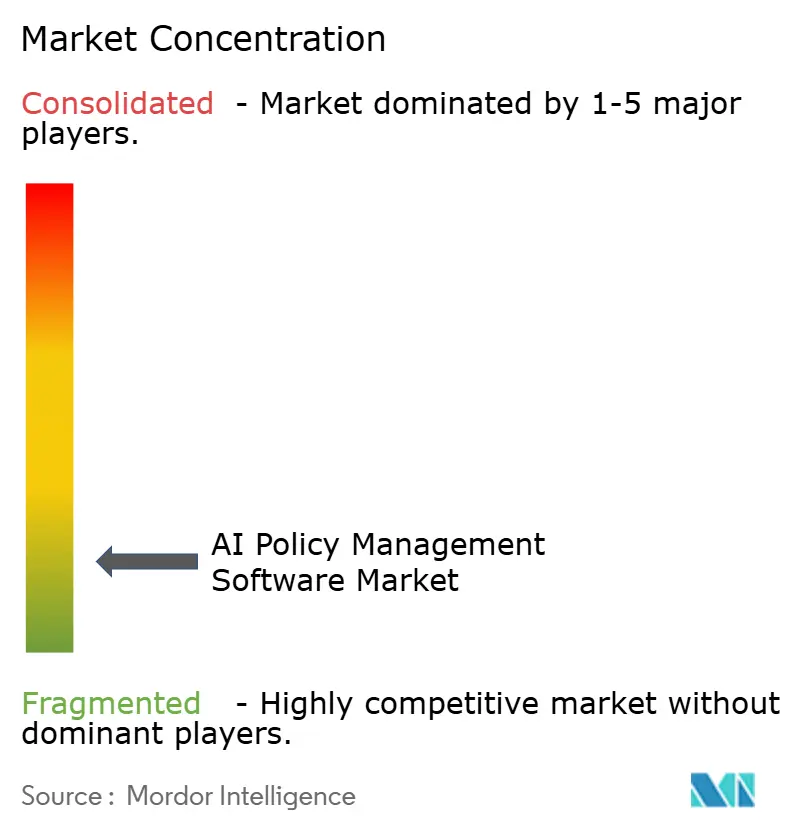
| Market Concentration | Low |
Major Players *Disclaimer: Major Players sorted in no particular order Image © Mordor Intelligence. Reuse requires attribution under CC BY 4.0. | |
AI Policy Management Software Market Analysis by Mordor Intelligence
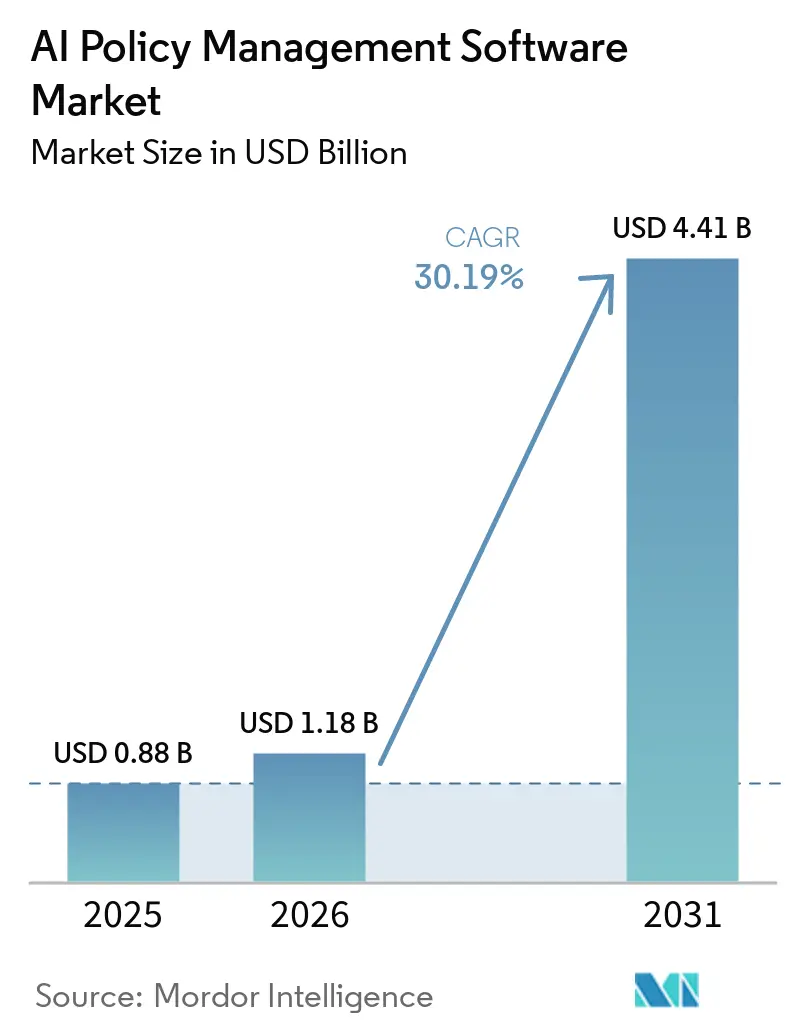
The AI Policy Management Software Market size is projected to be USD 0.88 billion in 2025, USD 1.18 billion in 2026, and reach USD 4.41 billion by 2031, growing at a CAGR of 30.19% from 2026 to 2031. Demand is shifting from written policies to systems that generate ongoing, auditable evidence for each AI deployment, including the policy applied, the responsible owner, the underlying record, and the review outcome. The EU AI Act made transparency obligations and full market-surveillance powers operational on August 2, 2026, which increased the need for structured controls among organizations operating in Europe. China’s AI Safety Governance Framework 2.0 also introduced risk-tiered lifecycle controls during September 2025, extending policy management needs beyond OECD markets. In the AI policy management software market, buyers increasingly favor platforms that can integrate governance, privacy, risk, and technical operations without requiring separate review processes. Competitive strategies, therefore, center on regulatory coverage, integration with enterprise systems, practical support for organizations with limited AI compliance capacity, and implementation approaches that do not require a large specialist team.
Key Report Takeaways
- By component, platforms and software suites held 74.28% of the AI policy management software market share in 2025, while services recorded the highest projected CAGR at 30.86% through 2031.
- By application area, regulatory compliance and audit trail applications accounted for 29.06% of the AI policy management software market size in 2025, while bias and fairness management is projected to expand at 30.59% CAGR through 2031.
- By deployment mode, cloud-based SaaS held 61.38% revenue share of the AI policy management software market in 2025 and was also the fastest-growing deployment model for 2026-2031.
- By organization size, large enterprises held 76.53% revenue share of the AI policy management software market in 2025, while small and mid-size enterprises are forecast to grow at 31.18% CAGR through 2031.
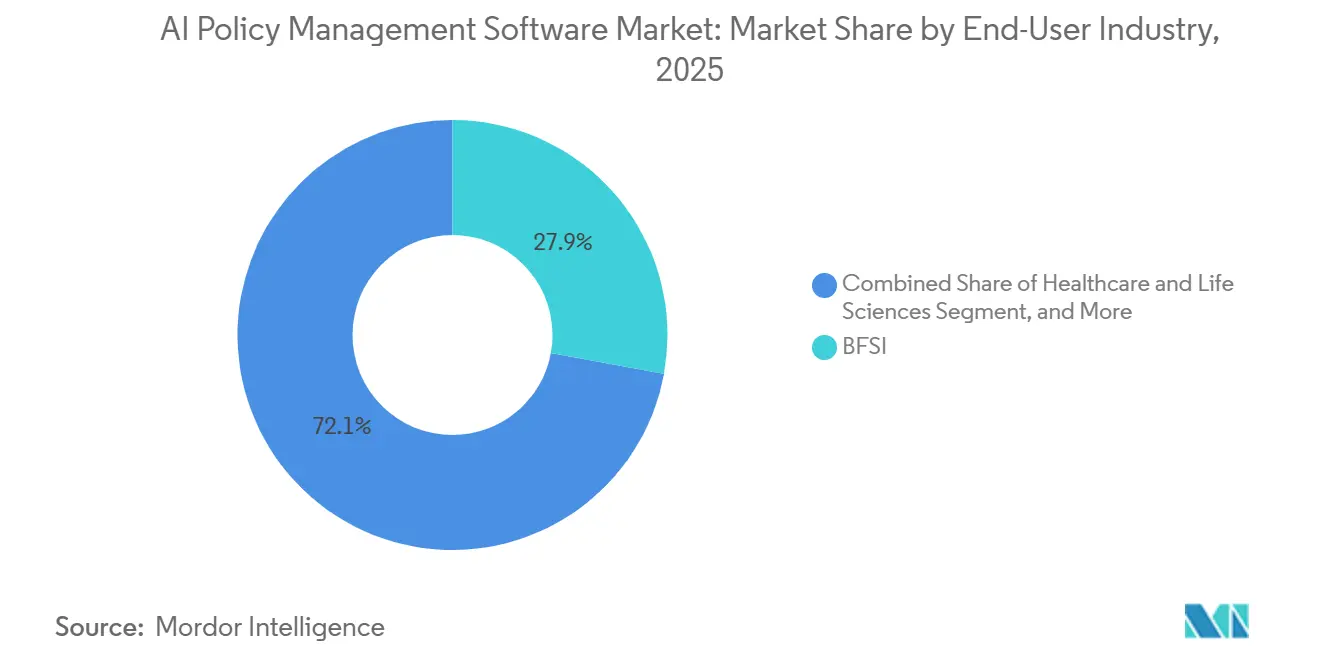
- By end-user industry, BFSI held 27.88% revenue share of the AI policy management software market in 2025, while healthcare and life sciences is projected to advance at 30.68% CAGR through 2031.
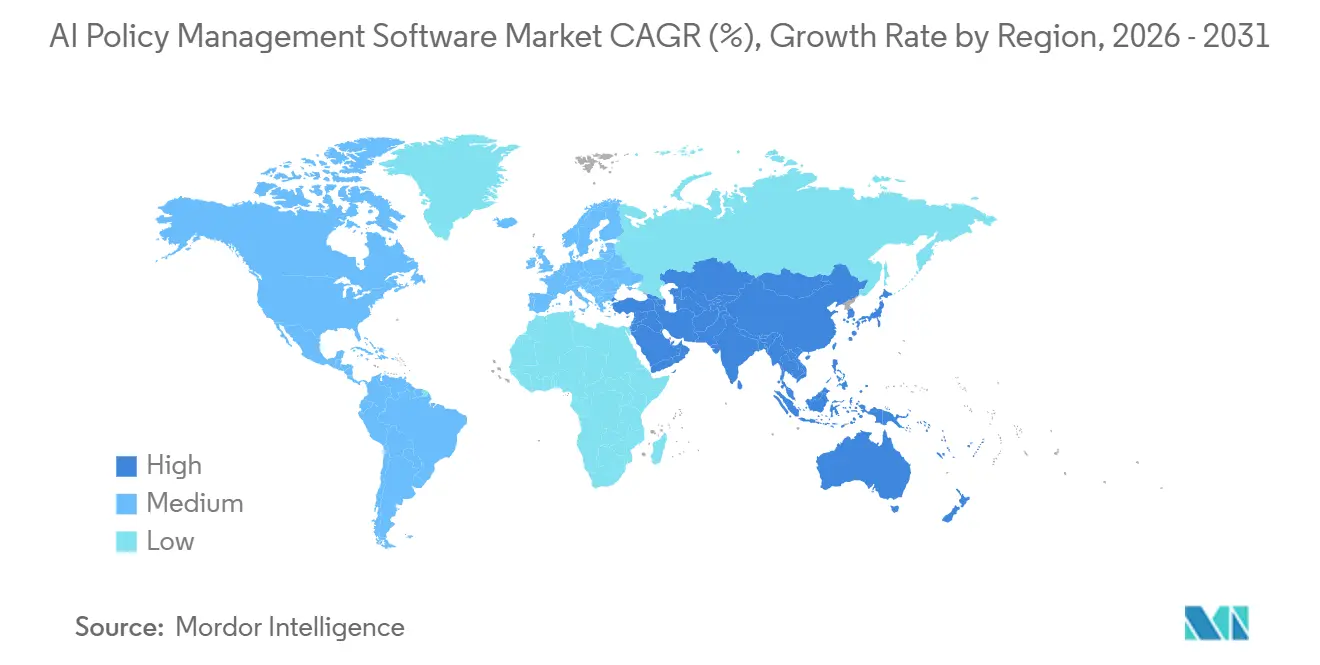
- By geography, North America held 39.21% revenue share of the AI policy management software market in 2025, while Asia-Pacific is forecast to expand at 30.73% CAGR through 2031.
Note: Market size and forecast figures in this report are generated using Mordor Intelligence’s proprietary estimation framework, updated with the latest available data and insights as of January 2026.
Market Trends and Insights
Drivers Impact Analysis of AI Policy Management Software Market*
| Driver | (~) % Impact on CAGR Forecast | Geographic Relevance | Impact Timeline |
|---|---|---|---|
| Intensifying AI-Specific Regulatory Mandates | +7.2% | Global, with primary weight in EU, North America, and APAC core | Short term (≤ 2 years) |
| Continuous Compliance Automation Replacing Periodic Audits | +5.8% | Global, highest density in BFSI and healthcare in North America and Europe | Medium term (2-4 years) |
| Expansion of Generative AI and Agentic AI Use Cases | +4.5% | North America, EU, China, Japan, South Korea | Medium term (2-4 years) |
| Convergence of AI Governance, Privacy, and Enterprise GRC | +4.2% | North America and EU with spillover to APAC enterprise clusters | Medium term (2-4 years) |
| Policy-as-Code Integration Across MLOps and Cloud Toolchains | +3.5% | North America and EU, emerging in Australia and Singapore | Long term (≥ 4 years) |
| Insurance and Procurement Incentives for Demonstrable AI Controls | +2.1% | North America, EU, Australia | Long term (≥ 4 years) |
| Source: Mordor Intelligence | |||
Intensifying AI-Specific Regulatory Mandates
Binding AI rules are creating a direct need for AI policy management software across regulated sectors. The EU AI Act activated Article 50 transparency obligations and full market-surveillance powers on August 2, 2026.[1] Penalties under the Act can reach EUR 35 million (USD 40.37 Million), or 7% of global annual turnover, for certain violations. Germany launched its AI Service Desk in July 2025, showing that national support and enforcement structures were already taking shape. The later compliance dates for some high-risk requirements leave a planning window in which suppliers can establish multiyear platform relationships before formal deadline pressure reaches its highest level. ISO/IEC 42001 and the NIST AI Risk Management Framework remain useful anchors for organizations seeking control structures that work across European and U.S. requirements.
Continuous Compliance Automation Replacing Periodic Audits
Continuous monitoring is replacing annual or point-in-time AI reviews in the AI policy management software market. A peer-reviewed audit-as-code framework shows how governance rules can be mapped into technically auditable checks within development pipelines.[2] This approach can generate ongoing evidence instead of relying only on manual assessments in the AI policy management software market. IBM stated that watsonx.governance maps to more than 200 regulatory frameworks and can identify relevant obligations and produce audit-ready reporting. Automated evidence collection can allow compliance teams to focus more attention on high-risk cases that still need human judgment, cross-functional review, and timely escalation. It also supports managed services because buyers may seek help interpreting evidence, prioritizing findings, connecting them to internal policies, and resolving issues that automation identifies.
Expansion of Generative AI and Agentic AI Use Cases
Generative and agentic AI are expanding the operating scope of the AI policy management software market. Agentic systems can plan, decide, and act across multistep workflows, so they need monitoring during operation rather than only before deployment. Prompt injection, uncontrolled tool access, and accountability across delegated tasks are agent-specific risk areas.[3] ServiceNow expanded AI Control Tower in May 2026 with autonomous kill-switch features and observability across third-party agentic deployments. Microsoft also released the Agent Governance Toolkit in April 2026 to support runtime security and policy enforcement for AI agents. These needs favour controls that can enforce policies at scale without adding matching levels of review staff as organizations manage larger estates of autonomous systems.
Convergence of AI Governance, Privacy, and Enterprise GRC
Organizations are reducing the number of separate governance tools used across AI, privacy, and enterprise risk. IBM reported in 2025 that 50% of surveyed CEOs said their pace of AI investment had resulted in disconnected technology stacks.[4] Responsible AI due diligence is increasingly framed as part of broader responsible business conduct rather than a separate compliance discipline. This framing makes it easier for buyers to place AI controls within existing GRC workflows, rather than creating a separate governance process with its own owners, records, and reporting schedule. Integration with IT service management, security information systems, vendor risk processes, and established accountability workflows can matter more than isolated product features in large procurement decisions. The AI policy management software market can therefore benefit when governance platforms reduce duplicate processes across these functions.
Restraints Impact Analysis of AI Policy Management Software Market*
| Restraint | (~) % Impact on CAGR Forecast | Geographic Relevance | Impact Timeline |
|---|---|---|---|
| Fragmented Jurisdictional Definitions and Control Requirements | -2.8% | Global, highest friction in multinational operations spanning EU, U.S. states, APAC | Medium term (2-4 years) |
| Shortage of AI Risk and Compliance Specialists | -2.1% | Global, acutest in Europe and North America regulated sectors | Medium term (2-4 years) |
| Integration Complexity Across Legacy MLOps and GRC Stacks | -1.8% | North America and Europe, enterprise-scale deployments | Long term (≥ 4 years) |
| Limited Stand-Alone ROI Visibility for Smaller Buyers | -1.4% | South America, Middle East and Africa, emerging APAC, and the global mid-market | Long term (≥ 4 years) |
| Source: Mordor Intelligence | |||
Fragmented Jurisdictional Definitions and Control Requirements
Different national and regional rules make compliance design harder for multinational buyers. The EU AI Act, U.S. state rules, South Korea’s AI Basic Act, and China’s sectoral requirements use different definitions, risk classifications, documentation expectations, and control expectations. Organizations may need separate libraries for high-risk classifications, bias testing, audit records, documentation, and local processes for assigning control ownership. This requirement lengthens purchasing decisions and raises implementation effort for firms operating across several jurisdictions, particularly when model portfolios and regulatory responsibilities are distributed across business units. Providers with ready-made mapping libraries can reduce that burden for customers by giving implementation teams a usable baseline that they can adapt to specific systems, models, and jurisdictions. The AI policy management software market consequently rewards suppliers that translate regulatory variation into usable policy configurations.
Shortage of AI Risk and Compliance Specialists
Limited specialist capacity can slow the deployment of AI policy management software, especially in heavily regulated sectors. The supplied research found that only 5% of European SMEs reported the internal expertise needed to operationalize new EU AI Act obligations in 2025. Organizations need people who can interpret risk outputs, create governance processes, and work across legal and technical teams. The shortage increases demand for managed services and advisory support, but it can delay early implementation. It also concentrates decisions in a small pool of specialists within financial services and healthcare, where the same people may need to interpret regulation, review technical evidence, and manage operational approvals. Low-code configurations and prebuilt policy templates can reduce dependence on scarce expertise, provide a clearer starting point, and shorten adoption cycles for new buyers.
*Our forecasts treat driver/restraint impacts as directional, not additive. The impact forecasts reflect baseline growth, mix effects, and variable interactions.
AI Policy Management Software Market Segment Analysis
By Component:
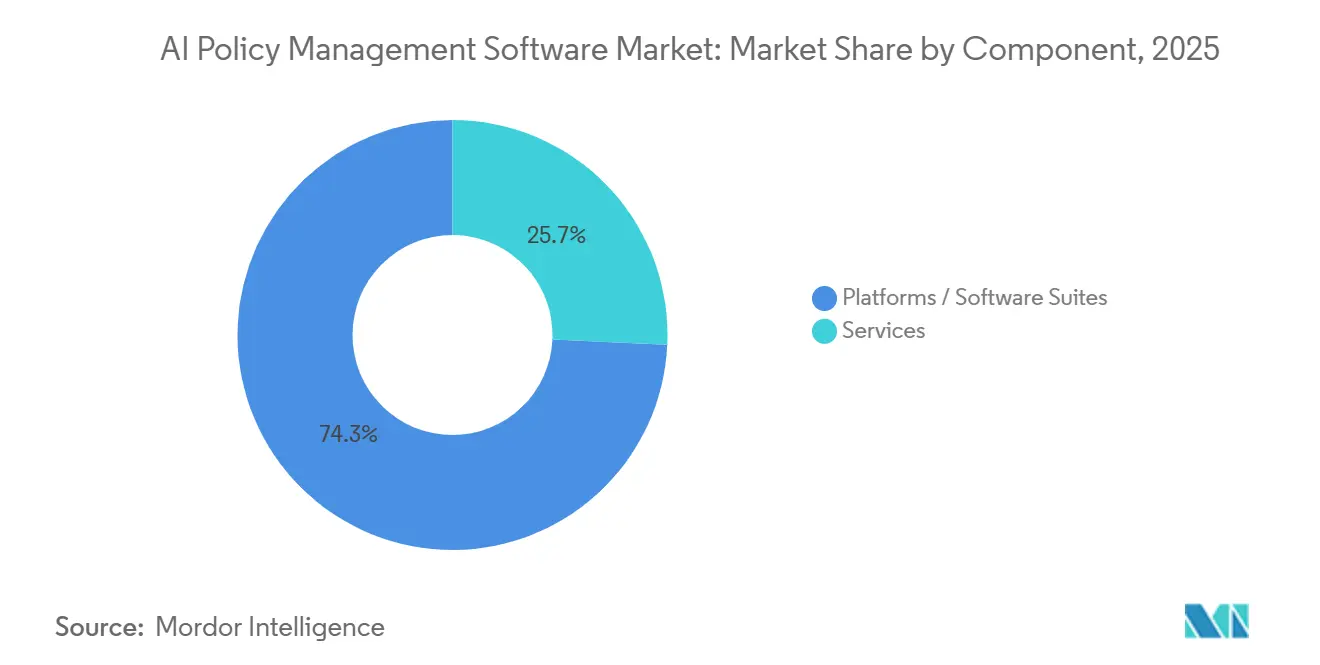
Platforms Lead Revenue While Services Expand QuicklyPlatforms and software suites held 74.28% of revenue in 2025, establishing them as the leading component in the AI policy management software market. Organizations favour a centralized layer that can manage policy definition, model registration, monitoring, audit reporting, ownership records, and evidence across multiple internal teams. Integrated platforms also reduce the burden of managing many specialized vendors, separate contracts, disconnected policy records, and inconsistent reporting practices that complicate internal oversight. A common evidence repository can make audit preparation easier for organizations with several AI systems, business units, and external reviewers. These characteristics favour platform procurement in the AI policy management software market where control requirements are broad and recurring.
Services are forecast to grow at 30.86% CAGR through 2031, the fastest rate within the component structure. Implementation work remains important because governance platforms must align with internal policies, existing technology, data controls, ownership structures, and local regulations. Services can include readiness assessments, control design, configuration, managed monitoring, implementation support, and help with interpreting compliance evidence. This work can deepen the relationship between a provider and its customer by embedding operational practices, policy mapping, review routines, and escalation paths into ongoing governance programs. IBM integrated Guardium data-security capabilities with watsonx.governance in 2025, bringing data protection into a wider governance offering. The resulting combination shows why platform capability and service support are increasingly linked when customers want one accountable partner across governance, security, implementation, and ongoing operational change over time.
By Application Area:
Compliance Leads Spending and Bias Management AcceleratesRegulatory compliance and audit trail applications held 29.06% of revenue in 2025, the largest application position. Organizations in finance and public procurement need records that show how AI controls were applied, approved, monitored, and reviewed over time. Those requirements sustain demand for tools that connect policies, evidence, approvals, reporting, incident records, review decisions, and the people responsible for action at each stage. In the AI policy management software industry, this application supports use cases where model decisions can create legal exposure. It also provides a practical starting point for companies building formal AI governance programs across development, procurement, operational review processes, executive oversight, and regular internal assurance activities.
Bias and fairness management is projected to grow at 30.59% CAGR through 2031. U.S. health care rules under Section 1557 require covered entities to address discriminatory outcomes in patient care decision support tools. A 2025 review also found that major regulatory bodies were strengthening bias-related frameworks for health care AI. Policy lifecycle management and model risk monitoring support the path between a written rule and verifiable enforcement across development, deployment, and ongoing model use. Audit-as-code methods can make that path more consistent by placing deterministic checks within technical workflows.
By Deployment Mode:
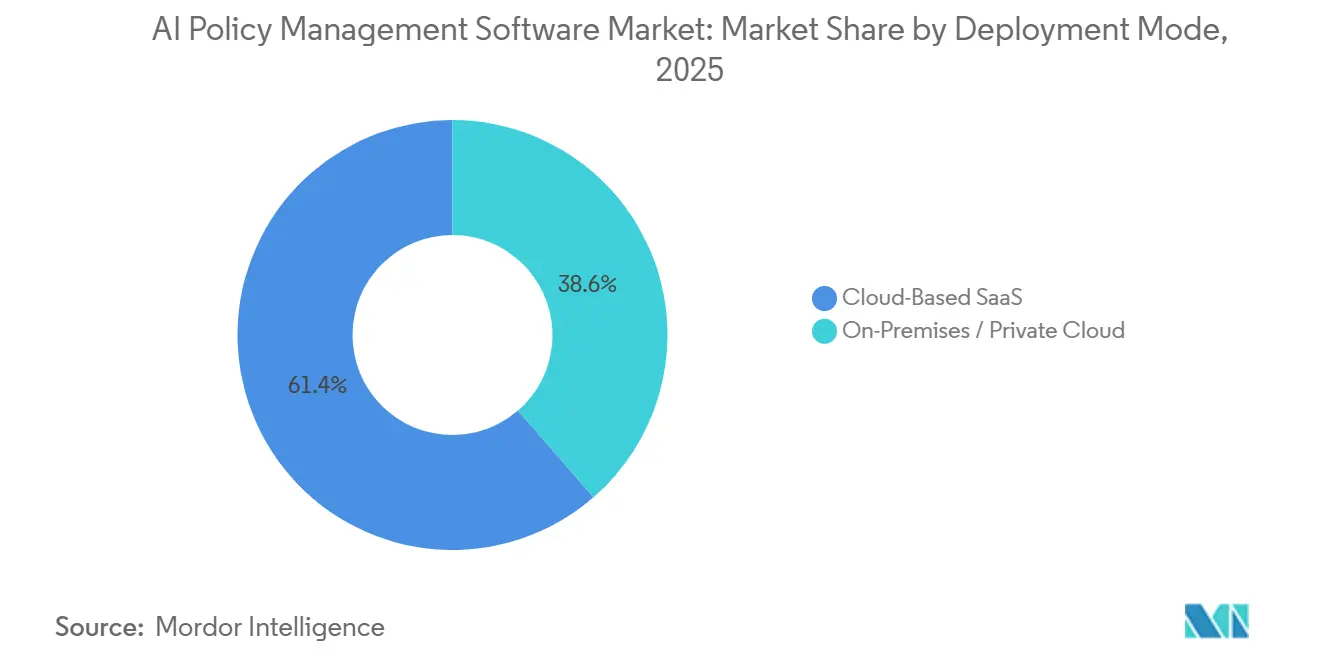
Cloud SaaS Combines Scale With Faster UpdatesCloud-based SaaS held 61.38% of deployment revenue in 2025 and remained the fastest-growing deployment mode. In the AI policy management software market, it offers faster provisioning and lets vendors update regulatory mappings and control libraries centrally. This is valuable when governance requirements change frequently and customers need current control libraries without waiting for internal technology upgrades. Cloud delivery can also give customers access to new integrations, updated framework mappings, and control changes without requiring their own upgrade projects. These benefits support its leading position in the AI policy management software market, especially for buyers seeking a centrally maintained operating model that can keep pace with new requirements and expanding AI portfolios.
On-premises and private cloud remain relevant for sovereign AI, financial market infrastructure, and defense buyers. These users may be unable to place model metadata or policy configurations on external networks. IBM received FedRAMP authorization in April 2026 for 11 AI and automation solutions, including watsonx.governance, on AWS GovCloud. The authorization shows that government-certified cloud environments can meet demanding public-sector requirements. Suppliers that maintain comparable functionality across cloud and private deployments can serve a broader regulated customer base without forcing buyers to compromise on policy coverage.
By Organization Size:
Large Enterprises Lead While SMEs Gain MomentumLarge enterprises held 76.53% of revenue in 2025, reflecting the early cost and complexity of enterprise governance systems. Large deployments often involve several models, business units, regulatory jurisdictions, and a mix of internal and third-party technology providers. They also receive closer scrutiny from boards, regulators, auditors, and internal risk teams that need clear ownership and escalation procedures. Responsible AI risk management is increasingly placed within broader enterprise responsibility structures. This makes formal governance infrastructure a reasonable priority for large organizations active in the AI policy management software market.
Small and mid-size enterprises are expected to advance at 31.18% CAGR through 2031. Their regulatory exposure is rising as AI rules apply according to system risk rather than company size, even when a firm lacks a large central compliance function. Germany’s AI Service Desk was launched partly to guide smaller companies through the resulting requirements. Limited in-house expertise makes simple configuration, prebuilt policy templates, and accessible implementation help important for smaller organizations. Modular tools and consumption-based pricing can make governance capabilities more accessible to these buyers, while managed support can help them begin with a narrower use case and extend coverage over time.
By End-User Industry:
BFSI Anchors Demand and Health Care Grows FastestBFSI held 27.88% of revenue in 2025, making it the largest end-user category. Credit scoring, insurance pricing, and risk assessment can affect financial rights and are treated as high-risk uses under the EU AI Act, requiring more formal controls. These applications need clear controls, records, review processes, and traceable responses when risk findings or model changes require attention. Financial institutions also operate within established risk and compliance functions. That foundation supports their continued role and sustained spending in the AI policy management software market.
Health care and life sciences are forecast to grow at 30.68% CAGR through 2031. Clinical decision support, diagnostics, and drug discovery use sensitive data and can affect patient outcomes, which raises the importance of explainability and bias review. A 2025 health care review described more active work on bias detection, explainability, and lifecycle monitoring by major regulatory bodies. Government and defense buyers need accountable AI use in public services and procurement, including records that show how approved controls were applied. IT and telecom buyers need governance that works across multi-cloud environments, while retail, automotive, and media remain earlier-stage adopters.

Geography Analysis
North America AI Policy Management Software Market
North America held 39.21% of revenue in 2025, the largest geographic position in the AI policy management software market. The AI policy management software market in the region has a dense base of regulated AI deployments across financial services and government, where formal documentation and accountable processes matter in procurement. IBM’s April 2026 FedRAMP authorization for watsonx.governance positioned the company for federal opportunities.
Europe and North America AI Policy Management Software Market
Canada and Mexico are expanding governance requirements more gradually. Within the AI policy management software market, Europe is the second-largest geography and has the most complex regulatory setting. Full EU AI Act market-surveillance powers became operational in August 2026. National authorities can now investigate noncompliance, impose penalties, and order product withdrawals under the Act. EIOPA published an opinion on AI governance and risk management in August 2025, clarifying expectations for the insurance sector. Dedicated regional AI governance legislation was not yet in force in the supplied research.
APAC and MEA AI Policy Management Software Market
Asia-Pacific is projected to grow at 30.73% CAGR through 2031, the fastest regional rate in the AI policy management software market. South Korea’s AI Basic Act took effect in January 2026 and is driving structured governance programs among conglomerates and technology exporters. China’s AI+ action plan, published in August 2025, set a 70% application penetration target across 6 priority sectors by 2027. China’s 2025 safety framework also calls for continuous lifecycle monitoring. The Middle East and Africa remain earlier-stage areas, with the United Arab Emirates and Saudi Arabia serving as primary demand centers.
Competitive Landscape
The AI policy management software market is a highly competitive market. IBM watsonx.governance, Microsoft Purview combined with the Azure Agent Governance Toolkit, and ServiceNow AI Control Tower compete for large enterprise accounts. IBM was recognized as a Leader in Gartner’s first Magic Quadrant for AI Governance Platforms in July 2026, according to an IBM community post. ServiceNow expanded AI Control Tower in May 2026 to support more than 30 enterprise connectors across cloud and application providers.
Specialist providers including Credo AI, Fiddler AI, Arthur AI, Holistic AI, and VerifyWise compete through AI-specific capability depth. Fiddler AI raised USD 30 million in a January 2026 Series C round to develop a neutral control plane for compound AI systems. Arthur AI launched its Agent Discovery and Governance platform on the Google Cloud Marketplace in January 2026. IBM also advanced its multi-agent approach through the next generation of watsonx Orchestrate in May 2026. The AI policy management software market remains open to providers that combine policy management with runtime controls, data security, and identity oversight.
The mid-market multi-jurisdictional segment remains less fully served by either broad platforms or specialist vendors. Organizations with 500-5,000 employees may need enterprise-level coverage in the AI policy management software market but cannot support lengthy implementations. Preconfigured regulatory templates and low-code policy authoring can address this need. Managed monitoring can further reduce the demand for internal compliance specialists. Competitive outcomes in the AI policy management software market will depend on how well providers balance regulatory depth, integration, implementation effort, and usable ongoing support.
AI Policy Management Software Industry Leaders
-
IBM Corporation
-
Microsoft Corporation
-
OneTrust LLC
-
Alphabet Inc.
-
Credo AI
- *Disclaimer: Major Players sorted in no particular order
AI Policy Management Software Market Companies Covered in this Report
- IBM Corporation
- Microsoft Corporation
- Alphabet Inc.
- Amazon Web Services, Inc.
- SAP SE
- Oracle Corporation
- Salesforce, Inc.
- ServiceNow, Inc.
- SAS Institute Inc.
- OneTrust LLC
- Credo AI
- Fiddler AI
- Arthur AI
- DataRobot, Inc.
- Collibra NV
- LogicGate, Inc.
- Trustible, Inc.
- VerifyWise AB
- Holistic AI
- ModelOp, Inc.
Recent Industry Developments in AI Policy Management Software Market
- May 2026: IBM unveiled the next generation of watsonx Orchestrate at Think 2026, evolving it into a multi-agent orchestration control plane with consistent policy enforcement and accountability across agents from any source; this positions IBM's governance layer as the enforcement runtime for enterprise multi-agent deployments.
- May 2026: ServiceNow expanded its AI Control Tower at Knowledge 2026 to include discovery and governance across 30+ enterprise integrations, spanning all major hyperscalers and enterprise applications including SAP, Oracle, and Workday; new autonomous kill-switch capabilities were also unveiled, allowing policies to automatically disable non-compliant agents without human intervention.
- April 2026: IBM received FedRAMP authorization for 11 AI and automation solutions, including watsonx.governance, deployed on AWS GovCloud; the authorization significantly expands IBM's addressable market within the U.S. federal government, which faces mandatory responsible AI documentation requirements under OMB guidance.
- January 2026: Fiddler AI raised USD 30 million in Series C funding led by RPS Ventures, with participation from Lightspeed Venture Partners, Lux Capital, and Capgemini Ventures, among others; total funding reached USD 100 million, with proceeds directed toward building a neutral AI control plane for compound and agentic AI systems.
Global AI Policy Management Software Market Report Scope
The AI Policy Management Software Market Report is Segmented by Component (Platforms / Software Suites and Services), Application Area (Regulatory Compliance and Audit Trail, Policy Lifecycle and Workflow Management, Model Risk and Performance Monitoring, Bias and Fairness Management, and Others), Deployment Mode (Cloud-Based SaaS and On-Premises / Private Cloud), Organization Size (Large Enterprises and Small and Mid-Size Enterprises), End-User Industry (BFSI, Healthcare and Life Sciences, Government and Defense, IT and Telecom, Retail and E-Commerce, Automotive and Mobility, Media and Entertainment, and Other End-User Industries), and Geography (North America, South America, Europe, Asia-Pacific, Middle East, and Africa). The Market Forecasts are Provided in Terms of Value (USD).
Segmentation Overview
| Platforms / Software Suites |
| Services |
| Regulatory Compliance and Audit Trail |
| Policy Lifecycle and Workflow Management |
| Model Risk and Performance Monitoring |
| Bias and Fairness Management |
| Other Application Areas |
| Cloud-Based SaaS |
| On-Premises / Private Cloud |
| Large Enterprises |
| Small and Mid-Size Enterprises |
| BFSI |
| Healthcare and Life Sciences |
| Government and Defense |
| IT and Telecom |
| Retail and E-Commerce |
| Automotive and Mobility |
| Media and Entertainment |
| Other End-User Industries |
| North America | United States |
| Canada | |
| Mexico | |
| South America | Brazil |
| Argentina | |
| Colombia | |
| Rest of South America | |
| Europe | United Kingdom |
| Germany | |
| France | |
| Italy | |
| Spain | |
| Russia | |
| Rest of Europe | |
| Asia-Pacific | China |
| Japan | |
| India | |
| South Korea | |
| Singapore | |
| Australia | |
| Rest of Asia-Pacific | |
| Middle East | United Arab Emirates |
| Saudi Arabia | |
| Israel | |
| Turkey | |
| Rest of Middle East | |
| Africa | South Africa |
| Egypt | |
| Nigeria | |
| Rest of Africa |
| By Component | Platforms / Software Suites | |
| Services | ||
| By Application Area | Regulatory Compliance and Audit Trail | |
| Policy Lifecycle and Workflow Management | ||
| Model Risk and Performance Monitoring | ||
| Bias and Fairness Management | ||
| Other Application Areas | ||
| By Deployment Mode | Cloud-Based SaaS | |
| On-Premises / Private Cloud | ||
| By Organization Size | Large Enterprises | |
| Small and Mid-Size Enterprises | ||
| By End-User Industry | BFSI | |
| Healthcare and Life Sciences | ||
| Government and Defense | ||
| IT and Telecom | ||
| Retail and E-Commerce | ||
| Automotive and Mobility | ||
| Media and Entertainment | ||
| Other End-User Industries | ||
| By Geography | North America | United States |
| Canada | ||
| Mexico | ||
| South America | Brazil | |
| Argentina | ||
| Colombia | ||
| Rest of South America | ||
| Europe | United Kingdom | |
| Germany | ||
| France | ||
| Italy | ||
| Spain | ||
| Russia | ||
| Rest of Europe | ||
| Asia-Pacific | China | |
| Japan | ||
| India | ||
| South Korea | ||
| Singapore | ||
| Australia | ||
| Rest of Asia-Pacific | ||
| Middle East | United Arab Emirates | |
| Saudi Arabia | ||
| Israel | ||
| Turkey | ||
| Rest of Middle East | ||
| Africa | South Africa | |
| Egypt | ||
| Nigeria | ||
| Rest of Africa | ||
Key Questions Answered in the Report
What is the current market size for AI Policy Management Software Market?
The AI Policy Management Software Market size is projected to be USD 0.88 billion in 2025, USD 1.18 billion in 2026, and reach USD 4.41 billion by 2031, growing at a CAGR of 30.19% from 2026 to 2031.
Which component leads AI policy management software revenue?
Platforms and software suites led with 74.28% of revenue in 2025, while services is the fastest-growing component at 30.86% CAGR through 2031.
Why is cloud SaaS the leading deployment model?
Cloud-based SaaS held 61.38% of deployment revenue in 2025 because it supports faster provisioning and centrally managed regulatory updates.
Which end-user sector has the strongest growth outlook?
Health care and life sciences is projected to grow at 30.7% CAGR through 2031, supported by requirements for bias detection and lifecycle monitoring.
Which region is expected to grow fastest through 2031?
Asia-Pacific is projected to expand at 30.7% CAGR through 2031 as regional AI adoption and governance rules strengthen.
What should buyers consider when choosing a governance platform?
Buyers should assess regulatory mapping, integration with existing risk systems, deployment needs, and available implementation support.