
AI-Native Platform-as-a-Service (PaaS) Market Size and Share
Market Overview
| Study Period | 2020 - 2031 |
|---|---|
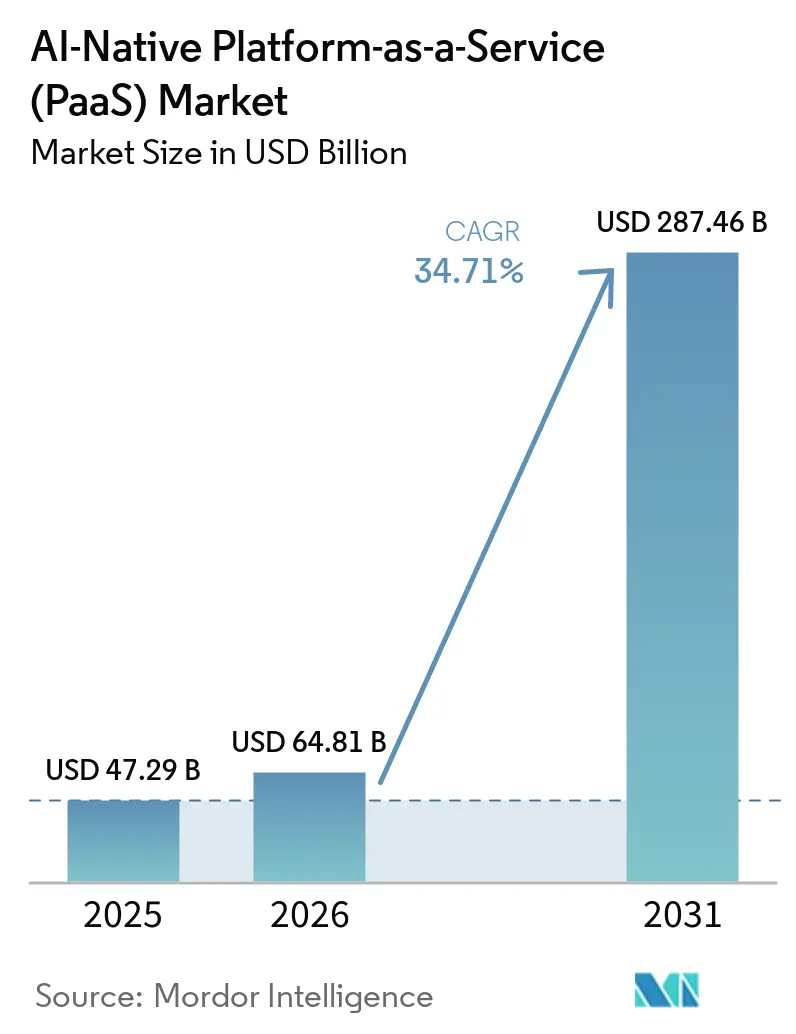
| Market Size (2026) | USD 64.81 Billion |
| Market Size (2031) | USD 287.46 Billion |
| Growth Rate (2026 - 2031) | 34.71 % |
| Fastest Growing Market | Asia-Pacific |
| Largest Market | North America |
| Market Concentration | Low |
Major Players *Disclaimer: Major Players sorted in no particular order Image © Mordor Intelligence. Reuse requires attribution under CC BY 4.0. | |
AI-Native Platform-as-a-Service (PaaS) Market Analysis by Mordor Intelligence
The AI-native platform-as-a-service (PaaS) market size is expected to expand from USD 47.29 billion in 2025 to USD 64.81 billion in 2026, and is forecast to reach USD 287.46 billion by 2031, at a 34.71% CAGR over 2026-2031. Enterprise buyers are shifting from limited AI trials to production systems that need reliable inference, monitoring, governance, and service commitments. This change favors platforms that bring model development, deployment, evaluation, and operations into a connected environment. Open-weight models are making production deployments more accessible and are increasing demand for infrastructure that can support private, hybrid, and sovereign deployments. Competitive strategies increasingly combine compute capacity with model serving, observability, and agent development capabilities, while variable accelerator prices remain a material planning risk. The AI-native platform-as-a-service (PaaS) market also allows providers to serve smaller firms through serverless services while supporting large organizations with dedicated capacity and governance controls.
Key Report Takeaways
- By platform layer, Application and Agent Development Platforms held 33.42% of the AI-native platform-as-a-service (PaaS) market share in 2025, while AI Observability, Evaluation, and Governance Services are projected to expand at a 35.69% CAGR through 2031.
- By deployment model, cloud held 78.81% of the AI-native PaaS market share in 2025, while on-premise deployment is expected to expand at a 35.11% CAGR through 2031.
- By application, Generative AI Applications accounted for 41.26% of the AI-native platform-as-a-service (PaaS) market size in 2025, while Computer Vision and Multimodal AI are projected to expand at a 35.91% CAGR through 2031.
- By organization size, large enterprises held 63.58% of the market in 2025, while small and medium-sized enterprises are expected to expand at a 35.09% CAGR through 2031.
- By end-user industry, IT and Telecommunications accounted for 29.37% of the market in 2025, while Healthcare and Life Sciences are projected to expand at a 35.87% CAGR through 2031.
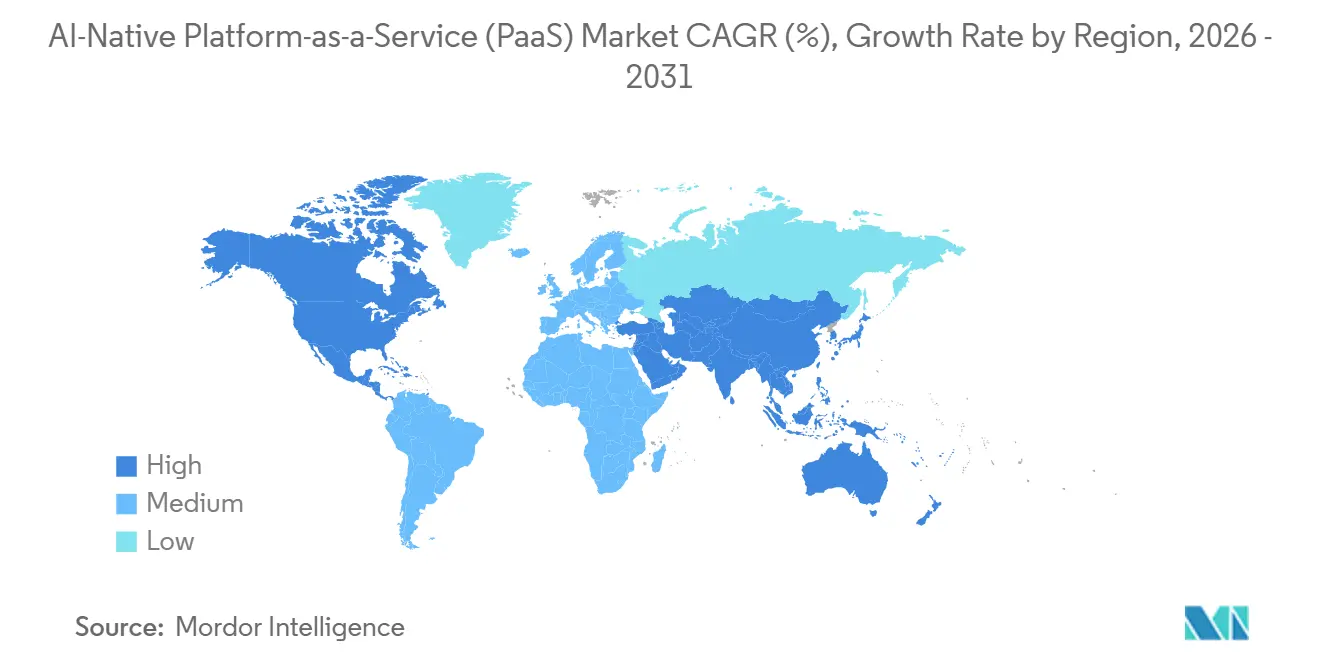
- By geography, North America held 39.77% of the market in 2025, while Asia-Pacific is expected to expand at a 35.58% CAGR through 2031.
Note: Market size and forecast figures in this report are generated using Mordor Intelligence’s proprietary estimation framework, updated with the latest available data and insights as of January 2026.
Market Trends and Insights
Drivers Impact Analysis of AI-Native Platform-as-a-Service (PaaS) Market*
| Driver | (~) % Impact on CAGR Forecast | Geographic Relevance | Impact Timeline |
|---|---|---|---|
| Enterprise Shift From AI Experiments to Production Applications | +9.2% | Global, with concentration in North America and Europe | Short term (≤ 2 years) |
| AI Agent and Multi-Model Application Proliferation | +8.6% | Global, with highest acceleration in North America and Asia-Pacific | Short term (≤ 2 years) |
| Demand for Low-Latency Generative AI Inference | +6.4% | Global, with near-term lead in North America and rapid adoption in Asia-Pacific | Short term (≤ 2 years) |
| Expansion of Open-Weight Model Deployment | +5.8% | Global, most pronounced in Asia-Pacific and Europe due to data sovereignty requirements | Medium term (2-4 years) |
| Developer Preference for Managed GPU and Serverless Workloads | +3.9% | North America and Asia-Pacific, with spillover to Europe and the Middle East | Medium term (2-4 years) |
| Fragmented AI Toolchains Creating Demand for Unified Platforms | +3.2% | Global, with early consolidation gains in large enterprises in North America and Europe | Long term (≥ 4 years) |
| Source: Mordor Intelligence | |||
Enterprise Shift From AI Experiments to Production Applications
The shift from experimentation to production is the strongest driver of demand for the AI-native platform-as-a-service (PaaS) market. Production systems require dependable model operations, governance, monitoring, and service-level commitments that temporary internal stacks often cannot provide. Organizations across sectors are moving AI agents into live workflows, yet reliable scaling remains difficult. This gap directs spending toward platforms that manage performance after a system goes live through model drift checks, retraining triggers, audit records, and cost monitoring. Enterprise teams assess evaluation, monitoring, access controls, and workload routing alongside model quality. The AI-native platform-as-a-service (PaaS) market benefits when providers bring these functions together across multiple models and agents within a single controlled operating environment.
AI Agent and Multi-Model Application Proliferation
Organizations are moving beyond single-model calls toward applications that coordinate models, tools, data sources, and agents. This makes orchestration, memory handling, evaluation, and access control central functions in the AI-native platform-as-a-service (PaaS) market. Anyscale introduced a public preview of its Azure integration in June 2026, allowing multimodal data preparation, fine-tuning, inference, and agent workloads within a customer-controlled Azure tenancy.[1] The company reported up to 4 times faster experimentation and up to 90% lower total AI cost of ownership than with fragmented stacks. LangChain and NVIDIA launched the NemoClaw Deep Agents blueprint in July 2026, and its benchmark comparison stated that NVIDIA Nemotron 3 Ultra delivered 10 times lower inference cost than the nearest-performing closed model. The AI-native platform-as-a-service (PaaS) market is supported by demand for common environments that can manage agent communication, tool calls, memory, and permissions.
Demand for Low-Latency Generative AI Inference
Interactive applications require faster responses than batch-oriented AI systems, creating new expectations for the AI-native platform-as-a-service (PaaS) market. Amazon Web Services described 250 milliseconds or less as the target for time to first token in responsive generative AI interactions. MLCommons added a low-latency Llama 2 70B Interactive benchmark to MLPerf Inference v5.0 in April 2025, citing the wider use of real-time chatbots and agent systems. Meta described internal decoding targets below 25 milliseconds for the time to an incremental token in its 2025 engineering discussion. Google Cloud reported that Baseten achieved 225% better cost performance for high-throughput inference and a 25% improvement for latency-sensitive inference using A4 virtual machines with NVIDIA Blackwell GPUs. These requirements make optimized serving, routing, caching, and GPU-aware data paths important differentiators in the AI-native platform-as-a-service (PaaS) market.
Expansion of Open-Weight Model Deployment
Open-weight models are expanding the range of deployments that platform providers can support in the AI-native platform-as-a-service (PaaS) market. They allow organizations to use models within their own infrastructure boundaries and to adjust them for specific data or workflow needs. Together AI stated in July 2026 that it had completed a USD 800 million Series C financing at a USD 8.3 billion valuation and reported annual bookings above USD 1.15 billion. The company linked its expansion to rising enterprise use of open-source and open-weight AI infrastructure. Anyscale positioned its Azure offering around keeping proprietary data, model weights, and training pipelines in the customer’s own Azure tenancy. The AI-native PaaS market can benefit as buyers seek fine-tuning, serving, security, and monitoring services for private, hybrid, and sovereign deployments.
Restraints Impact Analysis of AI-Native Platform-as-a-Service (PaaS) Market*
| Restraint | (~) % Impact on CAGR Forecast | Geographic Relevance | Impact Timeline |
|---|---|---|---|
| AI Accelerator Cost and Capacity Volatility | -3.8% | Global, most acute for mid-market and small and medium-sized enterprises outside North America | Short term (≤ 2 years) |
| Data Privacy, Sovereignty and Regulatory Constraints | -3.2% | Europe and Asia-Pacific, with spillover to the Middle East and South America | Medium term (2-4 years) |
| GPU Workload Isolation and Secure Execution Complexity | -2.1% | North America and Europe, plus regulated sectors globally | Medium term (2-4 years) |
| Model Drift, Evaluation Uncertainty and Unpredictable Inference Economics | -1.7% | Global, with greater effect on less mature enterprise AI programs | Long term (≥ 4 years) |
| Source: Mordor Intelligence | |||
AI Accelerator Cost and Capacity Volatility
Accelerator availability and pricing can delay platform commitments, especially for customers who need dedicated capacity. Pricing can vary widely between cloud providers for comparable accelerator configurations, complicating estimates for training and inference costs. This uncertainty is particularly challenging for small and medium-sized enterprises that cannot reserve large amounts of capacity in advance. Inference costs can affect provider margins and customer pricing because inference accounts for a large share of AI compute. The AI-native platform-as-a-service (PaaS) market can reduce this concern through flexible purchasing options, workload scheduling, usage caps, model selection tools, and support for multiple accelerator architectures. These measures help make the AI-native platform-as-a-service (PaaS) market more practical for budget-conscious users, though they do not remove capacity constraints.
Data Privacy, Sovereignty, and Regulatory Constraints
Data protection requirements influence where organizations can train, serve, and monitor AI systems. The European Union’s AI Act establishes a risk-based framework with transparency, documentation, and oversight requirements for relevant AI systems.[2] These obligations increase the need for auditability, controlled data flows, regional infrastructure, and access controls in the AI-native platform-as-a-service (PaaS) market. Pinecone launched a Frankfurt cloud region in May 2026 to provide Central European customers with local access to its serverless vector database and knowledge infrastructure. The company also introduced Pinecone Nexus, KnowQL, and Dedicated Read Nodes in the same announcement. The AI-native platform-as-a-service (PaaS) market must balance local compliance needs with the efficiency of a common global platform architecture.
*Our forecasts treat driver/restraint impacts as directional, not additive. The impact forecasts reflect baseline growth, mix effects, and variable interactions.
AI-Native Platform-as-a-Service (PaaS) Market Segment Analysis
By Platform Layer:
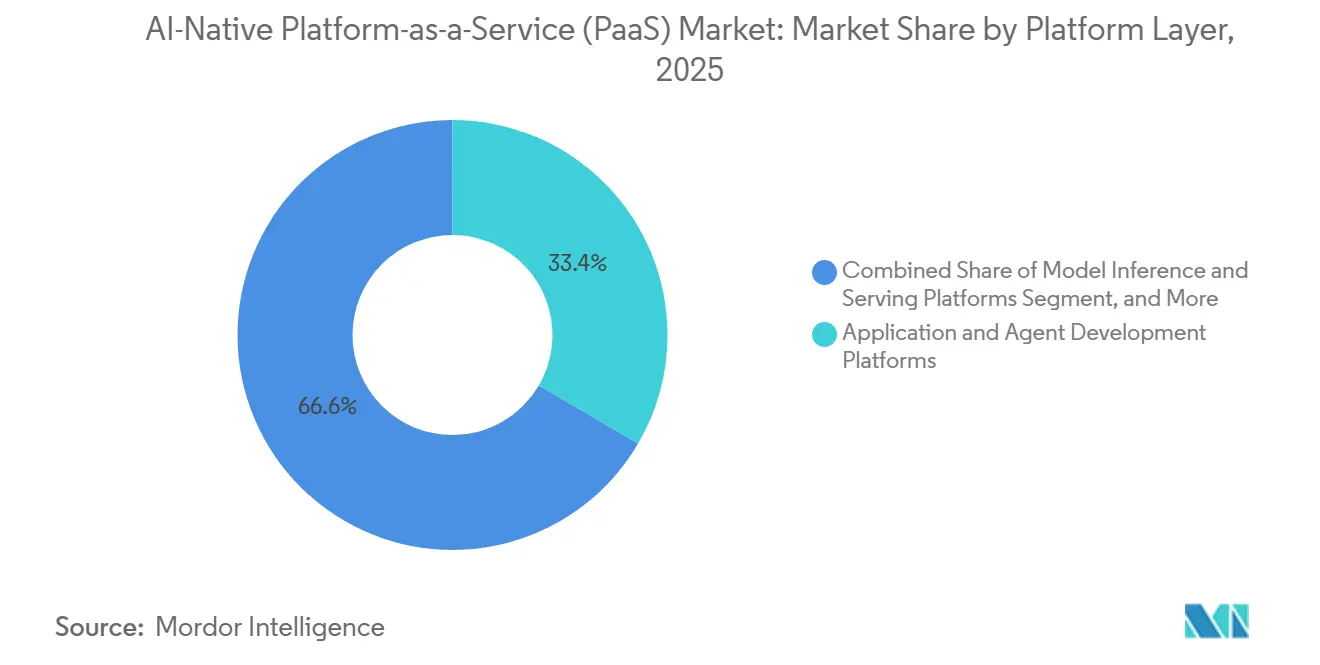
Governance And Observability Increase Their Role Alongside Development ToolsApplication and Agent Development Platforms held 33.42% of the market in 2025. Their position reflects demand for tools that shorten the path from a model prototype to a managed production workflow. Model Inference and Serving Platforms provide the runtime layer for production workloads. Model Training and Fine-Tuning Platforms remain important as organizations adjust existing models for specialized data and business tasks. AI Data, Vector, and Retrieval Services also support retrieval-augmented generation and knowledge-based applications. Together, these layers show that buyers need an integrated workflow rather than a stand-alone model endpoint.
AI Observability, Evaluation, and Governance Services is projected to expand at a 35.69% CAGR through 2031, the fastest pace within the platform layer. Dynatrace reported in 2025 that AI capabilities were the leading criterion for selecting an observability platform for 29% of respondents. Pinecone’s Frankfurt launch included Dedicated Read Nodes, which the company stated could deliver up to 97% cost reduction at scale for applicable high-throughput retrieval workloads. CoreWeave completed its acquisition of Weights and Biases in May 2025, linking compute infrastructure with experiment tracking and observability. These developments indicate that evaluation and monitoring are becoming part of the operating platform. The AI-native platform-as-a-service (PaaS) industry is likely to favor vendors that connect these functions with development and serving tools.

By Deployment Model:
Cloud Retains Scale While Customer-Controlled Environments Gain DemandCloud deployment accounted for 78.81% of the market in 2025. Its lead is supported by elastic capacity, rapid provisioning, and access to specialized compute without major upfront investment. Cloud services can also simplify access to managed databases, model services, and monitoring tools. These advantages matter when teams need to launch and modify workloads quickly. For many organizations, cloud remains the most direct way to reach production-scale AI capacity. The AI-native platform-as-a-service (PaaS) market, therefore, continues to rely heavily on cloud delivery.
On-premise deployment is projected to expand at a 35.11% CAGR through 2031. This momentum reflects the need for control over sensitive data, model weights, and workload locations. Anyscale’s Azure integration allows customers to run data preparation, fine-tuning, inference, and agent workloads within their own Azure tenancy. This approach shows how managed platforms can operate within customer-defined infrastructure boundaries. It also supports a bring-your-own-cloud model that combines service management with customer control. Customer-controlled deployments can therefore expand without requiring a strict choice between public cloud and local infrastructure.
By Application:
Generative AI Leads Spending While Visual And Multimodal Workloads AdvanceGenerative AI Applications accounted for 41.26% of the market in 2025. Organizations use these applications for content creation, code assistance, document processing, and workflow automation. Natural Language Processing, Predictive Analytics, and Classical Machine Learning remain active application areas with established use cases. Recommendation and personalization continue to support retail and media activities through data-driven customer experiences. These workloads increasingly combine established machine learning methods with retrieval and generative functions. The result is a broad base of applications for platform providers.
Computer Vision and Multimodal AI is projected to expand at a 35.91% CAGR through 2031. Demand comes from visual inspection, satellite imagery, autonomous systems, document processing, and applications that combine text with images or other inputs. Together AI expanded its fine-tuning service in March 2026 to support vision-language model training, tool calling, reasoning, and models with more than 100 billion parameters. Anyscale reported that integrating NVIDIA cuDF into Ray Data reduced the cost of GPU-native multimodal processing by 80% compared with equivalent CPU pipelines in its cited configuration. These examples show that multimodal workloads require data and compute optimization as well as model access. Providers that support these requirements can address a growing part of the AI-native platform-as-a-service (PaaS) market.
By Organization Size:
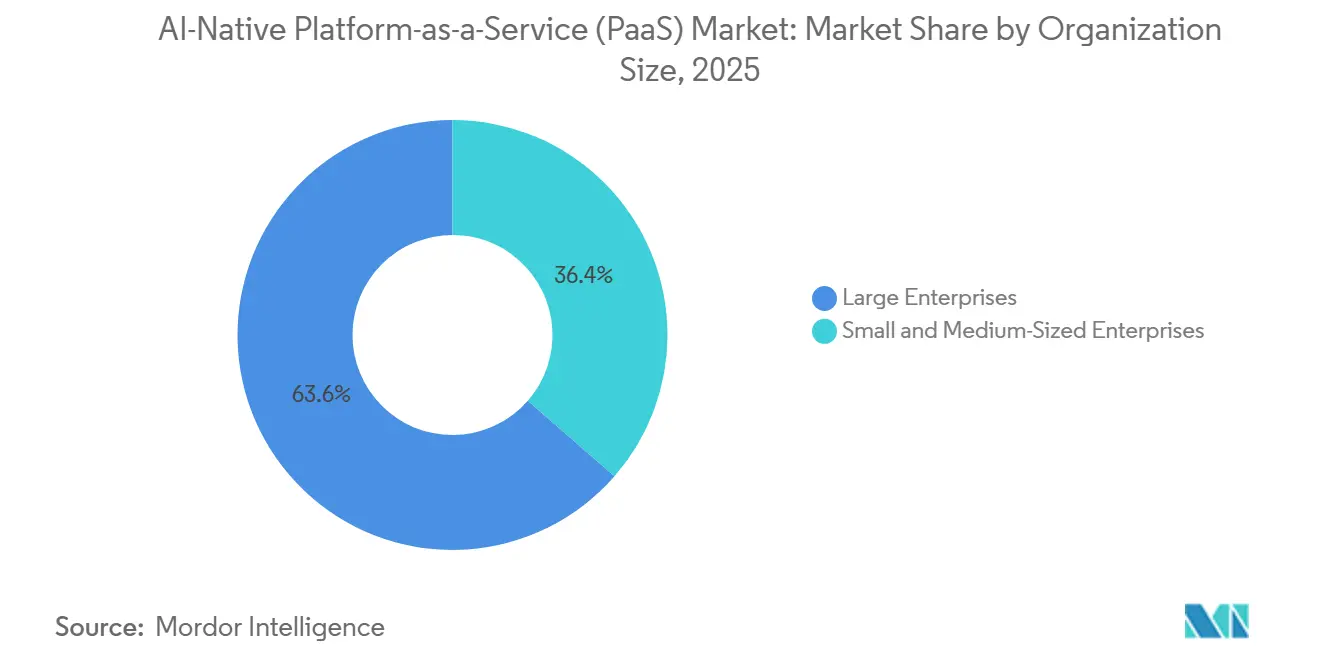
Large Enterprises Provide Scale While Small And Medium-Sized Enterprises Broaden AdoptionLarge enterprises held 63.58% of the market in 2025. Their share reflects larger technology budgets, long procurement cycles, and the resources needed to run production-scale AI platforms. Merck and Google Cloud announced a multi-year partnership in April 2026 valued at up to USD 1 billion to deploy an agentic AI platform across research and development, manufacturing, commercial, and corporate functions. Such agreements demonstrate how large organizations are shifting from isolated tools to wider platform commitments. They also create demand for governance, security, and system integration across several teams. The AI-native platform-as-a-service (PaaS) market gains stability when these customers standardize on long-term platforms.
Small and medium-sized enterprises are projected to expand at a 35.09% CAGR through 2031. Serverless inference and usage-based pricing can lower the initial commitment required to deploy AI applications. Together AI reported in March 2026 that it had served more than 1 million developers and thousands of paying customers. The company also reported 10 times year-over-year growth in annual contract revenue. This model allows smaller organizations to begin with self-service tools and increase usage as requirements become clearer. A provider with both self-service and dedicated options can serve the needs of organizations at different stages. That flexibility supports broader participation in the AI-native platform-as-a-service (PaaS) industry.
By End-User Industry:
IT And Telecommunications Lead Demand While Healthcare And Life Sciences AccelerateIT and Telecommunications held 29.37% of the market in 2025. Software firms and cloud infrastructure companies are both key buyers and suppliers of AI-native platform capabilities. Telecommunications providers also use AI infrastructure for network optimization and customer-experience automation. Banking, Financial Services, and Insurance use these platforms for fraud detection, risk modeling, and document processing. Media and Entertainment use generative tools for content and personalization, while Retail and E-Commerce use them for forecasting and customer interactions. This broad demand base makes the AI-native platform-as-a-service (PaaS) market relevant across industries with substantial digital workflows.
Healthcare and Life Sciences are projected to expand at a 35.87% CAGR through 2031. IQVIA introduced IQVIA.ai in 2026 as an agentic AI platform for clinical, commercial, and real-world life sciences operations. ICON selected Microsoft in June 2026 as a preferred technology partner to scale its secure agentic AI clinical trial platform, Orbis, on Azure. Oracle launched its Life Sciences AI Data Platform in January 2026 with AI agents for drug discovery, synthetic control arms, pharmacovigilance, and regulatory submissions. These moves show that regulated health organizations are choosing structured platform deployments for specialized workflows. The AI-native platform-as-a-service (PaaS) market meets this demand by combining life sciences capabilities with privacy, audit, and security controls.
Geography Analysis
North America AI-Native Platform-as-a-Service (PaaS) Market
North America held 39.77% of global demand in 2025. The region benefits from a concentration of infrastructure providers, enterprise technology spending, and active investment in AI capacity. Many leading platform companies have headquarters or major operations in North America, including Anyscale, Together AI, Pinecone, Arize AI, LangChain, and Weights and Biases. This supplier base supports local customer adoption and strong demand from organizations across software, cloud, telecommunications, financial services, and life sciences.
EMEA and South America AI-Native Platform-as-a-Service (PaaS) Market
Europe has expanding enterprise demand, but data localization and system governance pose constraints that Pinecone addressed with its AWS Frankfurt region launch in May 2026. The European Union’s AI Act supports a stronger focus on transparency, documentation, and risk management for relevant AI systems. South America remains in an earlier stage of adoption, with Brazil’s technology ecosystem and financial services modernization providing important demand channels. The Middle East is becoming a strategic source of AI infrastructure capital, as shown by Aramco Ventures leading Together AI’s USD 800 million Series C in July 2026.[3] Africa has a limited current presence and is developing through government digital transformation programs and multinational deployments in South Africa, Nigeria, and Egypt.
APAC AI-Native Platform-as-a-Service (PaaS) Market
Asia-Pacific is projected to expand at a 35.58% CAGR through 2031, the fastest regional rate. The region combines large enterprise demand, active cloud investment, and programs focused on sovereign AI capabilities. Japan, South Korea, India, China, and the wider Asia-Pacific region are important demand centers for localized AI platforms. Providers that can support local languages, data residency, regional hosting, and customer-controlled deployments are positioned to address these needs. This supports the regional role of the AI-native PaaS market in distributed global infrastructure.
Competitive Landscape
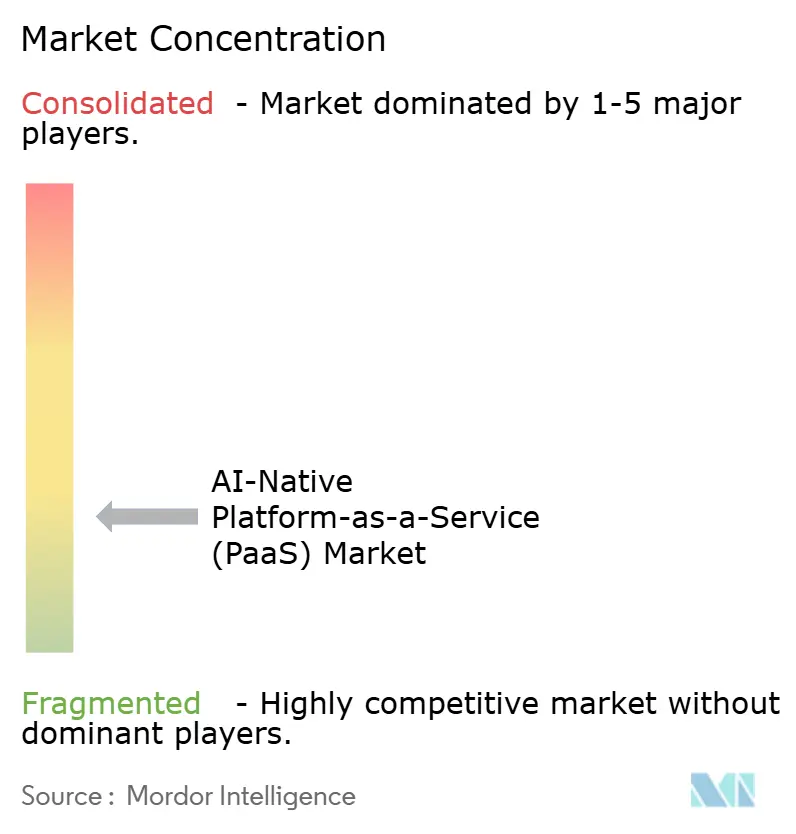
The AI-native PaaS market is fragmented across development, data and retrieval, training, serving, observability, and governance functions. No provider is identified as holding a dominant position across the full stack. Specialists can build strong positions within a single layer, while cloud and neocloud providers compete on capacity, model access, performance, and price. This structure gives buyers choices but can also create integration work when separate tools are used together. The competitive direction is toward platforms that combine complementary layers without losing technical flexibility.
CoreWeave completed the acquisition of Weights and Biases in May 2025, connecting AI infrastructure with experimentation and observability capabilities. Modular acquired BentoML in February 2026 to combine its hardware-aware inference optimization with BentoML’s model serving platform. Together AI’s USD 800 million Series C in July 2026 provides capital to increase capacity for open-weight infrastructure. These moves show an effort to capture more value across the compute, serving, and operations segments. They also increase pressure on point solutions that cannot demonstrate a clear advantage in integration.
Anyscale signed a definitive agreement to join Nscale in July 2026, and the companies stated that Nscale planned to become a platinum member of the PyTorch Foundation. This action shows how open-source participation can support a vendor’s ecosystem position. Smaller providers can still compete by specializing in model optimization, agent management, retrieval systems, or evaluation tools. The main opportunity is to offer enterprise-grade controls without requiring a large internal platform engineering team. The AI-native platform-as-a-service (PaaS) market is therefore likely to reward products that reduce integration work and give customers clear choices across models and infrastructure.
AI-Native Platform-as-a-Service (PaaS) Industry Leaders
-
Anyscale, Inc.
-
Baseten Labs, Inc.
-
Modal Labs, Inc.
-
Replicate, LLC
-
TogetherAI, Inc.
- *Disclaimer: Major Players sorted in no particular order
AI-Native Platform-as-a-Service (PaaS) Market Companies Covered in this Report
- Anyscale, Inc.
- Baseten Labs, Inc.
- Modal Labs, Inc.
- Replicate, LLC
- Runpod Inc.
- TogetherAI, Inc.
- Fireworks AI, Inc.
- Northflank Ltd
- Beam Cloud, Inc.
- BentoML, Inc.
- Predibase, Inc.
- Lightning AI, Inc.
- Hugging Face, Inc.
- Pinecone Systems, Inc.
- Weaviate B.V.
- Qdrant Solutions GmbH
- Zilliz, Inc.
- Arize AI, Inc.
- LangChain, Inc.
- Weights & Biases, Inc.
- Lepton AI, Inc.
- OctoML, Inc.
Recent Industry Developments in AI-Native Platform-as-a-Service (PaaS) Market
- July 2026: Together AI raised USD 800 million in a Series C round led by Aramco Ventures at a USD 8.3 billion valuation, with participation from NVIDIA, Vista Equity Partners, and General Catalyst. The company reported annual bookings exceeding USD 1.15 billion and plans to expand its infrastructure capacity by 50 times over 5 years. The round signals accelerating enterprise migration toward open-weight neocloud platforms.
- July 2026: LangChain and NVIDIA launched the NemoClaw for LangChain Deep Agents blueprint, enabling enterprises to build, evaluate, and deploy open-weight enterprise agents with NVIDIA Nemotron 3 Ultra at 10 times lower inference cost than the nearest-performing closed model on benchmarks. EY is building an implementation practice around the stack.
- June 2026: CoreWeave launched the ARIA AI research agent, built using Weights and Biases Weave, which entered general availability simultaneously. ARIA automates AI experiment analysis within the Weights and Biases platform, enabling continuous model iteration without manual trace review, and extends CoreWeave’s compute-to-observability stack into agentic automation.
- June 2026: ICON plc selected Microsoft as a preferred technology partner for a multi-year investment to scale Orbis, its secure agentic AI clinical trial platform, on Azure using Microsoft AI Services and Microsoft Foundry, accelerating the path from prototype to production-grade AI in regulated clinical workflows.
Global AI-Native Platform-as-a-Service (PaaS) Market Report Scope
The AI-Native Platform-as-a-Service (PaaS) market encompasses cloud-based and on-premise managed platforms purpose-built to develop, train, deploy, serve, monitor, and govern artificial intelligence and machine learning workloads at production scale. Unlike general-purpose PaaS offerings that added AI capabilities as ancillary features, AI-native platforms are architected from the ground up around GPU-accelerated compute, foundation model APIs, vector data infrastructure, and AI-specific DevOps tooling. The market includes revenues derived from platform subscription and consumption fees, managed inference and fine-tuning services, vector database and retrieval-augmented generation (RAG) infrastructure, AI observability and evaluation tooling, and associated professional and integration services, provided by specialist AI infrastructure vendors, neocloud operators, and AI platform divisions of hyperscalers where those divisions are analytically separable from broader cloud infrastructure revenue.
The AI-Native Platform-as-a-Service (PaaS) Market Report is Segmented by Platform Layer (Model Inference and Serving Platforms, Application and Agent Development Platforms, Model Training and Fine-Tuning Platforms, AI Data, Vector, and Retrieval Services, and AI Observability, Evaluation, and Governance Services), Deployment Model (Cloud, and On-Premise), Application (Generative AI Applications, Natural Language Processing, Computer Vision and Multimodal AI, Recommendation and Personalization, Predictive Analytics and Classical Machine Learning, and Other Applications), Organization Size (Large Enterprises, and Small and Medium Enterprises), End-User Industry (Retail and E-Commerce, IT and Telecommunications, Banking, Financial Services, and Insurance, Healthcare and Life Sciences, Media and Entertainment, and Other End-User Industries), and Geography (North America, South America, Europe, Asia-Pacific, Middle East, and Africa). The Market Forecasts are Provided in Terms of Value (USD).
Segmentation Overview
| Model Inference and Serving Platforms |
| Application and Agent Development Platforms |
| Model Training and Fine-Tuning Platforms |
| AI Data, Vector, and Retrieval Services |
| AI Observability, Evaluation, and Governance Services |
| Cloud |
| On-Premise |
| Generative AI Applications |
| Natural Language Processing |
| Computer Vision and Multimodal AI |
| Recommendation and Personalization |
| Predictive Analytics and Classical Machine Learning |
| Other Applications |
| Large Enterprises |
| Small and Medium Enterprises |
| Retail and E-Commerce |
| IT and Telecommunications |
| Banking, Financial Services, and Insurance |
| Healthcare and Life Sciences |
| Media and Entertainment |
| Other End-User Industries |
| North America | United States |
| Canada | |
| Mexico | |
| South America | Brazil |
| Argentina | |
| Rest of South America | |
| Europe | Germany |
| United Kingdom | |
| France | |
| Italy | |
| Spain | |
| Rest of Europe | |
| Asia-Pacific | China |
| India | |
| Japan | |
| South Korea | |
| Rest of Asia-Pacific | |
| Middle East | United Arab Emirates |
| Saudi Arabia | |
| Turkey | |
| Rest of Middle East | |
| Africa | South Africa |
| Nigeria | |
| Egypt | |
| Rest of Africa |
| By Platform Layer | Model Inference and Serving Platforms | |
| Application and Agent Development Platforms | ||
| Model Training and Fine-Tuning Platforms | ||
| AI Data, Vector, and Retrieval Services | ||
| AI Observability, Evaluation, and Governance Services | ||
| By Deployment Model | Cloud | |
| On-Premise | ||
| By Application | Generative AI Applications | |
| Natural Language Processing | ||
| Computer Vision and Multimodal AI | ||
| Recommendation and Personalization | ||
| Predictive Analytics and Classical Machine Learning | ||
| Other Applications | ||
| By Organization Size | Large Enterprises | |
| Small and Medium Enterprises | ||
| By End-User Industry | Retail and E-Commerce | |
| IT and Telecommunications | ||
| Banking, Financial Services, and Insurance | ||
| Healthcare and Life Sciences | ||
| Media and Entertainment | ||
| Other End-User Industries | ||
| By Geography | North America | United States |
| Canada | ||
| Mexico | ||
| South America | Brazil | |
| Argentina | ||
| Rest of South America | ||
| Europe | Germany | |
| United Kingdom | ||
| France | ||
| Italy | ||
| Spain | ||
| Rest of Europe | ||
| Asia-Pacific | China | |
| India | ||
| Japan | ||
| South Korea | ||
| Rest of Asia-Pacific | ||
| Middle East | United Arab Emirates | |
| Saudi Arabia | ||
| Turkey | ||
| Rest of Middle East | ||
| Africa | South Africa | |
| Nigeria | ||
| Egypt | ||
| Rest of Africa | ||
Key Questions Answered in the Report
What is the value of the AI-native PaaS sector?
The sector is expected to increase from USD 64.81 billion in 2026 to USD 287.46 billion by 2031 at a 34.71% CAGR.
Which platform layer has the largest share?
Application and Agent Development Platforms held the largest platform-layer share at 33.42% in 2025.
Which deployment model leads demand?
Cloud deployment led with 78.81% of the market in 2025, while on-premise deployment is expected to expand at a 35.11% CAGR through 2031.
What application is expanding fastest?
Computer Vision and Multimodal AI is projected to expand at a 35.91% CAGR through 2031, supported by visual and multimodal enterprise workloads.
Which end-user sector is projected to expand fastest?
Healthcare and Life Sciences is projected to expand at a 35.87% CAGR through 2031, supported by clinical, commercial, and life sciences AI platforms.
Which region is projected to expand fastest?
Asia-Pacific is expected to expand at a 35.58% CAGR through 2031, the fastest rate among the regions covered.