
AI Dubbing For OTT Market Size and Share
Market Overview
| Study Period | 2020 - 2031 |
|---|---|
| Market Size (2026) | USD 0.75 Billion |
| Market Size (2031) | USD 2.45 Billion |
| Growth Rate (2026 - 2031) | 26.71 % |
| Fastest Growing Market | Asia-Pacific |
| Largest Market | North America |
| Market Concentration | Medium |
Major Players *Disclaimer: Major Players sorted in no particular order Image © Mordor Intelligence. Reuse requires attribution under CC BY 4.0. | |
AI Dubbing For OTT Market Analysis by Mordor Intelligence
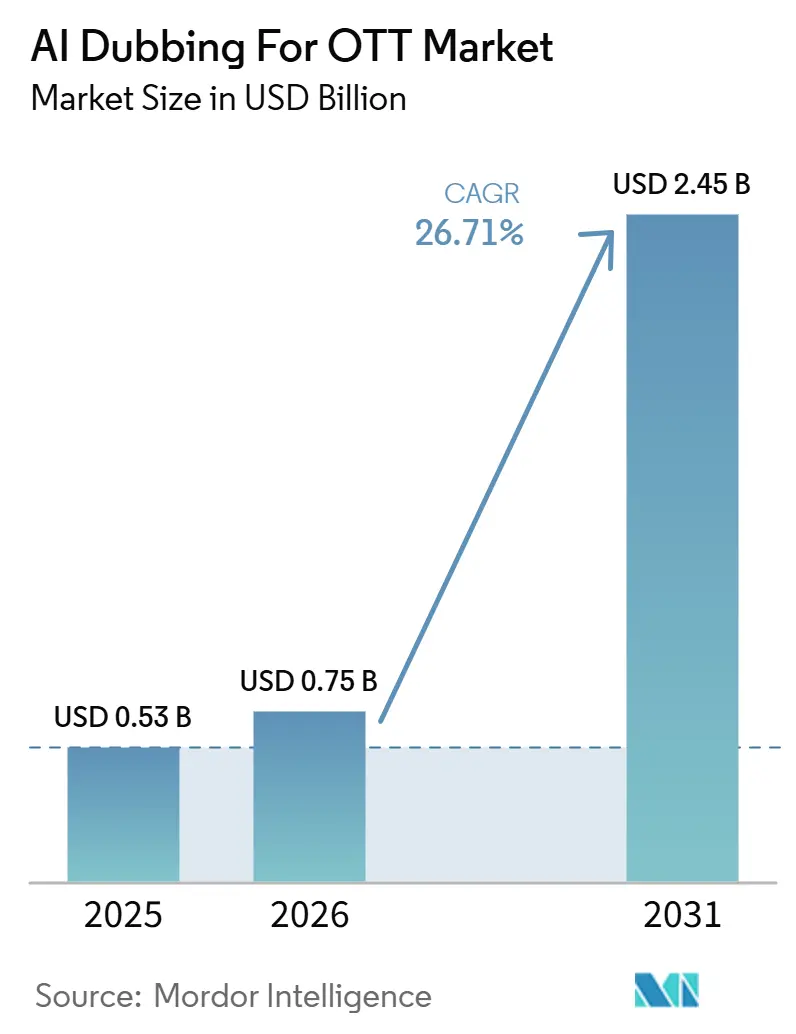
The AI Dubbing For OTT Market size is projected to be USD 0.53 billion in 2025, USD 0.75 billion in 2026, and reach USD 2.45 billion by 2031, growing at a CAGR of 26.71% from 2026 to 2031. The AI dubbing for OTT market is growing as streaming services need practical ways to release more titles across languages without extending release schedules. Cloud-based workflows meet this demand by processing multiple language tracks and catalog titles without dedicated local infrastructure. Platforms are also using hybrid workflows that combine generated voices with professional review, especially where dialogue, cultural context, and actor rights need closer attention. The opportunity is strongest where previously underlocalized libraries can be made available to new audiences, although disclosure rules and performer authorization requirements are increasing the cost of compliance in some territories.
Key Report Takeaways
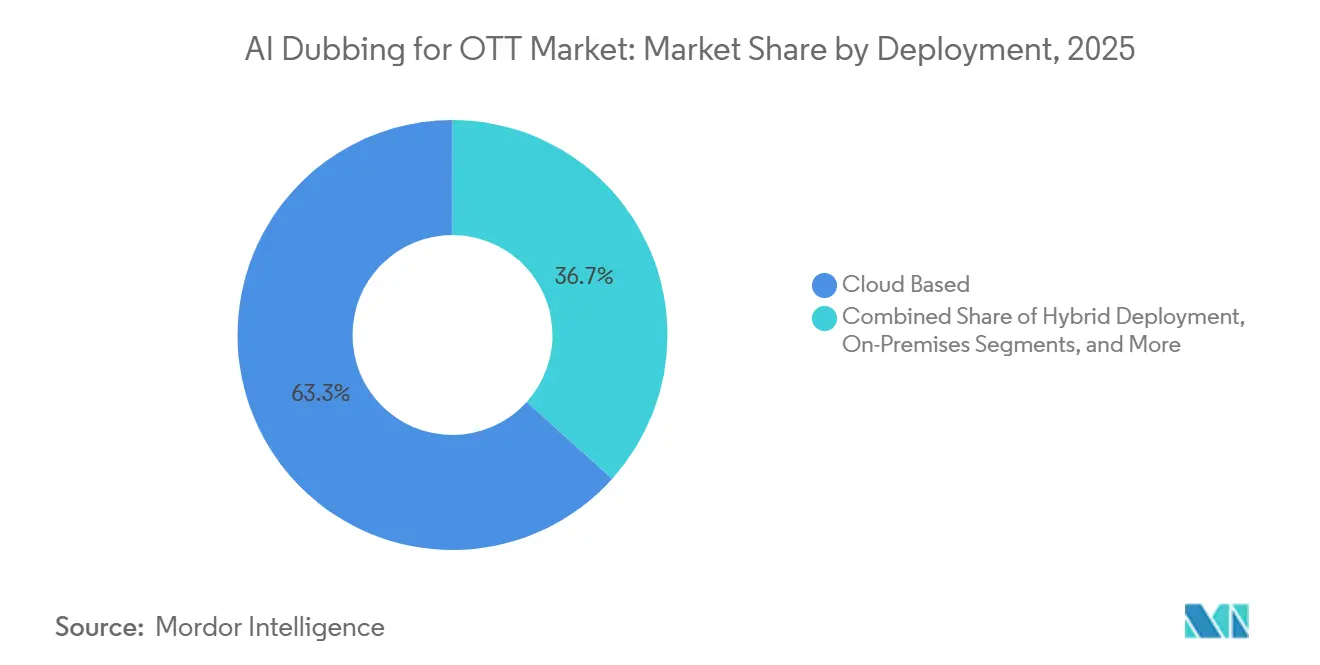
- By deployment, cloud-based solutions held 63.34% of AI dubbing for OTT market share in 2025 and are projected to expand at a 27.38% CAGR through 2031.
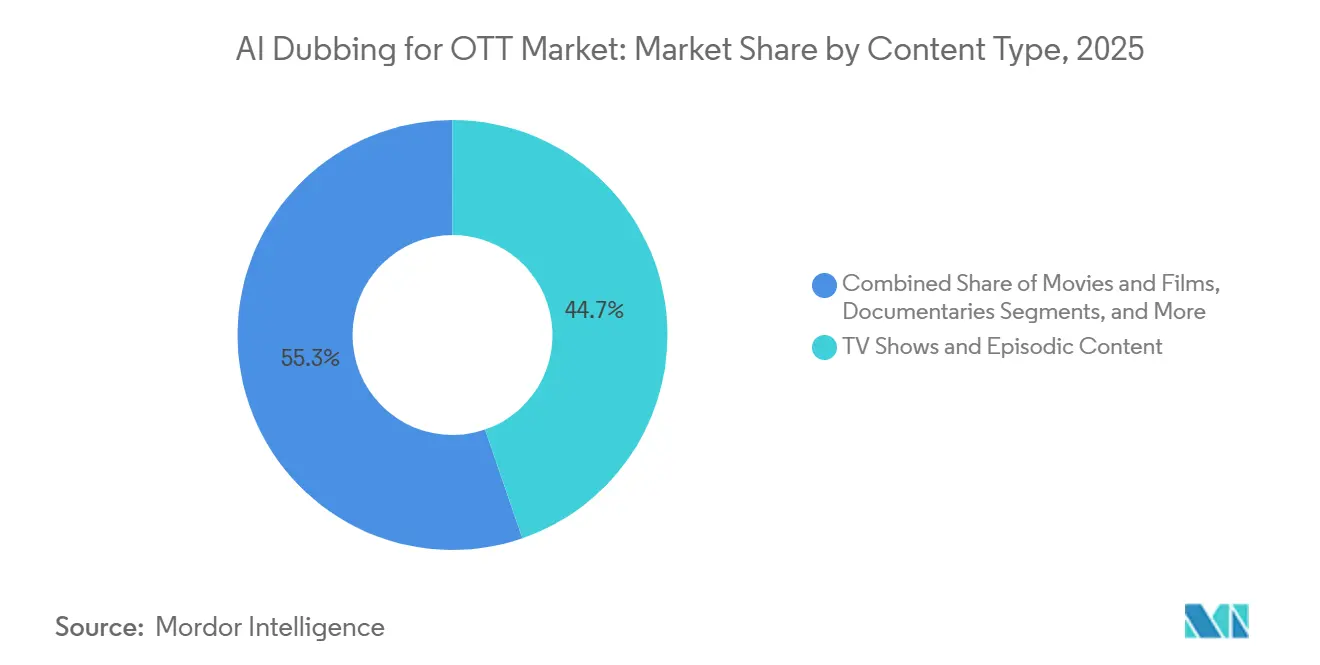
- By content type, TV shows and episodic content accounted for 44.72% of AI dubbing for OTT market share in 2025, while documentaries are projected to expand at a 27.43% CAGR through 2031.
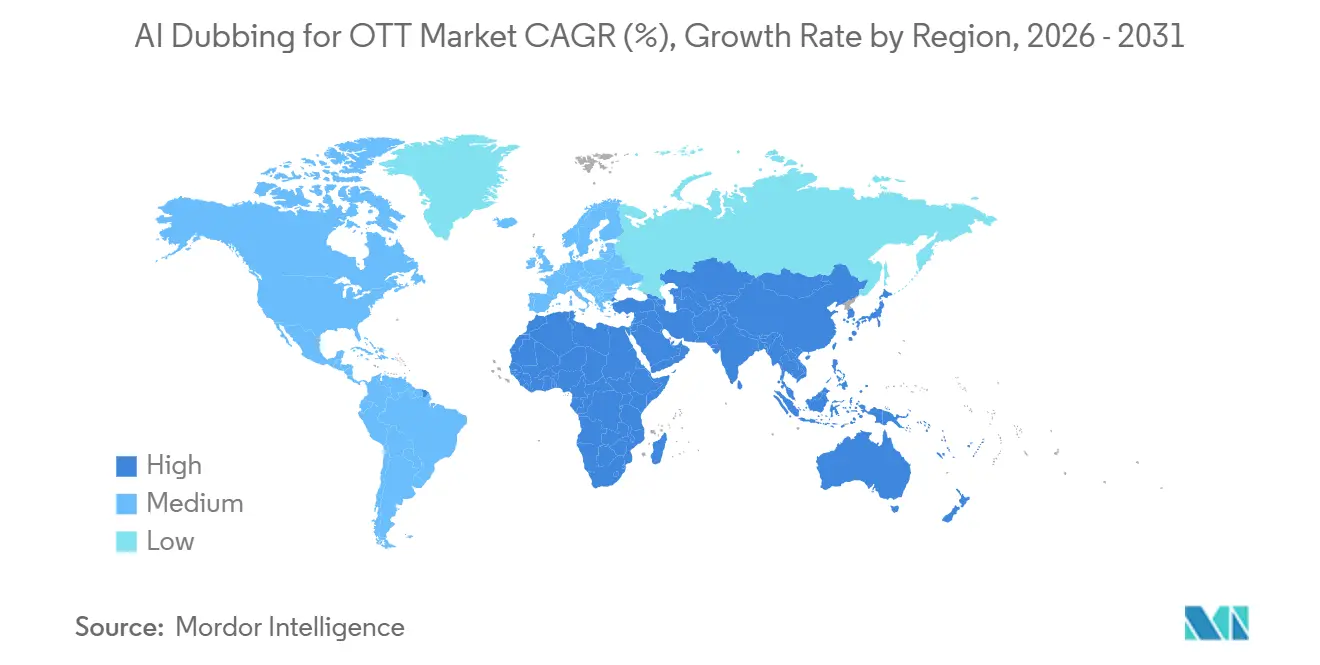
- By geography, North America accounted for 42.56% of revenue in 2025, while Asia-Pacific is expected to expand at a 27.96% CAGR through 2031.
Note: Market size and forecast figures in this report are generated using Mordor Intelligence’s proprietary estimation framework, updated with the latest available data and insights as of January 2026.
Market Trends and Insights
Drivers Impact Analysis of AI Dubbing For OTT Market*
| Driver | (~) % Impact on CAGR Forecast | Geographic Relevance | Impact Timeline |
|---|---|---|---|
| Expansion of Multilingual Streaming Catalogs | +7.2% | Global, strongest in North America and Asia-Pacific | Short term (≤ 2 years) |
| Demand for Faster Global Content Release | +5.8% | Global, strongest in North America, Europe, and South Korea | Short term (≤ 2 years) |
| Lower Localization Cost Per Minute | +4.5% | Global, with highest adoption impact in Asia-Pacific and South America | Medium term (2-4 years) |
| Growth of Creator-Led and Short-Form Video Distribution | +3.8% | Global, with early gains in North America, India, and South Korea | Medium term (2-4 years) |
| Real-Time Multilingual Broadcasting and Live Dubbing | +2.6% | North America, Europe, South Korea, with spillover to the Middle East and South America | Medium term (2-4 years) |
| Reuse of Under localized Back-Catalog Content | +2.1% | Global, concentrated in platforms with large legacy English-language libraries | Long term (≥ 4 years) |
| Source: Mordor Intelligence | |||
Expansion of Multilingual Streaming Catalogs
The AI dubbing for OTT market benefits from the continued expansion of non-English programming on international streaming services. Netflix reported a larger Korean content presence among its non-English originals in 2025, and the increase in new seasons added to the volume of programming that needed language adaptation. In 2026, Amazon Prime Video stated that it could offer up to 22 dubbed languages and 36 subtitle tracks across 240 countries and territories.[1]Amazon Web Services and Deepdub, “Deepdub's AI Localization Tools Unlock Business Opportunities for Paramount's Ananey Studios,” Amazon Web Services, aws.amazon.com. Each new release can create a future need to localize earlier seasons and related catalog titles. South Korea's Ministry of Science and ICT supported AI dubbing across 1,200 K-content titles, totaling 1,400 hours, in English, Spanish, and Portuguese. The program reached 100 million cumulative viewers across 22 countries within 5 months, demonstrating that a coordinated localization program can expand distribution beyond its original-language base.
Demand for Faster Global Content Release
The AI dubbing for OTT market is supported by platforms seeking to narrow the gap between original releases and their localized editions. Traditional language production can take 6 to 12 weeks per language, while automated workflows can reduce the time to initial output. Deepdub and Amazon Web Services documented a deployment with Paramount's Ananey Studios that reduced localization turnaround by more than 70%. Amazon Prime Video began a hybrid pilot in March 2025 across 12 licensed films and series in English and Spanish. The model used AI for initial voice generation and professional localization teams for review. Faster processing is especially useful for reality and competition programming, where delayed releases may lose relevance after results circulate online.
Lower Localization Cost Per Minute
Lower production cost is widening the range of titles that can be localized in the AI dubbing for OTT market. Commercial AI services charged USD 2 to USD 12 per finished minute per language in the source material, while traditional film dubbing required substantially higher studio, engineering, and voice talent spending. This change allows platforms to consider catalog programs that previously did not meet internal language-adaptation spending thresholds. ZDF Digital partnered with Dubhub to create South American Spanish versions of its Get.factual documentary channel for YouTube. Large inventories of unscripted programming are therefore becoming more practical candidates for multilingual distribution. Savings may be partly offset in some markets by consent, documentation, and disclosure obligations for generated audio.
Growth of Creator-Led and Short-Form Video Distribution
Creator-led video is extending the addressable audience for the AI dubbing for OTT market beyond studio productions. YouTube made its AI autodubbing feature available across 27 languages in February 2026, following an earlier closed pilot, increasing access to translated audio for creators. Short-form video and creator programming are increasingly carried by ad-supported streaming and FAST services. Amazon's MX Player aggregated more than 20,000 dubbed international titles in India, while more than 60% of Prime Video customers in India watched content in 4 or more languages. Sarvam AI launched Sarvam Dub in February 2026 for 11 Indian languages. It also supported live AI dubbing of India's Union Budget 2026, showing how local-language tools are moving into high-visibility use cases.
Restraints Impact Analysis of AI Dubbing For OTT Market*
| Restraint | (~) % Impact on CAGR Forecast | Geographic Relevance | Impact Timeline |
|---|---|---|---|
| Inconsistent Emotional And Cultural Localization Quality | -2.4% | Global, most acute for premium scripted content in Europe and Asia-Pacific | Short term (≤ 2 years) |
| Voice Consent, Likeness, And Royalty Uncertainty | -2.0% | North America, Europe, and Mexico, with spillover to South America | Medium term (2-4 years) |
| Lip-Sync Failure Under Complex Visual Conditions | -1.5% | Global, highest impact in premium scripted film and drama formats | Medium term (2-4 years) |
| Scarcity Of High-Quality Training Data For Lower-Resource Languages | -0.9% | Africa, South Asia, Southeast Asia, and the Middle East | Long term (≥ 4 years) |
| Source: Mordor Intelligence | |||
Inconsistent Emotional and Cultural Localization Quality
Quality differences continue to limit the use of AI dubbing for OTT market tools in premium scripted programming. The source material identified lower lip-sync accuracy in non-English languages, particularly where phoneme complexity, tonal speech, and limited training data affect the output. Amazon Prime Video's South American Spanish AI-dubbed anime trial in 2025 drew criticism focused on emotional range, rhythm, and natural delivery. The company labeled the option as a beta feature, which reflected the need to manage quality expectations. RWS acquired Papercup's intellectual property in June 2025 and combined the technology with its human linguist network, reflecting the value placed on editorial review. Human review remains important for close-up scenes and dialogue, where viewers are most likely to notice mismatches between voice, performance, and lip movement.
Voice Consent, Likeness, and Royalty Uncertainty
Voice rights requirements can slow procurement and deployment in the AI dubbing for OTT market. California's SB-1142, the Digital Dignity Act, requires authorization for specified AI-based voice replication in commercial audiovisual settings. Mexico enacted Article 29 of the Ley Federal de Cine y el Audiovisual in April 2026, requiring prior performer authorization for AI dubbing in audiovisual productions. The EU AI Act Article 50 takes effect on August 2, 2026, and requires transparency measures for AI-generated audio. SAG-AFTRA has also provided guidance on artificial intelligence and performer protections. A service operating in many countries may therefore need separate consent, labeling, and compensation processes for the same title.
*Our forecasts treat driver/restraint impacts as directional, not additive. The impact forecasts reflect baseline growth, mix effects, and variable interactions.
AI Dubbing For OTT Market Segment Analysis
By Deployment:
Cloud-Based Delivery Leads Scalable LocalizationCloud-based delivery accounted for 63.34% of the AI dubbing for OTT market share in 2025 and is projected to record a 27.38% CAGR from 2026 to 2031. The model supports GPU processing, model inference, and concurrent creation of multiple language tracks. It also connects dubbing services with content delivery and media workflows through application programming interfaces. CAMB.AI and Deepdub have built cloud-integrated workflows for multilingual output, and Deepdub's Amazon Web Services deployment showed how localization can fit broader media operations. These features suit operators managing frequent releases across several territories.
The AI dubbing for OTT industry uses cloud delivery because capacity can expand without local systems for every release. Broadcasters and telecom operators with rights-sensitive material may use hybrid arrangements that retain selected processing in controlled environments. On-premises systems remain relevant where data sovereignty rules or internal controls are strict, but they are less flexible for high-volume, multilingual catalog work. Deepdub introduced Deepdub Live in April 2025 for real-time multilingual broadcasting, reporting a first-token audio latency of 125 milliseconds.[2]Deepdub, “Introducing Deepdub Live: AI-Powered Emotion-Based Dubbing for Real-Time Multilingual Broadcasts,” Deepdub, deepdub.ai. Continuous cloud model updates can improve voice quality and lip-sync performance without a separate replacement cycle.



By Content Type:
Episodic Content Holds the Largest Revenue PositionTV shows and episodic content held 44.72% of AI dubbing for OTT market share in 2025. Serialized programs create recurring work because new seasons often need the same language combinations as earlier installments. This supports predictable schedules for platforms and service providers. Films require closer scrutiny, as high-value scenes require precise synchronization and performance continuity, whereas Flawless AI's TrueSync is positioned as assistive technology that preserves an actor's performance during language adaptation. This approach is relevant where studios want automation without fully replacing a finished performance.
Documentaries are projected to expand at a 27.43% CAGR from 2026 to 2031, the highest rate among content types in the AI dubbing for OTT market. Voice-over formats can require less visual synchronization than drama, reducing the need for human review in some programs. ZDF Digital's Get Factual deployment shows how documentary libraries can be adapted for a different language audience. Catalogs that were not previously dubbed can now be assessed for FAST channels and digital distribution. Short-form video and aggregated FAST programming are another volume source as platform-level audio translation becomes more widely available.
Geography Analysis
North America AI Dubbing for OTT Market
North America held 42.56% of AI dubbing for OTT market share in 2025. The region contains the headquarters of several large streaming platforms that buy, test, and sometimes develop AI dubbing capabilities. Netflix's internal DeepSpeak system and Amazon Prime Video's March 2025 hybrid pilot illustrated early platform involvement, while Prime Video indicated that its international offering could reach up to 22 dubbed languages in 2026. The United States was the main regional revenue contributor, while Mexico's performer authorization rules created a separate compliance consideration. Hudson AI signed an agreement with Sinclair Broadcasting Group in January 2026 to develop an AI-dubbed K-content channel for U.S. terrestrial broadcasting.
APAC AI Dubbing for OTT Market
Asia-Pacific is projected to be the fastest-growing region at a 27.96% CAGR from 2026 to 2031. The region's language diversity gives the AI dubbing for OTT market a recurring need for localization. Sarvam Dub supports 11 Indian languages and was used for live dubbing of the Union Budget 2026, while South Korea expanded its Global K-FAST Alliance from 22 to 82 participants in July 2026 and selected 3 consortia to launch 4 new AI-dubbed K-content channels.[3]Yonhap News Agency, “K콘텐츠에 AI 더빙 입혔더니…22개국 1억명이 봤다,” Yonhap News Agency, yna.co.kr. In India, a single streaming title can require 6 or more regional language versions, and more than 60% of Prime Video customers watched content in 4 or more languages.
EMEA and South America AI Dubbing for OTT Market
Europe, South America, the Middle East, and Africa offer different demand conditions for the AI dubbing for OTT market. In Europe, the EU AI Act's audio disclosure rules create a common regulatory baseline for services distributed across member states. Spain, Germany, France, Italy, and the United Kingdom have established dubbing cultures, which make automation attractive but heighten the importance of performer relations. TelevisaUnivision explored AI dubbing for ViX in 2025, while MBC Shahid released Arabic-language programming with English lip-synced dubbing after 3 years of testing. In Africa, local-language localization could become more viable as streaming services expand mobile distribution and build more cost-effective workflows.

Competitive Landscape
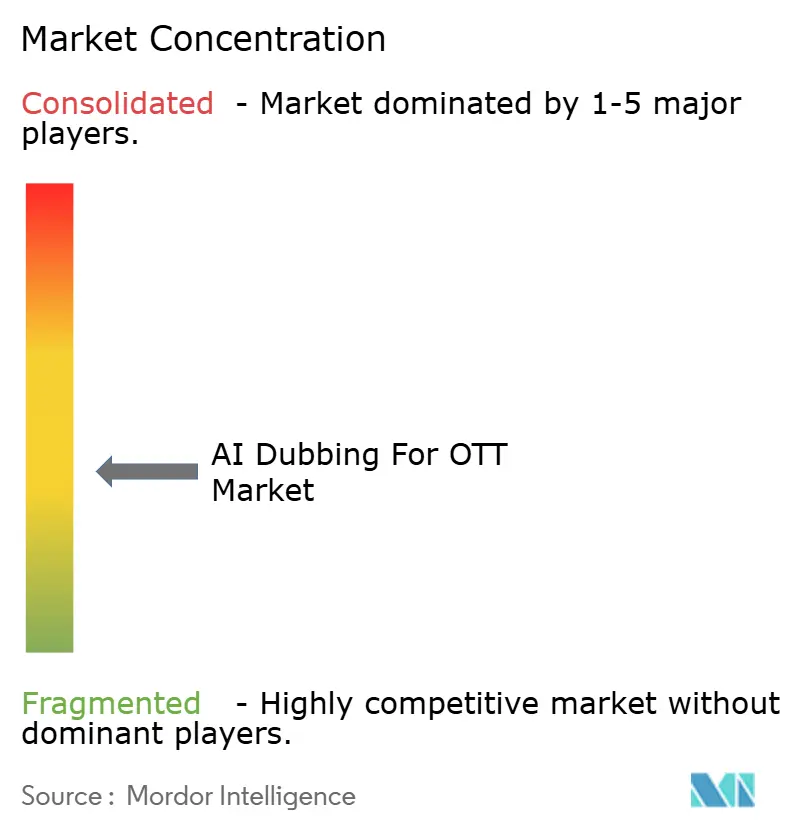
The AI dubbing for OTT market is a moderately fragmented structure that includes voice AI companies, specialist localization providers, media technology vendors, and large cloud platforms. ElevenLabs raised USD 500 million in a Series D round at an USD 11 billion valuation in February 2026. The company introduced Dubbing v2 in 2026 with emotion cloning and a transcript-free workflow. Deepdub used a managed production workflow for premium media clients and stated that it had localized more than 5,000 premium titles and 300,000 streaming minutes by 2025.
Vendors are differentiating through quality assurance, workflow integration, real-time delivery, and the treatment of rights-sensitive content. RWS acquired Papercup's intellectual property in June 2025, linking AI voice technology with its language services and human review capabilities.[4]RWS, “RWS Acquires Papercup's IP to Power Next-Gen AI Dubbing for Enterprise Clients,” RWS, rws.com. CAMB.AI delivered real-time Italian commentary for the 2026 Trophée des Champions match through an Amazon Web Services-integrated live broadcasting architecture. Flawless AI received the 2026 Lumière Award and the 2026 HPA Award for TrueSync, which supports language adaptation while preserving the original performance. These moves show that product value is not defined only by voice generation speed.
The AI dubbing for OTT market has room for vendors serving live sports, news, and languages with limited data resources. Fast response time matters because viewers expect localized commentary close to the original broadcast. Research presented at CVPR 2026 described FlashLips, a zero-shot lip-sync architecture that achieved more than 100 frames per second at native 4K resolution. Such improvements may address quality concerns in scripted film and drama. Compliance tools for consent management and AI-audio disclosure are also becoming a source of differentiation.
AI Dubbing For OTT Industry Leaders
RWS Holdings plc
Deepdub, Inc.
ElevenLabs, Inc.
HeyGen, Inc.
Google LLC
- *Disclaimer: Major Players sorted in no particular order
AI Dubbing For OTT Market Companies Covered in this Report
- RWS Holdings plc
- Deepdub, Inc.
- ElevenLabs, Inc.
- HeyGen, Inc.
- Google LLC
- Amazon Web Services, Inc.
- Microsoft Corporation
- NAVER CLOUD Corp.
- Camb.ai Inc.
- Dubverse.ai, Inc.
- Respeecher Inc.
- AppTek, Inc.
- Speechify, Inc.
- PlayHT, Inc.
- Elai, Inc.
- Verbit, Inc.
- Flawless AI
- SyncWords, Inc.

Recent Industry Developments in AI Dubbing For OTT Market
- May 2026: ElevenLabs completed the third close of its USD 500 million Series D funding, adding institutional investors including BlackRock, Wellington, D. E. Shaw, NVIDIA through NVentures, and Salesforce Ventures. The company crossed USD 500 million in ARR by April 2026, up from USD 330 million at year-end 2025, raising total funding to more than USD 781 million since its 2022 founding.
- February 2026: Sarvam AI launched Sarvam Dub, an AI dubbing model supporting 11 Indian languages, including Hindi, Tamil, Telugu, and Kannada. The same month, Sarvam AI-powered live AI dubbing of India's Union Budget 2026, as Finance Minister Nirmala Sitharaman delivered her address, marking the first national budget dubbed live using AI.
- February 2026: YouTube expanded its AI autodubbing feature from a closed pilot of 80 million creators, initiated in June 2025, to universal availability across 27 languages.
- January 2026: Hudson AI signed a memorandum of understanding with Sinclair Broadcasting Group to launch K Channel 82, a K-content channel on U.S. terrestrial broadcast infrastructure using AI dubbing technology. Sinclair's network of more than 185 local television stations provided an AI-dubbed K-content channel distributed through over-the-air U.S. broadcasting.


Global AI Dubbing For OTT Market Report Scope
AI dubbing for OTT refers to the use of artificial intelligence technologies, including speech recognition, machine translation, voice synthesis, and voice cloning, to translate and dub audio content for over-the-top streaming platforms. The scope includes market trends, growth drivers, challenges, technology developments, and competitive dynamics across key geographies.
The AI Dubbing for OTT Market Report is Segmented by Deployment (Cloud-Based, On-Premises, and Hybrid Deployment), Content Type (Movies and Films, TV Shows and Episodic Content, Documentaries, and Other Content Types), and Geography (North America, South America, Europe, Asia-Pacific, Middle East, and Africa). The Market Forecasts are Provided in Terms of Value (USD).
| Cloud-Based |
| On-Premises |
| Hybrid Deployment |
| Movies and Films |
| TV Shows and Episodic Content |
| Documentaries |
| Other Content Types |
| North America | United States |
| Canada | |
| Mexico | |
| South America | Brazil |
| Argentina | |
| Chile | |
| Rest of South America | |
| Europe | Germany |
| United Kingdom | |
| France | |
| Italy | |
| Spain | |
| Rest of Europe | |
| Asia-Pacific | China |
| Japan | |
| India | |
| South Korea | |
| Australia | |
| Rest of Asia-Pacific | |
| Middle East | Saudi Arabia |
| United Arab Emirates | |
| Qatar | |
| Rest of Middle East | |
| Africa | South Africa |
| Egypt | |
| Nigeria | |
| Rest of Africa |
| By Deployment | Cloud-Based | |
| On-Premises | ||
| Hybrid Deployment | ||
| By Content Type | Movies and Films | |
| TV Shows and Episodic Content | ||
| Documentaries | ||
| Other Content Types | ||
| By Geography | North America | United States |
| Canada | ||
| Mexico | ||
| South America | Brazil | |
| Argentina | ||
| Chile | ||
| Rest of South America | ||
| Europe | Germany | |
| United Kingdom | ||
| France | ||
| Italy | ||
| Spain | ||
| Rest of Europe | ||
| Asia-Pacific | China | |
| Japan | ||
| India | ||
| South Korea | ||
| Australia | ||
| Rest of Asia-Pacific | ||
| Middle East | Saudi Arabia | |
| United Arab Emirates | ||
| Qatar | ||
| Rest of Middle East | ||
| Africa | South Africa | |
| Egypt | ||
| Nigeria | ||
| Rest of Africa | ||


Key Questions Answered in the Report
What is the size of the AI dubbing for OTT market?
The AI Dubbing For OTT Market size is projected to be USD 0.53 billion in 2025, USD 0.75 billion in 2026, and reach USD 2.45 billion by 2031, growing at a CAGR of 26.71% from 2026 to 2031.
What is driving adoption of AI dubbing by streaming platforms?
The AI dubbing for OTT market is supported by more language tracks, shorter localization timelines, and the ability to adapt underlocalized catalog titles at lower production cost. Streaming services also need language options that can accompany broader international programming releases.
Which deployment model leads AI dubbing for OTT?
Cloud-based deployment led with 63.34% of revenue in 2025 and is projected to grow at a 27.38% CAGR through 2031. It supports concurrent language processing, elastic capacity, and integration with existing media workflows. Hybrid delivery remains relevant for organizations that need controlled processing for rights-sensitive content.
Which content type is growing fastest in AI dubbing?
Documentaries are projected to grow at a 27.43% CAGR through 2031. This part of the AI dubbing for OTT market can benefit from voice-over formats that require less complex visual synchronization and potentially lower review demands than scripted drama.
Which region is expected to grow fastest?
Asia-Pacific is projected to record a 27.96% CAGR from 2026 to 2031. The AI dubbing for OTT market in the region is supported by language diversity in India and AI-dubbed K-content initiatives in South Korea.
What are the principal barriers to wider AI dubbing use?
The AI dubbing for OTT market continues to face quality differences in emotional dialogue, voice consent requirements, lip-sync challenges, and limited training data for lower-resource languages. These issues are most consequential in premium scripted content and in jurisdictions with specific disclosure rules.
Page last updated on:





