
AI Data Readiness Services Market Size and Share
Market Overview
| Study Period | 2020 - 2031 |
|---|---|
| Market Size (2026) | USD 31.29 Billion |
| Market Size (2031) | USD 85.91 Billion |
| Growth Rate (2026 - 2031) | 22.38 % |
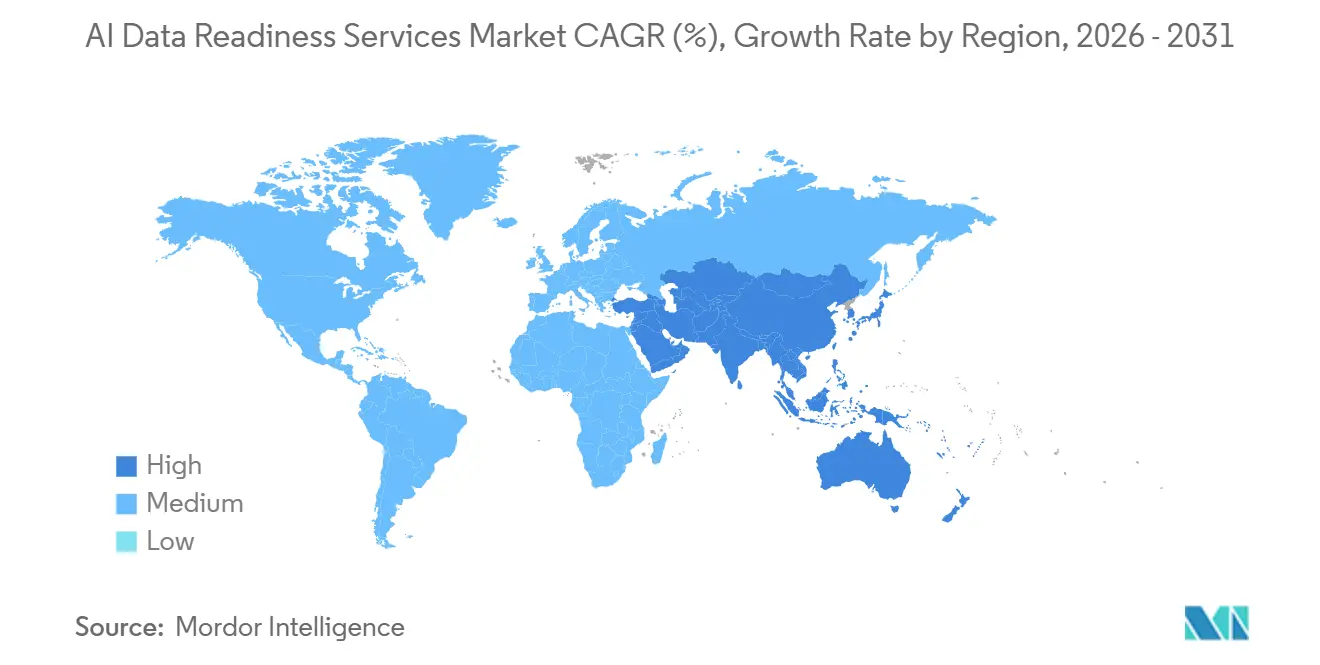
| Fastest Growing Market | Asia-Pacific |
| Largest Market | North America |
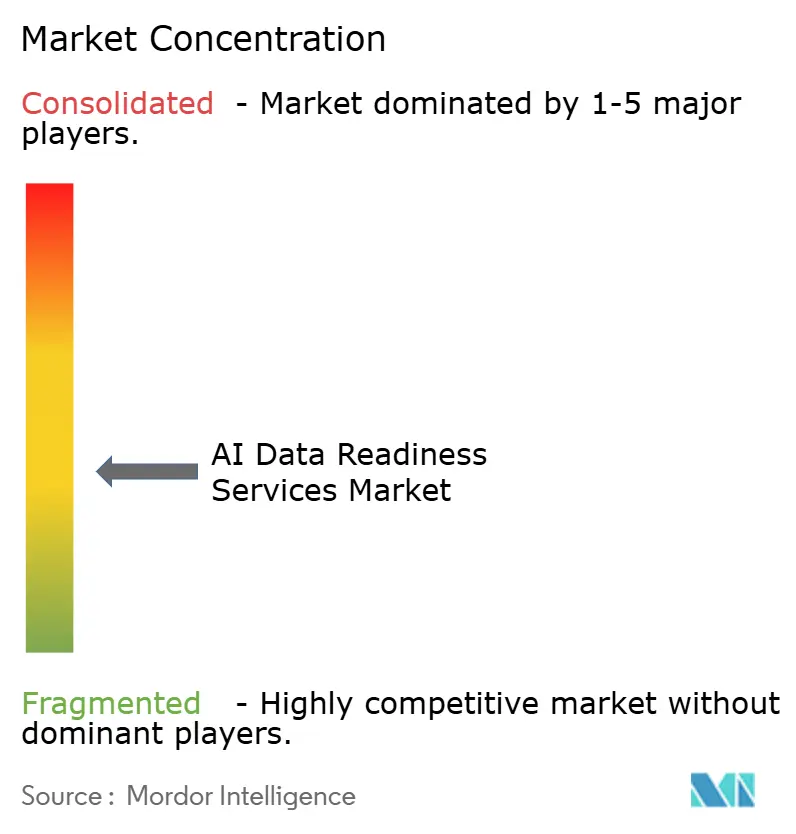
| Market Concentration | Medium |
Major Players *Disclaimer: Major Players sorted in no particular order Image © Mordor Intelligence. Reuse requires attribution under CC BY 4.0. | |
AI Data Readiness Services Market Analysis by Mordor Intelligence
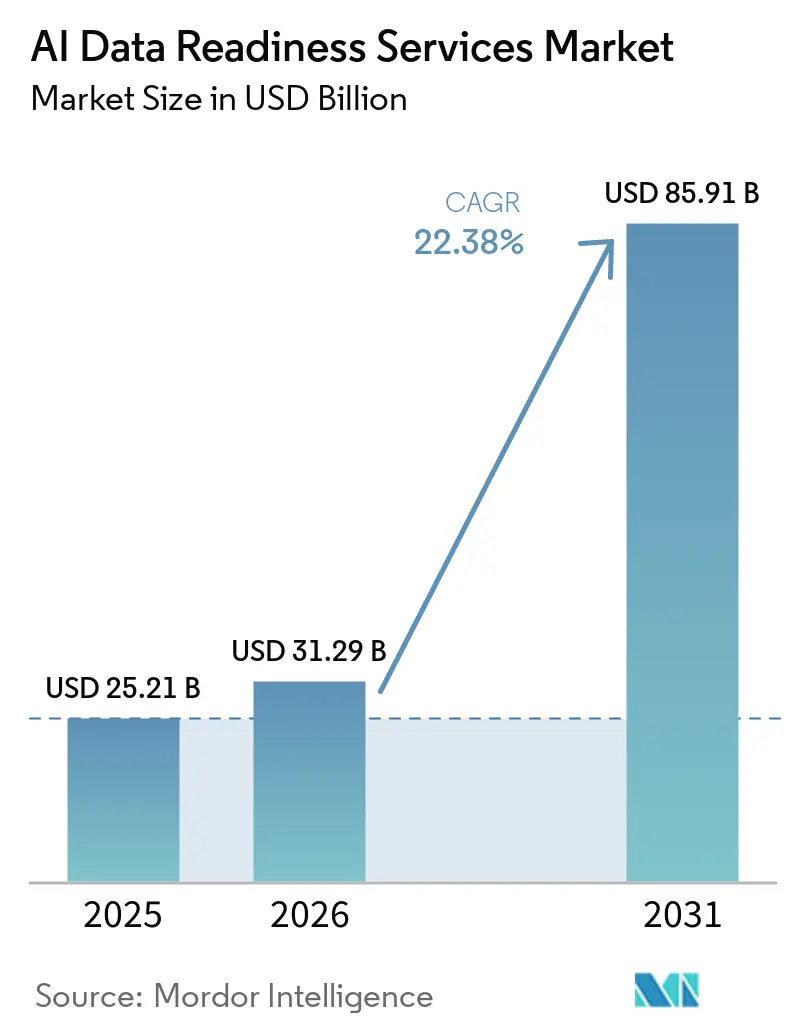
The AI data readiness services market size is expected to increase from USD 25.21 billion in 2025 to USD 31.29 billion in 2026 and reach USD 85.91 billion by 2031, growing at a CAGR of 22.38% over 2026-2031. Enterprise demand is moving beyond experimental artificial intelligence work because live systems require reliable, accessible, and governed data. The gap between AI plans and usable data remains wide, which supports demand for preparation, integration, quality assessment, and governance work. Providers are expanding beyond one-time remediation projects toward recurring services that maintain data pipelines and improve training datasets. Competition is widening as annotation specialists, systems integrators, cloud providers, and data platform vendors address overlapping client needs. Opportunities are strongest where buyers need traceable data, specialist knowledge, and continuous quality controls that standard tools cannot provide alone.
Key Report Takeaways
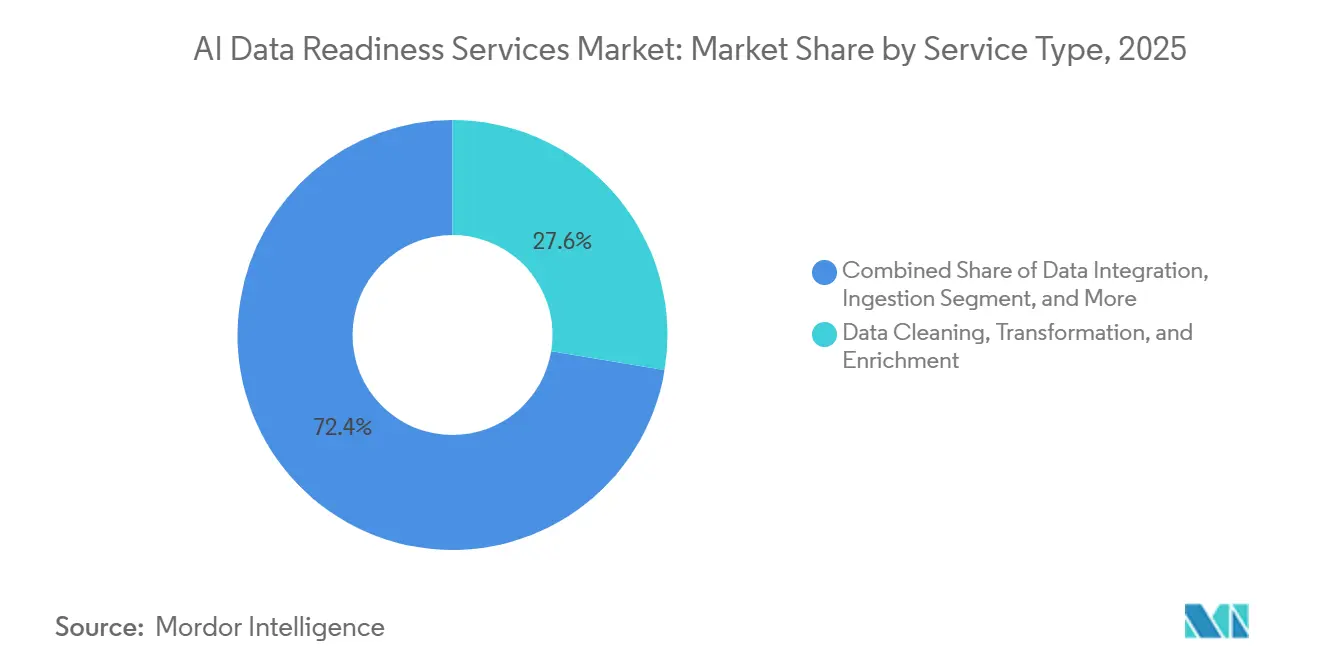
- By service type, Data Cleaning, Transformation, and Enrichment held 27.61% of the AI data readiness services market revenue share in 2025, while Data Integration, Ingestion, and Engineering is forecast to grow at a 22.96% CAGR through 2031.
- By delivery model, Consulting and Advisory Services held 31.28% revenue share in the AI data readiness services market in 2025, while Technology-Enabled Services is forecast to grow at a 23.42% CAGR through 2031.
- By deployment model, Cloud accounted for 49.57% revenue share of the AI data readiness services market in 2025 and is forecast to grow at a 23.19% CAGR through 2031.
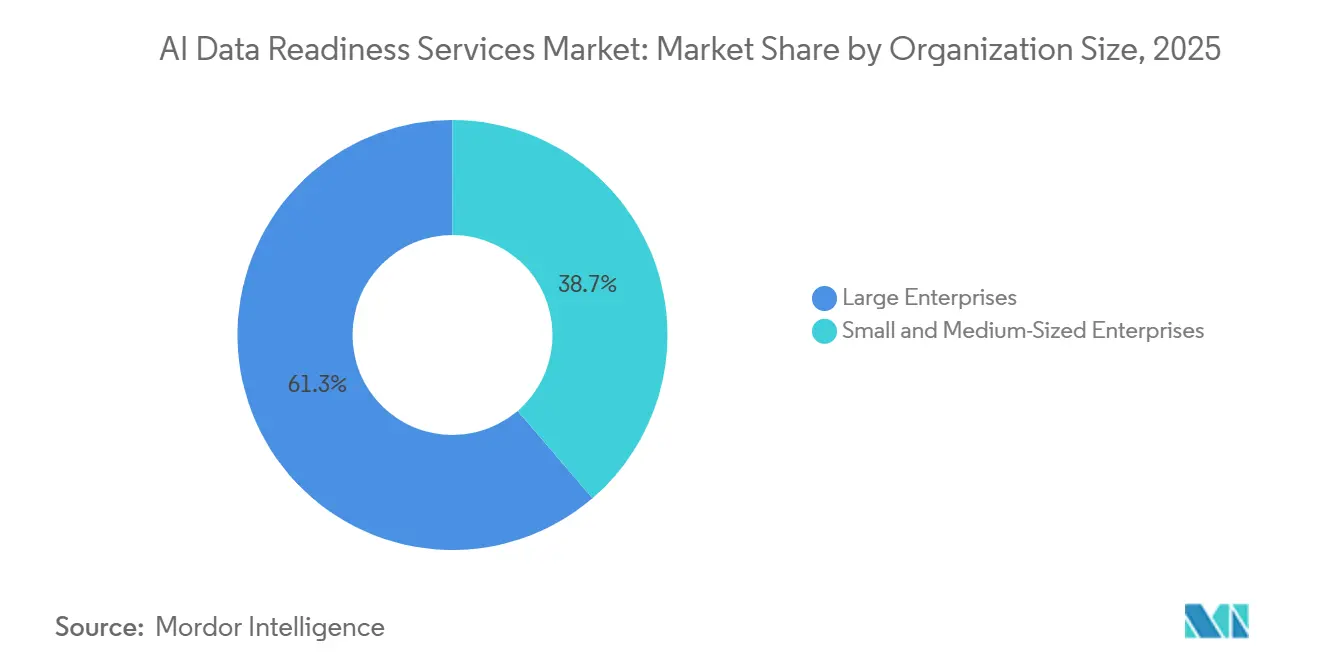
- By organization size, Large Enterprises held 61.29% revenue share of the AI data readiness services market in 2025, while Small and Medium-Sized Enterprises are forecast to grow at a 22.83% CAGR through 2031.
- By end-user industry, Information Technology and Telecommunications held 24.19% revenue share of the AI data readiness services market in 2025, while Healthcare and Life Sciences is forecast to grow at a 22.91% CAGR through 2031.
- By geography, North America held 37.71% revenue share of the AI data readiness services market in 2025, while Asia-Pacific is forecast to grow at a 22.79% CAGR through 2031.
Note: Market size and forecast figures in this report are generated using Mordor Intelligence’s proprietary estimation framework, updated with the latest available data and insights as of January 2026.
Market Trends and Insights
Drivers Impact Analysis of AI Data Readiness Services Market*
| Driver | (~) % Impact on CAGR Forecast | Geographic Relevance | Impact Timeline |
|---|---|---|---|
| Enterprise AI Deployment Moving From Pilot To Production | +5.2% | Global, concentrated in North America and Europe | Short term (≤ 2 years) |
| Rising Demand For High-Quality Multimodal Training Data | +4.3% | Global, driven by North America and Asia-Pacific | Short term (≤ 2 years) |
| Expansion Of Generative AI, Agentic AI, And Foundation Models | +3.8% | Global, with Asia-Pacific accelerating | Medium term (2-4 years) |
| Increasing Regulatory Need For Traceable And Governed Data | +2.9% | Europe, with spillover to North America and Asia-Pacific | Medium term (2-4 years) |
| Model Failure Feedback Creating Recurring Data Improvement Demand | +2.1% | Global, acute in North America and Europe | Medium term (2-4 years) |
| Scarcity Of Domain-Specific, Rights-Cleared Data Assets | +1.7% | Global, with early shortages in healthcare and legal domains | Long term (≥ 4 years) |
| Source: Mordor Intelligence | |||
Enterprise AI Deployment Moving from Pilot to Production
The move from pilot work to production deployment is a central driver for the AI Data Readiness Services Market because organizations are committing operational systems, customer interactions, internal decisions, and employee-facing knowledge tools to AI-supported workflows that must meet normal business standards for reliability and control. A pilot can operate on a limited, cleaned dataset, but a production system must work with data from multiple business applications, often created for different purposes and managed by separate teams. Organizations must connect legacy systems, review sensitive records, align data definitions, set access rules, and monitor quality after deployment. This raises the need for data integration, lineage documentation, quality checks, exception handling, and corrective work across the full data environment rather than within an isolated model-development team. IBM launched Enterprise Advantage in January 2026 to help clients build, govern, and operate internal AI platforms across multicloud environments, which reflects the shift toward governed production delivery. The AI Data Readiness Services Market benefits when clients treat preparation as an operating requirement that continues through deployment, updates, performance reviews, changes in data ownership, and the addition of new use cases, rather than as a project completed before model training.
Rising Demand for High-Quality Multimodal Training Data
The AI Data Readiness Services Market is also supported by the growing use of models that span text, images, audio, video, and sensor data within the same business process. These data types need to be aligned and reviewed together, which creates a wider quality-control task than text-only model development and often requires teams to understand the setting in which each record was created, the source of each label, and the reason that an example was retained. Teams must check whether labels are accurate, whether files match the correct event or object, whether different formats use comparable definitions, and whether coverage is sufficient for the intended use. Research presented at CVPR 2026 found that visually convincing synthetic images can still be poor training data because fine texture variation collapses.[1] That result limits the use of unreviewed synthetic data as a substitute for curated datasets when a model must recognize detailed features in real-world conditions. It also keeps demand focused on annotation, validation, sample selection, quality assurance, review instructions, and documented exception handling carried out with clear policies and relevant subject knowledge.
Expansion of Generative AI, Agentic AI, and Foundation Models
Generative and agentic AI systems are increasing the volume and range of data that enterprises must prepare before they can use those systems consistently. These systems retrieve information from multiple sources and may take actions through connected applications, making stale, incomplete, duplicated, poorly governed, or contextually misleading data more consequential for users and operating teams. Data environments must support frequent queries while retaining controls over access, provenance, permitted use, updates, the reliability of information retrieved from individual sources, and the ability to trace outputs back to a source record. Research from VLDB CIDR describes the need to redesign data systems for agent-first workloads, rather than relying only on traditional data pipelines.[2] The AI Data Readiness Services Market is therefore extending from initial dataset preparation to continuous monitoring, validation, remediation, documentation, and review as enterprise systems evolve. Providers that can identify recurring data gaps and explain their causes can offer managed work that tracks the AI system's lifecycle and supports clearer decisions about where to direct remedial effort.
Increasing Regulatory Need for Traceable and Governed Data
Regulatory obligations are making data preparation more formal for many AI uses, particularly when the output can affect people, safety, access to services, or material business decisions. Article 10 of the EU AI Act requires providers of high-risk AI systems to use data governance and management practices for training, validation, and testing data.[3] The requirement covers relevant design choices, data collection, data preparation, assumptions, and examination for potential biases, which means that records must remain understandable to people outside the original development team and be available for later review. It makes data lineage and quality records part of the evidence a provider must maintain, rather than an internal technical preference that can be discarded after a system launches. The AI Data Readiness Services Market benefits from this requirement, as organizations need practical ways to document, review, correct, approve, and retain evidence of data across complex systems. The obligation also creates demand for services that bring technical teams, legal teams, risk owners, business owners, and records-management functions into the same data-governance process.
Restraints Impact Analysis of AI Data Readiness Services Market*
| Restraint | (~) % Impact on CAGR Forecast | Geographic Relevance | Impact Timeline |
|---|---|---|---|
| Shortage Of Skilled Data And Domain Experts | -2.8% | Global, acute in North America and Europe | Short term (≤ 2 years) |
| Data Privacy, Sovereignty, And Cross-Border Transfer Restrictions | -2.1% | Europe, China, India, with spillover to North America | Medium term (2-4 years) |
| Ambiguous Ownership Of Synthetic And Human-Generated Training Data | -1.4% | Global, with early litigation in North America and Europe | Long term (≥ 4 years) |
| Weak Label-Policy Portability Across Models And Providers | -0.9% | Global | Long term (≥ 4 years) |
| Source: Mordor Intelligence | |||
Shortage of Skilled Data And Domain Experts
The need for specialized workers can slow delivery in the AI Data Readiness Services Market, especially when projects require more than basic data labeling. General labeling capacity is not sufficient for tasks involving medical records, legal materials, engineering content, or complex reasoning data where a reviewer must understand the underlying context as well as the instructions and the potential consequences of a poor classification. These tasks require people who understand the relevant domain, can apply clear policies consistently, can recognize when an example does not fit the intended classification, and can explain why a case should be escalated. Providers must also train reviewers, maintain quality checks, resolve disagreements across large annotation programs, and keep records that explain how difficult cases were handled. This requirement raises delivery costs and can limit capacity when demand rises quickly or when many clients seek similar specialist skills at the same time. It gives an advantage to firms that have established expert networks, repeatable quality processes, and tools that direct specialists toward the cases where human review matters most.
Data Privacy, Sovereignty, And Cross-Border Transfer Restrictions
Data privacy and sovereignty rules can limit the places where providers prepare, store, or review sensitive data for the AI Data Readiness Services Market. Organizations may need to keep healthcare, financial, public-sector, or personal data within specific jurisdictions, even when a central delivery team has the relevant technical skills, approved tools, and established quality procedures. This can reduce the ability to route work to centralized delivery centers and can create separate processes, access controls, contracts, and review procedures for different countries, business units, and categories of information. The EU AI Act reinforces the importance of governed data practices for high-risk systems, including documented examination of datasets. The AI Data Readiness Services Market must therefore support controlled access, secure workflows, local delivery options, detailed records, and clear escalation procedures without making projects too difficult to operate. Providers with local delivery capacity and sound governance methods can turn this restraint into a differentiator for clients that need to preserve control over sensitive information while still gaining access to specialized data skills.
*Our forecasts treat driver/restraint impacts as directional, not additive. The impact forecasts reflect baseline growth, mix effects, and variable interactions.
AI Data Readiness Services Market Segment Analysis
By Service Type:
Cleaning And Enrichment Anchor Revenue, While Integration Engineering Leads GrowthData Cleaning, Transformation, and Enrichment held 27.61% of the AI Data Readiness Services Market share in 2025. The service is a required step because models can spread incorrect, duplicated, incomplete, or inconsistent data at scale, including records that appear usable until they are compared across systems. Clients use cleaning work to standardize fields, correct errors, remove duplication, reconcile formats, identify missing values, and prepare records for later processing. Transformation and enrichment add useful structure and context to the source data, enabling the same item to be interpreted consistently by downstream users and applications. This work remains important even where clients use modern cloud platforms because the quality, completeness, and traceability of source records still determine whether the resulting dataset can support a dependable AI use case.
Data Integration, Ingestion, and Engineering is forecast to expand at a 22.96% CAGR through 2031. Agentic applications require reliable access to information from multiple sources rather than a static dataset prepared for a single model run, so teams must manage interfaces, data movement, permissions, and changes in source systems. This raises demand for connectors, data pipelines, schema alignment, metadata management, quality checks, and ongoing engineering support that helps information remain usable after an application enters production. Databricks introduced Genie Code in 2026 to convert proprietary code into open ANSI SQL, demonstrating how platform suppliers are simplifying specific parts of data migration and integration.[4] Data Readiness Assessment and Roadmapping, Data Discovery, Profiling, and Quality Assessment, synthetic-data work, data licensing advice, and rights-clearance support identify gaps in coverage, representation, governance, data availability, and permitted use before and during delivery, allowing providers to sequence diagnostic work, remediation, and ongoing verification around the client’s changing technical and operating needs.

By Delivery Model:
Consulting Leads Revenue, While Technology-Enabled Services Lead GrowthConsulting and Advisory Services held 31.28% of the AI Data Readiness Services Market in 2025. Enterprises often need help defining the required data state, understanding weaknesses across systems, prioritizing the business problems that matter most, and setting a governance model before remediation begins. Advisory work is especially relevant where many business units own related data but use different standards, processes, accountability models, and measures of data quality. Providers can link operating requirements with data architecture, policy design, program sequencing, and change-management needs that determine whether new practices are adopted. This service model remains relevant because technical tools alone do not resolve ownership, policy, funding, or priority decisions that arise when data must be shared across functions.
Technology-Enabled Services is forecast to grow at a 23.42% CAGR through 2031. Software-supported workflows can help providers handle larger volumes of validation, labeling, quality control, review assignment, and audit records at a lower unit cost than purely manual delivery. IBM and Google Cloud announced a strategic Google Cloud Practice in June 2026 that combines delivery tools with Gemini Enterprise capabilities for governed AI deployment across hybrid environments. Managed Services address ongoing data quality operations after the initial readiness program is complete, while Human-in-the-Loop Services remain necessary when automated pre-labeling cannot reliably assess complex cases or make regulated decisions. The AI Data Readiness Services industry is likely to retain both advisory and software-supported models because clients move through different stages of readiness and require different levels of recurring support, from early assessment and governance design to long-running monitoring, correction, and expert review.
By Deployment Model:
Cloud Leads Both Scale And GrowthCloud deployment held 49.57% of the AI Data Readiness Services Market share in 2025 and is forecast to grow at a 23.19% CAGR through 2031. Elastic computing resources and usage-based tools make cloud environments practical for many data preparation programs, particularly when workloads spike during data ingestion, labeling, validation, or model evaluation. Cloud platforms also support integration with AI development tools, storage services, collaboration tools, and model operations systems that are used by distributed technical teams. This is particularly useful when teams need to adjust processing capacity as data volumes, review requirements, or the number of supported use cases change. The AI Data Readiness Services Market benefits from this model, as it enables faster deployment across distributed users and data sources without requiring every client to maintain the same level of internal infrastructure.
On-premises deployment remains important where sensitive or classified records cannot leave a controlled environment. Defense, critical infrastructure, and financial services organizations may use this approach to apply their own security controls, retain direct oversight of processing, and comply with internal policies governinga requirement that restricted data. Hybrid deployment serves organizations that need cloud capabilities but must retain selected data or workloads in local environments, which requires consistent controls and clear movement rules between environments. IBM and Google Cloud positioned their June 2026 partnership around hybrid AI delivery, reflecting the need to support multiple environments within a single enterprise program. Service providers must therefore design processes that preserve data controls across cloud, local, and combined architectures while keeping workflows understandable for client teams, including clear ownership of data transfers, review results, permissions, and records produced by the readiness process.
By Organization Size:
Large Enterprises Drive Demand, While SMEs Grow FasterLarge Enterprises held 61.29% of the AI Data Readiness Services Market in 2025. Their data estates often contain years of accumulated systems, separate enterprise resource planning instances, departmental data stores, acquired businesses, and local applications that do not use the same rules. This creates a broad need for cleaning, integration, documentation, governance work, and program management across functions that may have separate technology budgets and data owners. Large organizations also operate across multiple jurisdictions and may require separate controls for sensitive datasets, individual business units, and local regulatory requirements. Those conditions support larger, longer-running readiness programs than are generally required for smaller clients, because the work must align operating practices with technical systems.
Small and medium-sized enterprises are forecast to grow at a 22.83% CAGR through 2031. Cloud-based, subscription-supported tools reduce the need for a large in-house data engineering group and allow firms to adopt selected capabilities as their use cases evolve. These firms can use focused services when they start applying AI to customer support, operations, sales, product development, or internal knowledge management. Accenture Edge and Google Cloud announced preconfigured agentic AI solutions for mid-market companies in July 2026, illustrating efforts to reduce implementation time for this customer segment. The AI Data Readiness Services industry can serve this group through defined packages, repeatable controls, technology-supported delivery, and clear advice on data ownership, access rights, quality policies, and the practical limits of early deployments, helping firms progress without attempting to reproduce the large internal data programs used by global enterprises.
By End-User Industry:
IT And Telecom Lead, While Healthcare And Life Sciences Grow FastestInformation Technology and Telecommunications held 24.19% of the AI Data Readiness Services Market in 2025. These organizations have generally adopted AI earlier and have existing investments in data infrastructure, cloud services, software engineering, and operations systems that generate large volumes of usable but varied data. Their use cases require reliable customer, network, software, and operational data at large volumes, often with controls that prevent errors from entering service delivery or network management decisions. Banking, Financial Services, and Insurance is another major source of demand because explainability, audit trails, provenance requirements, and sensitivity of customer information align directly with readiness work. Scale AI reported more than USD 1 billion in new data business bookings in 2025, including Mayo Clinic, BP, and Allianz, indicating demand is extending beyond technology buyers.
Healthcare and Life Sciences are forecast to grow at a 22.91% CAGR through 2031. Health records may be complete for audit purposes yet remain fragmented, inconsistently coded, or missing the clinical and operational context required by AI systems. Providers need to organize records, manage permissions, establish traceability, and test whether data can be used for the intended model development task without losing key context. Data quality and provenance are also relevant to AI systems submitted for drug-development uses, while Automotive and Transportation need engineering support for sensor and multimodal datasets. Retail and E-Commerce, Manufacturing and Industrial, and Energy and Utilities represent further demand groups at earlier stages of AI readiness, each requiring preparation that reflects its operational systems, safety needs, data-access rules, established terminology, and the level of human review appropriate for decisions within that sector.
Geography Analysis
North America AI Data Readiness Services Market
North America held 37.71% of the AI Data Readiness Services Market in 2025. The region combines concentrated AI spending by technology and financial services firms with a developed ecosystem of cloud providers, specialist vendors, research institutions, and enterprise buyers who are actively moving systems beyond early testing into applications requiring reliable integration and managed data operations. Organizations in the region are moving data work closer to production AI deployments and need support for governance, documentation, quality control, integration, model evaluation, and consistent workflows across complex technology environments that often include both established and newer cloud-based systems. Scale AI reported over USD 1 billion in new data business bookings during 2025 and stated that the U.S. Department of Defense awarded it contracts totaling nearly USD 200 million. The combination of enterprise demand and public-sector programs supports continued spending on data preparation, evaluation, quality operations, domain-specific review, and services that make large datasets more usable for high-value operational AI applications.
APAC AI Data Readiness Services Market
Asia-Pacific is forecast to grow at a 22.79% CAGR through 2031. China, India, Japan, and South Korea combine large technology markets with public and private investment in AI capabilities, expanding cloud adoption, and growing attention to domestic AI capacity to support local business needs and national technology priorities. The region is both a source of AI demand and a delivery location for annotation and data operations, although clients need locally relevant language, context, privacy practices, governance methods, and review policies for multilingual models and regional datasets. The AI Data Readiness Services Market in the region can benefit from cloud adoption and growing enterprise AI use, but varying local rules make regional delivery capacity, local data knowledge, secure operations, and the ability to adapt service practices important for providers.
EMEA and South America AI Data Readiness Services Market
Europe holds the third-largest regional position in the AI Data Readiness Services Market. The region has a compliance-led demand profile because the EU AI Act requires data governance practices for high-risk AI systems. Companies must prepare evidence on data provenance, processing, and bias considerations as they develop covered systems, which can increase demand for documented quality and governance services. The Middle East is an emerging growth area where sovereign AI programs create demand for locally governed, rights-cleared data. South America and Africa remain earlier-stage markets because cloud infrastructure density can limit delivery even where AI interest is strong, while Brazil’s public-sector programs and South Africa’s financial services sector provide nearer-term openings for providers with locally suitable services.
Competitive Landscape
The AI Data Readiness Services Market is fragmented across platform providers, specialist data vendors, and enterprise service providers. Amazon Web Services, Microsoft, and Google compete through platforms that integrate storage, computing, data tools, and model development services, creating close links between data preparation and the environments where models are built and operated. Specialist vendors such as Scale AI, Appen, Labelbox, CloudFactory, Toloka AI, and TELUS Digital focus on human review, annotation networks, domain specialization, and the quality processes that make datasets usable for demanding tasks, including work where automated review does not yet provide sufficient confidence. Large service providers work between enterprise data environments and platform tools, helping clients join architecture, governance, operating procedures, delivery, internal controls, and practical change management across multiple functions that may have different priorities and data owners. Databricks is extending data-platform functionality through tools such as Genie Code, which simplifies selected migration and code conversion work and raises the bar for specialist providers.
Consolidation is changing the competitive position of firms that own specialized data assets and expert networks. EXL completed its USD 310 million acquisition of iMerit in August 2026, combining EXL’s enterprise AI capabilities with iMerit’s model training, evaluation, and reinforcement-learning services. The deal added iMerit’s Ango Hub platform and its Scholars network of physicians, scientists, and engineers, strengthening its access to specialized human expertise. IBM and Google Cloud also announced a strategic partnership for June 2026 to combine IBM Consulting Advantage with Gemini Enterprise capabilities for governed AI delivery, while Accenture and Google Cloud expanded their Gemini Enterprise Acceleration Program in April 2026. These actions show that major providers are pairing platforms and service delivery with reusable data, governance, and expert-review assets.
The AI Data Readiness Services Market also offers opportunities for specialists who focus on specific industries or data challenges. Life sciences require data harmonization that supports controlled records and specialized review; autonomous-vehicle programs require sensor-fusion engineering and data validation; and financial institutions require dataset documentation that supports explainability and audit requirements. Providers that can manage these needs can compete on domain capabilities rather than scale alone, while buyers can select platform, specialist, and service partners separately or combine them into a broader program, depending on their internal data maturity, regulatory needs, budget, and need for continuous support. The competitive picture remains fragmented because the supplied material does not report a combined market share for leading providers and does not establish a dominant supplier group.
AI Data Readiness Services Industry Leaders
-
Scale AI, Inc.
-
Appen Limited
-
TELUS Digital International Inc.
-
Accenture plc
-
Cognizant Technology Solutions Corporation
- *Disclaimer: Major Players sorted in no particular order
AI Data Readiness Services Market Companies Covered in this Report
- Appen Limited
- Scale AI, Inc.
- TELUS Digital International Inc.
- Cognizant Technology Solutions Corporation
- International Business Machines Corporation
- Accenture plc
- Amazon Web Services, Inc.
- Microsoft Corporation
- Google LLC
- Labelbox, Inc.
- CloudFactory Limited
- SamaSource, Inc.
- DataLoop Ltd.
- SuperAnnotate AI, Inc.
- Encord Inc.
- Snorkel AI, Inc.
- iMerit Technology Services Pvt. Ltd.
- Toloka AI B.V.
- RWS Holdings plc
- TransPerfect Translations International, Inc.
- Lionbridge Technologies, LLC
- Qualitest Group
- Technology Platforms International, Inc.
- Oracle Corporation
- Snowflake Inc.
- Databricks, Inc.
Recent Industry Developments in AI Data Readiness Services Market
- July 2026: Accenture Federal Services won a USD 821 million, 5-year Pentagon AI data platform contract from the US Department of Defense to integrate hundreds of military data streams, manage platform operations, and deliver cybersecurity capabilities for the DoD's primary AI data infrastructure.
- July 2026: Cognizant expanded its strategic partnership with Anthropic to embed Claude across Cognizant's industry platforms, including agentic contract intelligence for life sciences and AI-assisted underwriting for insurance. Cognizant's Agent Foundry has built over 2,000 agents to date.
- July 2026: UniCredit, Accenture, and IBM announced a long-term strategic collaboration to build a next-generation European banking platform. Accenture acquired IBM's majority stake in UniCredit's technology infrastructure joint venture, and IBM provided modernized Z-series and software platforms for multi-market AI and data modernization.
- July 2026: Cognizant expanded its Google Cloud partnership and was designated a Diamond-tier Google Cloud partner, winning Google Cloud Partner of the Year 2026 in Data and Analytics and Healthcare and Life Sciences, and adding jointly delivered solutions and reusable agents to its enterprise AI data offering.
Global AI Data Readiness Services Market Report Scope
The AI Data Readiness Services Market Report is Segmented by Service Type (Data Readiness Assessment and Roadmapping, Data Discovery, Profiling, and Quality Assessment, Data Cleaning, Transformation, and Enrichment, Data Integration, Ingestion, and Engineering, and Other Service Type), Delivery Model (Managed Services, Consulting and Advisory Services, Technology-Enabled Services, Human-in-the-Loop Services, and Other Delivery Model), Deployment Model (Cloud, On-Premises, and Hybrid), Organization Size (Small and Medium-Sized Enterprises, and Large Enterprises), End-User Industry (Information Technology and Telecommunications, Banking, Financial Services, and Insurance, Healthcare and Life Sciences, Automotive and Transportation, Retail and E-Commerce, Manufacturing and Industrial, Energy and Utilities, and Other End-User Industries), and Geographic (North America, South America, Europe, Asia-Pacific, Middle East, and Africa). The Market Forecasts are Provided in Terms of Value (USD).
Segmentation Overview
| Data Readiness Assessment and Roadmapping |
| Data Discovery, Profiling, and Quality Assessment |
| Data Cleaning, Transformation, and Enrichment |
| Data Integration, Ingestion, and Engineering |
| Other Services Type |
| Managed Services |
| Consulting and Advisory Services |
| Technology-Enabled Services |
| Human-in-the-Loop Services |
| Other Delivery Models |
| Cloud |
| On-Premises |
| Hybrid |
| Small and Medium-Sized Enterprises |
| Large Enterprises |
| Information Technology and Telecommunications |
| Banking, Financial Services, and Insurance |
| Healthcare and Life Sciences |
| Automotive and Transportation |
| Retail and E-Commerce |
| Manufacturing and Industrial |
| Energy and Utilities |
| Other End-User Industries |
| North America | United States |
| Canada | |
| Mexico | |
| South America | Brazil |
| Argentina | |
| Colombia | |
| Rest of South America | |
| Europe | United Kingdom |
| Germany | |
| France | |
| Italy | |
| Russia | |
| Rest of Europe | |
| Asia-Pacific | China |
| Japan | |
| India | |
| South Korea | |
| Australia | |
| Singapore | |
| Rest of Asia-Pacific | |
| Middle East | United Arab Emirates |
| Saudi Arabia | |
| Israel | |
| Turkey | |
| Rest of Middle East | |
| Africa | South Africa |
| Nigeria | |
| Egypt | |
| Kenya | |
| Rest of Africa |
| By Service Type | Data Readiness Assessment and Roadmapping | |
| Data Discovery, Profiling, and Quality Assessment | ||
| Data Cleaning, Transformation, and Enrichment | ||
| Data Integration, Ingestion, and Engineering | ||
| Other Services Type | ||
| By Delivery Model | Managed Services | |
| Consulting and Advisory Services | ||
| Technology-Enabled Services | ||
| Human-in-the-Loop Services | ||
| Other Delivery Models | ||
| By Deployment Model | Cloud | |
| On-Premises | ||
| Hybrid | ||
| By Organization Size | Small and Medium-Sized Enterprises | |
| Large Enterprises | ||
| By End-User Industry | Information Technology and Telecommunications | |
| Banking, Financial Services, and Insurance | ||
| Healthcare and Life Sciences | ||
| Automotive and Transportation | ||
| Retail and E-Commerce | ||
| Manufacturing and Industrial | ||
| Energy and Utilities | ||
| Other End-User Industries | ||
| By Geographic | North America | United States |
| Canada | ||
| Mexico | ||
| South America | Brazil | |
| Argentina | ||
| Colombia | ||
| Rest of South America | ||
| Europe | United Kingdom | |
| Germany | ||
| France | ||
| Italy | ||
| Russia | ||
| Rest of Europe | ||
| Asia-Pacific | China | |
| Japan | ||
| India | ||
| South Korea | ||
| Australia | ||
| Singapore | ||
| Rest of Asia-Pacific | ||
| Middle East | United Arab Emirates | |
| Saudi Arabia | ||
| Israel | ||
| Turkey | ||
| Rest of Middle East | ||
| Africa | South Africa | |
| Nigeria | ||
| Egypt | ||
| Kenya | ||
| Rest of Africa | ||
Key Questions Answered in the Report
How large is the AI Data Readiness Services Market?
The market stood at USD 31.29 billion in 2026 and is forecast to reach USD 85.91 billion by 2031 at a 22.38% CAGR.
What is driving demand for AI data readiness services?
Demand is rising as organizations move AI systems into production and need data integration, quality controls, governance records, ongoing monitoring, and dependable ways to correct issues that emerge when systems begin using live business information.
Which service type is growing fastest?
Data Integration, Ingestion, and Engineering is forecast to grow at a 22.96% CAGR through 2031 as enterprises connect data across more systems.
Why is cloud deployment important for data readiness programs?
Cloud deployment held 49.57% in 2025 and is forecast to grow at a 23.19% CAGR because it supports elastic processing and integration with AI tools.
Which end-user sector has the fastest projected growth?
Healthcare and Life Sciences is forecast to grow at a 22.91% CAGR through 2031 because its records need specialized preparation, traceability, and governance.
What are the main constraints on service delivery?
The main constraints are a shortage of domain experts and limits on moving sensitive data across jurisdictions, which can affect delivery capacity, costs, the design of cross-border operating models, reviewer access, and the speed at which projects can move from planning into controlled production use across complex enterprise environments.