
AI Content Moderation For OTT Market Size and Share
Market Overview
| Study Period | 2020 - 2031 |
|---|---|
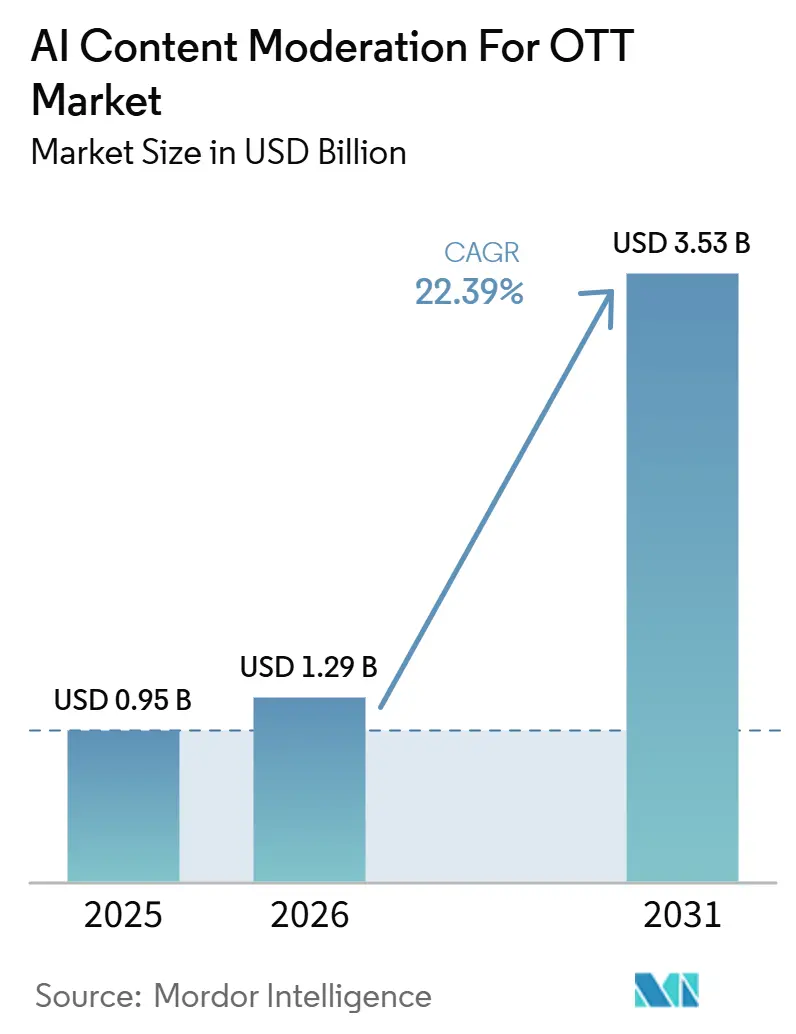
| Market Size (2026) | USD 1.29 Billion |
| Market Size (2031) | USD 3.53 Billion |
| Growth Rate (2026 - 2031) | 22.39 % |
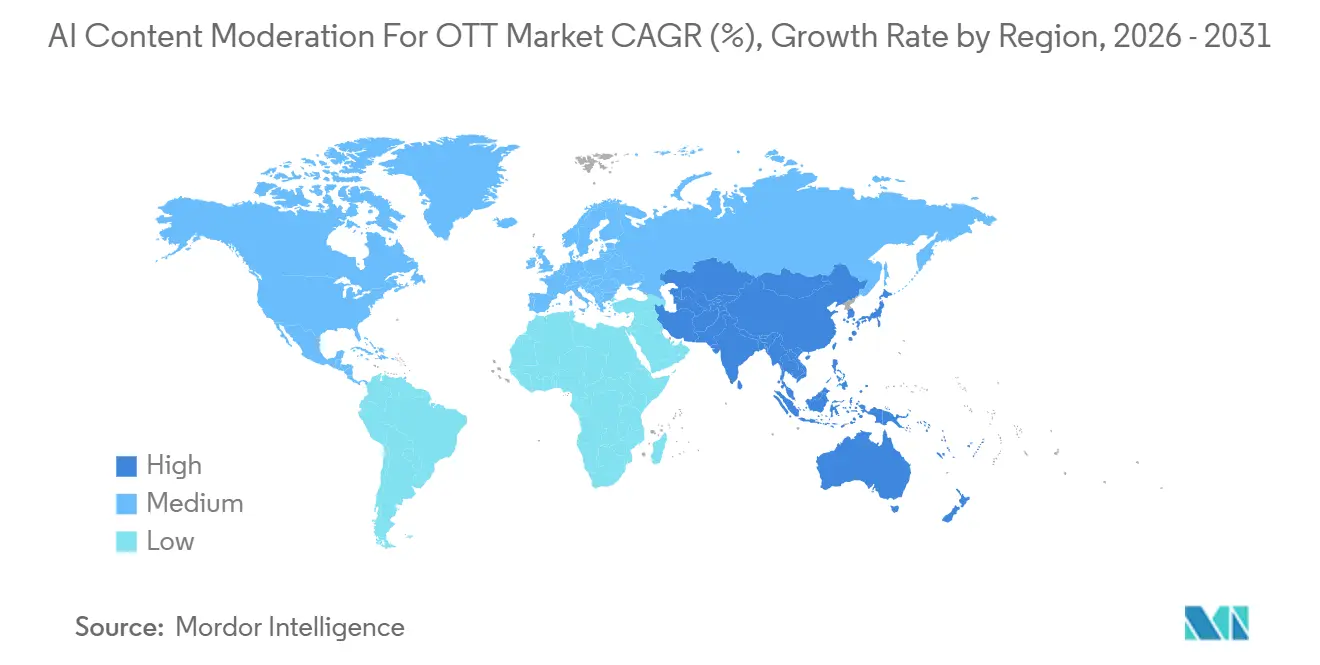
| Fastest Growing Market | Asia-Pacific |
| Largest Market | North America |
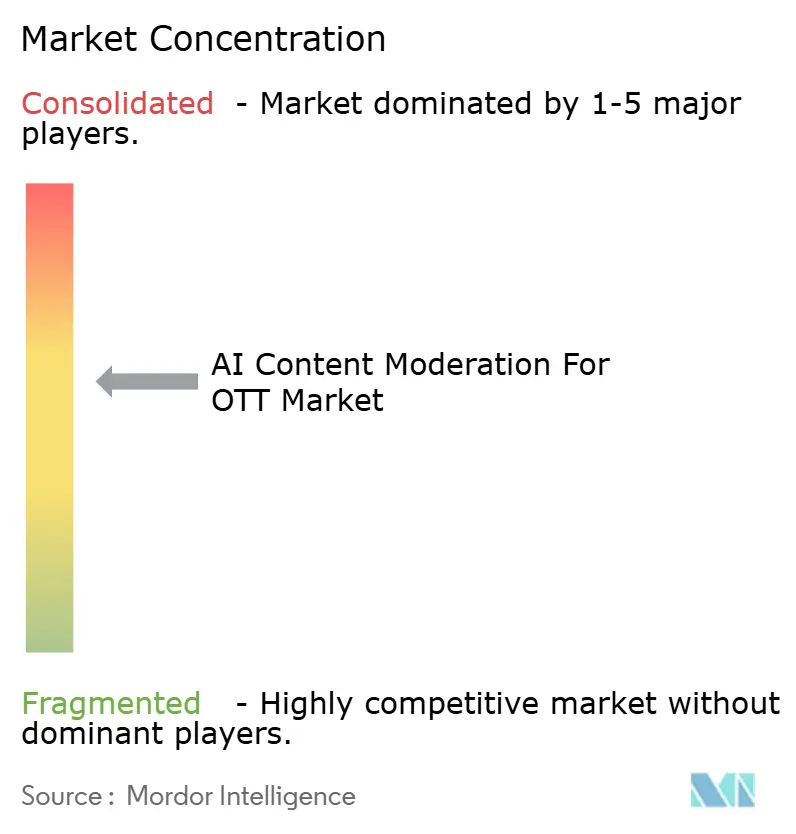
| Market Concentration | Medium |
Major Players *Disclaimer: Major Players sorted in no particular order Image © Mordor Intelligence. Reuse requires attribution under CC BY 4.0. | |
AI Content Moderation For OTT Market Analysis by Mordor Intelligence
The AI Content Moderation for OTT Market size is projected to expand from USD 0.95 billion in 2025 and USD 1.29 billion in 2026 to USD 3.53 billion by 2031, registering a CAGR of 22.39% between 2026 to 2031. Regulatory obligations are moving moderation budgets from discretionary technology spending into ongoing compliance programs. This shift supports demand when platform growth slows because operators must still meet notice, removal, and appeal requirements. The AI content moderation for OTT market is also being shaped by the volume and speed of live, user-generated media. Multimodal systems are widening coverage across text, images, video, and audio while reducing the need for separate processing tools. Suppliers are responding with integrated application programming interfaces, configurable policies, audit trails, and human escalation workflows.
Key Report Takeaways
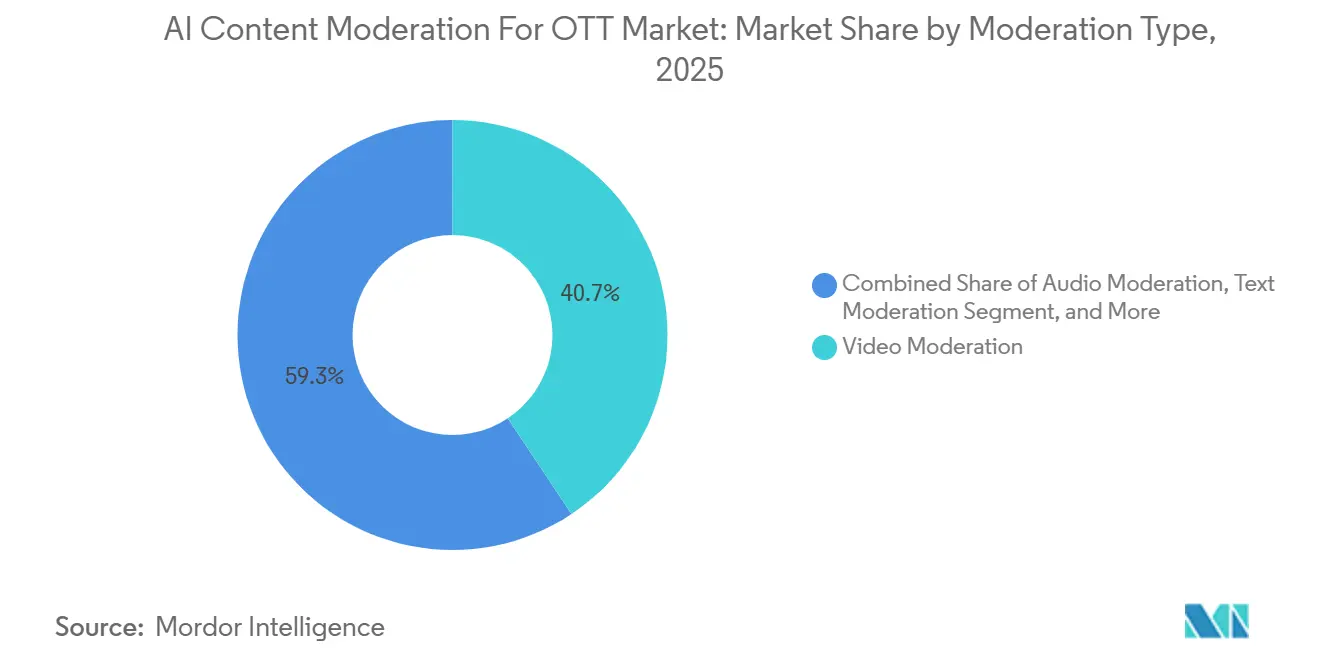
- By moderation type, video moderation held 40.66% of the AI content moderation for OTT market share in 2025, while audio moderation is projected to expand at a 22.96% CAGR through 2031.
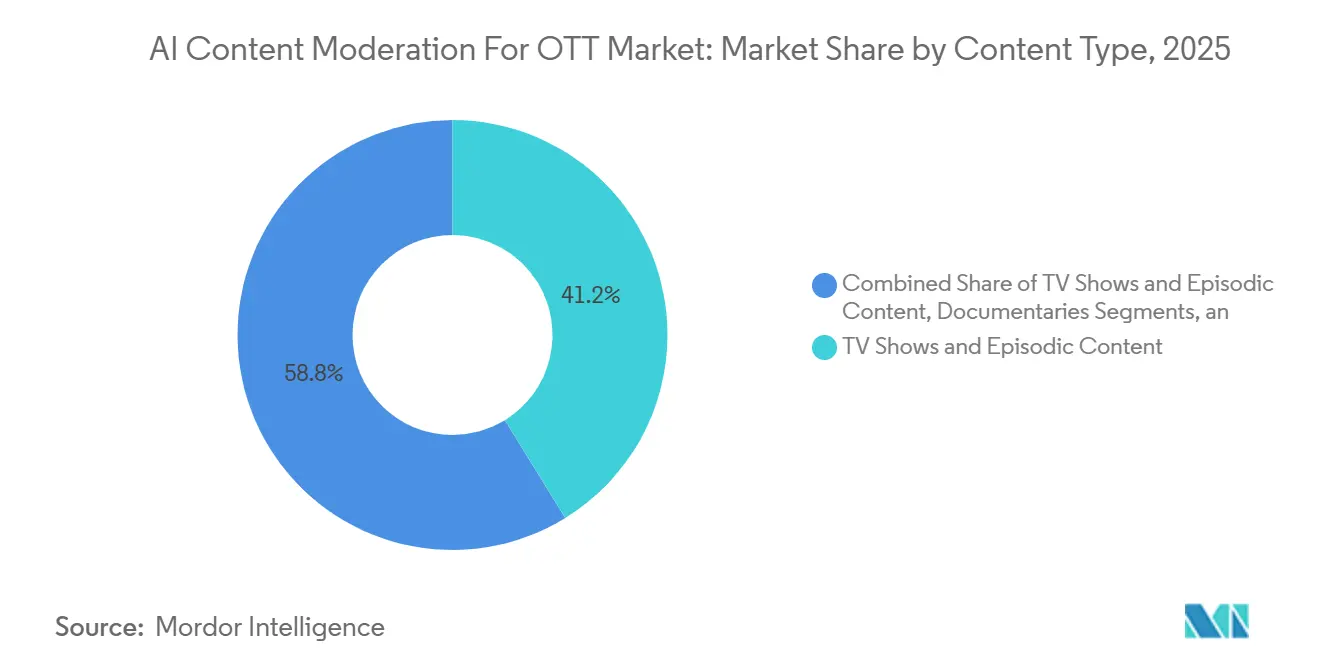
- By content type, TV shows and episodic content accounted for 41.22% of the AI content moderation for OTT market size in 2025, while documentaries are expected to grow at a 22.84% CAGR through 2031.
- By geography, North America held 38.76% of the AI content moderation for OTT market share in 2025, while Asia-Pacific is projected to expand at a 23.14% CAGR through 2031.
Note: Market size and forecast figures in this report are generated using Mordor Intelligence’s proprietary estimation framework, updated with the latest available data and insights as of January 2026.
Market Trends and Insights
Drivers Impact Analysis of AI Content Moderation For OTT Market*
| Driver | (~) % Impact on CAGR Forecast | Geographic Relevance | Impact Timeline |
|---|---|---|---|
| Rising User-Generated Video and Live-Stream Volume | +4.5% | Global, with peak growth in Asia-Pacific and North America | Short term (≤ 2 years) |
| Stricter Platform Liability and Digital Safety Regulation | +3.8% | EU, UK, North America, Australia, with spillover to Asia-Pacific | Medium term (2-4 years) |
| Multimodal AI Lowers Per-Asset Moderation Cost | +3.2% | Global, with early adoption in North America and Europe | Medium term (2-4 years) |
| Advertiser Brand-Safety and Suitability Spending | +2.9% | North America and Europe core markets | Short term (≤ 2 years) |
| Regulation-Aware Moderation for Synthetic and Deepfake Content | +2.4% | Global, with early gains in Europe and North America | Medium term (2-4 years) |
| Edge-Ready Moderation for Live and Interactive Media | +1.8% | Asia-Pacific core, with spillover to the Middle East and Africa | Long term (≥ 4 years) |
| Source: Mordor Intelligence | |||
Rising User-Generated Video and Live-Stream Volume
The rising volume of user-generated video and live streams is exceeding the capacity of human-only review operations, making automated review a core operating requirement for the AI content moderation for OTT market. Streamlabs and Stream Hatchet reported strong year-over-year growth in Kick's hours streamed, while South Korea's CHZZK recorded a significant increase in hours watched. Smaller and newer platforms often operate with limited trust and safety teams, increasing their reliance on external moderation tools.[1]Streamlabs and Stream Hatchet, “Q1 2026 Live Streaming Report,” Streamlabs, streamlabs.com Live content reduces the time available for enforcement decisions from minutes to seconds. This requirement favors systems that can identify risky material and route uncertain cases to reviewers during broadcasts.
Stricter Platform Liability and Digital Safety Regulation
Digital safety rules are making content moderation a compliance obligation rather than a cost center. The European Data Protection Board stated that moderation systems handling personal data must meet both Digital Services Act notice-and-action requirements and General Data Protection Regulation lawfulness conditions.[2]European Data Protection Board, “Guidelines 3/2025 on the Interplay Between the DSA and the GDPR,” European Data Protection Board, edpb.europa.eu This dual requirement raises the importance of privacy-by-design architecture in European deployments. It also supports demand for systems that can record decisions, support appeals, and apply different rules to users in different jurisdictions. The AI content moderation for OTT market, therefore, benefits from a move toward policy engines that can be adjusted without rebuilding a platform's full review process. Companies that provide transparent escalation paths can address regulatory expectations while retaining automation for large volumes.
Multimodal AI Lowers Per-Asset Moderation Cost
Multimodal models allow a platform to assess text, images, video, and audio within a connected review process. This approach can replace overlapping single-purpose tools and reduce operational complexity. The AI content moderation for OTT market is benefiting because smaller platforms can adopt broader coverage without building separate pipelines for every signal. Audio has been less automated than text or images, which leaves a clear capability gap for suppliers to address. Li and colleagues introduced Omni-Fake, a benchmark that covers image, audio, and video deepfakes through one annotation protocol. The work reflects a wider move toward cross-modal detection rather than isolated tools for each media type. Vendors that combine accuracy, auditing, and cloud delivery can compete for customers, replacing older image-only tools and manual workflows.
Advertiser Brand-Safety and Suitability Spending
Advertisers are creating a separate source of demand for moderation tools through brand safety and suitability requirements. CreatorIQ reported that a significant share of enterprise marketers considered brand safety more important during the previous year. This increased focus reflects concerns about AI-generated material and the need to demonstrate returns on campaign spending. Brand safety focuses on avoiding policy-violating content, while suitability assesses whether surrounding content aligns with an advertiser's standards. Therefore, the AI content moderation for OTT market serves both platform enforcement teams and advertising buyers. Multimodal systems can assess visual, spoken, and written context, helping advertisers move beyond simple keyword lists. This shift creates opportunities for tools that reduce incorrect exclusions while helping advertisers place campaigns in appropriate environments.
Restraints Impact Analysis of AI Content Moderation For OTT Market*
| Restraint | (~) % Impact on CAGR Forecast | Geographic Relevance | Impact Timeline |
|---|---|---|---|
| False Positives and Context-Sensitivity Gaps | -3.2% | Global | Short term (≤ 2 years) |
| Moderator Well-Being and Human-Escalation Costs | -2.1% | Global, acute in the Philippines, Kenya, and India | Medium term (2-4 years) |
| Data Residency Limits on Cross-Border Review Operations | -1.6% | Europe, Asia-Pacific, and India | Medium term (2-4 years) |
| Adversarial Prompting and Model Poisoning Risks | -1.4% | Global | Long term (≥ 4 years) |
| Source: Mordor Intelligence | |||
False Positives and Context-Sensitivity Gaps
False positives remain a significant commercial and reputational constraint for the AI content moderation for OTT market. Davidson found that multimodal large language models can align more closely with human hate-speech judgments, but political speech can still receive disproportionate false-positive flags. The study also found sharper topic-toxicity bias in some more advanced models despite lower overall error rates. An ACM CHI study of commercial application programming interfaces found over-moderation of explicit group-targeted content and under-moderation of implicit hate speech.[3]ACM SIGCHI, “Lost in Moderation: How Commercial Content Moderation APIs Over- and Under-Moderate Group-Targeted Hate Speech and Linguistic Variations,” ACM CHI 2025, dl.acm.org Incorrect removals create appeal, explanation, and reversal work for platforms operating under algorithmic accountability rules. The practical response is a hybrid design that sends low-confidence or legally sensitive decisions to trained reviewers instead of fully replacing human judgment.
Moderator Well-Being and Human-Escalation Costs
Human reviewers remain essential when cases involve context, cultural nuance, or significant legal implications. A recent longitudinal study of professional moderators found that many experienced moderate to severe psychological distress despite wellness interventions. The study also reported modest but statistically significant declines in compassion satisfaction and resilience over time. These pressures increase cost pressures and availability risks for human escalation services. Therefore, the AI content moderation for OTT market must support structured workflows that identify cases requiring expert review while limiting reviewer exposure to routine high-volume tasks. Systems that clearly display confidence levels and case histories can help operators maintain escalation readiness during high-risk incidents.
*Our forecasts treat driver/restraint impacts as directional, not additive. The impact forecasts reflect baseline growth, mix effects, and variable interactions.
AI Content Moderation For OTT Market Segment Analysis
By Moderation Type:
Video Leads Demand While Audio Expands Capability CoverageVideo moderation held 40.66% of revenue in 2025. The segment was supported by the large volume of uploaded videos and live media requiring fast policy enforcement. Video also carries high processing needs and considerable brand-safety exposure for social media, streaming, and live commerce services. Those characteristics made AI-assisted video review a priority for trust and safety teams. The AI content moderation for OTT market size for video depends on both the number of assets and the higher review value of time-sensitive visual material. Platforms need tools that can detect violations rapidly and direct difficult cases to humans. This requirement is strongest when content is broadcast live or reaches a large audience quickly. Video suppliers are consequently adding real-time detection, review queues, and evidence records to their offerings.
Audio moderation is projected to record the highest growth at a 22.96% CAGR from 2026 to 2031. It addresses hate speech in podcasts, synthetic voice in deepfakes, and commentary in live streams. Audio signals were often excluded from older automated pipelines that focused on text and images. Multimodal systems are making joint audio and visual assessment more practical for platform operators. Text moderation remains the most mature area and serves enterprise prompt and response screening needs. Image moderation and other moderation types, including behavioral metadata and emoji-sequence analysis, are gaining use in gaming, dating, and community services. These environments can contain violations that text classifiers do not identify. Cross-modal coverage is becoming a central purchase criterion for buyers that want fewer separate vendor relationships.



By Content Type:
Episodic Content Holds Revenue While Documentaries Grow FasterTV shows and episodic content accounted for 41.22% of the AI content moderation for OTT market size in 2025. The segment reflects the output scale of streaming platforms and the review demands attached to formal programming. A high-profile episode can require checks for rights issues, synthetic media insertion, and audience-harm categories. This makes an individual review workflow more valuable than a short user-generated clip. The AI content moderation industry serves this segment through review systems that combine content classification with audit documentation. Streaming providers also need consistent policies across large catalogs and varied audience settings. Regulatory accountability increases the need to record how decisions were reached. Episodic content therefore retains a substantial role in supplier revenue even as short-form media grows.
Documentaries are projected to expand at a 22.84% CAGR from 2026 to 2031. Streaming platforms are increasing documentary production, while factual formats create complex review needs. Providers must assess claims, identify synthetic b-roll, and detect altered interview material. These tasks require multimodal forensic capabilities that general-purpose systems are still developing. Movies and films also require review related to theatrical distribution, watermarking, piracy detection, and rights compliance. Other content types include clips, stories, and reels, which have lower value per asset but much higher decision volumes. Their economics favor application programming interface-priced automation over labor-heavy review. The growth opportunity for documentary review is driven by the complexity of synthetic-media detection as well as content volume.
Geography Analysis
North America AI Content Moderation for OTT Market
North America held 38.76% of revenue in 2025. The region benefits from the concentration of major social media platforms, streaming services, and digital advertising networks in the United States. Platform operators are shifting from business-process-outsourcing-heavy review models toward AI-supported enforcement systems. This shift increases demand for tools that can screen high volumes while preserving human review for appeals and high-risk decisions. Canada also has research activity focused on AI safety guardrails for youth interactions. Mila and the Robust Open Online Safety Tools consortium released an open-source suicide prevention guardrail for AI chatbots in July 2026.
APAC AI Content Moderation for OTT Market
Asia-Pacific is projected to grow at a 23.14% CAGR from 2026 to 2031, the fastest rate among regions. Its live commerce activity and diverse language requirements create continuous moderation needs. CHZZK's more than 1 billion hours watched in 2025 shows the scale of live content that regional platforms must review. India's Information Technology Rules require significant social media intermediaries to use automated tools to identify prohibited material. The AI content moderation for OTT market in the region is increasingly supported by local language models and localized policy deployment. The region is shifting from a services-export location toward a major source of demand for moderation technology.
EMEA and South America AI Content Moderation for OTT Market
Europe's AI content moderation for OTT market is supported by a mature framework for platform accountability. The EDPB guidelines issued in September 2025 clarified the combined obligations of the Digital Services Act and the General Data Protection Regulation. This raises technical requirements for privacy, notice handling, and enforcement records in European deployments. South America, the Middle East, and Africa remain emerging areas where many services are delivered through business-process-outsourcing models. Research presented at the 2026 CHI Conference documented gaps in psychological support and contractual protections for moderators in sub-Saharan Africa. Stronger labor protections could raise the cost of human escalation and encourage more automation in these regions.

Competitive Landscape
The AI content moderation for OTT market has moderate concentration among the leading technology providers. Microsoft, Google LLC, and Amazon Web Services have advantages in global infrastructure, established enterprise relationships, and bundled application programming interface pricing. Their approach is to include moderation as part of broader cloud and AI services. This makes standalone moderation tools harder to price at a premium. It also brings automated review to platforms that previously lacked budgets for dedicated systems. Specialist suppliers, including Hivemoderation and ActiveFence, compete through detailed policy configuration and threat intelligence. ActiveFence rebranded as Alice in January 2026 and expanded its positioning toward AI safety guardrail infrastructure.
The AI content moderation for OTT market also contains white space in jurisdiction-specific enforcement, emerging languages, and synthetic-content forensics. Buyers increasingly need tools that recognize regional language use and adapt to changing policy definitions. Hive partnered with the Internet Watch Foundation in January 2025 to integrate the foundation's data into its moderation application programming interface. This move gave clients access to digital fingerprints of known child sexual abuse material through a unified connection. Mila and ROOST also made an open-source guardrail available in July 2026 for youth-facing AI chatbot interactions. These moves show that safety tools are broadening beyond basic content classification.
Business-process-outsourcing providers, including TELUS Digital, TaskUs, and Accenture, are repositioning their services around AI-assisted human review. TELUS Corporation completed its acquisition of the remaining TELUS Digital shares in October 2025 for aggregate consideration of USD 539 million. Providers that cannot show measurable AI integration may face pricing pressure as large platforms increase internal enforcement capabilities. Enterprise buyers are also placing more emphasis on ISO/IEC 42001 readiness and third-party audit trails. These requirements favor suppliers with governance processes and documented control frameworks. The competitive field remains open for vendors that can combine automation, specialized intelligence, and reliable human escalation.
AI Content Moderation For OTT Industry Leaders
Microsoft Corporation
Google LLC
Amazon Web Services, Inc.
Meta Platforms, Inc.
Clarifai, Inc.
- *Disclaimer: Major Players sorted in no particular order
AI Content Moderation For OTT Market Companies Covered in this Report
- Microsoft Corporation
- Google LLC
- Amazon Web Services, Inc.
- Meta Platforms, Inc.
- OpenAI, Inc.
- Clarifai, Inc.
- Accenture plc
- Cognizant Technology Solutions Corporation
- Genpact Limited
- Wipro Limited
- TELUS International (Cda) Inc.
- TaskUs, Inc.
- Appen Limited
- Concentrix Corporation
- LiveWorld, Inc.
- WebPurify, Inc.
- Besedo Global AB
- Hivemoderation, Inc.
- ActiveFence Ltd.
- Spectrum Labs

Recent Industry Developments in AI Content Moderation For OTT Market
- July 2026: Mila and the Robust Open Online Safety Tools consortium released the first version of an open-source Suicide Prevention Guardrail for AI chatbots, designed to prevent AI-generated content from directing youth toward self-harm. The tool was developed following a partnership announced at the 2026 G7 Digital Ministers' Meeting in Paris and marks the first concrete open-source AI safety output from that initiative.
- April 2026: MediaMelon joined the Akamai Qualified Compute Partner Program, enabling its AI-powered SmartSight platform to run on Akamai Cloud. The platform provides AI-powered session insights and real-time analytics for OTT, CTV, FAST, and live-streaming operators, supporting automated detection of content and viewing anomalies.
- February 2026: OpenAI partnered with Reliance to integrate AI capabilities into JioHotstar, including multilingual conversational AI and content understanding features. The partnership strengthens the use of AI for large-scale OTT content discovery, classification, and personalized content management.
- January 2026: ActiveFence Ltd. rebranded to Alice, extending its product positioning from content moderation and threat intelligence to broader AI safety guardrail infrastructure, including prompt injection defense and output filtering for enterprise generative AI deployments.


Global AI Content Moderation For OTT Market Report Scope
AI Content Moderation for OTT Market refers to the use of AI systems to automatically detect, flag, and manage harmful, illegal, or policy-violating video content on OTT platforms. It covers text, audio, images, and video analysis used to moderate user-generated content, comments, thumbnails, live streams, and uploaded titles at scale.
The AI Content Moderation for OTT Market Report is Segmented by Moderation Type (Text Moderation, Image Moderation, Video Moderation, and Audio Moderation), Content Type (Movies and Films, TV Shows and Episodic Content, and Documentaries), and Geography (North America, South America, Europe, Asia-Pacific, Middle East, and Africa). The Market Forecasts are Provided in Terms of Value (USD).
| Text Moderation |
| Image Moderation |
| Video Moderation |
| Audio Moderation |
| Other Moderation Types |
| Movies and Films |
| TV Shows and Episodic Content |
| Documentaries |
| Other Content Types |
| North America | United States |
| Canada | |
| Mexico | |
| South America | Brazil |
| Argentina | |
| Rest of South America | |
| Europe | Germany |
| United Kingdom | |
| France | |
| Italy | |
| Spain | |
| Russia | |
| Rest of Europe | |
| Asia-Pacific | China |
| India | |
| Japan | |
| South Korea | |
| Australia | |
| Rest of Asia-Pacific | |
| Middle East | Turkey |
| Saudi Arabia | |
| United Arab Emirates | |
| Rest of Middle East | |
| Africa | South Africa |
| Egypt | |
| Rest of Africa |
| By Moderation Type | Text Moderation | |
| Image Moderation | ||
| Video Moderation | ||
| Audio Moderation | ||
| Other Moderation Types | ||
| By Content Type | Movies and Films | |
| TV Shows and Episodic Content | ||
| Documentaries | ||
| Other Content Types | ||
| By Geography | North America | United States |
| Canada | ||
| Mexico | ||
| South America | Brazil | |
| Argentina | ||
| Rest of South America | ||
| Europe | Germany | |
| United Kingdom | ||
| France | ||
| Italy | ||
| Spain | ||
| Russia | ||
| Rest of Europe | ||
| Asia-Pacific | China | |
| India | ||
| Japan | ||
| South Korea | ||
| Australia | ||
| Rest of Asia-Pacific | ||
| Middle East | Turkey | |
| Saudi Arabia | ||
| United Arab Emirates | ||
| Rest of Middle East | ||
| Africa | South Africa | |
| Egypt | ||
| Rest of Africa | ||


Key Questions Answered in the Report
How large is AI content moderation for OTT market in 2026?
The sector is USD 1.29 billion in 2026 and is projected to reach USD 3.53 billion by 2031 at a 22.39% CAGR.
Which moderation type leads revenue?
Video moderation led with 40.66% revenue share in 2025 because platforms need rapid review of uploaded and live visual content.
Which content category is growing fastest?
Documentaries are projected to grow at a 22.84% CAGR through 2031, supported by the need to identify altered footage and synthetic media.
Why is audio moderation expanding?
Audio moderation is projected to grow at a 22.96% CAGR as platforms address synthetic voices, podcast speech, and live-stream commentary.
Which region is expected to grow fastest?
Asia-Pacific is projected to record a 23.14% CAGR through 2031, supported by live commerce, platform growth, and local-language requirements.
What are the main barriers to wider adoption?
False positives, limited context sensitivity, human escalation costs, data residency requirements, and adversarial risks remain key barriers.
Page last updated on:





