
AI-Based Certification Workflow Tools Market Size and Share
Market Overview
| Study Period | 2020 - 2031 |
|---|---|
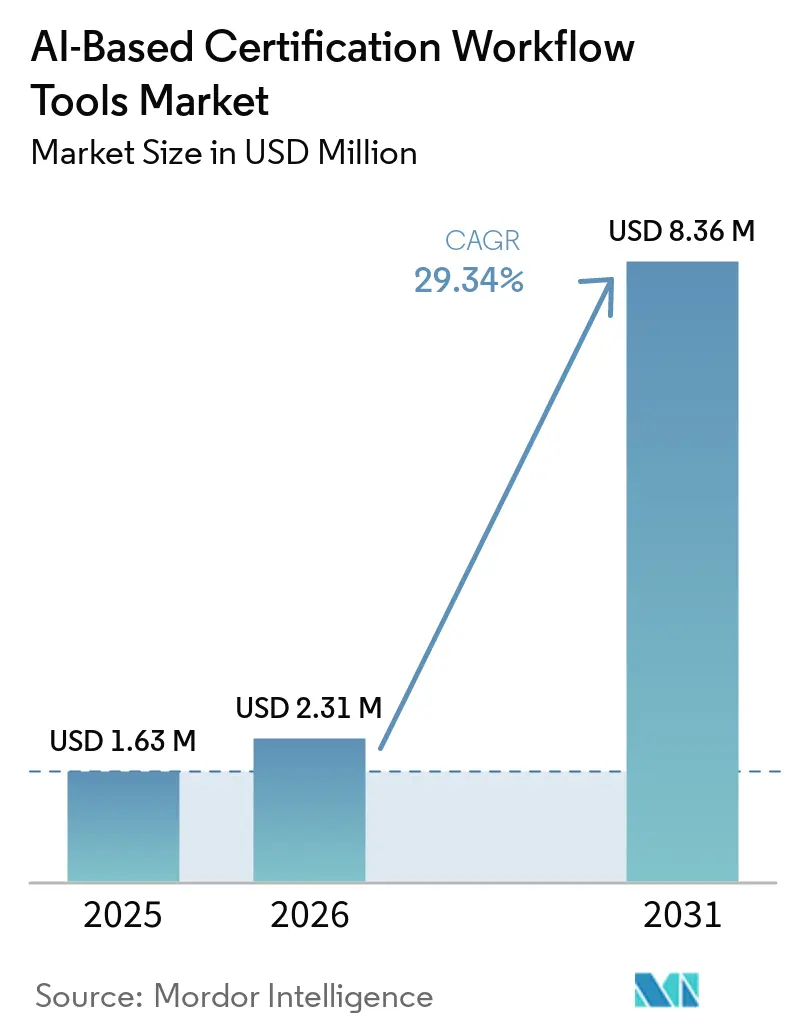
| Market Size (2026) | USD 2.31 Million |
| Market Size (2031) | USD 8.36 Million |
| Growth Rate (2026 - 2031) | 29.34 % |
| Fastest Growing Market | Asia-Pacific |
| Largest Market | North America |
| Market Concentration | Medium |
Major Players *Disclaimer: Major Players sorted in no particular order Image © Mordor Intelligence. Reuse requires attribution under CC BY 4.0. | |
AI-Based Certification Workflow Tools Market Analysis by Mordor Intelligence
The AI-based certification workflow tools market size was valued at USD 1.63 million in 2025 and USD 2.31million in 2026, and is projected to reach USD 8.36 million by 2031, growing at a CAGR of 29.34% during 2026-2031. The AI-based certification workflow tools market is expanding as organizations replace periodic audit preparation with systems that collect, organize, and retain evidence year-round. New AI governance obligations are making certification workflows more formal, especially where companies must show that their controls, documentation, and oversight processes are maintained. Buyers increasingly expect a single system that can schedule audits, track nonconformities, issue certificates, and provide access to authorized parties. Demand is strongest where organizations manage several sites, standards, or jurisdictions, and manual evidence collection creates delays. The AI-based certification workflow tools market, therefore, offers vendors an opportunity to combine workflow management with interoperable evidence records and enterprise system integration.
Key Report Takeaways
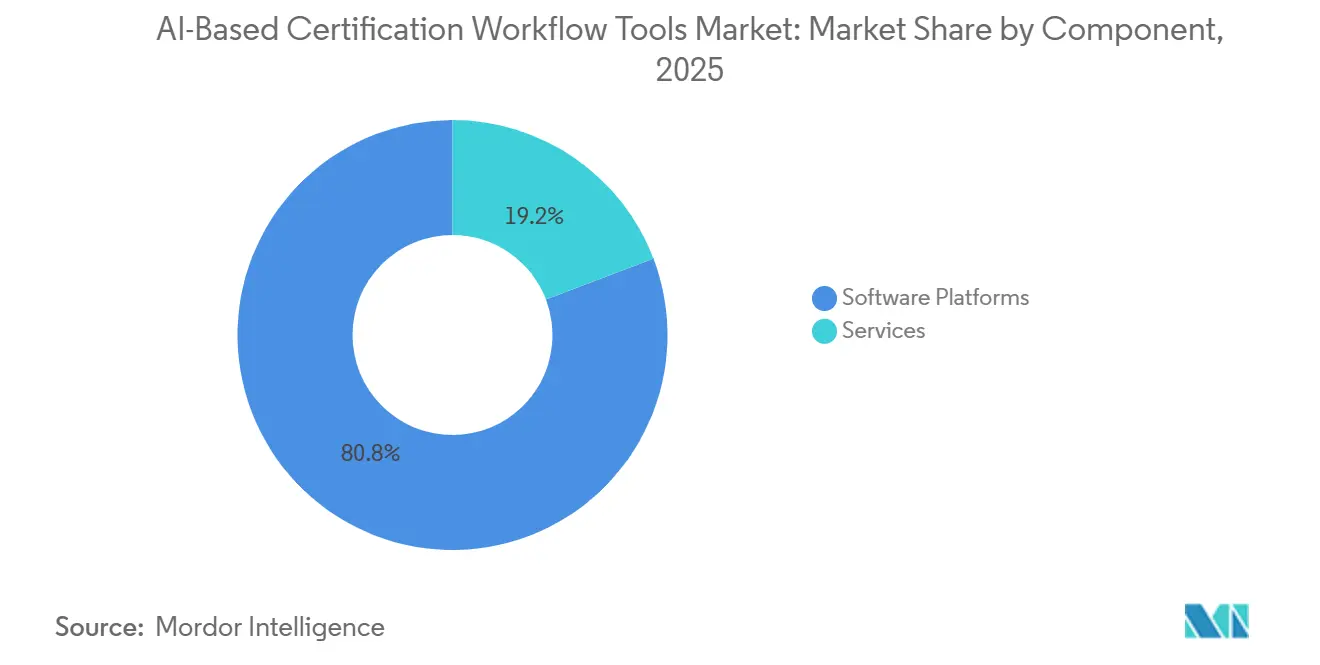
- By component, software platforms held 80.78% of the AI-based certification workflow tools market share in 2025 and are projected to expand at a CAGR of 31.07% through 2031.
- By deployment mode, cloud-based solutions accounted for 73.59% of market revenue in 2025 and are projected to grow at a 32.02% CAGR through 2031.
- By end user, certification bodies held 34.87% of market revenue in 2025 in the AI-based certification workflow tools market, while internal audit and compliance departments are projected to expand at a CAGR of 33.52% through 2031.
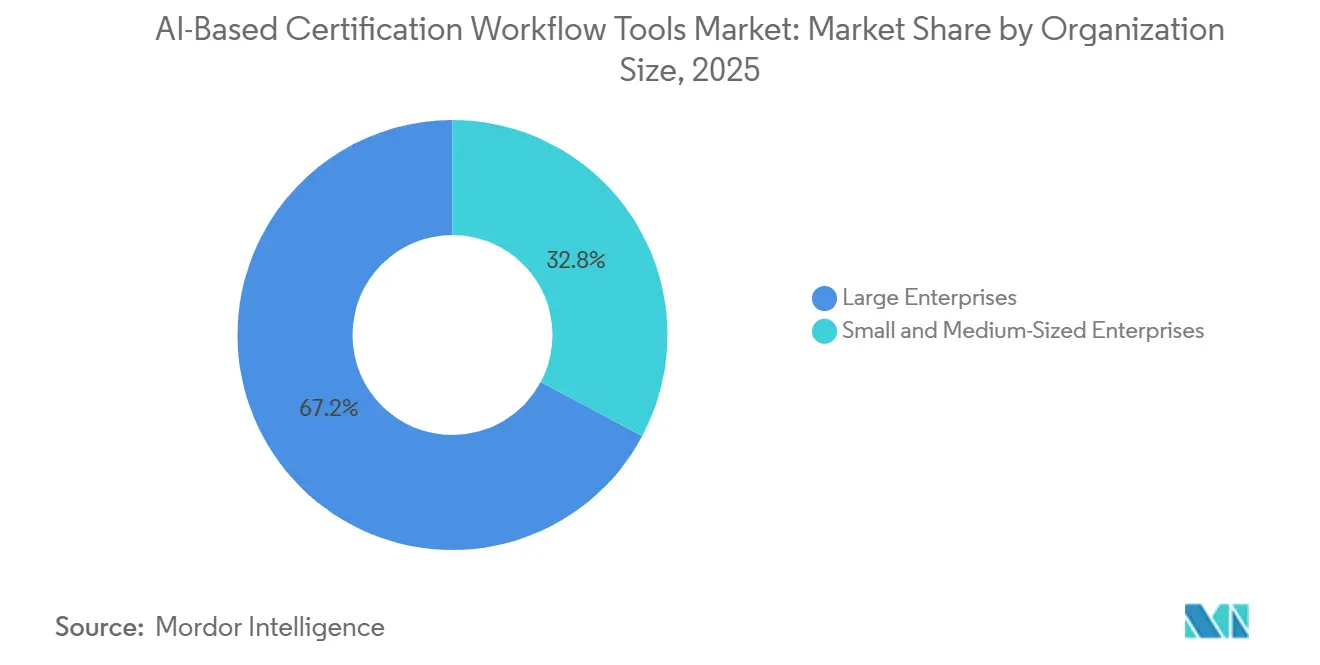
- By organization size, large enterprises held 67.21% of market revenue in 2025 and are projected to grow at a CAGR of 32.27% through 2031.
- By industry vertical, information technology and telecommunications held 58.47% of market revenue in 2025, while financial services are projected to expand at a CAGR of 33.86% through 2031.
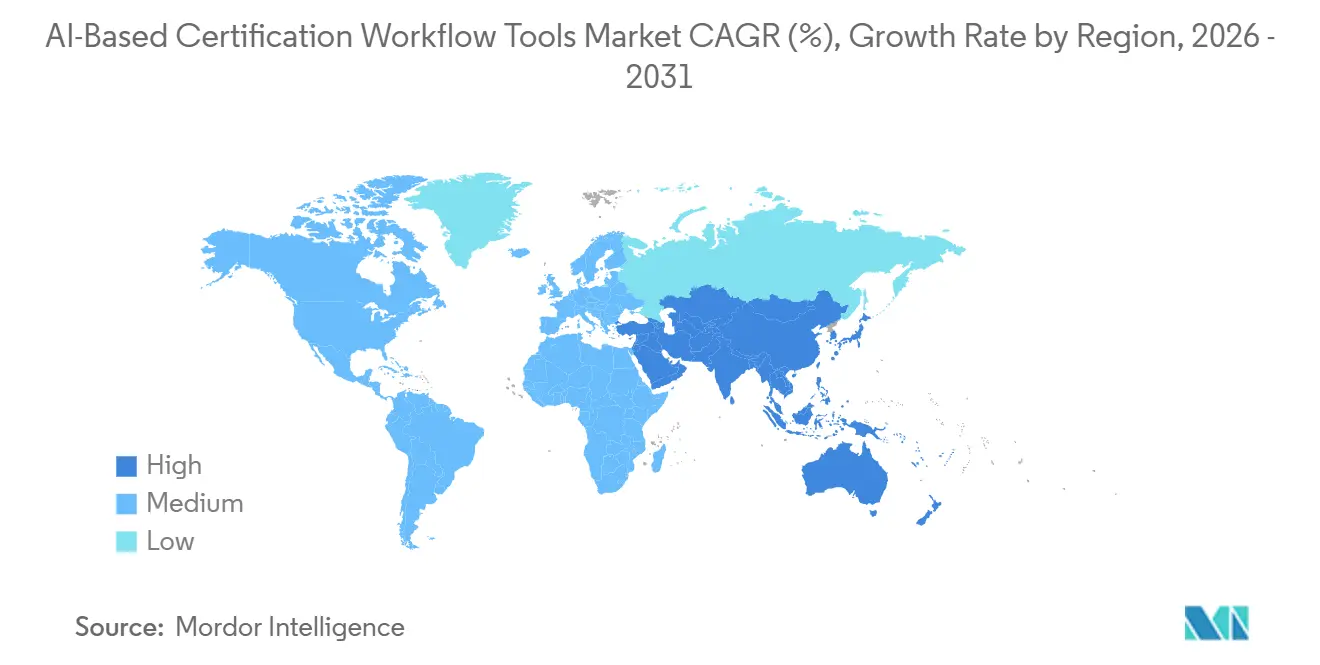
- By geography, North America held 35.12% of market revenue in 2025, while Asia-Pacific is projected to expand at a CAGR of 34.04% through 2031 in the AI-based certification workflow tools market.
Note: Market size and forecast figures in this report are generated using Mordor Intelligence’s proprietary estimation framework, updated with the latest available data and insights as of January 2026.
Market Trends and Insights
Drivers Impact Analysis of AI-Based Certification Workflow Tools Market*
| DRIVER | (~) % IMPACT ON CAGR FORECAST | GEOGRAPHIC RELEVANCE | IMPACT TIMELINE |
|---|---|---|---|
| Regulatory Expansion of AI Assurance and Conformity Assessment | +5.8% | Global | Medium term (2-4 years) |
| Shift From Periodic Audits to Continuous Compliance Monitoring | +4.9% | Global | Short term (≤ 2 years) |
| Demand for Machine-Readable and Cryptographically Verifiable Evidence | +3.7% | North America and Europe, with Asia-Pacific spillover | Medium term (2-4 years) |
| Integration of Certification Workflows With Enterprise Systems | +3.2% | North America and Europe | Short term (≤ 2 years) |
| Expansion of Remote and Distributed Certification Operations | +2.1% | Global | Short term (≤ 2 years) |
| AI-Assisted Document Intelligence and Audit Decision Support | +2.5% | North America and Asia-Pacific | Medium term (2-4 years) |
| Source: Mordor Intelligence | |||
Regulatory Expansion of AI Assurance and Conformity Assessment
The EU AI Act has created a significant demand signal for the AI-based certification workflow tools market because high-risk AI providers face conformity assessment obligations. The regulation allowed penalties of up to EUR 35 million, equivalent to USD 38.85 million at the stated 2025 average rate, or 7% of global annual revenue for certain infringements.[1] Germany’s Bundesnetzagentur became an operational notifying authority for AI conformity assessment bodies in August 2025. This institutional structure increases the need for well-organized evidence packages for certification bodies to review. ISO/IEC 42001 also provides a management system framework that certification programs can use to assess AI governance. These requirements are shortening procurement decision-making in regulated sectors where organizations must maintain current and reliable evidence of control.
Shift From Periodic Audits to Continuous Compliance Monitoring
The AI-based certification workflow tools market is driven by the shift from annual assessments to continuous monitoring of controls and evidence. Organizations can reduce the manual effort required to prepare evidence when connected systems provide records throughout the control cycle. This approach helps audit teams identify missing documents and incomplete controls before a scheduled audit begins. It also creates a record of evidence that helps users review recurring issues over time. Vendors with real-time evidence ingestion and automated reminders can better address enterprise needs than platforms built around batch document requests. The change favors established platforms because a longer history of evidence can make migrating to another system more difficult for customers.
Demand for Machine-Readable and Cryptographically Verifiable Evidence
Certification bodies and regulators are increasingly moving beyond PDF archives toward evidence that can be checked by software. The W3C Verifiable Credentials Data Model 2.0 defines a framework for issuing tamper-evident credentials that a verifier can validate without contacting the issuer. An IETF draft applies cryptographic verification concepts to AI governance attestations and links them to ISO/IEC 42001 and the NIST AI Risk Management Framework.[2] This direction raises the requirements for older workflow systems that only store documents. Microsoft’s supplier assurance guidance recognized ISO/IEC 42001 for AI systems as a compliance alternative in its vendor verification process. The resulting supplier requirements can extend demand for trusted, machine-readable evidence through wider procurement networks.
Integration of Certification Workflows With Enterprise Systems
Enterprise buyers assess the AI-based certification workflow tools market by how effectively a platform connects with identity, security, quality, and ERP systems. Connected workflows avoid duplicate data entry and reduce the risk that evidence remains separated in spreadsheets and email folders. SAP introduced a program in 2026 to certify partner-built Joule AI agents against its Business AI Platform, including alignment with ISO/IEC 42001. IBM reported ISO/IEC 42001 certification for the AI management system governing its Granite open-source language model family in 2025. Bureau Veritas’s Maestro portal supports audit scheduling, nonconformity tracking, and performance reporting across multiple sites. Such examples reinforce demand for tools that serve as part of the customer’s wider operating environment.
Restraints Impact Analysis of AI-Based Certification Workflow Tools Market*
| RESTRAINT | (~) % IMPACT ON CAGR FORECAST | GEOGRAPHIC RELEVANCE | IMPACT TIMELINE |
|---|---|---|---|
| Auditor Liability and Human Oversight Requirements | -3.8% | Global | Medium term (2-4 years) |
| Fragmented Standards and Limited Credential Interoperability | -3.2% | Global | Long term (≥ 4 years) |
| Sensitive Client Data and Model-Governance Constraints | -2.8% | North America and Europe | Medium term (2-4 years) |
| Inconsistent Training Data Across Standards, Languages, and Jurisdictions | -2.1% | Global, particularly Asia-Pacific and Middle East and Africa | Long term (≥ 4 years) |
| Source: Mordor Intelligence | |||
Auditor Liability and Human Oversight Requirements
The AI-based certification workflow tools market remains limited by requirements that qualified auditors retain responsibility for conformity decisions. The EU AI Act includes human oversight requirements for high-risk AI systems. Accreditation bodies are still determining how the use of AI by conformity assessment organizations relates to competence requirements under ISO/IEC 17021. This uncertainty limits the scope for tools that remove reviewer checkpoints entirely. Vendors must therefore build approval stages into evidence collection, findings, and certificate decisions. Those controls can lengthen implementation and sales cycles for large customers. They also preserve a level of labor cost within audit workflows, even as evidence gathering becomes more automated.
Fragmented Standards and Limited Credential Interoperability
The AI-based certification workflow tools market faces challenges because ISO/IEC 42001, the NIST AI Risk Management Framework, EU AI Act documentation rules, and national requirements use different terms and evidence structures. Organizations operating across borders may need parallel evidence streams for the same AI system. This raises the cost of maintaining control libraries and keeping workflow templates current. Mutual-recognition efforts by accreditation organizations can address some duplication, but AI-specific requirements have not yet reached full harmonization. The lack of a common machine-readable credential can force vendors to prioritize some standards over others. This limits the ability of a single platform to offer complete coverage for every jurisdiction.
*Our forecasts treat driver/restraint impacts as directional, not additive. The impact forecasts reflect baseline growth, mix effects, and variable interactions.
AI-Based Certification Workflow Tools Market Segment Analysis
By Component:
Software Platforms Lead Workflow OrchestrationSoftware platforms held 80.78% of the AI-based certification workflow tools market share in 2025 and are projected to grow at a CAGR of 31.07% through 2031. Their lead reflects the need to coordinate audit programs across sites, standards, and audit teams. A connected platform can replace separate document repositories and email-based evidence requests. Certyze, Intact Systems, CertRoute, and Zertic focus on configurable workflows, standards coverage, and enterprise integrations. GRC-oriented providers such as Qualtrax and Jadian address related requirements for customers managing wider risk programs. Certyze stated that its software supports certification bodies and conformity assessment bodies across ISO/IEC 17021-1, ISO/IEC 17025, and ISO/IEC 17065 workflows.[3]
Services make up the remaining component segment and include implementation consulting, auditor training, managed compliance delivery, regulatory-change support, and assistance for organizations that do not have deep internal certification expertise. Their role is most visible during onboarding, when a customer must convert existing document routines into configured workflows, define responsibilities, train users, and map each required control to available evidence. Intact Systems launched OASIS Insights with the International Aerospace Quality Group in April 2025 for the Online Aerospace Supplier Information System. The tool generated performance benchmarking reports for certified aerospace suppliers after initial, recertification, or surveillance audits, showing how completed audit events can become usable quality information rather than remain static records. This model gives software providers a way to complement services with recurring analytics and helps explain why platforms that support continuing operational review can be more valuable than legacy systems that only store documents.
By Deployment Mode:
Cloud Delivery Supports Continuous AssuranceCloud-based solutions accounted for 73.59% of the AI-based certification workflow tools market size in 2025 and are projected to grow at a CAGR of 32.02% through 2031. Centralized repositories enable distributed auditors to access the same evidence under defined user permissions. Cloud systems can also connect with identity and quality management applications through interfaces. This supports regular evidence collection and scheduled control checks. Alerts can notify control owners before gaps become audit findings. Zertic stated that its ISO 27001-certified system supports certification bodies in Europe, North America, and South America.[4]
On-premises and hybrid deployments hold the remaining share and remain important when data-protection obligations under the GDPR, national data-localization rules, or internal policies limit cloud-hosted evidence processing. Hybrid designs allow organizations to retain sensitive repositories on their own infrastructure while using cloud services for audit scheduling, report production, stakeholder communication, and cross-site coordination. This transitional architecture can reduce disruption for customers moving from older systems and can preserve local control over high-sensitivity records. Cloud delivery nonetheless aligns with a wider preference for subscription software that can be updated as requirements change, can support combined audits across several standards, and does not require a separate local environment for every operating location. Providers of on-premises systems therefore need a clear data-governance case, rather than a simple preference for older architecture, when competing for new customer deployments.
By End User:
Certification Bodies Lead While Internal Teams ExpandCertification bodies held 34.87% of the AI-based certification workflow tools market size in 2025. They manage high volumes of audit scheduling, auditor competence records, nonconformity resolution, and certificate lifecycle work. This concentration gives them a strong need for dedicated workflow systems. Accreditation and scheme owners use related tools for oversight, reporting, and coordination across certification bodies. Testing, inspection, and certification providers such as TÜV SÜD, Bureau Veritas, and SGS also use digital workflows within broader service delivery. Regulatory organizations and supply-chain audit teams represent a smaller but developing user group.
Internal audit and compliance departments are projected to be the fastest-growing end-user group at a CAGR of 33.52% through 2031, as they manage a growing combination of AI governance, SOX, and operational resilience requirements. Many teams previously relied on documents, email requests, and spreadsheets to prepare for review cycles, a process that becomes harder to manage when evidence must be current across multiple business units. Dedicated workflow systems provide a more consistent path from evidence collection to reviewer approval, findings management, and reporting for senior management. They are especially relevant where in-house teams need auditable records while using AI-assisted document review, because the platform can preserve human checkpoints and ownership. The projected growth reflects the transfer of more routine conformity work from external bodies to internal functions that must demonstrate control over data, models, suppliers, and operating processes.
By Organization Size:
Large Enterprises Drive Current DemandLarge enterprises commanded 67.21% of the AI-based certification workflow tools market share in 2025 and are projected to grow at a CAGR of 32.27% through 2031. These organizations often manage several sites, countries, and management-system standards at the same time. A multinational using ISO 9001, ISO 27001, ISO/IEC 42001, and sector-specific schemes requires coordinated evidence and certification processes. For these users, workflow software is an operating requirement rather than a discretionary productivity tool. Their larger technology budgets also support integrations with audit, risk, identity, and quality systems. Continuing regulatory requirements should sustain migration from legacy tools.
Small and medium-sized enterprises remain an important underserved group because they often need the same evidence discipline as larger organizations, but cannot carry the same implementation burden. The European Commission’s impact assessment for the EU AI Act estimated first-implementation costs of EUR 6,000 to EUR 7,500 per high-risk AI system, or USD 6,480 to USD 8,100 at the stated 2025 average rate. Such costs make straightforward, lower-cost workflow tools attractive, particularly where a small team must prepare for ISO 27001 or AI-related assessments while maintaining day-to-day operations. Zertic launched Zertic GO in December 2025 for small certification teams and newly established certification bodies. Tiered product designs, guided configuration, and limited-scope subscriptions can help vendors serve these organizations without forcing them to buy the complexity required by multinational clients.
By Industry Vertical:
IT and Telecom Leads While Financial Services AcceleratesInformation technology and telecommunications held 58.47% of the AI-based certification workflow tools market share in 2025. The sector both develops AI systems and buys governance tools for its own use. Providers face demanding documentation needs where their products are subject to AI governance requirements. Enterprise procurement also increasingly considers ISO/IEC 42001 in AI vendor assessment. SAP announced ISO/IEC 42001 certification for key AI services in 2025 through an independent third-party audit. Manufacturing and industrial users form the second-largest user base because aerospace, automotive, and defense supply chains require dense quality and certification workflows.
Financial services are projected to be the fastest-growing vertical at a CAGR of 33.86% through 2031 because AI governance requirements interact with digital operational resilience, capital reporting, disclosure obligations, and established control practices. Existing regulatory technology systems give many institutions a stronger foundation for adopting connected certification workflows than sectors that are still building basic compliance infrastructure. Healthcare and life sciences also require structured support when AI-enabled medical-device expectations interact with European medical-device requirements and the need to retain detailed technical evidence. Food and agriculture, energy and utilities, construction and infrastructure, and transportation and logistics are adopting tools through supply-chain certification, quality renewal, and international procurement requirements. This range of use cases broadens the AI-based certification workflow tools market beyond its current technology-centered base and gives vendors a path to develop sector-specific templates without changing the core evidence-management model.
Geography Analysis
North America AI-Based Certification Workflow Tools Market
North America held 35.12% of the AI-based certification workflow tools market share in 2025. The region benefits from mature compliance programs in financial services, aerospace, and technology, as well as a dense base of accredited certification bodies. Established digital quality management practices give customers a practical foundation for connected audit tools. SOX-related work creates a large and recurring workload for many U.S. organizations. Regulatory guidance from the PCAOB and SEC continues to shape the acceptable use of AI-assisted audit methods. Canada and Mexico also add demand through supply-chain requirements linked to North American manufacturing networks.
Europe AI-Based Certification Workflow Tools Market
Europe represented the second-largest regional position in 2025, supported by EU AI Act conformity assessment requirements. Bureau Veritas launched an independent AI systems audit for European enterprises in April 2026 in partnership with AWS. The offering was designed to reduce audit cycles through automated document analysis and testing. Germany’s notifying authority provides a formal route for AI conformity assessment bodies. This combination of regulation, certification infrastructure, and enterprise demand supports continued adoption in the region.
APAC, South America and MEA AI-Based Certification Workflow Tools Market
Asia-Pacific is projected to be the fastest-growing geography at a CAGR of 34.04% through 2031. China’s developing AI governance framework, Japan’s industrial standards work, and Singapore’s governance environment support regional demand. India’s ISO-certified exporters in automotive, pharmaceutical, and IT supply chains need efficient support for multi-standard compliance. South Korea and Australia add further governance-related demand. Brazil supports early adoption in South America through enterprise certification programs for agricultural and industrial exporters. The Middle East is developing through public-sector digital programs, while Africa remains smaller with early adoption in financial services and telecommunications.
Competitive Landscape
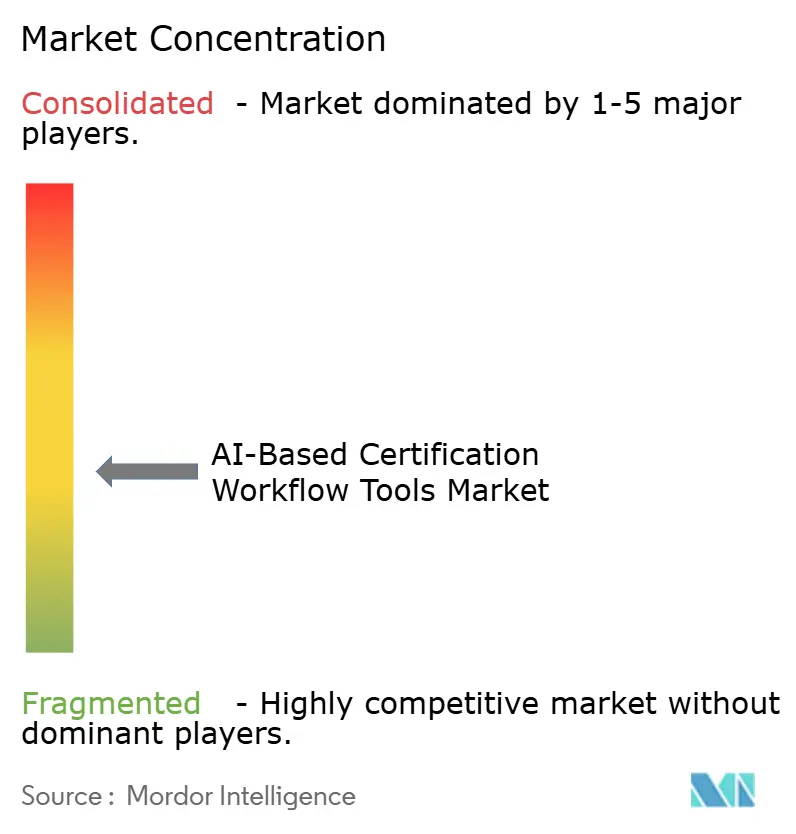
The AI-based certification workflow tools market is moderately fragmented, with several groups of competitors, each with distinct strengths. Specialist providers such as Certyze, Zertic, Intact Systems, CertRoute, AuditOne, and Audit-AI focus on certification bodies and testing, inspection, and certification operators. They compete through workflow configuration, scheme coverage, and features used by auditors. Enterprise vendors, including IBM, SAP, Oracle, and Microsoft, embed governance and certification capabilities in broader compliance platforms. Their installed customer bases can help them extend into certification-related needs. Traditional providers such as TÜV SÜD, Bureau Veritas, and SGS use digital systems to strengthen their existing accreditation and audit services.
Bureau Veritas launched an independent AI assessment offering for European enterprises in April 2026 with AWS. The service uses automated document review and testing as part of its audit process. IBM obtained ISO/IEC 42001 certification for the system governing its Granite open-source language models in 2025.[5] SAP also obtained ISO/IEC 42001 certification for key AI services in 2025 through an independent audit. These steps show that vendors are using independently assessed governance practices to build customer trust. The AI-based certification workflow tools market may increasingly favor vendors that combine standards expertise with system integration and ongoing evidence management.
A clear opening remains in credential interoperability. No provider in the supplied material was shown to offer a production system that combines ISO/IEC 42001, EU AI Act technical documentation, NIST AI Risk Management Framework requirements, and W3C credential issuance in one evidence package. The first company to connect these requirements could gain an advantage with customers operating in several jurisdictions. Specialist platforms are also moving from process coordination toward operational analytics and quality intelligence. Larger GRC vendors have the resources to add comparable capabilities through internal development or acquisition. The competitive landscape is therefore fragmented, and leadership depends on integration depth, credibility with certification users, and support for evolving standards.
AI-Based Certification Workflow Tools Industry Leaders
-
Microsoft Corporation
-
International Business Machines Corporation
-
SAP SE
-
Oracle Corporation
-
TÜV SÜD AG
- *Disclaimer: Major Players sorted in no particular order
AI-Based Certification Workflow Tools Market Companies Covered in this Report
- Microsoft Corporation
- International Business Machines Corporation
- SAP SE
- Oracle Corporation
- TÜV SÜD AG
- Intact Systems
- Audit-AI
- AuditOne
- Certyze
- Zertic
- CertRoute
- Jadian
- Qualtrax
- VigiTrust
- Centrieva
- Dossier Solutions
- eLumen
- Liaison International
- Accredible, Inc.
- Parchment LLC
- Bureau Veritas SA
- SGS SA
Recent Industry Developments in AI-Based Certification Workflow Tools Market
- April 2026: Bureau Veritas launched an independent AI systems audit for European enterprises in partnership with AWS, powered by the AWS AI Risk Intelligence automated governance solution, reducing audit cycles from several weeks to a few days through automated document review and direct testing across 8 risk pillars. Deployment began in Q2 2026 across France, the United Kingdom, Spain, Italy, the Netherlands, and Nordic countries.
- March 2026: Forescout Technologies introduced Automated Security Controls Assessment within its Vistaro platform, replacing manual spreadsheet-based compliance audits with continuous, real-time automated evidence collection and reporting for security and GRC teams, setting a new standard for real-time compliance assurance and eliminating point-in-time audit blind spots.
- October 2025: SAP achieved ISO/IEC 42001 certification for its key AI services through independent third-party audit, choosing external certification over self-attestation to establish a higher level of governance objectivity for enterprise customers evaluating AI vendor risk.
- April 2025: Intact Systems, as technology partner to IAQG, launched OASIS Insights, an AI-powered analytics tool embedded in the Online Aerospace Supplier Information System that automatically generates performance benchmarking reports for certified aerospace suppliers following completion of initial, recertification, or surveillance audits.
Global AI-Based Certification Workflow Tools Market Report Scope
The AI-Based Certification Workflow Tools Market encompasses software solutions that leverage artificial intelligence to automate and optimize certification-related processes, including document review, compliance validation, audit preparation, risk assessment, approval workflows, and certificate management. These solutions enable certification bodies, testing laboratories, and regulated enterprises to enhance accuracy, reduce processing times, and ensure regulatory compliance. The market serves a wide range of industries, including manufacturing, healthcare, food safety, sustainability, information security, and quality management systems.
The AI-Based Certification Workflow Tools Market Report is Segmented by Component (Software Platforms, and Services), Deployment Mode (Cloud-Based, On-Premises, and Hybrid Deployment), End User (Certification Bodies, Accreditation and Scheme Owners, Internal Audit and Compliance Departments, Testing, Inspection, and Certification Providers, and Other End Users), Organization Size (Large Enterprises, and Small and Medium-Sized Enterprises), Industry Vertical (Information Technology and Telecommunications, Manufacturing and Industrial, Healthcare and Life Sciences, Food and Agriculture, Energy and Utilities, Construction and Infrastructure, Financial Services, Transportation and Logistics, and Other Industry Verticals), and Geography (North America, South America, Europe, Asia-Pacific, Middle East, and Africa). The Market Sizes and Forecasts are Provided in Terms of Value in (USD).
Segmentation Overview
| Software Platforms |
| Services |
| Cloud-Based |
| On-Premises |
| Hybrid Deployment |
| Certification Bodies |
| Accreditation and Scheme Owners |
| Internal Audit and Compliance Departments |
| Testing, Inspection, and Certification Providers |
| Other End Users |
| Large Enterprises |
| Small and Medium-Sized Enterprises |
| Information Technology and Telecommunications |
| Manufacturing and Industrial |
| Healthcare and Life Sciences |
| Food and Agriculture |
| Energy and Utilities |
| Construction and Infrastructure |
| Financial Services |
| Transportation and Logistics |
| Other Industry Verticals |
| North America | United States |
| Canada | |
| Mexico | |
| South America | Brazil |
| Argentina | |
| Colombia | |
| Rest of South America | |
| Europe | Germany |
| United Kingdom | |
| France | |
| Italy | |
| Spain | |
| Russia | |
| Rest of Europe | |
| Asia-Pacific | China |
| Japan | |
| India | |
| South Korea | |
| Australia | |
| Singapore | |
| Rest of Asia-Pacific | |
| Middle East | United Arab Emirates |
| Saudi Arabia | |
| Israel | |
| Turkey | |
| Rest of Middle East | |
| Africa | South Africa |
| Nigeria | |
| Egypt | |
| Rest of Africa |
| By Component | Software Platforms | |
| Services | ||
| By Deployment Mode | Cloud-Based | |
| On-Premises | ||
| Hybrid Deployment | ||
| By End User | Certification Bodies | |
| Accreditation and Scheme Owners | ||
| Internal Audit and Compliance Departments | ||
| Testing, Inspection, and Certification Providers | ||
| Other End Users | ||
| By Organization Size | Large Enterprises | |
| Small and Medium-Sized Enterprises | ||
| By Industry Vertical | Information Technology and Telecommunications | |
| Manufacturing and Industrial | ||
| Healthcare and Life Sciences | ||
| Food and Agriculture | ||
| Energy and Utilities | ||
| Construction and Infrastructure | ||
| Financial Services | ||
| Transportation and Logistics | ||
| Other Industry Verticals | ||
| By Geography | North America | United States |
| Canada | ||
| Mexico | ||
| South America | Brazil | |
| Argentina | ||
| Colombia | ||
| Rest of South America | ||
| Europe | Germany | |
| United Kingdom | ||
| France | ||
| Italy | ||
| Spain | ||
| Russia | ||
| Rest of Europe | ||
| Asia-Pacific | China | |
| Japan | ||
| India | ||
| South Korea | ||
| Australia | ||
| Singapore | ||
| Rest of Asia-Pacific | ||
| Middle East | United Arab Emirates | |
| Saudi Arabia | ||
| Israel | ||
| Turkey | ||
| Rest of Middle East | ||
| Africa | South Africa | |
| Nigeria | ||
| Egypt | ||
| Rest of Africa | ||
Key Questions Answered in the Report
What is the size of the AI-based certification workflow tools market?
The AI-based certification workflow tools market size was valued at USD 1.63 million in 2025 and USD 2.31million in 2026, and is projected to reach USD 8.36 million by 2031, growing at a CAGR of 29.34% during 2026-2031
What is driving adoption of AI-based certification workflow tools?
Demand is supported by AI governance requirements, continuous evidence collection, and the need to connect audit workflows with enterprise systems.
Which component leads demand for certification workflow tools?
Software platforms led with 80.78% of revenue in 2025 and are projected to grow at a CAGR of 31.07% through 2031.
Why are cloud-based certification workflow tools gaining adoption?
Cloud deployment held 73.59% of revenue in 2025 because it supports shared evidence repositories, distributed auditor access, and connected control monitoring.
Which end users are adopting these tools most rapidly?
Internal audit and compliance departments are projected to expand at a CAGR of 33.52% through 2031 as they manage more AI governance and control evidence work.
Which region is projected to grow fastest through 2031?
Asia-Pacific is projected to grow at a CAGR of 34.04% through 2031, supported by regional AI governance activity and exporter certification needs.