
AI Audit Platforms Market Size and Share
Market Overview
| Study Period | 2020 - 2031 |
|---|---|
| Market Size (2026) | USD 3.91 Billion |
| Market Size (2031) | USD 8.16 Billion |
| Growth Rate (2026 - 2031) | 15.85 % |
| Fastest Growing Market | Asia-Pacific |
| Largest Market | North America |
| Market Concentration | Low |
Major Players *Disclaimer: Major Players sorted in no particular order Image © Mordor Intelligence. Reuse requires attribution under CC BY 4.0. | |
AI Audit Platforms Market Analysis by Mordor Intelligence
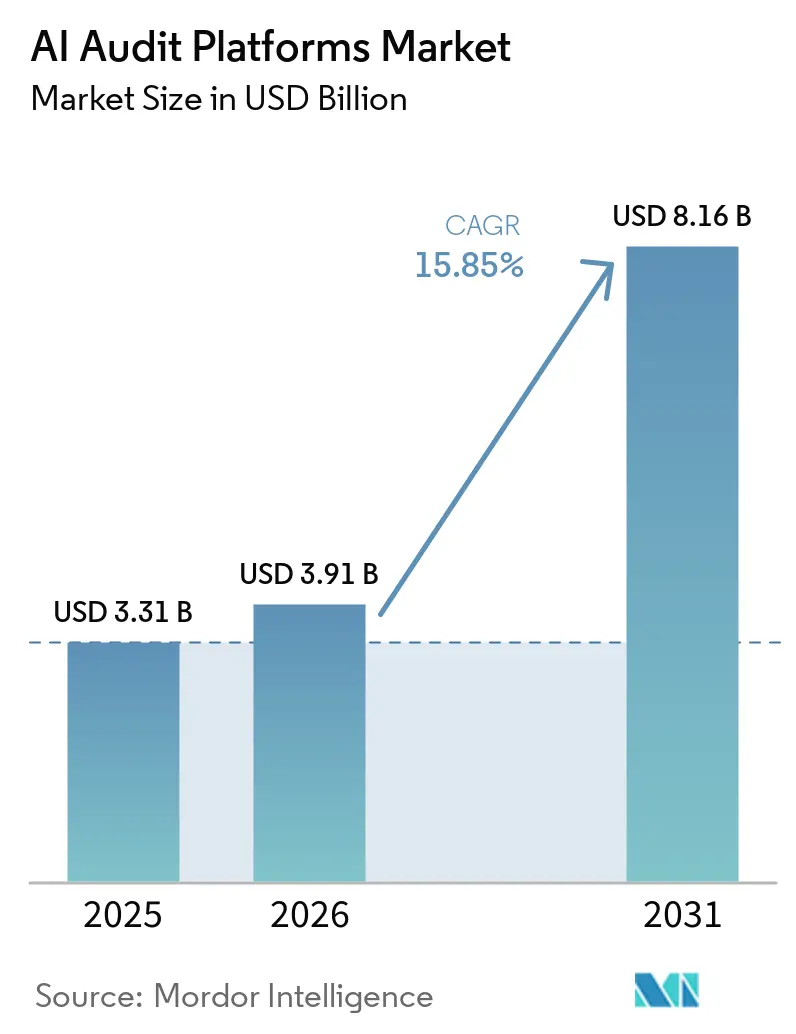
The AI Audit Platforms Market size is expected to grow from USD 3.31 billion in 2025 to USD 3.91 billion in 2026, and is forecast to reach USD 8.16 billion by 2031, at a 15.85% CAGR over 2026-2031. The AI Audit Platforms Market is expanding as autonomous systems make decisions and execute tasks that require reliable records of controls, approvals, and outcomes. Buyers increasingly require continuous evidence from production systems instead of periodic reviews based on limited samples. Regulatory deadlines in the European Union, the United States, and Asia are moving governance budgets toward compliance programs for regulated uses. Vendors that connect policy requirements with deployment data can support broader enterprise adoption and reduce the work required for audit preparation. The AI Audit Platforms Market also faces practical limits, where several providers contribute to a single workflow,, and audit responsibility is unclear.
Key Report Takeaways
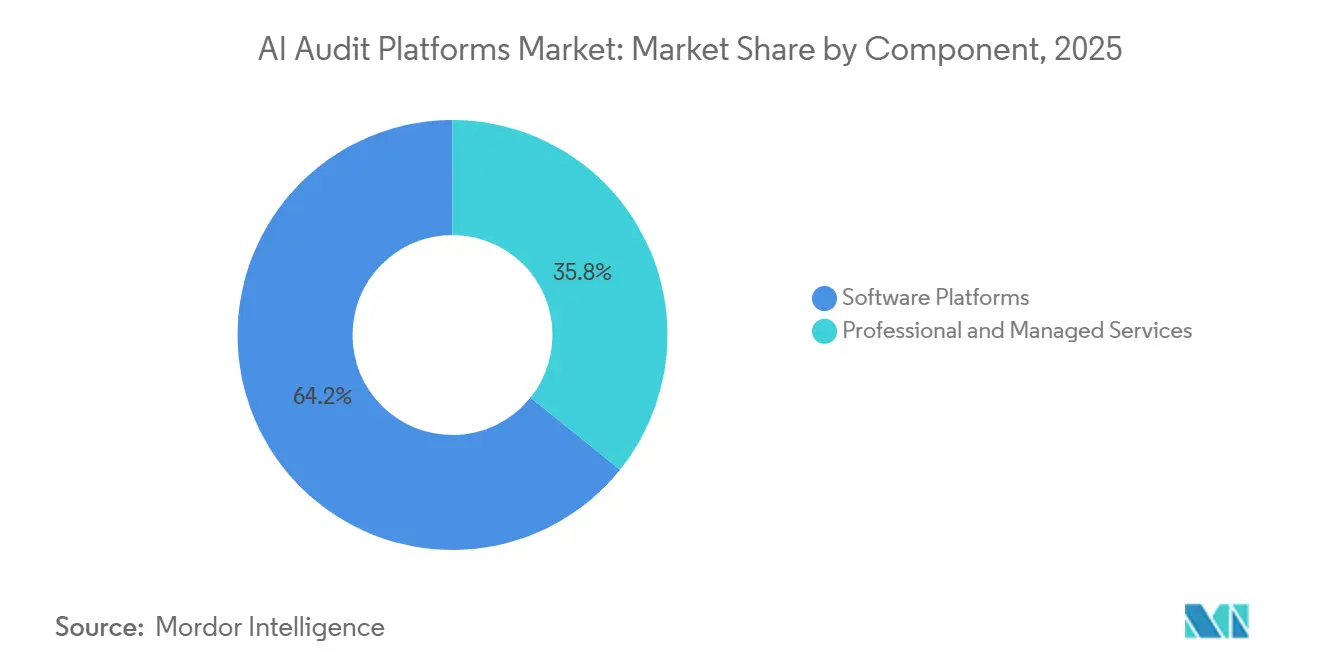
- By component, software platforms accounted for 64.23% of the AI Audit Platforms Market revenue in 2025, while professional and managed services are forecast to grow at a 17.24% CAGR through 2031.
- By audit function, compliance evidence and reporting accounted for 38.71% of revenue in 2025, while bias, fairness, and explainability auditing are forecast to grow at a 17.68% CAGR through 2031.
- By deployment, cloud-based deployment accounted for 58.42% of AI Audit Platforms Market revenue in 2025, while hybrid deployment is forecast to grow at a 16.94% CAGR through 2031.
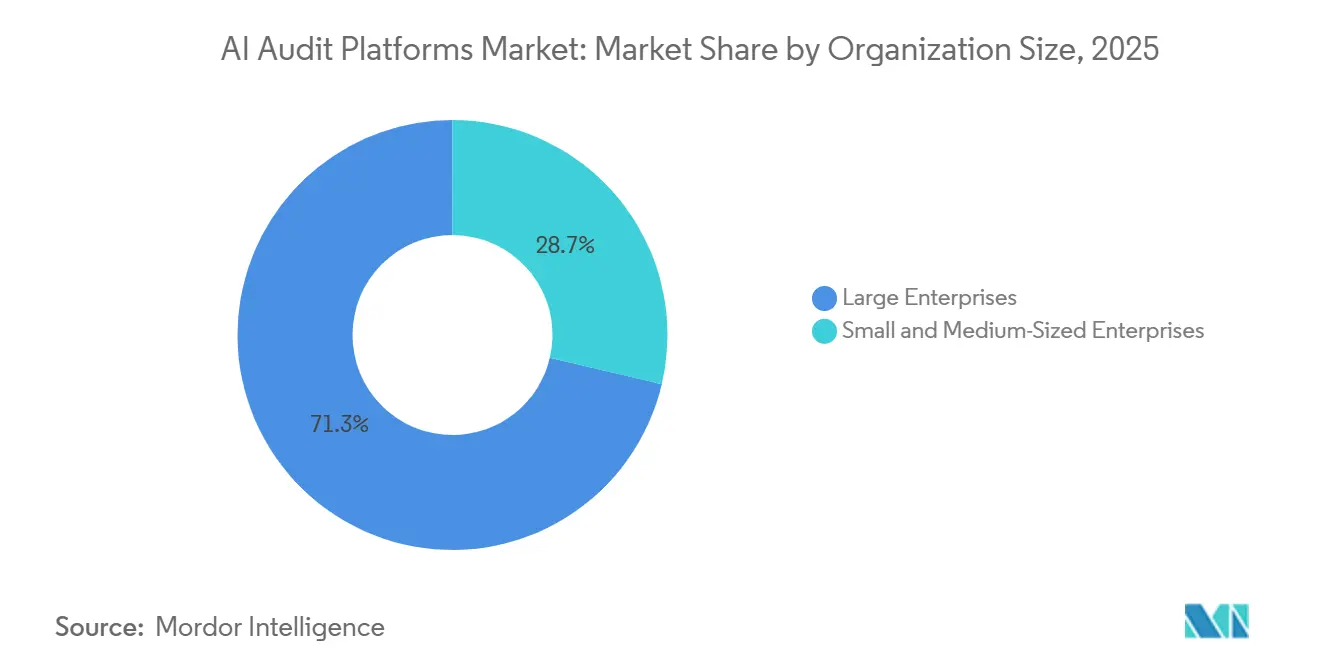
- By organization size, large enterprises accounted for 71.33% of revenue in 2025, while SMEs are forecast to grow at a 17.81% CAGR through 2031.
- By end-user industry, BFSI accounted for 29.16% of revenue in 2025, while healthcare and life sciences are forecast to grow at a 17.12% CAGR through 2031.
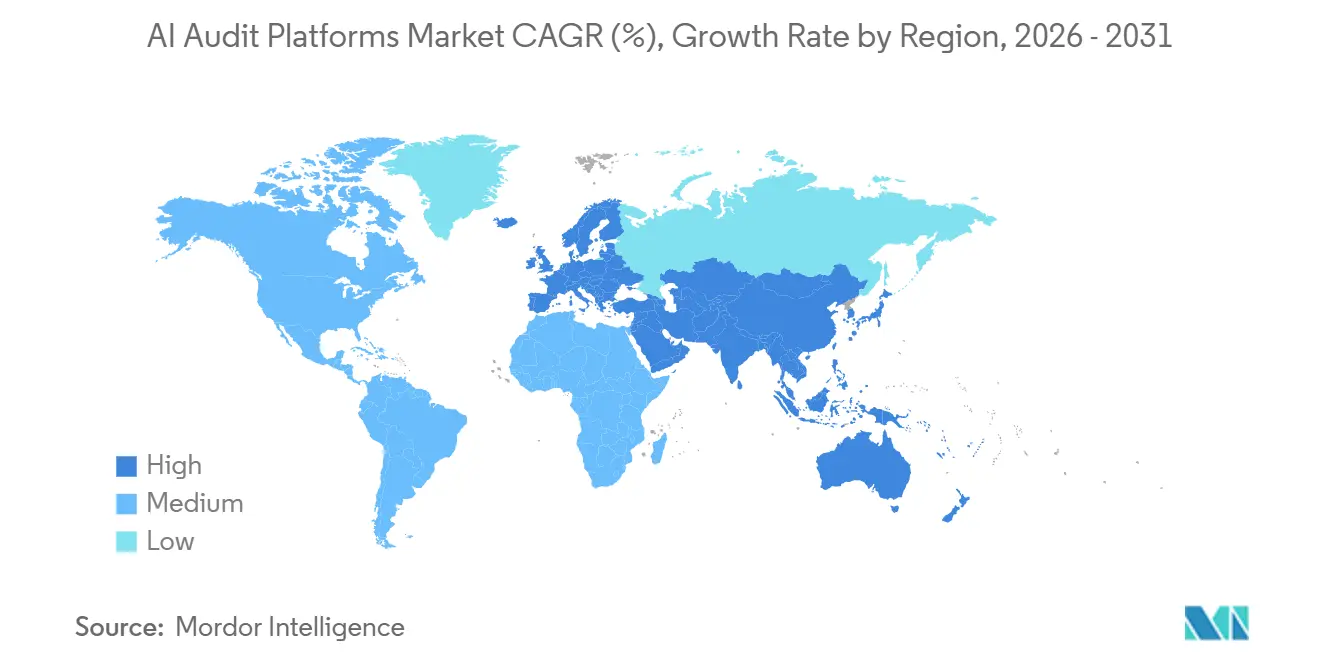
- By geography, North America accounted for 42.87% of the AI Audit Platforms Market revenue in 2025, while Asia-Pacific is forecast to grow at a 16.91% CAGR through 2031.
Note: Market size and forecast figures in this report are generated using Mordor Intelligence’s proprietary estimation framework, updated with the latest available data and insights as of January 2026.
Market Trends and Insights
Drivers Impact Analysis of AI Audit Platforms Market*
| Driver | (~) % Impact on CAGR Forecast | Geographic Relevance | Impact Timeline |
|---|---|---|---|
| Phased AI Regulation and Mandatory Audit Evidence | +3.8% | Global, concentrated in EU, US, and South Korea | Short term (≤ 2 years) |
| Expansion of Generative AI and Agentic AI Deployments | +3.2% | Global, led by North America and Asia-Pacific | Short term (≤ 2 years) |
| Shift From Sample-Based Testing to Continuous Full-Population Monitoring | +2.6% | Global, highest intensity in North America and Europe | Medium term (2-4 years) |
| Demand for Explainability, Fairness, and Model Accountability | +2.1% | Global, with compliance factors most acute in EU, US, and Australia | Medium term (2-4 years) |
| Integration of AI Audit Controls Into Enterprise Procurement | +1.8% | North America and EU core, with spillover to Middle East and Asia-Pacific | Medium term (2-4 years) |
| Machine-Readable Regulatory Control Mapping | +1.4% | Global, with early gains in EU and Singapore | Long term (≥ 4 years) |
| Source: Mordor Intelligence | |||
Phased AI Regulation and Mandatory Audit Evidence
The AI Audit Platforms Market is supported by regulations requiring documented controls for high-risk systems. The EU AI Act entered its full enforcement stage for high-risk AI systems in August 2026, requiring risk management, technical documentation, and post-market monitoring.[1] The Federal Reserve, the OCC, and the FDIC issued SR 26-2 in April 2026, updating United States bank model risk guidance to cover generative and agentic AI. South Korea’s Basic AI Act also took effect in January 2026 with risk-based duties and assessment requirements for high-risk systems. These concurrent requirements favor platforms with reusable controls that work across regulatory frameworks. The AI Audit Platforms Market benefits because compliance teams need evidence that remains available after a model or agent enters production.
Expansion of Generative AI and Agentic AI Deployments
Agentic systems can plan tasks, use external tools, and act without confirmation at each step. Their context, memory, and tool state can change the decision path, making retrospective review incomplete for important actions. IBM states that agentic AI requires AI assurance to operate as a continuous capability rather than a periodic review process. Singapore’s Model AI Governance Framework for Agentic AI outlines human approval checkpoints for high-stakes, irreversible actions.[2] This architecture creates demand for logging, policy checks, and traceability across each action in a workflow. The AI Audit Platforms Market, therefore, gains from organizations that need oversight systems designed for changing agent behavior.
Shift From Sample-Based Testing to Continuous Full-Population Monitoring
Periodic testing cannot fully capture the behavior of models that change after deployment. Continuous monitoring collects evidence from live logs, model parameters, and operational data across the system lifecycle. NIST identified post-deployment monitoring as the least mature area of enterprise AI governance in a 2025 workshop report.[3] This gap supports demand for systems that collect evidence, detect drift, and track bias measures during use. The AI Audit Platforms Market is moving toward products that can test the entire operating population rather than selected historical records. Vendors must also show that their monitoring approach works when models, data sources, and agents are updated frequently.
Demand for Explainability, Fairness, and Model Accountability
Explainability and fairness controls are becoming formal parts of AI governance programs. ISO/IEC TS 6254:2025 provides objectives and approaches for explainability and interpretability of machine learning models and AI systems.[4] The European Data Protection Supervisor has linked fairness, accuracy, and data minimization in its guidance for AI risk management. These requirements increase the need to measure model behavior on an ongoing basis, rather than prepare one-time documentation. A peer-reviewed study found that explainable AI tools in internal audit workflows can provide traceability at a scale that manual review cannot match. The AI Audit Platforms Market is consequently widening beyond compliance reporting toward testing and documentation of accountable decisions.
Restraints Impact Analysis of AI Audit Platforms Market*
| Restraint | (~) % Impact on CAGR Forecast | Geographic Relevance | Impact Timeline |
|---|---|---|---|
| Fragmented Accountability Across AI Providers and Deployers | -1.2% | Global | Short term (≤ 2 years) |
| Shortage of AI Governance and Conformity-Assessment Specialists | -0.9% | Global, most acute in Asia-Pacific and South America | Medium term (2-4 years) |
| Integration Friction Across Shadow AI and Legacy MLOps Estates | -0.7% | Global, concentrated in large enterprises | Medium term (2-4 years) |
| Privacy and Data-Residency Restrictions on Audit Telemetry | -0.5% | EU, Middle East, and Asia-Pacific data-sovereignty jurisdictions | Long term (≥ 4 years) |
| Source: Mordor Intelligence | |||
Fragmented Accountability Across AI Providers and Deployers
AI workflows often combine cloud infrastructure, foundation models, business applications, and downstream user actions. This structure makes it difficult to establish a single complete audit trail or to allocate responsibility for control failures. The Financial Stability Board identified third-party AI dependencies and service-provider concentration as material vulnerabilities in responsible AI adoption. Organizations may not have contractual rights to receive training data, lineage, or performance evidence in formats their internal tools can use. The problem is more pronounced in multi-agent workflows that connect 5 or more services, each with separate logging and liability rules. The AI Audit Platforms Market must address this constraint by adopting interoperable evidence formats and clarifying provider-deployer control boundaries.
Shortage of AI Governance and Conformity-Assessment Specialists
Organizations need people who can translate regulatory requirements into technical controls and audit tests. The IAPP reported that 23.5% of organizations identified access to qualified AI governance professionals as a primary challenge in 2025. Georgetown University found demand for more than 100,000 AI ethics and governance professionals annually in its 2024 job-market analysis. This shortage can delay platform deployments because buyers need expertise to define policies, configure controls, and interpret results. It also supports managed services for assessment, bias testing design, and regulatory evidence preparation. The AI Audit Platforms Market has an opportunity to simplify governance work for buyers who cannot build specialized teams.
*Our forecasts treat driver/restraint impacts as directional, not additive. The impact forecasts reflect baseline growth, mix effects, and variable interactions.
AI Audit Platforms Market Segment Analysis
By Component:
Software Platforms Lead Revenue and Services Address Governance CapacitySoftware platforms held 64.23% of the AI Audit Platforms Market share in 2025, reflecting enterprise demand for policy-based tools that operate at inference speed and provide a common record across models, agents, and business uses. These systems collect operational data from MLOps pipelines, agent orchestration tools, and deployment registries, and high switching effort can reinforce their position once connected to core workflows. Platforms can update policy libraries as requirements change, reducing duplicated work across legal, risk, technical, and audit teams. The segment benefits when buyers need repeatable evidence rather than manual reports, with vendors competing on integrations, control coverage, and the usability of their evidence records. Software, therefore, remains the central procurement choice for organizations with broad AI portfolios in the AI Audit Platforms Market.
Professional and managed services are forecast to grow at 17.24% CAGR through 2031 because organizations need support for conformity assessment, bias-testing design, and documentation across multiple regulators. Deloitte, KPMG, Accenture, and PwC are building work around EU AI Act readiness, SR 26-2 compliance, and agentic AI risk assessment, often alongside specialized software. ModelOp’s August 2025 partnership with Angularis.ai combined lifecycle management with governance-as-a-service delivery. This model responds to the shortage of governance specialists and can range from full platform deployment to recurring audit packages. The AI Audit Platforms Market is likely to see closer links between subscriptions and managed support as buyers seek practical capacity.
By Audit Function:
Compliance Reporting Leads and Explainability Auditing Grows FastestCompliance evidence and reporting accounted for 38.71% of revenue in 2025, making it the largest audit function, as regulators and internal risk teams require structured documentation. This function records policies, approvals, controls, and evidence demonstrating whether high-risk systems were governed throughout their lifecycle. The AI Audit Platforms Market uses reporting as an entry point for first-time buyers and a common record for senior management. Strong reporting capabilities can reduce duplicated work between legal, risk, and technical teams while keeping records consistent across use cases. Its leading 2025 share reflects the priority that buyers place on organized compliance evidence.
Bias, fairness, and explainability auditing is forecast to grow at 17.68% CAGR through 2031, while model and data lineage and runtime decision logging are also expanding. ISO/IEC TS 6254:2025 provides a common reference for explainability and interpretability practices. OWASP’s agentic application risk taxonomy has increased attention on tool misuse and memory poisoning. The AI Audit Platforms Market supports these functions by linking an inference, a tool call, and a policy decision into a single evidence record, while pure-play vendors retain technical strength. Demand is shifting from basic reporting to records that explain what happened and why.
By Deployment:
Cloud Leads and Hybrid Deployment Responds to Data ResidencyCloud-based deployment accounted for 58.42% of revenue in 2025, supported by scalable telemetry collection, centralized policy management, and the distribution of product updates and regulatory content. Buyers can gather audit information from many applications and operating locations, which is useful for enterprises with distributed development teams and expanding AI portfolios. The AI Audit Platforms Market has benefited from cloud systems, which provide broad visibility without extensive local infrastructure. Centralized access to current policy libraries, reporting capabilities, and development tool integrations reinforces this position where data requirements permit. These operational benefits made the cloud the leading deployment model in 2025.
Hybrid deployment is forecast to grow at a 16.94% CAGR through 2031 because it separates policy management from telemetry processing, which may involve sensitive personal or financial information. This approach helps buyers meet data residency requirements in the European Union, the Middle East, and parts of Asia-Pacific, while on-premises systems remain relevant for air-gapped defense, intelligence, and critical infrastructure use cases. IBM expanded watsonx governance to the FedRAMP Moderate Government Cloud for AWS in April 2026. The AI Audit Platforms Market is not moving toward a single deployment standard because buyers are selecting architectures based on evidence, data location, and sensitivity. Vendors with modular control and telemetry designs are better placed to meet this demand.
By Organization Size:
Large Enterprises Lead and SMEs Expand Through Accessible OfferingsLarge enterprises held 71.33% of the AI Audit Platforms Market share in 2025 because their portfolios operate across countries, business units, regulated activities, and large technology estates. These buyers must inventory models, agents, data sources, and vendors while managing greater exposure to regulatory review. IBM’s governance offerings illustrate the value of connecting control sets with operational evidence for this environment. Large enterprises commonly expect prebuilt policy content, deep integration, broad reporting, and support for several frameworks. Their requirements continue to shape platform capabilities and current revenue.
SMEs are forecast to grow at 17.81% CAGR through 2031, the fastest organization-size rate, as governance expectations enter supply chains and consumption-based pricing improves access. These organizations often have less capacity to address governance gaps through internal hiring, making modular tools and managed support important. Credo AI released its Agent Registry in public preview in September 2025 to help organizations inventory first-party, third-party, and vendor AI. The AI Audit Platforms Market can grow when suppliers make inventory, policy management, and testing capabilities usable for smaller teams. Buyers may start with a focused function and extend their program as compliance needs develop.
By End-User Industry:
BFSI Leads and Healthcare and Life Sciences Grow FastestBFSI accounted for 29.16% of revenue in 2025, the largest end-user share, because financial institutions already use structured model validation and risk management processes. SR 26-2, issued in April 2026, addresses AI-specific risks including bias, explainability, and model drift. The AI Audit Platforms Market supports financial buyers with policy controls, model records, and runtime monitoring for credit, underwriting, fraud, and customer-service applications. Buyers also need controls that fit established model-risk programs and provide evidence for validation and senior management oversight. These requirements explain BFSI’s established demand and leading 2025 revenue position.
Healthcare and life sciences are forecast to grow at a 17.12% CAGR through 2031 as regulatory activities increase attention to audit trails across AI medical device lifecycles and clinical research uses. The FDA issued final guidance on Predetermined Change Control Plans for AI-enabled device software functions in December 2024 and announced an AI in clinical trials pilot program in April 2026. Information technology and telecommunications, government and public sector, retail and e-commerce, and manufacturing and automotive are also relevant buyers with different control needs. Retail organizations focus on pricing and recommendation systems, while manufacturing and automotive need evidence under changing operating conditions. The AI Audit Platforms Market is expanding across these use cases because each requires records to support accountability.
Geography Analysis
North America AI Audit Platforms Market
North America accounted for 42.87% of regional revenue in 2025, supported by a large base of AI deployments and established model risk practices. The Federal Reserve, OCC, and the FDIC issued SR 26-2 in April 2026, prompting financial institutions to assess gaps in their governance programs. The FDA also started a pilot program in April 2026 that connects AI governance practices in clinical trials with the NIST AI Risk Management Framework. These actions support buyer interest in auditable governance infrastructure across financial and health applications.
Europe and South America AI Audit Platforms Market
Europe held the second-largest regional position in 2025. The EU AI Act’s August 2026 enforcement milestone requires high-risk AI systems to meet documentation and monitoring duties. Germany, the United Kingdom, and France have active AI governance bodies and sector-specific requirements that add to regional demand. The European AI Office can request technical documentation and impose penalties under the EU AI Act. South America is a growing opportunity, led by Brazil’s data-protection compliance culture and early-stage national AI governance frameworks.
APAC and MEA AI Audit Platforms Market
Asia-Pacific is forecast to grow at 16.91% CAGR through 2031, the highest regional rate in the AI Audit Platforms Market. South Korea’s Basic AI Act took effect in January 2026 and introduced risk-tiered obligations and pre-deployment assessments. Singapore’s agentic AI governance framework and financial-sector AI risk management work provide additional regional reference points. Japan’s AI Promotion Act came fully into force in September 2025, while its Cabinet published a revised draft AI Basic Plan in June 2026. India established the AI Governance and Economic Group in April 2026, following the national guidelines that were issued in November 2025. Demand in the Middle East and Africa is increasing as national AI strategies in the United Arab Emirates and Saudi Arabia impose governance requirements on public AI programs.
Competitive Landscape
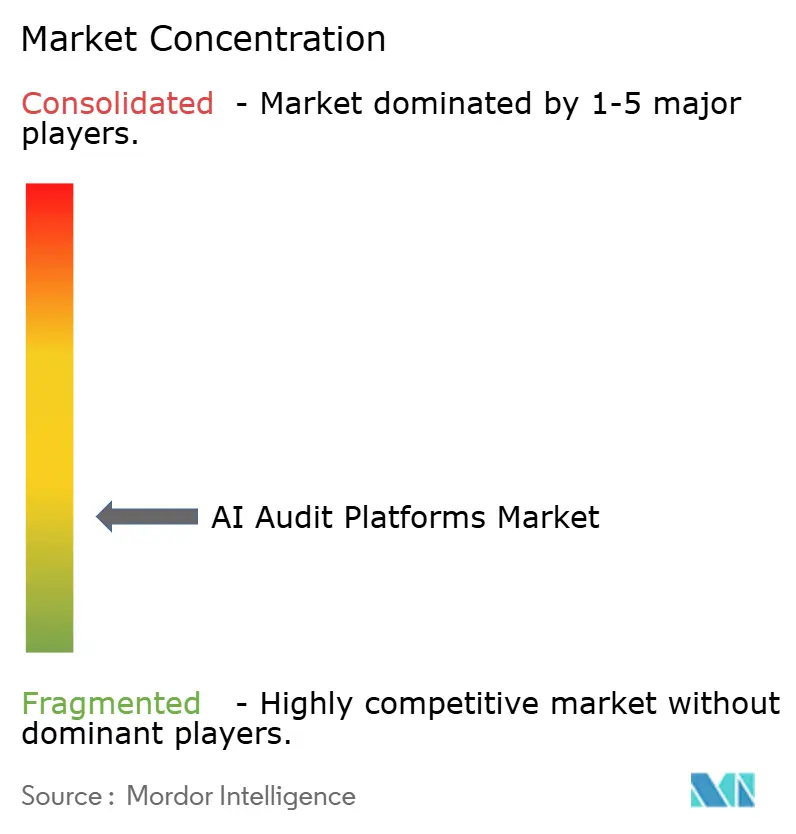
The AI Audit Platforms Market has a fragmented competitive structure. IBM and Microsoft are established platform providers with governance, security, and enterprise integration capabilities. IBM received Leader recognition for watsonx governance in the inaugural Gartner Magic Quadrant for AI Governance Platforms in June 2026. Microsoft made Agent 365 generally available in May 2026 as a control plane for enterprise AI agents. Both companies benefit from existing relationships across cloud, identity, data, and developer tools. Their scale makes integrated governance products attractive to organizations with established enterprise technology stacks.
Pure-play vendors compete through specialized functions such as policy mapping, agent inventory, observability, and runtime controls. Credo AI’s policy and inventory products address requirements for structured controls and visibility across AI assets. Microsoft open-sourced its Agent Governance Toolkit in April 2026, providing policy enforcement for the 10 OWASP agentic AI risk categories. This move may make basic enforcement mechanisms more widely available. Differentiation is therefore shifting toward regulatory content, evidence management, service delivery, and integrations. Vendors that package evidence for several regulatory frameworks can address a clear buyer need. The AI Audit Platforms Market also rewards products that work across cloud providers and different AI development environments.
Dynatrace signed a definitive agreement to acquire Arize AI for USD 915 million in August 2026. The transaction combines agent observability with systems-level tracing and logging. IBM published watsonx. Governance Enforcement Tracking for watsonx Orchestrate in August 2026, which records agent evaluation metrics as governance evidence. Microsoft’s Agent 365 launch introduced a unified control plane to observe, govern, and secure agents both inside and outside its ecosystem. These moves show that runtime evidence and observability are becoming important competitive capabilities. White space remains in cross-cloud audit interoperability, evidence packages that work across multiple regulations, and tools for non-English regulatory environments. The AI Audit Platforms Market continues to attract specialized and established providers as governance needs expand with AI deployment.
AI Audit Platforms Industry Leaders
-
International Business Machines Corporation
-
Microsoft Corporation
-
Alphabet Inc.
-
Amazon.com, Inc.
-
Oracle Corporation
- *Disclaimer: Major Players sorted in no particular order
AI Audit Platforms Market Companies Covered in this Report
- International Business Machines Corporation
- Microsoft Corporation
- Alphabet Inc.
- Amazon.com, Inc.
- Oracle Corporation
- Salesforce, Inc.
- SAP SE
- SAS Institute Inc.
- FICO
- Accenture plc
- Deloitte Touche Tohmatsu Limited
- PricewaterhouseCoopers International Limited
- Ernst & Young Global Limited
- KPMG International Cooperative
- Credo AI, Inc.
- Holistic AI, Inc.
- Fiddler Labs, Inc.
- ModelOp, Inc.
- Monitaur, Inc.
- FairNow, Inc.
- Saidot Oy
- DataRobot, Inc.
- Arize AI, Inc.
- Arthur AI, Inc.
- H2O.ai, Inc.
Recent Industry Developments in AI Audit Platforms Market
- August 2026: Dynatrace signed a definitive agreement to acquire Arize AI in a cash-and-stock transaction valued at USD 915 million, combining Arize's agent observability platform with Dynatrace's systems-level tracing and logging infrastructure, creating an integrated evaluation-to-audit capability from development through production.
- August 2026: IBM published watsonx.governance Enforcement Tracking for watsonx Orchestrate, automatically collecting agent evaluation metrics and recording them as enforcement evidence within the governance system, shifting governance from policy documentation to runtime proof.
- May 2026: Microsoft launched Agent 365 at general availability, providing enterprises with a unified control plane to observe, govern, and secure AI agents built within and outside the Microsoft ecosystem, with context mapping, policy-based controls, and runtime blocking capabilities.
- April 2026: IBM expanded watsonx.governance to FedRAMP Moderate Government Cloud for AWS, enabling US federal agencies and regulated entities with government data requirements to deploy enterprise AI governance tooling within a government-compliant cloud boundary.
Global AI Audit Platforms Market Report Scope
The AI audit platforms market refers to software platforms and associated services designed to systematically evaluate, monitor, and document the behavior of AI models. These solutions provide capabilities for compliance reporting, data lineage tracking, runtime decision logging, and bias or fairness auditing. Deployed across cloud, hybrid, or on-premises environments, they help organizations ensure their AI systems are transparent, accountable, and aligned with regulatory standards.
The AI Audit Platforms Market Report is Segmented by Component (Software Platforms and Professional and Managed Services), Audit Function (Compliance Evidence and Reporting, Model and Data Lineage, Runtime Decision Logging, Bias, Fairness, and Explainability Auditing, and Other Audit Functions), Deployment (Cloud-Based, Hybrid, and On-Premises), Organization Size (Large Enterprises and Small and Medium-Sized Enterprises), End-User Industry (Banking, Financial Services, and Insurance, Healthcare and Life Sciences, Information Technology and Telecommunications, Government and Public Sector, Retail and E-Commerce, Manufacturing and Automotive, and Other End-User Industries), and Geography (North America, South America, Europe, Asia-Pacific, Middle East, and Africa). The Market Forecasts are Provided in Terms of Value (USD).
Segmentation Overview
| Software Platforms |
| Professional and Managed Services |
| Compliance Evidence and Reporting |
| Model and Data Lineage |
| Runtime Decision Logging |
| Bias, Fairness, and Explainability Auditing |
| Other Audit Functions |
| Cloud-Based |
| Hybrid |
| On-Premises |
| Large Enterprises |
| Small and Medium-Sized Enterprises |
| Banking, Financial Services, and Insurance |
| Healthcare and Life Sciences |
| Information Technology and Telecommunications |
| Government and Public Sector |
| Retail and E-Commerce |
| Manufacturing and Automotive |
| Other End-User Industries |
| North America | United States |
| Canada | |
| Mexico | |
| South America | Brazil |
| Argentina | |
| Chile | |
| Rest of South America | |
| Europe | Germany |
| United Kingdom | |
| France | |
| Italy | |
| Spain | |
| Rest of Europe | |
| Asia-Pacific | China |
| Japan | |
| India | |
| South Korea | |
| Australia | |
| Rest of Asia-Pacific | |
| Middle East | United Arab Emirates |
| Saudi Arabia | |
| Qatar | |
| Rest of Middle East | |
| Africa | South Africa |
| Egypt | |
| Nigeria | |
| Rest of Africa |
| By Component | Software Platforms | |
| Professional and Managed Services | ||
| By Audit Function | Compliance Evidence and Reporting | |
| Model and Data Lineage | ||
| Runtime Decision Logging | ||
| Bias, Fairness, and Explainability Auditing | ||
| Other Audit Functions | ||
| By Deployment | Cloud-Based | |
| Hybrid | ||
| On-Premises | ||
| By Organization Size | Large Enterprises | |
| Small and Medium-Sized Enterprises | ||
| By End-User Industry | Banking, Financial Services, and Insurance | |
| Healthcare and Life Sciences | ||
| Information Technology and Telecommunications | ||
| Government and Public Sector | ||
| Retail and E-Commerce | ||
| Manufacturing and Automotive | ||
| Other End-User Industries | ||
| By Geography | North America | United States |
| Canada | ||
| Mexico | ||
| South America | Brazil | |
| Argentina | ||
| Chile | ||
| Rest of South America | ||
| Europe | Germany | |
| United Kingdom | ||
| France | ||
| Italy | ||
| Spain | ||
| Rest of Europe | ||
| Asia-Pacific | China | |
| Japan | ||
| India | ||
| South Korea | ||
| Australia | ||
| Rest of Asia-Pacific | ||
| Middle East | United Arab Emirates | |
| Saudi Arabia | ||
| Qatar | ||
| Rest of Middle East | ||
| Africa | South Africa | |
| Egypt | ||
| Nigeria | ||
| Rest of Africa | ||
Key Questions Answered in the Report
What is the size of the AI Audit Platforms Market?
The AI Audit Platforms Market is valued at USD 3.91 billion in 2026 and is forecast to reach USD 8.16 billion by 2031, growing at 15.85% CAGR.
What is driving demand for AI audit platforms?
Enforcement of the EU AI Act, revised United States bank model risk guidance, and wider deployment of agentic AI are increasing demand for continuous governance evidence.
Which component has the largest revenue share?
Software platforms held 64.23% of revenue in 2025 because buyers need policy-based tools that connect to production AI workflows.
Which deployment model is growing fastest?
Hybrid deployment is forecast to grow at 16.94% CAGR through 2031 as organizations address data-residency and sensitive telemetry requirements.
Which end-user sector leads adoption?
BFSI held 29.16% of revenue in 2025, supported by established model risk practices and stronger requirements for AI controls.
Which region is expanding most quickly?
Asia-Pacific is forecast to grow at 16.91% CAGR through 2031 as new AI legislation and governance frameworks are adopted across the region.