
Agricultural Transplanters Market Size and Share
Market Overview
| Study Period | 2022 - 2032 |
|---|---|
| Market Size (2027) | USD 3.43 Billion |
| Market Size (2032) | USD 4.45 Billion |
| Growth Rate (2027 - 2032) | 5.34 % |
| Fastest Growing Market | Asia-Pacific |
| Largest Market | Asia-Pacific |
| Market Concentration | Medium |
Major Players *Disclaimer: Major Players sorted in no particular order Image © Mordor Intelligence. Reuse requires attribution under CC BY 4.0. | |
Agricultural Transplanters Market Analysis by Mordor Intelligence
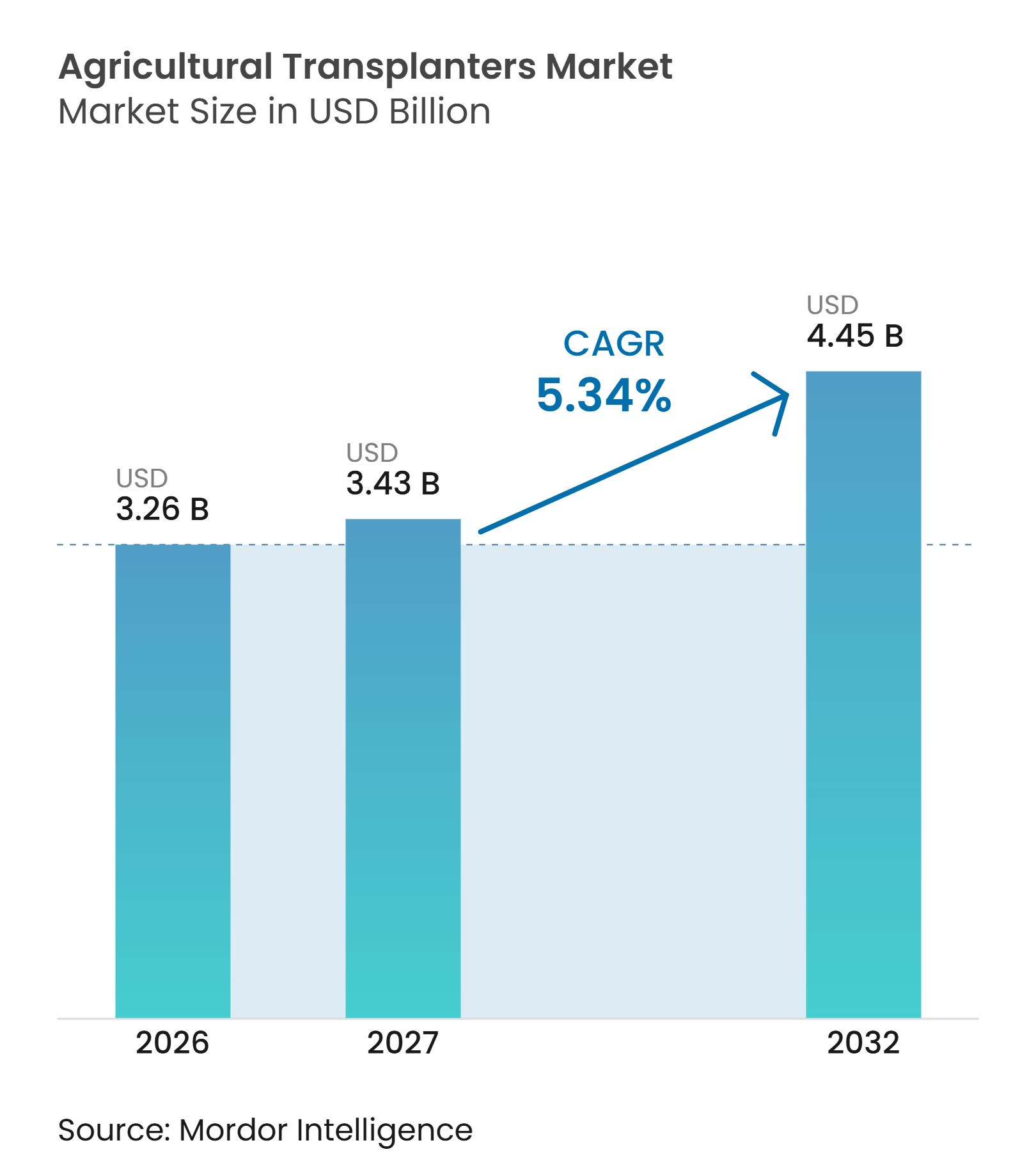
The agricultural transplanters market size was valued at USD 3.26 billion in 2026 and is forecast to grow from USD 3.43 billion in 2027 to USD 4.45 billion by 2032, at a CAGR of 5.34% from 2027 to 2032. Market growth is supported by labor shortages during seasonal planting periods, particularly in rice and vegetable cultivation. More than 25% of agricultural workers across OECD member countries are over 55 years old, with the proportion exceeding 70% in Korea and Japan[1]. These demographic trends increase the need for mechanized planting solutions. Mechanical transplanting reduces field labor needs by 30% to 94% compared with manual methods, providing a clear incentive to invest where labor costs and scheduling risks are high[2]. Demand is also shifting toward machines that offer consistent plant spacing, controlled planting depth, and compatibility with standardized plug trays. High equipment prices, fragmented farms, field delays, input-cost pressure, and limited rural service coverage continue to slow wider adoption in the agricultural transplanters market.
Key Report Takeaways
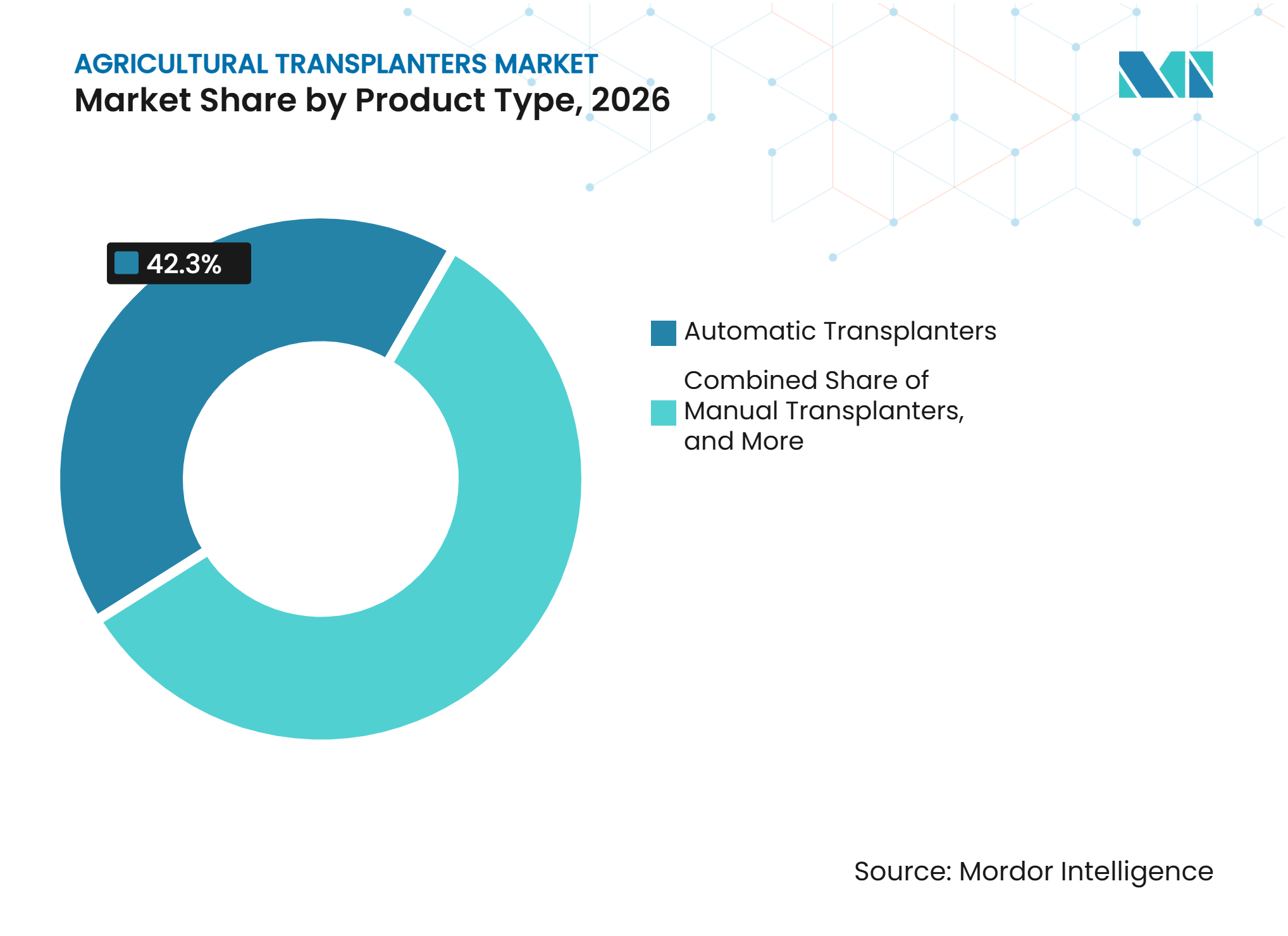
- By product type, automatic transplanters accounted for 42.3% of the agricultural transplanters market share in 2026 and are forecast to grow at a CAGR of 7.4% from 2027 to 2032.
- By crop type, rice accounted for 38.6% of the agricultural transplanters market share in 2026, while vegetables are forecast to grow at a CAGR of 8.2% from 2027 to 2032.
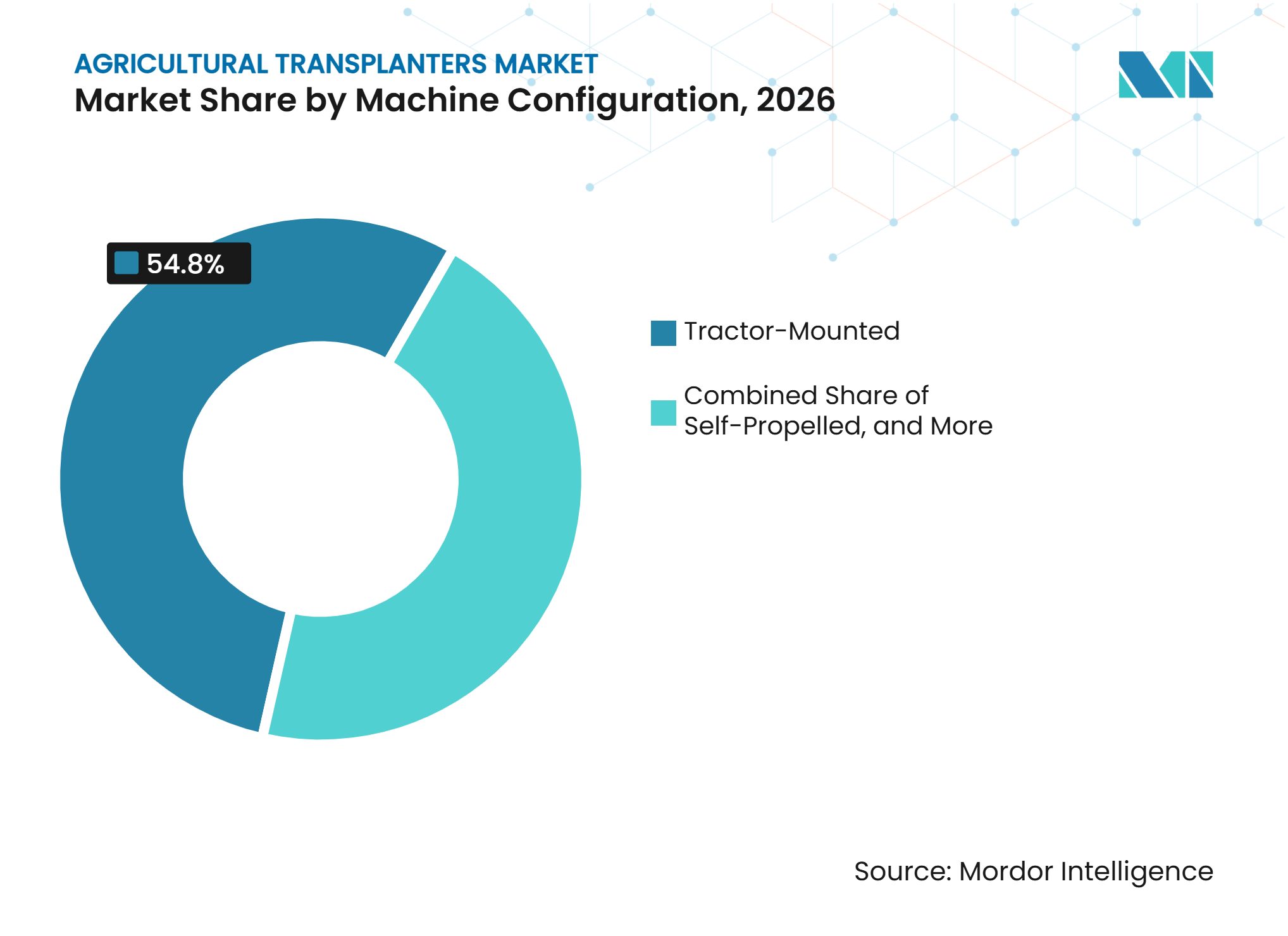
- By machine configuration, tractor-mounted transplanters accounted for 54.8% of the agricultural transplanters market share in 2026, while self-propelled transplanters are forecast to grow at a CAGR of 7.8% from 2027 to 2032.
- By geography, Asia-Pacific accounted for 44.7% of the agricultural transplanters market share in 2026 and is forecast to grow at a CAGR of 8.1% from 2027 to 2032.
Note: Market numbers in this report are based on Mordor Intelligence's proprietary estimation framework, which combines nine months of actuals with Q4 projections for base year 2026.
Market Trends and Insights
Labor Shortages and Rising Agricultural Labor Costs
Labor shortages and rising labor costs are driving the adoption of agricultural transplanters, as transplanting remains a labor-intensive activity in rice and vegetable cultivation. Research published by the OECD (Organisation for Economic Co-operation and Development) in 2025 highlighted ongoing challenges in attracting and retaining agricultural workers, as well as a continued reliance on seasonal and temporary labor. These constraints can increase labor costs and create uncertainty during peak planting periods. A 2026 review published in the ASEAN Journal on Science and Technology for Development reported that mechanical rice transplanting can reduce labor requirements by 30% to 94% compared with manual transplanting. Agricultural contractors can further improve equipment utilization by deploying transplanters across multiple farms, strengthening the economic case for ride-on and self-propelled machinery. These benefits are particularly relevant in regions where labor shortages and planting delays can expose farmers to unfavorable weather conditions and higher labor expenses.
Growing Mechanization of Rice and Vegetable Cultivation
The growing mechanization of rice and vegetable cultivation is supporting demand for agricultural transplanters by enabling timely planting and more consistent crop establishment across larger cultivated areas. Rice cultivation is a key application, as transplanting must often be completed within narrow seasonal windows, particularly in monsoon-dependent regions. Government-supported machinery hiring centers in countries such as India and Vietnam can improve farmers' access to mechanical rice transplanters without requiring individual farmers to own equipment. In commercial vegetable production, mechanized transplanting helps maintain consistent plant spacing and alignment, supporting subsequent crop management and harvesting operations. Demand also benefits when transplanters can be deployed across multiple planting cycles and farms, improving equipment utilization and the economics of mechanized cultivation.
Government Subsidies Supporting Agricultural Transplanter Adoption
Government subsidies are supporting the adoption of agricultural transplanters by reducing initial purchase costs and encouraging farmers to replace older equipment. In February 2025, China expanded its agricultural machinery trade-in subsidy program to include rice transplanters[3]. Henan Province also increased the subsidy standard for replacing rice transplanters with new machines within the same category during 2025. In India, government support schemes provide financial assistance for paddy transplanter purchases, with eligibility and subsidy rates varying by scheme and beneficiary category. These incentives can improve affordability and encourage farmers to invest in newer machinery, including models with greater capacity and higher levels of automation. By reducing the net cost of equipment acquisition, subsidy programs can stimulate new purchases and accelerate replacement cycles among farmers who might otherwise continue using older machines.
Growing Adoption of Precision Transplanting Technologies
The adoption of precision guidance and automated transplanting technologies is improving planting accuracy and operational consistency in agricultural transplanters. A 2025 study published in the Sustainable Futures journal reported planting accuracy above 90% for automated transplanters using sensors, GPS, and computer vision, compared with 70% to 80% for conventional mechanical machines. Improved seedling placement can support uniform crop establishment, reduce input waste, and improve consistency in crop development. GPS-based guidance can also reduce dependence on operator skill by helping maintain consistent planting paths and spacing. In addition, connected systems enable fleet operators to monitor planting settings and equipment performance, supporting more consistent operations across multiple fields. These capabilities can increase the appeal of advanced transplanters among commercial growers and agricultural contractors seeking greater precision and operational efficiency.
Restraints Impact Analysis of Agricultural Transplanters Market*
| Restraint | (~) % Impact on CAGR Forecast | Geographic Relevance | Impact Timeline |
|---|---|---|---|
| High Equipment Costs and Financing Constraints | -1.2% | Global, especially India, Indonesia, Nigeria, Kenya, Brazil | Medium term (2-4 years) |
| Fragmented Agricultural Landholdings and Field Accessibility Constraints | -0.9% | China, India, Vietnam, Indonesia, and the Philippines | Long term (≥ 4 years) |
| Shortage of Skilled Operators and Service Technicians | -0.7% | Asia-Pacific, Africa, and Brazil | Medium term (2-4 years) |
| Seedling Tray and Nursery Compatibility Constraints | -0.5% | Global, especially the United States, Italy, China, India, Kenya, and Mexico | Long term (≥ 4 years) |
| Source: Mordor Intelligence | |||
High Equipment Costs and Financing Constraints
High equipment costs and limited access to financing can constrain the adoption of agricultural transplanters, particularly among smallholder farmers in developing markets. A 2025 study published in Discover Agriculture found that mechanical transplanting in Nepal reduced production costs from USD 719 per hectare under manual methods to USD 577 per hectare, while paddy yields increased from 7.91 to 8.26 metric tons per hectare. Despite these potential economic benefits, the initial investment required to purchase a transplanter can remain prohibitive for farmers with limited capital. Access to credit may also be restricted by collateral requirements and repayment schedules that do not align with agricultural income cycles. Equipment-as-a-service and custom-hiring models can help address these constraints by allowing farmers to pay for transplanting services without purchasing machinery outright. However, the availability and affordability of these services vary across markets, limiting their ability to overcome equipment-access barriers.
Fragmented Agricultural Landholdings and Field Accessibility Constraints
Fragmented landholdings and irregular field layouts can constrain the adoption of agricultural transplanters, particularly in regions dominated by smallholder farming. In countries such as China, India, Vietnam, Indonesia, and the Philippines, small plots can limit the suitability of larger transplanting equipment. A 2025 article published in ORYZA – An International Journal of Rice highlighted the need for machinery capable of operating under different field conditions in India, including narrow fields. Terraced fields and uneven access paths can further restrict the maneuverability of large tractor-mounted and ride-on transplanters, increasing the need for compact and smaller-capacity models. Manufacturers must therefore accommodate diverse field conditions through a wider range of equipment designs, potentially increasing product development and manufacturing complexity.
*Our forecasts treat driver/restraint impacts as directional, not additive. The impact forecasts reflect baseline growth, mix effects, and variable interactions.
Agricultural Transplanters Market Segment Analysis
By Product Type:
Automatic Transplanters Lead and Grow FastestAutomatic transplanters accounted for 42.3% of the agricultural transplanters market share in 2026 and are forecast to grow at a 7.4% CAGR from 2027 to 2032. Commercial rice and vegetable growers are choosing these machines because they reduce operator involvement in decisions about row spacing and depth. Lower sensor costs and broader GPS availability support this shift. Organized buyers and processors also favor consistent seedling placement for its benefits in downstream handling. Checchi and Magli S.r.l. introduced ISOBUS connectivity on its DYNAMIC transplanter at Agritechnica 2025, allowing machine settings and planting information to be managed from the tractor cab display.
Semi-automatic machines continue to serve farms that need greater output but still rely on manual seedling presentation. These units provide a middle option between manual transplanting and fully automatic operation. Manual transplanters remain relevant in small, irregular, or hard-to-access plots where powered equipment cannot operate effectively. Chinese and Indian subsidy programs favor intelligent high-speed transplanters, improving the net purchase position of automatic models. This supports a gradual shift from manual to automatic configurations across the agricultural transplanters market.



By Crop Type:
Rice Leads, While Vegetables Grow FastestRice accounted for 38.6% of the agricultural transplanters market share in 2026, supported by established mechanization in Japan, South Korea, and China. Programs in India and Vietnam are also encouraging machine adoption through hiring centers and public support. Vegetables are forecast to grow at a CAGR of 8.2% from 2027 to 2032, driven by commercial horticulture, protected cultivation, and year-round supply requirements. Retail requirements for consistent product size and quality further increase the importance of uniform transplanting.
Fruit-crop planting is gaining relevance in strawberry and berry production, where specialized nurseries supply plug-tray seedlings that can be handled efficiently by modern transplanting machines. Flower and tobacco applications remain smaller but are concentrated in specific producing regions. Tobacco mechanization is established in Italy, Spain, and southern Brazil, while premium flower production is prominent in the Netherlands, the UAE, and Kenya's export-floriculture sector. Forestry seedlings and medicinal plants represent smaller opportunities for modular machines to handle varied root-ball shapes.
By Machine Configuration:
Tractor-Mounted Units Lead and Self-Propelled Units ExpandTractor-mounted accounted for 54.8% of the agricultural transplanters market size in 2026. These units hold a leading position because they offer a lower incremental investment for farms that already own a tractor. A three-point hitch-mounted machine allows growers to add transplanting capacity without purchasing a separate power unit. This configuration is common on large paddy farms in China, India, and Thailand, and can simplify equipment logistics during the planting cycle.
Self-propelled is forecast to grow at a CAGR of 7.8% from 2027 to 2032. These machines integrate the propulsion system with the planting mechanism, reducing reliance on a separate tractor and supporting efficient operations on farms that require dedicated transplanting equipment. Ride-on machines hold the second-largest configuration position, particularly in Japan and South Korea, where Yanmar Holdings Co., Ltd. and ISEKI & CO., LTD. have introduced models that combine GPS guidance with dense-seedling planting. Walk-behind machines remain necessary in hilly areas of China, Vietnam, the Philippines, and Nepal, where larger units cannot operate. Their revenue contribution may decline as land consolidation increases and lower-priced ride-on units become more widely available. The agricultural transplanters market will continue to require both large plain-field machines and compact units for fragmented terrain.

Geography Analysis
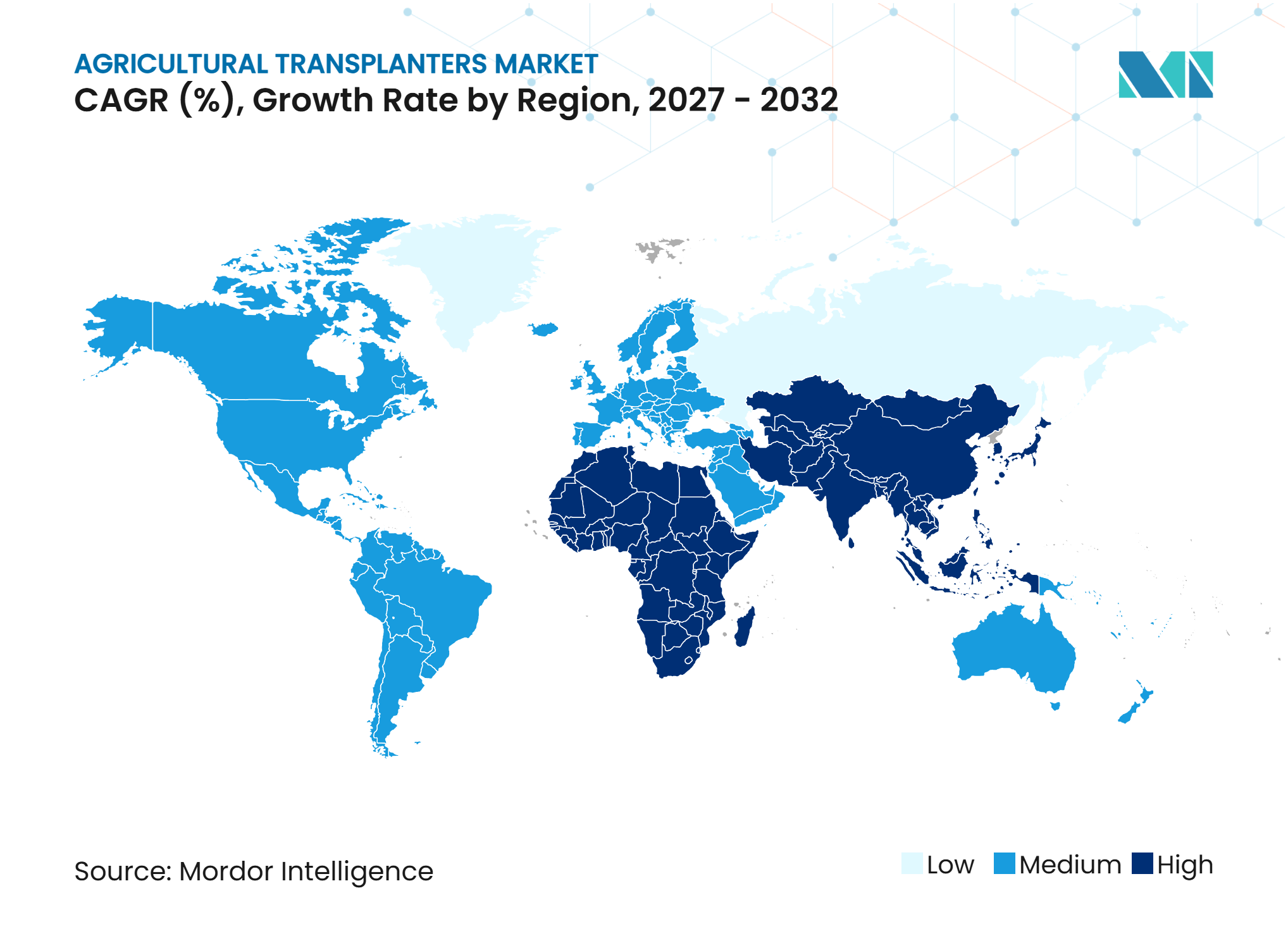
Asia-Pacific accounted for 44.7% of the agricultural transplanters market size in 2026 and is forecast to grow at a CAGR of 8.1% from 2027 to 2032. China prioritizes intelligent high-speed rice transplanters within its agricultural machinery subsidy framework and expanded its replacement subsidy in 2025. India has lower paddy-transplanting mechanization outside irrigated plains, leaving room for wider adoption when financing becomes more accessible. Japan and South Korea support premium revenue through precision upgrades, although demand for first-time machines is more limited.
North America is supported by seasonal labor costs and expanding horticulture operations in California, Florida, and Ontario. Contractors use automated vegetable transplanters for tomatoes, peppers, and leafy crops. Europe has established activity among vegetable and tobacco producers in Italy, Spain, and France. Plug-tray workflows are also well established among greenhouse growers in the Netherlands and Belgium.
South America benefits from the mechanization of vegetables and tobacco in Brazil and Argentina. State-level credit programs in Brazil help mid-sized growers consider semi-automatic and automatic equipment as labor costs rise in Sao Paulo and Minas Gerais. Chile adds a smaller demand base through exports of tomatoes and peppers. Africa's growth is driven by its low level of mechanization and the expansion of irrigated horticulture. Demand in South Africa, Kenya, Egypt, Nigeria, Saudi Arabia, and the UAE includes greenhouse vegetables and field crops, while Kubota's African financing alliance signals a longer-term focus on regional access to machinery.
Competitive Landscape
Market Concentration

The agricultural transplanters market was moderately concentrated in 2026. Kubota Corporation, Yanmar Holdings Co., Ltd., ISEKI & CO., LTD., Mahindra & Mahindra Limited, and Checchi & Magli S.r.l. form the leading group. Japanese suppliers hold a strong position in rice transplanting due to long histories of product development and extensive dealer coverage, while Italian specialists, including Ferrari Growtech S.p.A. and Hortech S.r.l., focus on automated vegetable equipment. Chinese producers compete on price in domestic rice markets and are extending bundled-finance offerings into Southeast Asia.
Manufacturers serving terraced and fragmented farms can address an opening for lower-cost modular machines. Contractors in India and Sub-Saharan Africa present an opening for equipment-as-a-service models. Retrofit guidance kits could improve existing semi-automatic equipment without requiring complete replacement. European and Japanese companies also use machine vision and ISOBUS patents to create barriers for new entrants. ISEKI & CO., LTD. identifies patent filings as a structured part of its competitive approach in its 2025 strategy report.
Recent product developments indicate the direction of competition in the agricultural transplanters market. Checchi & Magli S.r.l. launched the DYNAMIC modular automated transplanter with a robotic picking system and ISOBUS connectivity at Agritechnica 2025. Kubota Corporation formed a 3-year financing alliance with Sumitomo Mitsui Banking Corporation in August 2025 to support agricultural machinery sales in Africa. PlantTape commercially launched its Automated Tomato Transplanter in 2025, combining planting, deep placement, and water injection in one field pass. Robotic and semi-autonomous machines remain under development, but broad commercial use at mass-market price points is still several years away.
Agricultural Transplanters Industry Leaders
-
Kubota Corporation
-
Yanmar Holdings Co., Ltd.
-
ISEKI & CO., LTD.
-
Mahindra & Mahindra Limited
-
Checchi & Magli S.r.l.
- *Disclaimer: Major Players sorted in no particular order
Agricultural Transplanters Market Companies Covered in this Report
- Kubota Corporation
- Yanmar Holdings Co., Ltd.
- ISEKI & CO., LTD.
- Mahindra & Mahindra Limited
- Checchi & Magli S.r.l.
- Ferrari Growtech S.p.A. (formerly Ferrari Costruzioni Meccaniche)
- Holland Transplanter Company
- Mechanical Transplanter Company
- PlantTape, Inc.
- Hortech S.r.l.
- Nantong Shengli Agricultural Equipment Co., Ltd.
- National Agro Industries
- Farm Rover (Agriterra OPC Private Limited)
- TechAgro
- KisanKraft Limited
Recent Industry Developments in Agricultural Transplanters Market
- February 2026: Ferrari Growtech S.p.A. (formerly Ferrari Costruzioni Meccaniche) expanded the Australian availability of its FUTURA automatic transplanter through a distribution partnership with Vin Rowe Farm Machinery in Victoria. The machine is designed for vegetable transplanting and can handle up to 8,000 plants per hour per row, with compatibility across different tray sizes and materials.
- November 2025: Checchi & Magli S.r.l. unveiled the DYNAMIC modular automated transplanter at Agritechnica 2025 in Hanover. The machine features an integrated seedling storage unit, an electro-pneumatic picking system, ISOBUS connectivity, and a robotic system capable of handling up to 14,400 plants per hour per row, reaching 86,400 plants per hour in the six-row configuration.
- November 2025: Escorts Kubota Limited introduced its third-generation Kubota-brand ride-on rice transplanters, the KA6 and KA8, across seven Indian states: Tamil Nadu, Punjab, Odisha, Madhya Pradesh, Andhra Pradesh, Kerala, and Telangana. Engineered in Japan, the models feature fuel-efficient 21 HP and 24 HP engines, a smart turning system, an automatic lift function, and redesigned planting claws to reduce missed planting.
Global Agricultural Transplanters Market Report Scope
Agricultural transplanters are agricultural machines designed to transfer seedlings from nursery trays or seedbeds into prepared soil, helping establish crops efficiently while reducing manual labor requirements.
The Agricultural Transplanters Market Report is Segmented by Product Type (Manual Transplanters, Semi-Automatic Transplanters, and Automatic Transplanters), by Crop Type (Rice, Vegetables, Fruits, Flowers, Tobacco, and Other Crops), by Machine Configuration (Walk-Behind, Ride-On, Tractor-Mounted, and Self-Propelled), and by Geography (North America, South America, Europe, Asia-Pacific, Middle East, and Africa). The Market Forecasts are Provided in Terms of Value (USD).
Segmentation Overview
| Manual Transplanters |
| Semi-Automatic Transplanters |
| Automatic Transplanters |
| Rice |
| Vegetables |
| Fruits |
| Flowers |
| Tobacco |
| Other Crops |
| Walk-Behind |
| Ride-On |
| Tractor-Mounted |
| Self-Propelled |
| North America | United States |
| Canada | |
| Mexico | |
| Rest of North America | |
| South America | Brazil |
| Argentina | |
| Chile | |
| Rest of South America | |
| Europe | Germany |
| France | |
| Italy | |
| Spain | |
| United Kingdom | |
| Russia | |
| Rest of Europe | |
| Asia-Pacific | China |
| India | |
| Japan | |
| South Korea | |
| Vietnam | |
| Thailand | |
| Indonesia | |
| Australia | |
| Rest of Asia-Pacific | |
| Middle East | Turkey |
| Saudi Arabia | |
| United Arab Emirates | |
| Rest of Middle East | |
| Africa | South Africa |
| Egypt | |
| Nigeria | |
| Kenya | |
| Rest of Africa |
| By Product Type | Manual Transplanters | |
| Semi-Automatic Transplanters | ||
| Automatic Transplanters | ||
| By Crop Type | Rice | |
| Vegetables | ||
| Fruits | ||
| Flowers | ||
| Tobacco | ||
| Other Crops | ||
| By Machine Configuration | Walk-Behind | |
| Ride-On | ||
| Tractor-Mounted | ||
| Self-Propelled | ||
| By Geography | North America | United States |
| Canada | ||
| Mexico | ||
| Rest of North America | ||
| South America | Brazil | |
| Argentina | ||
| Chile | ||
| Rest of South America | ||
| Europe | Germany | |
| France | ||
| Italy | ||
| Spain | ||
| United Kingdom | ||
| Russia | ||
| Rest of Europe | ||
| Asia-Pacific | China | |
| India | ||
| Japan | ||
| South Korea | ||
| Vietnam | ||
| Thailand | ||
| Indonesia | ||
| Australia | ||
| Rest of Asia-Pacific | ||
| Middle East | Turkey | |
| Saudi Arabia | ||
| United Arab Emirates | ||
| Rest of Middle East | ||
| Africa | South Africa | |
| Egypt | ||
| Nigeria | ||
| Kenya | ||
| Rest of Africa | ||
Key Questions Answered in the Report
What is the forecasted value of the agricultural transplanters market?
The agricultural transplanters market is forecast to grow from USD 3.43 billion in 2027 to USD 4.45 billion by 2032, at a CAGR of 5.34% from 2027 to 2032.
Which product type leads the agricultural transplanters market?
Automatic transplanters accounted for 42.3% of the market share in 2026 and are forecast to grow at a CAGR of 7.4% from 2027 to 2032.
Why are growers adopting automated transplanting equipment?
Automated transplanters can reduce manual labor requirements and improve planting consistency through more controlled seedling spacing and planting depth.
Which crop type is forecast to grow fastest?
Vegetable crop type is forecast to grow at a CAGR of 8.2% from 2027 to 2032, supported by commercial horticulture and protected cultivation.
Which machine configuration holds the largest market share?
Tractor-mounted transplanters accounted for 54.8% of the market share in 2026, supported by their compatibility with tractors that farms already own.