
Agentic Workflow Audit Services Market Size and Share
Market Overview
| Study Period | 2020 - 2031 |
|---|---|
| Market Size (2026) | USD 0.61 Billion |
| Market Size (2031) | USD 3.72 Billion |
| Growth Rate (2026 - 2031) | 43.56 % |
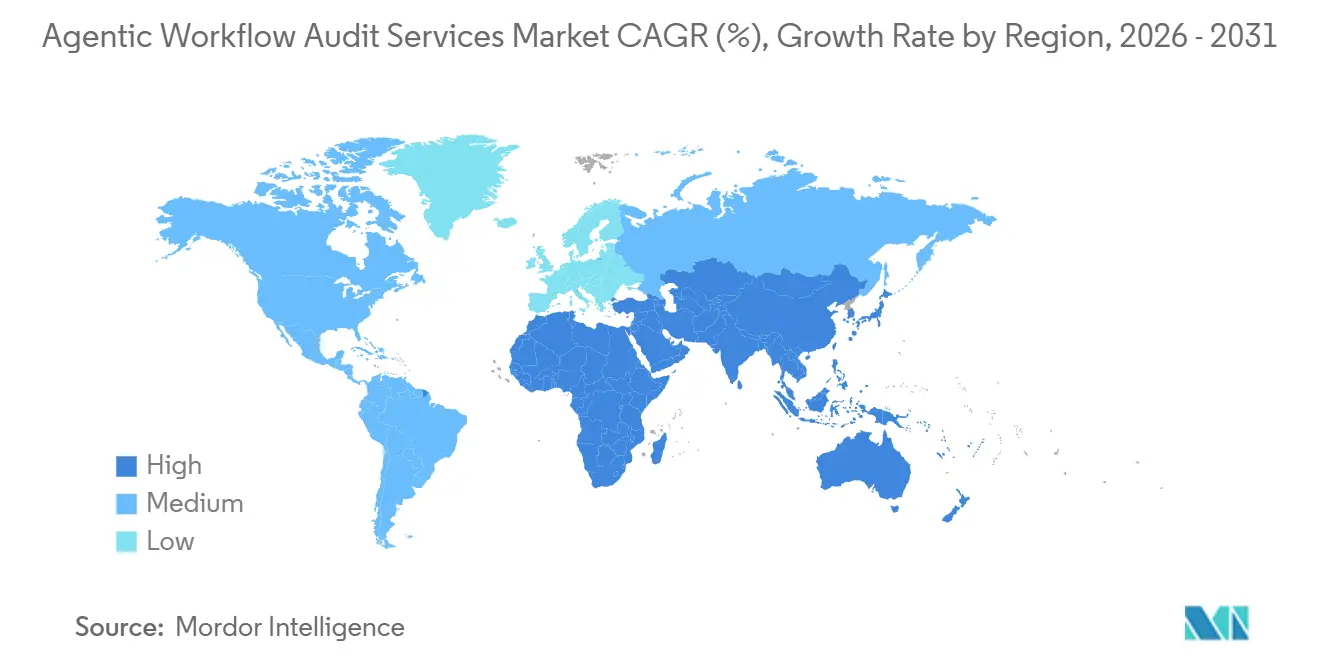
| Fastest Growing Market | North America |
| Largest Market | Asia-Pacific |
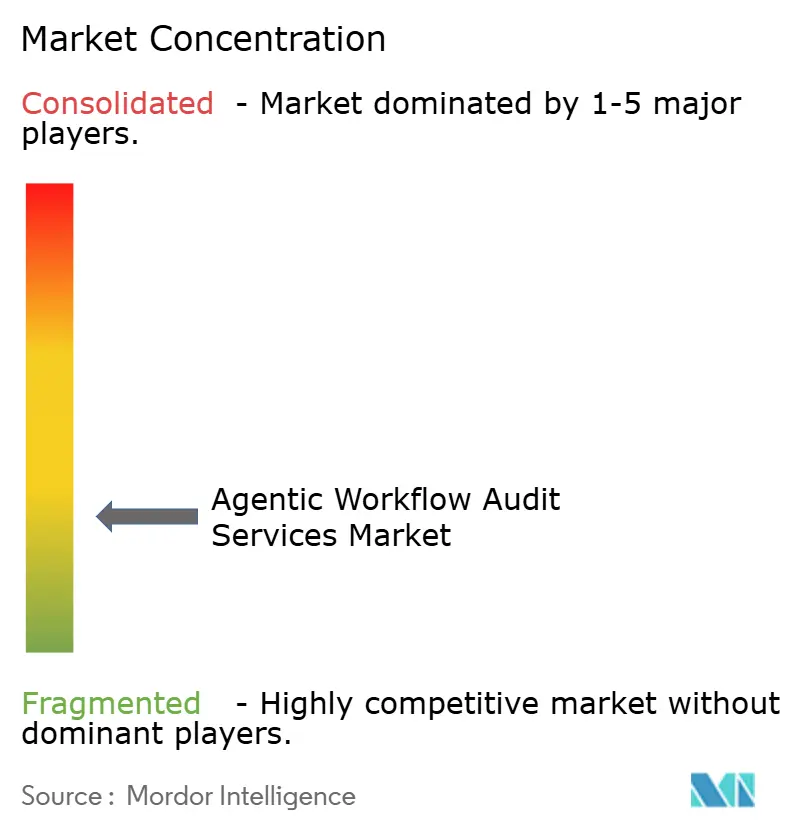
| Market Concentration | Low |
Major Players *Disclaimer: Major Players sorted in no particular order Image © Mordor Intelligence. Reuse requires attribution under CC BY 4.0. | |
Agentic Workflow Audit Services Market Analysis by Mordor Intelligence
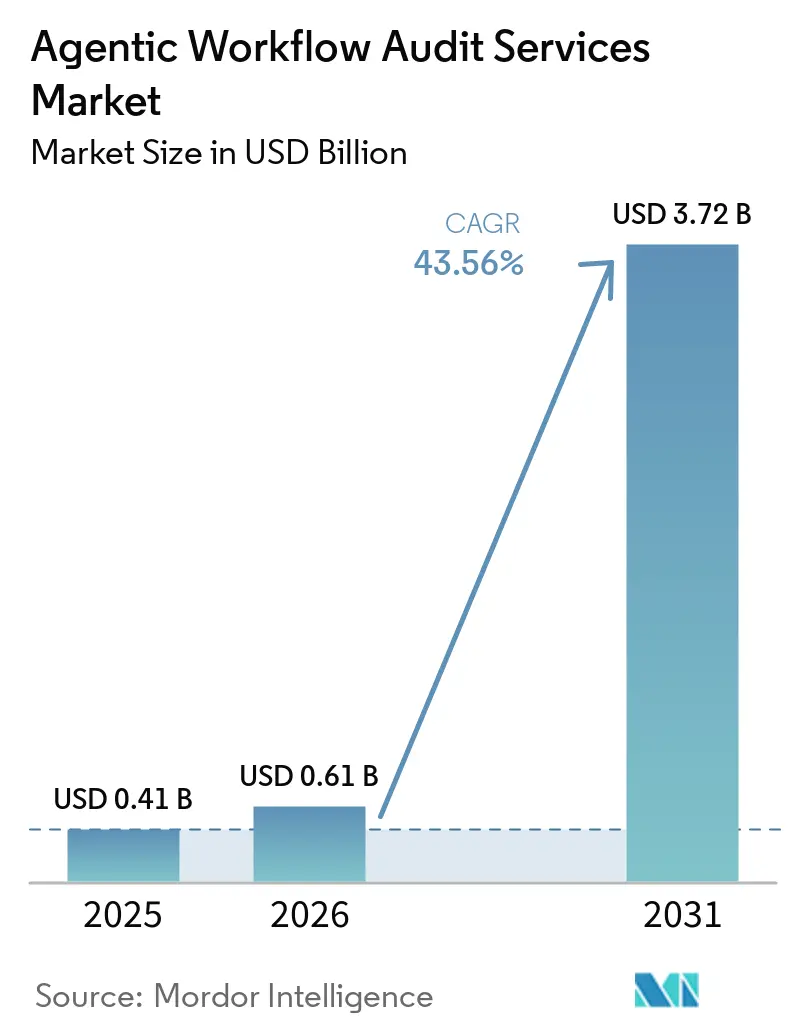
The Agentic Workflow Audit Services Market size is expected to grow from USD 0.41 billion in 2025 to USD 0.61 billion in 2026, and is forecast to reach USD 3.72 billion by 2031, at a 43.6% CAGR over 2026-2031. Growth depends on organizations producing reliable records of agent actions, tool use, intermediate decisions, and memory changes. The EU AI Act makes record-keeping a central requirement for high-risk AI systems, shifting audit work beyond standard application logging. This requirement favors services that can test identity continuity, behavioral reproducibility, and decision transparency across an agent’s operating life. The Agentic Workflow Audit Services Market is also moving toward continuous monitoring because model updates, tool changes, and evolving context can alter an agent’s behavior after release. Providers are therefore combining assessment, evidence capture, and compliance attestation in longer-running engagements.
Key Report Takeaways
- By service type, Pre-Deployment Agent Audit held 32.58% of the Agentic Workflow Audit Services Market share in 2025, while Runtime Assurance Monitoring is projected to grow at a 44.93% CAGR through 2031.
- By enterprise size, large enterprises held 73.29% of the Agentic Workflow Audit Services Market share in 2025, while SMEs are forecast to expand at a 45.05% CAGR through 2031.
- By end user, BFSI accounted for 27.88% of the Agentic Workflow Audit Services Market size in 2025, while Healthcare and Life Sciences are expected to grow at a 44.83% CAGR through 2031.
- By agent architecture, Multi-Agent Workflows held 54.73% of the Agentic Workflow Audit Services Market share in 2025 and are forecast to grow at a 44.76% CAGR through 2031.
- By geography, North America held 39.49% of the Agentic Workflow Audit Services Market share in 2025, while Asia-Pacific is forecast to grow at a 44.89% CAGR through 2031.
Note: Market size and forecast figures in this report are generated using Mordor Intelligence’s proprietary estimation framework, updated with the latest available data and insights as of January 2026.
Market Trends and Insights
Drivers Impact Analysis of Agentic Workflow Audit Services Market*
| Driver | (~) % Impact on CAGR Forecast | Geographic Relevance | Impact Timeline |
|---|---|---|---|
| Rising Regulatory Demand for Agentic AI Evidence | +5.5% | Global, highest intensity in EU, North America, and Singapore | Short term (≤ 2 years) |
| Growth of Autonomous AI Agents in High-Impact Workflows | +4.8% | Global, early concentration in North America and Europe | Medium term (2-4 years) |
| Expansion of Continuous Runtime Assurance Requirements | +4.2% | Global, with spillover from Asia-Pacific into the Middle East | Medium term (2-4 years) |
| Increasing Enterprise Demand for Independent AI Assurance | +3.8% | North America and EU, with emerging demand in Asia-Pacific | Medium term (2-4 years) |
| Agent Identity and Permission Drift Across Multi-Agent Estates | +3.1% | Global, highest in North American large-enterprise deployments | Long term (≥ 4 years) |
| Auditability Requirements for Agent Memory and Context Mutation | +2.5% | Global, led by healthcare and financial services | Long term (≥ 4 years) |
| Source: Mordor Intelligence | |||
Rising Regulatory Demand for Agentic AI Evidence
The Agentic Workflow Audit Services Market is supported by rules that require operators of high-risk systems to maintain usable records. Article 12 of the EU AI Act requires automatic logging over the system’s lifetime and identifies events relevant to risk management and post-market monitoring.[1] The regulation also requires providers to retain technical documentation for 10 years and, in specified cases, keep logs under their control for at least 6 months. Germany’s Bundesnetzagentur took on a role in AI Act implementation in July 2026, adding an enforcement channel for firms operating in that market. These developments make structured evidence a procurement issue before formal deadlines arrive. The Agentic Workflow Audit Services Market benefits when organizations need records that connect an action to the responsible agent, its permissions, and the controls applied at the time.
Growth of Autonomous AI Agents in High-Impact Workflows
The Agentic Workflow Audit Services Market is expanding as autonomous agents enter credit decisions, clinical documentation, code generation, and claims processing. These uses create more consequential actions than simple chat interfaces and require stronger evidence of how tasks were completed. Standard monitoring tools can record inputs and outputs, but they may not explain work delegated across several agents. NIST identified agent hijacking as an ongoing challenge in evaluation, underscoring why agent identity and instruction integrity require close testing.[2] Organizations can reduce later compliance work by collecting immutable records and testing controls from the first deployment. This approach brings audit specialists into the development process rather than using them only after an incident.
Expansion of Continuous Runtime Assurance Requirements
The Agentic Workflow Audit Services Market is increasingly shaped by monitoring that continues after an agent is approved for use. Changes to models, connected tools, and operating context can make a previous assessment incomplete within a short period. The Financial Stability Board’s 2026 consultation treats post-deployment monitoring and human oversight as separate governance practices for financial institutions.[3] This creates demand for services that detect drift, capture exceptions, and document reviews during normal operations. IBM introduced enforcement tracking for watsonx Orchestrate agents in August 2026 to collect production evaluation metrics as governance evidence. The service model shifts toward recurring monitoring and evidence management instead of a single review before deployment.
Increasing Enterprise Demand for Independent AI Assurance
The Agentic Workflow Audit Services Market gains support when buyers seek evidence from parties outside the team that built the system. Board risk committees and procurement teams increasingly expect vendors to demonstrate that governance controls have been tested rather than simply described. Salesforce received ISO 42001 certification for Agentforce, the Einstein AI Platform, and Slack AI, providing a visible example of third-party management-system certification for enterprise AI offerings. An independent review can help buyers compare governance practices across software providers and internal projects. It also gives suppliers a way to demonstrate readiness in regulated accounts. This demand supports offerings that map evidence to established management, security, and sector-specific control frameworks.
Restraints Impact Analysis of Agentic Workflow Audit Services Market*
| Restraint | (~) % Impact on CAGR Forecast | Geographic Relevance | Impact Timeline |
|---|---|---|---|
| Lack of Consistent Agent Audit Criteria | -3.9% | Global, most acute where national AI Act equivalents are absent | Short term (≤ 2 years) |
| High Cost of Evidence Collection Across Distributed Agent Stacks | -3.4% | Global, with greater impact on SMEs and developing-market enterprises | Medium term (2-4 years) |
| Difficulty Reproducing Non-Deterministic Agent Decisions | -2.8% | Global, highest in multi-agent LLM-backend deployments | Long term (≥ 4 years) |
| Limited Liability and Accountability Clarity for Autonomous Actions | -2.1% | Global, acute where AI liability frameworks are absent | Medium term (2-4 years) |
| Source: Mordor Intelligence | |||
Lack of Consistent Agent Audit Criteria
The Agentic Workflow Audit Services Market faces a near-term constraint because regulators have not yet prescribed a single technical schema for agent audit records. The EU AI Act specifies logging objectives and risk-relevant events, but it does not define a single completeness test or format for the records. Providers may therefore use different methods to show that a record is complete, durable, and useful for later review. Buyers can find it harder to compare services when there is no shared technical baseline. This uncertainty can extend sales cycles and increase the work needed to define acceptance criteria. It also creates risk where a provider’s evidence method differs from the expectations later applied by a regulator or conformity assessor.
High Cost of Evidence Collection Across Distributed Agent Stacks
The Agentic Workflow Audit Services Market is constrained by the cost of collecting evidence across cloud models, internal orchestration engines, third-party tools, and embedded software. Each system can generate telemetry in different formats and may have separate access controls, retention rules, and data locations. Organizations must normalize this information and protect it from later alteration if it is to support an audit. The burden is greater for smaller firms that lack dedicated governance teams and for enterprises operating multiple agent frameworks simultaneously. Multi-vendor estates also limit the visibility of any single platform. Providers that can consolidate evidence across heterogeneous environments without requiring broad redesign can address this operational barrier.[4]
*Our forecasts treat driver/restraint impacts as directional, not additive. The impact forecasts reflect baseline growth, mix effects, and variable interactions.
Agentic Workflow Audit Services Market Segment Analysis
By Service Type:
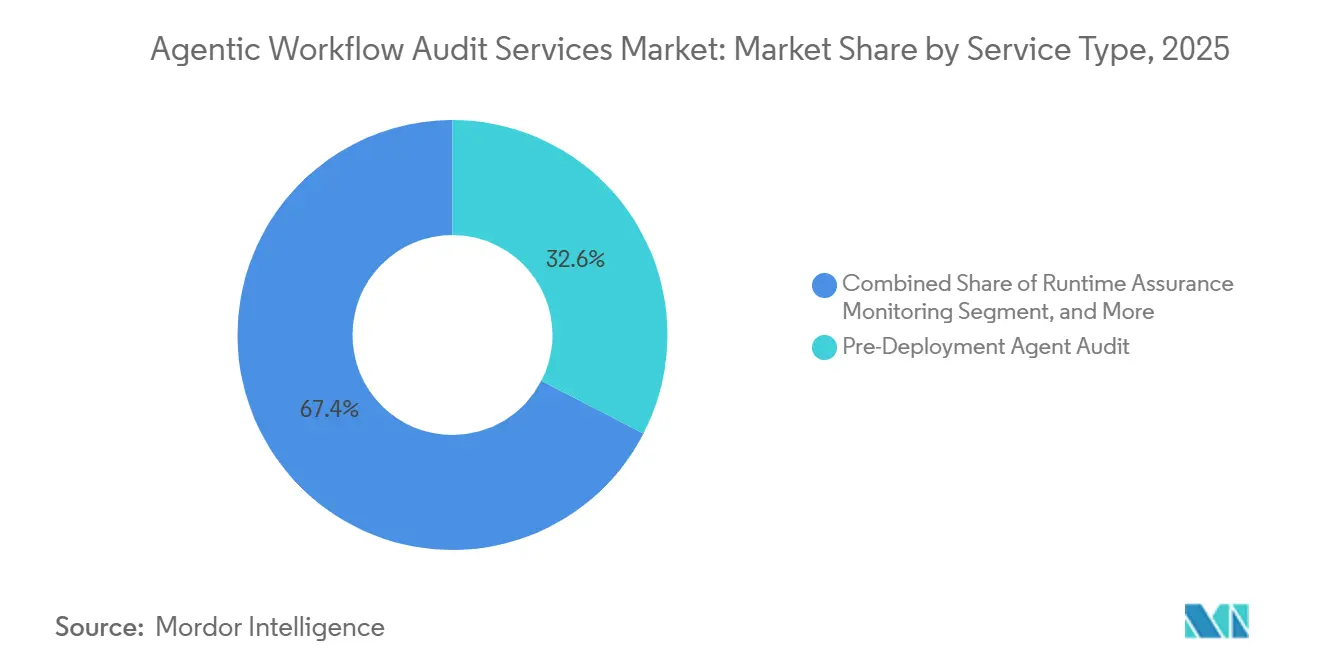
Runtime Monitoring Extends Audit Work Into ProductionPre-Deployment Agent Audit held 32.58% of the service segment in 2025, making it the principal starting point for governance programs. This service reviews core capabilities, agent identity, permissions, and the ability to reproduce important behavior before release. It remains relevant because organizations need a baseline to judge whether subsequent activity has changed. Runtime Assurance Monitoring is projected to advance at a 44.93% CAGR from 2026 to 2031. The Agentic Workflow Audit Services Market size for this service is supported by rules and buyer expectations that extend beyond initial documentation. Continuous monitoring can record tool calls, exceptions, policy decisions, and changes to the deployed environment. It can also provide a traceable history for incident review and periodic control testing. Compliance Attestation is gaining importance as organizations map deployments to ISO/IEC 42001, the NIST AI RMF, and sector-specific requirements. It translates audit findings into a form that procurement, risk, and compliance teams can review. It also gives organizations a defined basis for maintaining evidence as controls change.
Bias and Safety Testing was the smallest service segment in 2025. It remains important for users of healthcare and financial services who face scrutiny of fairness in clinical triage and credit decisions. The Agentic Workflow Audit Services Market is likely to reward providers that place these checks alongside identity, security, and runtime controls. Specialist providers are directing product development toward control planes that standardize telemetry, continuous monitoring, and auditable governance across compound AI systems. Fiddler’s acquisition of Lumeus also extended its control-plane approach to coding agents. A unified subscription can make it easier to retain customers as audit histories and operational evidence accumulate over time. Those records can become difficult to move between platforms, especially where continuity of evidence matters. Providers can use this history to support recurring tests and to review later exceptions more effectively. Customers still need clear access to the records when they change systems or service partners.

By Enterprise Size:
Supply-Chain Requirements Broaden SME DemandLarge enterprises held 73.29% of the market in 2025. Their share reflected higher regulatory exposure, established governance teams, and existing relationships with advisory firms and platform providers. These buyers often operate across several jurisdictions and must coordinate policy, evidence, and oversight across many internal teams. They can also negotiate broader agreements that combine assessment with ongoing monitoring. Large enterprises remain important to the Agentic Workflow Audit Services Market because they deploy agents in functions with substantial operational and regulatory consequences. Their use of multi-agent systems increases the need to link actions to identities and permissions. Their large technology estates also increase the value of framework-agnostic evidence collection. This demand supports providers that can work across cloud, on-premise, and software-as-a-service environments. It also increases the importance of services that present evidence in a consistent form for internal audit and risk teams. A fragmented technology base makes that consistency a practical selection factor.
SMEs are forecast to grow at a 45.05% CAGR through 2031. Their adoption is supported by supply chain requirements when large customers request evidence of AI governance from vendors. This can lead firms to adopt audit practices even when their direct regulatory exposure is limited. The Agentic Workflow Audit Services Market can reach these firms through preconfigured control sets and guided documentation workflows. Small teams often have less capacity to interpret complex requirements or build their own evidence systems. Simpler products can reduce the effort required to establish baseline records and satisfy customer requests. The broader use of enterprise agents also expands the potential SME buyer base beyond firms with mature compliance departments. This creates an opportunity for providers that offer scoped and repeatable services rather than only large consulting engagements. Clear templates can help smaller buyers establish control, ownership, and retain the records needed for customer reviews. Flexible delivery can also fit firms that adopt agents gradually across a limited number of workflows.
By End User:
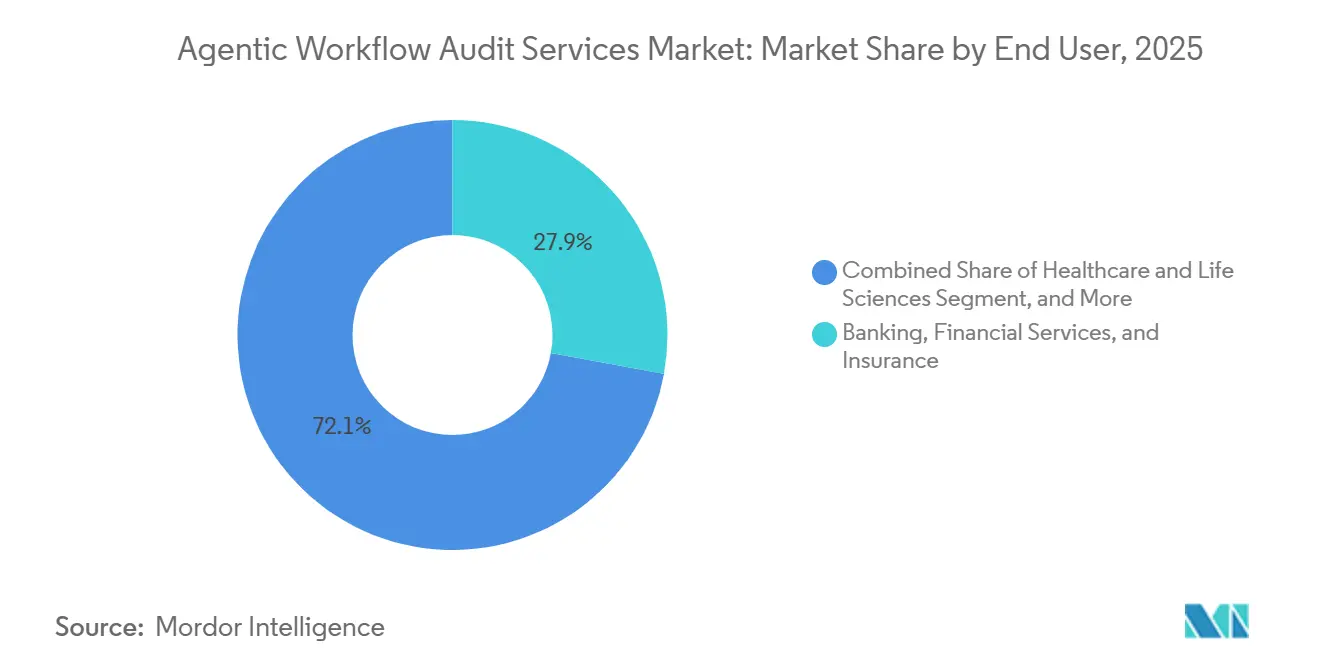
BFSI Provides the Largest Base While Healthcare AcceleratesBFSI accounted for 27.88% of the market in 2025, the largest end-user share. The segment has mature model-risk functions and uses agents in areas where decisions, records, and human oversight are closely examined. Financial institutions need to document how agents interact with data, tools, customer communications, and approval processes. The Financial Stability Board’s 2026 consultation reinforced the importance of governance, monitoring, and oversight in the financial sector's AI adoption. This gives the Agentic Workflow Audit Services Market a strong initial customer base for continuous assurance. Buyers in this group can favor evidence that supports internal control testing and regulator discussions. Their procurement can also encourage suppliers and service partners to meet similar governance expectations. This can extend the need for common evidence beyond a financial institution’s direct agent deployments. It may also favor providers that can relate technical controls to existing internal assurance processes.
Healthcare and Life Sciences are forecast to grow at a 44.83% CAGR from 2026 to 2031. The segment uses AI in clinical documentation, device software, and workflows where reliability and traceability are important. Audit services can help show whether an agent acted within approved boundaries and whether people retained oversight where required. Information Technology and Telecommunications play a different role because these firms build agent platforms and deploy agents internally. Their need for governance can therefore span product assurance and internal operations. Government and public-sector demand is still developing, but it is strategically important as ministries and agencies formalize AI risk-assessment practices. Retail, logistics, and manufacturing form an emerging group of users, although their compliance timetables trail more regulated sectors. The Agentic Workflow Audit Services Market can grow as these sectors move from limited pilots to operational deployment. Their adoption can begin with individual workflows where the business case for traceability is clear. Broader use follows when governance processes can be applied without interrupting normal operations.
By Agent Architecture:
Multi-Agent Workflows Increase Attribution NeedsMulti-Agent Workflows held 54.73% of the agent architecture segment in 2025. These systems divide work among coordinators, specialists, and peer agents, making them useful for complex automation. Their structure also makes audit work harder because an outcome may depend on several actions, delegated tasks, and dynamic routing choices. The Agentic Workflow Audit Services Market share of multi-agent deployments reflects the need to trace how each contributing agent acted. Providers must capture identity, permission, policy context, tool use, and output lineage across the workflow. Standard orchestration tools may not natively create this evidence. A July 2026 research paper described TrustTrack, a protocol for verifiable identity, policy commitments, and tamper-resistant behavioral logs in multi-agent systems. Such approaches treat auditability as part of the infrastructure design rather than as a record assembled after an event. They can make it easier to review whether a task remained within its authorized policy boundaries. They also support a more complete account of how responsibility moved through a workflow.
Single-Agent Workflows are easier to review because their decision lineage can often be traced through one model and a smaller set of tools. They can serve as practical starting points before organizations move to more distributed architectures. Other agent architectures include hierarchical networks, mixture-of-agents systems, and agent-as-a-tool designs that do not fit neatly into either category. These models can still require strong evidence when authority shifts among components or when one agent invokes another. Some providers are placing continuous observation and intervention functions inside the agent environment. This type of design places observation and intervention inside the operating environment. The Agentic Workflow Audit Services Market can benefit as firms seek controls that work within these varied architectures. Providers will need to show that their methods remain useful as workflows become more distributed and less predictable. Control designs must accommodate changes in agent roles, tools, and routing paths. This makes adaptable evidence collection more useful than a fixed checklist alone.
Geography Analysis
North America Agentic Workflow Audit Services Market
North America held 39.49% of the Agentic Workflow Audit Services Market share in 2025. The region has a large base of financial institutions, technology firms, and regulated enterprises moving agents into operational workflows. Existing model-risk, security, and internal audit functions can absorb new assurance services. This environment favors providers that connect technical records with established risk and control processes.
Europe Agentic Workflow Audit Services Market
Europe was the second-largest region in 2025. The EU AI Act introduced phased obligations: prohibited practices apply from February 2025, general-purpose AI obligations from August 2025, and further provisions apply in August 2026. Germany, the United Kingdom, and France account for much of the regional demand. Germany’s Bundesnetzagentur now plays a formal role in implementing the AI Act, increasing the need for defensible records. The United Kingdom’s sector-led approach also creates demand for multi-framework coverage.
APAC, South America and MEA Agentic Workflow Audit Services Market
Asia-Pacific is forecast to grow at a 44.89% CAGR from 2026 to 2031. Japan issued AI Guidelines for Business Version 1.2 in March 2026, signaling closer attention to organizational governance and formal risk assessment for agentic systems. China’s evolving generative AI governance measures add demand in financial services. South America, the Middle East, and Africa remain smaller but developing regions for the Agentic Workflow Audit Services Market. Brazil’s data protection rules are creating early demand around automated decision-making, while Saudi Arabia and the United Arab Emirates support governance within sovereign AI programs.
Competitive Landscape
The Agentic Workflow Audit Services Market is fragmented, and no provider dominates every buyer group. Competition comes from large advisory firms, platform providers, and specialist governance companies. Deloitte launched Connected Agentic Intelligence in Deloitte Omnia in June 2026 for risk factor analysis, evidence extraction, and compliance evaluation. EY rolled out agentic AI in Assurance through EY Canvas in April 2026 across its global audit operations.
Platform companies compete by integrating governance modules into larger enterprise software estates. IBM added enforcement tracking for watsonx Orchestrate agents in August 2026 to gather production evaluation metrics as control evidence. IBM and e& also introduced a governance solution for legal, regulatory, and compliance workflows in January 2026. ServiceNow’s AI Control Tower and Microsoft’s Agent Governance Toolkit extend governance across multi-vendor environments. Microsoft released the toolkit as an open-source project in April 2026, covering the 10 OWASP Agentic AI risks with policy enforcement and compliance grading.
Specialist providers compete through observability, testing, policy enforcement, and audit evidence. Fiddler AI focuses on framework-agnostic telemetry and enforceable policy for compound AI systems. Arthur AI launched continuous evaluations and guardrails for agentic workflows through the AWS AI Agents Marketplace in July 2025. Vijil offers pre-production testing for multi-turn function calling and multi-agent routing through Google Cloud Marketplace. Cryptographic audit trails remain an opening because few suppliers provide tamper-evident logs without redesigning existing logging systems.
Agentic Workflow Audit Services Industry Leaders
-
Deloitte Touche Tohmatsu Limited
-
PricewaterhouseCoopers International Limited
-
Ernst & Young Global Limited
-
KPMG International Limited
-
Accenture plc
- *Disclaimer: Major Players sorted in no particular order
Agentic Workflow Audit Services Market Companies Covered in this Report
- Accenture plc
- Deloitte Touche Tohmatsu Limited
- PricewaterhouseCoopers International Limited
- Ernst & Young Global Limited
- KPMG International Limited
- International Business Machines Corporation
- Microsoft Corporation
- Salesforce, Inc.
- ServiceNow, Inc.
- Oracle Corporation
- Amazon.com, Inc.
- Anthropic PBC
- OpenAI, L.L.C.
- Fiddler Labs, Inc.
- Arthur AI, Inc.
- Credo AI Corporation
- Holistic AI
- BABL AI
- Innodata Inc.
- Vijil, Inc.
Recent Industry Developments in Agentic Workflow Audit Services Market
- August 2026: IBM launched enforcement tracking for watsonx Orchestrate agents in watsonx.governance, automatically collecting evaluation metrics from production agents as evidence against governance controls and eliminating manual audit evidence collection.
- July 2026: Deloitte launched Connected Agentic Intelligence within Deloitte Omnia, delivering a unified agent network for risk factor analysis, evidence extraction, compliance evaluation, and on-demand micro-training across 85,000 Audit and Assurance practitioners globally.
- April 2026: EY launched enterprise-scale agentic AI in Assurance globally through EY Canvas, embedding audit agents across 160,000 engagements in over 150 countries as part of a multibillion-dollar audit quality commitment.
- April 2026: IBM and e& unveiled an agentic AI governance solution at the World Economic Forum in Davos, built on IBM watsonx Orchestrate and integrated with IBM OpenPages, delivering traceable, governance-aligned responses for legal, regulatory, and compliance workflows.
Global Agentic Workflow Audit Services Market Report Scope
The Agentic Workflow Audit Services Market refers to specialized assessment services designed to evaluate the safety, compliance, and performance of autonomous AI workflows. These services include pre-deployment audits, runtime monitoring, and bias testing for both single-agent and multi-agent architectures, helping enterprises mitigate risks and ensure their AI systems operate reliably and within regulatory guidelines.
The Agentic Workflow Audit Services Market Report is Segmented by Service Type (Pre-Deployment Agent Audit, Runtime Assurance Monitoring, Compliance Attestation, and Bias and Safety Testing), Enterprise Size (Large Enterprises and Small and Medium-Sized Enterprises), End Users (Banking, Financial Services, and Insurance, Healthcare and Life Sciences, Information Technology and Telecommunications, Government and Public Sector, and Other End Users), Agent Architecture (Single-Agent Workflows, Multi-Agent Workflows, and Other Agent Architectures), and Geography (North America, South America, Europe, Asia-Pacific, Middle East, and Africa). The Market Forecasts are Provided in Terms of Value (USD).
Segmentation Overview
| Pre-Deployment Agent Audit |
| Runtime Assurance Monitoring |
| Compliance Attestation |
| Bias and Safety Testing |
| Large Enterprises |
| Small and Medium-Sized Enterprises |
| Banking, Financial Services, and Insurance |
| Healthcare and Life Sciences |
| Information Technology and Telecommunications |
| Government and Public Sector |
| Other End Users |
| Single-Agent Workflows |
| Multi-Agent Workflows |
| Others Agent Architectures |
| North America | United States |
| Canada | |
| Mexico | |
| South America | Brazil |
| Argentina | |
| Chile | |
| Rest of South America | |
| Europe | Germany |
| United Kingdom | |
| France | |
| Italy | |
| Spain | |
| Rest of Europe | |
| Asia-Pacific | China |
| Japan | |
| India | |
| South Korea | |
| Australia | |
| Rest of Asia-Pacific | |
| Middle East | United Arab Emirates |
| Saudi Arabia | |
| Qatar | |
| Rest of Middle East | |
| Africa | South Africa |
| Egypt | |
| Nigeria | |
| Rest of Africa |
| By Service Type | Pre-Deployment Agent Audit | |
| Runtime Assurance Monitoring | ||
| Compliance Attestation | ||
| Bias and Safety Testing | ||
| By Enterprise Size | Large Enterprises | |
| Small and Medium-Sized Enterprises | ||
| By End Users | Banking, Financial Services, and Insurance | |
| Healthcare and Life Sciences | ||
| Information Technology and Telecommunications | ||
| Government and Public Sector | ||
| Other End Users | ||
| By Agent Architecture | Single-Agent Workflows | |
| Multi-Agent Workflows | ||
| Others Agent Architectures | ||
| By Geography | North America | United States |
| Canada | ||
| Mexico | ||
| South America | Brazil | |
| Argentina | ||
| Chile | ||
| Rest of South America | ||
| Europe | Germany | |
| United Kingdom | ||
| France | ||
| Italy | ||
| Spain | ||
| Rest of Europe | ||
| Asia-Pacific | China | |
| Japan | ||
| India | ||
| South Korea | ||
| Australia | ||
| Rest of Asia-Pacific | ||
| Middle East | United Arab Emirates | |
| Saudi Arabia | ||
| Qatar | ||
| Rest of Middle East | ||
| Africa | South Africa | |
| Egypt | ||
| Nigeria | ||
| Rest of Africa | ||
Key Questions Answered in the Report
What is the Agentic Workflow Audit Services Market size?
The Agentic Workflow Audit Services Market is expected to grow from USD 0.41 billion in 2025 to USD 0.61 billion in 2026 and reach USD 3.72 billion by 2031, at a 43.56% CAGR from 2026 to 2031.
Why is runtime monitoring growing faster than other service types?
Runtime Assurance Monitoring is expected to grow at a 44.93% CAGR through 2031 because agents can change after deployment through model, tool, and context updates. Continuous evidence helps teams identify drift and document exceptions during normal operations. The service also preserves a usable trail for later control testing and incident review.
Which organizations are the largest buyers of audit services?
Large enterprises held 73.29% of demand in 2025 because they have greater regulatory exposure, complex technology estates, and established governance functions. They also need to coordinate evidence across multiple jurisdictions, business units, and technology providers. This creates a need for consistent controls across cloud, internal, and software-as-a-service systems.
Which end-user sector leads demand for agentic workflow audits?
BFSI held 27.88% in 2025, supported by established model-risk practices and strong needs for monitoring, oversight, and traceable records. Financial institutions also need controls that support internal review and discussions with regulators. Continuous assurance is valuable where changes in models or tools can affect a previously reviewed workflow.
Why do multi-agent systems need specialized audit controls?
Multi-Agent Workflows held 54.73% in 2025 and require attribution across several agents, delegated tasks, permissions, tools, and routing decisions. Audit records must connect each action to the policy context and authority that applied at that point. This is more difficult when a coordinator agent assigns work dynamically to specialized agents.
Which region is expected to grow the fastest?
Asia-Pacific is expected to grow at a 44.89% CAGR from 2026 to 2031, supported by evolving governance expectations in Japan, Singapore, and China. Regional demand is strengthened as financial services and government users formalize risk assessment and evidence practices. The regions varied regulatory approaches also create a need for services that work across more than one framework.