
Agentic Marketing Services Market Size and Share
Market Overview
| Study Period | 2020 - 2031 |
|---|---|
| Market Size (2026) | USD 4.18 Billion |
| Market Size (2031) | USD 10.25 Billion |
| Growth Rate (2026 - 2031) | 19.65 % |
| Fastest Growing Market | Asia-Pacific |
| Largest Market | North America |
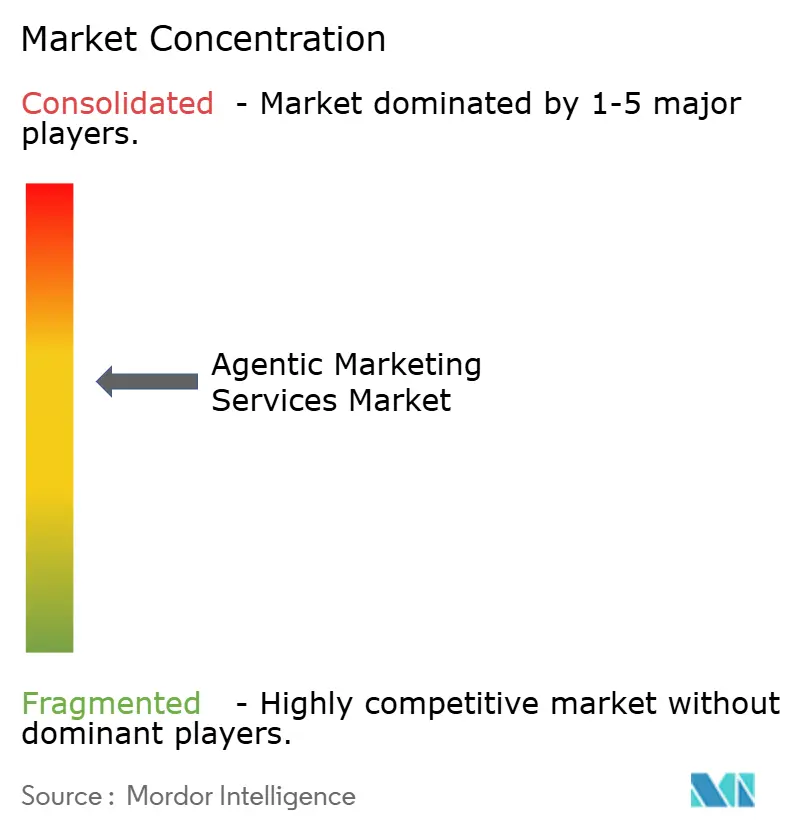
| Market Concentration | Medium |
Major Players *Disclaimer: Major Players sorted in no particular order Image © Mordor Intelligence. Reuse requires attribution under CC BY 4.0. | |
Agentic Marketing Services Market Analysis by Mordor Intelligence
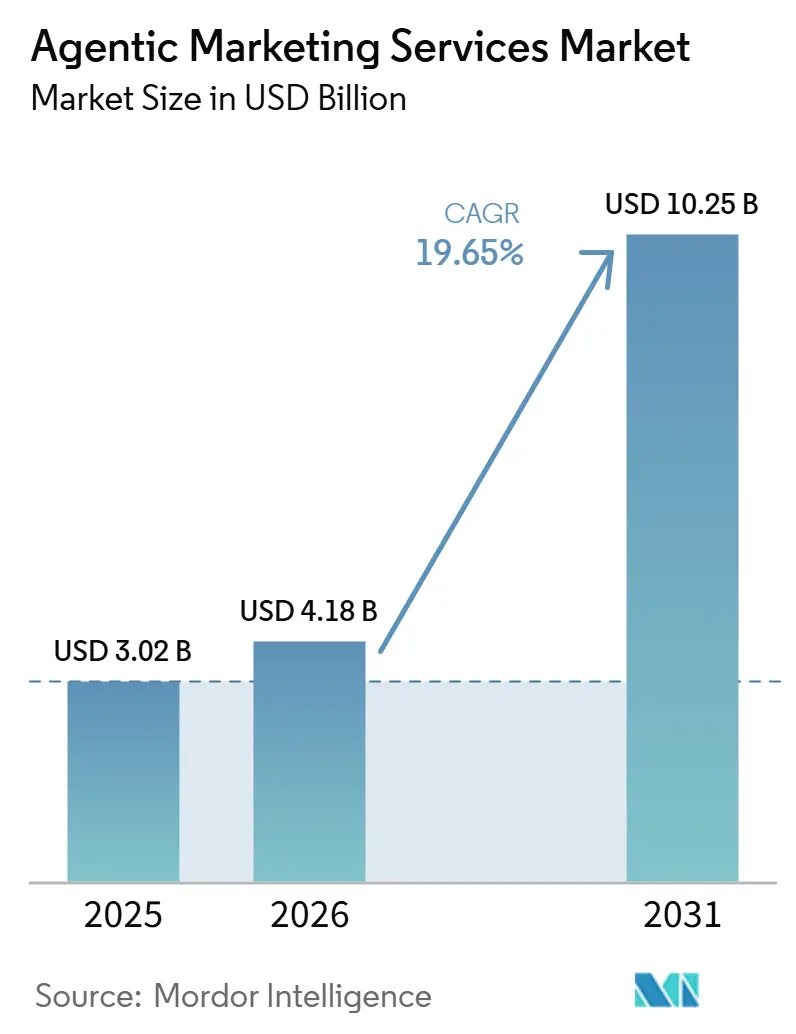
The agentic marketing services market size was USD 3.02 billion in 2025, USD 4.18 billion, and is projected to reach USD 10.25 billion by 2031, expanding at a CAGR of 19.65% from 2026 to 2031. Demand is shifting from tools that assist individual tasks toward managed services that coordinate planning, content, activation, and measurement across connected workflows and give enterprises a clearer operating model for increasingly complex customer engagement across global enterprises. Enterprise buyers are seeking faster campaign execution, stronger use of first-party data, and clearer links between spending and commercial results. This favors providers that combine marketing expertise with data infrastructure, workflow controls, and accountable delivery models. Retail, financial services, and technology companies are important early adopters because they have measurable customer interactions and strong pressure to show returns. The agentic marketing services market also faces a clear divide between large organizations with mature data assets and smaller buyers that still need integration, governance, and operational support.
Key Report Takeaways
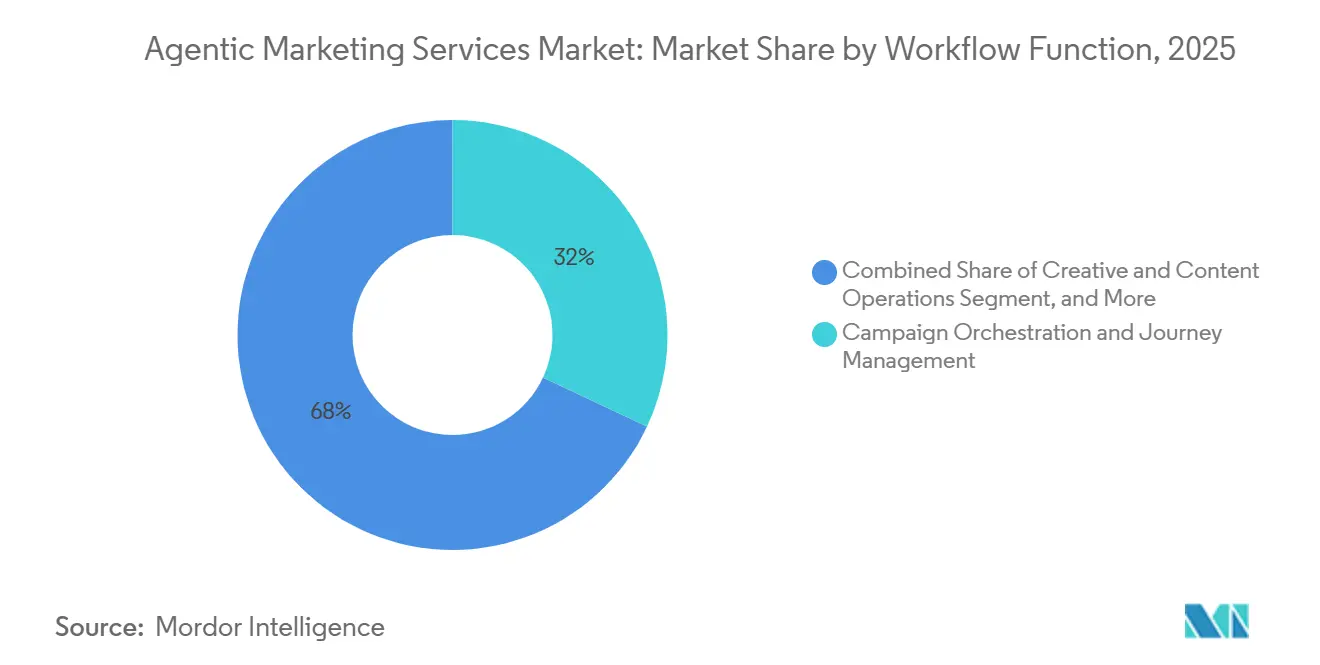
- By workflow function, Campaign Orchestration and Journey Management held 32.00% of the agentic marketing services market share in 2025, while AI Search Visibility and Discovery Optimization is projected to expand at a CAGR of 20.28% through 2031.
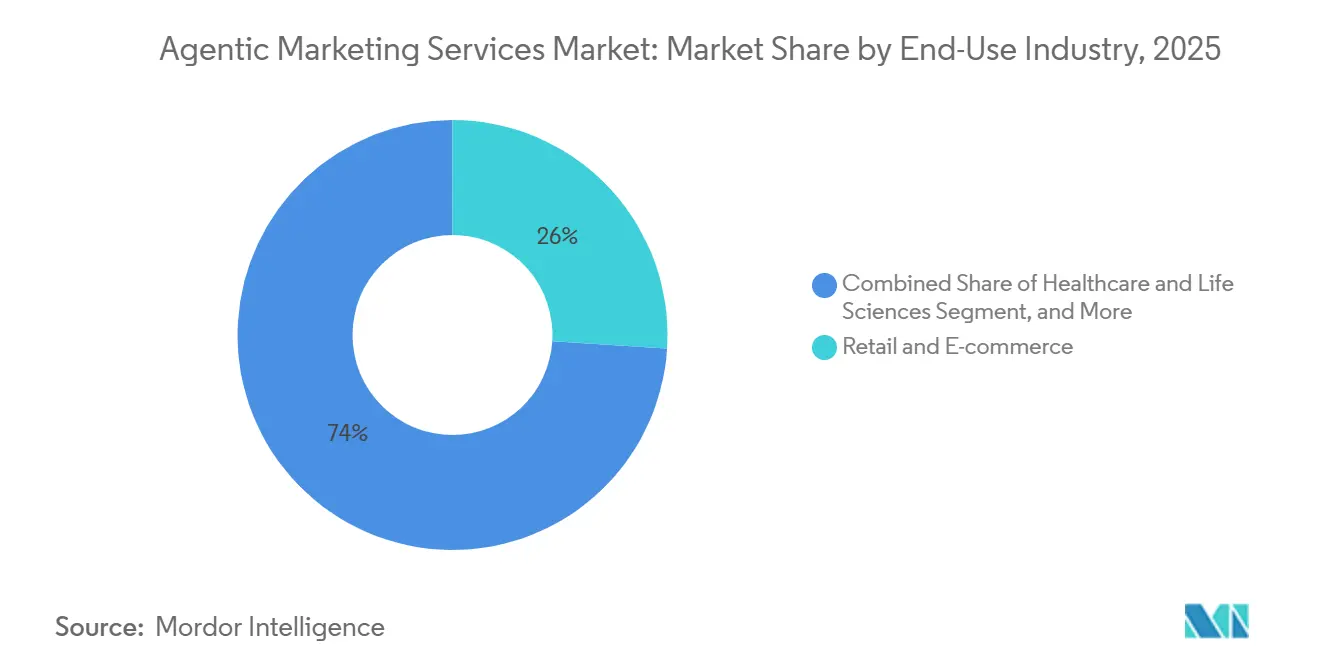
- By end-use industry, Retail and E-commerce held 26.00% of the agentic marketing services market share in 2025, while Technology and SaaS is projected to expand at a CAGR of 20.05% through 2031.
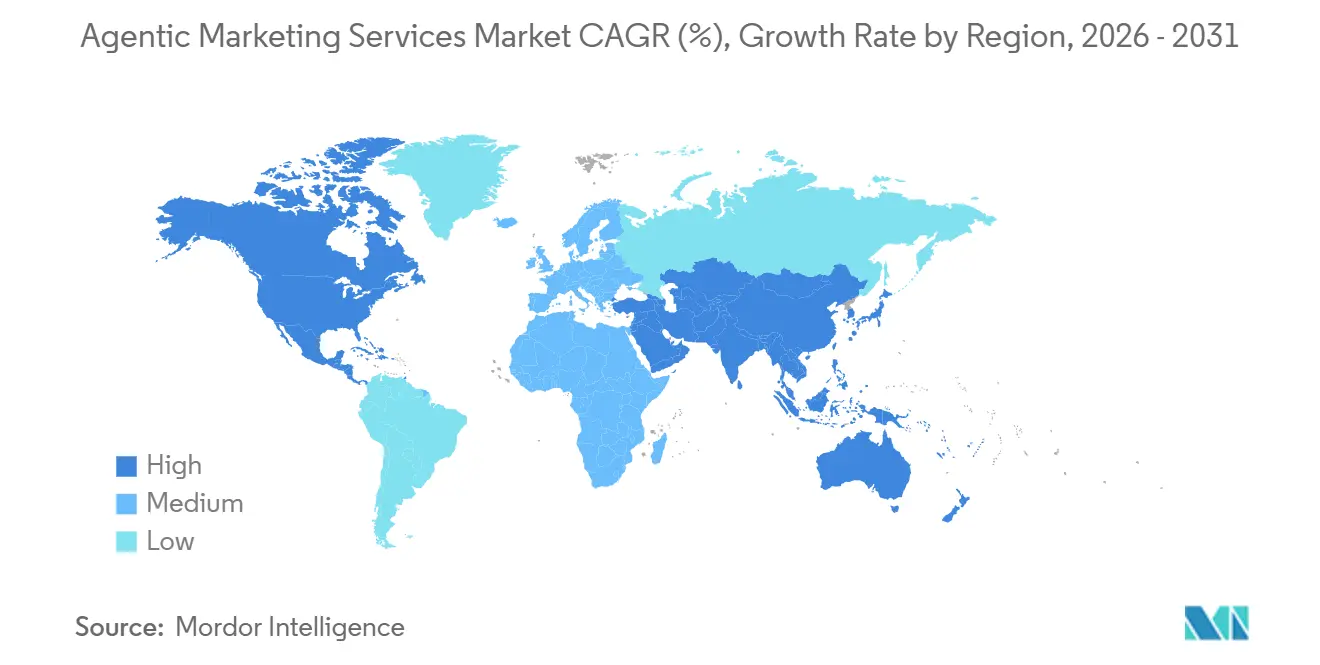
- By geography, North America accounted for 44.50% of the agentic marketing services market in 2025, while Asia-Pacific is projected to expand at a CAGR of 19.94% through 2031.
Note: Market size and forecast figures in this report are generated using Mordor Intelligence’s proprietary estimation framework, updated with the latest available data and insights as of January 2026.
Market Trends and Insights
Drivers Impact Analysis of Agentic Marketing Services Market*
| Driver | (~) % Impact on CAGR Forecast | Geographic Relevance | Impact Timeline |
|---|---|---|---|
| Need for Faster Campaign Launch and Iteration | +3.8% | Global, with early concentration in North America and Western Europe | Short term (≤ 2 years) |
| Demand for Hyper-Personalization Across Channels | +3.2% | Global, strongest in North America, the United Kingdom, and core Asia-Pacific markets | Medium term (2-4 years) |
| Pressure to Improve ROAS and Marketing Productivity | +2.8% | North America and Europe, with spillover to Asia-Pacific and South America | Short term (≤ 2 years) |
| Rising Enterprise Adoption of AI in Marketing and Sales | +2.5% | Global, with faster adoption in North America and East Asia | Medium term (2-4 years) |
| Shift to AI Search and Agent-Mediated Discovery | +2.0% | North America and Europe are primary markets, with Asia-Pacific expanding | Medium term (2-4 years) |
| Demand for Governance-Embedded Agent Operations | +1.5% | Europe has regulatory primacy, with global compliance spillover | Long term (≥ 4 years) |
| Source: Mordor Intelligence | |||
Need for Faster Campaign Launch and Iteration
Campaign speed has become a central operating priority for enterprise marketing teams, particularly when campaigns require coordinated work across media, content, customer data, and performance reporting. Traditional launches often relied on separate handoffs for briefs, creative work, audience selection, platform setup, and reporting, creating delays that could extend across several review cycles. Agentic marketing services can connect these tasks and reduce the delays created by sequential reviews, while retaining a clearer record of the actions taken in each workflow.[1] Salesforce introduced Agentforce Marketing in June 2026, including conversational campaign management in Slack through the Model Context Protocol, which shows how campaign work is moving toward coordinated, conversational workflows. Faster iteration can give teams more opportunities to test messaging, audiences, and channel choices within the same planning cycle. The resulting performance data can improve later decisions, which makes execution speed an important source of advantage in the agentic marketing services market.
Demand for Hyper-Personalization Across Channels
Many enterprises want to tailor communication across email, paid media, websites, and service channels without adding staff at the same pace. This requires timely customer data, connected identity records, and decisions that can adapt while a campaign is active, rather than static audience definitions applied only at launch. Agentic marketing services help buyers operate these activities as linked programs rather than as separate channel projects. The need is especially strong where companies manage frequent customer interactions and can measure responses across the purchase journey. Retailers, subscription businesses, and financial services firms can use this approach to align offers, messages, and follow-up activity with changing customer signals. The agentic marketing services market benefits when providers can turn complex personalization requirements into governed services that clients can operate at scale.
Pressure to Improve ROAS and Marketing Productivity
Marketing budgets are receiving closer financial review, particularly when a company needs to demonstrate the business value of technology spending and defend planned expenditure against competing priorities. Oracle reported a USD 5.44 return over 3 years for every USD 1 invested in marketing automation, with payback in under 6 months, showing why procurement teams seek measurable automation outcomes.[2] Agentic services are relevant because they can join campaign execution with performance measurement and frequent optimization across the same managed workflow. This changes commercial discussions from hours delivered to results achieved, including return on ad spend and acquisition efficiency. Providers that can explain workflow choices, data use, and performance changes are better placed to support performance-linked contracts. These conditions strengthen demand in the agentic marketing services market among buyers that want to improve productivity without reducing control over brand and budget decisions.
Rising Enterprise Adoption of AI in Marketing and Sales
Enterprise adoption has moved beyond isolated experimentation in many marketing and sales functions. The remaining question for many organizations is how to assign responsibility for systems that already influence campaign work, including the decisions that affect content, audiences, and customer engagement. This creates demand for managed services because many buyers do not have the internal talent, integrated data, or governance processes needed for wider deployment. Salesforce has continued to extend agentic capabilities across marketing workflows, making platform-based coordination more accessible to organizations that already use its customer relationship tools. Adoption also increases the need for services that connect marketing teams with technology, legal, security, and commercial stakeholders. The agentic marketing services market therefore has room to expand as clients move from individual pilots to broader operating models.
Restraints Impact Analysis of Agentic Marketing Services Market*
| Restraint | (~) % Impact on CAGR Forecast | Geographic Relevance | Impact Timeline |
|---|---|---|---|
| Fragmented First-Party Data and Measurement Signal Loss | -2.8% | Global, most acute in markets without robust customer data platforms, including South America and Africa | Short term (≤ 2 years) |
| Brand, IP, and Regulatory Compliance Risks | -2.2% | Europe has regulatory primacy, North America is increasing focus, with global compliance spillover | Medium term (2-4 years) |
| Low Observability Across Agent Behaviors and Permissions | -1.5% | Primarily North America and Europe, especially enterprises with complex technology stacks | Medium term (2-4 years) |
| Agent Sprawl and Identity-Control Complexity | -1.0% | Global, concentrated in large enterprise deployments | Long term (≥ 4 years) |
| Source: Mordor Intelligence | |||
Fragmented First-Party Data and Measurement Signal Loss
Agentic marketing systems depend on reliable customer, campaign, and conversion data. Many organizations still hold this information in disconnected systems that do not support consistent decisions across channels, making it difficult to reconcile customer identities, campaign responses, and commercial outcomes in a timely way. MuleSoft found that 50% of AI agents operate in isolated silos, while 86% of IT leaders said poor integration can add complexity without measurable value.[3]Privacy-related changes also reduce the signals available for attribution and performance measurement, weakening the feedback loops that autonomous optimization requires. Large enterprises with loyalty programs, direct commerce operations, and owned media often have stronger first-party data than smaller competitors. This can slow the agentic marketing services market in the near term because providers must first solve integration and measurement gaps before autonomous optimization can operate reliably.
Brand, IP, and Regulatory Compliance Risks
Autonomous systems that create or deploy marketing content can create brand, intellectual property, and regulatory exposure if oversight is weak. The European Commission states that the EU AI Act includes transparency obligations for certain AI-generated content and can impose fines of up to EUR 15 million or 3% of worldwide annual turnover for relevant breaches. Providers serving European clients must document oversight, support AI literacy, and consider disclosure requirements for synthetic media across their client-facing processes. The EU AI Act and the General Data Protection Regulation can apply at the same time when systems process personal data for targeting and profiling. Smaller providers may find these obligations more difficult to absorb because they have fewer legal and compliance resources. The agentic marketing services market is likely to reward vendors that build governance into delivery processes rather than treat it as a later add-on.
*Our forecasts treat driver/restraint impacts as directional, not additive. The impact forecasts reflect baseline growth, mix effects, and variable interactions.
Agentic Marketing Services Market Segment Analysis
By Workflow Function:
Campaign Orchestration Leads as AI Search Visibility AcceleratesCampaign Orchestration and Journey Management held 32.00% of the global market in 2025, reflecting its role in coordinating multi-channel enterprise activity. In the agentic marketing services market, this function links planning, creative development, audience selection, channel activation, and measurement, and it is often the practical starting point because fragmented handoffs slow campaigns and obscure accountability. Providers can bring established systems together without requiring every process to be replaced, while Media Planning and Autonomous Optimization supports bidding, audience selection, and budget allocation through connected performance data, Creative and Content Operations aligns assets with activation requirements, and Analytics, Measurement, and Insight Automation supplies the feedback needed to assess results. Omnicom unveiled its new Omni platform in January 2026, integrating Acxiom, Flywheel Commerce Cloud, Interact, and an expanded agentic AI framework to connect strategy, execution, and performance.
AI Search Visibility and Discovery Optimization is projected to expand at a CAGR of 20.28% from 2026 to 2031, making it the fastest-growing workflow function within the agentic marketing services market size. Generative search tools are changing how commercial audiences find brands, products, and vendors, which makes content optimization, language-model citation monitoring, and visibility management across AI answer engines more important in the agentic marketing services market. Adobe expanded GenStudio with Brand Intelligence and an agentic content supply chain in April 2026, connecting enterprise context, AI agents, and performance analytics across campaign work. The workflow is moving toward multi-agent coordination, giving providers an opportunity to help clients connect search visibility with content, campaign management, and measurement instead of relying on single-workflow pilots or treating discovery as a separate marketing activity.

By End-Use Industry:
Retail Commands Share, Technology and SaaS Defines Future GrowthRetail and E-commerce led the end-use segmentation with 26.00% of the agentic marketing services market size in 2025. Frequent transactions, direct customer relationships, and readily available behavioral data support rapid testing of offers, audiences, and creative approaches, while commerce signals make return on investment easier to assess and support a performance attribution culture. Financial Services holds a meaningful secondary position because campaign activity must meet demanding governance and customer-data requirements, especially in wealth management, insurance, and retail banking, where governed architectures can command a compliance premium. Healthcare and Life Sciences is also adopting these services for physician education and AI search brand defense, where providers need clear controls over data, permissions, content review, and promotional communications.
Technology and SaaS is projected to expand at a CAGR of 20.05% from 2026 to 2031, the fastest rate among end-use industries. Software companies increasingly face buying journeys in which prospective customers use AI answer engines instead of conventional search marketing, increasing the need for AI search visibility, autonomous demand generation, and linked pipeline work that spans discovery through sales engagement. Media and Entertainment companies apply agentic systems to content recommendations and audience segmentation, while Travel and Hospitality brands connect campaign activation to dynamic pricing decisions and reduce the delay between pricing changes and promotional execution. Automotive companies use nurture sequences that reflect financing status and dealership proximity, showing why the agentic marketing services industry can serve varied customer journeys while the agentic marketing services market retains common needs for analytics and orchestration.
Geography Analysis
The Americas Agentic Marketing Services Market
North America accounted for 44.50% of the global market in 2025. The United States combines global holding companies, marketing technology providers, AI-native agencies, specialist talent, and substantial proprietary data assets that support enterprise-scale delivery and early adoption of integrated operating models. Publicis Groupe announced its agreement to acquire LiveRamp for USD 2.167 billion in May 2026, illustrating the strategic value placed on data infrastructure for smarter marketing agents. Canada adds demand as enterprises extend corporate AI mandates to regional teams. South America, led by Brazil, is an emerging area where full-service providers may gain ground before platform-only adoption becomes widespread in the agentic marketing services market.
APAC Agentic Marketing Services Market
Asia-Pacific is projected to expand at a CAGR of 19.94% from 2026 to 2031, the fastest regional pace in the agentic marketing services market. Mobile-first commerce, high digital advertising intensity, and enterprise AI investment programs support demand across China, India, Japan, and South Korea, where businesses are adopting marketing infrastructure at compressed timelines relative to Western markets. India is adopting multi-agent marketing frameworks alongside cloud modernization, while China requires Mandarin-language optimization and country-specific approaches for Baidu, Alibaba's Quanzhantui, and ByteDance discovery environments. Singapore, Indonesia, and Vietnam are emerging as important Southeast Asian locations as commerce platforms expand AI-driven marketing application programming interfaces and brands incorporate them into their operating stacks. Publicis Groupe acquired Atomic 212° in Australia in January 2025, positioning the group for broader regional expansion.
EMEA Agentic Marketing Services Market
Europe held a significant share in 2025, supported by Germany, the United Kingdom, and France. The EU AI Act became fully applicable on August 2, 2026, creating compliance requirements and demand for services with governance embedded in their operating processes. WPP launched WPP Open Pro in October 2025 and introduced Agent Hub in 2026, giving users access to ready-made agents and governance-oriented platform capabilities. The Middle East is adopting agentic marketing services alongside national AI investment programs, while Africa remains at an earlier stage even as mobile commerce creates conditions for future demand in South Africa, Nigeria, and Kenya.
Competitive Landscape
The agentic marketing services market has moderate concentration in enterprise accounts, where Publicis Groupe, Omnicom, and WPP have large global delivery networks, established client relationships, proprietary data capabilities, and the resources to build shared platforms across regions. The lower and middle tiers remain more fragmented because AI-native providers can compete through specialized products, faster deployment, vertical specificity, and narrower commercial commitments that suit buyers not ready for a broad engagement. Large holding companies are building vertically integrated models that connect data infrastructure with campaign execution and seek to create more durable barriers to entry. Publicis Groupe's planned LiveRamp acquisition is designed to strengthen data co-creation for smarter agents. Omnicom's Omni platform combines Acxiom's identity graph, Flywheel's commerce data, and agentic AI capabilities, making it harder for pure-play providers to match incumbent data, activation, and service coverage.
WPP is converting institutional knowledge, data assets, and delivery practices into reusable platform capabilities. WPP Open Pro allows brands to plan, create, and publish campaigns with proprietary agents, data assets, and partner integrations, extending access beyond full-service managed engagements. Its Agent Hub adds ready-made agents and custom-agent capabilities for clients, including Nestlé and The Coca-Cola Company, and gives users a way to apply standardized tools to recurring marketing tasks. This model lets providers serve clients that need managed delivery or more self-directed use, while embedding governance and workflow standards for regulated sectors in the agentic marketing services market.
AI-native challengers such as Botonomy AI, Jasper AI, and Akii Technologies compete in creative operations and AI search visibility through modular offerings and rapid time to value. Platform companies are also expanding the field, as Salesforce announced Agentforce Marketing in June 2026 and Adobe introduced CX Enterprise Coworker and expanded GenStudio capabilities in April 2026. Adobe's Brand Intelligence layer links content creation with activation performance signals across GenStudio workflows. The agentic marketing services market has open opportunities in mid-market governance tools, vertical capabilities for regulated clients, and multi-agent orchestration systems that are not yet fully standardized.
Agentic Marketing Services Industry Leaders
-
Accenture plc
-
WPP plc
-
Publicis Groupe S.A.
-
Omnicom Group Inc.
-
Salesforce, Inc.
- *Disclaimer: Major Players sorted in no particular order
Agentic Marketing Services Market Companies Covered in this Report
- Accenture plc
- Adobe Inc.
- Akii Technologies, Ltd
- Botonomy Ai
- Capgemini Se
- Deloitte Touche Tohmatsu Limited
- Ey Global Limited
- Jellyfish Group Limited
- Jasper Ai, Inc.
- Kpmg International Limited
- Merkle Inc.
- Netcore Cloud Private Limited
- Omnicom Group Inc.
- Pricewaterhousecoopers International Limited
- Publicis Groupe S.A.
- Qualified.com, Inc.
- Salesforce, Inc.
- Stagwell Inc.
- Syntasa Technologies Inc.
- Wpp plc
Recent Industry Developments in Agentic Marketing Services Market
- June 2026: Salesforce announced Agentforce Marketing at its Connections event, providing marketers with a full AI marketing team for campaign building, pipeline generation, and content creation. Conversational campaign management in Slack via MCP became generally available, while the Agentforce Content Agent and Marketing Goals Agent entered pilot, advancing Salesforce's transformation from CRM platform into a digital labor system for marketing.
- May 2026: Publicis Groupe agreed to acquire LiveRamp for a total enterprise value of USD 2.167 billion in an all-cash transaction at USD 38.50 per share. The deal is expected to close before the end of 2026 subject to regulatory approvals, and is designed to position the Groupe as a leader in data co-creation for agentic marketing.
- April 2026: Adobe introduced Brand Intelligence and expanded GenStudio at Adobe Summit in Las Vegas, unveiling an agentic content supply chain connecting enterprise context, AI agents, and performance analytics across the full campaign lifecycle. Adobe simultaneously unveiled CX Enterprise Coworker, a multi-step AI agent coordinating workflows across its customer experience application suite.
- March 2026: Publicis Groupe acquired AdgeAI, a measurement and content intelligence company, to embed predictive performance scoring and real-time content measurement into Publicis Production's delivery capability. The integration enables brands to receive immediate predictive performance feedback on content assets before and during activation.
Global Agentic Marketing Services Market Report Scope
The Agentic Marketing Services Market refers to the ecosystem of professional services, consulting, implementation, management, optimization, and support solutions that leverage agentic artificial intelligence (AI) systems capable of autonomously planning, executing, monitoring, and refining marketing activities with minimal human intervention. These services encompass AI-driven campaign management, content creation and personalization, customer engagement orchestration, media buying, lead generation, marketing analytics, customer journey optimization, and decision automation across digital and omnichannel environments. The market includes services delivered by marketing agencies, technology consultants, system integrators, AI solution providers, and managed service vendors that help organizations deploy and operate autonomous AI agents to enhance marketing efficiency, customer targeting, conversion rates, and return on marketing investment. It serves enterprises of all sizes across industries such as retail, consumer goods, BFSI, healthcare, telecommunications, media, travel, and manufacturing, enabling data-driven, real-time, and scalable marketing operations through advanced AI, machine learning, natural language processing, and generative AI technologies.
The Agentic Marketing Services Msrket Report is Segmented by Workflow Function (Campaign Orchestration and Journey Management, Media Planning and Autonomous Optimization, Creative and Content Operations, AI Search Visibility and Discovery Optimization, and Analytics, Measurement, and Insight Automation), by End-Use Industry (Retail and E-commerce, Technology and SaaS, Financial Services, Healthcare and Life Sciences, Media and Entertainment, Travel and Hospitality, Automotive, and Other End-Use Industries), and Geography (North America, South America, Europe, Asia-Pacific, Middle East, and Africa). The Market Forecasts are Provided in Terms of Value (USD).
Segmentation Overview
| Campaign Orchestration and Journey Management |
| Media Planning and Autonomous Optimization |
| Creative and Content Operations |
| AI Search Visibility and Discovery Optimization |
| Analytics, Measurement, and Insight Automation |
| Retail and E-commerce |
| Technology and Saas |
| Financial Services |
| Healthcare and Life Sciences |
| Media and Entertainment |
| Travel and Hospitality |
| Automotive |
| Other End-Use Industries |
| North America | United States | |
| Canada | ||
| Mexico | ||
| South America | Brazil | |
| Argentina | ||
| Chile | ||
| Colombia | ||
| Rest of South America | ||
| Europe | Germany | |
| United Kingdom | ||
| France | ||
| Italy | ||
| Spain | ||
| Russia | ||
| Rest of Europe | ||
| Asia-Pacific | China | |
| Japan | ||
| India | ||
| South Korea | ||
| Australia and New Zealand | ||
| Southeast Asia | Singapore | |
| Indonesia | ||
| Thailand | ||
| Malaysia | ||
| Vietnam | ||
| Philippines | ||
| Rest of Asia-Pacific | ||
| Middle East | Saudi Arabia | |
| United Arab Emirates | ||
| Turkey | ||
| Israel | ||
| Rest of Middle East | ||
| Africa | South Africa | |
| Nigeria | ||
| Kenya | ||
| Rest of Africa | ||
| By Workflow Function | Campaign Orchestration and Journey Management | ||
| Media Planning and Autonomous Optimization | |||
| Creative and Content Operations | |||
| AI Search Visibility and Discovery Optimization | |||
| Analytics, Measurement, and Insight Automation | |||
| By End-Use Industry | Retail and E-commerce | ||
| Technology and Saas | |||
| Financial Services | |||
| Healthcare and Life Sciences | |||
| Media and Entertainment | |||
| Travel and Hospitality | |||
| Automotive | |||
| Other End-Use Industries | |||
| By Geography | North America | United States | |
| Canada | |||
| Mexico | |||
| South America | Brazil | ||
| Argentina | |||
| Chile | |||
| Colombia | |||
| Rest of South America | |||
| Europe | Germany | ||
| United Kingdom | |||
| France | |||
| Italy | |||
| Spain | |||
| Russia | |||
| Rest of Europe | |||
| Asia-Pacific | China | ||
| Japan | |||
| India | |||
| South Korea | |||
| Australia and New Zealand | |||
| Southeast Asia | Singapore | ||
| Indonesia | |||
| Thailand | |||
| Malaysia | |||
| Vietnam | |||
| Philippines | |||
| Rest of Asia-Pacific | |||
| Middle East | Saudi Arabia | ||
| United Arab Emirates | |||
| Turkey | |||
| Israel | |||
| Rest of Middle East | |||
| Africa | South Africa | ||
| Nigeria | |||
| Kenya | |||
| Rest of Africa | |||
Key Questions Answered in the Report
What is the size of the agentic marketing services market?
The agentic marketing services market size was USD 3.02 billion in 2025 and is projected to reach USD 10.25 billion by 2031, at a CAGR of 19.65% from 2026 to 2031.
Which workflow function leads agentic marketing services?
Campaign Orchestration and Journey Management led with a 32.00% share in 2025 because it connects planning, content, activation, and measurement across channels.
Which end-use sector is expanding fastest?
Technology and SaaS is projected to expand at a CAGR of 20.05% from 2026 to 2031, supported by AI-mediated discovery and automated demand generation needs.
Which region has the largest share?
North America held 44.50% in 2025, supported by its concentration of holding companies, marketing technology providers, proprietary data assets, and specialist talent.
Which region is expected to expand fastest?
Asia-Pacific is projected to expand at a CAGR of 19.94% through 2031, supported by mobile-first commerce and enterprise AI investment across major economies.
What is slowing the adoption of agentic marketing services?
Fragmented first-party data, weaker measurement signals, brand and intellectual property risks, and regulatory obligations can delay wider deployment.