
Agentic AI Governance Platforms In Healthcare Market Size and Share
Market Overview
| Study Period | 2020 - 2031 |
|---|---|
| Market Size (2026) | USD 8.48 Billion |
| Market Size (2031) | USD 13.93 Billion |
| Growth Rate (2026 - 2031) | 10.44 % |
| Fastest Growing Market | Asia-Pacific |
| Largest Market | North America |
| Market Concentration | Medium |
Major Players *Disclaimer: Major Players sorted in no particular order Image © Mordor Intelligence. Reuse requires attribution under CC BY 4.0. | |
Agentic AI Governance Platforms In Healthcare Market Analysis by Mordor Intelligence
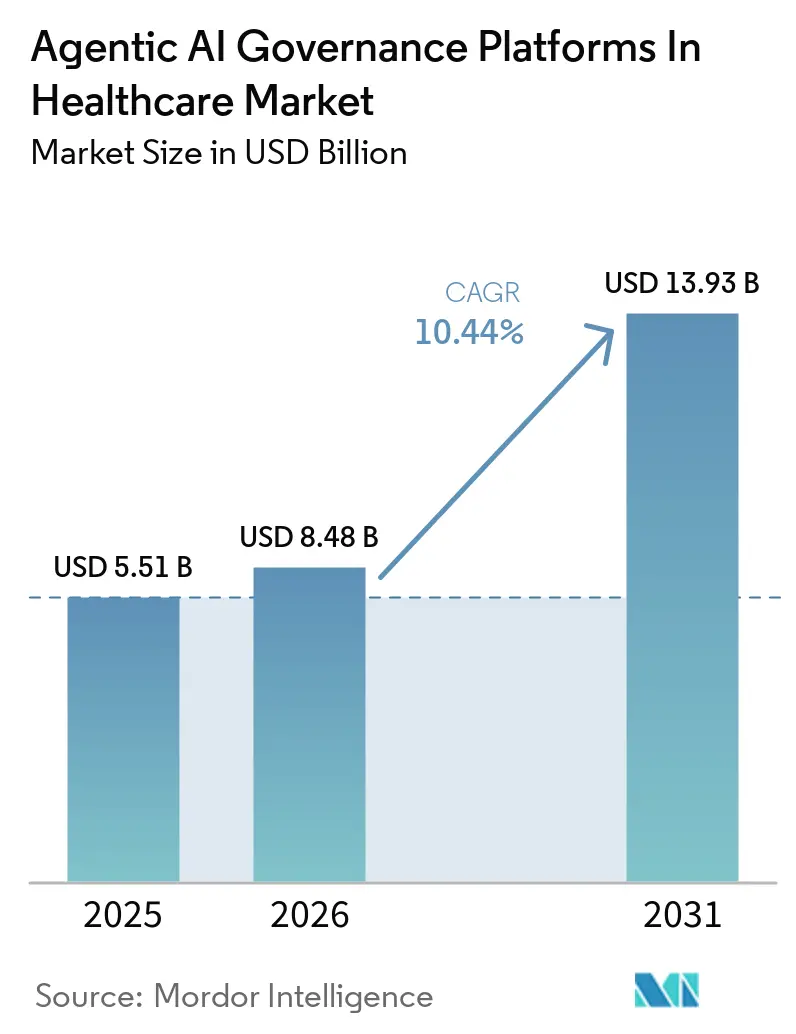
The Agentic AI Governance Platforms in Healthcare Market size is expected to grow from USD 5.51 billion in 2025 to USD 8.48 billion in 2026, and is forecast to reach USD 13.93 billion by 2031, at a 10.44% CAGR over 2026-2031. The Agentic AI Governance Platforms in the Healthcare Market are expanding as healthcare organizations move AI from pilot programs into clinical and administrative workflows. This shift increases the need for controls that document how an agent accesses data, selects tools, and escalates decisions. Regulatory requirements in the United States, Europe, and Asia-Pacific also make lifecycle documentation and human oversight more important. In July 2026, the World Health Organization Regional Office for Europe reported that nearly two-thirds of its 53 member states used AI in diagnostics, while almost 40% lacked ethical guidance on the use of AI in health care. The Agentic AI Governance Platforms in Healthcare Market favors platforms that combine policy controls, audit records, validation, and security within existing healthcare technology environments.
Key Report Takeaways
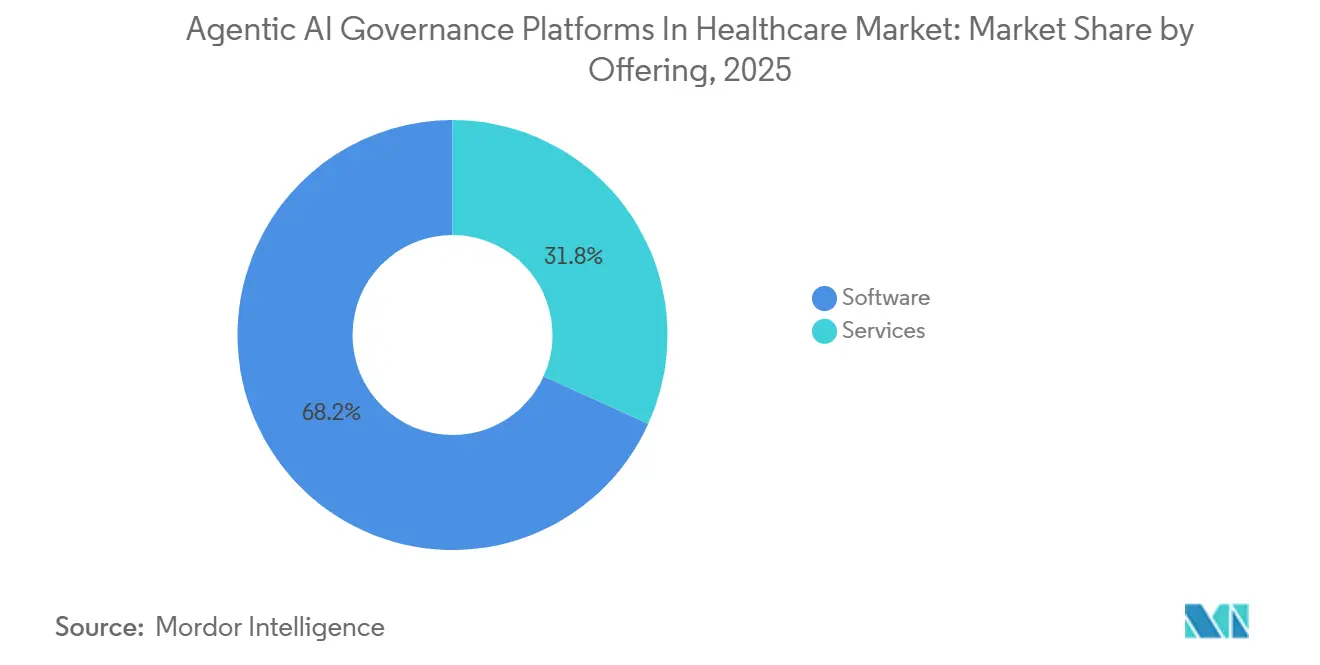
- By offering, software held 68.23% of the Agentic AI Governance Platforms in Healthcare Market share in 2025, while services are forecast to grow at 11.71% CAGR through 2031.
- By deployment model, cloud-based platforms accounted for 54.12% of the Agentic AI Governance Platforms in Healthcare Market size in 2025, while hybrid deployment is projected to expand at 11.82% CAGR through 2031.
- By function, runtime guardrails and human oversight accounted for 24.16% of the Agentic AI Governance Platforms in Healthcare Market share in 2025, while model and agent validation is expected to grow at a 11.93% CAGR through 2031.
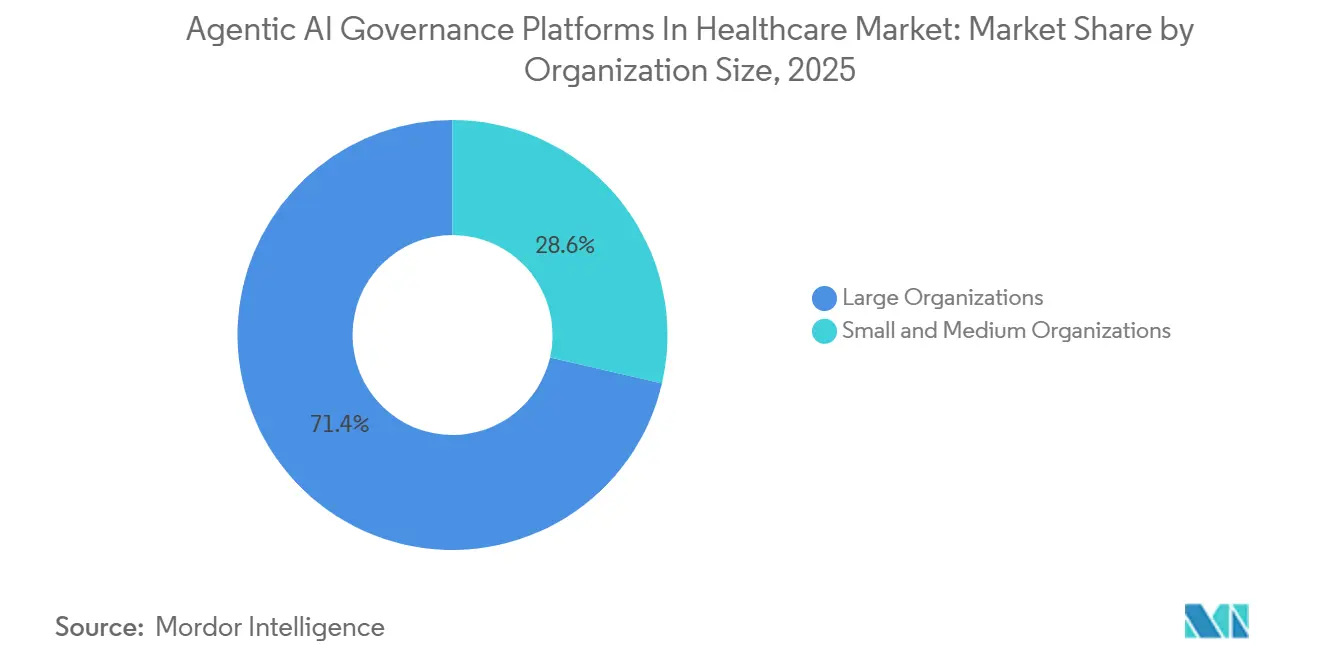
- By organization size, large organizations held 71.38% share in 2025, while small and medium organizations are forecast to grow at 12.14% CAGR through 2031.
- By end user, healthcare providers held 38.47% share in 2025, while pharmaceutical and biotechnology firms are forecast to grow at 12.26% CAGR through 2031.
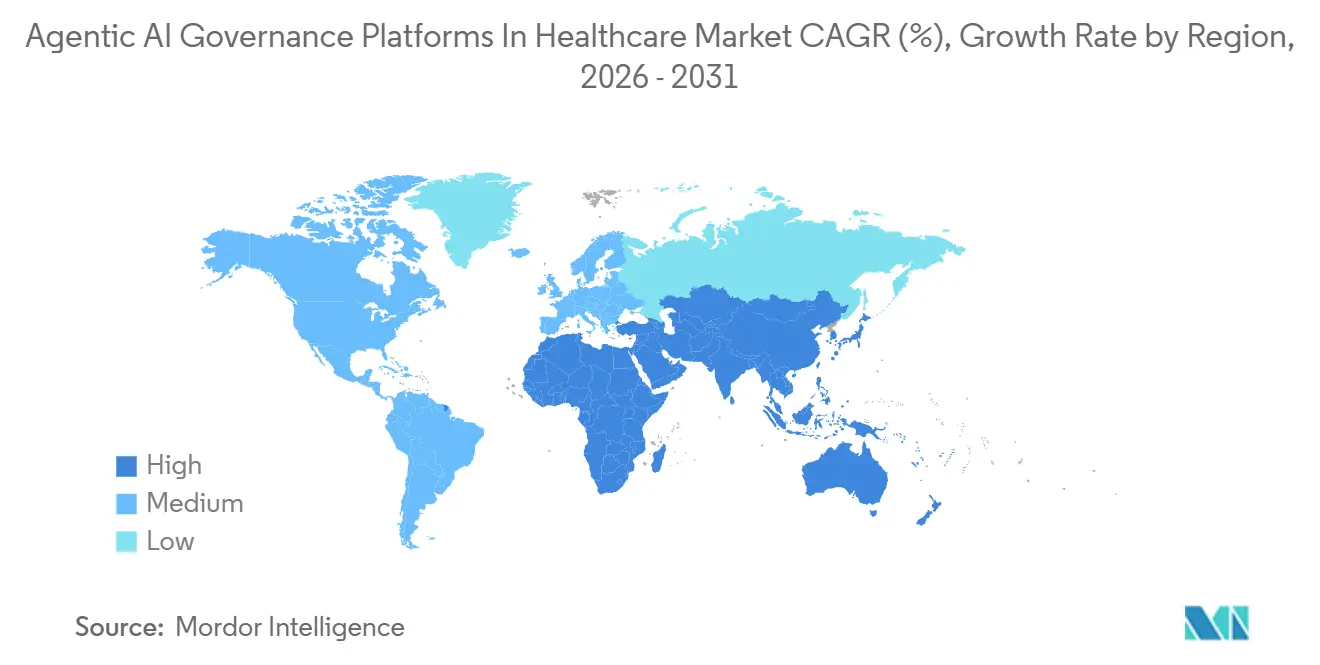
- By geography, North America held 42.81% share in 2025, while the Asia-Pacific is forecast to expand at 12.37% CAGR through 2031.
Note: Market size and forecast figures in this report are generated using Mordor Intelligence’s proprietary estimation framework, updated with the latest available data and insights as of January 2026.
Market Trends and Insights
Drivers Impact Analysis of Agentic AI Governance Platforms In Healthcare Market*
| Driver | (~) % Impact on CAGR Forecast | Geographic Relevance | Impact Timeline |
|---|---|---|---|
| Rising Healthcare AI Deployment and Accountability Requirements | +2.8% | Global, concentrated demand in the United States, United Kingdom, and European Union | Short term (≤ 2 years) |
| Expansion of Agentic Workflows Across Clinical and Administrative Care | +2.1% | North America and European Union, with spillover to Asia-Pacific | Medium term (2-4 years) |
| Increasing Regulatory Requirements for Lifecycle Evidence | +1.7% | European Union core, with adoption in the United States, Canada, Australia, and Singapore | Medium term (2-4 years) |
| Growth of Cloud-Based AI Governance Infrastructure | +1.2% | Global, with early gains in North America and North Asia | Short term (≤ 2 years) |
| Pre-Execution Policy Enforcement for Autonomous Healthcare Agents | +0.8% | North America and European Union, with spillover to Asia-Pacific | Medium term (2-4 years) |
| Synthetic-Population Testing for Rare and Vulnerable Patient Scenarios | +0.4% | North America, European Union, and selected Asia-Pacific countries | Long term (≥ 4 years) |
| Source: Mordor Intelligence | |||
Rising Healthcare AI Deployment and Accountability Requirements
Healthcare organizations are adopting AI faster than they are building formal governance processes. In July 2026, only 8% of the World Health Organization Regional Office for Europe’s 53 member states had a health-specific AI governance strategy, although nearly two-thirds had deployed AI in diagnostics.[1] A healthcare governance study based on engagement with 70 U.S. health-system leaders and more than 35 health delivery organizations found that effective oversight needs clinical, technical, informatics, operational, and regulatory expertise. Since January 2024, 22 U.S. states have enacted 38 laws addressing AI use in prior authorization and clinical decisions. The Agentic AI Governance Platforms in Healthcare Market benefit as buyers need documented accountability before AI reaches patient-facing workflows. Platforms can connect policies with approvals, evidence, exceptions, and human review.
Expansion of Agentic Workflows Across Clinical and Administrative Care
Agentic systems can access EHRs, clinical knowledge bases, scheduling platforms, and medication entry systems in sequence. These linked workflows require continuous control because each action can change the risk of the next action. The Healthcare AI Agents Regulatory Framework includes 42 requirements for tool use and integration security. Bluesight launched an agentic healthcare compliance product for 20 health systems in May 2026. The Agentic AI Governance Platforms in Healthcare Market grows as organizations deploy more connected workflows rather than single-purpose models. A common policy framework can also reduce the marginal governance cost of adding another agent.
Increasing Regulatory Requirements for Lifecycle Evidence
The U.S. Food and Drug Administration issued updated guidance on AI-enabled device software functions in January 2026.[2] The guidance clarified classification and lifecycle documentation for functions that meet medical-device thresholds. The European Union AI Act became fully applicable on August 2, 2026, and requires documentation, audit logs, and human oversight records for high-risk systems. Medical device guidance confirmed that healthcare AI can be subject to cumulative requirements under the AI Act and the Medical Device Regulation. The Agentic AI Governance Platforms in Healthcare Market benefits when a platform can map a single control across multiple frameworks. Buyers also value systems that document why an agent remained within approved use conditions.[3]
Growth of Cloud-Based AI Governance Infrastructure
Pacific AI made its CHAI-certified platform available on AWS Marketplace and Azure Marketplace in June 2026. The listing supports deployment within a customer’s cloud tenant via established purchasing channels, with no seat minimums. Cloud systems can update policy libraries and centralize audit records for distributed organizations. NHS England deployed Microsoft 365 Copilot with Agent 365 governance for 505,000 clinicians and support staff in June 2026.[4] The Agentic AI Governance Platforms in Healthcare Market benefits when cloud-native governance becomes a condition of enterprise AI deployment. Hybrid models remain relevant where organizations retain sensitive data locally but use cloud layers for orchestration and audit aggregation.
Restraints Impact Analysis of Agentic AI Governance Platforms In Healthcare Market*
| Restraint | (~) % Impact on CAGR Forecast | Geographic Relevance | Impact Timeline |
|---|---|---|---|
| Fragmented Cross-Border Health-Data and AI Regulation | -1.3% | Global, most acute in European Union-U.S. and Asia-Pacific cross-border deployments | Medium term (2-4 years) |
| Shortage of Clinical AI Risk and Validation Specialists | -0.9% | Global, most severe in Asia-Pacific and South America | Short term (≤ 2 years) |
| Hidden Governance Cost of Legacy EHR Integration | -0.6% | North America and Europe, given Epic and Cerner dominance | Medium term (2-4 years) |
| Liability Ambiguity for Autonomous Agent Decisions | -0.4% | Global, most acute in U.S. and European Union medical liability systems | Long term (≥ 4 years) |
| Source: Mordor Intelligence | |||
Fragmented Cross-Border Health-Data and AI Regulation
Multinational healthcare organizations face different AI and data obligations in every major jurisdiction. This can require parallel documentation sets for the same system, increasing validation costs. The European Union AI Act follows a different timetable from the U.S. Food and Drug Administration lifecycle approach. Pharmaceutical sponsors and medical technology manufacturers are especially exposed because their systems span research, patient support, and commercial processes. Buyers may defer platform decisions while internal legal and clinical teams determine which obligations apply. The Agentic AI Governance Platforms in Healthcare Market can be slowed when no common evidence format is accepted by all jurisdictions.
Shortage of Clinical AI Risk and Validation Specialists
Clinical AI governance needs people who understand patient workflows, model evaluation, regulation, and audit documentation. A healthcare governance study found that committees require participation from clinical, technical, informatics, operational, and regulatory teams. Large institutions have more capacity to assemble these groups than smaller health systems. Governance sustainment accounted for 10% to 15% of total AI program spending in the study. The Agentic AI Governance Platforms in Healthcare Market can face slower adoption when buyers lack the staff to manage alerts, investigate incidents, and revise policies. Service providers can address some capability gaps, but they do not remove the need for human accountability.
*Our forecasts treat driver/restraint impacts as directional, not additive. The impact forecasts reflect baseline growth, mix effects, and variable interactions.
Agentic AI Governance Platforms In Healthcare Market Segment Analysis
By Offering:
Software Anchors Revenue as Services Scale RapidlySoftware held 68.23% of the Agentic AI Governance Platforms in Healthcare Market share in 2025. Its position reflects the need for repeatable policy enforcement across models, agents, and data sources. Platform software can manage identities, authorized tools, approval rules, and bias monitoring dashboards. Healthcare organizations also need systems that preserve evidence for internal review and regulatory scrutiny. Software is central when buyers need direct control rather than advisory guidance.
Services is forecast to grow at 11.71% CAGR through 2031. Health systems need implementation support for EHRs, data warehouses, and multi-vendor AI environments. Service providers can translate regulatory duties into testing, approval, and monitoring processes. Governance sustainment accounted for 10%-15% of total AI program spending in a healthcare governance study. The Agentic AI Governance Platforms in Healthcare industry relies on services to turn platform features into working clinical controls.
By Deployment Model:
Cloud Leads While Hybrid Adoption BuildsCloud-based deployment accounted for 54.12% of the Agentic AI Governance Platforms in Healthcare Market size in 2025. Cloud environments support scalable audit storage, policy updates, and integration with enterprise AI platforms. AWS described a HIPAA-ready healthcare architecture with inference, agent deployment, audit trails, and automated threat detection. Marketplace procurement can also reduce deployment work for customers. These features explain the leading role of cloud delivery.
Hybrid deployment is forecast to expand at 11.82% CAGR through 2031. Academic medical centers, government agencies, and delivery networks may retain protected health information locally because of residency obligations. They can still use cloud services for policy orchestration and audit aggregation. On-premises systems remain relevant in sovereign health networks across Asia-Pacific and the Middle East. The Agentic AI Governance Platforms in Healthcare Market favors vendors that apply the same policy across local and cloud environments.
By Functions:
Runtime Controls Lead While Validation Gains PriorityRuntime guardrails and human oversight held 24.16% of the Agentic AI Governance Platforms in Healthcare Market share in 2025. These tools place policy checks and escalation rules within an agent’s action process. They can block unauthorized actions before they reach clinical or administrative systems. Deterministic middleware in the Healthcare AI Agents Regulatory Framework reduced unauthorized tool execution rates from 56% to 60% to 0% during red-team validation. Their leading role reflects the immediate need to control live agent behavior.
Model and agent validation is forecast to grow at 11.93% CAGR through 2031. Buyers are moving from static model testing toward workflows that combine multiple models and tools. The Healthcare AI Agents Regulatory Framework provides 279 requirements across 8 verification categories. Related functions include inventory, risk assessment, data governance, policy management, incident management, and reporting. The Agentic AI Governance Platforms in Healthcare Market can grow as procurement teams seek evidence for compound agent workflows.
By Organization Size:
Large Organizations Lead While Smaller Buyers Gain AccessLarge organizations held 71.38% of the Agentic AI Governance Platforms in Healthcare Market share in 2025. Integrated delivery networks and large pharmaceutical companies can fund committees, technical teams, and formal procurement processes. NHS England deployed Microsoft 365 Copilot with Agent 365 governance to 505,000 clinicians and support staff in June 2026. The deployment showed how a shared governance layer can support local workflows. These capabilities explain the continued lead held by large.
Small and medium organizations are forecast to grow at 12.14% CAGR through 2031. Pacific AI offered a free-tier platform, per-action billing, and no seat minimums through AWS and Azure Marketplaces in June 2026. Modular deployment can lower initial cost and infrastructure requirements. Smaller organizations can start with limited use cases and add controls over time. Staffing needs for alerts and audits remain a material constraint.
By End User:
Providers Lead While Pharmaceutical and Biotechnology Firms Grow FastestHealthcare providers held 38.47% of the Agentic AI Governance Platforms in Healthcare Market share in 2025. Providers use AI for inpatient and outpatient care, discharge planning, scheduling, and clinical decision support. Governance systems define permitted actions and preserve evidence of human intervention. Mayo Clinic and Microsoft announced a June 2026 collaboration on a healthcare AI model governed through real-world clinical validation. Provider demand reflects the breadth of patient-facing workflows that require oversight.
Pharmaceutical and biotechnology firms are forecast to grow at 12.26% CAGR through 2031. These firms use agentic AI for drug discovery, trial design, patient recruitment, and evidence generation. Owkin announced a multiyear collaboration with Sanofi to build AI agents in June 2026. Medical technology manufacturers also need tools for overlapping device and AI requirements. The Agentic AI Governance Platforms in Healthcare Market can serve these buyers through sector-specific control libraries.
Geography Analysis
North America Agentic AI Governance Platforms in Healthcare Market
North America held 42.81% of the Agentic AI Governance Platforms in Healthcare Market share in 2025. The region has a high concentration of healthcare AI deployments, mature cloud infrastructure, and buyers capable of funding formal governance programs. The U.S. Food and Drug Administration’s January 2026 guidance clarified lifecycle expectations for AI-enabled device software functions. The 38 laws enacted by 22 U.S. states since January 2024 add distinct obligations for clinical and prior-authorization use cases. These conditions increase demand for systems that link policies with documentation and post-deployment review.
Europe and South America Agentic AI Governance Platforms in Healthcare Market
Europe is shaped by the European Union's AI Act and medical device compliance requirements. The Act became fully applicable in August 2026 and requires documentation, audit records, and human oversight for high-risk AI systems. Medical device guidance confirmed that healthcare AI may need to comply with both regimes. South America remains earlier in adoption, with procurement focused on private hospital groups and multinational organizations using global standards.
APAC and MEA Agentic AI Governance Platforms in Healthcare Market
Asia-Pacific is forecast to grow at 12.37% CAGR through 2031. The region combines fast AI adoption with evolving national governance frameworks. Health systems are likely to need tools that support local documentation and testing requirements. The Middle East is building governance capacity through public hospital procurement linked to national AI programs, while Africa remains nascent, with adoption largely tied to international development programs. The Agentic AI Governance Platforms in Healthcare Market can expand as more countries move from general policy guidance toward enforceable implementation requirements.
Competitive Landscape
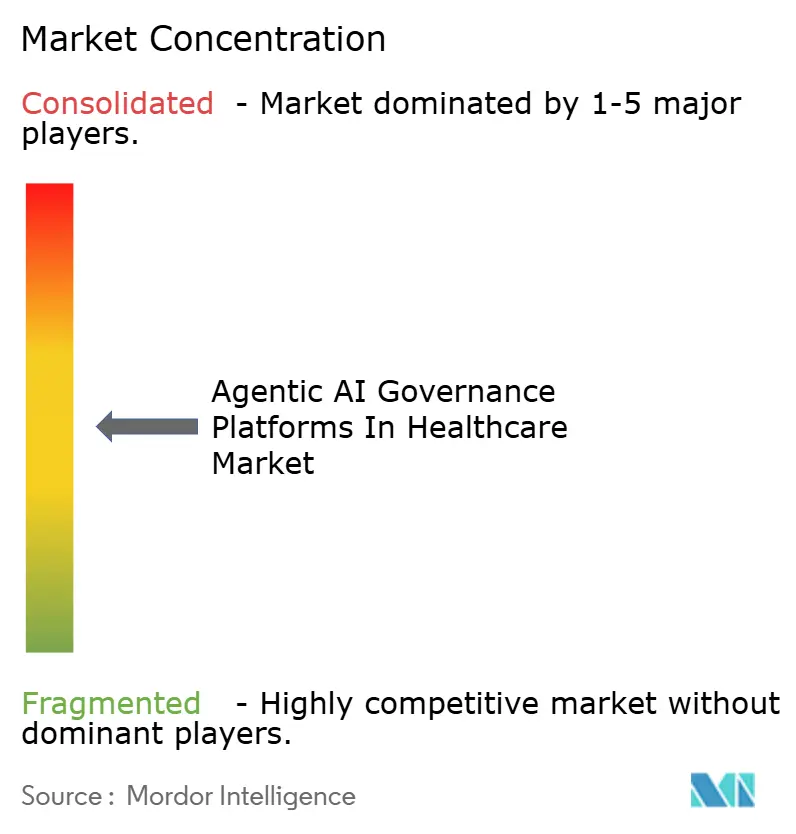
The Agentic AI Governance Platforms in Healthcare Market remains moderately fragmented, and no vendor is close to a dominant position. Microsoft, Amazon Web Services, and Google embed governance tools within broader healthcare cloud environments, using EHR connections and audit storage to make switching more difficult. IBM combined watsonx governance and Guardium AI Security in June 2025, adding automated red teaming, shadow AI discovery, and validation across 12 frameworks. IBM and Google Cloud announced a multibillion-dollar partnership in June 2026 to deliver governed production AI across regulated sectors, underscoring the importance of cloud integration, security, and ecosystem depth.
Specialized vendors, including Fiddler AI, DataRobot, ArthurAI, Arize AI, and WhyLabs, compete through regulatory libraries and detailed model or agent monitoring. Pacific AI targets smaller health systems through CHAI alignment and usage-based billing. Its June 2026 marketplace launch allowed deployment in a customer’s own cloud tenant. Governance for multi-agent workflows remains an open area because no single agent may own the final clinical decision. Vendors that connect authorization, security, validation, and reporting can have an advantage.
Synthetic-data testing can support validation for rare, pediatric, and vulnerable patient populations where real-world data are limited. Incident response aligned with U.S. post-market monitoring and European audit evidence is another important product area. ValidMind, H2O.ai, and WhyLabs are building workflow monitoring capabilities that could extend to governance orchestration for smaller organizations. Viz.ai achieved ISO/IEC 42001 accreditation in May 2026. The Agentic AI Governance Platforms in Healthcare Market is likely to favor firms that demonstrate control performance rather than only policy templates.
Agentic AI Governance Platforms In Healthcare Industry Leaders
-
Microsoft Corporation
-
International Business Machines Corporation
-
Google LLC
-
SAS Institute Inc.
-
Credo AI Corporation
- *Disclaimer: Major Players sorted in no particular order
Agentic AI Governance Platforms In Healthcare Market Companies Covered in this Report
- Microsoft Corporation
- International Business Machines Corporation
- Google LLC
- SAS Institute Inc.
- Credo AI Corporation
- Collibra NV
- Oracle Corporation
- Amazon Web Services, Inc.
- NVIDIA Corporation
- DataRobot, Inc.
- H2O.ai, Inc.
- Fiddler AI, Inc.
- Arize AI, Inc.
- WhyLabs, Inc.
- ArthurAI, Inc.
- ValidMind Inc.
- Pacific AI, Inc.
- Orchestral Technologies Limited
- OnStak Inc.
- i-GENTIC AI, Inc.
- Inferenz AI, Inc.
- League, Inc.
- Aethryx AI Ltd.
- KLA Digital Ltd.
Recent Industry Developments in Agentic AI Governance Platforms In Healthcare Market
- July 2026: Pacific AI listed its CHAI-certified healthcare AI governance platform simultaneously on AWS Marketplace and Azure Marketplace, enabling healthcare organizations to deploy a complete governance environment inside their own cloud tenant in minutes, with no seat minimums, billing through existing cloud accounts, and coverage of 250-plus mapped laws, regulations, and standards.
- June 2026: Mayo Clinic and Microsoft announced a strategic collaboration to develop a frontier healthcare AI model using Mayo Clinic's de-identified clinical health data and Microsoft's Azure Foundry infrastructure, the model is owned by Mayo Clinic, governed under real-world clinical validation requirements, and will be distributed globally through Azure APIs.
- June 2026: NHS England deployed Microsoft 365 Copilot with Agent 365 governance to 505,000 clinicians and support staff, the largest healthcare-sector AI deployment of its kind, following a trial across 90 NHS organizations demonstrating average administrative savings of 43 minutes per staff member per day.
- June 2026: IBM and Google Cloud announced a multi-billion-dollar Google Cloud Practice partnership combining IBM Consulting Advantage with Google Cloud's Gemini Enterprise Agent Platform, targeting governed production-grade agentic AI deployment across regulated industries including healthcare and life sciences
Global Agentic AI Governance Platforms In Healthcare Market Report Scope
The Agentic AI Governance Platforms In Healthcare Market refers to software and services that securely manage, monitor, and regulate autonomous AI agents in the healthcare sector. These platforms provide essential functions such as model validation, runtime guardrails, data lifecycle management, and audit trails to ensure continuous human oversight. Deployed across cloud, on-premises, or hybrid environments, they help healthcare providers, payers, pharmaceutical firms, and regulators ensure their AI systems comply with strict medical regulations while maintaining patient safety and data privacy.
The Agentic AI Governance Platforms in Healthcare Market Report is Segmented by Offering (Software, and Services), Deployment Model (Cloud-Based, On-Premises, and Hybrid), Functions (AI System Inventory and Registration, Risk and Impact Assessment, Policy and Control Management, Model and Agent Validation, Runtime Guardrails and Human Oversight, Monitoring, Audit Trails, and Traceability, Data Governance and Lifecycle Management, and Incident Management and Regulatory Reporting), Organization Size (Large Organizations, and Small and Medium Organizations), End User (Healthcare Providers, Healthcare Payers and Insurers, Pharmaceutical and Biotechnology Firms, MedTech and Device Manufacturers, Clinical Research Organizations, Regulators and Public Agencies, and Research Institutions and Academic Medical Centers), and Geography (North America, South America, Europe, Asia-Pacific, Middle East, and Africa). The Market Forecasts are Provided in Terms of Value (USD).
Segmentation Overview
| Software |
| Services |
| Cloud-Based |
| On-Premises |
| Hybrid |
| AI System Inventory and Registration |
| Risk and Impact Assessment |
| Policy and Control Management |
| Model and Agent Validation |
| Runtime Guardrails and Human Oversight |
| Monitoring, Audit Trails, and Traceability |
| Data Governance and Lifecycle Management |
| Incident Management and Regulatory Reporting |
| Large Organizations |
| Small and Medium Organizations |
| Healthcare Providers |
| Healthcare Payers and Insurers |
| Pharmaceutical and Biotechnology Firms |
| MedTech and Device Manufacturers |
| Clinical Research Organizations |
| Regulators and Public Agencies |
| Research Institutions and Academic Medical Centers |
| North America | United States |
| Canada | |
| Mexico | |
| South America | Brazil |
| Argentina | |
| Chile | |
| Rest of South America | |
| Europe | Germany |
| United Kingdom | |
| France | |
| Italy | |
| Spain | |
| Rest of Europe | |
| Asia-Pacific | China |
| Japan | |
| India | |
| South Korea | |
| Australia | |
| Rest of Asia-Pacific | |
| Middle East | United Arab Emirates |
| Saudi Arabia | |
| Qatar | |
| Rest of Middle East | |
| Africa | South Africa |
| Egypt | |
| Nigeria | |
| Rest of Africa |
| By Offering | Software | |
| Services | ||
| By Deployment Model | Cloud-Based | |
| On-Premises | ||
| Hybrid | ||
| By Functions | AI System Inventory and Registration | |
| Risk and Impact Assessment | ||
| Policy and Control Management | ||
| Model and Agent Validation | ||
| Runtime Guardrails and Human Oversight | ||
| Monitoring, Audit Trails, and Traceability | ||
| Data Governance and Lifecycle Management | ||
| Incident Management and Regulatory Reporting | ||
| By Organization Size | Large Organizations | |
| Small and Medium Organizations | ||
| By End User | Healthcare Providers | |
| Healthcare Payers and Insurers | ||
| Pharmaceutical and Biotechnology Firms | ||
| MedTech and Device Manufacturers | ||
| Clinical Research Organizations | ||
| Regulators and Public Agencies | ||
| Research Institutions and Academic Medical Centers | ||
| By Geography | North America | United States |
| Canada | ||
| Mexico | ||
| South America | Brazil | |
| Argentina | ||
| Chile | ||
| Rest of South America | ||
| Europe | Germany | |
| United Kingdom | ||
| France | ||
| Italy | ||
| Spain | ||
| Rest of Europe | ||
| Asia-Pacific | China | |
| Japan | ||
| India | ||
| South Korea | ||
| Australia | ||
| Rest of Asia-Pacific | ||
| Middle East | United Arab Emirates | |
| Saudi Arabia | ||
| Qatar | ||
| Rest of Middle East | ||
| Africa | South Africa | |
| Egypt | ||
| Nigeria | ||
| Rest of Africa | ||
Key Questions Answered in the Report
What is the size of the Agentic AI Governance Platforms in Healthcare Market?
The Agentic AI Governance Platforms in Healthcare Market is expected to increase from USD 5.51 billion in 2025 to USD 8.48 billion in 2026 and reach USD 13.93 billion by 2031, at a 10.44% CAGR.
Which offering holds the largest share?
Software held 68.23% share in 2025 because healthcare buyers need repeatable policy enforcement, audit records, and agent controls.
Which deployment model is growing fastest?
Hybrid deployment is projected to grow at 11.82% CAGR through 2031, supported by organizations that need both local data control and cloud-based governance services.
Which function leads healthcare AI governance adoption?
Runtime guardrails and human oversight held 24.16% share in 2025 because buyers need real-time checks before agents take actions.
Which end user is growing fastest?
Pharmaceutical and biotechnology firms are forecast to grow at 12.26% CAGR through 2031 as they use agents across drug discovery and clinical research workflows.
Which region is projected to grow fastest?
Asia-Pacific is forecast to expand at 12.37% CAGR through 2031 as regulatory frameworks for healthcare AI mature across China, Japan, and Singapore.