
Agentic AI Governance Platforms In BFSI Market Size and Share
Market Overview
| Study Period | 2020 - 2031 |
|---|---|
| Market Size (2026) | USD 8.92 Billion |
| Market Size (2031) | USD 14.18 Billion |
| Growth Rate (2026 - 2031) | 9.71 % |
| Fastest Growing Market | Asia-Pacific |
| Largest Market | North America |
| Market Concentration | Medium |
Major Players *Disclaimer: Major Players sorted in no particular order Image © Mordor Intelligence. Reuse requires attribution under CC BY 4.0. | |
Agentic AI Governance Platforms In BFSI Market Analysis by Mordor Intelligence
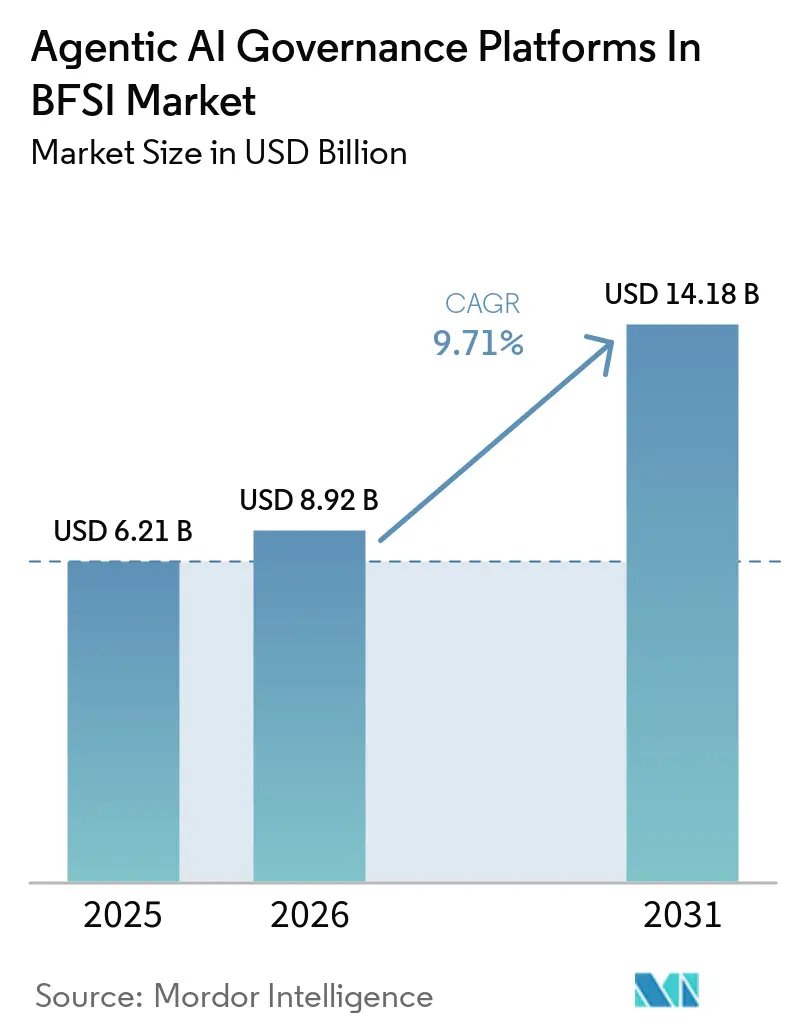
The Agentic AI Governance Platforms in BFSI Market size is expected to grow from USD 6.21 billion in 2025 to USD 8.92 billion in 2026, and is forecast to reach USD 14.18 billion by 2031, at a 9.71% CAGR over 2026-2031. Financial institutions are moving autonomous agents from trials into operating workflows, making governance controls part of deployment planning. New obligations in Europe and supervisory attention in other major markets are increasing demand for traceability, authorization, and human oversight. The Agentic AI Governance Platforms in BFSI Market also benefit from a shift away from one-time model review toward continuous control of interconnected agents. Buyers are seeking platforms that can cover policy enforcement, evidence collection, and regulatory mapping across business units. This favors suppliers that combine product depth with implementation support and can operate across cloud and internal environments.
Key Report Takeaways
- By offering, software held 68.23% of the Agentic AI Governance Platforms in BFSI Market share in 2025, while services is forecast to grow at 11.34% CAGR through 2031.
- By deployment, cloud deployment held 54.61% of the Agentic AI Governance Platforms in BFSI Market share in 2025, while hybrid architecture is forecast to grow at 11.27% CAGR through 2031.
- By organization size, large banks and financial groups accounted for 41.86% of revenue in 2025, while small banks, fintechs, and insurtechs are forecast to grow at a 10.93% CAGR through 2031.
- By governance function, regulatory compliance and control mapping accounted for 19.42% of revenue in 2025, while explainability and transparency are forecast to grow at a 11.68% CAGR through 2031.
- By geography, North America accounted for 38.17% of revenue in 2025, while Asia-Pacific is forecast to grow at a 10.81% CAGR through 2031.
Note: Market size and forecast figures in this report are generated using Mordor Intelligence’s proprietary estimation framework, updated with the latest available data and insights as of January 2026.
Market Trends and Insights
Drivers Impact Analysis of Agentic AI Governance Platforms In BFSI Market*
| Driver | (~) % Impact on CAGR Forecast | Geographic Relevance | Impact Timeline |
|---|---|---|---|
| Enterprise Demand for Autonomous Workflow Transformation | +2.8% | Global, North America primary | Short term (≤ 2 years) |
| Growing Need for AI Governance and Sovereign AI Readiness | +2.4% | Global, EU primary, APAC growing | Medium term (2-4 years) |
| Rising Complexity of Multi-Agent Enterprise Deployments | +1.9% | Global | Short term (≤ 2 years) |
| Expansion of Agentic AI Use Cases Across Regulated Industries | +1.3% | Global, Asia-Pacific and North America core | Medium term (2-4 years) |
| Shortage of Specialized Agentic AI Engineering and Change-Management Talent | +0.9% | North America and Europe primarily | Medium term (2-4 years) |
| Shift Toward Outcome-Based Agentic AI Transformation Programs | +0.4% | North America and Europe | Long term (≥ 4 years) |
| Source: Mordor Intelligence | |||
Enterprise Demand for Autonomous Workflow Transformation
Financial institutions are deploying agentic AI in production workflows, increasing the need for controls at each step. Barclays re-engineered client due diligence with agentic orchestration across document review, sanctions screening, and approval routing, while retaining audit evidence at each step. Standard Chartered described agentic AI as an operating model that institutions can begin adopting today, provided it is deployed safely within existing architecture.[1] The Agentic AI Governance Platforms in BFSI Market is therefore moving beyond traditional model validation toward lifecycle controls that cover agent identity, permissions, decisions, and records. Multi-agent systems combine orchestration, shared memory, and deterministic and nondeterministic workflows, which makes early control design more practical than later remediation. This requirement supports demand for platforms that integrate with operational systems rather than serving only as a compliance repository.
Growing Need for AI Governance and Sovereign AI Readiness
Regulatory requirements are making governance a procurement need rather than a separate best-practice exercise. The EU AI Act introduces transparency obligations as of August 2, 2026, adding direct duties for institutions that deploy relevant customer-facing AI systems.[2] The EBA updated internal governance guidelines in January 2026 to include AI risk management expectations covering board accountability, validation, and explainability for credit decisions. The United Kingdom’s financial authorities stated in May 2026 that firms should plan for and address AI-related cyber vulnerabilities at a pace that matches the pace of AI-driven threats. Sovereign AI priorities also encourage hybrid and internal deployments in which institutions retain sensitive data and controls within defined security boundaries. The Agentic AI Governance Platforms in BFSI Market can benefit when one system maps controls across regulatory and data-residency requirements without creating duplicate evidence work.
Rising Complexity of Multi-Agent Enterprise Deployments
Multi-agent deployments impose broader control requirements than a single model or chatbot. AWS identifies agent authentication, tool authorization, audit traces, and per-run cost controls as core requirements for financial services systems. FINRA expects firms that use agents with transaction authority to define access limits, behavioral guardrails, and traceability for agents' actions and decisions. These requirements increase the value of runtime governance, where policies are applied before an agent completes an action. The Agentic AI Governance Platforms in BFSI Market is also supported by the gap between awareness and operating readiness across financial institutions. A 2026 academic preprint found that only 24 of 75 large U.S. money managers that disclosed AI use reported a formal governance policy, and none reported an operational agentic AI governance framework. Platforms that connect decision traces, authority settings, and records can address this gap more directly than static documentation tools.
Expansion of Agentic AI Use Cases Across Regulated Industries
The use of agentic AI is expanding across financial activities, with varying supervisory and documentation requirements. Cambridge’s 2026 financial services report found that fintechs were more likely than incumbents to be at the transforming stage of AI adoption, with data quality, talent, and legacy architecture limiting progress.[3] Insurance uses involving life and health risk assessment and pricing can fall within the EU AI Act’s high-risk classifications, increasing the need for documentation and monitoring. Treasury management, multi-step compliance work, and post-trade processes each require different action logs and audit records. The Agentic AI Governance Platforms in BFSI Market has room to grow where buyers need one framework across credit, payments, insurance, trading, and reporting. Suppliers that address only credit scoring or conventional model reviews may become less relevant as enterprise use cases broaden.
Restraints Impact Analysis of Agentic AI Governance Platforms In BFSI Market*
| Restraint | (~) % Impact on CAGR Forecast | Geographic Relevance | Impact Timeline |
|---|---|---|---|
| Unclear Return on Investment for High-Autonomy Workflows | -1.8% | Global | Short term (≤ 2 years) |
| Accountability Gaps in Autonomous Decision-Making | -1.4% | Global, Europe and North America primarily | Medium term (2-4 years) |
| Fragmented Agent Interoperability and Evaluation Standards | -1.0% | Global | Medium term (2-4 years) |
| Rising Compute, Inference, and AgentOps Costs | -0.7% | Global | Short term (≤ 2 years) |
| Source: Mordor Intelligence | |||
Unclear Return on Investment for High-Autonomy Workflows
Governance platform budgets can be difficult to justify because much of the benefit appears as lower risk and faster audit work rather than immediate revenue. NTT DATA reported that agentic AI infrastructure upgrades may require 3 to 5 times the original AI investment budget, while complex implementations can add material inefficiency costs. EY noted that governance, organizational change, and regulatory impact become more visible as deployments scale, which requires a full view of the cost of ownership. The Agentic AI Governance Platforms in BFSI Market may face longer purchasing cycles when control benefits cannot be connected to clear business outcomes. A 2026 survey reported that only 18% of banking leaders were confident their AI controls would pass an independent review. Suppliers that document savings in audit time, approval cycles, and remediation effort can make the business case easier for buyers to evaluate.
Accountability Gaps in Autonomous Decision-Making
Autonomous decision chains can produce results that traditional inventory and validation methods do not capture. Guidehouse stated that individually acceptable actions across connected agents can create unintended outcomes, which creates a different control issue from a conventional model error. The EU AI Act’s transparency requirements increase the importance of records that show how and why relevant actions occurred. This makes it difficult to establish provenance across a large agent fleet when agents pass work and context between systems. The Agentic AI Governance Platforms in BFSI Market can address this need through action-level trails rather than simple model-version logs. However, the investment needed to establish these trails can delay a buyer’s decision, even where the underlying risk is already recognized.[4]
*Our forecasts treat driver/restraint impacts as directional, not additive. The impact forecasts reflect baseline growth, mix effects, and variable interactions.
Agentic AI Governance Platforms In BFSI Market Segment Analysis
By Offering:
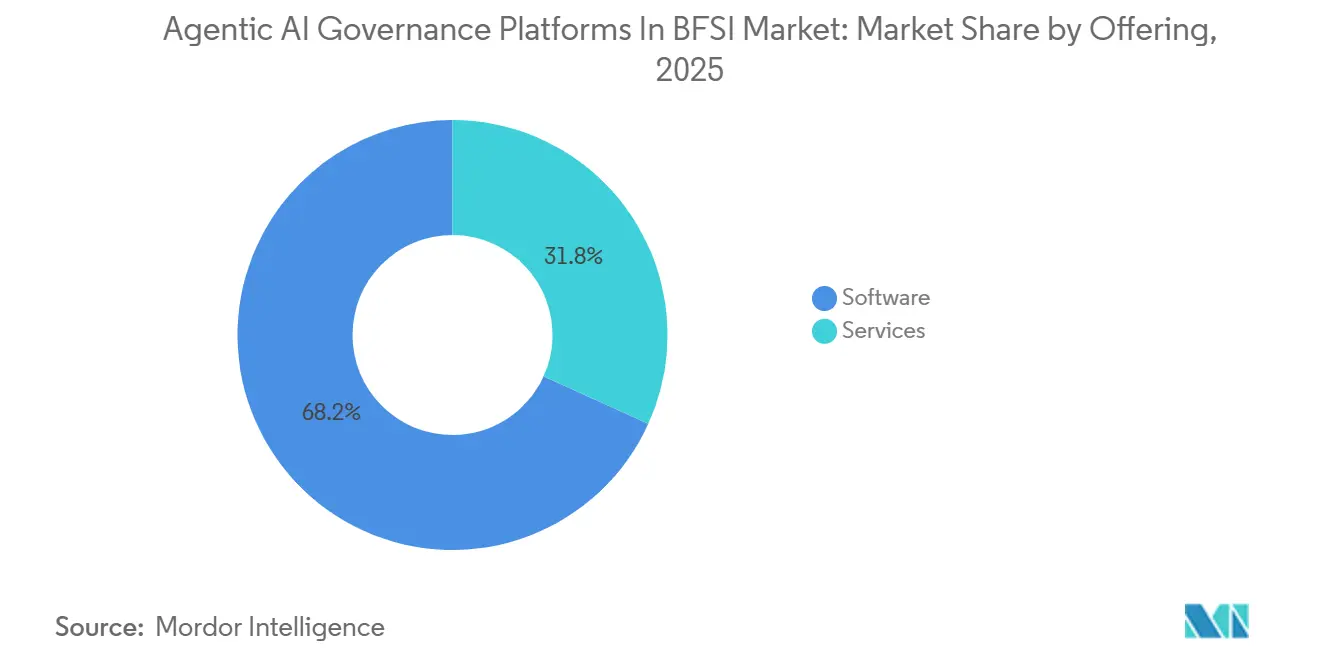
Software Leads While Services Support DeploymentSoftware held 68.23% of the Agentic AI Governance Platforms in BFSI Market share in 2025. Financial institutions in the Agentic AI Governance Platforms in BFSI Market initially prioritized platform licenses that support inventories, policy enforcement, and regulatory mapping across their expanding AI estates. These functions can be applied to a growing number of agents without matching the growth in manual-checking workload. Software also provides risk, compliance, and technology teams with a shared platform for managing policies and gathering evidence. The leading share reflects a need for repeatable controls rather than separate advisory projects for every implementation.
Services in the Agentic AI Governance Platforms in BFSI Market is forecast to grow at 11.34% CAGR from 2026 to 2031. Platform implementation requires change management, data integration, workflow redesign, and calibration against institution-specific rules. Internal teams may not have enough specialized staff to complete this work while maintaining existing control programs. This can shift demand toward managed services and specialist implementation partners that understand financial services processes. The Agentic AI Governance Platforms in BFSI Market industry is likely to reward vendors that combine software with practical deployment support.
By Deployment:
Cloud Leads While Hybrid Architecture Gains GroundCloud deployment accounted for 54.61% of the Agentic AI Governance Platforms in BFSI Market size in 2025. Cloud environments in the Agentic AI Governance Platforms in BFSI Market support shared monitoring workloads, standardized updates, and flexible computing capacity for governance operations. They also fit the broader use of cloud-native risk and compliance infrastructure by financial institutions. Many institutions can use cloud services for workloads that do not contain their most sensitive agent records. This makes cloud deployment a practical starting point for governance rollouts.
Hybrid architecture in the Agentic AI Governance Platforms in BFSI Market is forecast to grow at 11.27% CAGR from 2026 to 2031. Institutions operating in several jurisdictions must balance cloud efficiency with data residency, audit rights, and third-party risk controls. Hybrid designs let institutions retain sensitive audit logs, validation evidence, and decision records within their own environments. BaFin’s December 2025 guidance on ICT risks associated with AI use reinforces the need for financial institutions to manage technology risk. The Agentic AI Governance Platforms in BFSI Market can benefit from products that apply the same policy across cloud and internal systems.
By Organization Size:
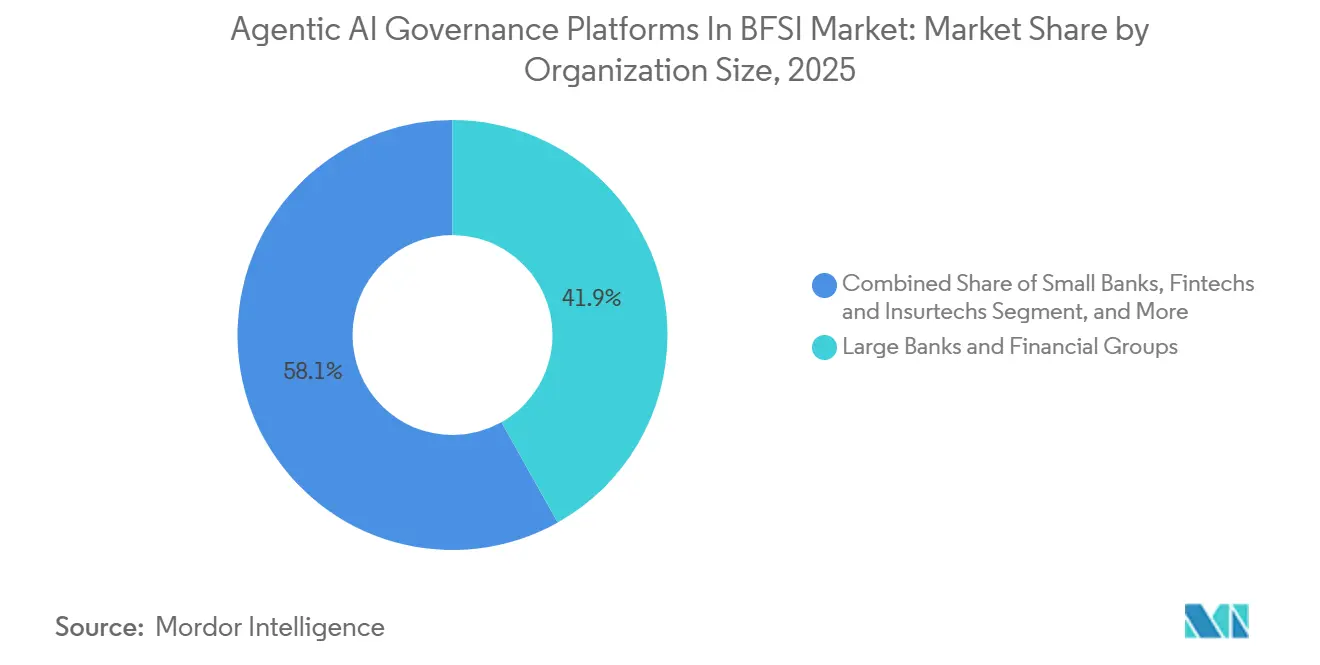
Large Banks Anchor Demand While Smaller Firms Grow FasterLarge banks and financial groups held 41.86% of Agentic AI Governance Platforms in BFSI Market revenue in 2025. Their scale, model portfolios, and exposure to multiple regulatory regimes create a clear need for formal governance systems. They often need a single control framework that supports credit, payments, insurance, and capital markets operations. Their procurement processes also place high value on reliable documentation and audit evidence. These needs make large institutions a central source of current demand.
Small banks, fintechs, and insurtechs are forecast to grow at 10.93% CAGR from 2026 to 2031. Their regulatory responsibilities are expanding even though their compliance teams are smaller and their technical resources are limited. Subscription-based tools can provide these organizations with access to governance capabilities without requiring them to build large internal control functions. Canada’s OSFI E-23 guidance, which takes effect in May 2027, is expected to increase the formal governance requirements for federally regulated institutions. The Agentic AI Governance Platforms in BFSI Market also serves mid-size banks, asset managers, insurers, and reinsurers with different use cases and risk exposures.

By Governance Function:
Compliance Mapping Leads While Explainability Grows FastestRegulatory compliance and control mapping held 19.42% of revenue in 2025. Institutions need to demonstrate how their controls align with applicable rules across credit, payments, insurance, and capital markets activities. A mapping failure can be evident during examinations, so this function is often treated as essential spending. It also connects internal policies to evidence that can be reviewed by risk teams, auditors, and supervisors. These requirements explain its leading position within the Agentic AI Governance Platforms in BFSI Market.
Explainability and transparency in the Agentic AI Governance Platforms in BFSI Market is forecast to grow at 11.68% CAGR from 2026 to 2031. The EU AI Act requires relevant transparency documentation for high-risk systems, thereby strengthening demand for records supporting the review of AI-supported decisions. Project Noor is developing tools to help supervisors independently evaluate AI model transparency, regardless of firm self-reporting. Inventory, risk classification, monitoring, and testing provide the underlying structure for these functions. Third-party AI risk management and audit reporting also become more important as banks use vendor-provided models and agents.
Geography Analysis
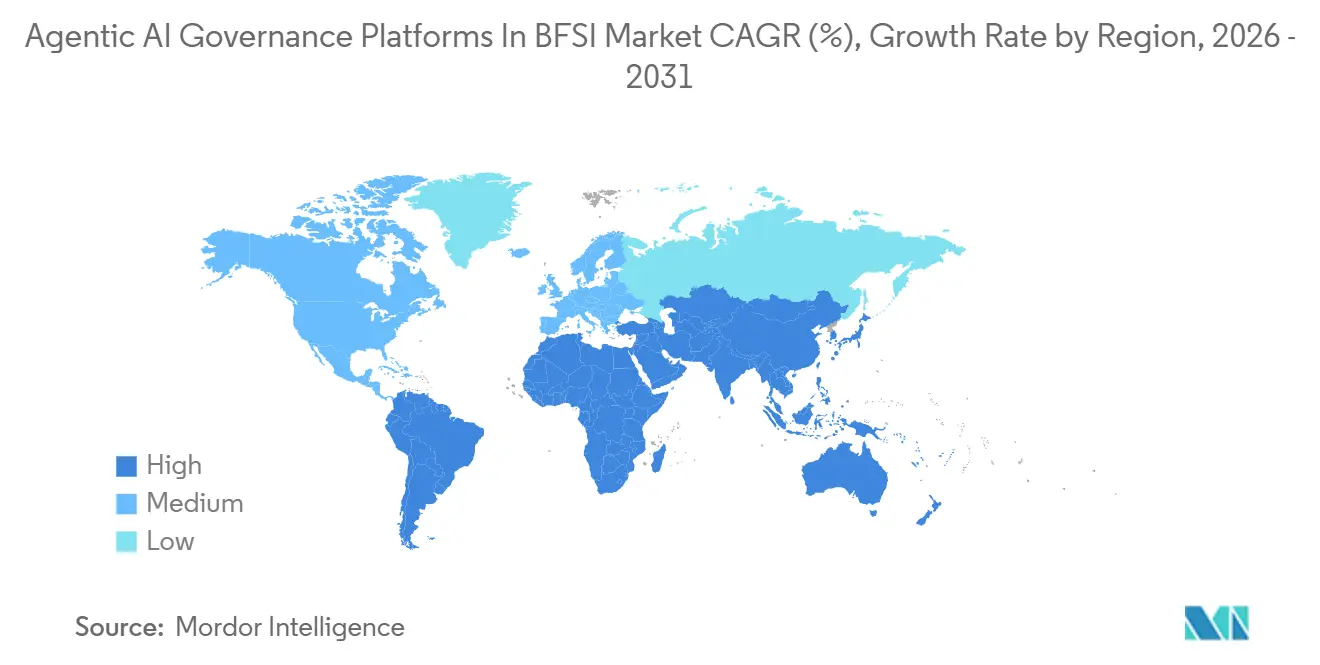
North America and Europe Agentic AI Governance Platforms in BFSI Market
North America held 38.17% of the Agentic AI Governance Platforms in BFSI Market share in 2025. Large bank technology budgets, sophisticated risk functions, and dense supervisory activity support demand across the region. Revised U.S. interagency model risk guidance in April 2026 changed the policy context for banks while leaving institutions to establish governance for generative and agentic AI outside the formal model risk scope. The U.S. Treasury’s financial services AI risk framework provides sector-specific control objectives that can help institutions structure these programs. Europe remains a major opportunity because banks must address the combined operational resilience and AI governance burden, while the ECB’s 2026 to 2028 supervisory priorities include a closer focus on generative AI applications in banking.
APAC and Middle East Agentic AI Governance Platforms in BFSI Market
Asia-Pacific is forecast to grow at 10.81% CAGR from 2026 to 2031. Singapore’s SAFR framework requires agentic actions to be declared, authorized, and assessed before execution, thereby supporting the demand for action-level controls. India’s evolving requirements for the Agentic AI Governance Platforms in BFSI Market emphasize explainability, accountability, risk management, and post-deployment monitoring for financial institutions. China, Japan, South Korea, and Australia are following different oversight paths, but each increases attention to monitoring and fairness documentation. The Middle East is an early-adopting regional opportunity as national AI strategies, financial modernization programs, and sovereign investment priorities support deployment.
South America and Africa Agentic AI Governance Platforms in BFSI Market
South America is an emerging opportunity for the Agentic AI Governance Platforms in BFSI Market. Peru’s DS 115-2025-PCM requires documentation, transparency, and human oversight for high-risk AI use, strengthening the need for controls in finance. Colombia and Chile are advancing their national AI strategies on their own timelines. Africa has focused potential in South Africa, Nigeria, and Egypt, where fintech deployment can outpace governance infrastructure, creating demand for specialized compliance tools as local requirements mature.
Competitive Landscape
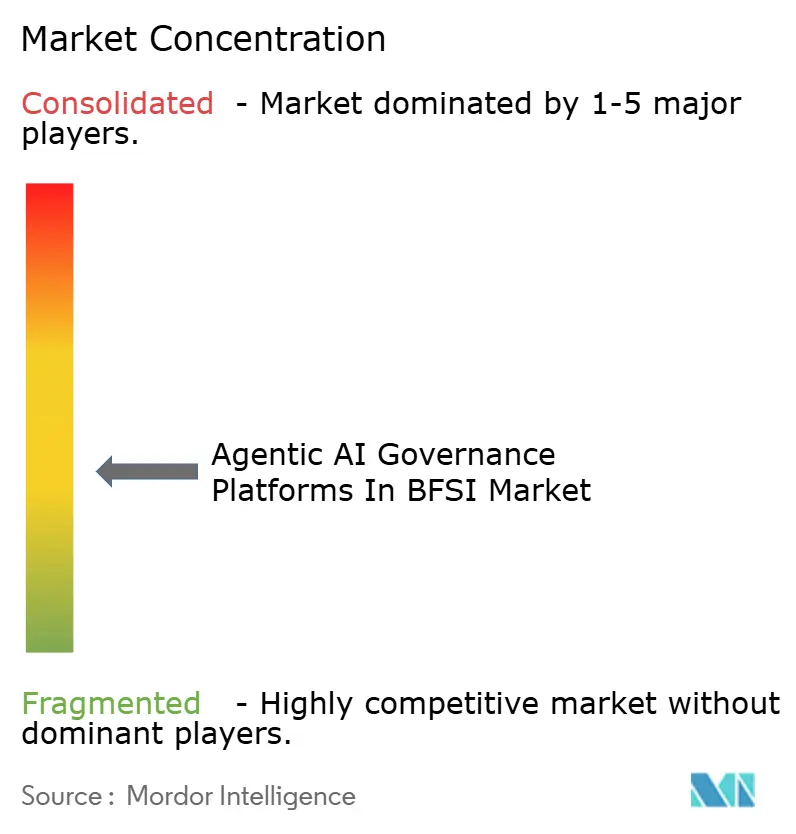
The Agentic AI Governance Platforms in BFSI Market is moderately fragmented. Purpose-built providers in the Agentic AI Governance Platforms in BFSI Market compete through regulatory mapping, lifecycle coverage, and runtime controls for actions completed by autonomous agents. Broader governance and MLOps vendors are adding related functions as modules within their existing platforms. Competition centers on pre-built regulatory mappings, session tracing, authority management, policy enforcement, and audit evidence. ISO/IEC 42001 is becoming a useful procurement reference where buyers want evidence of a structured AI management approach.
ValidMind released Atryum in June 2026 as an open-source control layer for AI agents and offered early access to its enterprise Agent Authority product. This move uses open infrastructure to broaden adoption while reserving enterprise controls for its commercial offering. Cranium AI acquired Aiceberg in May 2026 to combine AI security, governance, and agentic risk mapping across the lifecycle. This reflects the growing overlap between security controls, model oversight, and governance evidence. Fiddler AI raised USD 30 million in January 2026, bringing total funding to USD 100 million, to support its position as a control plane for compound AI systems.
The Agentic AI Governance Platforms in BFSI Market has open areas in cross-agent authority management, real-time auditability, and third-party AI risk management. These needs become more urgent when institutions use vendor-supplied agents or run interconnected workflows spanning several internal systems. Suppliers that link security telemetry with compliance evidence may gain an advantage in enterprise evaluations. The Financial Stability Board’s June 2026 consultation on sound practices for responsible AI adoption signals continued movement toward common global expectations.
Agentic AI Governance Platforms In BFSI Industry Leaders
-
International Business Machines Corporation
-
Credo AI
-
ModelOp, Inc.
-
Fiddler AI, Inc.
-
Holistic AI Limited
- *Disclaimer: Major Players sorted in no particular order
Agentic AI Governance Platforms In BFSI Market Companies Covered in this Report
- Credo AI, Inc.
- ValidMind, Inc.
- Fiddler AI, Inc.
- Holistic AI Limited
- ModelOp, Inc.
- Monitaur, Inc.
- Asenion Inc.
- Arthur AI, Inc.
- Trustible, Inc.
- Aporia Technologies Ltd.
- Truera, Inc.
- Saidot Oy
- International Business Machines Corporation
- Enkrypt AI, Inc.
- LatticeFlow AG
- Lakera AI AG
- Virtue AI, Inc.
- Veilfire, Inc.
- Straiker AI, Inc.
- Pillar Security, Inc.
- Cranium AI, Inc.
- Geordie AI, Inc.
- Aethryx AI Ltd.
- KLA Digital Ltd.
Recent Industry Developments in Agentic AI Governance Platforms In BFSI Market
- July 2026: Credo AI released Agent Governor (Research Preview), enabling compliance teams to enforce policies and monitor agent behavior in real time across enterprise agentic AI environments. This follows the May 2026 general availability of GAIA, the company’s AI governance agent, extending Credo AI’s agentic coverage across the full model-to-agent lifecycle.
- June 2026: ValidMind launched Atryum, an open-source control layer for AI agents available on GitHub, and announced early access to ValidMind Agent Authority, its enterprise product built on the Atryum framework. The release addresses action-level authority verification, checking whether an agent is authorized to act, not merely whether its credentials are valid, a gap that existing security and compliance tools do not close.
- May 2026: Cranium AI acquired Aiceberg, an agentic AI security and risk management company, creating an end-to-end platform spanning AI discovery, security, governance, and agentic risk mapping across the full AI lifecycle. The deal integrates Aiceberg’s runtime agentic risk-mapping technology with Cranium’s existing AI security framework.
- April 2026: Credo AI joined the Coalition for Health AI (CHAI) Partner Program to advance standardized vendor AI assessments and governance workflows for agentic AI in healthcare, extending the platform’s applicability across regulated sectors beyond financial services.
Global Agentic AI Governance Platforms In BFSI Market Report Scope
The Agentic AI Governance Platforms in BFSI Market refer to specialized software and services designed to manage the risks and compliance of autonomous AI agents in the banking, financial services, and insurance sectors. These platforms provide comprehensive governance functions, including model lifecycle management, bias detection, regulatory compliance mapping, and automated policy enforcement. Deployed in cloud or on-premises models, they enable financial institutions to securely scale agentic AI while ensuring transparency, data privacy, and compliance with strict industry regulations.
The Agentic AI Governance Platforms in BFSI Market Report is Segmented by Offering (Software and Services), Deployment (Cloud Deployment, On-Premises Deployment, and Hybrid), Organization Size (Large Banks and Financial Groups, Mid-Size Banks and Credit Institutions, Small Banks, Fintechs and Insurtechs, Asset Managers and Capital Markets Firms, and Insurance Companies and Reinsurers), Governance Function (AI Inventory and Discovery, Risk Classification and Tiering, Model and Agent Lifecycle Management, Policy Management and Policy-as-Code, Model Risk Management and Validation, Monitoring, Testing and Evaluation, Bias, Fairness and Discrimination Management, Explainability and Transparency, Privacy, Data Protection and Confidentiality, Regulatory Compliance and Control Mapping, Audit Evidence and Reporting, Third-Party AI Risk Management, and Incident Management and Remediation), and Geography (North America, South America, Europe, Asia-Pacific, Middle East, and Africa). The Market Forecasts are Provided in Terms of Value (USD).
Segmentation Overview
| Software |
| Services |
| Cloud Deployment |
| On-Premises Deployment |
| Hybrid |
| Large Banks and Financial Groups |
| Mid-Size Banks and Credit Institutions |
| Small Banks, Fintechs and Insurtechs |
| Asset Managers and Capital Markets Firms |
| Insurance Companies and Reinsurers |
| AI Inventory and Discovery |
| Risk Classification and Tiering |
| Model and Agent Lifecycle Management |
| Policy Management and Policy-as-Code |
| Model Risk Management and Validation |
| Monitoring, Testing and Evaluation |
| Bias, Fairness and Discrimination Management |
| Explainability and Transparency |
| Privacy, Data Protection and Confidentiality |
| Regulatory Compliance and Control Mapping |
| Audit Evidence and Reporting |
| Third-Party AI Risk Management |
| Incident Management and Remediation |
| North America | United States |
| Canada | |
| Mexico | |
| South America | Brazil |
| Argentina | |
| Chile | |
| Rest of South America | |
| Europe | Germany |
| United Kingdom | |
| France | |
| Italy | |
| Spain | |
| Rest of Europe | |
| Asia-Pacific | China |
| Japan | |
| India | |
| South Korea | |
| Australia | |
| Rest of Asia-Pacific | |
| Middle East | United Arab Emirates |
| Saudi Arabia | |
| Qatar | |
| Rest of Middle East | |
| Africa | South Africa |
| Egypt | |
| Nigeria | |
| Rest of Africa |
| By Offering | Software | |
| Services | ||
| By Deployment | Cloud Deployment | |
| On-Premises Deployment | ||
| Hybrid | ||
| By Organization Size | Large Banks and Financial Groups | |
| Mid-Size Banks and Credit Institutions | ||
| Small Banks, Fintechs and Insurtechs | ||
| Asset Managers and Capital Markets Firms | ||
| Insurance Companies and Reinsurers | ||
| By Governance Function | AI Inventory and Discovery | |
| Risk Classification and Tiering | ||
| Model and Agent Lifecycle Management | ||
| Policy Management and Policy-as-Code | ||
| Model Risk Management and Validation | ||
| Monitoring, Testing and Evaluation | ||
| Bias, Fairness and Discrimination Management | ||
| Explainability and Transparency | ||
| Privacy, Data Protection and Confidentiality | ||
| Regulatory Compliance and Control Mapping | ||
| Audit Evidence and Reporting | ||
| Third-Party AI Risk Management | ||
| Incident Management and Remediation | ||
| By Geography | North America | United States |
| Canada | ||
| Mexico | ||
| South America | Brazil | |
| Argentina | ||
| Chile | ||
| Rest of South America | ||
| Europe | Germany | |
| United Kingdom | ||
| France | ||
| Italy | ||
| Spain | ||
| Rest of Europe | ||
| Asia-Pacific | China | |
| Japan | ||
| India | ||
| South Korea | ||
| Australia | ||
| Rest of Asia-Pacific | ||
| Middle East | United Arab Emirates | |
| Saudi Arabia | ||
| Qatar | ||
| Rest of Middle East | ||
| Africa | South Africa | |
| Egypt | ||
| Nigeria | ||
| Rest of Africa | ||
Key Questions Answered in the Report
What is the size of the Agentic AI Governance Platforms in BFSI Market?
The market is USD 8.92 billion in 2026 and is forecast to reach USD 14.18 billion by 2031, at a 9.71% CAGR over 2026-2031.
What is driving adoption of agentic AI governance platforms in BFSI?
Autonomous workflow deployment, enforceable AI obligations, and the need for traceable control of interconnected agents are the main drivers.
Which offering leads agentic AI governance platform demand in BFSI?
Software led with 68.23% of revenue in 2025, while services is the faster-growing offering at 11.34% CAGR through 2031.
Why are hybrid governance deployments growing in financial services?
Hybrid architecture supports data residency, audit rights, and internal retention of sensitive logs, while allowing use of cloud infrastructure.
Which region is growing fastest for AI governance platforms in BFSI?
Asia-Pacific is forecast to expand at 10.81% CAGR through 2031, supported by action-level governance expectations in Singapore and evolving requirements across the region.
What capabilities do banks need from agentic AI governance platforms?
Banks need authorization controls, action-level audit trails, policy enforcement, regulatory mapping, monitoring, and explainability records.