
Agentic AI Governance Platform In Public Sector Market Size and Share
Market Overview
| Study Period | 2020 - 2031 |
|---|---|
| Market Size (2026) | USD 10.91 Billion |
| Market Size (2031) | USD 44.09 Billion |
| Growth Rate (2026 - 2031) | 32.22 % |
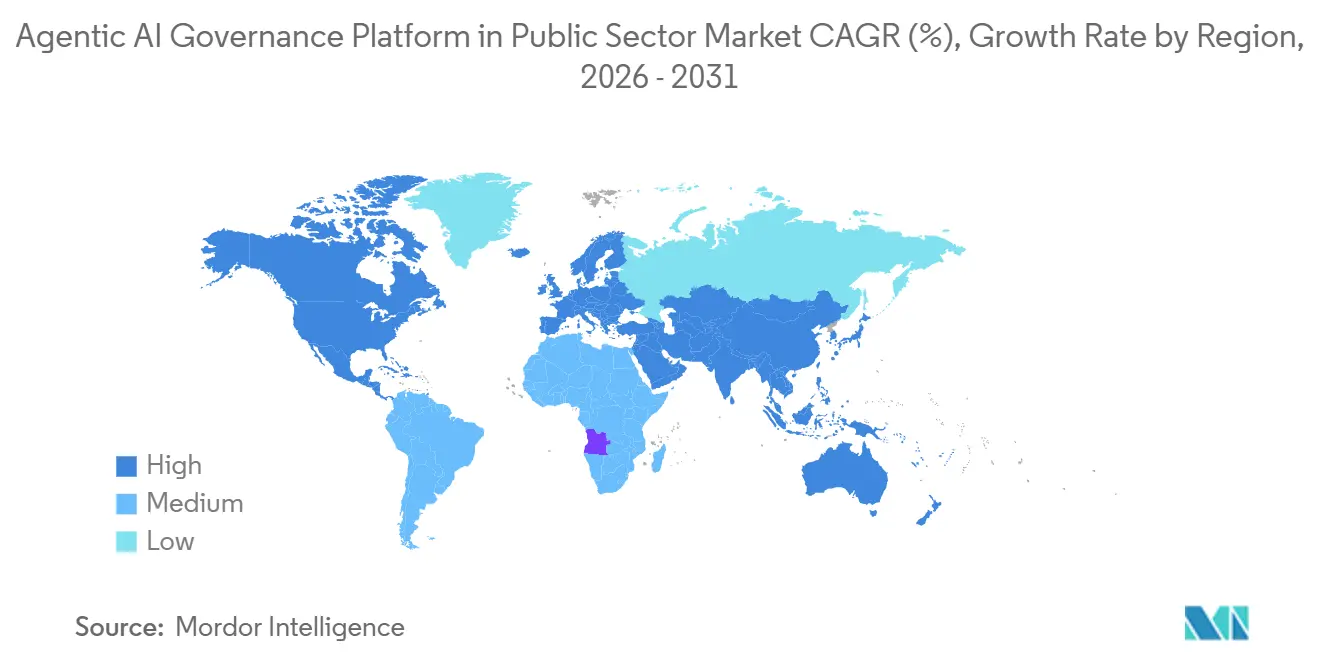
| Fastest Growing Market | Asia-Pacific |
| Largest Market | North America |
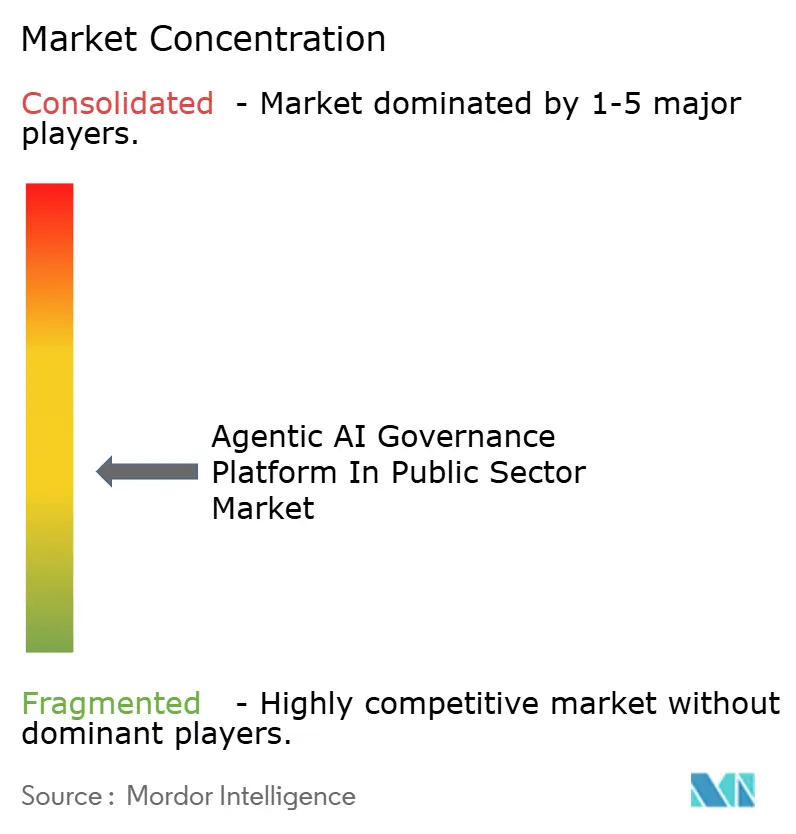
| Market Concentration | Medium |
Major Players *Disclaimer: Major Players sorted in no particular order Image © Mordor Intelligence. Reuse requires attribution under CC BY 4.0. | |
Agentic AI Governance Platform In Public Sector Market Analysis by Mordor Intelligence
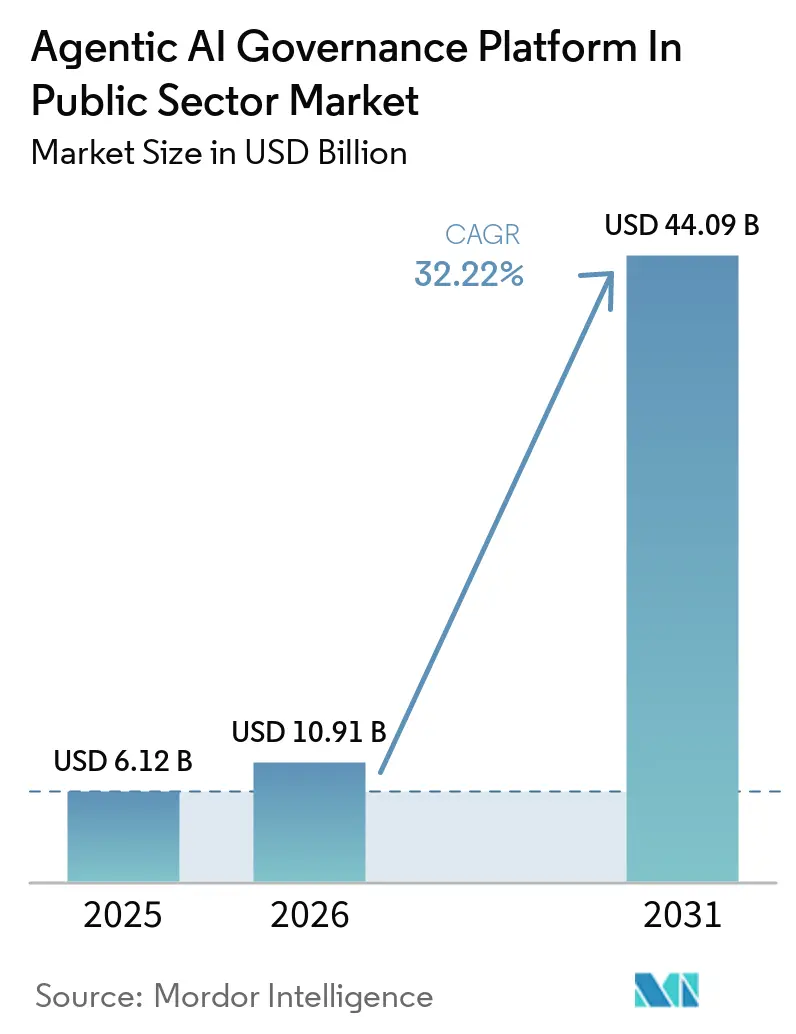
The Agentic AI governance platform in public sector market size was valued at USD 6.12 billion in 2025 and is estimated to grow from USD 10.91 billion in 2026 to reach USD 44.09 billion by 2031, at a CAGR of 32.22% during the forecast period (2026-2031). Mandatory compliance rules are moving agency purchases from pilot projects toward operational controls that document each important AI action. Autonomous workflows also create demand because agencies need to trace how an agent gathered information, applied rules, and prepared a recommendation. Sovereign deployment requirements are expanding opportunities for vendors that can retain records locally and provide audit-ready logs. Government buyers are increasingly favoring suppliers that support public procurement channels instead of requiring commercial purchasing processes. The Agentic AI governance platform in public sector market therefore depends on both regulatory readiness and the ability to fit diverse government technology environments.
Key Report Takeaways
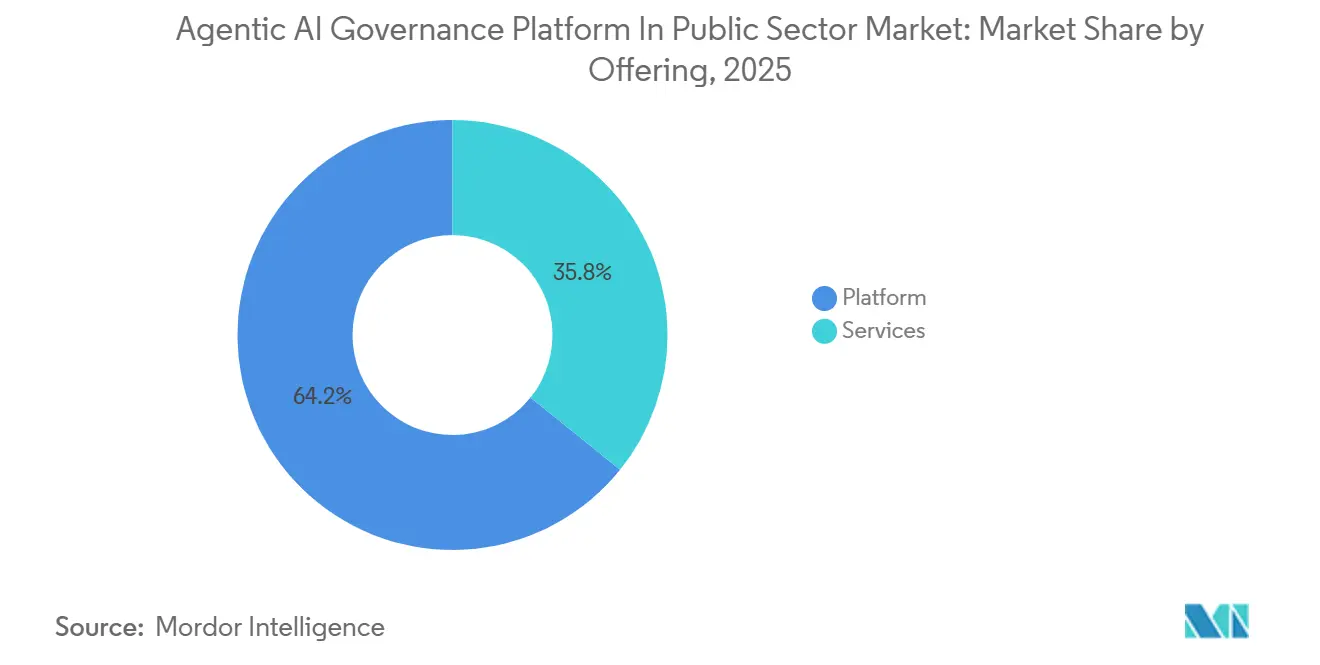
- By offering, Platform held 64.23% of the Agentic AI governance platform in public sector market share in 2025, while Services is projected to grow at a 33.47% CAGR through 2031.
- By governance function, Policy Management and Compliance accounted for 28.61% of the Agentic AI governance platform in public sector market share in 2025, while Explainability and Transparency is forecast to expand at a 33.84% CAGR through 2031.
- By deployment mode, Cloud held 57.12% of 2025 installations, while Hybrid is projected to grow at a 33.26% CAGR through 2031.
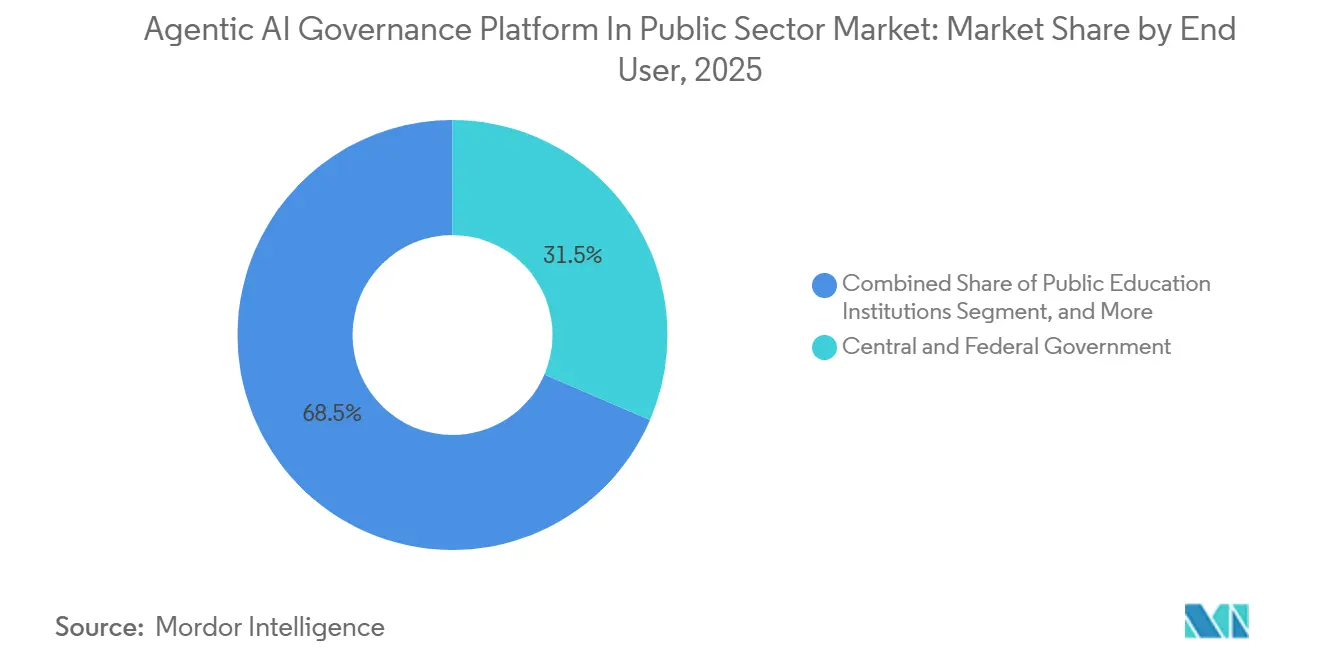
- By end user, Central and Federal Government agencies represented 31.46% of 2025 demand, while Public Education Institutions are expected to record a 33.71% CAGR through 2031.
- By organization size, Large Government Organizations commanded 71.28% of 2025 demand, while Small and Medium-Sized Government Organizations are forecast to grow at a 33.92% CAGR through 2031.
- By geography, North America accounted for 42.37% share of the Agentic AI governance platform in public sector market, while Asia-Pacific is forecast to grow at 34.08% CAGR through 2031.
Note: Market size and forecast figures in this report are generated using Mordor Intelligence’s proprietary estimation framework, updated with the latest available data and insights as of January 2026.
Market Trends and Insights
Drivers Impact Analysis of Agentic AI Governance Platform In Public Sector Market*
| Driver | (~) % Impact on CAGR Forecast | Geographic Relevance | Impact Timeline |
|---|---|---|---|
| Public-Sector Digital Service Modernization | +8.5% | Global | Short term (≤ 2 years) |
| Mandatory AI Accountability and Assurance Requirements | +7.2% | North America and EU | Short term (≤ 2 years) |
| Rising Deployment of Autonomous Government Workflows | +5.8% | Global, with concentration in North America and Asia-Pacific | Medium term (2-4 years) |
| Demand for Sovereign and Audit-Ready AI Operations | +4.6% | EU, Middle East, and Asia-Pacific | Medium term (2-4 years) |
| Agent Registries for Shadow-AI Discovery | +3.3% | North America and EU | Medium term (2-4 years) |
| Cross-Agent Permission and Identity Complexity | +2.4% | Global | Long term (≥ 4 years) |
| Source: Mordor Intelligence | |||
Public-Sector Digital Service Modernization
Government agencies across OECD countries used AI agents in permits, benefits, tax support, and border management during 2025 and 2026. These tools can work through incomplete records and ambiguous rules, which limits the usefulness of earlier automation controls. mapped 70 government functions by agentic AI potential and deployment complexity in April 2026.[1] Agencies with modernized data can move into deployment faster than agencies with disconnected legacy systems. In the Agentic AI governance platform in public sector market, suppliers that join data integration with policy controls can address this difference. reported that transparency registries and procurement support infrastructure still lag in government, leaving an operational gap for governance platforms.
Mandatory AI Accountability and Assurance Requirements
Regulatory requirements shifted from guidance to enforceable obligations during 2025 and 2026, shortening procurement timelines. Italy enacted Law No. 132/2025, assigning AgID as a notifying authority for its national AI framework. Japan's 2025 AI law created a structured basis for government risk assessment and oversight.[2] These rules make continuous records and clear responsibility more relevant when public services use AI systems. The Agentic AI governance platform in public sector market benefits where buyers need controls that map to multiple formal requirements. ISO/IEC 42001 alignment also provides agencies with a common reference point for assessing governance procedures.
Rising Deployment of Autonomous Government Workflows
Agentic systems now perform multi-step administrative work, including reviewing applications, requesting missing records, analyzing documents, and preparing proposals. Their decision paths can change at intermediate stages without a separate human approval event. Germany launched the Agentic AI Hub in March 2026, connecting 17 municipalities and 10 AI startups through 18 pilot projects focused on housing benefits and naturalization. The program provides evidence from municipal deployments rather than only conceptual policy discussions. It also shows why public buyers need identity, authorization, and activity records for each agent. The Agentic AI governance platform in public sector market is becoming more relevant as agencies move these workflows into live services.
Demand for Sovereign and Audit-Ready AI Operations
Data residency, verifiable audit trails, and model version records are becoming considerations in procurement for national AI programs. Government buyers need records that can support independent inspection rather than only technical troubleshooting. described a public-sector governance framework in 2025 that mapped controls to ISO/IEC 42001 and addressed agent actions.[3] Germany launched the MaKI national AI transparency register in January 2025 and planned a nationwide rollout from December 2025. This type of registry can give vendors an integration route into government governance processes. The Agentic AI governance platform in public sector market can gain where it supports local records, version control, and reviewable decision histories.
Restraints Impact Analysis of Agentic AI Governance Platform In Public Sector Market*
| Restraint | (~) % Impact on CAGR Forecast | Geographic Relevance | Impact Timeline |
|---|---|---|---|
| Unresolved Legal Liability for Autonomous Public Decisions | -4.2% | Global | Long term (≥ 4 years) |
| Fragmented Cross-Border AI Rules and Procurement Controls | -3.5% | EU, Asia-Pacific, and G7 cross-border | Medium term (2-4 years) |
| Prompt-Injection and Tool-Misuse Exposure in Citizen Services | -2.8% | Global | Short term (≤ 2 years) |
| Evidence Retention Burden Across Long-Lived Government Records | -1.9% | EU and North America | Long term (≥ 4 years) |
| Source: Mordor Intelligence | |||
Unresolved Legal Liability for Autonomous Public Decisions
An autonomous denial of a benefit claim or a security risk flag can make it difficult to assign responsibility. Existing administrative rules do not always separate the responsibilities of the agency, platform provider, and model developer. This uncertainty can delay procurement because legal teams need clearer exposure before approving deployments. It can also increase implementation costs when vendors include uncertainty in contract terms. The Agentic AI governance platform in public sector market faces this restraint even where technical controls are ready. Phased deployment and carefully defined contractual responsibilities can reduce friction until public rules become clearer.
Fragmented Cross-Border AI Rules and Procurement Controls
Government organizations working across jurisdictions must manage different risk categories, documentation rules, and audit expectations. In September 2025, France proposed establishing up to 16 competent authorities to implement the EU AI Act, creating multiple regulatory interfaces for public institutions. Canada's strategy, Japan's 2025 law, and U.S. policy frameworks also differ in their governance requirements. This variation raises configuration work and can extend deployment time, especially for smaller agencies without dedicated governance staff. The Agentic AI governance platform in public sector market needs policy engines that recognize jurisdictional differences without creating separate systems for each rule. Vendors that map controls across NIST AI RMF requirements and EU AI Act obligations can be more useful to cross-border buyers.
*Our forecasts treat driver/restraint impacts as directional, not additive. The impact forecasts reflect baseline growth, mix effects, and variable interactions.
Agentic AI Governance Platform In Public Sector Market Segment Analysis
By Offering:
Platform Anchors Revenue, Services Drive ExpansionPlatform held 64.23% of the 2025 Agentic AI governance platform in public sector market share because agencies preferred integrated suites over separate point tools. These suites bring policy enforcement, bias monitoring, explainability, and audit logging into a single working environment. A consolidated setup can reduce the burden of coordinating several suppliers and evidence stores. It is particularly useful when an agency needs common policies across several AI applications. Platform demand also reflects the need to monitor both models and autonomous agents. The preference for integrated control points supports the central role of platforms in public procurement.
Services are projected to grow at a 33.47% CAGR from 2026 to 2031 as agencies require configuration, calibration, and ongoing operational support. Many government IT teams do not yet have the specialist skills needed to continuously manage governance tooling. Managed services can therefore help agencies maintain their controls after implementation. Credo AI announced a January 2026 arrangement that made the platform available through NASA SEWP V, ITES-SW2, NASPO ValuePoint, TIPS, and OMNIA Partners. This approach aligns with government purchasing processes rather than requiring buyers to use commercial channels. It reinforces the services opportunity within the Agentic AI governance platform in public sector market.
By Governance Function:
Policy and Compliance Lead, Explainability AcceleratesPolicy Management and Compliance captured 28.61% of the 2025 Agentic AI governance platform in public sector market share. Agencies need enforceable policies and a documented compliance record before other controls can carry institutional weight. This function provides the structure for reviewing whether systems operate within approved boundaries. It also creates a record that can be used in internal oversight and external review. Bias and fairness monitoring remains relevant for high-stakes work, including benefit decisions and predictive policing. Security, privacy, incident management, and performance monitoring address other risks that emerge as agents take actions across systems.
Explainability and Transparency is forecast to expand at a 33.84% CAGR through 2031. This pace reflects stronger expectations that citizen-facing AI decisions should be understandable and reviewable. The United Kingdom required algorithmic transparency reporting by central government departments in 2025, and 125 records had been published by midyear. Argentina's Public Procurement Directive No. 44/2026 established explainability as a requirement for government AI contracts. These requirements raise the value of tools that show how an AI output was reached. They also support broader adoption in the Agentic AI governance platform in public sector market.
By Deployment Mode:
Cloud Dominates, Hybrid Gains on Sovereignty ConcernsCloud held 57.12% of 2025 installations in the Agentic AI governance platform in public sector market. Faster procurement cycles, lower upfront investment, and connections to cloud-native AI development environments supported adoption. Cloud delivery can help agencies begin governance work without having to build separate local infrastructure. It can also simplify updates when rules and policies change. Amazon Bedrock received FedRAMP High authorization in GovCloud (US-West), creating a cloud path for agencies with demanding data controls. However, using the cloud does not eliminate the need to manage data classification and access restrictions.
Hybrid deployment is projected to grow at a 33.26% CAGR from 2026 to 2031. Agencies can use cloud environments for development while keeping classified or citizen-facing workloads within sovereign on-premises controls. This model retains flexibility while recognizing that some information cannot be hosted outside a controlled environment. On-premises deployments remain relevant for defense, intelligence, and public health organizations with strict classification rules. Suppliers need to synchronize policies across cloud and local settings if agencies are to maintain consistent oversight. That requirement creates a practical opening for the Agentic AI governance platform in public sector market.
By End User:
Federal Leadership Holds, Education Emerges as Growth EngineCentral and Federal Government agencies held 31.46% of the 2025 end-user demand. Mature procurement systems and Chief AI Officer requirements gave these agencies an early advantage in formalizing governance. Japan's May 2025 procurement guideline required national ministries to appoint a Chief AI Officer and conduct standardized risk assessments. Defense and national security agencies are also adopting controls for autonomous decision-support systems. The U.S. Department of Defense's APFIT program offers a structured procurement channel for relevant technology. These conditions support continued federal demand in the Agentic AI governance platform in public sector market.
Public Education Institutions are forecast to grow at a 33.71% CAGR through 2031. AI tutors, automated grading, and predictive student models increase the number of systems that require accountability. Education providers must consider how automated decisions affect students and how those decisions can be questioned. Jurisdictions that classify educational AI as high risk increase the need for documented governance. This creates a different adoption path from federal procurement, but the control needs are similar. Education therefore broadens the user base for the Agentic AI governance platform in public sector market.

By Organization Size:
Large Agencies Lead Spend, Smaller Bodies Scale FastLarge Government Organizations commanded 71.28% of the 2025 demand in the Agentic AI governance platform in public sector market. Their deployment volumes and budgets support investment in enterprise governance infrastructure. These organizations also face more visible regulatory scrutiny because they operate important public services at scale. Larger agencies can fund teams that connect governance systems across many applications. This helps explain their early spending position. Their requirements also encourage suppliers to develop full-featured platforms and procurement support.
Small and Medium-Sized Government Organizations is projected to grow at a 33.92% CAGR from 2026 to 2031. Subscription-priced cloud tools can lower the capital requirement that previously limited smaller agencies to static checklists. Germany's Agentic AI Hub showed this potential through municipal pilots involving district offices and AI startups. The pilots indicated that governance-embedded workflows can be used at scales below the enterprise level when implementing program structure. High-risk AI obligations apply regardless of organization size in relevant cases. This expands the addressable base for the Agentic AI governance platform in public sector market.
Geography Analysis
North America Agentic AI Governance Platform in Public Sector Market
North America held 42.37% of the 2025 Agentic AI governance platform in public sector market share. U.S. federal purchasing channels and deployments across defense and intelligence agencies supported the region's position. Executive Order 14409, issued in June 2026, directed agencies to strengthen AI infrastructure against exploitation by adversaries and modernize government systems. This reinforces the importance of controls across civilian and defense uses.[4] Federal requirements for auditable AI oversight also create demand for continuous records. The regional base rests on regulation, procurement infrastructure, and high-stakes deployment needs.
North America and APAC Agentic AI Governance Platform in Public Sector Market
Canada launched its AI for All strategy in June 2026, extending accountability and procurement requirements across public-sector deployments. The strategy broadens the demand for governance beyond the federal tier and into provincial bodies. Asia-Pacific is the fastest-growing geography, with a 34.08% CAGR projected through 2031. Japan's 2025 law and ministry-level procurement guidance create formal governance requirements for national bodies. Singapore published its whole-of-government Agentic AI Primer in April 2025, placing governance and compliance among foundational design considerations. These actions place the Agentic AI governance platform in public sector market within several distinct national policy programs.
Europe, Middle East and South America Agentic AI Governance Platform in Public Sector Market
Europe held the second-largest share in 2025, supported by the EU AI Act enforcement environment in 2026. Germany paired 17 municipalities with AI startups through its Agentic AI Hub while also pursuing a national transparency register. This pairing shows that governments can support both deployment and oversight simultaneously. Middle Eastern public institutions are also showing interest in sovereign AI compliance capabilities. Brazil's 2025 regulatory sandbox and Argentina's 2026 procurement directive show growing policy activity in South America. Together, these regions extend the opportunity for the Agentic AI governance platform in public sector market beyond its current largest geography.
Competitive Landscape
The Agentic AI governance platform in public sector market is moderately fragmented, and no supplier holds a dominant position across functions, deployment models, and regions. Credo AI, Fiddler AI, and ModelOp compete by offering public-sector integration and capabilities designed for autonomous agents. Vendors are differentiating around agent identity, multi-step logging, and policy enforcement across multiple agents. These capabilities address government buyers who need to know which agent took an action and under what authority. The field includes established governance specialists and newer suppliers focused on agentic systems. This mix keeps the competitive environment open while procurement and regulatory experience become increasingly important.
U.S.-focused vendors are using government purchasing vehicles, including FedRAMP, SEWP V, and ITES-SW2, to lower transaction barriers. Credo AI used this route in January 2026 by making the platform available through several government contract vehicles. European suppliers are developing more robust compliance features to meet the EU AI Act timetable. raised CHF 8.7 million in July 2025, equivalent to USD 9.57 million, to scale its AI governance platform. raised EUR 6 million in July 2026, equivalent to USD 6.60 million, to strengthen regulatory compliance automation. These moves show different regional routes to serve the Agentic AI governance platform in public sector market.
There remains a gap for real-time permission management across agents working in several public bodies. No generally available standards-compliant interoperability layer was identified in the supplied material for this use case. Smaller municipalities also need tools that are less complex than enterprise platforms. made its Agent Discovery and Governance platform available through Google Cloud Marketplace in January 2026, expanding access to agent discovery and policy controls. That move reflects the focus on production agent inventory and acceptable-use enforcement. The Agentic AI governance platform in public sector market can remain open to specialist suppliers that combine usable controls with public procurement access.
Agentic AI Governance Platform In Public Sector Industry Leaders
-
Microsoft Corporation
-
International Business Machines Corporation
-
DataRobot, Inc.
-
Credo AI, Inc.
-
ModelOp, Inc.
- *Disclaimer: Major Players sorted in no particular order
Agentic AI Governance Platform In Public Sector Market Companies Covered in this Report
- Credo AI, Inc.
- Microsoft Corporation
- International Business Machines Corporation
- ModelOp, Inc.
- Fiddler AI, Inc.
- Arthur AI, Inc.
- Monitaur, Inc.
- Fairly AI, Inc.
- DataRobot, Inc.
- Saidot Oy
- LatticeFlow AI AG
- Lumenova AI, Inc.
- Cranium AI, Inc.
- Enzai Limited
- Naaia SAS
- Fruggr SAS
- Corvair AI, Inc.
- Clarifai, Inc.
- Truera, Inc.
- Superwise AI Ltd.
Recent Industry Developments in Agentic AI Governance Platform In Public Sector Market
- June 2026: Canada's Prime Minister Mark Carney launched the "AI for All" national AI strategy, establishing mandatory AI accountability and procurement requirements for public-sector deployments that create governance platform demand across federal and provincial government bodies through the forecast period.
- June 2026: The White House signed Executive Order 14409, "Promoting Advanced Artificial Intelligence Innovation and Security," directing federal agencies to harden AI infrastructure against adversary exploitation, reinforcing compliance requirements for agentic AI governance platforms across U.S. federal and defense deployments.
- March 2026: Germany's Federal Ministry for Digital and State Modernization launched the Agentic AI Hub, pairing 17 municipalities with 10 AI startups across 18 pilot projects in housing benefit and naturalization workflows, generating real-world governance evidence for autonomous agent deployments at municipal scale.
- March 2026: Credo AI and Carahsoft announced a Master Government Aggregator partnership, making Credo AI's governance platform available to U.S. federal, state, and local agencies through NASA SEWP V, ITES-SW2, NASPO ValuePoint, TIPS, and OMNIA Partners procurement contracts aligned with NIST AI RMF requirements.
Global Agentic AI Governance Platform In Public Sector Market Report Scope
The Agentic AI Governance Platform In Public Sector Market refers to specialized platforms and services designed to manage, monitor, and secure autonomous AI agents used by government agencies and public institutions. These solutions provide critical governance functions, including policy compliance, bias monitoring, explainability, and incident management. Deployed via cloud, on-premises, or hybrid models, they help federal, state, local, and defense organizations ensure that their AI systems operate transparently, protect citizen data, and adhere to strict public-sector regulations.
The Agentic AI Governance Platform in Public Sector Market Report is Segmented by Offering (Platform, and Services), Governance Function (Policy Management and Compliance, Bias and Fairness Monitoring, Explainability and Transparency, Security and Privacy, Risk and Incident Management, Performance and Drift Monitoring, and Other Governance Functions), Deployment Mode (Cloud, On-Premises, and Hybrid), End User (Central and Federal Government, State, Provincial, and Regional Government, Local Government and Municipal Authorities, Defense and National Security Agencies, Public Healthcare Institutions, Public Education Institutions, and Public Utilities and Infrastructure Authorities), Organization Size (Large Government Organizations, and Small and Medium-Sized Government Organizations), and Geography (North America, South America, Europe, Asia-Pacific, Middle East, and Africa). The Market Forecasts are Provided in Terms of Value (USD).
Segmentation Overview
| Platform |
| Services |
| Policy Management and Compliance |
| Bias and Fairness Monitoring |
| Explainability and Transparency |
| Security and Privacy |
| Risk and Incident Management |
| Performance and Drift Monitoring |
| Other Governance Functions |
| Cloud |
| On-Premises |
| Hybrid |
| Central and Federal Government |
| State, Provincial, and Regional Government |
| Local Government and Municipal Authorities |
| Defense and National Security Agencies |
| Public Healthcare Institutions |
| Public Education Institutions |
| Public Utilities and Infrastructure Authorities |
| Large Government Organizations |
| Small and Medium-Sized Government Organizations |
| North America | United States |
| Canada | |
| Mexico | |
| South America | Brazil |
| Argentina | |
| Chile | |
| Rest of South America | |
| Europe | Germany |
| United Kingdom | |
| France | |
| Italy | |
| Spain | |
| Rest of Europe | |
| Asia-Pacific | China |
| Japan | |
| India | |
| South Korea | |
| Australia | |
| Rest of Asia-Pacific | |
| Middle East | United Arab Emirates |
| Saudi Arabia | |
| Qatar | |
| Rest of Middle East | |
| Africa | South Africa |
| Egypt | |
| Nigeria | |
| Rest of Africa |
| By Offering | Platform | |
| Services | ||
| By Governance Function | Policy Management and Compliance | |
| Bias and Fairness Monitoring | ||
| Explainability and Transparency | ||
| Security and Privacy | ||
| Risk and Incident Management | ||
| Performance and Drift Monitoring | ||
| Other Governance Functions | ||
| By Deployment Mode | Cloud | |
| On-Premises | ||
| Hybrid | ||
| By End User | Central and Federal Government | |
| State, Provincial, and Regional Government | ||
| Local Government and Municipal Authorities | ||
| Defense and National Security Agencies | ||
| Public Healthcare Institutions | ||
| Public Education Institutions | ||
| Public Utilities and Infrastructure Authorities | ||
| By Organization Size | Large Government Organizations | |
| Small and Medium-Sized Government Organizations | ||
| By Geography | North America | United States |
| Canada | ||
| Mexico | ||
| South America | Brazil | |
| Argentina | ||
| Chile | ||
| Rest of South America | ||
| Europe | Germany | |
| United Kingdom | ||
| France | ||
| Italy | ||
| Spain | ||
| Rest of Europe | ||
| Asia-Pacific | China | |
| Japan | ||
| India | ||
| South Korea | ||
| Australia | ||
| Rest of Asia-Pacific | ||
| Middle East | United Arab Emirates | |
| Saudi Arabia | ||
| Qatar | ||
| Rest of Middle East | ||
| Africa | South Africa | |
| Egypt | ||
| Nigeria | ||
| Rest of Africa | ||
Key Questions Answered in the Report
What is the size of the Agentic AI governance platform in public sector market?
The market was valued at USD 6.12 billion in 2025, is estimated at USD 10.91 billion in 2026, and is forecast to reach USD 44.09 billion by 2031.
What is driving government demand for agentic AI governance platforms?
Enforceable accountability requirements, digital service modernization, autonomous workflows, and sovereign audit needs are supporting demand.
Which offering leads public-sector adoption?
Platform led with 64.23% of 2025 demand because agencies favored integrated policy, monitoring, explainability, and audit capabilities.
Which deployment model is growing fastest for government governance tools?
Hybrid deployment is projected to grow at a 33.26% CAGR through 2031 as agencies combine cloud flexibility with sovereign local controls.
Which public-sector users are expanding adoption fastest?
Public Education Institutions is projected to grow at a 33.71% CAGR as AI tutoring, grading, and student models require accountable use.
Which region is expected to grow fastest through 2031?
Asia-Pacific is forecast to expand at a 34.08% CAGR, supported by national policy programs and formal governance requirements.