
Africa Organic Compost Market Size and Share
Market Overview
| Study Period | 2021 - 2031 |
|---|---|
| Forecast Data Period | 2026 - 2031 |
| Base Year Market Size (2025) | USD 180 Million |
| Market Size (2026) | USD 196 Million |
| Market Size (2031) | USD 300.20 Million |
| Growth Rate (2026 - 2031) | 8.90 % |
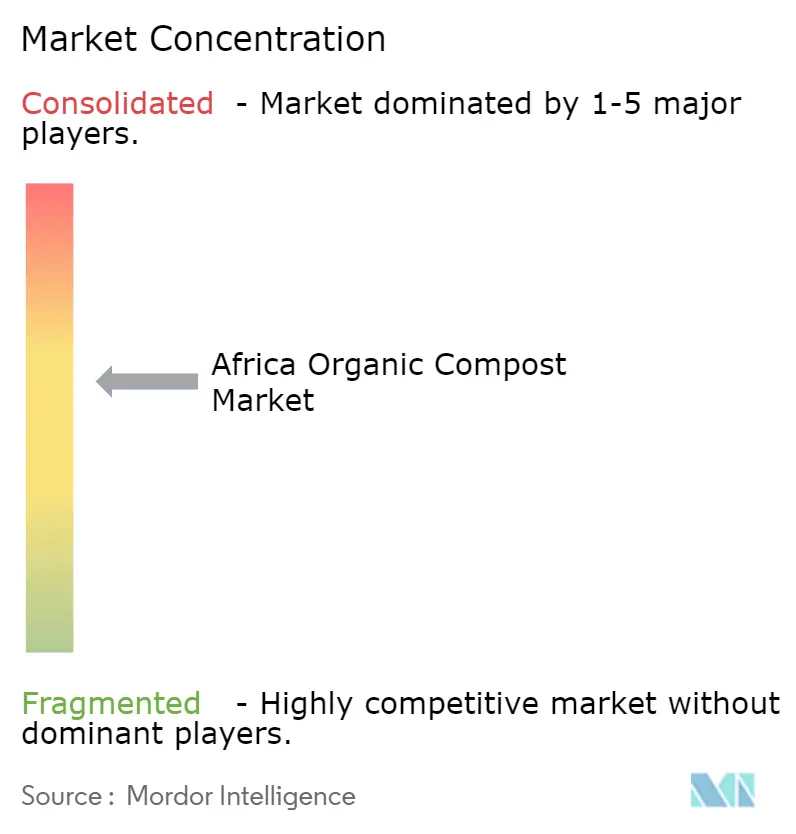
| Market Concentration | Medium |
Major Players *Disclaimer: Major Players sorted in no particular order Image © Mordor Intelligence. Reuse requires attribution under CC BY 4.0. | |
Africa Organic Compost Market Analysis by Mordor Intelligence
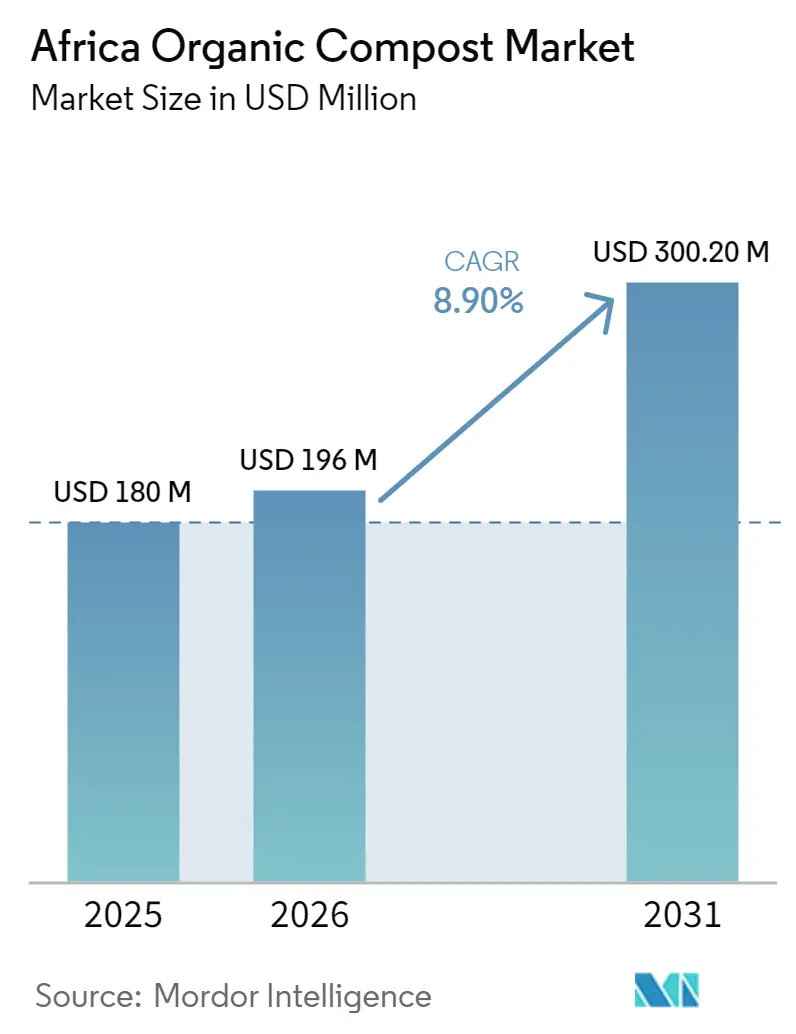
The Africa organic compost market size was valued at USD 180.0 million in 2025 and is projected to grow from USD 196.0 million in 2026 to USD 300.20 million by 2031, registering a CAGR of 8.90% during 2026-2031. The market's growth is driven by the issue of soil degradation, which has become a significant challenge for farm productivity across many cultivated areas. This has sustained demand for organic compost as a long-term solution for soil recovery rather than a short-term alternative to synthetic inputs. According to the Food and Agriculture Organization, 40% of Africa’s soils were degraded in 2025 due to factors such as erosion, nutrient depletion, and declining organic matter, maintaining a high structural demand for organic soil amendments. The market is further supported by the region's heavy reliance on imported synthetic fertilizers, which has exposed smallholder farmers to recurring price volatility. This has increased the relevance of locally produced compost in farm economics. Additionally, waste diversion policies, export-driven organic compliance requirements, and improved agronomic evidence are strengthening the commercial viability for compost producers, particularly those capable of securing clean feedstock and ensuring product consistency. However, certain challenges continue to limit faster market expansion. These include contamination in mixed waste streams, weak collection and distribution infrastructure, and a persistent preference among farmers for fast-acting synthetic nutrients, especially in seasonal cash crop systems.
Key Report Takeaways
- By product type, windrow compost accounted for 38.0% of the Africa organic compost market share in 2025, while vermicompost is forecast to grow at a CAGR of 13.2% from 2026 to 2031.
- By feedstock source, municipal organic waste held the largest share at 33.0% in 2025, while agricultural residues are forecast to grow at a CAGR of 11.1% from 2026 to 2031, making them the fastest-growing feedstock source.
- By form, granular compost accounted for the largest share at 41.0% in 2025, while liquid compost is forecast to grow at a CAGR of 12.4% from 2026 to 2031.
- By application, row crops held the largest share at 36.0% in 2025, while horticulture is forecast to grow at a CAGR of 12.0% from 2026 to 2031.
- By geography, South Africa accounted for the largest 29.0% share of the Africa organic compost market size in 2025, while Ethiopia is forecast to grow at a CAGR of 11.3% from 2026 to 2031.
Note: Market size and forecast figures in this report are generated using Mordor Intelligence’s proprietary estimation framework, updated with the latest available data and insights as of January 2026.
Market Trends and Insights
Drivers Impact Analysis of Africa Organic Compost Market*
| Driver | (~) % Impact on CAGR Forecast | Geographic Relevance | Impact Timeline |
|---|---|---|---|
| Rising soil organic matter depletion across intensively farmed zones | +2.3% | Pan-Africa, strongest in Sub-Saharan Africa cereal belts and irrigated zones in Morocco and Egypt | Long term (≥ 4 years) |
| Compost-based soil restoration supported by agronomic yield recovery evidence | +1.8% | East Africa and Southern Africa | Medium term (2-4 years) |
| Municipal organic waste diversion policies creating reliable feedstock streams | +1.5% | South Africa, Kenya, Morocco, Egypt, and Nigeria | Short term (≤ 2 years) |
| Smallholder input affordability versus imported synthetic fertilizer volatility | +1.2% | Sub-Saharan Africa, especially Ethiopia, Tanzania, and Uganda | Short term (≤ 2 years) |
| Expansion of certified organic horticulture and export crop value chains | +0.9% | Kenya, Ethiopia, Morocco, and Egypt | Medium term (2-4 years) |
| Carbon soil health and circular economy financing for compost producers | +0.6% | Kenya, Uganda, South Africa, Nigeria, and Morocco | Long term (≥ 4 years) |
| Source: Mordor Intelligence | |||
Rising Soil Organic Matter Depletion Across Intensively Farmed Zones
The depletion of soil organic matter in Africa's intensively cultivated agricultural regions is a significant factor driving the growth of the organic compost market in the region. According to the International Fund for Agricultural Development (IFAD), in 2024, approximately 75–80% of Africa's cultivated land is projected to be degraded, with soils losing 30–60 kg of essential nutrients per hectare annually[1]Source: International Fund for Agricultural Development (IFAD), “Africa Fertilizer and Soil Health Summit: A Catalyst for Change in African Agriculture,” ifad.org.. This ongoing nutrient loss diminishes soil fertility, water retention capacity, and biological activity, ultimately impacting long-term crop productivity. Consequently, farmers are increasingly turning to organic compost to restore soil organic matter, improve soil structure, and enhance resilience to climate-related production challenges, thereby contributing to the market's sustained growth.
Compost-Based Soil Restoration Supported by Agronomic Yield Recovery Evidence
Compost-based soil restoration is gaining traction as agronomic studies highlight its measurable productivity benefits, driving growth in the African organic compost market. A study titled “Effect of Vermicompost on Soil Fertility and Crop Productivity in the Drylands of Ethiopia” by Teka et al. (2024), published in Compost Science and Utilization, reported that applying 10 t ha−1 of vermicompost led to a 1.5-fold increase in grain yield compared to untreated control plots. Additionally, it enhanced soil organic carbon, total nitrogen, and available phosphorus levels. These scientifically validated improvements in yield and soil health are promoting the broader adoption of organic compost in African farming systems.
Municipal Organic Waste Diversion Policies Creating Reliable Feedstock Streams
Municipal organic waste diversion policies are enhancing feedstock availability in the Africa organic compost market by establishing more consistent streams of segregated organic material. Kenya’s 2024 Waste Management Regulations mandate waste generators to segregate waste at the source using the National Waste Colour Code[2]Source: National Environment Management Authority (NEMA Kenya), “Sustainable Waste Management (Segregation of Waste at Source) Regulations, 2024,” nema.go.ke.. This facilitates the separate collection of organic waste for composting and other circular-economy applications. The regulatory change enhances the quality and reliability of compost feedstocks while minimizing contamination from mixed waste streams. As additional African municipalities implement source-separation frameworks, compost producers are likely to experience improved feedstock security, greater operational efficiency, and scalable organic waste processing capabilities.
Smallholder Input Affordability Versus Imported Synthetic Fertilizer Volatility
Challenges related to smallholder input affordability and exposure to fluctuations in imported fertilizer prices are driving interest in locally sourced soil fertility solutions, thereby supporting the growth of the Africa organic compost market. A World Bank study published in 2024 revealed that fertilizer price shocks led to average fertilizer application shortfalls exceeding 55% of the desired quantities among farmers in Ethiopia, Tanzania, and Uganda[3]Source: World Bank, “Fertilizer Price Shocks and Farm Input Use in Sub-Saharan Africa,” worldbank.org.. Limited access to affordable fertilizers has restricted crop input usage and negatively impacted farm productivity, underscoring the vulnerability of African agriculture to disruptions in the global fertilizer market. Organic compost, as a locally available alternative, is gaining recognition for its potential to enhance soil fertility while reducing reliance on imported agricultural inputs.
Restraints Impact Analysis of Africa Organic Compost Market*
| Restraint | (~) % Impact on CAGR Forecast | Geographic Relevance | Impact Timeline |
|---|---|---|---|
| Feedstock contamination and inconsistent compost quality | -1.4% | Pan-Africa, strongest where source separation remains weak | Short term (≤ 2 years) |
| Weak collection, sorting, and logistics infrastructure | -1.2% | Sub-Saharan Africa, with secondary impact in Morocco and Egypt | Medium term (2-4 years) |
| Long payback cycles for industrial composting assets | -0.9% | Pan-Africa, especially landlocked and peri-urban markets | Long term (≥ 4 years) |
| Farmer preference for fast-acting nutrient inputs in cash crop systems | -0.7% | West Africa and North Africa cash crop systems | Short term (≤ 2 years) |
| Source: Mordor Intelligence | |||
Feedstock Contamination and Inconsistent Compost Quality
Feedstock contamination and inconsistent compost quality are key challenges in the Africa organic compost market, especially when organic waste is sourced from mixed municipal streams. A 2025 study published in Frontiers in Sustainable Food Systems highlights that inadequate source segregation and poor coordination among waste management, sanitation, and agricultural institutions hinder the production of high-quality compost in African countries. Contaminated feedstocks may introduce plastics, pathogens, and other impurities, reducing compost effectiveness and complicating compliance with quality standards. These issues lead to higher processing costs, diminished buyer confidence, and limited commercial adoption of compost products across the region.
Weak Collection, Sorting, and Logistics Infrastructure
Inadequate collection, sorting, and logistics infrastructure continues to hinder the growth of the Africa organic compost market by limiting the conversion of organic waste into commercially viable feedstock. According to the International Council for Local Environmental Initiatives (ICLEI) Circulars (2025), organic waste constitutes approximately 60% of the municipal solid waste stream generated in African cities. However, a significant portion of this waste remains uncollected, unsorted, or disposed of in dumpsites and landfills due to insufficient waste management infrastructure. The absence of efficient collection networks and processing facilities restricts feedstock availability, increases transportation costs, and limits operational scale, posing substantial challenges to the expansion of industrial composting activities in the region.
*Our forecasts treat driver/restraint impacts as directional, not additive. The impact forecasts reflect baseline growth, mix effects, and variable interactions.
Africa Organic Compost Market Segment Analysis
By Product Type:
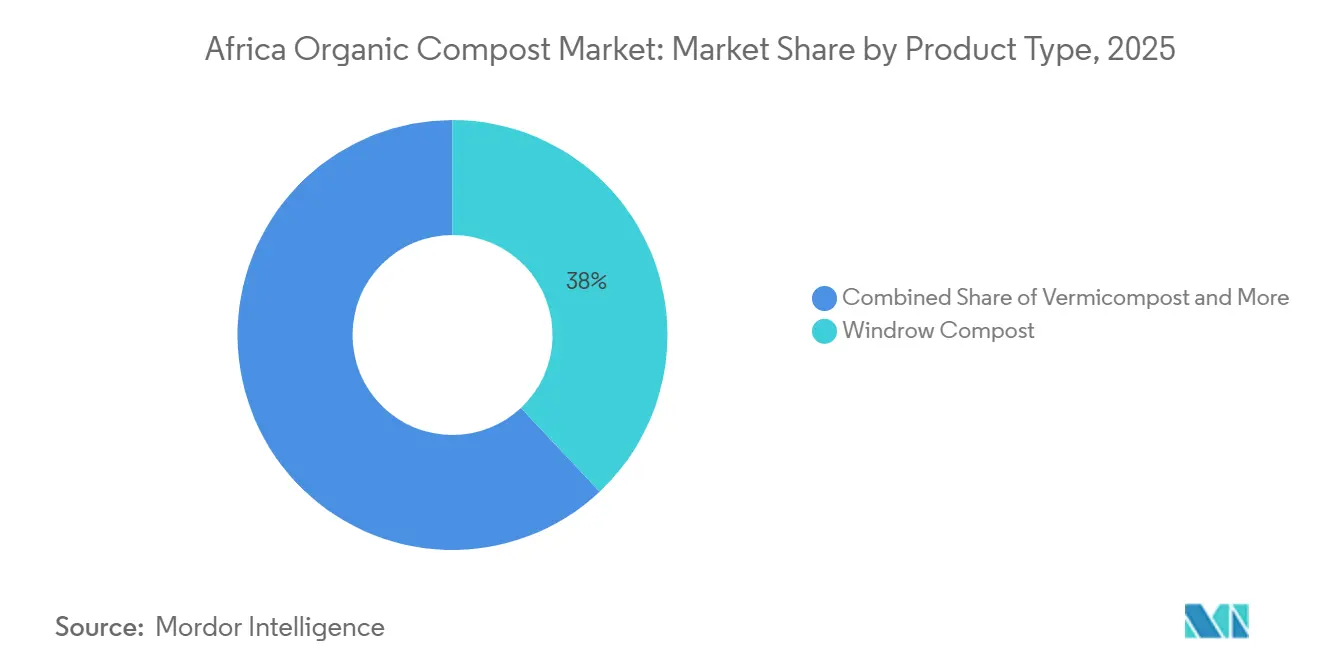
Windrow Compost Retains Scale While Vermicompost Expands FasterWindrow accounted for the largest at 38.0% of the Africa Organic Compost Market share in 2025. This method remains dominant due to its adaptability for processing a wide range of organic feedstocks and its suitability for various operational scales. Windrow composting is widely adopted as it requires relatively simple infrastructure and can be utilized in municipal, agricultural, and commercial composting operations. Its ability to handle large volumes of organic material makes it widely used across multiple end-use sectors. These attributes continue to position windrow compost as the preferred product type in many African composting facilities.
Vermicompost is projected to grow at the fastest CAGR of 13.2% from 2026 to 2031. This growth is driven by increasing demand for value-added organic soil amendments that enhance nutrient availability and biological activity. Vermicompost is gaining traction among growers focused on improving soil structure, nutrient efficiency, and sustainable cultivation practices. The product is particularly appealing for intensive agricultural systems where soil health management is a growing priority. Rising awareness of regenerative farming practices and the increasing demand for premium organic inputs are projected to further drive the adoption of vermicompost in African agricultural markets.



By Feedstock Source:
Municipal Organic Waste Leads While Agricultural Residues Gain MomentumMunicipal organic waste accounted for the largest share, at 33.0%, in 2025. This leading position is attributed to the consistent generation of organic waste from urban areas and its availability as a large-scale feedstock for compost production. Municipal organic waste provides compost producers with a significant amount of biodegradable material that can be processed into agricultural inputs. The growing focus on waste diversion, landfill reduction, and resource recovery further reinforces the importance of municipal waste streams in compost manufacturing. These factors continue to support its dominance as the primary feedstock category in the market.
Agricultural residues are forecast to grow at the fastest CAGR of 11.1% for the Africa organic compost market size from 2026 to 2031. Agricultural residues are becoming increasingly significant as producers explore alternative feedstocks that are readily available near farming regions. Crop residues present opportunities for value creation by converting them into soil-enhancing products while addressing disposal challenges. Their expanding use also promotes circular agricultural practices by reintegrating organic matter into production systems. With rising interest in sustainable resource utilization, agricultural residues are projected to play a more prominent role in future compost production across the region.
By Form:
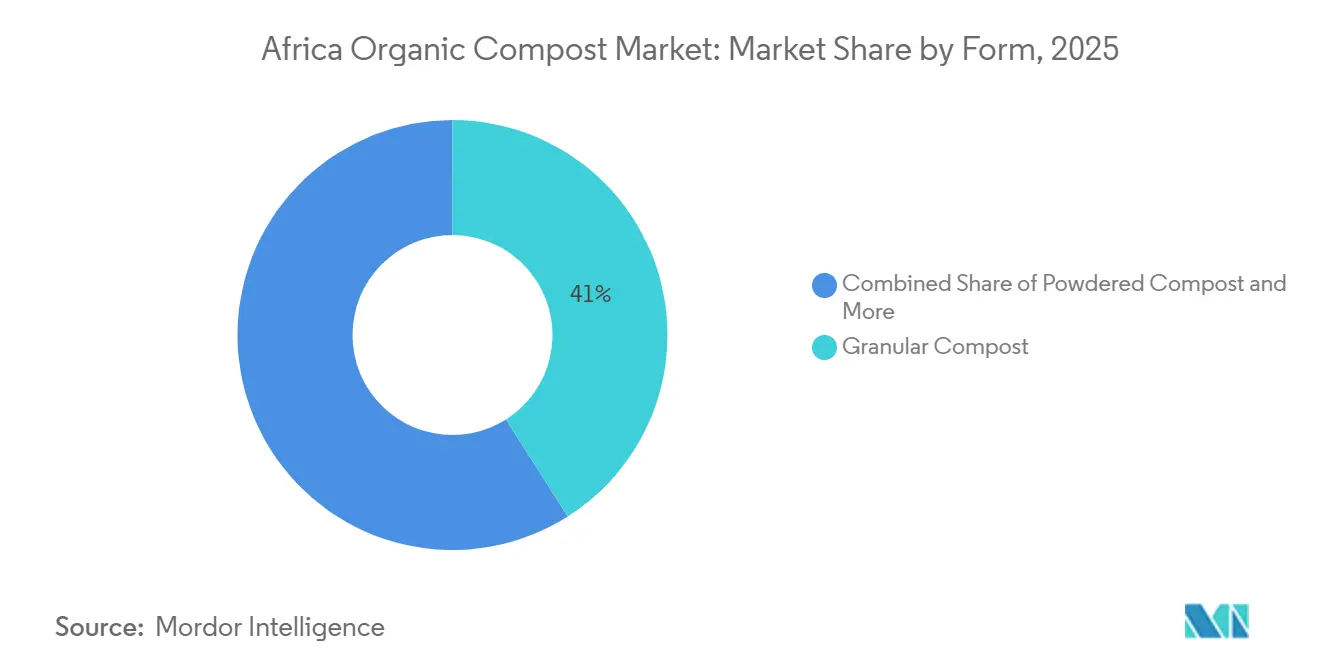
Granular Compost Dominates While Liquid Compost Benefits From Precision UseGranular compost accounted for the largest 41.0% share in 2025. This form of compost remains preferred due to its ease of storage, transportation, and application across various farming systems. Granular compost offers practical handling features that cater to both commercial agricultural operations and smaller-scale users. Its compatibility with conventional spreading equipment and established farm management practices has contributed to its widespread acceptance. Additionally, granular formulations provide adaptability across diverse crop production environments, ensuring their leading position in the Africa organic compost market during the forecast period.
Liquid compost is projected to grow at the fastest CAGR of 12.4% from 2026 to 2031. The growing interest in efficient nutrient delivery methods and precision farming practices is driving demand for liquid compost products. These formulations are compatible with modern application systems and are particularly suitable for intensive cultivation environments. Liquid compost also offers flexibility in nutrient management and supports targeted application strategies. As growers increasingly prioritize optimizing input utilization and enhancing operational efficiency, the adoption of liquid compost is projected to rise across various agricultural segments in the region.
By Application:
Row Crops Drive Scale While Horticulture Delivers Faster GrowthRow crops held the largest 36.0% share in 2025. This dominance is attributed to the widespread cultivation of staple crops within African agricultural systems. The application of compost in row crop production enhances soil quality, increases organic matter, and supports long-term productivity goals. The extensive cultivation areas drive significant demand for soil amendments that promote sustainable crop production. Additionally, compost use in this segment aligns with broader initiatives to improve soil health and resilience. These factors reinforce the position of row crops as the leading application area for organic compost products.
Horticulture is projected to grow at the fastest CAGR of 12.0% from 2026 to 2031. This growth is driven by a heightened focus on crop quality, productivity, and sustainable farming practices. Horticultural producers increasingly require reliable soil management solutions to ensure nutrient availability and plant health. Organic compost is gaining importance in fruit, vegetable, and specialty crop production systems due to its positive impact on soil structure and fertility. Rising consumer demand for sustainably produced agricultural products and the expansion of commercial horticulture activities are projected to further drive growth in this segment.
Geography Analysis
South Africa Organic Compost Market
South Africa accounted for the largest 29.0% share of the Africa organic compost market in 2025. This leading position is attributed to its relatively established composting ecosystem, greater awareness of soil health management practices, and significant participation from both commercial agriculture and landscaping sectors. The presence of organized waste management activities and an increasing focus on sustainable agricultural inputs continue to drive compost utilization across various end-use applications. Additionally, South Africa's diversified agricultural sector generates demand for soil amendment products across field crops, horticulture, and specialty farming operations.
Ethiopia Organic Compost Market
Ethiopia is projected to grow at the fastest CAGR of 11.3% from 2026 to 2031. This growth is supported by rising interest in soil fertility restoration, sustainable farming practices, and the use of locally produced organic inputs. Agricultural development initiatives and increasing awareness of long-term soil productivity are fostering the adoption of compost products among farming communities. Ethiopia's extensive agricultural base and its focus on improving crop yields through integrated soil management approaches create favorable conditions for market expansion. These factors position Ethiopia as a key growth market within the regional organic compost landscape.
Morocco and Egypt Organic Compost Market
Morocco and Egypt continue to strengthen their positions within the regional organic compost industry through policy support and investment in organic waste utilization. In March 2025, a cooperation protocol was signed between Egypt’s Ministry of Environment, Ministry of Agriculture and Land Reclamation, and the Arab Organization for Industrialization to collaborate on producing organic fertilizer from plant and animal waste. This initiative highlights formal government backing for the development of organic inputs. Similarly, Morocco is expanding its organic waste processing infrastructure through initiatives aimed at supporting composting and green waste management. These efforts are enhancing feedstock utilization and promoting the adoption of sustainable soil fertility solutions across North Africa.
Competitive Landscape
The Africa organic compost market is moderately consolidated, with key players including ITRACOM Holdings Ltd., Safi Organics Limited, Organic Fertilizer Manufacturers Botswana (Proprietary) Limited, Micro Biological Fertilizer International Limited, and Bioceres Crop Solutions Corp. Competition in the market is primarily influenced by factors such as feedstock availability, processing capabilities, and proximity to agricultural demand centers. Market participants range from specialized compost producers and waste management operators to companies engaged in broader organic and specialty fertilizer activities. Competitive positioning is largely determined by the ability to secure consistent raw material supplies and maintain high product quality standards. These factors continue to shape the competitive landscape across various national markets in Africa.
Market participants are increasingly focusing on expanding feedstock networks, enhancing compost quality, and developing products tailored to specific agricultural needs. Strategic priorities include strengthening partnerships with municipalities, agricultural cooperatives, and commercial farming operations to improve access to organic waste resources and end-user markets. Companies are also investing in advanced processing technologies and quality assurance practices to ensure product consistency and build customer confidence. As demand for sustainable soil management solutions grows, competitive differentiation is becoming more reliant on operational reliability, agronomic performance, and long-term customer relationships rather than scale alone.
Competitive activity in the market is further supported by investments aimed at strengthening local organic input production capacity. For instance, in June 2025, ITRACOM Holdings Ltd. inaugurated an organo-mineral fertilizer manufacturing facility in Dodoma, Tanzania, with an annual production capacity of 1 million metric tons of organo-mineral fertilizer and 100,000 metric tons of agricultural lime. This development underscores the increasing industry focus on integrated soil fertility solutions and domestic input production. Similar investments are enhancing regional supply capabilities and promoting the adoption of organic and organo-mineral soil amendment products across African agricultural markets.
Africa Organic Compost Industry Leaders
ITRACOM Holdings Ltd.
Safi Organics Limited
Organic Fertilizer Manufacturers Botswana (Proprietary) Limited
Micro Biological Fertilizer International Limited
Bioceres Crop Solutions Corp.
- *Disclaimer: Major Players sorted in no particular order
Africa Organic Compost Market Companies Covered in this Report
- ITRACOM Holdings Ltd.
- Safi Organics Limited
- Organic Fertilizer Manufacturers Botswana (Proprietary) Limited
- Micro Biological Fertilizer International Limited
- Hello Nature International S.r.l. (Italpollina S.p.A.)
- T. Stanes and Company Limited
- Bioceres Crop Solutions Corp. (Bioceres Group Limited)
- Miegos Fertilizers (Outgreens Group)
- Integrated Recycling and Compost Plant Limited
- PolyOrganics (Pty) Ltd.
- Agri Organics (Pty) Ltd.
- Reliance Compost (Pty) Ltd.

Recent Industry Developments in Africa Organic Compost Market
- August 2025: ITRACOM Holdings Ltd. inaugurated its organomineral fertilizer factory in Dodoma, Tanzania, with an annual production capacity of 1 million metric tons of organomineral fertilizer and 100,000 metric tons of agricultural lime, strengthening the supply of organic soil amendments across East and Central Africa.
- June 2025: ITRACOM Holdings Ltd. has inaugurated its organomineral fertilizer factory in Nala, Dodoma, Tanzania, with the ceremony attended by the Presidents of Tanzania and Burundi. The facility has an annual production capacity of 1 million metric tons of organomineral fertilizer and 100,000 metric tons of agricultural lime, making it one of the largest in East and Central Africa. This development strengthens the supply capacity for the Africa organic compost market and soil amendment market. Notably, 50% of the factory's inputs are derived from natural raw materials, including cattle manure.
- March 2025: Egypt's Ministry of Agriculture and Land Reclamation, in collaboration with the Arab Organization for Industrialization, signed an agreement to produce organic fertilizer using agricultural and animal waste. This initiative aims to support the organic compost market by increasing the use of agricultural residues and livestock waste as organic compost, while encouraging domestic production of sustainable soil fertility inputs for agricultural purposes.


Africa Organic Compost Market Report Scope
Organic compost is a nutrient-rich soil amendment created by decomposing organic materials, including plant residues, food waste, and animal manure. It enhances soil fertility, structure, moisture retention, and crop productivity. The Africa organic compost market report is segmented by product type (windrow compost, aerated static pile compost, in-vessel compost, vermicompost, and bokashi compost), by feedstock source (municipal organic waste, agricultural residues, animal manure, food processing waste, and green waste), by form (granular compost, powdered compost, pelletized compost, and liquid compost), by application (row crops, horticulture, fruits and vegetables, turf and landscaping, and nursery and greenhouse), and by geography (South Africa, Kenya, Nigeria, Morocco, Egypt, Ethiopia, and rest of Africa). The market forecasts are provided in terms of value (USD).
| Windrow Compost |
| Aerated Static Pile Compost |
| In-Vessel Compost |
| Vermicompost |
| Bokashi Compost |
| Municipal Organic Waste |
| Agricultural Residues |
| Animal Manure |
| Food Processing Waste |
| Green Waste |
| Granular Compost |
| Powdered Compost |
| Pelletized Compost |
| Liquid Compost |
| Row Crops |
| Horticulture |
| Fruits and Vegetables |
| Turf and Landscaping |
| Nursery and Greenhouse |
| South Africa |
| Kenya |
| Nigeria |
| Morocco |
| Egypt |
| Ethiopia |
| Rest of Africa |
| By Product Type | Windrow Compost |
| Aerated Static Pile Compost | |
| In-Vessel Compost | |
| Vermicompost | |
| Bokashi Compost | |
| By Feedstock Source | Municipal Organic Waste |
| Agricultural Residues | |
| Animal Manure | |
| Food Processing Waste | |
| Green Waste | |
| By Form | Granular Compost |
| Powdered Compost | |
| Pelletized Compost | |
| Liquid Compost | |
| By Application | Row Crops |
| Horticulture | |
| Fruits and Vegetables | |
| Turf and Landscaping | |
| Nursery and Greenhouse | |
| By Geography | South Africa |
| Kenya | |
| Nigeria | |
| Morocco | |
| Egypt | |
| Ethiopia | |
| Rest of Africa |


Key Questions Answered in the Report
What is the current value of Africa organic compost demand in 2026?
The Africa organic compost market is valued at USD 196.0 million in 2026.
Which country leads compost demand across Africa?
South Africa held the largest country share at 29.0% in 2025.
Which product type is growing the fastest in this space?
Vermicompost is the fastest-growing product type, with a projected 13.2% CAGR from 2026 to 2031.
Why are farmers shifting toward organic compost in Africa?
Soil degradation, imported fertilizer volatility, and export-linked organic compliance are the main reasons demand is rising across several crop systems.
Page last updated on:





