
Aerosol Caps Market Size and Share
Market Overview
| Study Period | 2021 - 2031 |
|---|---|
| Market Size (2026) | USD 448.76 Million |
| Market Size (2031) | USD 569.71 Million |
| Growth Rate (2026 - 2031) | 4.89 % |
| Fastest Growing Market | Asia-Pacific |
| Largest Market | Asia-Pacific |
| Market Concentration | Medium |
Major Players *Disclaimer: Major Players sorted in no particular order Image © Mordor Intelligence. Reuse requires attribution under CC BY 4.0. | |
Aerosol Caps Market Analysis by Mordor Intelligence
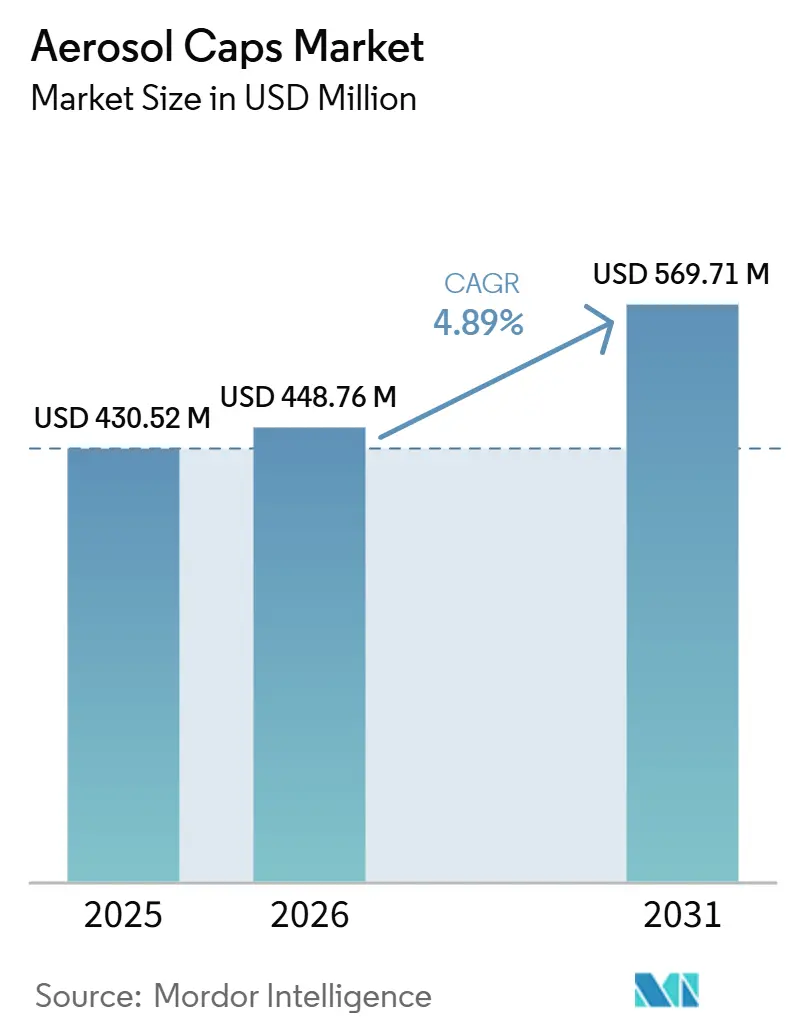
The Aerosol Caps Market was valued at USD 430.52 million in 2025 and is estimated to grow from USD 448.76 million in 2026 to reach USD 569.71 million by 2031, at a CAGR of 4.89% during the forecast period (2026–2031). The aerosol caps market is supported by demand for differentiated personal care packaging, safety-oriented closures, and designs that use fewer materials. Brand owners are giving more weight to cap appearance, usability, and material recovery when they select aerosol components. This favors suppliers that can combine design support, compliance knowledge, and reliable production. Larger Fast-Moving Consumer Goods (FMCG) customers are also concentrating on component purchasing, which can extend qualification periods and raise pressure on smaller suppliers. At the same time, recyclable polypropylene designs and fiber-based alternatives show that material choice is becoming part of supplier approval decisions rather than a secondary product feature.
Key Report Takeaways
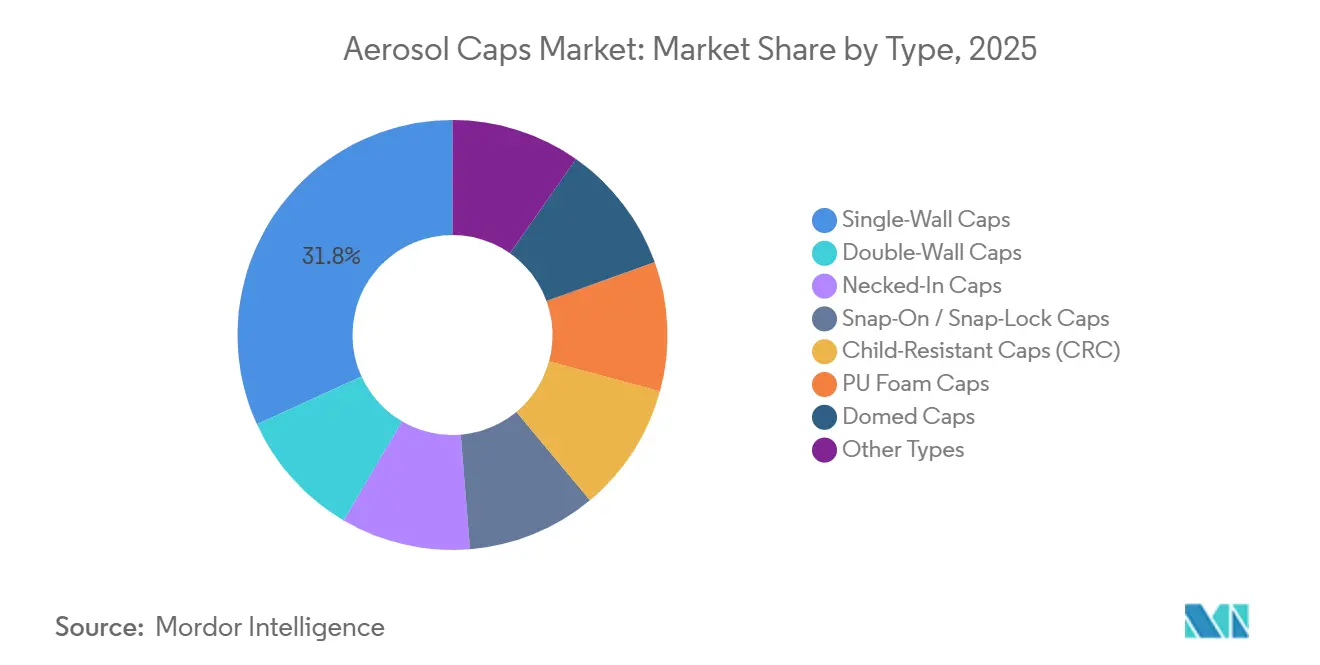
- By type, single-wall caps held 31.82% of the aerosol caps market share in 2025, while child-resistant caps are projected to grow at 6.24% CAGR through 2031.
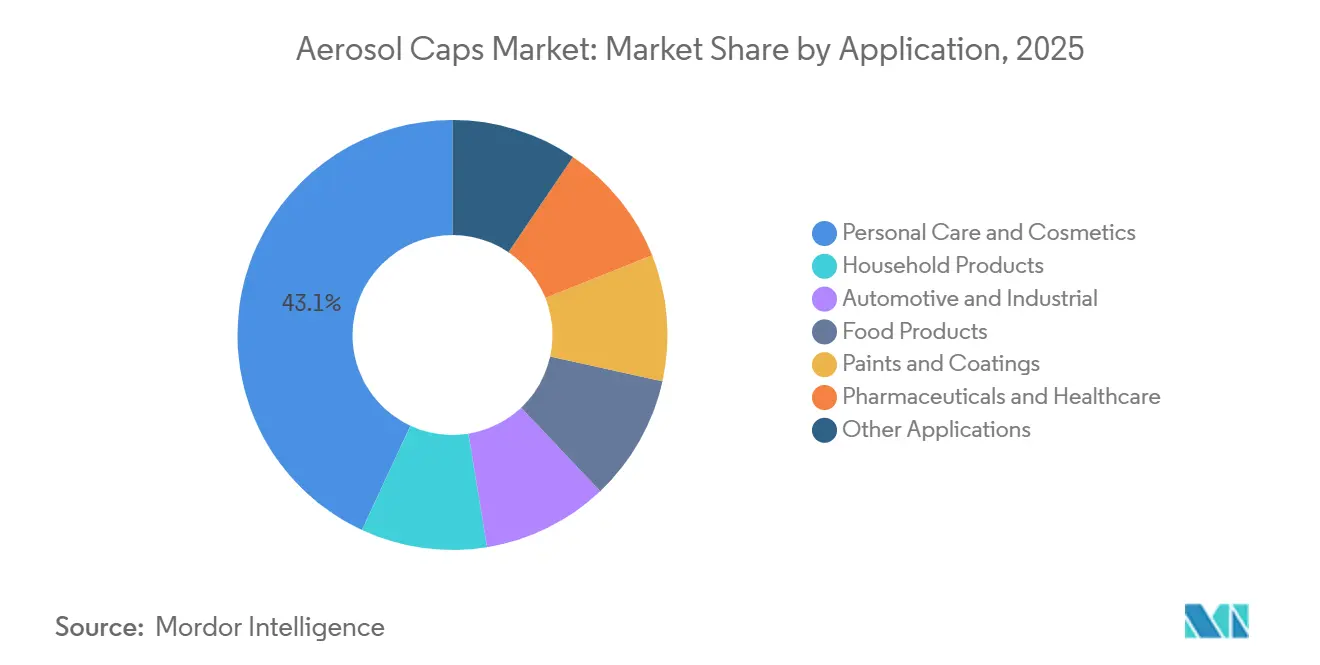
- By application, personal care and cosmetics accounted for 43.08% of the aerosol caps market share in 2025, while pharmaceuticals and healthcare is projected to grow at a 5.35% CAGR through 2031.
- By geography, Asia-Pacific held 41.35% of the aerosol caps market share in 2025 and is forecast to expand at a 5.44% CAGR through 2031.
Note: Market size and forecast figures in this report are generated using Mordor Intelligence’s proprietary estimation framework, updated with the latest available data and insights as of January 2026.
Market Trends and Insights
Drivers Impact Analysis of Aerosol Caps Market*
| Driver | (~) % Impact on CAGR Forecast | Geographic Relevance | Impact Timeline |
|---|---|---|---|
| Growing Demand for Premium Aerosol Packaging in Personal Care and Cosmetic Products | +1.5% | Global, with concentrated gains in Asia-Pacific and Latin America | Medium term (2-4 years) |
| Increasing Adoption of Lightweight and Recyclable Aerosol Cap Designs | +0.9% | Europe (regulatory-led), spill-over to North America and Asia-Pacific | Medium term (2-4 years) |
| Rising Demand for Tamper-Evident and Child-Resistant Aerosol Closure Solutions | +0.8% | North America and Europe (compliance-driven), expanding to Asia-Pacific | Short term (≤ 2 years) |
| Expansion of Contract Manufacturing for Aerosol-Based FMCG and Household Products | +0.5% | Asia-Pacific core, spill-over to Latin America and Middle-East and Africa | Medium term (2-4 years) |
| Increasing Automation of Aerosol Cap Manufacturing and Quality Inspection Processes | +0.4% | Global, with early adoption in Europe and North America | Long term (≥ 4 years) |
| Source: Mordor Intelligence | |||
Growing Demand for Premium Aerosol Packaging in Personal Care and Cosmetic Products
Personal care and cosmetics remain the main value driver for advanced aerosol cap specifications. Brand owners are seeking metallic finishes, tailored colors, and ergonomic shapes that support product positioning at the shelf. These requirements raise tooling and design demands, which can be difficult for suppliers focused on standard single-wall parts. Personal care aerosol formats give brand owners a clear reason to differentiate closure appearance, handling, and overall product presentation. This mix favors higher-value personal care formats over lower-specification household formats. The aerosol caps market, therefore, gives greater weight to suppliers that can provide consistent decoration, fit, and actuator compatibility across a brand portfolio.
Increasing Adoption of Lightweight and Recyclable Aerosol Cap Designs
Packaging requirements are making material selection a more important part of aerosol cap development. The European Union Packaging and Packaging Waste Regulation requires packaging on the European market to be recyclable by 2030, creating pressure on cap designs that combine incompatible materials. An all-polypropylene cap and insert design can avoid the separation issues associated with mixed-material formats. This approach also gives brand owners a clearer route to using recycled polypropylene where the application and local collection system permit it. The change affects product qualification because recyclability must be considered alongside fit, appearance, and dispensing performance. The aerosol caps market can benefit when suppliers convert material simplification into repeatable, production-ready designs rather than isolated product concepts.
Rising Demand for Tamper-Evident and Child-Resistant Aerosol Closure Solutions
Child-resistant caps are the fastest-growing type in the aerosol caps market, with a forecast CAGR of 6.24% through 2031. In the United States, certain regulated packages must meet child-resistant effectiveness requirements under 16 Code of Federal Regulations (CFR) 1700.15. The applicable standard requires effectiveness of at least 85% without a demonstration and 80% after a demonstration. The Consumer Product Safety Commission also identifies aerosol package types within its child-resistant packaging index[1]U.S. Consumer Product Safety Commission, “Child-Resistant Packaging Index, ASTM Package Type,” U.S. Consumer Product Safety Commission, cpsc.gov. These requirements make controlled torque, repeatable assembly, and documented testing central to the design process. As nasal, topical, household cleaning, and pesticide aerosol applications seek safety features, certified suppliers can compete on proven performance rather than on unit price alone.
Expansion of Contract Manufacturing for Aerosol-Based FMCG and Household Products
Contract manufacturers are increasing aerosol filling capacity closer to important consumer markets. This creates demand for cap and actuator suppliers that can support local production schedules and shorter replenishment cycles. Integrated filling and component operations can offer customers one procurement relationship for several packaging functions. That model may reduce the addressable role of independent component suppliers that only provide standard caps. It can also improve responsiveness for brands that need regional packaging variations or fast product launches. The aerosol caps market is likely to reward suppliers that can coordinate tooling, production, and quality support with local aerosol filling networks.
Restraints Impact Analysis of Aerosol Caps Market*
| Restraint | (~) % Impact on CAGR Forecast | Geographic Relevance | Impact Timeline |
|---|---|---|---|
| Challenges Associated with Recycling Multicomponent and Multilayer Aerosol Caps | -0.5% | Europe and North America (compliance-led), expanding to Asia-Pacific | Medium term (2-4 years) |
| Lengthy Product Qualification and Approval Cycles with Global Brand Owners | -0.3% | Global | Short term (≤ 2 years) |
| Increasing Packaging Lightweighting and Adoption of Refillable Packaging Formats | -0.4% | Europe (early), spill-over to North America and Asia-Pacific | Long term (≥ 4 years) |
| Source: Mordor Intelligence | |||
Challenges Associated with Recycling Multicomponent and Multilayer Aerosol Caps
Caps that combine polypropylene shells, Polyoxymethylene (POM) inserts, metal elements, or other mixed materials remain difficult to manage in recovery systems. Their complexity can limit material sorting and make it harder to present a clear recyclability claim. The Can Manufacturers Institute and the Household & Commercial Products Association issued an aerosol playbook for material recovery facilities in February 2026. The playbook supports safer and more consistent handling of aerosol containers and targets 85% household recycling access by 2030[2]Can Manufacturers Institute and Household & Commercial Products Association, “CMI and HCPA Publish the Aerosol Playbook for Material Recovery Facilities,” Household & Commercial Products Association, thehcpa.org. Cap suppliers must still address the distinct issue of mixed polymers within an individual closure. The aerosol caps market faces a practical constraint where brands exclude designs that cannot support their packaging recovery commitments or future European compliance needs.
Lengthy Product Qualification and Approval Cycles with Global Brand Owners
New cap designs can require 12 to 24 months of compatibility testing, performance checks, regulatory review, and consumer assessment. The process becomes more demanding for pharmaceutical aerosols because a component change may require additional regulatory documentation. This protects established designs that a brand owner already approves. It can also delay revenue from new tooling and sustainable material investments. Mid-sized suppliers may find it difficult to fund qualification work across several large customer accounts at the same time. The aerosol caps market consequently favors manufacturers with the technical resources and customer relationships to carry long approval cycles without disrupting service levels.
*Our forecasts treat driver/restraint impacts as directional, not additive. The impact forecasts reflect baseline growth, mix effects, and variable interactions.
Aerosol Caps Market Segment Analysis
By Type:
Single-Wall Caps Retains Its Lead While Child-Resistant Caps Grow FasterSingle-wall caps held 31.82% of the aerosol caps market size in 2025, reflecting their use in high-volume deodorant, air freshener, and industrial spray products. Their widespread use comes from straightforward construction, familiar assembly processes, and a low unit cost. Double-wall caps and domed caps are more relevant where brands seek a premium appearance or a particular spray presentation. Necked-in caps and snap-on or snap-lock designs meet can-diameter and line-compatibility requirements in defined product programs. Polyurethane (PU) foam caps serve a narrower role where cosmetic products need protection during distribution.
Child-resistant caps are projected to grow at a 6.24% CAGR through 2031. The difference between standard and safety-led formats is important for supplier planning. Single-wall caps generate substantial unit demand, but they also face the greatest price competition from regional manufacturers. They are more exposed to requests for lower material use and to brand scrutiny of conventional mixed-material designs. Child-resistant caps have a smaller qualified supplier base because they must meet documented performance and safety requirements. This can support a higher value per unit when the supplier has the required testing and production controls. Suppliers that develop configurable safety and premium formats can use related tooling concepts across several customers while keeping critical compliance features consistent.



By Application:
Personal Care Holds the Largest Base While Healthcare Adds GrowthPersonal care and cosmetics accounted for 43.08% of the aerosol caps market share in 2025, supported by global demand for deodorant, hairspray, dry shampoo, and body spray formats. These products require closures that protect the actuator and also contribute to visual presentation. Pharmaceuticals and healthcare is forecast to expand at a 5.35% CAGR through 2031. Nasal sprays, topical products, and inhaled delivery systems raise the need for precise parts and controlled closure performance. Household products usually place more emphasis on component cost and dependable supply. Automotive and industrial products generally use standard overcaps, where cost and availability are more important than detailed customization.
Food products, paints, and coatings are smaller application areas with defined material and performance needs. Food-contact packaging must meet relevant compliance requirements, which establish a basic threshold for cap materials. In personal care, brands are more willing to specify customized surface finishes, actuator combinations, and user-friendly locking features. Healthcare customers place greater emphasis on repeatable performance, quality records, and regulatory support. The aerosol caps market, therefore, has two distinct demand pools, with personal care sustaining broad value demand and healthcare increasing the need for technically controlled closures.
Geography Analysis
APAC Aerosol Caps Market
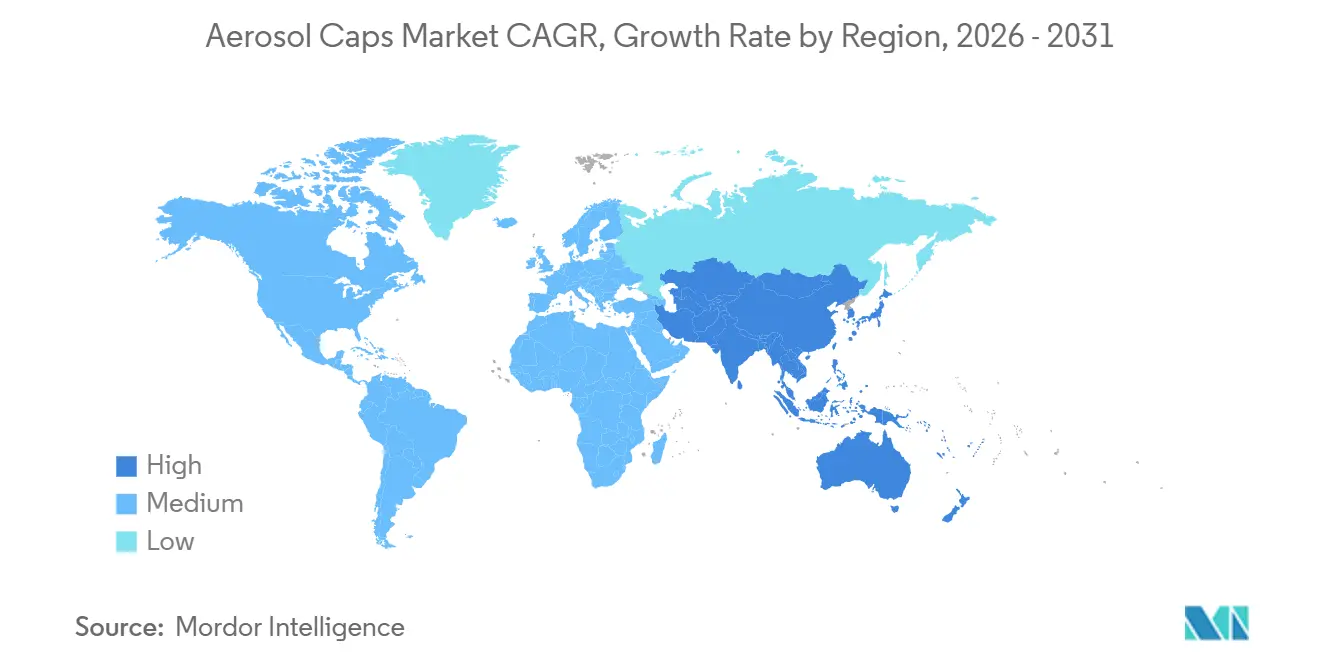
Asia-Pacific accounted for 41.35% of the aerosol caps market size in 2025 and is forecast to grow at a 5.44% CAGR through 2031. China has an established base for aerosol containers, valves, and related components. India is supported by growing personal care consumption, pharmaceutical activity, and contract manufacturing investment. Japan and South Korea contribute premium value because cosmetics brands often specify high-precision and differentiated closure designs. Southeast Asian manufacturing hubs also attract interest from global brands seeking regional supply relationships.
India, China and Japan Aerosol Caps Market
Regional compliance requirements make cross-border sourcing more complex. India applies Bureau of Indian Standards requirements, while China uses its own aerosol packaging standards. Japan's High-Pressure Gas Safety Act adds another compliance consideration for suppliers and brand owners. These differing requirements can support local manufacturers that already have certification and operating experience. They can also extend the time needed to qualify one cap design across several countries.
The Americas and EMEA Aerosol Caps Market
North America and Europe remain important for high-value pharmaceutical, household, and personal care aerosol uses. Child-resistant packaging requirements in regulated applications support North American demand. Europe is moving suppliers toward mono-material and recycled-content cap options as packaging recyclability rules take effect. South America, and Middle-East and Africa are smaller regions, but local aerosol production investment can create demand for nearby cap and actuator capacity. Regional suppliers that offer dependable lead times and adaptable designs can benefit when customers seek to reduce long supply routes.

Competitive Landscape
The aerosol caps market is moderately concentrated worldwide, with technically capable dispensing suppliers holding a stronger position in regulated and premium applications. AptarGroup, LINDAL Group, Precision Valve Corporation, Coster Tecnologie Speciali, and Silgan Dispensing Systems are among the established suppliers identified in the supplied research. Regional producers compete more directly in standard household, paint, and commodity personal care categories. This creates a split between suppliers that compete through technical capability and those that compete primarily through price. Product platforms have become an important way to reduce the effort required to adapt a design across several customer products.
Aptar Beauty introduced Double Click technology for its Twist-to-Lock hoodless aerosol actuator collection in May 2026. The company stated that the collection can reduce resin use by up to 55% compared with a standard actuator and overcap arrangement and offers selected references with up to 100% post-consumer recycled (PCR) resin. This move shows that suppliers are pursuing dispensing designs that reduce material use while maintaining usability and e-commerce performance. Silgan Dispensing Systems introduced Aspire Chroma in February 2026, a customizable fragrance pump platform using Pirouette technology to enable cap separation for refilling or recyclability. Although it is a fragrance format, the product illustrates the broader emphasis on separation and circular design across dispensing components.
Manufacturing process capability is becoming a key competitive factor, particularly for suppliers that must deliver reliable high-volume production and traceable component performance. Consistent inspection, process control, and documented quality checks are especially important in regulated aerosol applications. Opportunities remain in pharmaceutical-grade child-resistant formats, where local suppliers lack the necessary approvals. Recyclable mono-material designs also create opportunities for companies that can validate product performance without increasing assembly complexity.
Aerosol Caps Industry Leaders
Silgan Dispensing Systems
Crown
Clayton Corp.
Amcor plc
LINDAL Group Holding GmbH
- *Disclaimer: Major Players sorted in no particular order

Aerosol Caps Market Companies Covered in this Report
- Amcor plc
- AptarGroup, Inc.
- Capardoni e C. Srl
- Clayton Corp.
- Coster Tecnologie Speciali S.p.A
- Crown
- LINDAL Group Holding GmbH
- MITANI VALVE CO.,LTD
- Precision Valve Corporation
- Shenzhen i-Like Fine Chemical Co., Ltd.
- Silgan Dispensing Systems
- Summit Packaging Systems

Recent Industry Developments in Aerosol Caps Market
- May 2026: Aptar Beauty introduced Double Click technology for twist-to-lock aerosol actuators, providing audible and tactile feedback to confirm when the aerosol cap is securely locked or unlocked. The innovation enhances accessibility, reduces the risk of accidental dispensing during shipping, and improves the reliability of aerosol packaging for e-commerce applications.
- March 2025: Koehler Paper, part of the Koehler Group, partnered with French cardboard packaging manufacturer Wimbée to develop the first aerosol cap made entirely of cardboard and paper. The newly developed cap was made using Koehler NexCoat Smart, a flexible packaging paper.


Global Aerosol Caps Market Report Scope
Aerosol caps are top closures and dispensing mechanisms used on spray cans, ranging from fine mist sprayers to industrial and graffiti paint nozzles. These caps protect the contents from dust and accidental leaks while controlling the spray pattern.
The Aerosol Caps Market is segmented by type, application, and geography. By type, the market is segmented into single-wall caps, double-wall caps, necked-in caps, snap-on/snap-lock caps, child-resistant caps (CRC), PU foam caps, domed caps, and other types. By application, the market is segmented into personal care and cosmetics, household products, automotive and industrial, food products, paints and coatings, pharmaceuticals and healthcare, and other applications. The report also covers the market size and forecasts for aerosol caps in 16 countries across major regions. For each segment, the market sizing and forecasts have been done on the basis of value (USD).
| Single-Wall Caps |
| Double-Wall Caps |
| Necked-In Caps |
| Snap-On / Snap-Lock Caps |
| Child-Resistant Caps (CRC) |
| PU Foam Caps |
| Domed Caps |
| Other Types |
| Personal Care and Cosmetics |
| Household Products |
| Automotive and Industrial |
| Food Products |
| Paints and Coatings |
| Pharmaceuticals and Healthcare |
| Other Applications |
| Asia-Pacific | China |
| India | |
| Japan | |
| South Korea | |
| Rest of Asia-Pacific | |
| North America | United States |
| Canada | |
| Mexico | |
| Europe | Germany |
| United Kingdom | |
| France | |
| Italy | |
| Russia | |
| Rest of Europe | |
| South America | Brazil |
| Argentina | |
| Rest of South America | |
| Middle-East and Africa | Saudi Arabia |
| South Africa | |
| Rest of Middle-East and Africa |
| By Type | Single-Wall Caps | |
| Double-Wall Caps | ||
| Necked-In Caps | ||
| Snap-On / Snap-Lock Caps | ||
| Child-Resistant Caps (CRC) | ||
| PU Foam Caps | ||
| Domed Caps | ||
| Other Types | ||
| By Application | Personal Care and Cosmetics | |
| Household Products | ||
| Automotive and Industrial | ||
| Food Products | ||
| Paints and Coatings | ||
| Pharmaceuticals and Healthcare | ||
| Other Applications | ||
| By Geography | Asia-Pacific | China |
| India | ||
| Japan | ||
| South Korea | ||
| Rest of Asia-Pacific | ||
| North America | United States | |
| Canada | ||
| Mexico | ||
| Europe | Germany | |
| United Kingdom | ||
| France | ||
| Italy | ||
| Russia | ||
| Rest of Europe | ||
| South America | Brazil | |
| Argentina | ||
| Rest of South America | ||
| Middle-East and Africa | Saudi Arabia | |
| South Africa | ||
| Rest of Middle-East and Africa | ||


Key Questions Answered in the Report
What is the size of the aerosol caps market?
The aerosol caps market stands at USD 448.76 million and is projected to reach USD 569.71 million by 2031.
Which aerosol cap type is expected to grow the fastest?
Child-resistant caps are forecast to expand at a 6.24% CAGR through 2031 as regulated pharmaceutical and household applications require proven safety performance.
Which application led the market demand in 2025?
Personal care and cosmetics held 43.08% of the market revenue in 2025, supported by deodorant, hairspray, dry shampoo, and body spray products.
Why are recyclable cap designs important?
Mixed-material caps can complicate sorting and recovery, while European packaging rules are increasing the need for recyclable design choices.
Page last updated on:





