
Aeroponics Market Size and Share
Market Overview
| Study Period | 2022 - 2032 |
|---|---|
| Market Size (2027) | USD 3.31 Billion |
| Market Size (2032) | USD 5.65 Billion |
| Growth Rate (2027 - 2032) | 11.29 % |
| Fastest Growing Market | Asia-Pacific |
| Largest Market | North America |
| Market Concentration | Low |
Major Players *Disclaimer: Major Players sorted in no particular order Image © Mordor Intelligence. Reuse requires attribution under CC BY 4.0. | |
Aeroponics Market Analysis by Mordor Intelligence
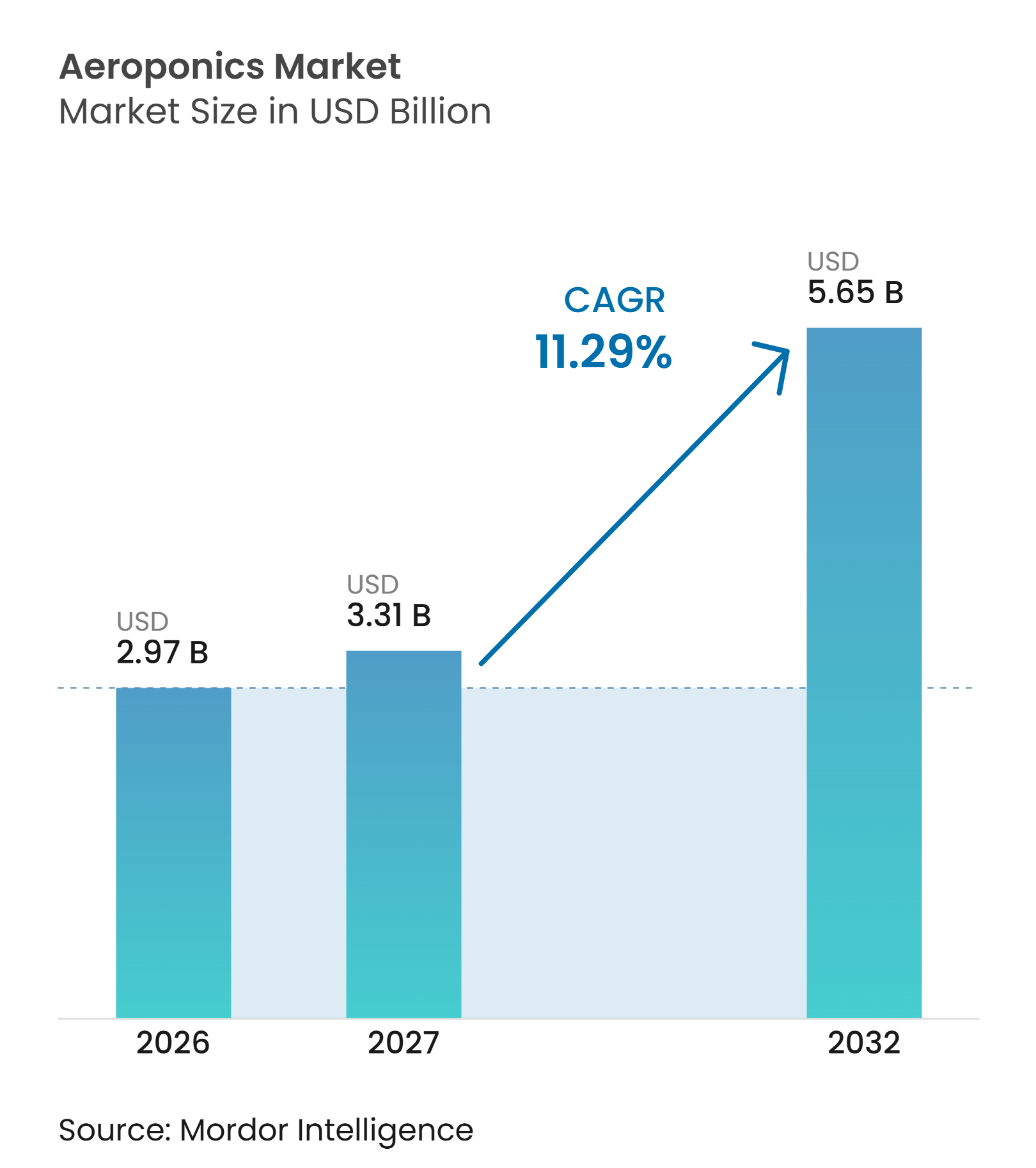
The Aeroponics market size was valued at USD 2.97 billion in 2026 and is forecast to grow from USD 3.31 billion in 2027 to USD 5.65 billion by 2032, at a CAGR of 11.29% from 2027 to 2032. Demand for locally produced food with verified origins and limited pesticide residues supports market growth. Pressure on freshwater supplies is making high water productivity more commercially relevant across several farming regions. Declining costs for LED lighting, sensors, and automation are improving the case for controlled-environment facilities. Retail procurement, public food-security programs, and technology partnerships are shaping where new capacity is developed. However, the market faces challenges, including high power consumption, a limited set of crops with proven large-scale economics, and more cautious lending following recent vertical-farm restructurings.
Key Report Takeaways
- By crop type, leafy greens accounted for 34% of the aeroponics market share in 2026, while fruits are forecast to grow at a CAGR of 13% from 2027 to 2032.
- By component, lighting systems accounted for 58% of the market share in 2026, while sensors and monitoring devices are forecast to grow at a CAGR of 13.4% from 2027 to 2032.
- By farming method, indoor farming accounted for 65% of the aeroponics market share in 2026 and is forecast to grow at a CAGR of 12% from 2027 to 2032
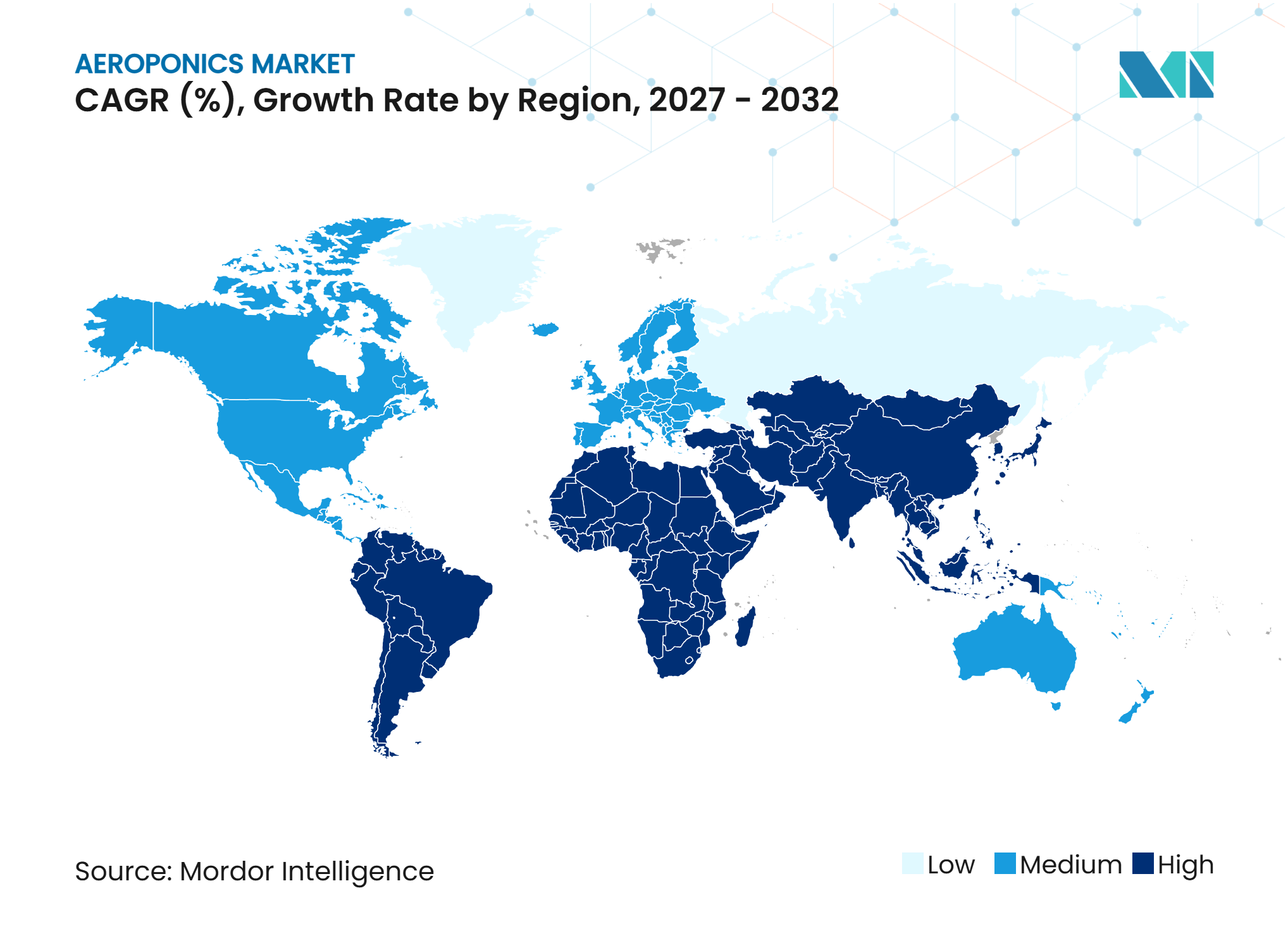
- By geography, North America accounted for 33% of the aeroponics market share in 2026, while Asia-Pacific is forecast to grow at a CAGR of 12.5% from 2027 to 2032.
Note: Market numbers in this report are based on Mordor Intelligence's proprietary estimation framework, which combines nine months of actuals with Q4 projections for base year 2026.
Market Trends and Insights
Drivers Impact Analysis of Aeroponics Market*
| Driver | (~) % Impact on CAGR Forecast | Geographic Relevance | Impact Timeline |
|---|---|---|---|
| Rising Demand for Locally Grown, High-Quality Produce | +2.3% | Global, concentrated in North America, Europe, and urban Asia-Pacific | Short term (≤ 2 years) |
| Water Scarcity and the Need for Higher Water-Use Efficiency | +2.0% | Global; most acute in Middle East, Asia-Pacific, and Mediterranean Europe | Medium term (2-4 years) |
| Controlled-Environment Production for Year-Round Supply | +1.8% | North America, Europe, and Asia-Pacific core markets | Short term (≤ 2 years) |
| Advancements in Lighting, Sensors, and Automation | +1.6% | Global, with adoption acceleration in Asia-Pacific and North America | Short term (≤ 2 years) |
| Food-Security Investment in Land-Constrained Regions | +2.0% | Middle East, Singapore, Japan, South Korea, and urban Asia-Pacific | Medium term (2-4 years) |
| Growing Adoption of Aeroponics for High-Value Seed Production | +1.2% | South Asia, East Africa, South America, and Asia-Pacific | Long term (≥ 4 years) |
| Source: Mordor Intelligence | |||
Rising Demand for Locally Grown, High-Quality Produce
Consumer interest in produce with limited pesticide residues and verifiable origin is influencing retail and foodservice procurement. The aeroponics market benefits when buyers seek consistent quality and shorter distribution distances for fresh products. In July 2025, AeroFarms expanded its distribution across the Harris Teeter chain while continuing its relationship with Whole Foods, indicating broader retail access for aeroponic microgreens. These relationships favor operators that combine production capabilities with category marketing and retail execution. Consumer willingness to pay a premium for differentiated microgreens and fresh packaged salads can help offset the higher costs associated with controlled-environment production. Growing demand for fresh, traceable produce can create opportunities for aeroponic producers to strengthen retail partnerships and expand their market presence.
Water Scarcity and the Need for Higher Water-Use Efficiency
Aeroponic mist delivery can use up to 90% less water than conventional field agriculture. The U.S. Department of Agriculture recognizes aeroponics as an innovative food-production approach that can conserve water and extend growing seasons in resource-constrained settings[1]. The aeroponics market has greater commercial potential in regions where water prices reflect scarcity, groundwater regulations are becoming stricter, or desalinated water accounts for a substantial share of supply. Municipal water constraints can also influence the operating-cost comparison between controlled systems and conventional farms. The Middle East and Mediterranean Europe present distinct market conditions, but both face pressure on irrigation availability. Facilities in these regions may benefit from lower water requirements and greater alignment with local resource-efficiency priorities. As water availability becomes a more significant constraint on agricultural production, the potential to reduce water consumption can strengthen the commercial case for adopting aeroponic systems.
Controlled-Environment Production for Year-Round Supply
Institutional produce buyers value reliable supply when outdoor temperatures and daylight vary across seasons. The aeroponics market can serve growers seeking to adjust crop cycles in response to seasonal demand and prevailing prices. This scheduling flexibility is less readily available to field producers operating within fixed growing seasons. Operators that integrate production planning with market-price information can respond more quickly to changes in crop margins, making operational data an important input for commercial planning rather than simply a post-harvest record. As facility data improves, flexible crop planning may become increasingly valuable for operators seeking to increase revenue per square meter. The ability to maintain consistent production schedules can help aeroponic growers meet year-round supply requirements and strengthen relationships with institutional buyers.
Advancements in Lighting, Sensors, and Automation
Advancements in lighting, sensing, and automation technologies can improve resource management and reduce the need for manual monitoring in controlled-environment agriculture. Research published in the Korean Journal of Applied Science and Technology reported that optimized LED spectra increased leafy green yields by up to 25% and reduced energy consumption by 50% under controlled trial conditions[2]. Improved lighting performance can make crop-specific production strategies more practical in the aeroponics market. Sensors and automation can also reduce the need for routine manual checks across facilities with multiple growing zones. These technologies can improve operational efficiency and support more consistent growing conditions, although the benefits depend on electricity prices, equipment reliability, and operators' ability to apply collected data in daily decisions. Continued improvements in these technologies may strengthen the commercial viability of aeroponic facilities by helping operators optimize resource use and production performance.
Restraints Impact Analysis of Aeroponics Market*
| Restraint | (~) % Impact on CAGR Forecast | Geographic Relevance | Impact Timeline |
|---|---|---|---|
| High Electricity Load and Capital Intensity | -2.5% | Global, most acute in Europe and North America | Medium term (2-4 years) |
| Limited Economically Viable Crop Basket at Scale | -1.8% | Global | Long term (≥ 4 years) |
| Limited Financing Access and Investment Risks | -1.4% | North America and Europe | Medium term (2-4 years) |
| Technical Complexity and Risks of Misting-System Failure | -1.0% | Global, elevated in high-humidity Asia-Pacific settings | Short term (≤ 2 years) |
| Source: Mordor Intelligence | |||
High Electricity Load and Capital Intensity
Pumps, LED arrays, climate-control hardware, and facility construction create substantial cost barriers for indoor aeroponic operations. Electricity can account for 30% to 40% of total operating expenditure in fully indoor facilities. A commercial aeroponic tower consumes 0.216 kWh per cycle, making energy procurement an important consideration in site selection. Operators with access to renewable energy, agricultural energy support, or below-market public financing have an advantage over facilities paying standard commercial rates. AeroFarms refinanced its debt through a USDA-guaranteed bridge structure in May 2025, including equipment financing provisions intended to improve its financing terms. Access to specialized financing increasingly influences which operators can develop commercial-scale facilities in locations with high electricity costs. These substantial upfront investments and recurring energy expenses can limit market entry for smaller operators and constrain the commercial expansion of aeroponic facilities.
Limited Economically Viable Crop Basket at Scale
Leafy greens, herbs, and microgreens remain the most established crop groups for commercial aeroponics. Their short production cycles and premium retail positioning support more frequent use of facility space. Fruiting crops require longer production cycles, often ranging from 60 to 120 days, which can reduce production turnover and delay revenue generation. The aeroponics market must demonstrate reliable returns across crop categories beyond leafy greens and salad crops to broaden its commercial base. This constraint is especially relevant in markets where local consumers cannot sustain premium prices for controlled-environment produce. Seed potatoes and other high-value planting materials offer potential alternatives, but their commercial success depends on technical management and buyer acceptance. Differences in crop economics and market demand can limit the range of crops that operators can cultivate profitably at commercial scale.
*Our forecasts treat driver/restraint impacts as directional, not additive. The impact forecasts reflect baseline growth, mix effects, and variable interactions.
Aeroponics Market Segment Analysis
By Crop Type:
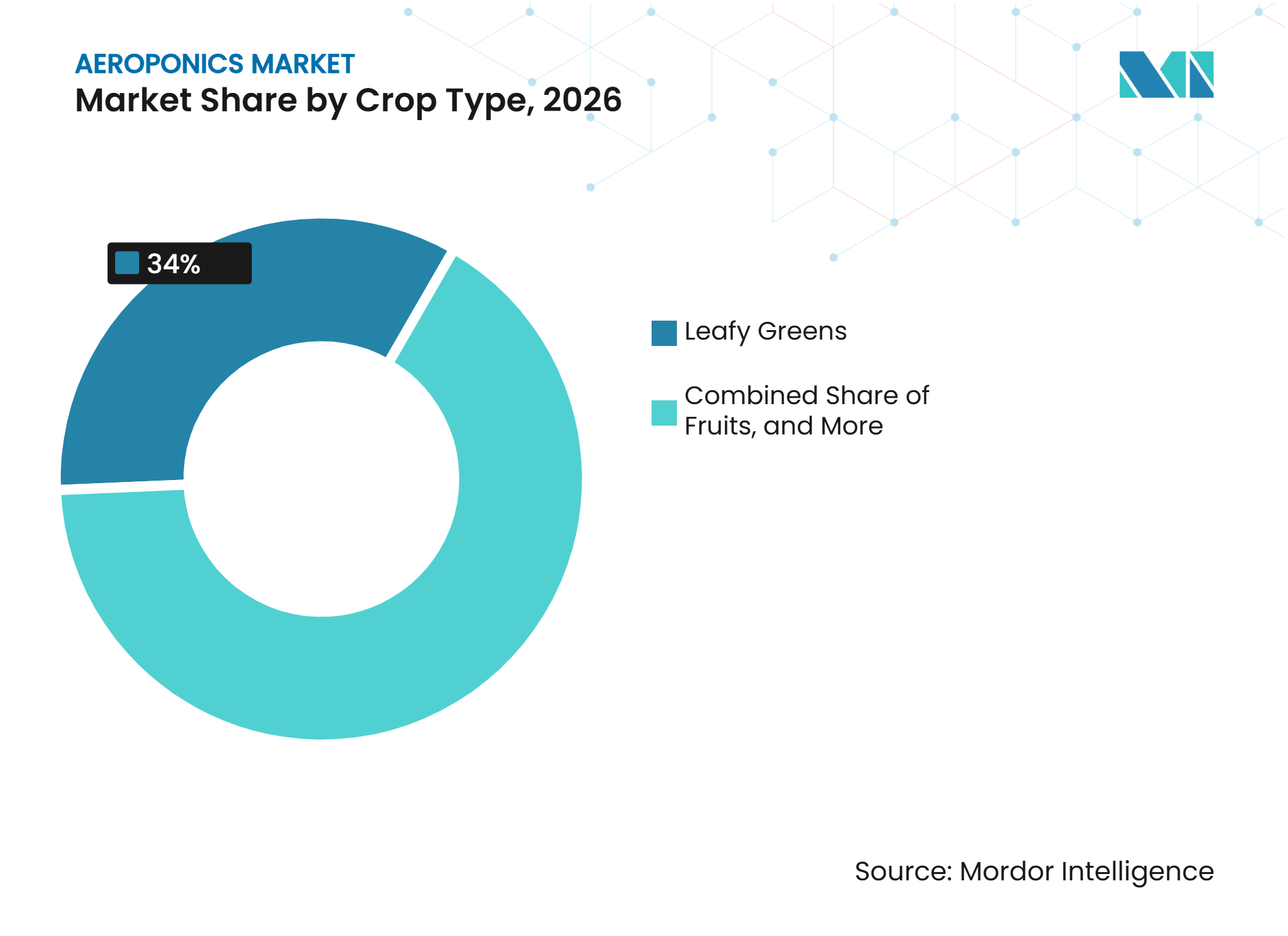
Leafy Greens Anchor Revenue While Fruits Drive ExpansionLeafy greens accounted for 34% of the aeroponics market share in 2026, supported by the suitability of lettuce, spinach, kale, and arugula for intermittent mist delivery. Their relatively short production cycles of 14 to 30 days support frequent facility turnover. Fresh packaged salads also have established demand in high-income urban retail channels. Herbs and microgreens held the second-largest revenue position, as foodservice and specialty grocery buyers support premium pricing. AeroFarms' relationships with Whole Foods and Harris Teeter demonstrate the retail access available to established microgreen producers. Fruiting vegetables, flowers and ornamentals, and other crops make up the remaining crop mix, allowing growers to diversify beyond standard leafy products.
Fruits are forecast to grow at a CAGR of 13% from 2027 to 2032, making them the fastest-growing crop type in the aeroponics market. Advances in aeroponic cultivation techniques may support the production of strawberries and other high-value crops, although longer production cycles can reduce asset turnover and increase capital requirements compared with leafy greens. Aeroponic seed production offers another potential avenue for growth in high-value planting materials. Potato production of 2,094 minitubers per square meter in aeroponic systems, compared with 771 in soil-based nursery beds, supports interest in seed applications[3]. Operators that establish payback periods below 5 years outside the salad category may improve investor interest. The crop mix therefore depends on balancing margins, production duration, and the certainty of customer demand.



By Component:
Lighting Systems Lead Market Share While Sensors and Monitoring Devices Drive GrowthLighting systems accounted for 58% of the aeroponics market share in 2026, reflecting their importance in indoor facilities that rely on artificial illumination. LED arrays are fundamental in fully indoor farms with no natural-light supplement. Dynamic spectrum control, full-coverage panels, and dimming are transforming lighting from a fixed expense into a production control tool, allowing growers to adjust conditions by crop variety and development stage. Climate-control systems and irrigation components account for the remaining component demand, with climate control becoming more important when facilities operate in hot climates or at high latitudes. The component structure reflects the need to maintain light, nutrient delivery, and temperature conditions within defined ranges.
Sensors and monitoring devices are forecast to grow at a CAGR of 13.4% from 2027 to 2032, making them the fastest-growing component category. Continuous root-zone monitoring can replace periodic manual observation and help identify conditions that may cause crop losses. The AEROMATICS project, active from September 2026, combines smart sensing, 3D-printed aeroponic modules, and hybrid artificial-intelligence controls, demonstrating that sensing hardware and analysis tools are becoming central elements in new aeroponic designs. Operators also require reliable monitoring to support the production forecasts used in supply contracts. Facility specifications that apply controlled-environment design practices can further increase demand for validated sensor systems. As a result, hardware selection in the aeroponics market is becoming increasingly tied to data quality and operational resilience, making component choices more consequential for farm performance.
By Farming Method:
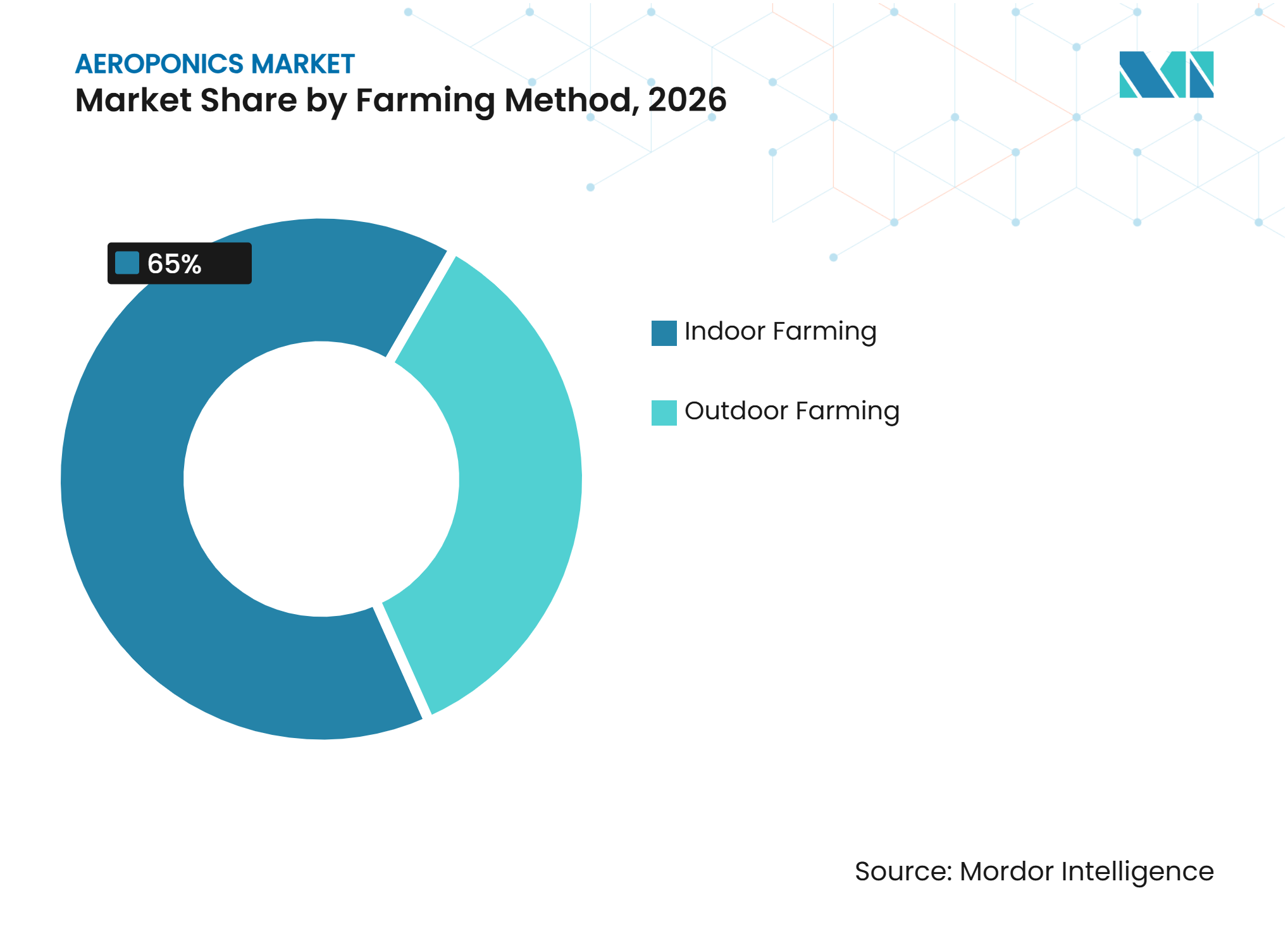
Indoor Farming Leads and Grow FastestIndoor farming accounted for 65% of the aeroponics market share in 2026 and is forecast to grow at a CAGR of 12% from 2027 to 2032. Enclosed farms allow controlled nutrient delivery, pest exclusion, and year-round production. These benefits are strongest where operators can manage temperature, lighting, humidity, and sanitation within the same facility. AeroFarms states that its tower architecture removes the weight of soil and retained water, enabling taller growing columns and higher output per square foot. Outdoor systems account for a smaller share of the farming-method mix and are used mainly for seed propagation and high-value crop programs in temperate settings. Lower infrastructure requirements can make outdoor deployment relevant when ambient conditions are favorable.
New project activity in Asia-Pacific and the Middle East exceeded that in North America during 2025 and 2026, pointing to increased investment in regions where food-security policy supports development. Outdoor systems remain important for aeroponic seed potatoes and similar applications. Pakistan's agricultural research partnership aims to produce 160,000 tons of certified seed potatoes annually using aeroponic greenhouses. The two methods, therefore, serve different needs within the aeroponics market, with indoor farms centered on urban produce and outdoor applications more closely connected to seed systems.

Geography Analysis
North America accounted for 33% of the aeroponics market share in 2026. The United States has a developed retail base for aeroponic produce and a high concentration of commercial operators. USDA-guaranteed lending supported AeroFarms' May 2025 refinancing through an asset-based loan and a permanent facility. Canada supports controlled-environment vegetable production in northern climates. Mexico offers greenhouse-compatible opportunities where ambient conditions can reduce infrastructure requirements. The United States is expected to maintain its market leadership through 2032 as facilities target distribution within 100 miles of large metropolitan areas.
Asia-Pacific is forecast to grow at a CAGR of 12.5% from 2027 to 2032, supported by food-security initiatives, investment in controlled-environment agriculture, and demand for locally grown produce. Singapore, Japan, and South Korea support controlled-environment agriculture through food-security frameworks, subsidies, and institutional procurement. China has a separate demand base tied to facility agriculture modernization. Zhejiang fog-cultivation pilot bases began year-round production in 2025, with individual sites reporting daily output of 3,000 jin and annual targets nearing 2 million jin. India has strong potential driven by horticulture support and peri-urban demand in Pune, Bengaluru, and Hyderabad.
Europe has an established controlled-environment agriculture sector, with the United Kingdom, Germany, and the Netherlands contributing to technology development and commercial cultivation. Spain and other water-stressed areas may also benefit from growing systems designed to improve water-use efficiency. The European Union signed a EUR 1,663,320 grant, equivalent to USD 1.8 million, for the AEROMATICS project in April 2026. The Middle East is adopting aeroponics for food security where conventional agriculture is constrained by arid conditions. Africa is at an early commercial stage, with seed-potato programs demonstrating its role in development agriculture. South America is exploring high-elevation and urban-corridor applications where climate variability affects conventional supply.
Competitive Landscape
Market Concentration
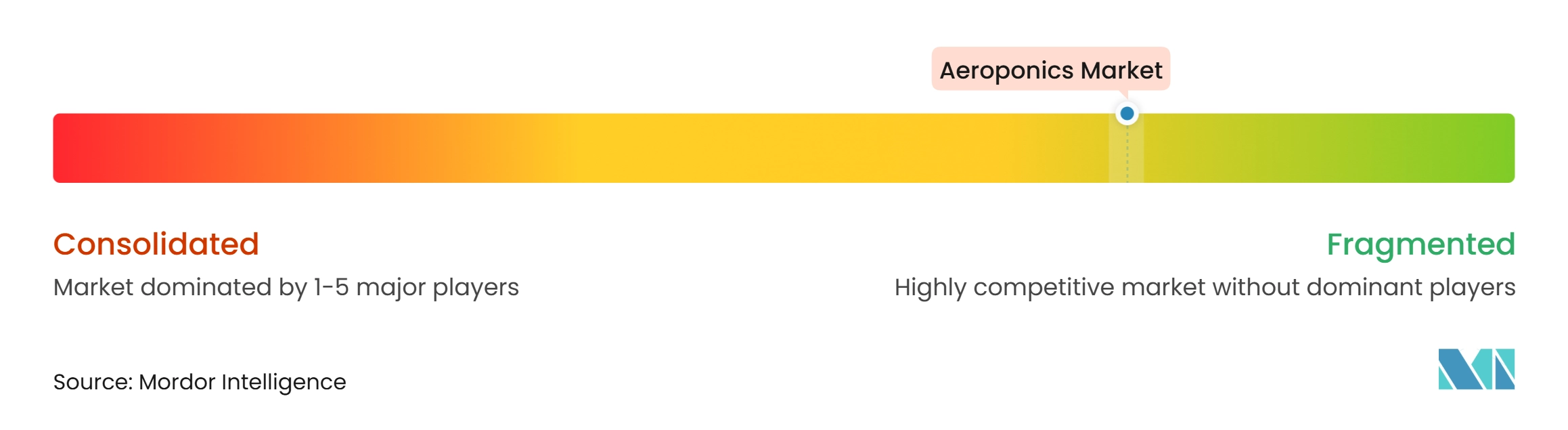
The aeroponics market is fragmented in 2026, with AeroFarms, Living Greens Farm, LettUs Grow, AgriHouse Brands, and Tower Garden operating alongside regional farm operators, equipment suppliers, and technology integrators. This structure allows different business models to coexist. Branded producers control facilities and retail distribution, while technology providers pursue partnership-led expansion. AeroFarms represents the branded-producer model through its microgreens retail distribution and farm development activity. LettUs Grow represents the technology-provider model through its systems and commercial partnerships.
LettUs Grow and KG Systems announced a global distribution partnership in March 2025 for Aeroponic Rolling Bench systems, targeting more than 10 hectares of installations by 2030. AEssenseGrows uses its Guardian Grow Manager software as a unified control layer across AEtrium deployments in North America, Israel, and South Africa, demonstrating how software can connect growers to a defined technology ecosystem. Competition in the aeroponics market is also intensifying around mist optimization, modular architecture, and sensor-based yield control. These developments distinguish companies that sell farm equipment from those that provide an integrated operating platform.
Farm-as-a-Service remains an open commercial model for buyers that want local supply without owning a farm. Under this model, a specialist manages production for an institutional food buyer under a service agreement. The AEROMATICS project is developing 3D-printed, recyclable modules, adding materials development to the hardware competition. neoFarms and Morganic Agritech Solutions target institutional and specialty commercial customers in regional markets. Artificial-intelligence-based controls may simplify root-zone management for growers with less specialized expertise, potentially expanding the user base for commercial aeroponic systems, though reliable equipment and operational knowledge will remain essential. These dynamics keep the aeroponics market open to a variety of competitors.
Aeroponics Industry Leaders
-
AeroFarms LLC
-
Living Greens Farm, Inc.
-
LettUs Grow Ltd.
-
AgriHouse Brands Ltd.
-
Tower Garden (The Juice Plus+ Company)
- *Disclaimer: Major Players sorted in no particular order
Aeroponics Market Companies Covered in this Report
- AeroFarms LLC
- Living Greens Farm, Inc.
- LettUs Grow Ltd.
- AgriHouse Brands Ltd.
- AEssenseGrows, Inc.
- Heliponix LLC (anu)
- Tower Garden (The Juice Plus+ Company)
- Aponic International Ltd.
- neoFarms GmbH
- Eden Grow Systems, Inc.
- AERO Development Corp.
- Sanctuary Industries LLC (Aero-Gro)
- Morganic Agritech Solutions Ltd.
- Barton Breeze Pvt. Ltd.
Recent Industry Developments in Aeroponics Market
- May 2026: LettUs Grow Ltd. and Ceres Greenhouse Solutions announced a collaboration to integrate Ceres’ greenhouse designs with LettUs Grow’s Advanced Aeroponics technology. The collaboration focuses on providing integrated greenhouse and aeroponic systems for commercial and community-scale growers in North America and other markets. Commercial spinach trials reported yield improvements of more than 50% compared with standard hydroponic systems and a 96% saleable yield.
- April 2026: The European Commission funded the AEROMATICS project under the Marie Skłodowska-Curie Actions program, allocating EUR 1.66 million for a 48-month initiative coordinated by Università degli Studi di Torino. The project focuses on developing aeroponic vertical farming systems that use 3D-printed recyclable modules, advanced sensors, and artificial intelligence. Its objectives include reducing water consumption by up to 40% and nutrient use by up to 30%, alongside evaluating the systems’ environmental and economic performance.
- March 2025: LettUs Grow Ltd. and KG Systems announced a global distribution partnership to expand the availability of LettUs Grow’s Aeroponic Rolling Bench systems through KG Systems’ international horticultural projects. The partnership aims to support the installation of more than 10 hectares of aeroponic systems worldwide by 2030.
Global Aeroponics Market Report Scope
The aeroponics market covers the cultivation of plants in soil-free systems in which plant roots are suspended in air and supplied with nutrient-rich mist. These systems enable precise delivery of water and nutrients, supporting efficient resource use and controlled crop production across commercial farms, greenhouses, and vertical farming facilities.
The Aeroponics Market is Segmented by Crop Type (Leafy Greens, Herbs and Microgreens, Fruiting Vegetables, Fruits, Flowers and Ornamentals, and Other Crops), by Component (Irrigation Components, Lighting Systems, Sensors and Monitoring Devices, Climate-Control Systems, and Other Components), by Farming Method (Indoor Farming and Outdoor Farming), and by Geography (North America, South America, Europe, Asia-Pacific, Middle East, and Africa). The Market Forecasts are Provided in Terms of Value (USD).
Segmentation Overview
| Leafy Greens |
| Herbs and Microgreens |
| Fruiting Vegetables |
| Fruits |
| Flowers and Ornamentals |
| Other Crops |
| Irrigation Components |
| Lighting Systems |
| Sensors and Monitoring Devices |
| Climate-Control Systems |
| Other Components |
| Indoor Farming |
| Outdoor Farming |
| North America | United States |
| Canada | |
| Mexico | |
| Rest of North America | |
| South America | Brazil |
| Argentina | |
| Rest of South America | |
| Europe | Germany |
| United Kingdom | |
| France | |
| Italy | |
| Spain | |
| Russia | |
| Rest of Europe | |
| Asia-Pacific | China |
| India | |
| Japan | |
| South Korea | |
| Australia | |
| Singapore | |
| Rest of Asia-Pacific | |
| Middle East | Saudi Arabia |
| United Arab Emirates | |
| Israel | |
| Turkey | |
| Rest of Middle East | |
| Africa | South Africa |
| Egypt | |
| Kenya | |
| Rest of Africa |
| By Crop Type | Leafy Greens | |
| Herbs and Microgreens | ||
| Fruiting Vegetables | ||
| Fruits | ||
| Flowers and Ornamentals | ||
| Other Crops | ||
| By Component | Irrigation Components | |
| Lighting Systems | ||
| Sensors and Monitoring Devices | ||
| Climate-Control Systems | ||
| Other Components | ||
| By Farming Method | Indoor Farming | |
| Outdoor Farming | ||
| By Geography | North America | United States |
| Canada | ||
| Mexico | ||
| Rest of North America | ||
| South America | Brazil | |
| Argentina | ||
| Rest of South America | ||
| Europe | Germany | |
| United Kingdom | ||
| France | ||
| Italy | ||
| Spain | ||
| Russia | ||
| Rest of Europe | ||
| Asia-Pacific | China | |
| India | ||
| Japan | ||
| South Korea | ||
| Australia | ||
| Singapore | ||
| Rest of Asia-Pacific | ||
| Middle East | Saudi Arabia | |
| United Arab Emirates | ||
| Israel | ||
| Turkey | ||
| Rest of Middle East | ||
| Africa | South Africa | |
| Egypt | ||
| Kenya | ||
| Rest of Africa | ||
Key Questions Answered in the Report
What is the current size of the aeroponics market?
The aeroponics market was valued at USD 2.97 billion in 2026 and is forecast to reach USD 5.65 billion by 2032.
What is driving demand for aeroponic production?
Demand is supported by interest in locally produced food, reduced pesticide residues, water-use efficiency, and year-round production.
Why do indoor aeroponic farms account for most activity?
Indoor farming accounted for 65% of the aeroponics market share in 2026, supported by controlled nutrient delivery, lighting, pest management, and year-round production.
Which regions are expanding most rapidly in aeroponics?
Asia-Pacific is forecast to grow at a CAGR of 12.5% from 2027 to 2032, supported by food-security initiatives and investment in controlled-environment agriculture.