
Aerogel Insulation Market Size and Share
Market Overview
| Study Period | 2021 - 2031 |
|---|---|
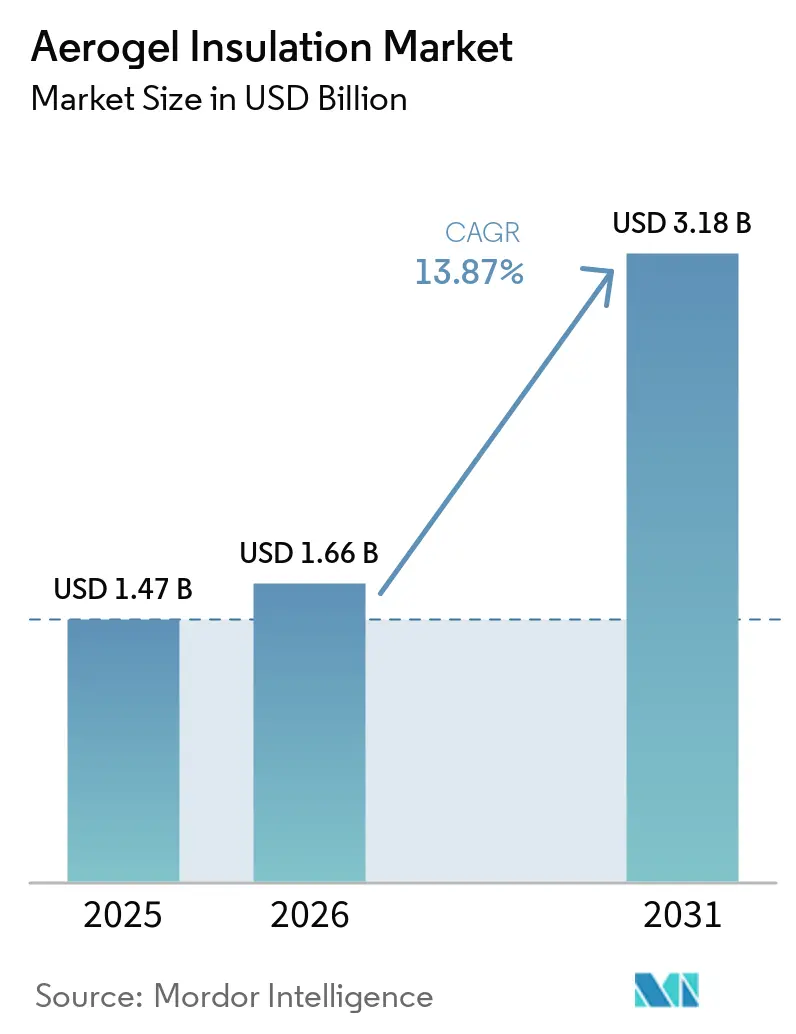
| Market Size (2026) | USD 1.66 Billion |
| Market Size (2031) | USD 3.18 Billion |
| Growth Rate (2026 - 2031) | 13.87 % |
| Fastest Growing Market | Asia-Pacific |
| Largest Market | North America |
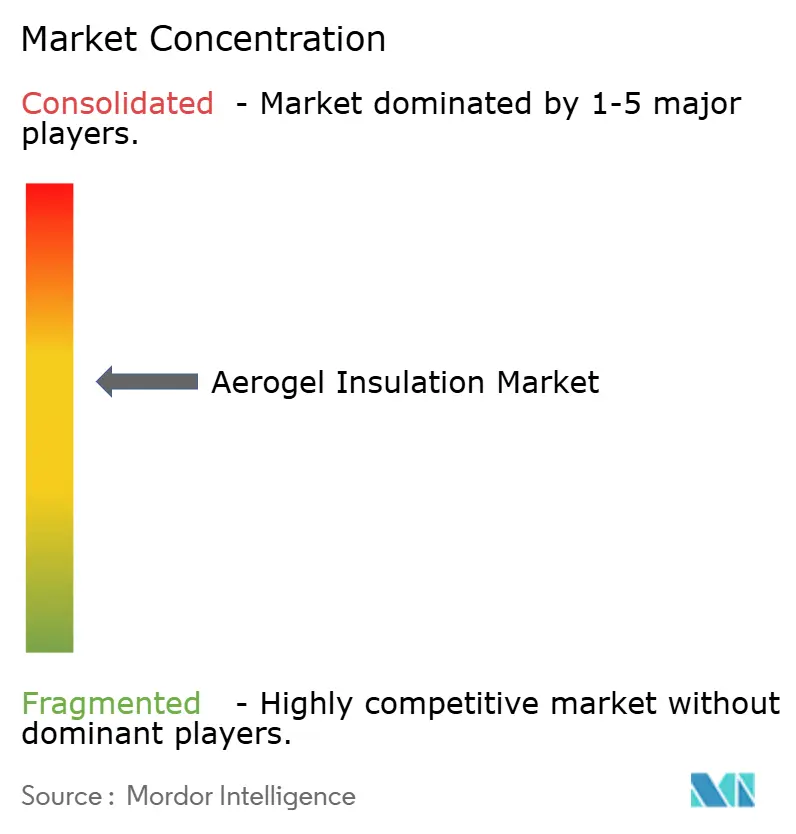
| Market Concentration | Medium |
Major Players *Disclaimer: Major Players sorted in no particular order Image © Mordor Intelligence. Reuse requires attribution under CC BY 4.0. | |
Aerogel Insulation Market Analysis by Mordor Intelligence
The aerogel insulation market size is projected to expand from USD 1.47 billion in 2025 and USD 1.66 billion in 2026 to USD 3.18 billion by 2031, at a CAGR of 13.87% between 2026 and 2031. Energy-efficiency rules in major construction regions are raising the value of insulation in the aerogel insulation market, which can meet performance requirements within thin wall assemblies. LNG terminals, subsea pipelines, and refinery assets continue to require insulation that works at cryogenic and high operating temperatures. Battery safety requirements are also widening demand in the aerogel insulation market for thermal barriers in electric vehicles. These demand pools support the aerogel insulation market when activity in one end use slows, although high cost and careful handling still limit wider replacement of conventional materials.
Key Report Takeaways
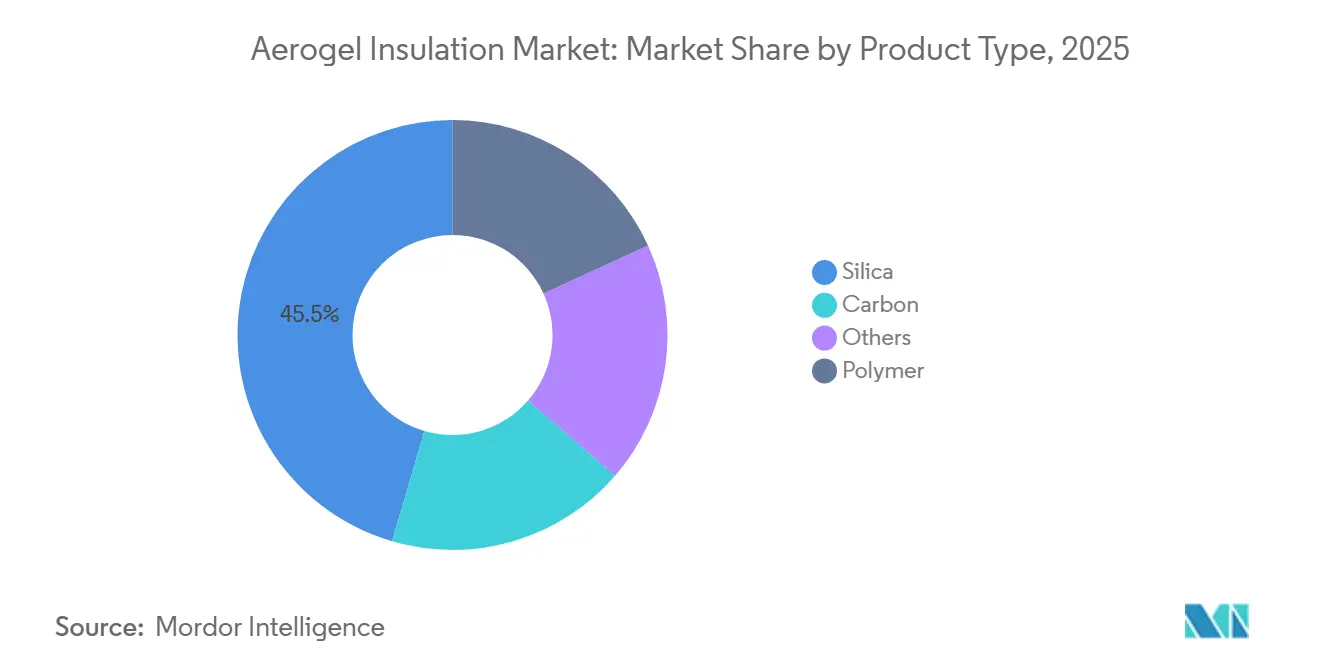
- By product type, silica aerogel held 45.47% revenue share in 2025, while polymer aerogel is forecast to grow at a 14.56% CAGR through 2031.
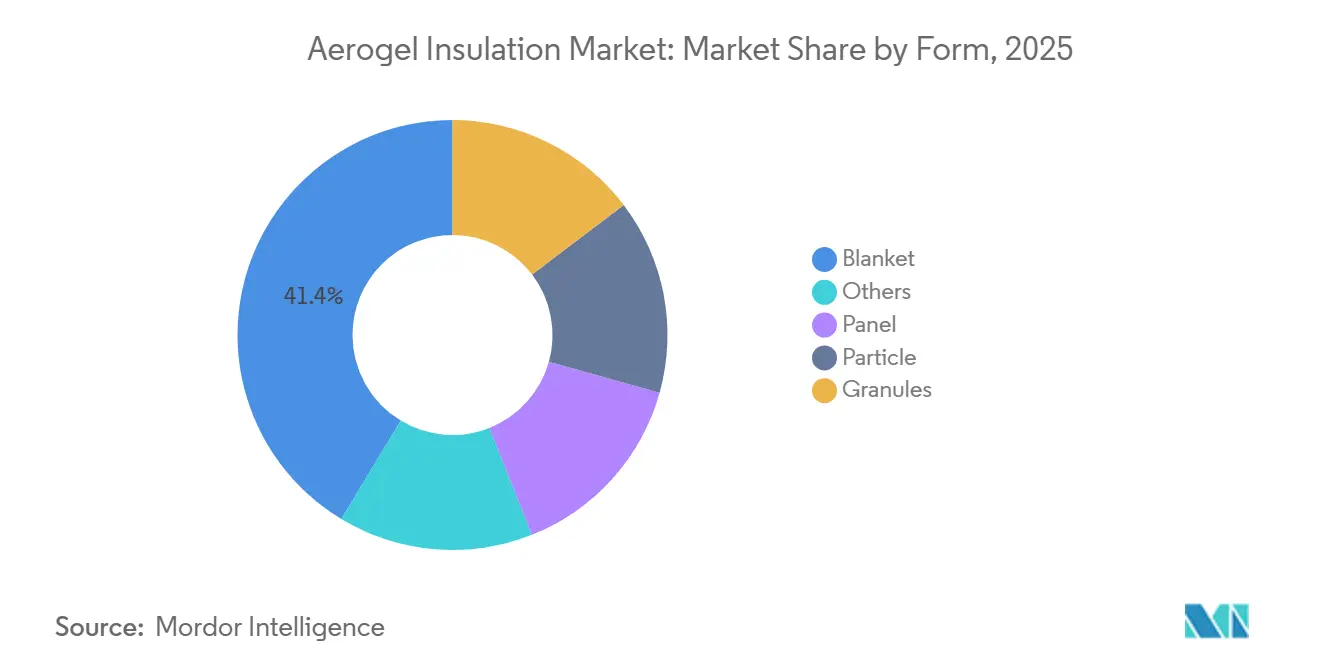
- By form, blankets held 41.35% revenue share in 2025, while particles are forecast to grow at a 14.23% CAGR through 2031.
- By application, oil and gas held 52.84% revenue share in 2025, while building and construction is forecast to grow at a 15.17% CAGR through 2031.
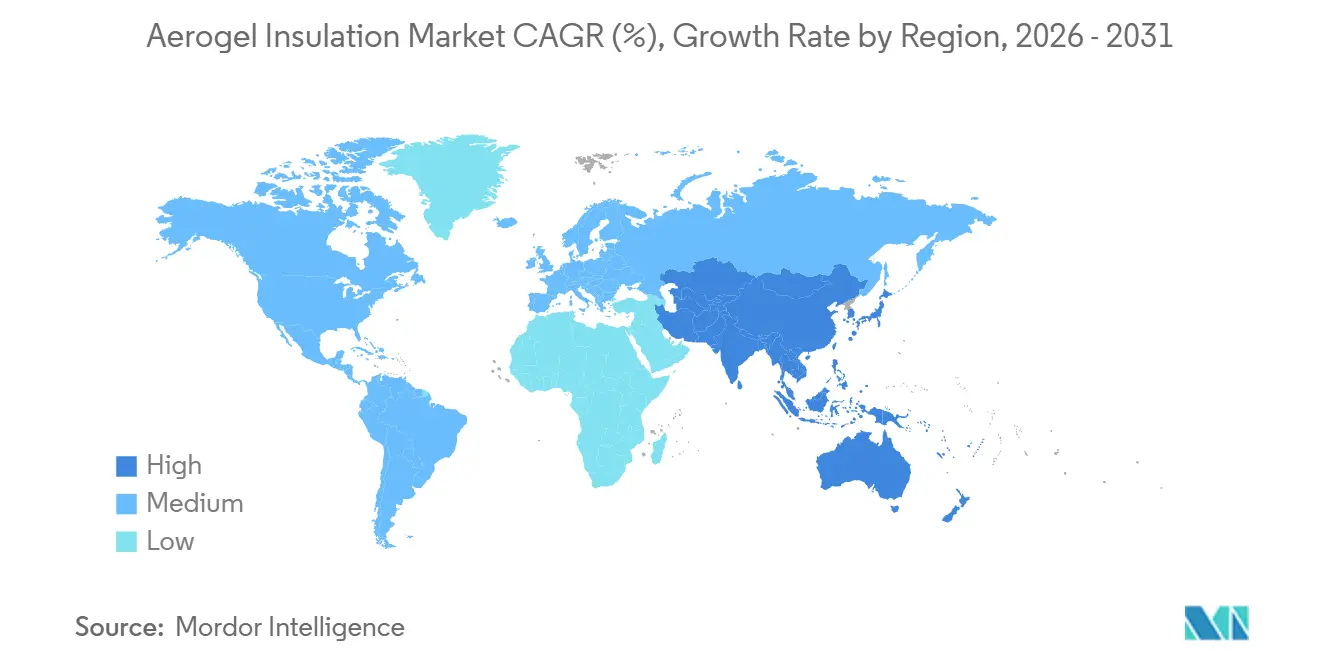
- By geography, North America held 41.13% revenue share in 2025, while Asia-Pacific is forecast to grow at a 14.78% CAGR through 2031.
Note: Market size and forecast figures in this report are generated using Mordor Intelligence’s proprietary estimation framework, updated with the latest available data and insights as of January 2026.
Market Trends and Insights
Drivers Impact Analysis of Aerogel Insulation Market*
| Driver | (~) % Impact on CAGR Forecast | Geographic Relevance | Impact Timeline |
|---|---|---|---|
| Tightening Energy-Efficiency Regulations | +4.2% | Global, with highest intensity in North America, EU, and China | Medium term (2-4 years) |
| LNG Infrastructure and Cryogenic Insulation Expansion | +3.8% | Middle East, North America, Asia-Pacific, Southeast Asia, and Australia | Short term (≤ 2 years) |
| EV Battery Thermal-Runaway Protection | +3.5% | North America, Europe, and China | Medium term (2-4 years) |
| Industrial Retrofit and Corrosion-Under-Insulation Mitigation | +2.5% | North America, Middle East, and core Asia-Pacific | Short term (≤ 2 years) |
| Thin-Profile Insulation for Heritage and Space-Constrained Buildings | +1.2% | Europe, North America, Japan, and South Korea | Long term (≥ 4 years) |
| Source: Mordor Intelligence | |||
Tightening Energy-Efficiency Regulations
California’s 2025 Title 24 standards took effect on January 1, 2026, and require continuous insulation in non-residential metal-framed wall assemblies. The revised EU Energy Performance of Buildings Directive and the related 2025 delegated regulation set methods for cost-optimal building performance and deep renovation. These rules make thin, high-performing insulation more relevant where floor area and wall depth matter. China’s GB/T 46993-2025 became effective on July 1, 2026, giving design institutes a national specification for aerogel blankets used in buildings. Heritage renovation also supports the aerogel insulation market because façade changes are limited, and interior space is often constrained. A 2026 study of an aerogel-plaster renovation found lower annual heating and cooling energy demand without changing a protected building’s architectural character.[1]
LNG Infrastructure and Cryogenic Insulation Expansion
LNG export, regasification, and subsea pipeline projects support demand in the aerogel insulation market for flexible cryogenic insulation in the aerogel insulation market. Fiber-reinforced aerogel blankets can perform in LNG storage conditions and can reduce heat transfer and boil-off compared with perlite-based systems. The material is useful where a vacuum-insulated system is not practical. Aspen Aerogels stated that its Pyrogel products had been specified in nearly 50 major LNG liquefaction and regasification projects.[2] The company also disclosed a North Sea subsea pipeline award with delivery scheduled for the third quarter of 2026. Scheduled maintenance at older LNG assets can create recurring replacement demand in addition to new-project orders.
EV Battery Thermal-Runaway Protection
Battery thermal runaway can expose neighboring cells, creating demand in the aerogel insulation market to very high temperatures within seconds, increasing the need for effective thermal barriers. A 2025 study found that silica aerogel sheets could suppress thermal-runaway propagation across LFP, NCM 111, and NCM 523 module chemistries. In April 2026, Nanjing Tech University reported a 2.3 mm silica aerogel firewall that kept its opposite face below 100°C during a five-minute, 1,000°C exposure. Aspen Aerogels confirmed a PyroThin supply award from Jaguar Land Rover for 2 next-generation vehicle architectures, with production targeted for 2027. JIOS Aerogel also reported that its Korean licensee secured a contract for Hyundai and Kia's next-generation and purpose-built vehicles. Certified materials can gain importance as China, the UN, and North American battery-safety requirements shape vehicle qualification.
Industrial Retrofit and Corrosion-Under-Insulation Mitigation
Industrial retrofit work supports the aerogel insulation market, where assets need insulation replacement without major changes to pipe geometry. Hydrophobic aerogel blankets can limit moisture retention at damaged jacketing or cut edges. Aspen Aerogels presented a 10-year field result with no corrosion on an 84°C pipeline insulated with Pyrogel. The blankets can also be removed and reapplied, which may reduce replacement material during inspection and maintenance. Their thin profile is useful at refineries, heat exchangers, and equipment where clearance is limited. This combination supports specifications based on lifecycle performance rather than initial material cost.
Restraints Impact Analysis of Aerogel Insulation Market*
| Restraint | (~) % Impact on CAGR Forecast | Geographic Relevance | Impact Timeline |
|---|---|---|---|
| High Production and Installation Costs | -0.9% | Global, most acute in price-sensitive emerging markets and budget-constrained construction | Short term (≤ 2 years) |
| Competition from Mineral Wool and Polymer Foams | -0.6% | Global, particularly in noncritical building-insulation segments | Medium term (2-4 years) |
| Low Mechanical Strength and Handling Sensitivity | -0.2% | Global | Short term (≤ 2 years) |
| Source: Mordor Intelligence | |||
High Production and Installation Costs
Supercritical drying requires substantial energy and capital, leaving installed aerogel costs 5 to 10 times higher per unit area than mineral wool or expanded polystyrene. An academic review identifies cost and silica-dust generation during handling as major barriers to broader adoption. In budget-sensitive building projects, value engineering can replace aerogel insulation market products even after it is specified. Chinese producers are expanding ambient-pressure drying, while automation may reduce manual production work. Leading producers have identified unit-cost reductions of up to 25% in 5-year production road maps. Installation training, personal protective equipment, dust controls, and precise cutting can keep the total cost gap wider than material-cost comparisons suggest.
Material Competition and Handling Sensitivity
Mineral wool has mature supply chains and thermal conductivity of 0.032 to 0.044 W/m·K, which meets many code requirements in unconstrained assemblies. Polymer foams are also improving in building uses where fire ratings and dimensional stability guide product choice. Silica aerogel remains brittle because its nanoporous structure is not designed to carry mechanical loads. Cutting and fitting can generate fine silica dust, requiring controlled work practices and protective equipment. Fiber mats and polymer carriers can improve strength, but they may alter thermal performance or add manufacturing complexity. A 2026 study reported a chitosan-MXene-SiO₂ composite with 1.172 MPa compressive strength and thermal conductivity of 0.034 W/m·K, showing that the trade-off remains an active development area.
*Our forecasts treat driver/restraint impacts as directional, not additive. The impact forecasts reflect baseline growth, mix effects, and variable interactions.
Aerogel Insulation Market Segment Analysis
By Product Type:
Silica Holds a Leading Position While Polymer Aerogels ExpandSilica aerogel held 45.47% of the aerogel insulation market share in 2025, supported by thermal conductivity commonly below 0.020 W/m·K and established hydrophobic performance. Its performance profile remains important in oil and gas systems that operate from -200°C to 650°C. Polymer aerogel is forecast to grow at a 14.56% CAGR from 2026 to 2031. BASF SE’s Slentex composite panels illustrate how flexible polymer formulations can serve building applications. Polymer processing can fit roll-to-panel production methods and ambient-pressure drying routes. These characteristics can broaden the aerogel insulation market producer base compared with supercritical silica manufacturing.
Carbon aerogel serves aerospace, defense, and electronics uses where electrical conductivity and high thermal performance are both needed. It remains a smaller category, but it is relevant for battery electrodes and thermal-management research. The others category includes hybrid and bio-based materials, including cellulose-based formulations and olivine-derived silica precursors. Companies such as Aerobel are developing routes that avoid costly organosilane chemistry. Fire certification is also shaping product design, rather than remaining only a final testing step. This shift favors composites that combine insulation, flame resistance, reinforcement, and moisture control in one material system.

By Form:
Blankets Lead Current Demand While Particles Grow FasterBlankets held 41.35% of the aerogel insulation market share in 2025, reflecting their use in oil and gas piping and LNG cryogenic systems. Flexible roll-to-wrap installation can reduce field labor on curved pipes compared with rigid alternatives. Their cross-section hydrophobicity can also support corrosion-under-insulation control. Panel aerogel is used in façades and heritage retrofits where stability and compatibility with exterior insulation systems are important. European Technical Assessments issued by DIBT in 2024 and 2025 established a pathway for silica and polyurethane aerogel insulation boards in the European Union.
Particles are forecast to expand at a 14.23% CAGR from 2026 to 2031, the fastest rate among the reported forms. Cabot’s ENTERA particle portfolio serves battery barriers in blankets, pads, sheets, films, foams, and coatings. Particle materials can also be mixed into aerogel insulation market construction composites and applied on complex surfaces. Granules are gaining use in insulated concrete. Svenska Aerogel reported that Quartzene reached 0.031 W/m·K in cellular concrete developed with Isoltech while maintaining structural integrity. Spray-applied coatings remain relevant where wrapping with blankets is impractical.
By Application:
Oil and Gas Leads While Construction Gains MomentumOil and gas retained 52.84% of the aerogel insulation market share in 2025. The segment uses aerogel where cryogenic roles below -100°C and high-temperature pipeline duties above 500°C leave few cost-competitive alternatives. Industrial process insulation is another major use across process piping, reactors, and heat exchangers. Aging facilities in North America and the Middle East are entering maintenance cycles that support retrofit specifications. Aerospace and defense remain smaller, high-value applications where lower weight can justify a higher material cost. A 2026 electric-aircraft battery study reported a dual-network carbon-silica aerogel system that limited temperature nonuniformity to 1.8°C in a confined-space test.
Building and construction is forecast to grow at a 15.17% CAGR from 2026 to 2031, the fastest application rate in the aerogel insulation market size. Near-zero-energy building rules make higher R-values in thinner walls more useful in dense projects. This use case gives the space-saving property a direct design value. China’s building standard for aerogel blankets creates a more formal route from pilot projects to standardized procurement. Automotive demand is centered on electric-vehicle battery thermal management. Aspen’s PyroThin won the 2024 Automotive News PACE Award, which supported its recognition in series-production vehicle programs.
Geography Analysis
North America Aerogel Insulation Market
North America held 41.13% of the aerogel insulation market share in 2025. The aerogel insulation market demand in the region is supported by Gulf Coast LNG, refinery maintenance, Canadian oil sands, and a growing need for thin building insulation. California’s 2025 Title 24 code took effect in 2026 and requires continuous insulation in specified non-residential wall assemblies. Canada adds stable demand from Alberta oil sands operations. Mexico’s midstream modernization creates more limited project opportunities. Aspen reported USD 168.9 million in full-year 2025 thermal-barrier revenue, down from USD 306.8 million in 2024, and cited regulatory and incentive changes affecting electric-vehicle production schedules.
APAC Aerogel Insulation Market
Asia-Pacific is forecast to grow at a 14.78% CAGR from 2026 to 2031. China is expected to generate the largest aerogel insulation market demand increase during the forecast period. Domestic capacity expansion and building standards can support broader availability of aerogel products. India offers another growth path through industrial expansion and building construction, although price sensitivity and installer capability may limit adoption. Japan and South Korea sustain demand in high-value automotive and aerospace applications. Southeast Asian LNG projects in Vietnam, the Philippines, and Indonesia can create demand for cryogenic insulation as regasification capacity expands.
EMEA and South America Aerogel Insulation Market
Europe’s aerogel insulation market demand is shaped by the revised EPBD and the 2025 delegated regulation on cost-optimal energy performance. Germany’s renovation support directs attention toward thin aerogel plasters and blankets for heritage façades. DIBT assessments show active use of aerogel boards in Germany and the wider European Union. South America is linked mainly to Brazilian deepwater oil and gas and selected LNG projects. Construction demand in the region remains price-constrained. The Middle East and Africa rely on oil and gas pipelines, refineries, and petrochemical assets, which provide a continuing base for cryogenic and high-temperature blankets.
Competitive Landscape
The aerogel insulation market is moderately concentrated, with full-cycle silica producers holding leading positions alongside newer Asian and polymer-aerogel suppliers. Aspen Aerogels operates in electric-vehicle thermal barriers and energy industrial insulation. The company reported USD 49.8 million in second-quarter 2026 revenue, a 32% sequential increase, and guided to USD 65 million to USD 80 million for the third quarter. Its Jaguar Land Rover supply award covers 2 next-generation vehicle architectures and multiple JLR brands. This award is scheduled to begin production in 2027. Cabot Corporation competes through Enova and ENTERA particle materials for coatings, daylighting, and battery applications.
ARMACELL supplies ArmaGel HT blankets for LNG and industrial-process insulation. BASF SE uses Slentex composite panels to bring aerogel into its construction-chemicals portfolio. ENERSENS has formed a joint venture with a European automotive OEM to develop lightweight battery insulation. JIOS Aerogel uses a Hub & Spoke model that centralizes powder production in Korea and licenses regional barrier assembly. Its Korean licensee’s Hyundai and Kia award demonstrates how that approach can serve automotive customers without building multiple downstream plants. Guangdong Alison Technology, IBIH Advanced Material, NANO TECH CO., LTD, and Zhejiang UGOO Technology are expanding China’s silica aerogel supply.
Competition increasingly centers on complete material systems, not only low thermal conductivity. Producers are combining aerogel with flame retardants, fiber reinforcement, hydrophobic treatments, and vapor-management features. This approach can improve performance in applications where installation conditions and safety requirements matter as much as thermal resistance. Fire-integrated building products remain an area for development in Asian markets as high-rise building rules evolve. The aerogel insulation market, therefore, contains both performance-focused leaders and cost-focused entrants. New aerogel insulation market capacity can place pressure on standard blanket pricing, while certified materials can retain value in regulated applications. No combined share for the leading companies is provided, so a score based on the specified market-share thresholds cannot be assigned without introducing unsupported data.
Aerogel Insulation Industry Leaders
-
Aspen Aerogels, Inc.
-
Cabot Corporation
-
BASF
-
ARMACELL
-
Aerogel Technologies, LLC
- *Disclaimer: Major Players sorted in no particular order
Aerogel Insulation Market Companies Covered in this Report
- Active Aerogels
- Aerogel Technologies, LLC
- aerogel-it
- ARMACELL
- Aspen Aerogels, Inc.
- BASF
- Beerenberg
- Cabot Corporation
- ENERSENS
- Guangdong Alison Technology Co., Ltd.
- IBIH Advanced Material Co., Ltd.
- JIOS Aerogel
- NANO TECH CO., LTD
- Svenska Aerogel
- Zhejiang UGOO Technology Co., Ltd.
Recent Industry Developments in Aerogel Insulation Market
- August 2026: Aspen Aerogels reported Q2 2026 total revenue of USD 49.8 million, a 32% sequential increase quarter-on-quarter. The company secured a PyroThin supply award from Jaguar Land Rover covering 2 next-generation vehicle architectures and multiple JLR brands, with start of production targeted for 2027.
- July 2026: China’s national standard GB/T 46993-2025, Thermal Insulation Products, Aerogel Blanket for Buildings, Specification, issued by SAMR and SAC, took effect July 1, 2026, establishing the first formal technical specification for factory-made aerogel blankets in building insulation. The standard provides design institutes with the procedural basis to specify aerogel in energy-saving designs under Chinese building regulations.
Global Aerogel Insulation Market Report Scope
The aerogel insulation market refers to the market for high-performance thermal insulation materials made using aerogel, primarily used in buildings, industrial facilities, pipelines, oil & gas infrastructure, LNG systems, and other applications requiring superior insulation performance with minimal thickness. The market includes aerogel blankets, panels, particles, and other forms supplied for thermal and energy-efficiency applications.
The aerogel insulation market is segmented by product type, form, application, and geography. By product type, the market is segmented into silica, polymer, carbon, and others. By form, the market is segmented into blanket, panel, particle, granules, and others. By application, the market is segmented into oil and gas, building and construction, industrial process insulation, automotive, aerospace and defense, and other applications. By geography, the market is segmented into Asia Pacific, North America, Europe, South America, Middle East, and Africa. The report also covers the aerogel insulation market size and forecasts for the aerogel insulation market in 15 countries across major regions. For each segment, the market sizing and forecasts have been done on the basis of value (USD).
Segmentation Overview
| Silica |
| Polymer |
| Carbon |
| Others |
| Blanket |
| Panel |
| Particle |
| Granules |
| Others |
| Oil and Gas |
| Building and Construction |
| Industrial Process Insulation |
| Automotive |
| Aerospace and Defense |
| Other Applications |
| Asia-Pacific | China |
| India | |
| Japan | |
| South Korea | |
| Rest of Asia-Pacific | |
| North America | United States |
| Canada | |
| Mexico | |
| Europe | Germany |
| United Kingdom | |
| France | |
| Italy | |
| Rest of Europe | |
| South America | Brazil |
| Argentina | |
| Rest of South America | |
| Middle East and Africa | Saudi Arabia |
| South Africa | |
| Rest of Middle East and Africa |
| By Product Type | Silica | |
| Polymer | ||
| Carbon | ||
| Others | ||
| By Form | Blanket | |
| Panel | ||
| Particle | ||
| Granules | ||
| Others | ||
| By Application | Oil and Gas | |
| Building and Construction | ||
| Industrial Process Insulation | ||
| Automotive | ||
| Aerospace and Defense | ||
| Other Applications | ||
| By Geography | Asia-Pacific | China |
| India | ||
| Japan | ||
| South Korea | ||
| Rest of Asia-Pacific | ||
| North America | United States | |
| Canada | ||
| Mexico | ||
| Europe | Germany | |
| United Kingdom | ||
| France | ||
| Italy | ||
| Rest of Europe | ||
| South America | Brazil | |
| Argentina | ||
| Rest of South America | ||
| Middle East and Africa | Saudi Arabia | |
| South Africa | ||
| Rest of Middle East and Africa | ||
Key Questions Answered in the Report
How large is the aerogel insulation market in 2026 and how much is it forecast to reach in 2031??
The aerogel insulation market size is USD 1.66 billion in 2026 and is forecast to reach USD 3.18 billion by 2031.
Which aerogel product type leads revenue?
Silica aerogel led with 45.47% revenue share in 2025, supported by its thermal and hydrophobic properties.
Which application is growing fastest through 2031?
Building and construction is forecast to grow at a 15.17% CAGR from 2026 to 2031.
Which region is growing fastest through 2031?
Asia-Pacific is forecast to grow at a 14.78% CAGR, supported by China, industrial development, and LNG projects.