
Aerial Work Platform Truck Market Size and Share
Market Overview
| Study Period | 2020 - 2032 |
|---|---|
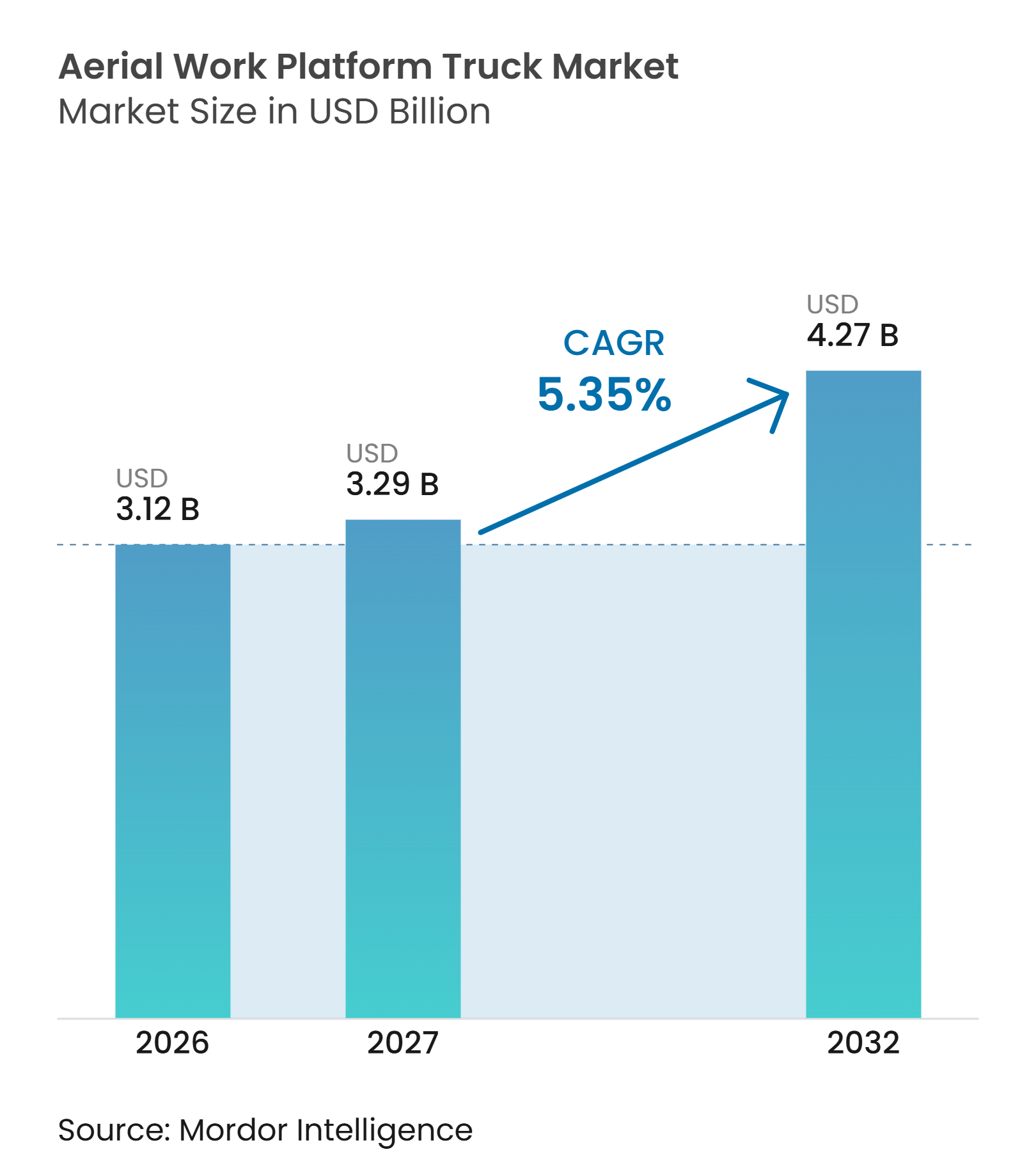
| Market Size (2027) | USD 3.29 Billion |
| Market Size (2032) | USD 4.27 Billion |
| Growth Rate (2027 - 2032) | 5.35 % |
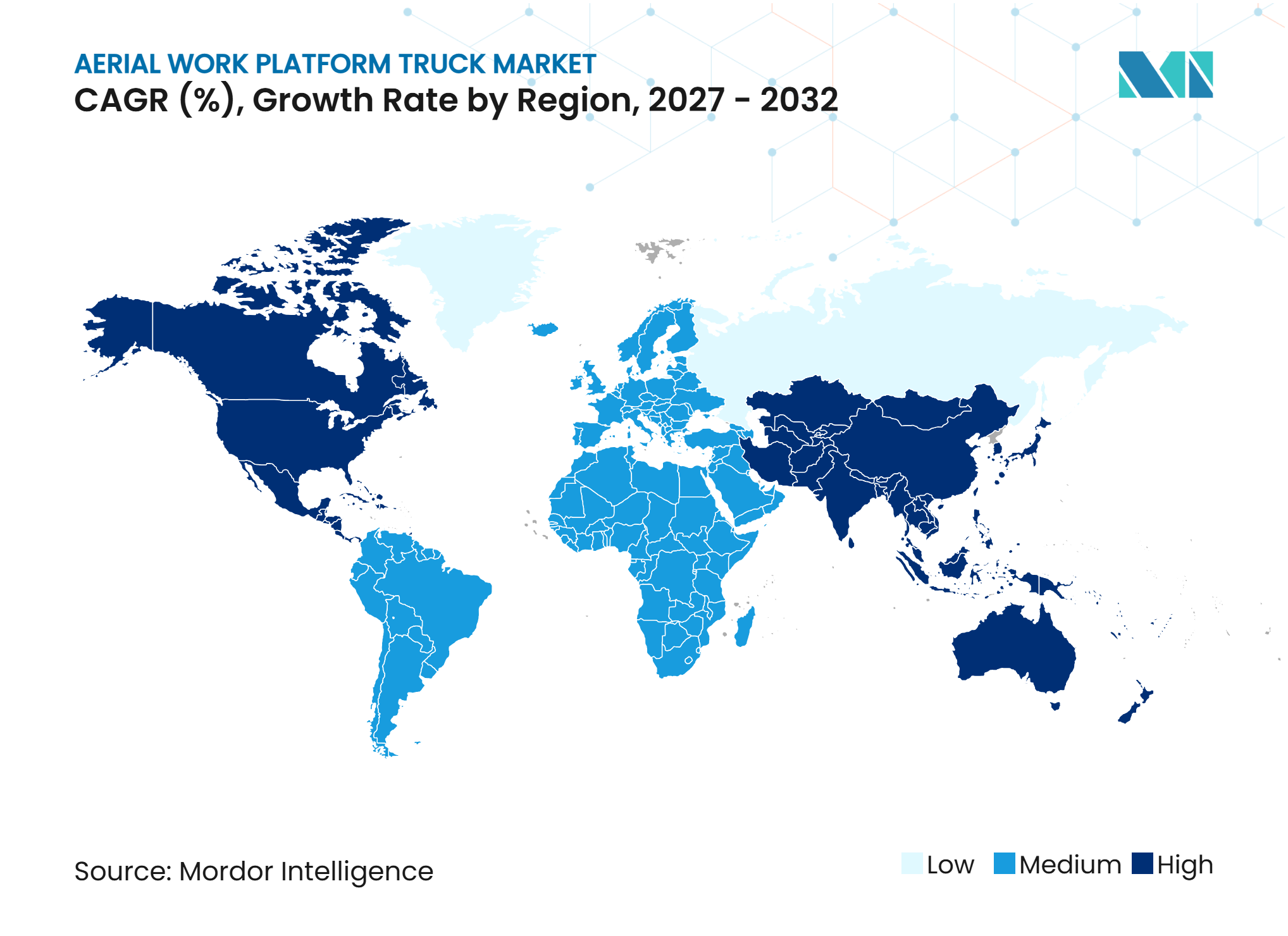
| Fastest Growing Market | Asia-Pacific |
| Largest Market | North America |
| Market Concentration | Medium |
Major Players *Disclaimer: Major Players sorted in no particular order Image © Mordor Intelligence. Reuse requires attribution under CC BY 4.0. | |
Aerial Work Platform Truck Market Analysis by Mordor Intelligence
The Aerial Work Platform Truck Market size was valued at USD 3.12 billion in 2026 and is estimated to reach USD 3.29 billion in 2027 and USD 4.27 billion by 2032, growing at a CAGR of 5.35% over 2027-2032. The aerial work platform truck market is supported by utility investment in grid hardening, automation, and replacement programs. U.S. investor-owned electric utilities planned nearly USD 208 billion of investment in 2025, which supports a sustained need for equipment used on distribution networks. Global grid investment is running at USD 400 billion each year, extending the underlying demand for pole-based installation and maintenance work. Broadband deployment adds a second demand base, as fiber networks require recurring aerial work during installation, repair, and upgrades [1]. Manufacturers are responding with electric-ready platforms, battery-assisted power take-off systems, and lighter chassis configurations that fit dense urban work sites. Operator availability and chassis lead times may slow fleet conversion, even where buyers are ready to adopt newer equipment.
Key Report Takeaways
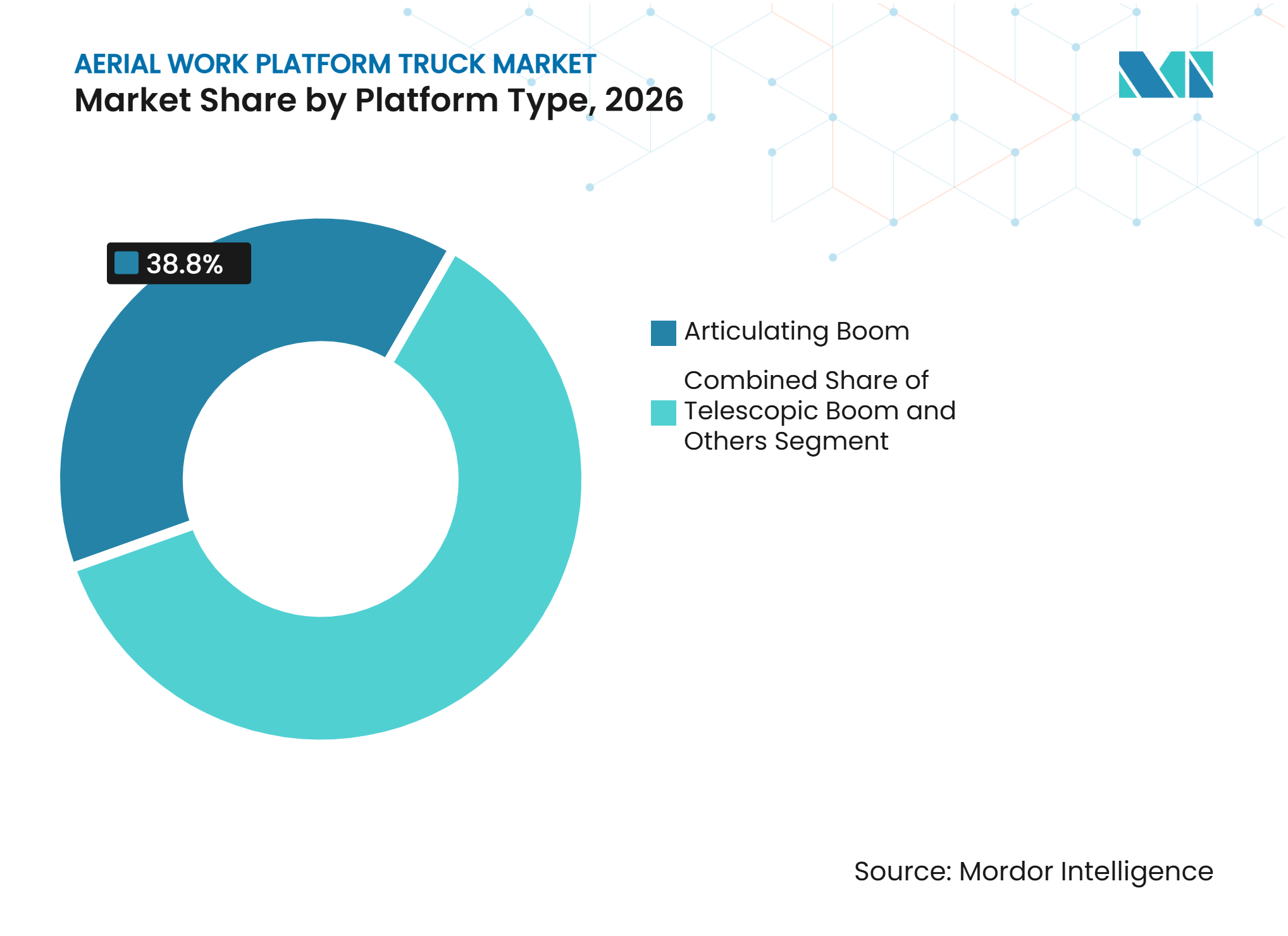
• By platform type, articulating boom platforms held 38.81% of the aerial work platform truck market share in 2026 and are projected to grow at a 6.51% CAGR through 2032.
• By insulation, insulated platforms held 56.73% of the aerial work platform truck market share in 2026, while non-insulated platforms are projected to grow at a 6.44% CAGR through 2032.
• By working height, platforms up to 20 m accounted for 45.56% of the aerial work platform truck market size in 2026, while platforms above 40 m are projected to grow at a 6.71% CAGR through 2032.
• By chassis type, medium-duty trucks held 42.37% of demand in 2026, while light-duty trucks and vans are projected to grow at a 6.67% CAGR through 2032.
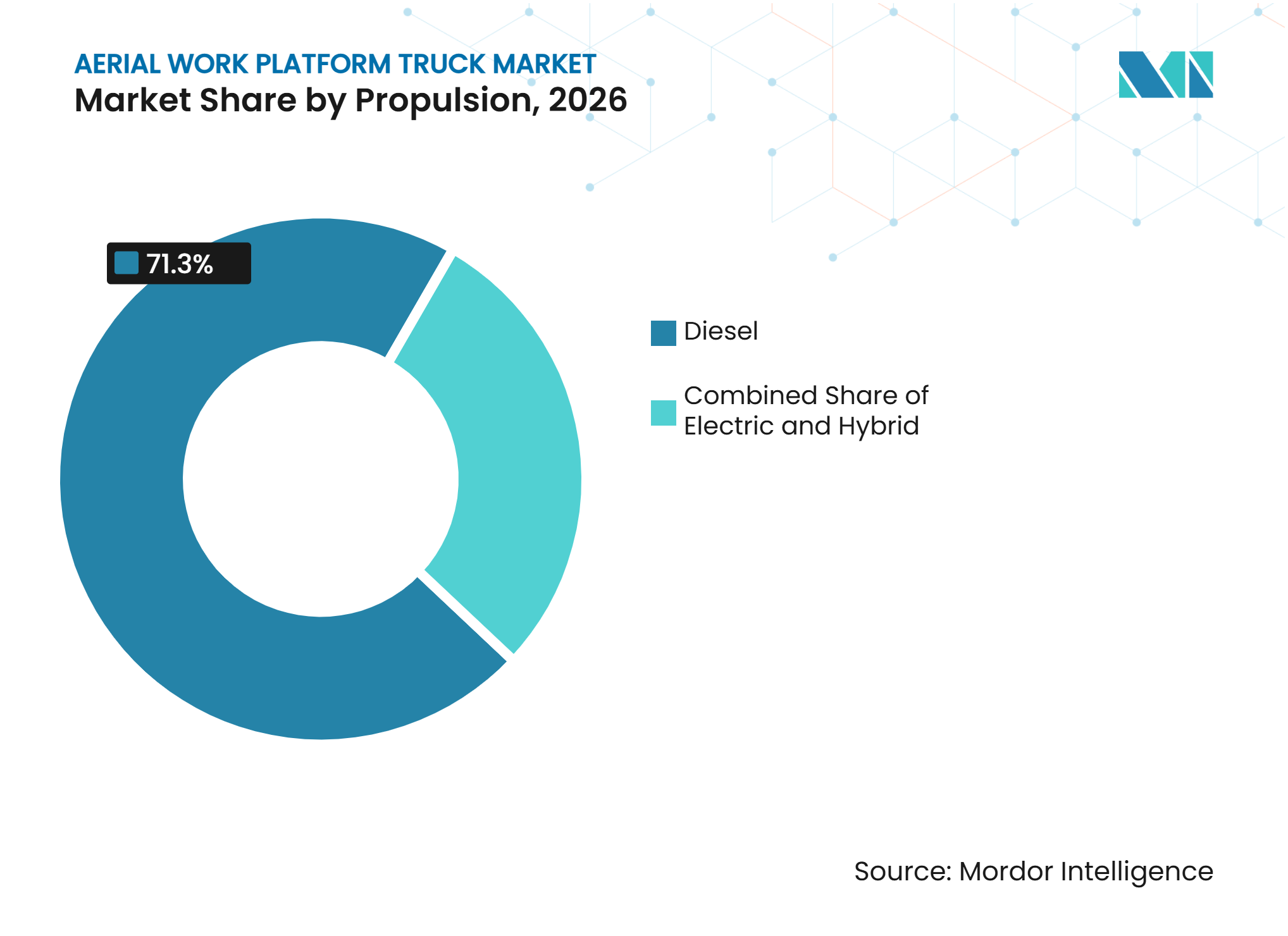
• By propulsion, diesel held 71.27% of demand in 2026, while electric propulsion is projected to grow at a 6.64% CAGR through 2032.
• By end user, utilities and telecom held 48.56% of demand in 2026 and are projected to grow at a 6.83% CAGR through 2032.
• By geography, North America held 34.45% of demand in 2026, while Asia-Pacific is projected to grow at a 6.85% CAGR through 2032.
Note: Market numbers in this report are based on Mordor Intelligence's proprietary estimation framework, which combines nine months of actuals with Q4 projections for base year 2026.
Market Trends and Insights
Drivers Impact Analysis of Aerial Work Platform Truck Market*
| Driver | (~) % Impact on CAGR Forecast | Geographic Relevance | Impact Timeline |
|---|---|---|---|
| Grid Modernization and Storm-Response Fleet Renewal | +1.6% | North America, Europe, APAC core | Long term (≥ 4 years) |
| Broadband, 5G and Fiber Network Expansion | +1.1% | Global, with intensity in North America, South & East Asia | Medium term (2–4 years) |
| Worker-Safety Compliance and Replacement of Ladders or Scaffolding | +0.9% | Global; strongest in North America, EU, Japan | Medium term (2–4 years) |
| Low-Noise and Zero-Emission Operation in Urban Service Fleets | +0.6% | EU, Japan, Australia, urban North America | Medium term (2–4 years) |
| Compact High-Reach Platforms for Constrained Urban Sites | +0.4% | EU, UK, Japan, Southeast Asia | Short term (≤ 2 years) |
| Battery-Assisted PTO and Telematics-Enabled Fleet Utilisation | +0.3% | North America, Europe | Medium term (2–4 years) |
| Source: Mordor Intelligence | |||
Grid Modernization and Storm-Response Fleet Renewal
Utility capital spending supports the aerial work platform truck market because grid assets require installation and service at height. U.S. investor-owned electric utilities planned nearly USD 208 billion in 2025 investment for a stronger, more resilient grid. Sensors, reclosers, and automated switching equipment must still be installed and maintained on poles after digital systems are deployed. Storm-response programs also require insulated bucket trucks that can be used near energized circuits. This favors suppliers that have established rental fleets, field-service capacity, and rapid dispatch coverage. ANSI/SAIA A92.20, A92.22, and A92.24 establish design, safe-use, and training expectations that shape fleet replacement decisions.
Broadband, 5G and Fiber Network Expansion
The aerial work platform truck market has gained a major source of demand alongside utility procurement. The Fiber Broadband Association reported that 11.8 million new homes received fiber access in 2025. The same report placed aerial fiber deployment cost at USD 8.00 per foot, with a 14% year-over-year increase driven mainly by labor. Higher labor costs strengthen the case for equipment that improves the output of each splice crew. U.S. BEAD funding also supports aerial fiber construction, with all 56 state and territory final proposals approved by mid-2026. These projects require safe work practices on aerial plant and create repeat work for truck-mounted platforms.
Worker-Safety Compliance and Replacement of Ladders or Scaffolding
Safety rules are moving some buyers from ladders and mobile scaffolding toward dedicated aerial equipment. OSHA standards for vehicle-mounted elevating and rotating work platforms set requirements for equipment used for work at height [2]. ANSI A92.20 also requires active platform load sensing and dynamic terrain sensing on new equipment. These requirements raise the standard for fleet additions and make older equipment less attractive to retain. Municipal lighting contractors and tree-care operators may face a stronger reason to replace aging equipment. The effect is more durable than construction-led demand because employers must manage safety and compliance risk regardless of project cycles.
Low-Noise and Zero-Emission Operation in Urban Service Fleets
Urban fleet requirements are changing platform and chassis specifications for municipal and telecom users. Isuzu added a special-purpose ELF EV chassis for aerial work platforms in February 2025. The chassis uses a 66-kWh lithium-ion battery and has a stated 190-km range at a constant 60 km/h. PALFINGER also made its TEC range ready for electric drive, allowing fleets to select hybrid or full-electric configurations without changing the mounting architecture. This approach helps fleets update vehicles while preserving options for later replacement. European General Safety Regulation requirements are also reflected in newer platform specifications.
Restraints Impact Analysis of Aerial Work Platform Truck Market*
| Restraint | (~) % Impact on CAGR Forecast | Geographic Relevance | Impact Timeline |
|---|---|---|---|
| High Upfront Cost and Long Payback for Low-Utilization Buyers | -1.1% | Global; most pronounced in emerging markets and SME construction | Long term (≥ 4 years) |
| Shortage of Qualified Operators and Service Technicians | -0.7% | North America, Europe, Australia | Medium term (2–4 years) |
| Chassis Availability, Payload and Mounting Constraints | -0.5% | North America, Europe | Short to medium term (≤ 4 years) |
| Certification, Outrigger and Road-Access Complexity | -0.3% | EU, Japan, South America | Medium term (2–4 years) |
| Source: Mordor Intelligence | |||
High Upfront Cost and Long Payback for Low-Utilization Buyers
A fully specified insulated truck-mounted aerial platform can cost more than USD 300,000. This cost limits purchases by small utilities, independent tree-care operators, and municipal departments with limited capital budgets. Lower-utilization owners can face a payback period longer than 8 years. The challenge becomes greater for electric units, which carry a premium over comparable diesel equipment. Rental fleets can reduce the immediate cost for some customers, but they also concentrate equipment ownership among larger operators. Manufacturers can address this barrier through maintenance packages, leasing, and financing structures that improve the ownership case.
Shortage of Qualified Operators and Service Technicians
The operator shortage limits fleet utilization while creating a service opportunity for manufacturers and large rental businesses. ANSI/SAIA A92.22 and A92.24 require equipment-specific training and familiarization for operators. New electric and telematics-enabled platforms can therefore create another training cycle for a fleet. IPAF reported that European powered-access rental revenue reached EUR 3.6 billion in 2025, increasing 2% as operating cost pressure and technician capacity constrained utilization [3]. Service skills for high-voltage power take-off systems remain limited in several markets. Fleets that build training programs and secure OEM service support can protect uptime more effectively than buyers without those capabilities.
*Our forecasts treat driver/restraint impacts as directional, not additive. The impact forecasts reflect baseline growth, mix effects, and variable interactions.
Aerial Work Platform Truck Market Segment Analysis
By Platform Type:
Articulating Configurations Set the Industry StandardArticulating boom platforms held 38.81% of demand in 2026 and are projected to grow at a 6.51% CAGR through 2032. Their multi-directional movement helps crews work around tree limbs, building facades, and energized conductors. This makes them useful in distribution corridors where a straight-reach unit cannot be positioned freely. The aerial work platform truck market continues to favor this configuration where access paths are constrained. Telescopic booms retain a role in transmission construction and wind installation, where maximum outreach on open sites is more important. RUTHMANN introduced the STEIGER T 1000 HF at bauma 2025, presenting a 100-m working-height truck-mounted platform designed to weigh 10 tonnes less than comparable models.
EN 280 and ANSI A92.20 requirements support active load and terrain-response systems in new mobile elevating work platforms. RUTHMANN also launched the T 570 HF Hybrid with 57 m working height and 600 kg basket capacity at bauma 2025. The launch shows that electrification is reaching premium articulating products where utilization can support the additional cost. The aerial work platform truck industry therefore retains multiple configurations, even as the aerial work platform truck market favors articulating equipment for broad utility and telecom use.



By Insulation:
Safety Standards Entrench Insulated Platform DemandInsulated platforms commanded 56.73% of the aerial work platform truck market size in 2026. OSHA requirements apply to vehicle-mounted elevating and rotating work platforms, while ANSI A92.2 addresses electrical safety expectations for relevant equipment. Utilities, telecom operators working on shared poles, and municipal lighting teams need equipment suited to work near distribution circuits. The aerial work platform truck market depends on dielectric integrity in these applications. Dielectric integrity therefore remains a core purchase requirement in many utility applications. Insulated equipment also supports an annual testing and recertification need across its operating life.
Non-insulated platforms are projected to grow at a 6.44% CAGR through 2032. Construction, tree-care, and rental work can use these units where energized conductors are not part of the normal work environment. This wider use helps non-insulated demand grow while insulated equipment remains central to utility fleets. Altec’s September 2025 Sourcewell agreement covered equipment, parts, accessories, and service support, showing the value of lifecycle service alongside initial equipment sales.
By Working Height:
Compact Platforms Lead, Extreme-Reach Units Gain GroundPlatforms up to 20 m held 45.56% of demand in 2026. Distribution-line service, street lighting, and low-rise telecom work account for a large part of daily fleet activity. These applications favor compact vehicles that can access urban streets and routine utility sites. The aerial work platform truck market uses this height range for a wide set of recurring field tasks. The 20-40 m range serves commercial building maintenance, industrial plants, and dense telecom infrastructure. PALFINGER’s TEC range covers 19-28 m applications on 3.5-10.5-tonne chassis.
Platforms above 40 m are projected to grow at a 6.71% CAGR through 2032. Transmission maintenance, wind-turbine inspection, tall-structure cleaning, and renewable-energy site access support this requirement. Tadano launched an upgraded 40-m HyperDeck AT-400CG in December 2025 on a three-axle chassis that weighs under 20 tonnes. Working height increasingly aligns with vehicle class, road rules, and driver requirements.
By Chassis Type:
Medium-Duty Trucks Form the Core, Light-Duty AcceleratesMedium-duty trucks held 42.37% of the aerial work platform truck market size in 2026. This chassis class balances payload, road-weight compliance, and ownership cost for established utility and telecom fleets. Heavy-duty trucks serve high-reach and high-capacity work, including transmission and industrial maintenance. The aerial work platform truck market uses medium-duty trucks as a common base for established fleet configurations. Light-duty trucks and vans are projected to grow at a 6.67% CAGR through 2032. Compact platforms on lighter chassis can expand deployment options in urban telecom, municipal maintenance, and tree-care work.
Light-duty configurations can avoid commercial driver’s license requirements in many U.S. states and European jurisdictions, widening the potential operator pool. Terex designed its TRX Series for Class 5 or 6 chassis, reflecting the need to optimize reach-to-weight performance for this type of user. Electric drivetrain adoption is also concentrated in light-duty and medium-duty vehicles because their layouts can accommodate battery systems within road-weight limits. This changes chassis evaluation toward platform-power integration and useful payload, not drive range alone.
By Propulsion:
Diesel Remains the Fleet Base as Electric Builds Structural MomentumDiesel held 71.27% of demand in 2026. This position reflects long replacement cycles across utility and telecom fleets. Many units purchased in 2010 remain in service because truck-mounted aerial equipment can operate for 15-20 years. The aerial work platform truck market is therefore replacing diesel equipment gradually rather than all at once. Electric propulsion is projected to grow at a 6.64% CAGR through 2032. Battery-assisted power take-off systems offer a practical bridge by removing engine idling during platform work while retaining diesel travel range.
Duke Energy adopted Viatec SmartPTO technology that powers aerial lifts from a 14.4-kWh battery while the diesel engine is off. The company reported no measurable reduction in aerial productivity under this configuration. Custom Truck One Source introduced an all-electric bucket truck with a Terex Optima TC55, Peterbilt 220EV chassis, and high-voltage ePTO system in October 2025. Chassis allocation and vehicle delivery schedules may still delay wider electric fleet conversion.

By End User:
Utilities and Telecom Drive the Market CoreUtilities and telecom operators held 48.56% of demand in 2026 and are projected to grow at a 6.83% CAGR through 2032. Grid automation and 5G densification require more aerial interventions across the life of a pole. A single pole can carry smart-grid equipment, a fiber enclosure, and other installed assets that require separate service visits. The aerial work platform truck market is supported by this recurring service work as well as new infrastructure construction. Construction remains important for heavy-duty, high-reach equipment used in industrial plants and commercial high-rise work. Its purchasing pattern remains more sensitive to project conditions than utility and telecom procurement.
Municipal and street-lighting operators follow asset replacement schedules and can be early users of electric and hybrid equipment because of urban operating limits. ITOCHU acquired a 27.28% stake in Aichi Corporation in May 2025 and identified electricity, telecom infrastructure maintenance, and tree care as growth areas for international expansion. Rental companies also serve construction, utility, and municipal customers from shared fleets. IPAF reported 2% growth in European powered-access rental revenue during 2025, with consolidation shaping results.
Geography Analysis
North America: Utility Capex and Broadband Funding Sustain Fleet Demand
North America held 34.45% of demand in 2026. U.S. investor-owned utilities planned nearly USD 208 billion of grid investment in 2025, supporting a structured replacement cycle for aerial devices. This spending supports grid hardening, automation, and expansion across a dense utility network. The aerial work platform truck market benefits from this spending because pole-based equipment needs installation and maintenance access. The NTIA had approved all 56 state and territory BEAD final proposals by mid-2026, adding federal support for broadband construction. Fiber deployment costs of USD 8.00 per foot in 2025, up 14% year over year, increase the value of equipment that can improve crew output. Altec announced a USD 9.7 million Mount Airy expansion with more than 100 expected jobs in 2026, which reflects confidence in utility equipment demand. OSHA rules and ANSI/SAIA safe-use and training standards continue to influence fleet renewal and operator practices.
Asia-Pacific: Infrastructure Scale and 5G Densification Fuel Growth
The aerial work platform truck market in Asia-Pacific is projected to record a 6.85% CAGR through 2032. The aerial work platform truck market in the region combines telecom buildout with large-scale grid expansion, creating demand across both routine and high-reach work. Japan provides a mature, density-focused use case with an increasing focus on electric chassis. Isuzu launched an ELF EV special-purpose chassis for aerial work platforms in February 2025, with a 66-kWh battery and stated 190-km range. Aichi Corporation planned a JPY 8.5 billion new assembly facility in Takasaki that is designed to increase capacity by 40% for overseas sales. ITOCHU’s 85-location network across 59 countries supports the company’s international expansion plans. Product certification and urban operating requirements will remain important as suppliers pursue Southeast Asian, European, and North American customers.
Europe, South America, and Middle East and Africa: Diverging Trajectories
Europe recorded EUR 3.6 billion in powered-access rental revenue during 2025, increasing 2%, according to IPAF. The region has varied conditions, as Germany, France, the UK, and the Netherlands faced pressure while Spain, Italy, and Nordic countries performed better. The aerial work platform truck market retains support through vehicle-mounted platforms from utilities and telecom operators that need access to aerial plant. Time Manufacturing consolidated Ruthmann, Versalift, France Élévateur, and Movex under a single European management structure in March 2025. PALFINGER’s electric-ready TEC range is available across EMEA and addresses the need for compact platforms in urban use. South America offers potential through grid expansion and construction, although currency and financing conditions affect purchase timing. The Middle East and Africa have smaller installed fleets but active rental demand connected with infrastructure construction, particularly in Saudi Arabia, the UAE, and Egypt.
Competitive Landscape
Market Concentration

The aerial work platform truck market is moderately concentrated. North American and European specialists retain durable positions through installed fleets, service coverage, and certification knowledge. Time Manufacturing brings together Ruthmann, Versalift, France Élévateur, and Movex in Europe under its One Europe organization. This structure is intended to improve collaboration, operations, and customer service across its European business. Smaller European manufacturers, including Multitel Pagliero, CTE, Isoli, Socage, and Oil & Steel, remain relevant in compact telecom and municipal equipment.
PALFINGER competes through an electric-ready TEC range that was made orderable across EMEA in 2025. Its PT 28 T and PT 22 TJ launches focus on electric operation within a 3.5-tonne class and electric van chassis. RUTHMANN’s HF Hybrid series, including the T 570 HF, supports high-reach applications with a battery system and a 600 kg basket capacity. These actions place electrification, uptime, and flexible fleet deployment at the center of product competition.
Tadano entered the North American access-platform segment through acquisitions of Nagano Industry and Oil & Steel in 2025. The company presented its expanded portfolio at ConExpo 2026, including the AS-63HD telescopic boom and the truck-mounted A62R platform. ITOCHU’s increased investment in Aichi also supports a wider sales and maintenance strategy across international markets. Competition in the aerial work platform truck market remains strongest where suppliers can provide safe operation, field service, financing, and parts availability alongside the vehicle. No combined share for the leading companies is available in the supplied material.
Aerial Work Platform Truck Industry Leaders
-
Altec Inc.
-
Terex Corporation
-
Time Manufacturing Company
-
PALFINGER AG
-
Aichi Corporation
- *Disclaimer: Major Players sorted in no particular order
Aerial Work Platform Truck Market Companies Covered in this Report
- Altec Inc.
- Terex Corporation
- Time Manufacturing Company
- PALFINGER AG
- RUTHMANN Holdings GmbH
- Elliott Equipment Company
- Dur-A-Lift, Inc.
- Teupen Maschinenbau GmbH
- Multitel Pagliero S.p.A.
- CTE S.p.A.
- Isoli S.p.A.
- Aichi Corporation
- Tadano Ltd.
- Socage S.r.l.
- Oil&Steel S.p.A.
- KLUBB Group
- Comet S.p.A.
- GSR S.p.A.
- Böcker Maschinenwerke GmbH
- XCMG Group
- CMC S.r.l.
- Manitex International, Inc.
Recent Industry Developments in Aerial Work Platform Truck Market
- June 2026: ITOCHU completed an additional acquisition of Aichi Corporation shares, deepening its capital and business alliance. The two companies have already launched a maintenance and leasing business for aerial work platforms in September 2025 and a used-vehicle distribution network in November 2025, and are pursuing sales expansion into the UK, Southeast Asia, and North America through ITOCHU’s 85-location global network.
- March 2026: Tadano showcased its expanded North American AWP portfolio at ConExpo 2026, including the North American debut of the AS-63HD heavy-duty telescopic boom with 2,200-lb capacity and up to 10 occupants, and the truck-mounted A62R platform, following its 2025 acquisitions of Nagano Industry and Oil & Steel.
- February 2026: Altec announced Project Poplar, a USD 9.7 million expansion of its Mount Airy production facility, adding new assembly space and a maintenance facility, with more than 100 new jobs anticipated by Q4 2026. The expansion is partly funded by a USD 500,000 grant from the North Carolina Department of Commerce and a USD 329,000 local cash grant, reinforcing the facility’s role as a core North American aerial device manufacturing hub.
- February 2026: Versalift introduced the V-Range, a family of seven 3.5-tonne truck-mounted aerial platforms with working heights from 17 to 27 meters, sold across Europe under the Versalift and France Elévateur brands, with shared controls, hydraulics, and fleet connectivity across all models.
Global Aerial Work Platform Truck Market Report Scope
The scope of the report includes Platform Type (Telescopic, Articulating Boom), Insulation (Insulated, Non-Insulated), Working Height (Up to 20 m, 20–40 m, Above 40 m), Chassis (Light, Medium, Heavy-Duty), Propulsion (Diesel, Hybrid, Electric), End User (Utilities & Telecom, Construction, Municipal, Tree Care, Rental), and Geography (North America, South America, Europe, APAC, MEA). Forecasts cover Value (USD) and Volume.
Segmentation Overview
| Telescopic Boom |
| Articulating Boom |
| Others |
| Insulated |
| Non-Insulated |
| Up to 20 m |
| 20-40 m |
| Above 40 m |
| Light-Duty Trucks/Vans |
| Medium-Duty Trucks |
| Heavy-Duty Trucks |
| Diesel |
| Hybrid |
| Electric |
| Utilities and Telecom |
| Construction |
| Municipal and Street Lighting |
| Tree Care and Forestry |
| Rental Companies |
| Others |
| North America | United States |
| Canada | |
| Mexico | |
| South America | Brazil |
| Argentina | |
| Chile | |
| Colombia | |
| Rest of South America | |
| Europe | Germany |
| Italy | |
| France | |
| United Kingdom | |
| Russia | |
| Rest of Europe | |
| Asia-Pacific | China |
| Japan | |
| India | |
| South Korea | |
| Australia | |
| Rest of Asia-Pacific | |
| Middle East and Africa | Saudi Arabia |
| United Arab Emirates | |
| Turkey | |
| South Africa | |
| Egypt | |
| Rest of Middle East and Africa |
| By Platform Type | Telescopic Boom | |
| Articulating Boom | ||
| Others | ||
| By Insulation | Insulated | |
| Non-Insulated | ||
| By Working Height | Up to 20 m | |
| 20-40 m | ||
| Above 40 m | ||
| By Chassis/Vehicle Type | Light-Duty Trucks/Vans | |
| Medium-Duty Trucks | ||
| Heavy-Duty Trucks | ||
| By Propulsion | Diesel | |
| Hybrid | ||
| Electric | ||
| By End User | Utilities and Telecom | |
| Construction | ||
| Municipal and Street Lighting | ||
| Tree Care and Forestry | ||
| Rental Companies | ||
| Others | ||
| By Geography | North America | United States |
| Canada | ||
| Mexico | ||
| South America | Brazil | |
| Argentina | ||
| Chile | ||
| Colombia | ||
| Rest of South America | ||
| Europe | Germany | |
| Italy | ||
| France | ||
| United Kingdom | ||
| Russia | ||
| Rest of Europe | ||
| Asia-Pacific | China | |
| Japan | ||
| India | ||
| South Korea | ||
| Australia | ||
| Rest of Asia-Pacific | ||
| Middle East and Africa | Saudi Arabia | |
| United Arab Emirates | ||
| Turkey | ||
| South Africa | ||
| Egypt | ||
| Rest of Middle East and Africa | ||
Key Questions Answered in the Report
What is the projected value of the aerial work platform truck sector by 2032?
The sector is projected to reach USD 4.27 billion by 2032, growing at a 5.35% CAGR during 2027-2032.
Which platform type leads aerial work platform truck demand?
Articulating boom platforms lead with a 38.81% share in 2026 and are projected to grow at a 6.51% CAGR through 2032.
Why do utilities and telecom operators use truck-mounted aerial platforms?
Utilities and telecom operators held 48.56% of demand in 2026 because grid, fiber, and pole-based assets require recurring installation and maintenance work at height.
How is electrification changing aerial work platform trucks?
Electric propulsion is projected to grow at a 6.64% CAGR through 2032, supported by electric chassis and battery-assisted power take-off systems.
Which region is growing fastest for aerial work platform trucks?
Asia-Pacific is projected to grow at a 6.85% CAGR through 2032, supported by telecom and grid infrastructure activity.
What constrains adoption of new aerial work platform trucks?
High purchase costs, operator and technician shortages, chassis availability, and certification requirements can delay fleet purchases and utilization.