
Advocacy Marketing Services Market Size and Share
Market Overview
| Study Period | 2020 - 2031 |
|---|---|
| Market Size (2026) | USD 6.11 Billion |
| Market Size (2031) | USD 11.34 Billion |
| Growth Rate (2026 - 2031) | 13.15 % |
| Fastest Growing Market | Asia-Pacific |
| Largest Market | North America |
| Market Concentration | Low |
Major Players *Disclaimer: Major Players sorted in no particular order Image © Mordor Intelligence. Reuse requires attribution under CC BY 4.0. | |
Advocacy Marketing Services Market Analysis by Mordor Intelligence
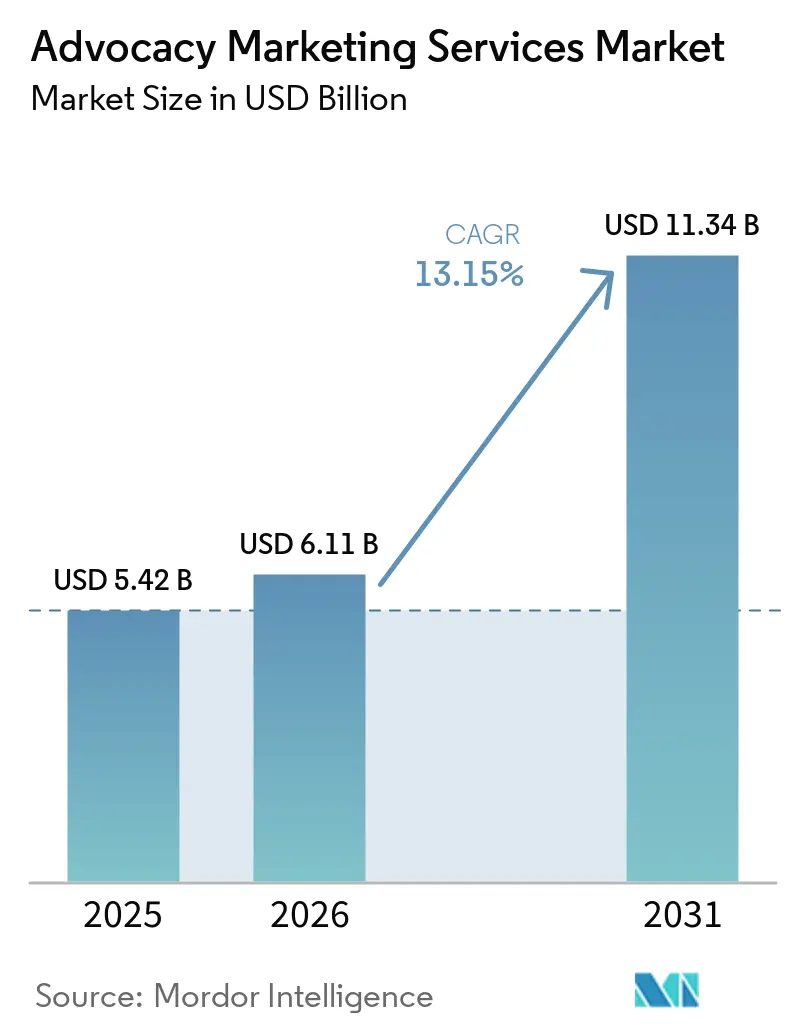
The advocacy marketing services market size was USD 5.42 billion in 2025 and is forecast to reach USD 11.34 billion by 2031, at a CAGR of 13.15% from 2026 to 2031. The advocacy marketing services market is gaining importance as brands seek lower-cost ways to acquire customers across consumer and business channels, particularly as more expensive paid media channels yield diminishing returns per additional campaign. Referral programs, employee advocacy, reviews, communities, and ambassador programs give brands access to customer and employee voices that are more credible than brand-created messages and can support conversion across both short and long purchase journeys. Rising paid-media costs are encouraging companies to direct more spending toward channels that can generate repeat referrals and first-party customer data, while private sharing and peer recommendations create activity that often sits outside conventional campaign reporting. The advocacy marketing services market also benefits from a wider need to verify the source of customer content as generative AI becomes more common in marketing. Vendors are responding by combining formerly separate tools to simplify operating workflows, although unclear measurement across the customer journey can still delay larger program investments and slow budget approval from finance leaders, especially when referral, review, community, and employee signals are reported through different systems and owned by separate internal marketing, sales, and customer teams.
Key Report Takeaways
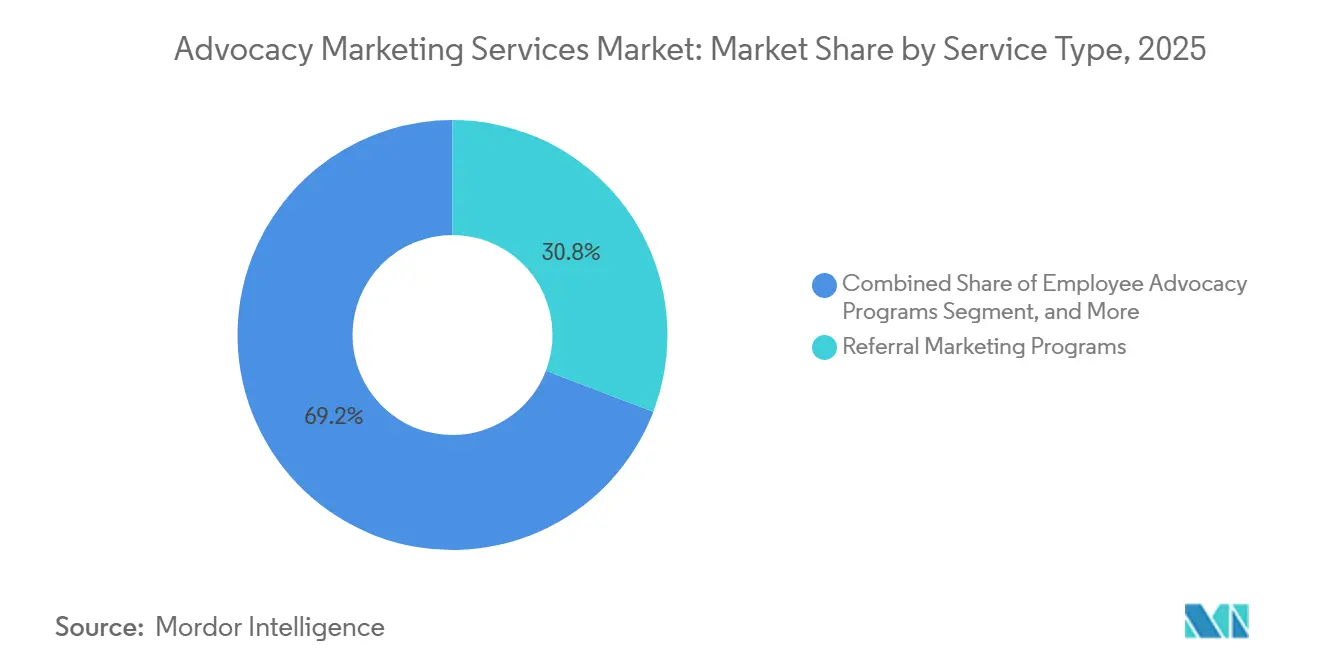
- By service type, referral marketing programs held 30.80% of the advocacy marketing services market share in 2025, while employee advocacy programs are projected to expand at a 13.84% CAGR through 2031.
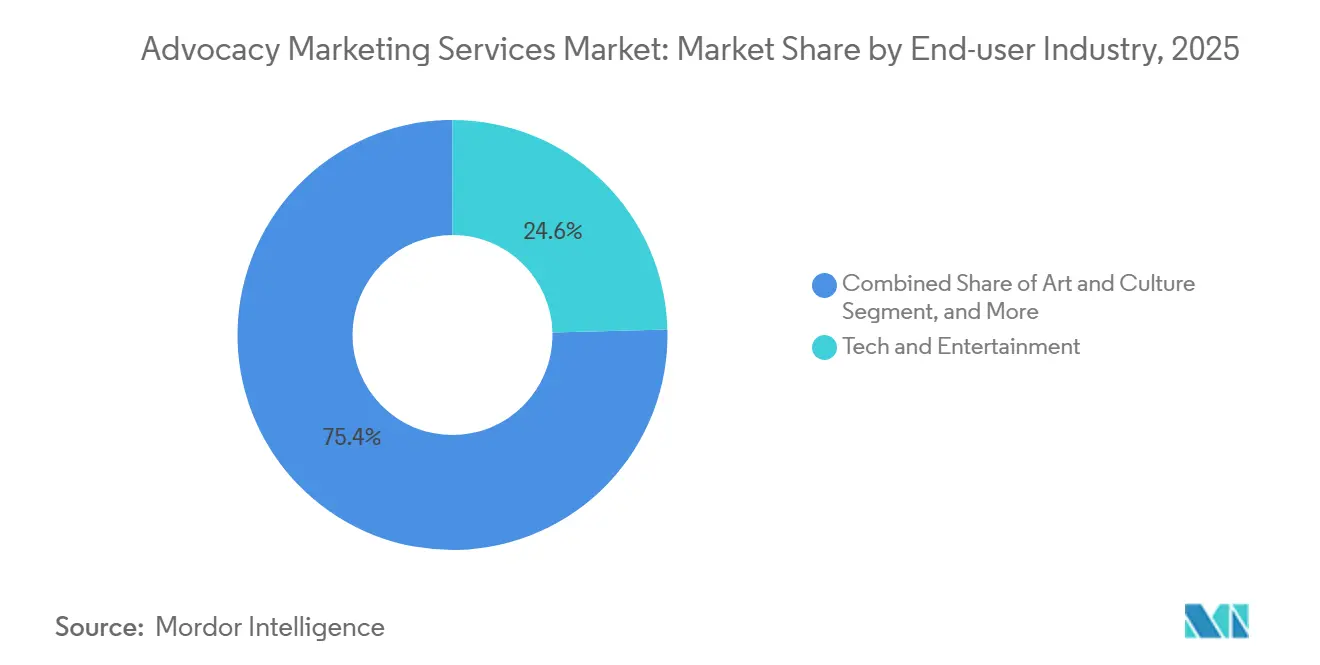
- By end-user industry, tech and entertainment held 24.60% of revenue in 2025, while art and culture is projected to expand at a 13.96% CAGR through 2031.
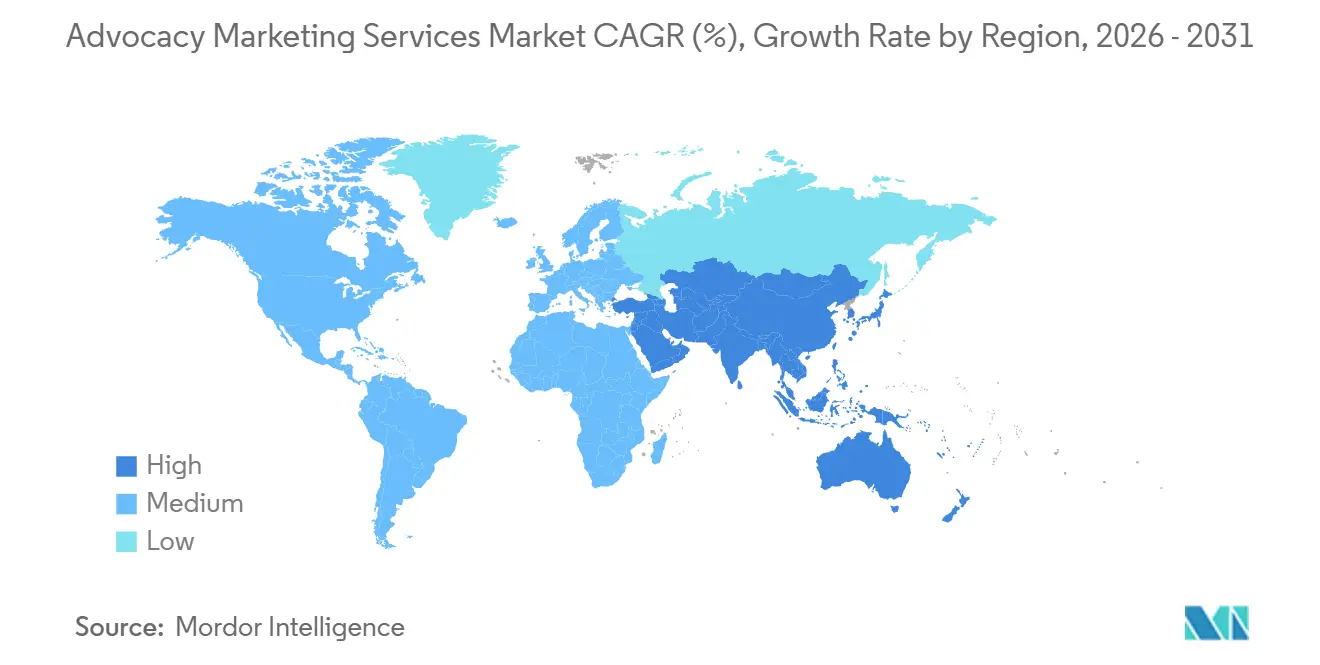
- By geography, North America held 38.40% of revenue in 2025, while Asia-Pacific is projected to expand at a 14.01% CAGR through 2031.
Note: Market size and forecast figures in this report are generated using Mordor Intelligence’s proprietary estimation framework, updated with the latest available data and insights as of January 2026.
Market Trends and Insights
Drivers Impact Analysis of Advocacy Marketing Services Market*
| Driver | (~) % Impact on CAGR Forecast | Geographic Relevance | Impact Timeline |
|---|---|---|---|
| Rising Pressure to Lower Customer Acquisition Costs | +3.5% | Global, strongest in North America and Europe where paid-media acquisition costs are highest | Short term (≤ 2 years) |
| Higher Trust in Peer Proof Than Brand Messaging | +2.8% | Global | Medium term (2-4 years) |
| Greater Adoption of Employee Advocacy in B2B Social Selling | +2.5% | North America and Europe, especially LinkedIn-focused B2B markets | Medium term (2-4 years) |
| Expansion of Omnichannel Referral and Review Workflows | +2.0% | Global, with North America and Europe leading adoption and Asia-Pacific accelerating | Medium term (2-4 years) |
| Synthetic Immunity to AI-Generated Brand Content | +1.8% | North America and Europe, where AI use in advertising is widespread | Short term (≤ 2 years) |
| Growing Use of Specialist Agencies to Scale Lean Advocacy Teams | +1.2% | Global, concentrated in North America and Europe among mid-sized brands | Long term (≥ 4 years) |
| Source: Mordor Intelligence | |||
Rising Pressure to Lower Customer Acquisition Costs
Customer acquisition costs had increased by 222% over the prior 8 years, and a 2026 analysis indicated a further 1%-16% increase over 2024 across the sectors reviewed. Referral and word-of-mouth programs reported customer acquisition costs of USD 5-USD 25, compared with USD 74 for paid search and USD 87 for influencer marketing in e-commerce.[1] This difference supports the advocacy marketing services market because referrals can reduce dependence on auction media and compound when referred customers become future advocates. This is particularly relevant where brands have limited room to increase promotional spending. Structured referral programs can therefore serve as a recurring acquisition channel rather than a short-term campaign tool. This gives the advocacy marketing services market a practical role in reducing recurring acquisition pressure.
Higher Trust in Peer Proof Than Brand Messaging
Trust in peer-created content is becoming more important as consumers question material created by brands or automated systems. Industry observations indicate that many consumers prefer brands that avoid using generative AI in consumer-facing content and frequently question whether content and information are authentic. This trend supports the role of verified employees, customers, and peers in the advocacy marketing services market. Authentic reviews and customer stories can help brands give prospective buyers information from a source that appears independent of paid advertising. This need is strongest when purchase decisions involve uncertainty, comparison, or a long buying process. Platforms that document the origin and consent status of customer content may strengthen the relevance of the advocacy marketing services market for trust-sensitive campaigns.
Greater Adoption of Employee Advocacy in B2B Social Selling
Employee advocacy is moving beyond brand awareness toward a clearer role in sales activity. DSMN8 reported that 94% of employee advocates considered LinkedIn posting beneficial to their careers, while sales teams represented 33% of program activity in 2026. The same benchmark found that 18% of programs achieved a cost per click below USD 1 through employee advocacy, compared with USD 5-10 for paid LinkedIn and USD 2-6 for broader paid B2B social activity. These economics are supporting adoption in the advocacy marketing services market, especially among organizations with sales teams that already use social channels. Employee activity can also signal early buyer interest to teams. That capability matters because it gives the advocacy marketing services market a clearer role in capturing B2B signals before a prospect completes a form.
Expansion of Omnichannel Referral and Review Workflows
Brands are extending referral and review programs across websites, mobile apps, email, SMS, and private messaging channels. Oktopost added WhatsApp Story sharing from Advocacy Boards in June 2026, allowing employee advocates to distribute approved content into messaging environments. This expansion broadens the role of the advocacy marketing services market beyond a single owned channel. Long B2B sales cycles require tracking methods that preserve referral information after cookies expire and across several customer interactions. That requirement favors vendors with server-side tracking, application programming interfaces, and customer relationship management integrations. Omnichannel workflows can reveal previously invisible private advocacy activity and widen the advocacy marketing services market beyond web-based referrals.
Restraints Impact Analysis of Advocacy Marketing Services Market*
| Restraint | (~) % Impact on CAGR Forecast | Geographic Relevance | Impact Timeline |
|---|---|---|---|
| Measurement Fragmentation Across Reviews, Referrals, and Revenue Attribution | -1.8% | Global | Short term (≤ 2 years) |
| Data Privacy and Consent Complexity Across Markets | -1.2% | Europe, North America, and Asia-Pacific | Medium term (2-4 years) |
| Tighter Platform Rules on Coached and Incentivized Reviews | -0.8% | North America and the United Kingdom | Short term (≤ 2 years) |
| Advocate Fatigue and Reference Burnout in High-Touch Programs | -0.5% | Global, strongest in mature North American and European B2B markets | Long term (≥ 4 years) |
| Source: Mordor Intelligence | |||
Measurement Fragmentation Across Reviews, Referrals, and Revenue Attribution
Measurement remains a major barrier when advocacy programs seek funding beyond an initial pilot. The draft evidence indicated that 70%-80% of the B2B buyer journey occurred before the first form fill, including review reading, private social exchanges, and community discussions. Click-based reporting can miss those interactions, leaving advocacy activity undercounted. Referral programs need long attribution windows that connect a single introduction with closed revenue months later. Reviews may improve search visibility and conversion, while employee programs create awareness that does not appear in last-touch reporting. The advocacy marketing services market, therefore, needs stronger integration among server-side tracking, customer relationship management data, self-reported attribution, and branded search analysis.
Data Privacy and Consent Complexity Across Markets
Privacy requirements affect how advocacy programs collect, store, and use contact information. Under the General Data Protection Regulation and the ePrivacy Directive, a referral email to a third party can involve processing personal data belonging to a person who has not consented to brand communications. The General Data Protection Regulation can impose fines of up to 4% of global annual turnover for noncompliance.[2] California privacy rules and India’s Digital Personal Data Protection Act add separate obligations for brands operating across those markets. Global companies may need to adapt the same referral flow for different consent requirements. This adds legal and technical work, but it encourages consent-first architectures as the advocacy marketing services market accommodates regional requirements.
*Our forecasts treat driver/restraint impacts as directional, not additive. The impact forecasts reflect baseline growth, mix effects, and variable interactions.
Advocacy Marketing Services Market Segment Analysis
By Service Type:
Referral Programs Lead a Diverse Service StackReferral Marketing Programs held 30.80% of the advocacy marketing services market share in 2025. Their position reflected the direct transfer of trust from an existing customer to a referred buyer. The category had broad use in business-to-consumer, direct-to-consumer, financial services, and software-as-a-service settings. Referral programs also suit brands that need first-party customer data following reduced access to third-party cookies. Employee Advocacy Programs are projected to record the highest growth at a 13.84% CAGR through 2031. Their growth is linked to the shift from optional marketing activity toward sales participation and revenue support. The advocacy marketing services market size for this service stack is also supported by reviews and ratings, which provide visible social proof during online purchase decisions. Yotpo’s AI Review Summaries, introduced in late 2025, generated condensed review sentiment on product pages. Early apparel adopters reported a 6%-11% lift in add-to-cart rates in internal cases presented at the company’s March 2026 merchant summit.
Community Advocacy Services are receiving greater attention as brands treat engaged members as a source of retention and product feedback. The draft cited performance data showing that active community members had 15%-25% higher 12-month retention than non-community peers. Brand Ambassador and Influencer Advocacy Services are also shifting from one-time campaigns to longer-term ambassador relationships. SocialLadder’s April 2025 research across hundreds of ambassador programs found that 14% of ambassadors generated 80% of program return on investment. This pattern has encouraged brands to identify and support their most effective advocates instead of distributing resources evenly across large rosters. Enterprise buyers may use separate providers for referrals, employee activity, reviews, communities, and ambassadors because these tools often serve different internal teams. That structure sustains demand across the broader advocacy marketing services industry. It also creates an opening for platforms that can connect several advocacy activities without forcing brands to replace every specialist tool.

By End-User Industry:
Tech Demand Anchors a Broadening End-User BaseTech and Entertainment held 24.60% of the advocacy marketing services market in 2025. Software-as-a-service companies were among the earliest to use customer and employee advocacy programs systematically. Their procurement processes generally emphasize measurable return, integrated workflows, and scalable automation. Those requirements align with the capabilities of leading advocacy platforms. Art and Culture is projected to record the highest growth at a 13.96% CAGR through 2031. This result reflects the growing commercial value of organized fan communities and creator-led engagement. The FIFA World Cup 2026 and other sports events in the first half of 2026 generated USD 8.2 billion in Media Impact Value across social, press, and owned channels.[3] Structured ambassador and community programs can help cultural properties capture value from this type of audience participation.
Sports, FMCG, and Consumer Goods represent additional areas of demand for the advocacy marketing services industry. Sports brands are investing in creator-led fan communities, while FMCG brands use referrals and reviews to protect shelf visibility against private-label products. Automotive companies are increasing advocacy investment as buyers consult online reviews and owner recommendations before making vehicle decisions. This is particularly relevant for electric vehicles, where consumers often seek peer views on range, charging, and total cost. BFSI remains underpenetrated but has clear potential for compliant referral tracking and incentive disclosures. Zerodha stated in 2025 that more than 50% of its growth came from word of mouth, including periods without a formal referral incentive. Fashion and Luxury brands are moving toward co-creation with ambassadors, including longer-running relationships that extend beyond individual product promotions.
Geography Analysis
North America Advocacy Marketing Services Market
North America held 38.40% of regional revenue in 2025. The region combines a high density of software-as-a-service buyers, established digital marketing operations, mature advocacy vendors, and US advertising, marketing, and data spending projected at USD 664.2 billion in 2026, up 9.4% from 2025. This scale gives brands room to redirect spending toward performance-focused channels when paid acquisition becomes less efficient. The regional compliance environment also shapes product design for reviews and referrals. The Federal Trade Commission rule prohibits specific deceptive review practices, including fake reviews and certain incentives, which can favor providers with stronger disclosure, consent, and moderation controls.[4]
Europe Advocacy Marketing Services Market
Europe’s advocacy marketing services market is shaped by demand for influence-based promotion and stricter privacy requirements. French brands invested EUR 587 million (USD 634 million) in influence marketing in 2025. European brands are increasingly adopting consent-first designs, which raise implementation complexity but can strengthen the quality and governance of first-party data. The United Kingdom remains an important referral market, in which Mention Me has processed more than 5 million referrals domestically. This illustrates the established operating base for the advocacy marketing services market in Europe.
APAC and MEA Advocacy Marketing Services Market
Asia-Pacific is projected to be the fastest-growing region in the advocacy marketing services market, with a 14.01% CAGR through 2031, driven by India’s expanding digital economy and China’s content-commerce model. Campaign Asia reported that Asia-Pacific advertising spending is projected to grow 5.4% to USD 376.4 billion in 2026. India’s Digital Personal Data Protection Act, enacted in 2025, encourages consent-based tracking and limits third-party data handling. Japan and Australia are mature markets with selective expansion in influencer and creator advocacy. The Middle East and Africa are earlier-stage opportunities, and Oktopost’s reseller partnership with South Africa-based Kakanyo Business Solutions shows how global vendors are building local routes to market.
Competitive Landscape
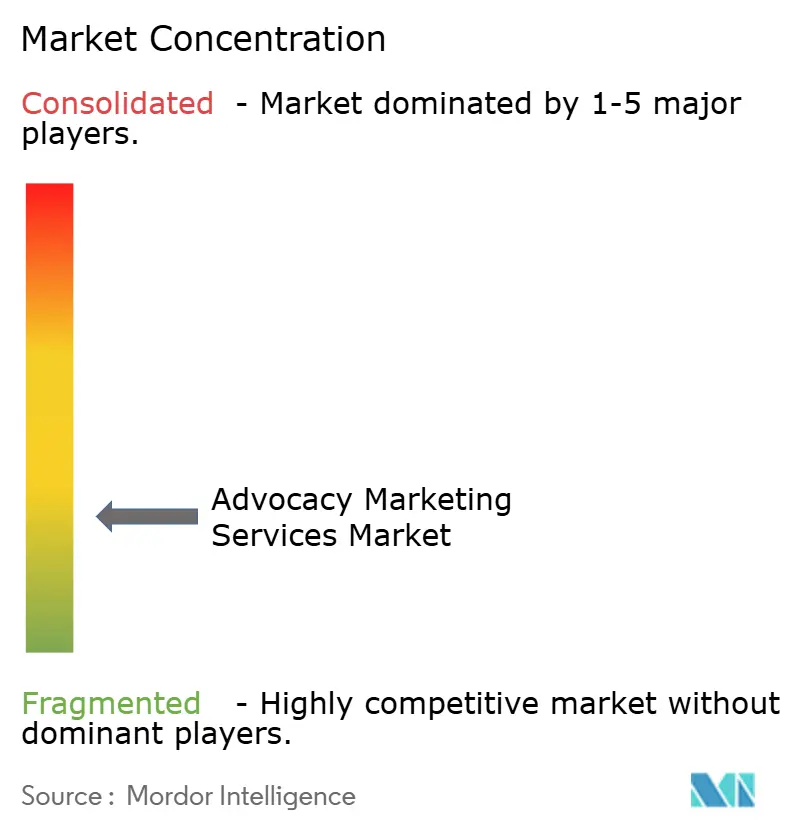
The advocacy marketing services market is fragmented across referral software, employee advocacy, review management, community platforms, and ambassador tools. No provider held a dominant position across all 5 service types, while large buyers are showing greater interest in multi-service platforms that reduce the need to manage several vendors. Yotpo had more than 40,000 active merchants in early 2026 after consolidating reviews, loyalty, SMS, and referrals into a single platform. Bazaarvoice remained a major provider of reviews and ratings for direct-to-consumer and large retail customers, and its Shopify certification in May 2026 expanded its ability to serve brands on that commerce platform. This consolidation direction may make integrated data and workflow support more important than a narrow feature set.
The advocacy marketing services market is also being shaped by AI features in established platforms. Extole launched an AI-ready developer platform in June 2026 with Model Context Protocol, application programming interfaces, software development kits, and command-line interface tools to support personalized referral and incentive programs. Oktopost introduced Advocacy Agent in June 2026 to create personalized employee post drafts while preserving individual voice. Bazaarvoice partnered with Google in May 2026 to enable AI Discovery, allowing review content from its network to be used in AI-powered search discovery. These developments show how suppliers are improving program operations and content visibility, but they do not remove the need for clear consent, provenance, and measurement.
The largest gaps concern cross-service attribution, compliant BFSI workflows, and regional capability in Asia-Pacific. A single metric that links referral conversions, employee influence, review-related conversions, and ambassador media value remains difficult to establish, creating an opportunity for vendors that connect multiple advocacy channels to customer relationship management systems. BFSI buyers need audit-ready referral tracking and clear incentive disclosures, and Extole joined the Candescent digital banking Marketplace in April 2026 to support refer-a-friend and loyalty programs in online and mobile banking. Asia-Pacific vendors need local-language support, suitable reward options, and architectures aligned with India’s Digital Personal Data Protection Act and China’s Personal Information Protection Law, while Mention Me, SOCXO, and ReferralCandy retain regional or segment-focused positions.
Advocacy Marketing Services Industry Leaders
-
Birdeye, Inc.
-
Yotpo Ltd.
-
Extole, Inc.
-
Influitive Corporation
-
Mention Me Limited
- *Disclaimer: Major Players sorted in no particular order
Advocacy Marketing Services Market Companies Covered in this Report
- Influitive Corporation
- Extole, Inc.
- Mention Me Limited
- Friendbuy, Inc.
- Referral Rock Inc.
- ReferralCandy Pte. Ltd.
- Annex Cloud, Inc.
- I2H, Inc.
- GaggleAMP Inc.
- SOCXO Solutions Private Limited
- EveryoneSocial, Inc.
- Higher Logic LLC
- Khoros, LLC
- UserEvidence, Inc.
- Crowdvocate, Inc.
- Brandbassador Limited
- SocialLadder Inc.
- Yotpo Ltd.
- Bazaarvoice, Inc.
- Oktopost Ltd.
Recent Industry Developments in Advocacy Marketing Services Market
- June 2026: Extole launched an AI-ready developer platform introducing new MCP, API, SDK, and CLI capabilities, enabling AI agents and developers to build, manage, and optimize personalized referral and incentive programs within tools such as Claude and ChatGPT. The release positions Extole at the intersection of AI-assisted marketing and enterprise-grade offer management for retail, financial services, and telecommunications clients.
- June 2026: Oktopost shipped the Advocacy Agent, an AI-native feature that generates personalized post drafts for employee advocates while preserving individual voice, directly reducing the blank-page friction that suppresses participation rates in mid-sized programs. The Advocacy Agent is available to all Oktopost Enterprise plan customers and follows Oktopost’s concurrent release of WhatsApp Story sharing directly from Advocacy Boards in the same month.
- May 2026: Bazaarvoice became a Shopify Certified Technology Partner following months of collaboration with Shopify, delivering a reimagined integration that provides native-app speed alongside its global review syndication network. The certification is material because it opens Bazaarvoice’s enterprise-grade content network to tens of thousands of Shopify-hosted brands that had historically defaulted to Yotpo or Okendo for review management.
- May 2026: Higher Logic Vanilla launched its MCP Server, which connects live community data to AI tools, including ChatGPT, Claude, and Cursor, via the Model Context Protocol. The release enables community managers and marketers to query platform data in natural language, compressing insight-extraction workflows and increasing the operational leverage of community advocacy investments.
Global Advocacy Marketing Services Market Report Scope
The Advocacy Marketing Services Market comprises professional services that help organizations identify, engage, manage, and activate customers, employees, partners, and brand advocates to promote products, services, and brands through authentic recommendations, referrals, reviews, testimonials, social sharing, and community participation. These services enable businesses to strengthen brand credibility, increase customer acquisition and retention, and improve marketing effectiveness by leveraging trusted peer-to-peer advocacy across digital and offline channels.
The Advocacy Marketing Services Market Report is Segmented by Service Type (Referral Marketing Programs, Employee Advocacy Programs, Review and Ratings Advocacy Services, Community Advocacy Services, and Brand Ambassador and Influencer Advocacy Services), End-User Industry (Tech and Entertainment, Art and Culture, Sports, FMCG and Consumer Goods, Automotive, BFSI, Fashion and Luxury, and Other End-User Industries), and Geography (North America, South America, Europe, Asia-Pacific, Middle East, and Africa). The Market Forecasts are Provided in Terms of Value (USD).
Segmentation Overview
| Referral Marketing Programs |
| Employee Advocacy Programs |
| Review and Ratings Advocacy Services |
| Community Advocacy Services |
| Brand Ambassador and Influencer Advocacy Services |
| Tech and Entertainment |
| Art and Culture |
| Sports |
| FMCG / Consumer Goods |
| Automotive |
| BFSI |
| Fashion and Luxury |
| Other End User Industries |
| North America | United States |
| Canada | |
| Mexico | |
| South America | Brazil |
| Argentina | |
| Chile | |
| Rest of South America | |
| Europe | Germany |
| United Kingdom | |
| France | |
| Italy | |
| Spain | |
| Netherlands | |
| Nordics | |
| Russia | |
| Rest of Europe | |
| Asia-Pacific | China |
| Japan | |
| India | |
| South Korea | |
| Australia | |
| Singapore | |
| Indonesia | |
| Rest of Asia-Pacific | |
| Middle East | United Arab Emirates |
| Saudi Arabia | |
| Turkey | |
| Israel | |
| Qatar | |
| Rest of Middle East | |
| Africa | South Africa |
| Nigeria | |
| Kenya | |
| Egypt | |
| Rest of Africa |
| By Service Type | Referral Marketing Programs | |
| Employee Advocacy Programs | ||
| Review and Ratings Advocacy Services | ||
| Community Advocacy Services | ||
| Brand Ambassador and Influencer Advocacy Services | ||
| By End-user Industry | Tech and Entertainment | |
| Art and Culture | ||
| Sports | ||
| FMCG / Consumer Goods | ||
| Automotive | ||
| BFSI | ||
| Fashion and Luxury | ||
| Other End User Industries | ||
| By Geography | North America | United States |
| Canada | ||
| Mexico | ||
| South America | Brazil | |
| Argentina | ||
| Chile | ||
| Rest of South America | ||
| Europe | Germany | |
| United Kingdom | ||
| France | ||
| Italy | ||
| Spain | ||
| Netherlands | ||
| Nordics | ||
| Russia | ||
| Rest of Europe | ||
| Asia-Pacific | China | |
| Japan | ||
| India | ||
| South Korea | ||
| Australia | ||
| Singapore | ||
| Indonesia | ||
| Rest of Asia-Pacific | ||
| Middle East | United Arab Emirates | |
| Saudi Arabia | ||
| Turkey | ||
| Israel | ||
| Qatar | ||
| Rest of Middle East | ||
| Africa | South Africa | |
| Nigeria | ||
| Kenya | ||
| Egypt | ||
| Rest of Africa | ||
Key Questions Answered in the Report
What is the size of the advocacy marketing services market?
The advocacy marketing services market was valued at USD 5.42 billion in 2025 and is forecast to reach USD 11.34 billion by 2031 at a 13.15% CAGR from 2026 to 2031.
Which service type leads advocacy marketing services?
Referral Marketing Programs led with a 30.80% share in 2025. Employee Advocacy Programs are projected to record the highest growth at a 13.84% CAGR through 2031.
Which end-user sector has the largest demand for advocacy services?
Tech and Entertainment held the largest end-user share at 24.60% in 2025, supported by early adoption among software-as-a-service enterprises.
Which region is expanding fastest for advocacy platforms?
Asia-Pacific is projected to expand at a 14.01% CAGR through 2031, supported by digital growth in India and content-commerce activity in China.
Why do brands use referral and employee advocacy programs?
Brands use them to obtain customer and employee-led recommendations, improve first-party data collection, and reduce reliance on paid acquisition channels.
What limits adoption of advocacy software and services?
Fragmented attribution, different privacy requirements, rules on incentivized reviews, and advocate fatigue can slow broader program investment.