
Advanced Infusion Systems Market Size and Share
Market Overview
| Study Period | 2020 - 2031 |
|---|---|
| Market Size (2026) | USD 9.38 Billion |
| Market Size (2031) | USD 13.95 Billion |
| Growth Rate (2026 - 2031) | 8.24 % |
| Fastest Growing Market | Asia-Pacific |
| Largest Market | North America |
| Market Concentration | Medium |
Major Players *Disclaimer: Major Players sorted in no particular order Image © Mordor Intelligence. Reuse requires attribution under CC BY 4.0. | |
Advanced Infusion Systems Market Analysis by Mordor Intelligence
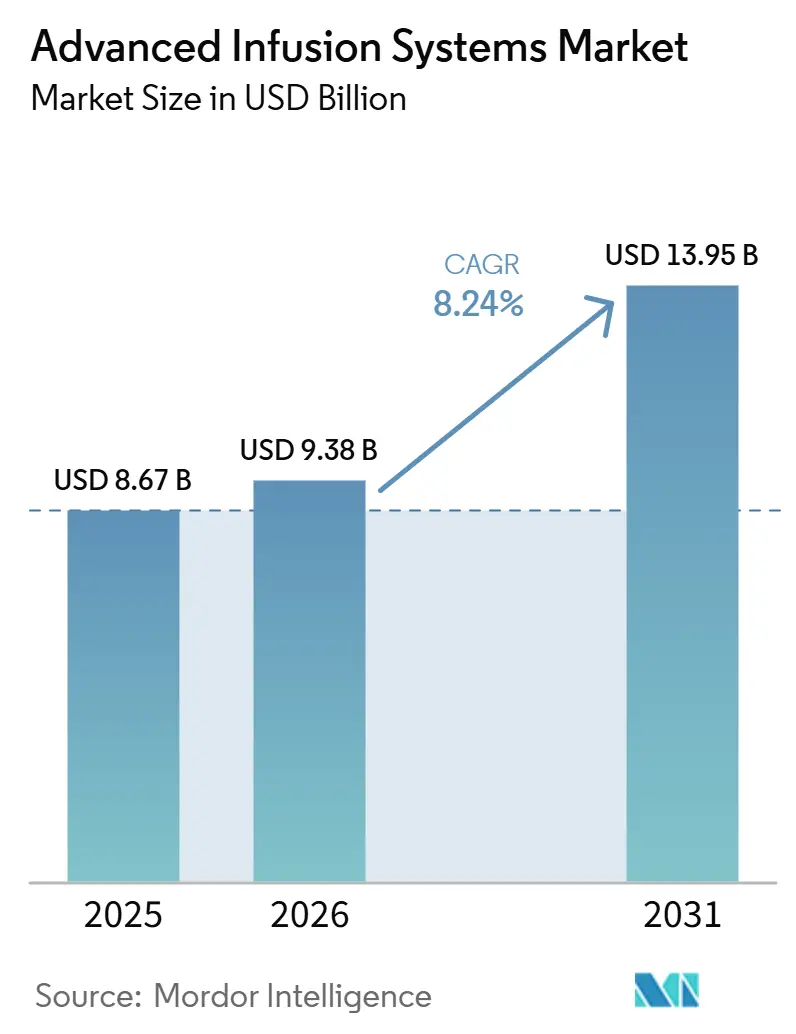
The Advanced Infusion Systems Market size is projected to expand from USD 8.67 billion in 2025 and USD 9.38 billion in 2026 to USD 13.95 billion by 2031, registering a CAGR of 8.24% between 2026 to 2031.
Rising cancer incidence and the wider use of complex biologics are increasing demand for precise, connected infusion equipment in hospitals and outpatient care. Home-based treatment is also changing purchase decisions because providers need pumps, software, and documentation tools that work outside traditional clinical settings. EHR connectivity has become a key requirement in hospital pump replacements because it supports medication documentation and drug library use. Manufacturers are therefore competing on software, cybersecurity, service capabilities, and clinical workflow support, rather than device specifications alone. Select subcutaneous delivery systems could reduce IV sessions for some treatments over time, but they also support more care outside hospital infusion chairs.
Key Report Takeaways
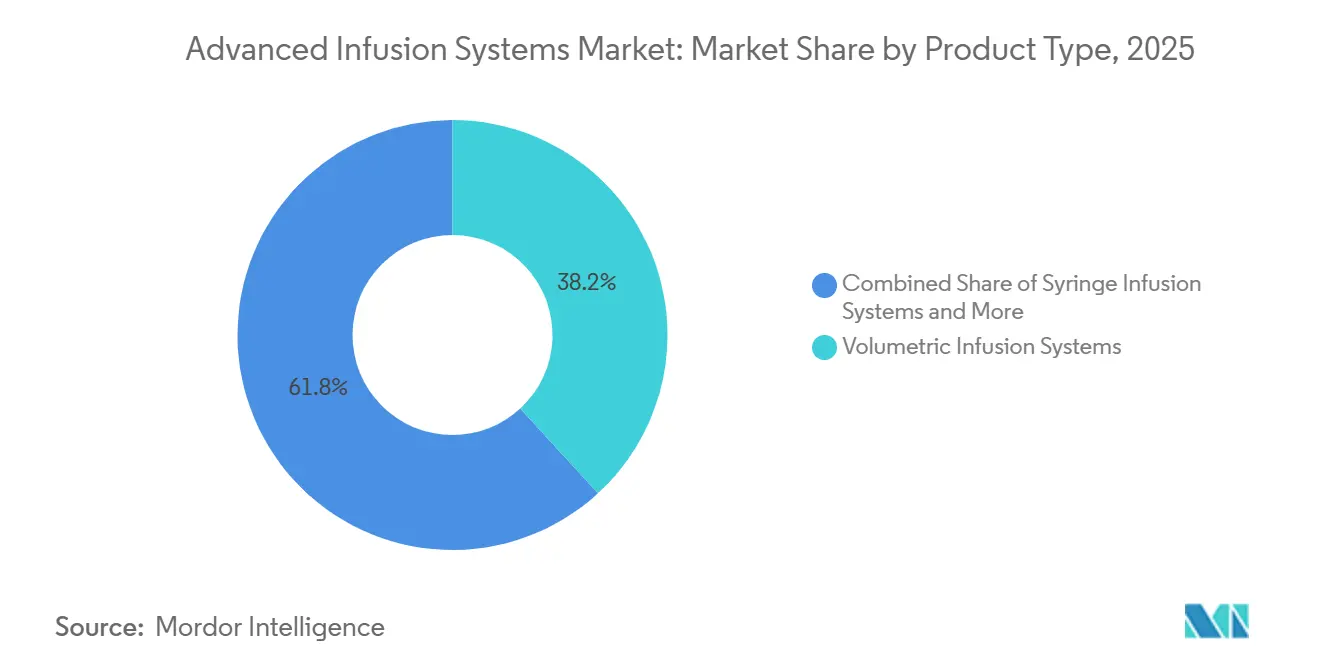
- By product type, volumetric infusion systems held 38.16% of the Advanced Infusion Systems Market share in 2025, while ambulatory infusion systems are forecast to grow at a 9.76% CAGR through 2031.
- By application, oncology and chemotherapy accounted for 31.77% of the Advanced Infusion Systems Market share in 2025, while diabetes management is forecast to expand at a 10.12% CAGR through 2031.
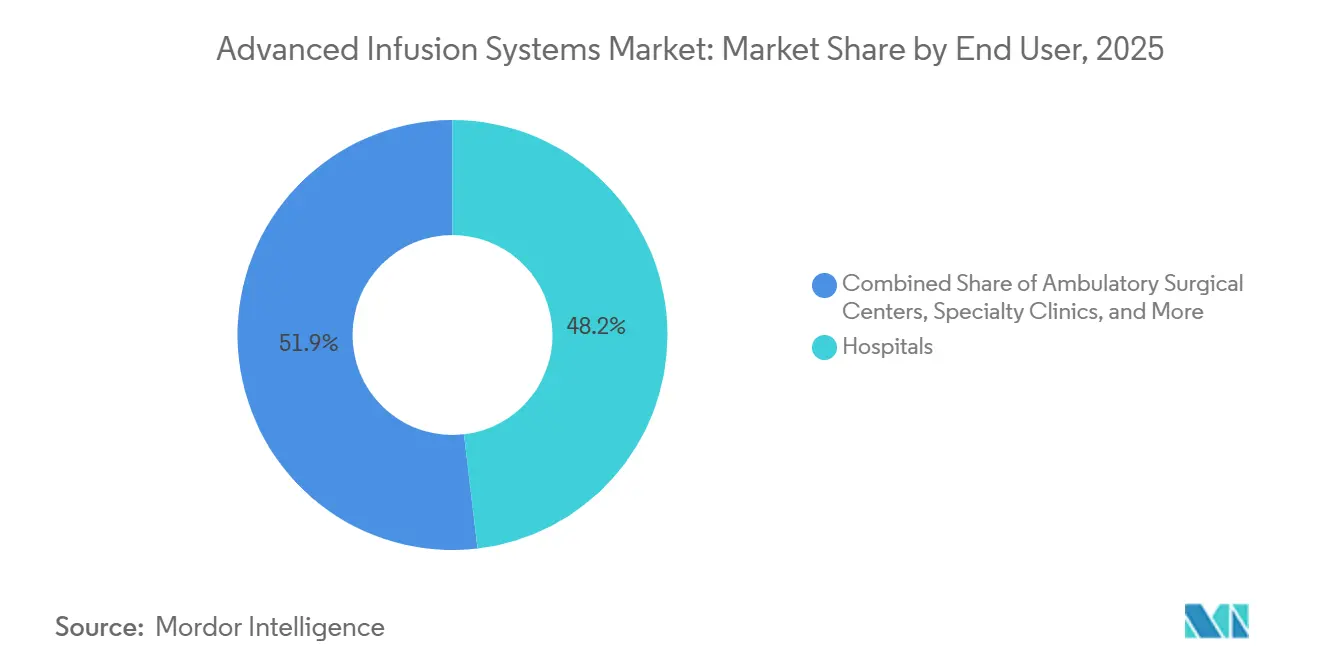
- By end user, hospitals held 48.15% share in 2025, while home care settings are forecast to grow at a 9.87% CAGR through 2031.
- By technology, smart infusion pumps accounted for 42.11% share in 2025, while AI-enabled infusion platforms are forecast to grow at a 13.17% CAGR through 2031.
- By geography, North America held 38.44% share in 2025, while Asia-Pacific is forecast to expand at a 9.56% CAGR through 2031.
Note: Market size and forecast figures in this report are generated using Mordor Intelligence’s proprietary estimation framework, updated with the latest available data and insights as of January 2026.
Global Advanced Infusion Systems Market Trends and Insights
Drivers Impact Analysis*
| Driver | (~) % Impact on CAGR Forecast | Geographic Relevance | Impact Timeline |
|---|---|---|---|
| Rising Chronic Disease and Oncology Treatment Demand | +2.5% | Global, concentrated in North America, Europe, and China | Long term (≥ 4 years) |
| Migration to Home and Alternate-Site Infusion | +1.5% | North America, with spillover to Europe and Asia-Pacific | Medium term (2-4 years) |
| EHR-Integrated Smart Pump Replacement Cycles | +1.2% | North America and Western Europe | Medium term (2-4 years) |
| Specialty Biologics and Precision-Dosing Requirements | +1.0% | Global, led by the United States, Germany, and Japan | Long term (≥ 4 years) |
| Reimbursement Expansion for Home Infusion Therapy | +0.8% | North America | Short term (≤ 2 years) |
| Device-Level Interoperability and Remote Fleet Management | +0.7% | North America and Western Europe | Medium term (2-4 years) |
| Source: Mordor Intelligence | |||
Rising Chronic Disease and Oncology Treatment Demand
Cancer created an estimated 20.6 million new cases and close to 10 million deaths annually, according to the World Health Organization’s 2026 report. The report expects annual new cases to approach 35 million by 2050 if current patterns continue. This growing treatment burden supports investment in infusion equipment, chemotherapy capacity, and specialty oncology services. Complex oncology regimens require controlled dosing, longer administration periods, and closer monitoring during treatment. These requirements favor advanced systems that can support high-acuity treatment protocols across hospital and community oncology settings. The Advanced Infusion Systems Market benefits as healthcare providers update equipment to support a larger and more complex patient population.
Migration to Home and Alternate-Site Infusion
Infusion therapy is moving from hospital departments to home and alternate-care locations. This change expands demand for ambulatory and elastomeric devices that are designed for use outside acute-care facilities. The Centers for Medicare & Medicaid Services published its CY 2026 national home infusion therapy rates on December 2, 2025. The rates reflected a 2.0% CPI-U productivity-adjusted increase and provide a reimbursement reference for providers planning Advanced Infusion Systems Market home infusion capacity. Home care requires different service models because clinicians need access to therapy information without relying on hospital documentation processes. The Advanced Infusion Systems Market is therefore shifting toward systems that combine mobility, straightforward operation, and remote access to treatment data.
EHR-Integrated Smart Pump Replacement Cycles
Hospitals are replacing legacy pumps as EHR interoperability becomes more important for medication safety and documentation. A 2025 systematic review of 7 U.S. observational studies found that bidirectional interoperability increased drug library compliance from baseline ranges of 31.5%-94% to post-implementation ranges of 55.7%-97.9%. The review also found that nurse time per infusion programming declined by 24.8%, while medication error measures improved in every study that evaluated them. BD reported in November 2025 that its Alaris EMR Interoperability solution was active at more than 960 U.S. hospital sites. The company also reported that the platform added 12 hospitals per month and worked with MEDITECH, Epic, and Cerner. These developments make connectivity a practical purchasing requirement for many large hospital systems in the Advanced Infusion Systems Market.[1]BMJ Health & Care Informatics, “Effects of a Bidirectional Interoperability between Electronic Health Records and Smart Infusion Pumps in Hospital Settings: A Systematic Review,” BMJ Health & Care Informatics, bmj.com
Specialty Biologics and Precision-Dosing Requirements
Biologics used in oncology, immunology, and neurology are raising expectations for infusion accuracy and monitoring. These therapies may require narrow dosing windows, handling of high-viscosity fluids, and observation for treatment-related events. ICU Medical received FDA clearance in April 2025 for the Plum Solo and Plum Duo precision IV pumps. The company stated that the devices provide ±3% dosing accuracy in real-world conditions, support blood product compatibility, and offer EHR interoperability through LifeShield software. Sanofi received FDA approval for Sarclisa Escena in July 2026 as the first anticancer treatment delivered through a subcutaneous on-body injector. That delivery option expands outpatient and home care possibilities, while placing selective long-term pressure on IV delivery in relevant indications for the Advanced Infusion Systems Market.
Restraints Impact Analysis*
| Restraint | (~) % Impact on CAGR Forecast | Geographic Relevance | Impact Timeline |
|---|---|---|---|
| High Fleet Replacement and Total Ownership Costs | -0.9% | Global, most acute in cost-constrained health systems in emerging markets | Long term (≥ 4 years) |
| Cybersecurity, Recall, and Software-Liability Exposure | -0.7% | Global, with highest regulatory scrutiny in North America and Western Europe | Medium term (2-4 years) |
| Stringent Safety and Clinical-Evidence Requirements | -0.6% | North America and Europe | Long term (≥ 4 years) |
| Clinician Training Burden and Alarm Fatigue | -0.5% | Global | Medium term (2-4 years) |
| Source: Mordor Intelligence | |||
High Fleet Replacement and Total Ownership Costs
The cost of replacing an infusion fleet extends beyond the device purchase price. Hospitals also need drug library licenses, connectivity infrastructure, software maintenance, cybersecurity controls, and staff training. These costs can delay upgrades at mid-size and community hospitals with limited capital budgets. Baxter reported lower infusion pump sales in its first-quarter 2026 results, partly because of a shipment and installation hold on Novum IQ LVP. The update shows that operational constraints can postpone revenue even after a product is ready for deployment. Health systems in emerging economies may continue to use lower-cost volumetric pumps, which limits Advanced Infusion Systems Market adoption because they cannot fund a full smart-pump ecosystem.
Cybersecurity, Recall, and Software-Liability Exposure
Connected pumps require strong cybersecurity controls because device failures can affect drug delivery. The FDA updated its notice on the Fresenius Kabi Ivenix Infusion System recall in January 2025. The agency identified software anomalies that could make the pump nonfunctional during repeated alarm events or cause unintended over-infusion volumes. The potential patient harms included arrhythmias, oversedation, and electrolyte imbalance. Such events increase development, remediation, and post-market monitoring requirements for manufacturers. They also make compliance capabilities an important factor when providers consider replacing an existing infusion fleet in the Advanced Infusion Systems Market.[2]U.S. Food and Drug Administration, “Update on Alert, Infusion Pump Software Issue from Fresenius Kabi USA,” U.S. Food and Drug Administration, fda.gov
*Our forecasts treat driver/restraint impacts as directional, not additive. The impact forecasts reflect baseline growth, mix effects, and variable interactions.
Segment Analysis
By Product Type: Ambulatory Formats Gain Ground on Volumetric Incumbents
Volumetric infusion systems held 38.16% of the Advanced Infusion Systems revenue share in 2025. Their position reflects their role in acute care, intensive care, and oncology treatments that need precise, large-volume delivery. Syringe infusion systems remain important in perioperative care and neonatal intensive care, where small-volume delivery must be carefully controlled. Patient-controlled analgesia pumps continue to serve post-surgical pain management programs. Elastomeric systems are gaining use in home antibiotic therapy and ambulatory oncology because they are disposable and do not require electronic programming. Their simpler operating model can be useful in lower-acuity settings with limited technical support.
Ambulatory infusion systems are forecast to grow at a 9.76% CAGR through 2031, the highest rate among product types. Payers and health systems are directing selected IV therapies to outpatient and home settings. This movement changes product demand because ambulatory systems are designed for mobility and distributed care. ICU Medical introduced the Plum Solo and Plum Duo in April 2025 with FDA clearances for precision IV delivery. The devices combine blood product compatibility, EHR connectivity, and ±3% real-world dosing accuracy. These features narrow the gap between hospital-grade precision and systems used across adjacent treatment settings in the Advanced Infusion Systems Market.[3]ICU Medical, “ICU Medical Introduces Its New Category of Infusion Devices with FDA Clearances of Plum Solo and Plum Duo Precision IV Pumps,” NASDAQ, nasdaq.com



By Application: Oncology Anchors Spend, Diabetes Fuels the Fastest Expansion
Oncology and chemotherapy accounted for 31.77% of the Advanced Infusion Systems Market size in 2025. Multi-session treatment protocols create recurring demand for capital equipment and infusion disposables. Complex antibody-based and combination regimens are lengthening infusion sessions and increasing administration requirements. This establishes a demand base for infusion systems even as some subcutaneous alternatives become available. Pain management, parenteral nutrition, pediatrics, and neonatology continue to provide stable application demand. Gastroenterology also adds procedure volumes as infusion-based biologics are used in specialty care within the Advanced Infusion Systems Market.
Diabetes management is projected to grow at a 10.12% CAGR through 2031. Automated insulin delivery systems are changing insulin pumps into connected platforms that combine algorithms, sensors, and pumps. Medtronic announced Medicare access in February 2026 for the MiniMed 780G system with the Instinct sensor. The company also reported FDA clearance for use by people with insulin-requiring type 2 diabetes. This access expansion broadens use beyond type 1 diabetes and supports demand for closed-loop treatment systems. The Advanced Infusion Systems Market includes this fast-moving category because insulin delivery increasingly depends on device connectivity and automated dosing capabilities.
By End User: Hospitals Command Share, Home Care Commands Momentum
Hospitals held 48.15% of the Advanced Infusion Systems revenue share in 2025. They care for high-acuity patients who need continuous or multi-agent IV treatment. Hospitals also procure large pump fleets through multi-year contracts and require vendor service support. Ambulatory surgical centers are expanding infusion capacity for outpatient oncology and biologic administration. Specialty clinics purchase ambulatory and elastomeric devices for immunology, neurology, and gastroenterology care. Long-term care and correctional settings make up the remaining end-user category and typically use standard volumetric platforms for less complex care.
Home care settings are forecast to grow at a 9.87% CAGR through 2031. Home infusion is used for anti-infectives, parenteral nutrition, immunoglobulin therapies, and selected oncology treatments. Eitan Medical and AlayaCare announced a June 2026 partnership that connects Eitan Insights with AlayaCare’s home care documentation system. The connection enables near real-time transfer of pump data into clinical records. It is intended to reduce manual transcription for home infusion nurses. This type of integration supports the Advanced Infusion Systems Market as complex treatments move to settings with fewer on-site clinical resources.
By Technology: Smart Pumps Dominate Today, AI Platforms Define Tomorrow
Smart infusion pumps accounted for 42.11% of the technology segment in 2025. They are widely used in acute care because drug libraries, dose-error reduction functions, and EHR programming support medication administration. Specialty pumps address applications such as neonatal care, anesthesia, and MRI-compatible therapy. Iradimed received FDA 510(k) clearance in May 2025 for the MRidium 3870 IV Infusion Pump System. The company began commercial rollout in the fourth quarter of 2025. Wireless and connected pumps extend smart-pump functions by allowing pharmacy teams to monitor equipment across a hospital network in the Advanced Infusion Systems Market.[4]Iradimed Corporation, “Iradimed Corporation Announces FDA 510(k) Clearance for MRidium 3870 IV Infusion Pump System,” Iradimed Corporation Exhibit Filed with the U.S. Securities and Exchange Commission, sec.gov
AI-enabled infusion platforms are forecast to grow at a 13.17% CAGR through 2031. A 2025 scientific study found that reinforcement learning agents in standalone infusion pumps managed multi-drug delivery in simulated critical-care settings. The study reported stronger delivery timing and dosing precision than manual control protocols in those simulations. These platforms combine drug libraries, analytics, and remote monitoring in a single software layer. This can make pump replacement more closely linked to data management and workflow design. The Advanced Infusion Systems Market is consequently moving toward systems that create ongoing software and service relationships after the hardware sale.
Geography Analysis
North America held 38.44% of the Advanced Infusion Systems revenue share in 2025. The region benefits from a high concentration of EHR-integrated hospital networks and established reimbursement for hospital and home infusion therapy. CMS published updated CY 2026 home infusion therapy national rates in December 2025. The 2.0% CPI-U productivity-adjusted increase provides a reimbursement reference for home infusion providers. Canada contributes demand through provincial health systems, while Mexico is supported by private hospital development and a growing chronic disease burden. Hospitals that delayed purchases after the pandemic are now entering replacement cycles, which can increase competition for large contracts.
Europe is the second-largest regional segment in the Advanced Infusion Systems Market. Germany has high healthcare spending, broad use of precision dosing protocols, and a domestic manufacturing base that includes B. Braun and Fresenius Kabi. A German public procurement notice published in March 2026 covered a planned hospital-wide replacement of infusion and syringe pumps. The notice reflects ongoing equipment renewal among European hospitals. EU Medical Device Regulation compliance also encourages the replacement of systems that cannot meet current software and cybersecurity requirements. BD launched its neXus infusion and medication management platform in the United Kingdom and Ireland in May 2025, showing continued investment in the regional Advanced Infusion Systems Market installed base.
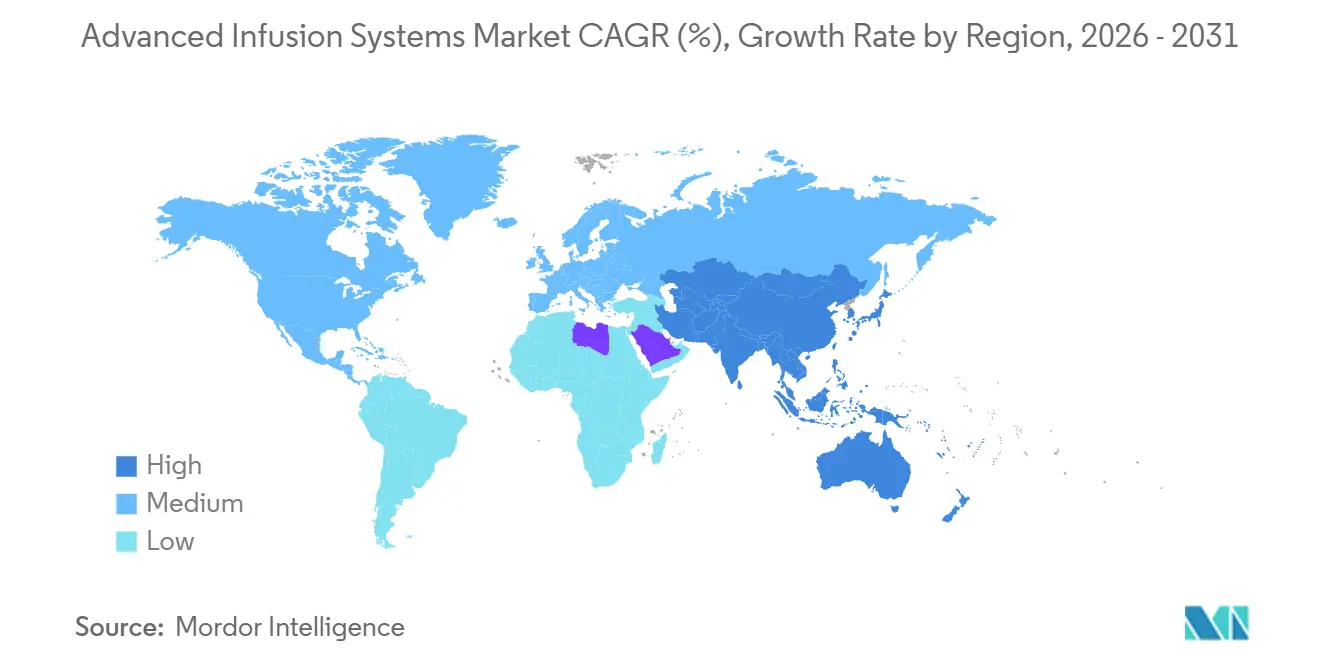
Asia-Pacific is forecast to expand at a 9.56% CAGR through 2031, making it the fastest-growing regional segment. China is increasing hospital capacity, and India is expanding private healthcare and community care delivery. These conditions support demand for ambulatory, cost-conscious, and connected infusion systems.

Competitive Landscape
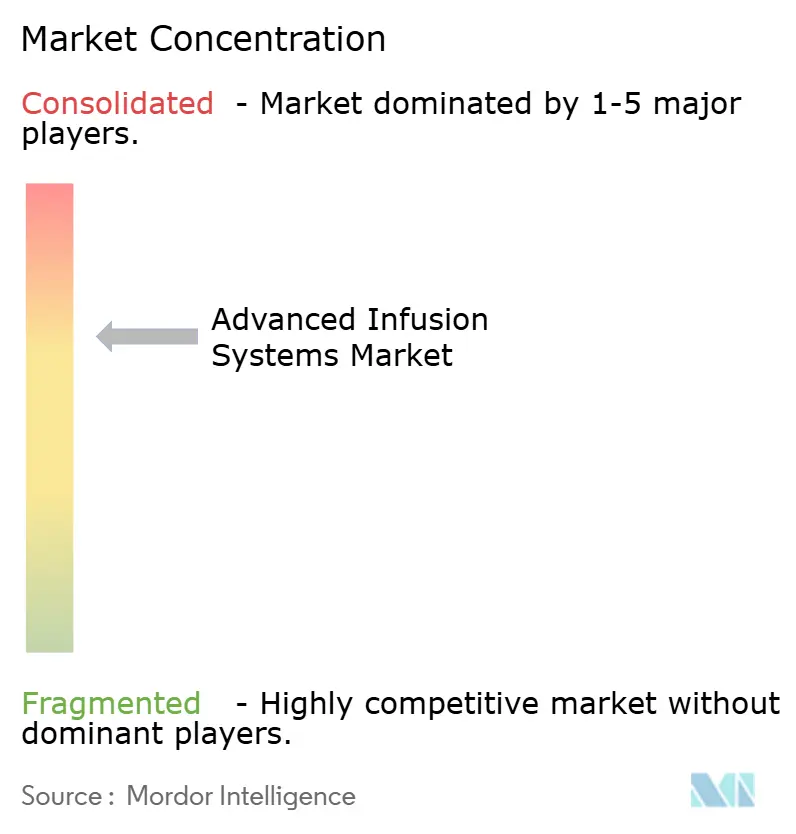
The advanced infusion systems market has moderate-to-high concentration in large hospital contracts. Baxter, BD, Fresenius Kabi, B. Braun, and ICU Medical hold strong positions through drug library systems, EHR connectivity, global service networks, and established customer relationships. Their offerings are evaluated as fleet-management systems rather than individual devices. Providers consider connectivity, compliance support, software maintenance, and service coverage alongside pump specifications. These factors create switching barriers for hospitals with large installed fleets. Home infusion remains a less mature area for connected fleet management and provides room for specialized suppliers.
Eitan Medical has focused on the home and ambulatory care opportunity. In June 2026, Eitan Medical and WeInfuse announced a partnership that connects smart pump technology with a workflow platform for infusion providers and specialty pharmacies. The partnership is designed to reduce manual documentation and support pump-to-workflow data integration. Eitan Medical also partnered with AlayaCare to transfer infusion pump data into home care documentation. These moves extend the company’s workflow presence beyond the device itself. They show how vendors can compete through software connections that support distributed Advanced Infusion Systems Market care delivery.
Iradimed serves a narrow MRI-compatible infusion segment that conventional pumps cannot address. Its MRidium 3870 received FDA clearance in May 2025, and commercial rollout began in the fourth quarter of 2025. In diabetes infusion, Medtronic is expanding access to automated insulin delivery for people with insulin-requiring type 2 diabetes. Sanofi’s July 2026 approval for Sarclisa Escena also introduces an on-body delivery option for an anticancer treatment. These moves show that competition includes both better IV platforms and alternative delivery methods. Manufacturers with established compliance, connectivity, and service capabilities are better placed to respond to product recalls and Advanced Infusion Systems Market replacement opportunities.
Advanced Infusion Systems Industry Leaders
B. Braun Melsungen AG
Baxter International Inc.
Becton, Dickinson and Company
Fresenius Kabi AG
ICU Medical, Inc.
- *Disclaimer: Major Players sorted in no particular order

Recent Industry Developments
- July 2026: Sanofi received FDA approval for Sarclisa Escena (isatuximab SC), the first anticancer treatment administered via an on-body injector.
- June 2026: Eitan Medical and WeInfuse announced a strategic partnership connecting Eitan Medical's smart pump technology with WeInfuse's clinical workflow platform for infusion providers and specialty pharmacies, reducing manual documentation burden and enabling seamless pump-to-workflow data integration.
- June 2026: Eitan Medical and AlayaCare announced a partnership integrating Eitan Insights cloud platform with AlayaCare's home care management system, enabling near real-time pump data flow, including flow rates, volumes delivered, and therapy parameters, into clinical documentation for home infusion nurses, eliminating manual transcription.
- February 2026: Medtronic announced Medicare access for the MiniMed 780G system with the Instinct sensor, alongside FDA clearance for its use in insulin-requiring type 2 diabetes, significantly expanding the addressable patient population for automated insulin delivery infusion systems beyond type 1.


Global Advanced Infusion Systems Market Report Scope
The advanced infusion systems market comprises sophisticated medical devices designed to deliver fluids, medications, and nutrients with high precision, safety, and efficiency across healthcare settings. These systems include smart infusion pumps, syringe pumps, patient-controlled analgesia devices, and ambulatory infusion systems, which support controlled and accurate therapy administration. Hospitals, clinics, and homecare settings widely use these devices to improve treatment delivery, reduce medication errors, enhance patient safety, and support the management of acute and chronic conditions.
The advanced infusion systems market is segmented by product type, application, end user, technology, and geography. By product type, it is further divided into volumetric infusion systems, syringe infusion systems, ambulatory infusion systems, elastomeric infusion systems, patient-controlled analgesia pumps, and others. By application, it is segmented into oncology and chemotherapy, diabetes management, pain management and analgesia, parenteral and clinical nutrition, gastroenterology, pediatrics and neonatology, and others. By end user, the market is segmented into hospitals, ambulatory surgical centers, specialty clinics, home care settings, and others. By technology, the market is segmented into smart infusion pumps, specialty infusion pumps, wireless and connected infusion pumps, ai-enabled infusion platforms, and others. The geography segment is further divided into North America, Europe, Asia-Pacific, the Middle East and Africa, and South America. The report also covers the estimated market sizes and trends for 17 countries across major regions globally. The report offers the market size and forecasts in value (USD) for the above segments.
| Volumetric Infusion Systems |
| Syringe Infusion Systems |
| Ambulatory Infusion Systems |
| Elastomeric Infusion Systems |
| Patient-Controlled Analgesia Pumps |
| Others |
| Oncology and Chemotherapy |
| Diabetes Management |
| Pain Management and Analgesia |
| Parenteral and Clinical Nutrition |
| Gastroenterology |
| Pediatrics and Neonatology |
| Others |
| Hospitals |
| Ambulatory Surgical Centers |
| Specialty Clinics |
| Home Care Settings |
| Others |
| Smart Infusion Pumps |
| Specialty Infusion Pumps |
| Wireless and Connected Infusion Pumps |
| AI-Enabled Infusion Platforms |
| Others |
| North America | United States |
| Canada | |
| Mexico | |
| Europe | Germany |
| United Kingdom | |
| France | |
| Italy | |
| Spain | |
| Rest of Europe | |
| Asia-Pacific | China |
| Japan | |
| India | |
| Australia | |
| South Korea | |
| Rest of Asia-Pacific | |
| Middle East and Africa | GCC |
| South Africa | |
| Rest of Middle East and Africa | |
| South America | Brazil |
| Argentina | |
| Rest of South America |
| By Product Type | Volumetric Infusion Systems | |
| Syringe Infusion Systems | ||
| Ambulatory Infusion Systems | ||
| Elastomeric Infusion Systems | ||
| Patient-Controlled Analgesia Pumps | ||
| Others | ||
| By Application | Oncology and Chemotherapy | |
| Diabetes Management | ||
| Pain Management and Analgesia | ||
| Parenteral and Clinical Nutrition | ||
| Gastroenterology | ||
| Pediatrics and Neonatology | ||
| Others | ||
| By End User | Hospitals | |
| Ambulatory Surgical Centers | ||
| Specialty Clinics | ||
| Home Care Settings | ||
| Others | ||
| By Technology | Smart Infusion Pumps | |
| Specialty Infusion Pumps | ||
| Wireless and Connected Infusion Pumps | ||
| AI-Enabled Infusion Platforms | ||
| Others | ||
| By Geography | North America | United States |
| Canada | ||
| Mexico | ||
| Europe | Germany | |
| United Kingdom | ||
| France | ||
| Italy | ||
| Spain | ||
| Rest of Europe | ||
| Asia-Pacific | China | |
| Japan | ||
| India | ||
| Australia | ||
| South Korea | ||
| Rest of Asia-Pacific | ||
| Middle East and Africa | GCC | |
| South Africa | ||
| Rest of Middle East and Africa | ||
| South America | Brazil | |
| Argentina | ||
| Rest of South America | ||


Key Questions Answered in the Report
What is driving growth in advanced infusion systems?
Demand is supported by rising cancer treatment needs, wider use of complex biologics, and home infusion expansion. Hospitals are also replacing legacy fleets with connected systems that support medication documentation, drug libraries, and EHR workflows.
How large will advanced infusion systems become by 2031?
The sector is forecast to reach USD 13.95 billion by 2031, growing at an 8.24% CAGR from 2026. The 2026 value is USD 9.38 billion, compared with USD 8.67 billion in 2025.
Which product type is growing fastest?
Ambulatory infusion systems are forecast to grow at a 9.76% CAGR through 2031. They support delivery of selected IV therapies in outpatient and home locations, where mobility and simpler administration are important.
Which application has the fastest projected growth?
Diabetes management is forecast to grow at a 10.12% CAGR through 2031. Expanded access to automated insulin delivery for people with insulin-requiring type 2 diabetes is widening the potential user base.
Why are hospitals replacing infusion pump fleets?
Hospitals are seeking EHR interoperability, drug library compliance, improved documentation, and safer medication administration workflows. Connected systems can also reduce nurse programming time and improve pharmacy visibility across distributed equipment fleets.
Which region will grow fastest through 2031?
Asia-Pacific is forecast to grow at a 9.56% CAGR through 2031. Hospital expansion, private healthcare investment, and broader community care delivery are supporting demand for cost-conscious and connected systems.
Page last updated on:





