
Additive Manufacturing Resins Market Size and Share
Market Overview
| Study Period | 2021 - 2031 |
|---|---|
| Market Size (2026) | USD 60.48 Billion |
| Market Size (2031) | USD 80.48 Billion |
| Growth Rate (2026 - 2031) | 5.88 % |
| Fastest Growing Market | Asia-Pacific |
| Largest Market | North America |
| Market Concentration | Medium |
Major Players *Disclaimer: Major Players sorted in no particular order Image © Mordor Intelligence. Reuse requires attribution under CC BY 4.0. | |
Additive Manufacturing Resins Market Analysis by Mordor Intelligence
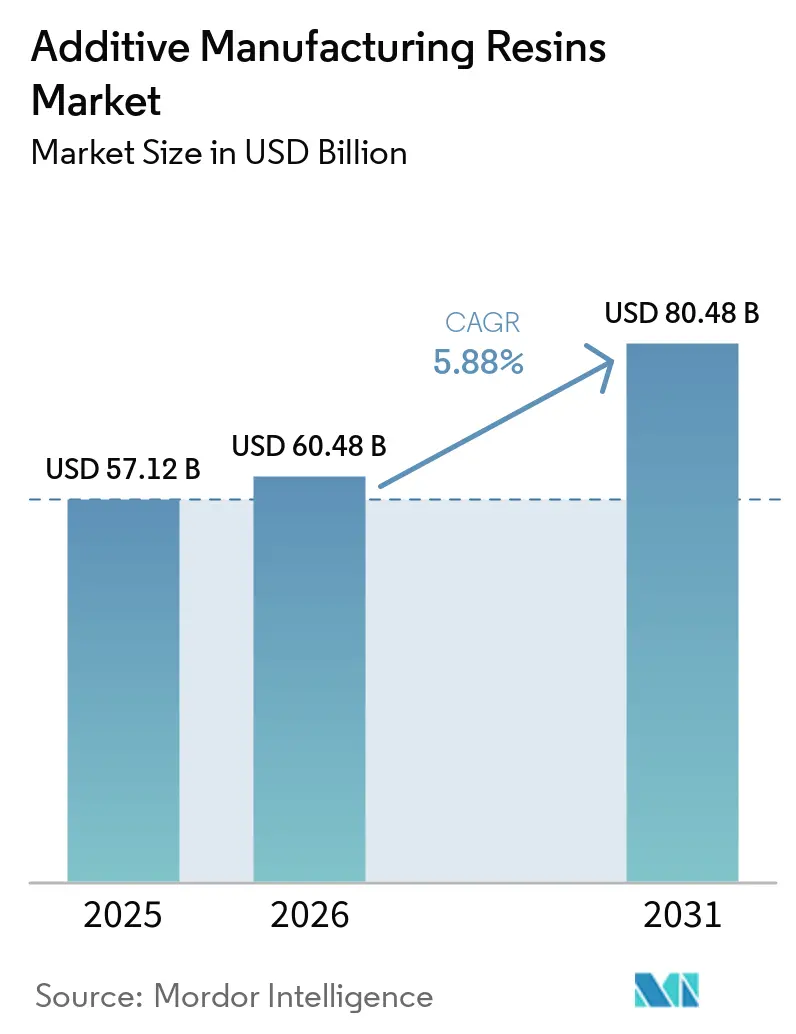
The Additive Manufacturing Resins Market size was valued at USD 57.12 billion in 2025 and is estimated to grow from USD 60.48 billion in 2026 to reach USD 80.48 billion by 2031, at a CAGR of 5.88% during the forecast period (2026-2031). The additive manufacturing resins market is moving beyond prototyping because medical, dental, and industrial users require validated materials for finished parts that meet defined performance and processing requirements. Biocompatible formulations are becoming more important as suppliers address clinical, regulatory, traceability, and post-processing requirements. Established specialty chemical suppliers benefit from the cost and documentation requirements attached to material certification and application validation. Hardware suppliers are also linking resin development with their printer platforms to secure recurring materials sales and more controlled customer workflows. Supply risks involving photoinitiators and oligomers are encouraging interest in printer-qualified materials from independent suppliers and open material ecosystems, particularly where certified engineering materials are difficult to replace.
Key Report Takeaways
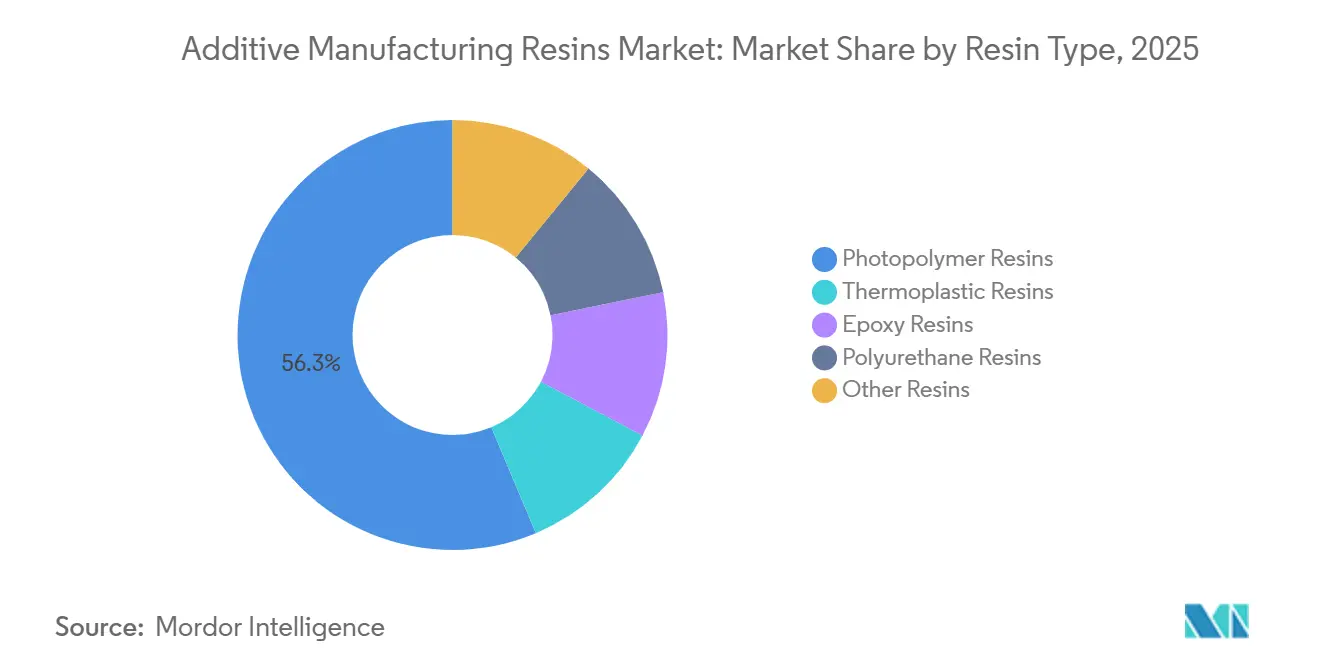
- By resin type, photopolymer resins held 56.34% of the additive manufacturing resins market share in 2025 and are projected to advance at a 6.45% CAGR through 2031.
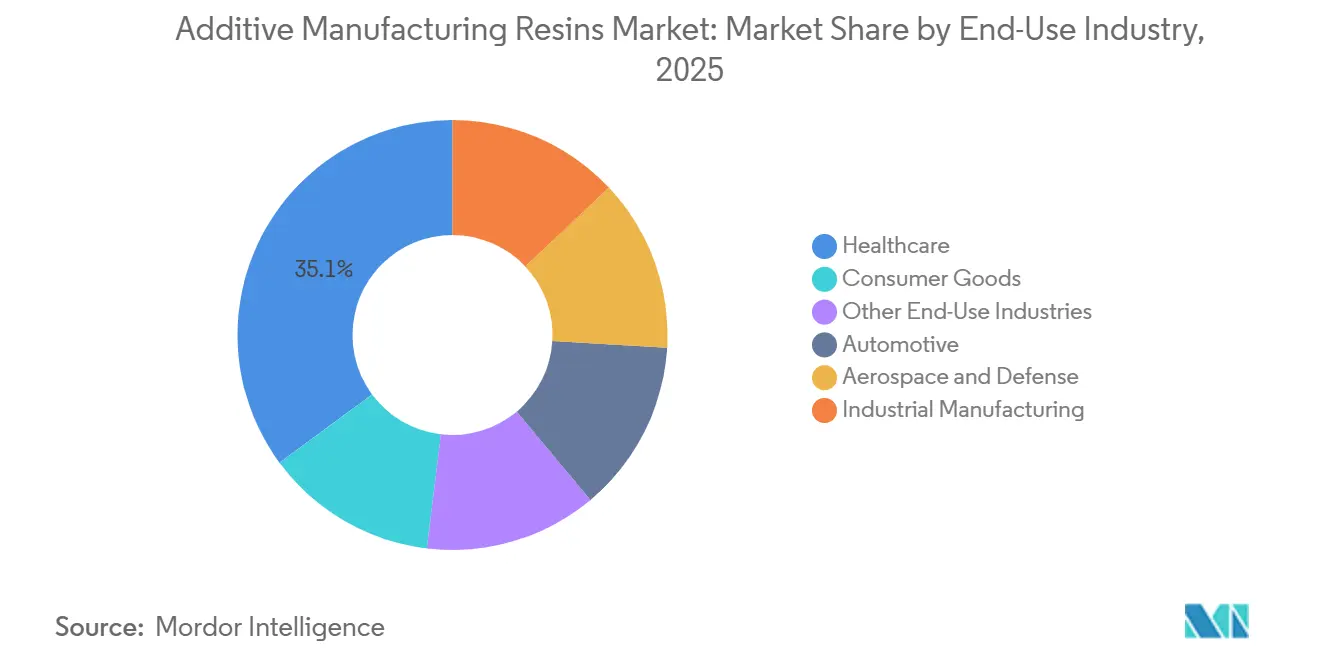
- By end-use industry, healthcare held 35.13% of the additive manufacturing resins market share in 2025 and is projected to advance at a 6.78% CAGR through 2031.
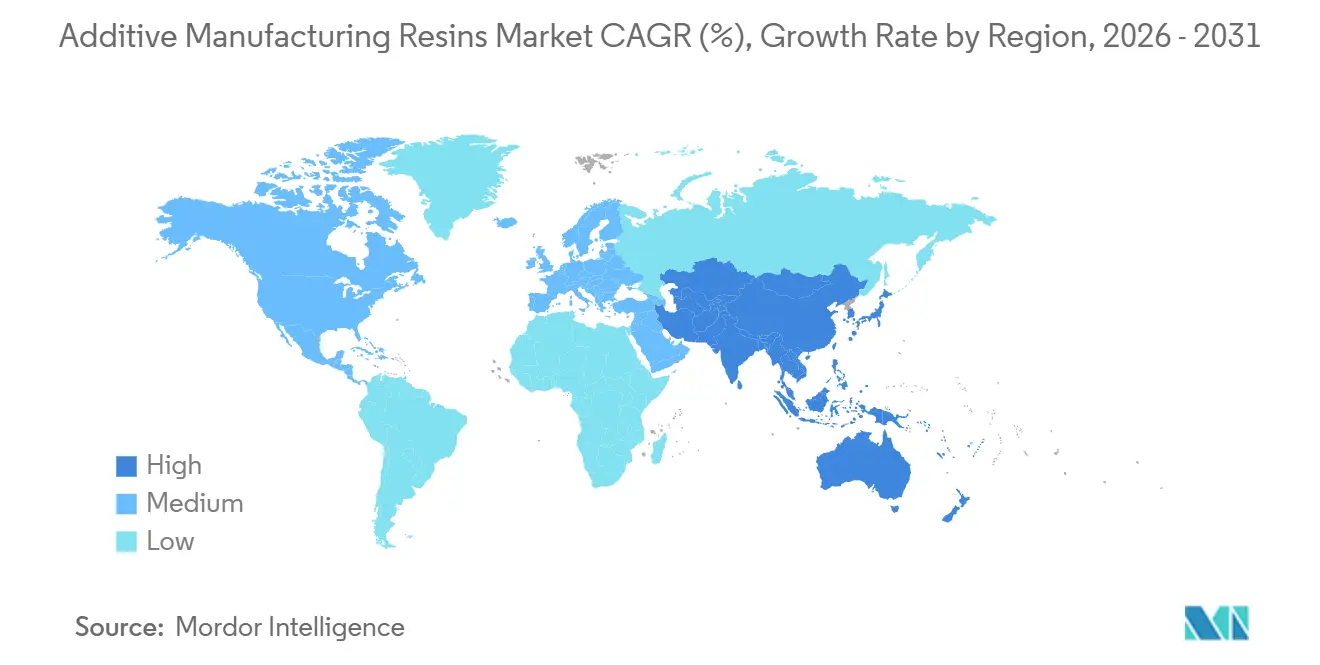
- By geography, North America held 38.77% of the additive manufacturing resins market share in 2025, while Asia-Pacific is projected to advance at a 6.33% CAGR through 2031.
Note: Market size and forecast figures in this report are generated using Mordor Intelligence’s proprietary estimation framework, updated with the latest available data and insights as of January 2026.
Market Trends and Insights
Drivers Impact Analysis of Additive Manufacturing Resins Market*
| Driver | (~) % Impact on CAGR Forecast | Geographic Relevance | Impact Timeline |
|---|---|---|---|
| Demand for Patient-Specific Medical Components | +1.6% | Global; North America, Europe, Japan leading | Long term (≥ 4 years) |
| Shift From Prototyping to Functional Resin Parts | +1.3% | Global; APAC and EU accelerating fastest | Medium term (2–4 years) |
| Expansion of Production-Grade Dental Workflows | +1.1% | North America, Europe, Japan, South Korea | Medium term (2–4 years) |
| Adoption of High-Throughput DLP and CLIP Platforms | +0.9% | North America, Germany, APAC core | Short term (≤ 2 years) |
| Printer-Qualified Open Material Ecosystems | +0.6% | Global; North America & EU leading adoption | Medium term (2–4 years) |
| Source: Mordor Intelligence | |||
Demand for Patient-Specific Medical Components
Personalized medical manufacturing supports long-term demand for the additive manufacturing resins market because clinical parts require defined material performance and controlled production records. International Organization for Standardization (ISO) 10993-series biocompatibility standards increasingly define the qualification threshold for medical resin products, including products intended for repeated patient contact. Stratasys’ P3 MED Silicone 25A is certified against ISO 10993-5, ISO 10993-10, and ISO 10993-23, and it is supported by a Food and Drug Administration (FDA) Master File for patient-specific wearable medical devices[1]. FDA and European Union Medical Device Regulation (EU MDR) post-market surveillance requirements favor suppliers with validated supply chains, traceable batch records, and established documentation processes. These requirements can support multiyear supply arrangements because manufacturers must protect the validated process used for each clinical application. Japan included 3D-printed complete denture materials in national insurance coverage in 2025 and expanded the applicable denture types in June 2026.
Shift From Prototyping to Functional Resin Parts
The additive manufacturing resins market is gaining support as industrial users shift from prototypes toward functional parts that must work consistently after printing. This transition changes purchasing priorities from basic printability toward performance under operational conditions, including fatigue, flex behavior, and dimensional reliability. Functional applications require resins with consistent mechanical properties, shelf stability, repeatable batch performance, and processing characteristics that suit the installed printer base. Formlabs launched Tough 1500 Resin in March 2025 to address fatigue and flex performance comparable with injection-molded polypropylene. The company introduced Tough 1000 Resin and an improved Tough 2000 Resin in November 2025, extending its functional materials range for assemblies that require impact resistance and improved surface quality. Production operations consume qualified resin at sustained rates and require tighter rheological control than prototyping environments, making validated formulations more valuable to users.
Expansion of Production-Grade Dental Workflows
Dental workflows are supporting wider use of the additive manufacturing resins market in clinical production because they combine repeatable part requirements with established laboratory processes. Keystone Industries and Carbon, Inc. developed FP3D, an FDA-cleared flexible partial denture resin that Carbon commercially launched in September 2025. The resin uses dual-cure chemistry to support dimensional accuracy, translucency, and patient-oriented denture applications while reducing dependence on conventional fabrication steps. Formlabs reports annual revenue above USD 250 million in 2026 and notes 4 consecutive quarters of dental portfolio growth. Japan’s insurance coverage for 3D-printed denture materials supports Mitsui Chemicals’ July 2026 integration of its dental 3D-printing operations into Sun Medical Co., Ltd. Public reimbursement can increase adoption where validated additive workflows provide a recognized clinical option and laboratories can use consistent materials.
Adoption of High-Throughput DLP and CLIP Platforms
High-throughput systems raise the resin consumption potential of the additive manufacturing resins market by allowing users to produce more qualified parts on each installed platform. Digital Light Processing (DLP) and Continuous Liquid Interface Production (CLIP) systems support faster production of functional parts than lower-throughput processes and can improve the economics of short production runs. Carbon’s Digital Light Synthesis (DLS) technology supports functional and isotropic parts for automotive, consumer, and medical uses. Stratasys expanded the Origin P3 DLP platform in April 2026 with Measurement-Based Warped Adaptive Modeling (WAM) software for automatic warping correction. The software supports electrical connectors, precision jigs, and industrial fixtures with less manual adjustment and more repeatable output. Higher printer throughput can raise annual resin demand when suppliers have platform-qualified formulations that meet the target application requirements.
Restraints Impact Analysis of Additive Manufacturing Resins Market*
| Restraint | (~) % Impact on CAGR Forecast | Geographic Relevance | Impact Timeline |
|---|---|---|---|
| High Cost of Certified Engineering and Biocompatible Resins | -1.4% | Global; most acute in SME-dominated South America and MEA | Long term (≥ 4 years) |
| Proprietary Printer-Resin Qualification Lock-In | -0.9% | Global; EU and North America show highest switching intent | Medium term (2–4 years) |
| Photoinitiator and Oligomer Supply Concentration | -0.6% | Global; concentrated pressure in Europe and East Asia | Short term (≤ 2 years) |
| Source: Mordor Intelligence | |||
High Cost of Certified Engineering and Biocompatible Resins
High certification costs constrain adoption in the additive manufacturing resins market, particularly among smaller medical and dental users who cannot spread qualification expenses across high production volumes. ISO 10993 cytotoxicity, irritation, and sensitization testing requires validated protocols, technical documentation, and controlled post-processing before a resin can serve body-contact applications. Stratasys’ Somos BioClear underwent ISO 10993-5, ISO 10993-10, and United States Pharmacopeia Class VI testing for medical device applications. Certified grades can cost 2-5 times more than standard prototyping grades, creating a clear price gap for laboratories and cost-sensitive manufacturing operations. Henkel AG & Co. KGaA pursued European Union 10/2011 food-contact requirements for Loctite 3D IND3785 after migration and extraction testing across food simulants. European compliance requirements can lengthen commercialization schedules and favor suppliers with larger regulatory teams, proven testing methods, and established quality systems.
Proprietary Printer-Resin Qualification Lock-In
Proprietary printer-resin qualification can limit material choice in the additive manufacturing resins market when approved materials are tied to a specific hardware platform. Platform-approved materials are often required to preserve warranty coverage, validated process performance, and the post-processing conditions used for certified applications. This approach protects the pricing power of integrated hardware and materials suppliers and can reduce opportunities for independent resin producers. It can also constrain users who need a certified grade unavailable in a single vendor’s catalog or require a property outside the available product range. Open material ecosystems offer an alternative where third-party suppliers can qualify materials for specific printers and end-use requirements. Adoption remains gradual because healthcare and aerospace users may avoid changes that affect service contracts, validation records, warranty conditions, and established quality procedures.
*Our forecasts treat driver/restraint impacts as directional, not additive. The impact forecasts reflect baseline growth, mix effects, and variable interactions.
Additive Manufacturing Resins Market Segment Analysis
By Resin Type:
Photopolymer Resins Lead Both Market Share and GrowthPhotopolymer resins held 56.34% of the additive manufacturing resins market share in 2025 and are projected to advance at a 6.45% CAGR through 2031. Their position reflected broad compatibility with stereolithography (SLA), DLP, and CLIP platforms used in dental, medical, and industrial applications, allowing suppliers to address multiple uses with related chemistry platforms and application-specific formulations. Thermoplastic resins served structural and high-temperature uses on fused deposition modeling (FDM) systems. These materials supported part designs where flexibility, temperature resistance, and geometry were more important than sub-50-micron resolution. Epoxy resins addressed tooling and composite lay-up mandrel applications that required dimensional stability under mechanical loading.
Polyurethane resins supported elastomeric and lattice applications across the additive manufacturing resins market because flexible components require controlled deformation after printing. Other resins included bio-based and ceramic-filled composites that addressed specialized performance requirements. Formlabs offered more than 40 SLA materials, while Stratasys supplied Somos BioClear for demanding applications. Arkema obtained International Sustainability and Carbon Certification (ISCC) PLUS certification for Sartomer sites in Chatham, Virginia, and West Chester, Pennsylvania, in April 2025. The certification enabled bio-attributed ultraviolet light-emitting diode electron beam resin solutions.

By End-Use Industry:
Healthcare Drives Both Revenue and Growth VelocityHealthcare held 35.13% of the additive manufacturing resins market share in 2025 and is projected to advance at a 6.78% CAGR through 2031. Surgical guide resins, audiology shell materials, orthodontic model compounds, and flexible denture formulations require application-specific clearances and clearly defined processing conditions. These requirements create recurring material demand after clinical workflows are validated by laboratories, clinicians, and device manufacturers. Carbon launched FP3D in September 2025 with Keystone Industries for flexible partial dentures in the United States and Canada and targeted European regulatory approvals for 2026.
The automotive industry is moving from prototyping toward functional end-use applications in the additive manufacturing resins market. Carbon and Group Lotus announced a May 2026 collaboration for a density-tuned DLS lattice car seat that replaced conventional foam construction. The aerospace and defense industry requires thermally stable and flame-retardant grades with material traceability and controlled production records. Stratasys launched ULTEM 1010 for the F3300 printer in April 2026 for composite tooling and high-temperature fixtures. Industrial manufacturing and consumer goods also use resins for jigs, fixtures, and short-run tooling, where digital production can replace conventional tooling steps. Healthcare growth is supported by insurance reimbursement in Japan and a growing range of biocompatible formulations.
Geography Analysis
North America and Europe Additive Manufacturing Resins Market
North America held 38.77% of the additive manufacturing resins market share in 2025. The region had a deep installed base of production-grade DLP and SLA systems, a high concentration of FDA-cleared photopolymer materials, and digitally advanced dental laboratories. Henkel AG & Co. KGaA completed a USD 30 million expansion of its Brandon, South Dakota, facility in September 2025, doubling the site to 70,000 square feet for LOCTITE-branded adhesives and thermal management materials[2]. Europe continued to serve as a significant regional base, with Germany acting as an industrial hub.
Europe and APAC Additive Manufacturing Resins Market
German compliance requirements support investment in materials with advanced performance and documentation. These requirements place emphasis on traceability, predictable processing, and the ability to meet application-specific standards. Asia-Pacific is projected to advance at a 6.33% CAGR through 2031. China and India support regional revenue, while Japan, South Korea, and Taiwan support specialty resin demand. The regional mix creates different requirements for lower-cost functional grades and premium specialty formulations.
APAC, South America and MEA Additive Manufacturing Resins Market
Japan's insurance coverage of 3D-printed denture materials began in 2025 and expanded in June 2026. Covestro AG opened a thermoplastic polyurethane facility in Zhuhai, South China, with an initial annual capacity of 30,000 metric tons. South America, the Middle East, and Africa remain early-stage markets where access to certified-grade materials limits adoption. These regions have demand potential, but distribution capacity and certification costs remain significant barriers.
Competitive Landscape
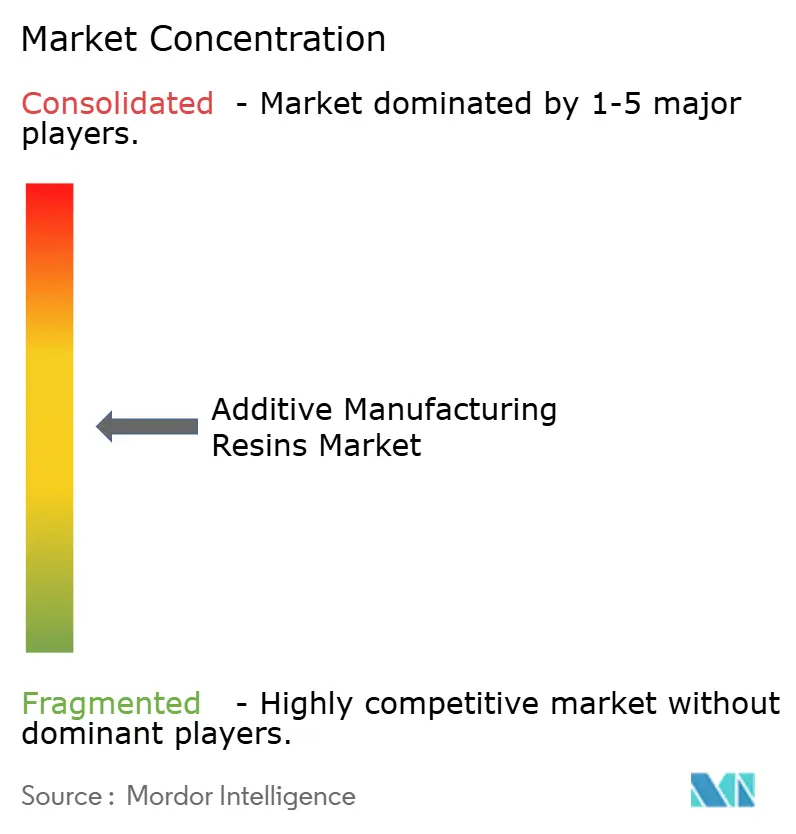
The additive manufacturing resins market is moderately fragmented, with the top five players including Stratasys, 3D Systems, Inc., BASF, Formlabs, and Henkel AG & Co. KGaA. Arkema, Henkel AG & Co. KGaA, Evonik Industries AG, and Covestro AG compete through certification depth, sustainable raw-material credentials, oligomer-system capabilities, and the breadth of resins they can support across demanding uses. Formlabs, Stratasys, and Carbon, Inc. connect printer adoption with recurring materials revenue, which makes their installed hardware base important to long-term material demand. Stratasys expanded the Origin P3 DLP platform with WAM software in April 2026 to correct production warping automatically, reducing the level of operator intervention needed for complex production parts. The move strengthens its production workflow offering without requiring a new resin formulation, while extending the quality-control functions associated with its platform.
Opportunities in the additive manufacturing resins market include biocompatible materials for near-patient and implantable uses, industrial resins for open DLP platforms, and bio-attributed photopolymers that preserve mechanical performance. Arkema opened a Graphic Arts Center of Excellence in Wetherby, United Kingdom, in January 2025 for photocurable ultraviolet, light-emitting diode, and electron beam technologies. The center supports development of monomers, oligomers, photoinitiators, and cationic systems for additive manufacturing applications, including sustainable and low-migration resin solutions. Forward AM entered insolvency in Germany in late 2024, disrupting certified engineering-resin supply for European customers and highlighting the exposure created by concentrated qualified-material supply. The disruption increased the opportunity for suppliers that can provide qualified materials across multiple platforms, maintain dependable product availability, and support existing industrial workflows.
Patent activity in CLIP chemistry and dual-cure photopolymer formulations supports competitive barriers in the additive manufacturing resins market because qualification work can be closely tied to proprietary material design. Carbon and Henkel AG & Co. KGaA are developing materials that address production, medical, and food-contact requirements across applications with different documentation needs. Carbon’s September 2025 FP3D launch combined hardware and materials expertise in a validated dental workflow for flexible partial dentures. Henkel presented Loctite 3D MED414 Red and MED414 Clear in November 2025 and previewed Loctite 3D IND3785 for food-contact applications.
Additive Manufacturing Resins Industry Leaders
-
Stratasys
-
3D Systems, Inc.
-
BASF
-
Formlabs
-
Henkel AG & Co. KGaA
- *Disclaimer: Major Players sorted in no particular order
Additive Manufacturing Resins Market Companies Covered in this Report
- 3D Systems, Inc.
- Arkema S.A.
- BASF
- Carbon, Inc.
- COVESTRO
- DWS S.r.l.
- Evonik Industries AG
- Formlabs
- Henkel AG & Co. KGaA
- Keystone Industries
- Photocentric Ltd
- Stratasys
- UnionTech
Recent Industry Developments in Additive Manufacturing Resins Market
- April 2026: Stratasys expanded its materials portfolio with ULTEM 1010, P3 Deflect 110, Loctite 3D IND3785, PolyJet ToughONE, and Somos WaterShed White for multiple 3D-printing platforms. The launch broadens the availability of high-performance photopolymer and thermoplastic materials across additive manufacturing systems, supporting demand for specialized resins and material solutions for automated production.
- November 2025: Formlabs unveiled Tough 1000 Resin and an improved Tough 2000 Resin at Formnext 2025, expanding its Tough Resin portfolio alongside Tough 1500 Resin. The launch broadens the availability of high-performance photopolymer resins for functional prototypes and end-use applications, supporting demand for specialized resins in additive manufacturing.
Global Additive Manufacturing Resins Market Report Scope
Additive manufacturing resins are polymer-based materials formulated to create three-dimensional components through layer-by-layer manufacturing processes. They enable the production of complex geometries, customized parts, prototypes, and functional components with controlled mechanical, thermal, and surface properties.
The Additive Manufacturing Resins Market is segmented by resin type, end-use industry, and geography. By resin type, the market is segmented into photopolymer resins, thermoplastic resins, epoxy resins, polyurethane resins, and other resins. By end-use industry, the market is segmented into healthcare, automotive, aerospace and defense, industrial manufacturing, consumer goods, and other end-use industries. The report also covers the market size and forecasts for additive manufacturing resins in 15 countries across major regions. For each segment, the market sizing and forecasts have been done on the basis of value (USD).
Segmentation Overview
| Photopolymer Resins |
| Thermoplastic Resins |
| Epoxy Resins |
| Polyurethane Resins |
| Other Resins |
| Healthcare |
| Automotive |
| Aerospace and Defense |
| Industrial Manufacturing |
| Consumer Goods |
| Other End-Use Industries |
| Asia-Pacific | China |
| India | |
| Japan | |
| South Korea | |
| ASEAN Countries | |
| Rest of Asia-Pacific | |
| North America | United States |
| Canada | |
| Mexico | |
| Europe | Germany |
| United Kingdom | |
| France | |
| Italy | |
| NORDIC Countries | |
| Rest of Europe | |
| South America | Brazil |
| Argentina | |
| Rest of South America | |
| Middle East and Africa | Saudi Arabia |
| South Africa | |
| Rest of Middle East and Africa |
| By Resin Type | Photopolymer Resins | |
| Thermoplastic Resins | ||
| Epoxy Resins | ||
| Polyurethane Resins | ||
| Other Resins | ||
| By End-Use Industry | Healthcare | |
| Automotive | ||
| Aerospace and Defense | ||
| Industrial Manufacturing | ||
| Consumer Goods | ||
| Other End-Use Industries | ||
| By Geography | Asia-Pacific | China |
| India | ||
| Japan | ||
| South Korea | ||
| ASEAN Countries | ||
| Rest of Asia-Pacific | ||
| North America | United States | |
| Canada | ||
| Mexico | ||
| Europe | Germany | |
| United Kingdom | ||
| France | ||
| Italy | ||
| NORDIC Countries | ||
| Rest of Europe | ||
| South America | Brazil | |
| Argentina | ||
| Rest of South America | ||
| Middle East and Africa | Saudi Arabia | |
| South Africa | ||
| Rest of Middle East and Africa | ||
Key Questions Answered in the Report
What is the size of the additive manufacturing resins market?
The additive manufacturing resins market stands at USD 60.48 billion in 2026 and is projected to reach USD 80.48 billion by 2031.
What is driving demand for additive manufacturing resins?
The additive manufacturing resins market is supported by patient-specific medical components, production-grade dental workflows, functional industrial parts, and higher-throughput DLP and CLIP production platforms. These uses require validated materials with consistent performance.
Which resin type led the market demand in 2025?
Photopolymer resins led with a 56.34% share in 2025 because they supported dental, medical, and industrial applications across SLA, DLP, and CLIP systems.
Which end-use industry is growing fastest through 2031?
Healthcare is projected to advance at a 6.78% CAGR through 2031.