
Adaptogenic Beverages Market Size and Share
Market Overview
| Study Period | 2021 - 2031 |
|---|---|
| Market Size (2026) | USD 1.61 Billion |
| Market Size (2031) | USD 2.33 Billion |
| Growth Rate (2026 - 2031) | 7.67 % |
| Fastest Growing Market | Asia-Pacific |
| Largest Market | North America |
| Market Concentration | Medium |
Major Players *Disclaimer: Major Players sorted in no particular order Image © Mordor Intelligence. Reuse requires attribution under CC BY 4.0. | |
Adaptogenic Beverages Market Analysis by Mordor Intelligence
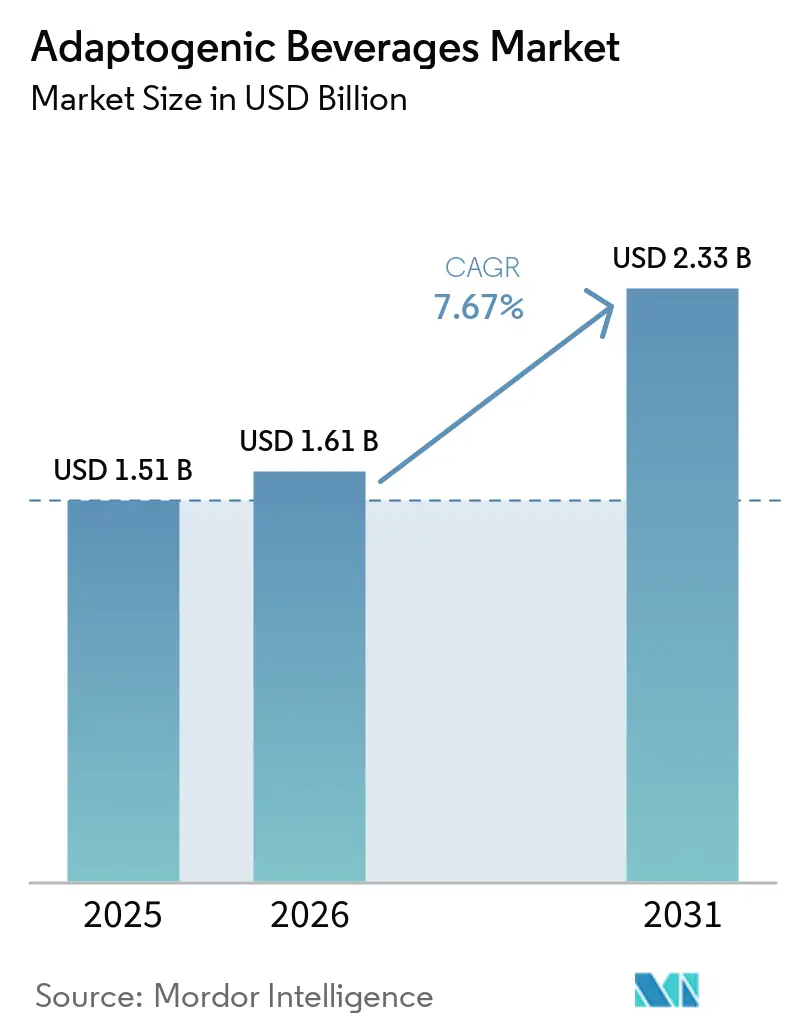
The adaptogenic beverages market size is expected to increase from USD 1.51 billion in 2025 to USD 1.61 billion in 2026 and reach USD 2.33 billion by 2031, growing at a CAGR of 7.67% over 2026-2031. The adaptogenic beverages market is moving beyond a specialist wellness purchase as shoppers look for drinks that fit daily routines and provide a stated functional purpose. Consumers can encounter these products through coffee, tea, ready-to-drink beverages, energy drinks, and alcohol-free social alternatives. Demand for alcohol-free options is widening the occasions in which brands can compete, including social settings, workdays, active lifestyles, and regular grocery trips. Retail visibility and online education are changing how consumers discover unfamiliar ingredients, compare formulations, and decide whether a product fits their needs.
Key Report Takeaways
- By product type, ready-to-drink beverages held 43.18% of the adaptogenic beverages market share in 2025, while energy drinks recorded the highest projected CAGR at 8.67% through 2031.
- By function, stress and relaxation accounted for 33.84% of the adaptogenic beverages market size in 2025, while energy and stamina is forecast to expand at an 8.51% CAGR through 2031.
- By distribution channel, supermarkets and hypermarkets held 38.25% in 2025, while online retail is forecast to grow at a 9.25% CAGR through 2031.
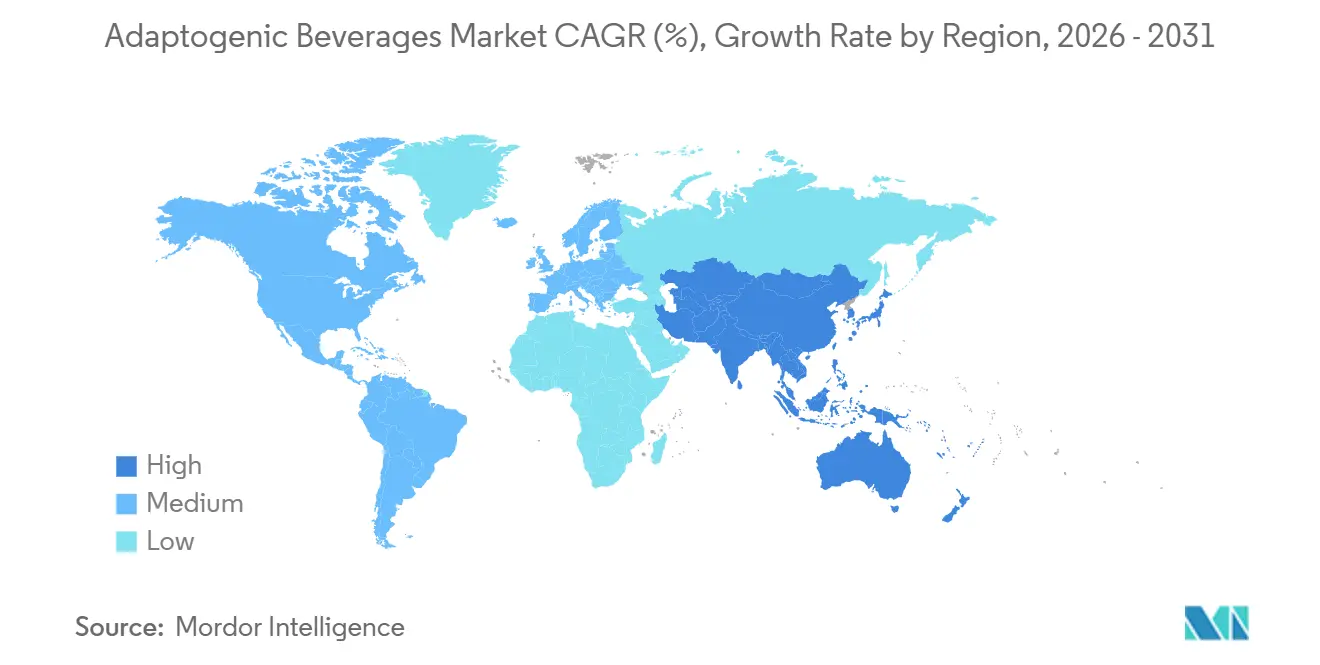
- By geography, North America commanded 42.73% revenue in 2025, while Asia-Pacific is poised for 9.04% CAGR growth through 2031.
Note: Market size and forecast figures in this report are generated using Mordor Intelligence’s proprietary estimation framework, updated with the latest available data and insights as of January 2026.
Market Trends and Insights
Drivers Impact Analysis of Adaptogenic Beverages Market*
| Driver | (~) % Impact on CAGR Forecast | Geographic Relevance | Impact Timeline |
|---|---|---|---|
| Rising consumer focus on health and wellness | +2.0% | Global | Medium term (2-4 years) |
| Increasing demand for functional beverages | +1.5% | Global, with Asia-Pacific and North America as primary growth poles | Medium term (2-4 years) |
| Growing awareness of stress management and mental wellness | +1.8% | Global, with North America and Europe leading and Asia-Pacific catching up | Short term (≤ 2 years) |
| Rising preference for natural and plant-based ingredients | +1.2% | Global, strongest in North America, Europe, and Australia | Medium term (2-4 years) |
| Growing demand for clean-label and low-sugar beverages | +0.8% | North America and Europe, with spillover to Asia-Pacific urban centers | Medium term (2-4 years) |
| Increasing popularity of non-alcoholic wellness drinks | +1.0% | North America and Europe, with early-stage Asia-Pacific and Middle East and Africa demand | Short term (≤ 2 years) |
| Source: Mordor Intelligence | |||
Rising Consumer Focus on Health and Wellness
Health awareness is supporting a shift from occasional wellness purchases toward products used more regularly. The adaptogenic beverages market benefits when consumers view beverages as part of a broader decision to moderate alcohol intake and choose products with a clear purpose. This change gives mainstream retailers a reason to give functional brands greater visibility beyond specialist shelves. Wider shelf placement can introduce adaptogenic ingredients to shoppers who would not otherwise search for them or understand how a formulation fits into a routine. The growing attention to mental well-being strengthens the appeal of products that address routine stress without presenting themselves as treatments. Brands need consistent information on ingredients, intended use, serving occasions, and product format to translate awareness into repeat demand.
Growing Awareness of Stress Management and Mental Wellness
Stress management has become a more visible reason for consumers to consider functional drinks in everyday routines. The World Health Organization reported in 2025 that more than 1 billion people live with a mental disorder, which keeps mental well-being central to public health and consumer discussions[1]. The same organization has stated that depression and anxiety cost the global economy USD 1 trillion each year and result in 12 billion lost working days. The adaptogenic beverages market has an opening for products positioned around calm, relaxation, and a manageable daily balance. Work and study occasions matter because consumers may seek a drink that fits a midday routine rather than a morning stimulant or evening ritual. Clear communication is important because products must distinguish a general wellness position from a medical claim.
Increasing Popularity of Non-alcoholic Wellness Drinks
Non-alcoholic drinks are creating another route to trial for adaptogenic products. The adaptogenic beverages market can benefit when consumers look for social alternatives that remain suitable for a bar, restaurant, gathering, or quiet occasion at home. This positioning expands the channel opportunity beyond health stores and grocery aisles. It also allows brands to compete during occasions that were previously associated mainly with alcoholic drinks and familiar social rituals. A successful alcohol-alternative offer must balance functional ingredients with familiar taste, format, and social relevance. The opportunity is strongest where brands can explain the product clearly and offer an experience that does not feel separate from the rest of the beverage menu.
Growing Demand for Clean-label and Low-sugar Beverages
Consumer preferences are increasingly shifting toward beverages with recognizable ingredients, minimal processing, and lower sugar content. This trend is supporting demand for adaptogenic beverages that combine functional benefits with cleaner nutritional profiles. According to research by the CBI Ministry of Foreign Affairs, clean-label products are projected to constitute over 70% of product portfolios in 2025 and 2026, up from 52% in 2021[2]. This rapid increase reflects growing consumer scrutiny of ingredient lists and formulation choices. Adaptogenic beverages align with these preferences by incorporating botanical and plant-based ingredients perceived as natural and functional. At the same time, reduced-sugar formulations are gaining traction as consumers seek healthier alternatives to conventional soft drinks.
Restraints Impact Analysis of Adaptogenic Beverages Market*
| Restraint | (~) % Impact on CAGR Forecast | Geographic Relevance | Impact Timeline |
|---|---|---|---|
| High cost of adaptogenic ingredients | -1.2% | Global, with supply concentrated in India and China | Medium term (2-4 years) |
| Premium pricing of adaptogenic beverages | -0.8% | Price-sensitive emerging markets in Asia-Pacific, South America, and Middle East and Africa | Medium term (2-4 years) |
| Lack of standardized regulations for adaptogenic claims | -0.9% | Global, with North America and the European Union most affected by regulatory ambiguity | Short term (≤ 2 years) |
| Supply-chain volatility for adaptogenic herbs and mushrooms | -0.7% | Global, with India and China sourcing zones most exposed | Medium term (2-4 years) |
| Source: Mordor Intelligence | |||
High Cost of Adaptogenic Ingredients
The cost of botanicals and mushroom ingredients can limit the ability of brands to offer accessible prices. Many important raw materials come from India and China, which exposes the adaptogenic beverages market to trade pressure and changes in supply conditions. A higher ingredient cost can move through the value chain into extract costs and retail prices. That pattern is especially difficult for brands serving mid-income consumers, who may switch to less expensive beverage options when prices rise. Supply risk also affects product quality because rising demand can place pressure on consistency and sourcing standards. Companies with diversified suppliers, quality controls, and longer procurement planning have a clearer route to managing these constraints.
Lack of Standardized Regulations for Adaptogenic Claims
The term adaptogen does not have a standardized pharmacological or clinical definition under the U.S. Food and Drug Administration framework. This creates uncertainty for brands deciding how to describe an ingredient and what supporting evidence they need for structure and function claims[3]. The issue can be more difficult for smaller companies because they have fewer resources to document claims, review labels, and adjust products when rules change. Regulatory uncertainty may lengthen launch planning and encourage more cautious language on packaging. It can also favor companies that have invested in substantiation and established safety documentation. Predictable regulatory pathways would help brands introduce newer botanicals with greater confidence while protecting consumers from poorly supported claims.
*Our forecasts treat driver/restraint impacts as directional, not additive. The impact forecasts reflect baseline growth, mix effects, and variable interactions.
Adaptogenic Beverages Market Segment Analysis
By Product Type:
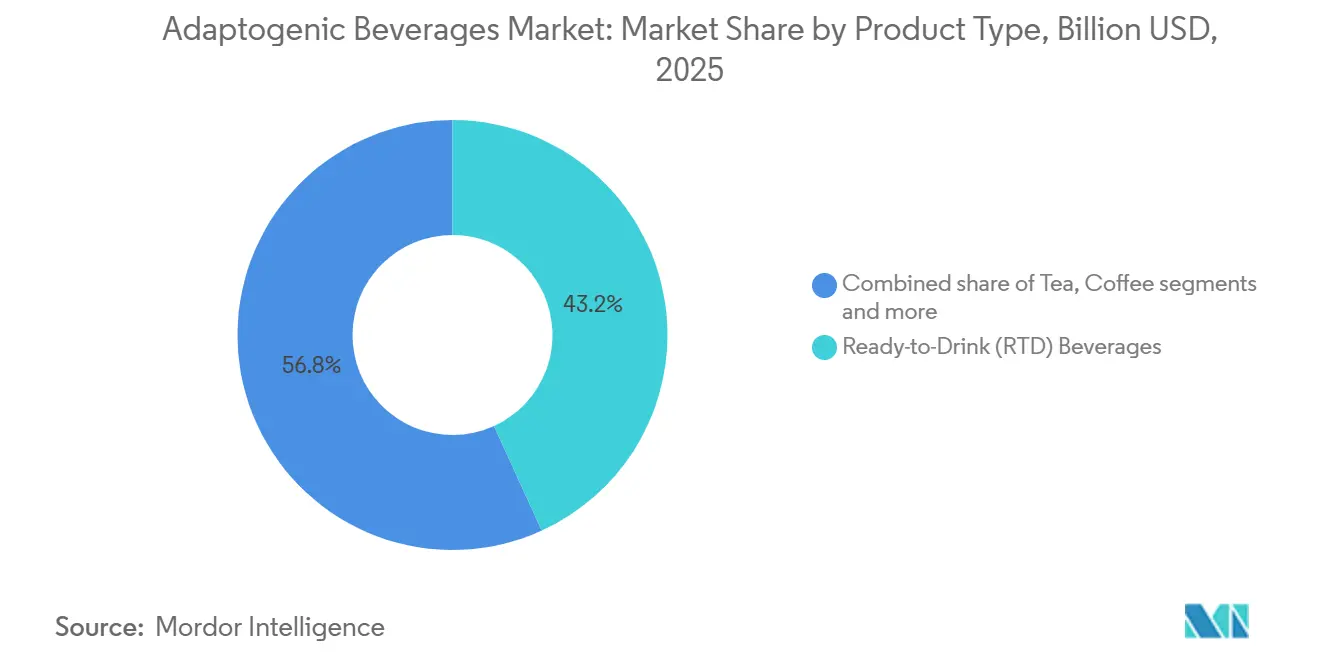
Ready-To-Drink Formats Support Wider AdoptionReady-to-drink beverages accounted for the largest share of the adaptogenic beverages market, representing 43.18% of the market in 2025. The segment benefits from growing consumer preference for convenient, ready-to-consume functional beverages that can easily fit into daily routines. Ready-to-drink formats eliminate preparation requirements, making them particularly attractive to consumers seeking wellness benefits while maintaining busy lifestyles. The increasing availability of adaptogenic ingredients in packaged beverages such as functional drinks, wellness beverages, and botanical-infused products is further supporting segment growth. Manufacturers are also introducing diverse flavor profiles and ingredient combinations to appeal to a broader consumer base.
Energy drinks are projected to be the fastest-growing product type in the adaptogenic beverages market, registering a CAGR of 8.67% through 2031. Growth is being supported by increasing consumer demand for beverages that combine energy enhancement with functional and wellness-oriented benefits. The incorporation of adaptogenic ingredients into energy drinks enables manufacturers to differentiate products beyond conventional energy-boosting formulations. Consumers are increasingly seeking alternatives that support energy, focus, and overall well-being, creating opportunities for adaptogenic energy beverages.

By Function:
Stress and Relaxation Leads Demand While Energy and Stamina Gains PaceStress and relaxation accounted for the largest share of the adaptogenic beverages market, representing 33.84% of the market size in 2025. The segment is supported by growing consumer interest in beverages that promote relaxation and help manage the effects of everyday stress. Increasing work-related pressures, busy lifestyles, and rising awareness of mental well-being are encouraging consumers to seek convenient wellness solutions. Adaptogenic ingredients are increasingly incorporated into beverages positioned around relaxation, calmness, and emotional balance. The availability of these products in convenient beverage formats is also making them accessible to consumers seeking functional benefits as part of their daily routines.
Energy and stamina is projected to be the fastest-growing functional segment in the adaptogenic beverages market, with a CAGR of 8.51% through 2031. Growth is being driven by rising demand for beverages that provide functional energy benefits while aligning with broader health and wellness preferences. Consumers are increasingly looking for alternatives that support sustained energy, physical performance, and endurance throughout the day. The integration of adaptogenic ingredients into energy-focused beverages is enabling manufacturers to offer products positioned beyond conventional energy drinks.
By Distribution Channel:
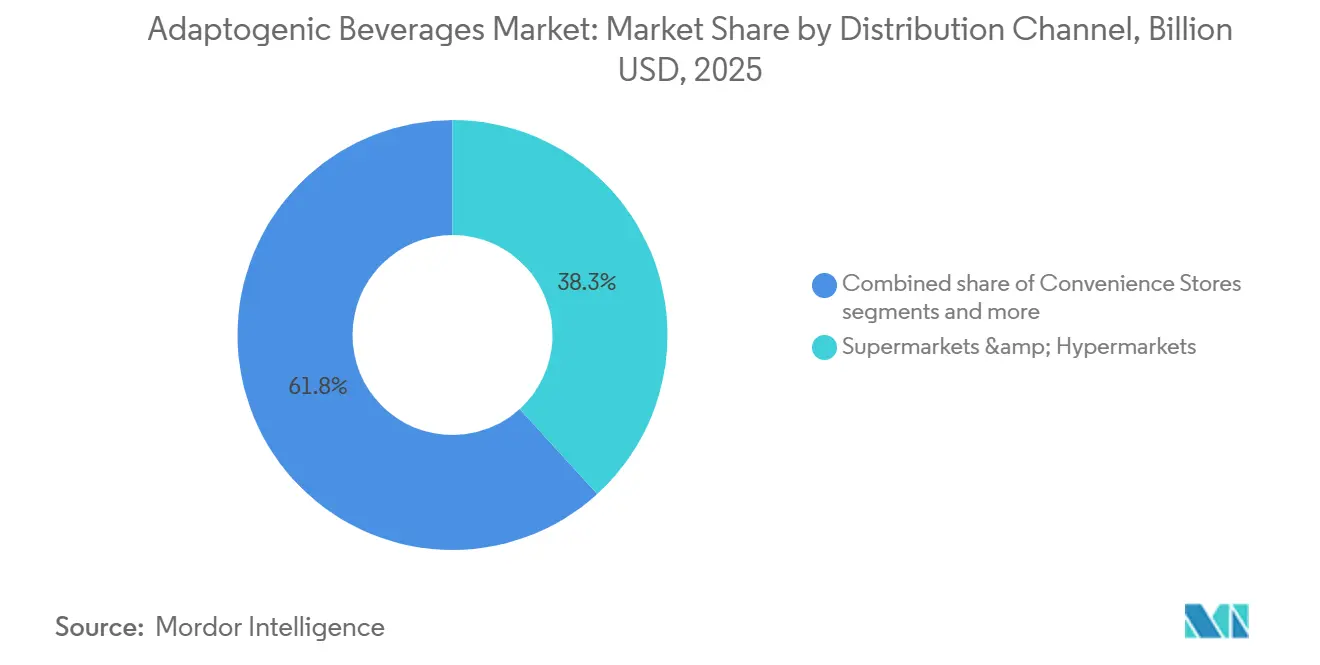
Supermarkets Anchor Reach While Online Retail Builds EngagementSupermarkets and hypermarkets represented the largest distribution channel in the adaptogenic beverages market, accounting for 38.25% of the market in 2025. Their leading position is supported by broad product availability and consumers' established preference for purchasing beverages through physical retail outlets. These channels provide consumers with convenient access to a wide range of functional and wellness-oriented beverages under one roof. The presence of established beverage brands alongside emerging adaptogenic products also improves product visibility and supports consumer discovery.
Online retail is projected to be the fastest-growing distribution channel for adaptogenic beverages, with a CAGR of 9.25% through 2031. The segment is benefiting from increasing consumer adoption of e-commerce for health, wellness, and functional beverage purchases. Online platforms provide consumers with access to a broader selection of adaptogenic products, including specialized and emerging brands that may have limited physical retail presence. Detailed product information, customer reviews, subscription options, and home delivery further enhance the convenience of purchasing through digital channels.
Geography Analysis
North America Adaptogenic Beverages Market
North America commanded the largest share of the adaptogenic beverages market, accounting for 42.73% of revenue in 2025. The region benefits from strong consumer awareness of functional beverages, wellness products, and plant-based ingredients. Growing interest in stress management, mental well-being, energy, and overall health is encouraging consumers to incorporate adaptogenic beverages into their daily routines. The presence of established functional beverage companies and a wide retail network further supports product availability across the region. Product innovation, including ready-to-drink formats and beverages combining multiple functional ingredients, is also strengthening consumer adoption. The United States remains a key market, supported by strong demand for convenient wellness-oriented beverages and continued expansion of premium functional products.
APAC Adaptogenic Beverages Market
Asia-Pacific is projected to be the fastest-growing regional market, with a CAGR of 9.04% through 2031. Growth is supported by increasing consumer interest in traditional herbs, botanical ingredients, and natural approaches to health and wellness. Adaptogenic ingredients are gaining relevance as consumers seek beverages associated with stress relief, energy, immunity, and overall well-being. Rising disposable incomes, urbanization, and expanding modern retail and e-commerce infrastructure are improving access to functional beverage products. Manufacturers are also introducing localized formulations and convenient beverage formats to appeal to evolving consumer preferences across the region.
EMEA and South America Adaptogenic Beverages Market
Europe represents another significant market, supported by increasing demand for natural, clean-label, and functional beverages, while growing consumer interest in holistic wellness is creating opportunities for adaptogenic products. South America is witnessing emerging demand for functional and health-oriented beverages as consumers become more attentive to wellness and natural ingredients. In the Middle East and Africa, expanding premium beverage offerings, rising health awareness, and the gradual development of modern retail and e-commerce channels are creating opportunities for market growth.
Competitive Landscape
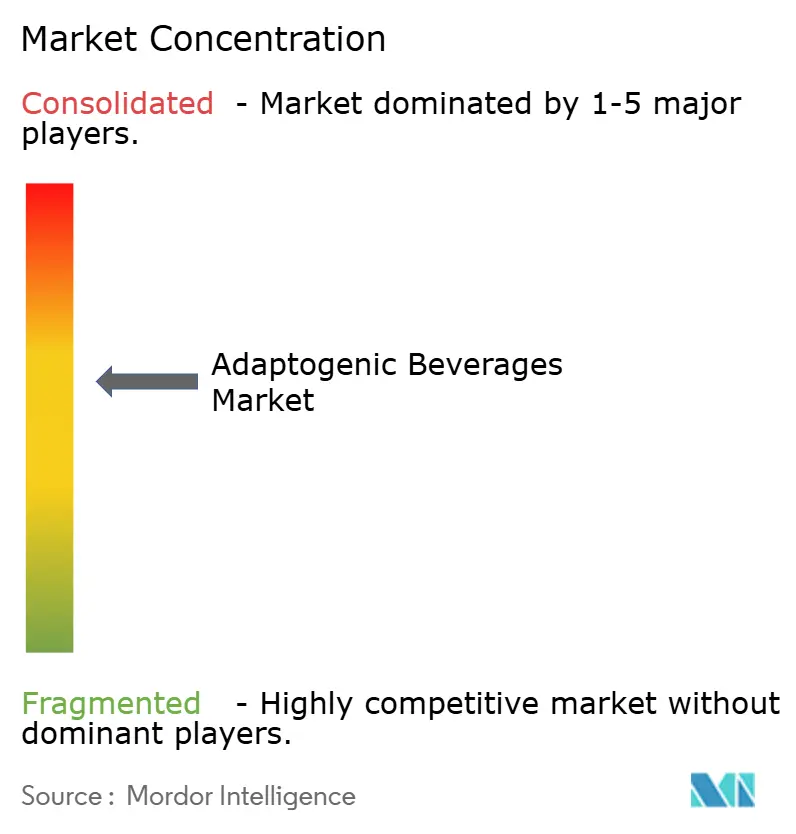
The adaptogenic beverages market is moderately fragmented, with several established and emerging players competing for market share. Market participants are competing through differentiated product offerings that target specific consumer needs such as stress management, relaxation, energy, stamina, and overall wellness. The presence of both large companies with established distribution networks and smaller specialized brands contributes to a diverse competitive environment.
Product innovation is a key competitive strategy in the market, with companies focusing on new adaptogenic ingredient combinations, clean-label formulations, and convenient ready-to-drink formats. Manufacturers are also incorporating adaptogens into energy drinks, functional beverages, and other wellness-oriented products to expand their consumer base. Formulations featuring botanical ingredients and multiple functional benefits are helping brands differentiate their offerings and respond to evolving consumer preferences.
Companies are also focusing on expanding distribution and strengthening their market presence through supermarkets and hypermarkets, specialty stores, and online retail platforms. The rapid growth of e-commerce is providing smaller and emerging brands with opportunities to reach consumers without relying solely on traditional retail networks. As demand for functional and wellness beverages continues to increase, companies are expected to pursue geographic expansion, strategic partnerships, and portfolio diversification to strengthen their competitive positions.
Adaptogenic Beverages Industry Leaders
-
REBBL, Inc.
-
Four Sigmatic Foods, Inc.
-
Kin Euphorics, Inc.
-
Adapt Drinks Ltd.
-
Sunwink, Inc.
- *Disclaimer: Major Players sorted in no particular order
Adaptogenic Beverages Market Companies Covered in this Report
- REBBL, Inc.
- Four Sigmatic Foods, Inc.
- Kin Euphorics, Inc.
- Adapt Drinks Ltd.
- Sunwink, Inc.
- Laird Superfood
- Peak and Valley, LLC
- Wylde One, Inc.
- Goodmylk Co.
- Moon Juice, Inc.
- MUD/WTR, Inc.
- Om Mushroom Superfood
- Laird Superfood, Inc.
- GT's Living Foods, LLC
- Life Cykel
- Elements of Herbology
- Ghia
- Three Spirit Drinks Ltd.
- De Soi, Inc.
- Hiyo, Inc.
Recent Industry Developments in Adaptogenic Beverages Market
- August 2026: Laird Superfood expanded its Perform Coffee and Creamer portfolio across Walmart stores nationwide in the US, representing a notable step in the mainstream retail penetration of functional mushroom coffee. The range includes K-Cup products formulated with chaga, lion’s mane, maitake, and cordyceps extracts, increasing consumer access beyond specialty retail channels at accessible price points.
- June 2026: Laird Superfood broadened its presence at Target stores nationwide by introducing Organic PERFORM and DEFEND Functional Mushroom Coffees. The expansion positions functional mushroom coffee as a mainstream option for consumers’ daily morning routines. PERFORM combines energy- and cognitive-support mushrooms with high-altitude Peruvian coffee, while DEFEND features immune-support extracts and delivers 15% of the daily value of vitamin D per serving.
- June 2026: Laird Superfood introduced Protein Matcha, an instant iced matcha latte mix containing 10 grams of milk protein, lion’s mane mushroom, and electrolytes per serving. Available in Original, Strawberry, and Lavender variants, the product expands the company’s functional beverage portfolio into the matcha category.
- June 2025: Laird Superfood partnered with Bluestone Lane to introduce functional mushroom coffee drinks across more than 50 U.S. cafés, featuring Chaga, Lion’s Mane, Maitake, and Cordyceps. The partnership expanded the adoption of functional mushrooms in mainstream café beverages and strengthened their positioning as everyday wellness and energy products.
Global Adaptogenic Beverages Market Report Scope
Adaptogenic beverages are functional drinks formulated with adaptogens natural substances, typically derived from herbs, roots, and botanical extracts, that are traditionally associated with helping the body adapt to physical and mental stress. The adaptogenic beverages market is segmented into product type, function, distribution channel and geography. Based on the product type, the market is segmented into ready-to-drink (RTD) beverages, tea, coffee, energy drinks and other product types. Based on function, the market is segmented into stress & relaxation, energy & stamina, focus & cognitive support, sleep & recovery, immune & general wellness. Based on distribution channel, the market is segmented into supermarkets & hypermarkets, convenience stores, specialty & health stores, online retail stores and other distribution channels. By geography, the market is segmented into North America, Europe, Asia-Pacific, South America, and Middle-East and Africa. For each segment, the market sizing and forecasting have been done in value terms (USD billion).
Segmentation Overview
| Ready-to-Drink (RTD) Beverages |
| Tea |
| Coffee |
| Energy Drinks |
| Other product Types |
| Stress and Relaxation |
| Energy and Stamina |
| Focus and Cognitive Support |
| Sleep and Recovery |
| Immune and General Wellness |
| Supermarkets & Hypermarkets |
| Convenience Stores |
| Specialty & Health Stores |
| Online Retail Stores |
| Other Distribution Channels |
| North America | United States |
| Canada | |
| Mexico | |
| Rest of North America | |
| Europe | United Kingdom |
| Germany | |
| France | |
| Spain | |
| Italy | |
| Belgium | |
| Poland | |
| Rest of Europe | |
| Asia-Pacific | China |
| Japan | |
| India | |
| Australia | |
| South Korea | |
| Indonesia | |
| Rest of Asia-Pacific | |
| South America | Brazil |
| Argentina | |
| Chile | |
| Peru | |
| Colombia | |
| Rest of South America | |
| Middle East and Africa | United Arab Emirates |
| South Africa | |
| Saudi Arabia | |
| Nigeria | |
| Egypt | |
| Morocco | |
| Rest of Middle East and Africa |
| By Product Type | Ready-to-Drink (RTD) Beverages | |
| Tea | ||
| Coffee | ||
| Energy Drinks | ||
| Other product Types | ||
| By Function | Stress and Relaxation | |
| Energy and Stamina | ||
| Focus and Cognitive Support | ||
| Sleep and Recovery | ||
| Immune and General Wellness | ||
| By Distribution Channel | Supermarkets & Hypermarkets | |
| Convenience Stores | ||
| Specialty & Health Stores | ||
| Online Retail Stores | ||
| Other Distribution Channels | ||
| By Geography | North America | United States |
| Canada | ||
| Mexico | ||
| Rest of North America | ||
| Europe | United Kingdom | |
| Germany | ||
| France | ||
| Spain | ||
| Italy | ||
| Belgium | ||
| Poland | ||
| Rest of Europe | ||
| Asia-Pacific | China | |
| Japan | ||
| India | ||
| Australia | ||
| South Korea | ||
| Indonesia | ||
| Rest of Asia-Pacific | ||
| South America | Brazil | |
| Argentina | ||
| Chile | ||
| Peru | ||
| Colombia | ||
| Rest of South America | ||
| Middle East and Africa | United Arab Emirates | |
| South Africa | ||
| Saudi Arabia | ||
| Nigeria | ||
| Egypt | ||
| Morocco | ||
| Rest of Middle East and Africa | ||
Key Questions Answered in the Report
What is the forecast for adaptogenic beverages through 2031?
The market is forecast to reach USD 2.33 billion by 2031, rising from USD 1.61 billion in 2026 at a 7.67% CAGR.
Which product format has the largest share?
Ready-to-drink beverages led product demand with 43.18% in 2025, supported by convenience and familiar consumption occasions.
Which function is growing the fastest?
Energy and stamina is expected to grow at an 8.51% CAGR through 2031, supported by demand for sustained energy and mental clarity.
Why are online sales important for adaptogenic drinks?
Online retail is projected to grow at a 9.25% CAGR through 2031 because it supports product education, bundles, and subscriptions.