
3D Printing Plastics Market Size and Share
Market Overview
| Study Period | 2021 - 2031 |
|---|---|
| Market Size (2026) | USD 2.86 Billion |
| Market Size (2031) | USD 4.37 Billion |
| Growth Rate (2026 - 2031) | 8.85 % |
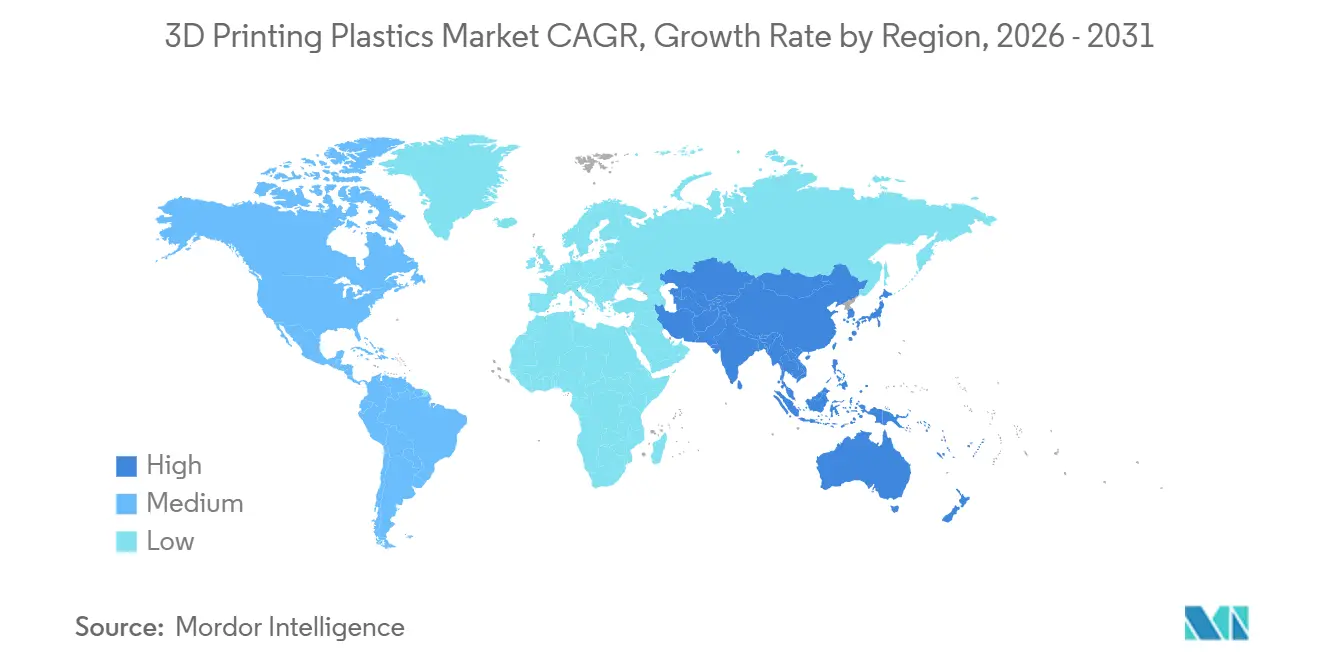
| Fastest Growing Market | Asia-Pacific |
| Largest Market | North America |
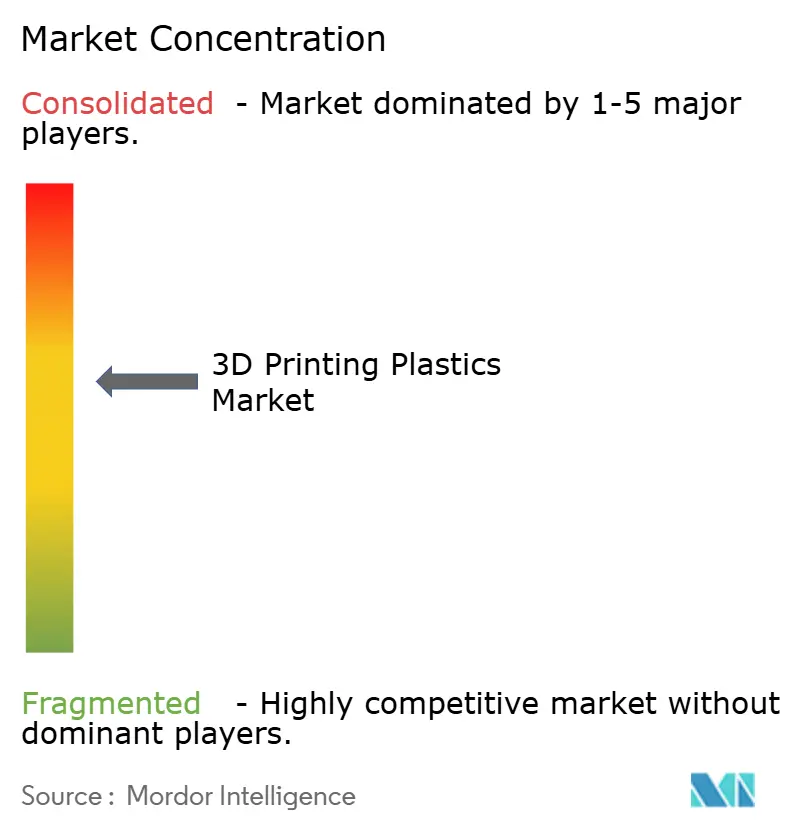
| Market Concentration | Medium |
Major Players *Disclaimer: Major Players sorted in no particular order Image © Mordor Intelligence. Reuse requires attribution under CC BY 4.0. | |
3D Printing Plastics Market Analysis by Mordor Intelligence
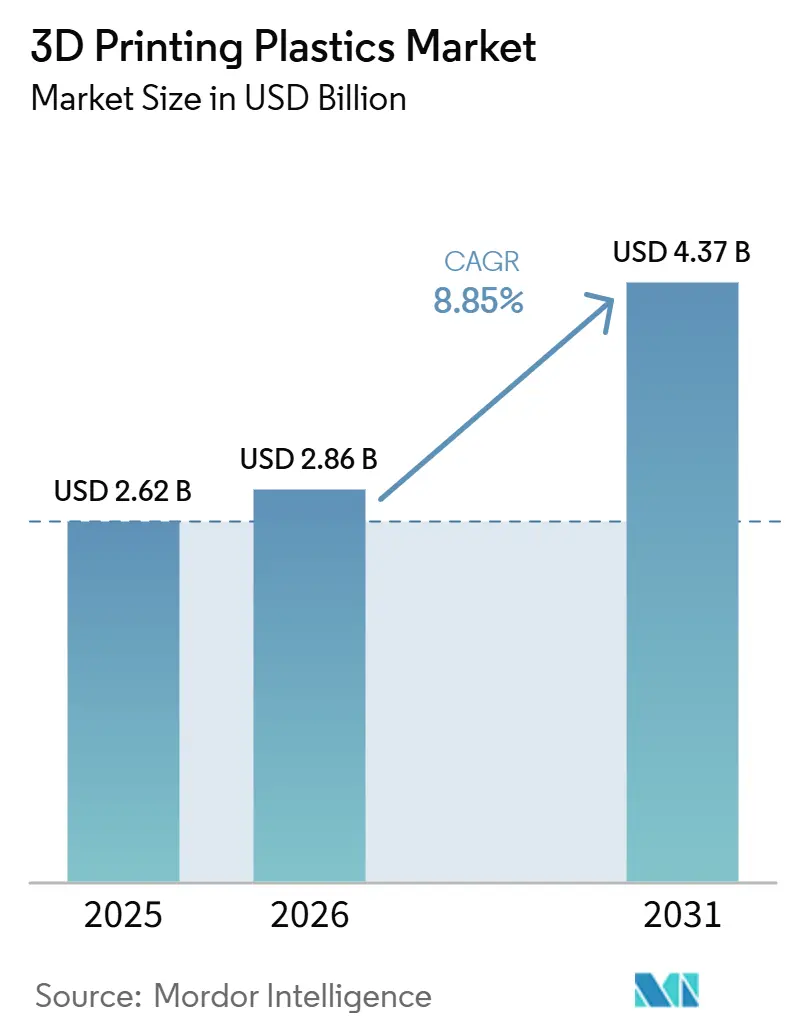
The 3D Printing Plastics Market was valued at USD 2.62 billion in 2025 and is estimated to grow from USD 2.86 billion in 2026 to reach USD 4.37 billion by 2031, at a CAGR of 8.85% during the forecast period (2026–2031). The 3D printing plastics market is moving from prototype-led demand toward repeatable production of functional parts, which increases the importance of material consistency, traceability, and validated process settings. A 2026 Protolabs survey found that 97% of manufacturing stakeholders used 3D printing for functional prototypes or end-use parts, showing that adoption now reaches beyond design teams into production supply chains. Specialty polymer suppliers can benefit when materials are qualified for specific printer platforms and applications, while suppliers of commodity grades face greater pressure. Certified material and machine combinations can shorten qualification work for customers and support recurring consumables sales for platform providers. Qualification cycles in aerospace and medical applications, along with changing costs for Polyether Ether Ketone (PEEK) and polycarbonate feedstocks, can delay revenue even when demand for advanced materials is strong.
Key Report Takeaways
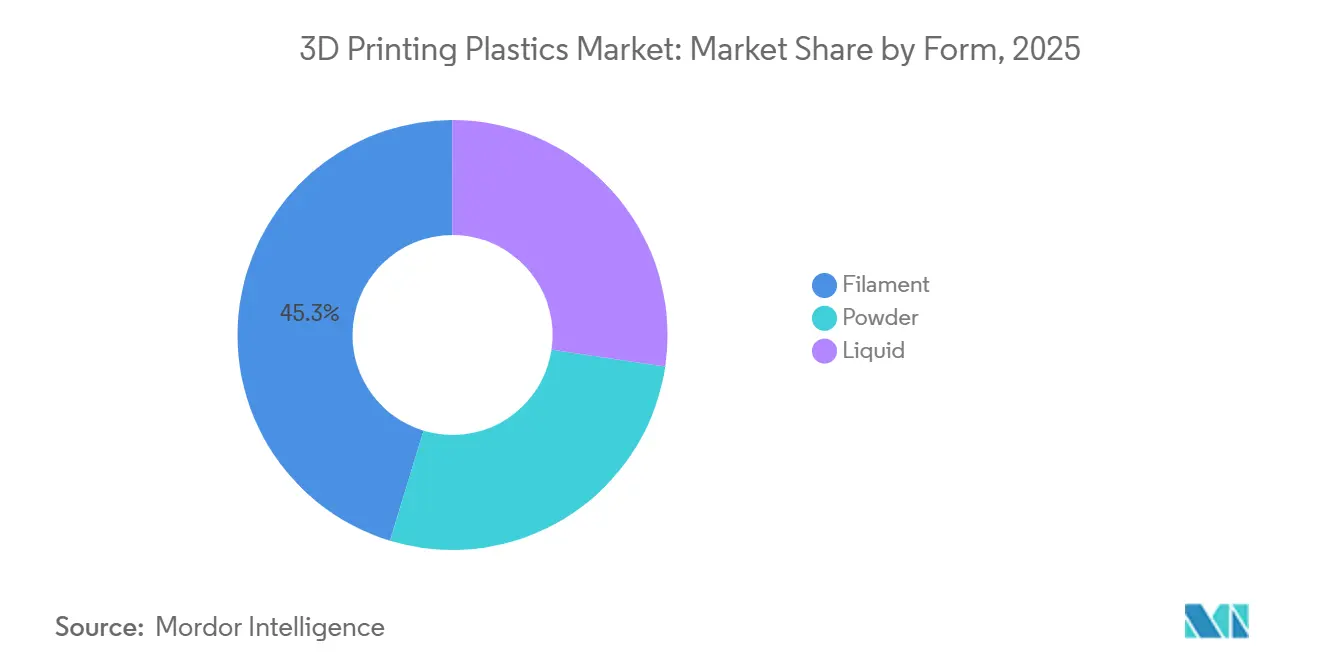
- By form, filament led with 45.31% of the 3D printing plastics market share in 2025, while powder is forecast to expand at a 9.06% CAGR through 2031.
- By material type, photopolymers held 24.94% of the 3D printing plastics market share in 2025, while Polyether Ether Ketone (PEEK) is forecast to expand at a 10.21% CAGR through 2031.
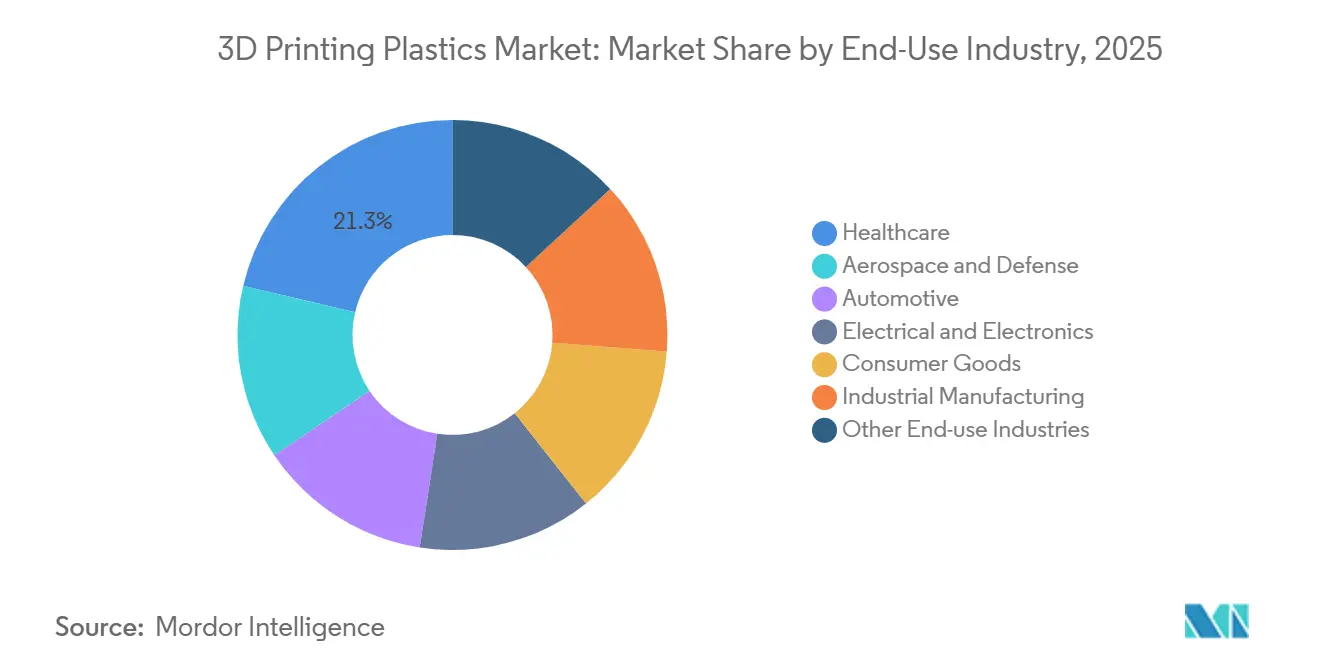
- By end-use industry, healthcare held 21.33% of the 3D printing plastics market share in 2025, while aerospace and defense is forecast to grow at a 9.47% CAGR through 2031.
- By geography, North America held 34.11% of the 3D printing plastics market share in 2025, while Asia-Pacific is forecast to grow at a 9.25% CAGR through 2031.
Note: Market size and forecast figures in this report are generated using Mordor Intelligence’s proprietary estimation framework, updated with the latest available data and insights as of January 2026.
Market Trends and Insights
Drivers Impact Analysis of 3D Printing Plastics Market*
| Driver | (~) % Impact on CAGR Forecast | Geographic Relevance | Impact Timeline |
|---|---|---|---|
| Growing Shift from Rapid Prototyping to Functional Parts Production | +2.0% | Global | Medium term (2-4 years) |
| Rising Demand for High-Performance Engineering Thermoplastics | +1.5% | Global, with concentration in North America and Asia-Pacific | Medium term (2-4 years) |
| Increasing Development of Application-Specific Polymer Formulations by 3D Printer Manufacturers | +1.2% | Global | Short term (≤ 2 years) |
| Expanding Use of Lightweight Polymer Components in Aerospace and Automotive Industries | +1.3% | North America & Europe | Long term (≥ 4 years) |
| Growing Adoption of On-Demand Manufacturing to Reduce Tooling Costs and Lead Times | +1.0% | Global | Short term (≤ 2 years) |
| Source: Mordor Intelligence | |||
Growing Shift from Rapid Prototyping to Functional Parts Production
The 3D printing plastics market is supported by wider use of additive manufacturing across design validation, bridge production, spare-parts management, and end-use component production. 3D Systems stated in July 2026 that rapid prototyping now supports the full product lifecycle rather than only early design work. This change requires polymer suppliers to provide repeatable results and documented material control, not only acceptable performance in a single print, because production users must be able to rely on the same material behavior across recurring orders and defined manufacturing schedules in the 3D printing plastics market. Manufacturers using printing in production also need quality systems that support traceability and sector-specific requirements. Materials that once moved in small volumes to prototyping laboratories can therefore be purchased under production schedules with larger and more predictable requirements. The shift favors suppliers that can support reliable output across extended production runs, which makes process documentation and material consistency central competitive requirements in the 3D printing plastics market.
Rising Demand for High-Performance Engineering Thermoplastics
PEEK is projected to grow at a 10.21% CAGR through 2031, reflecting its role in demanding medical and aerospace uses. Implant-grade PEEK that conforms to ASTM F2026 can support medical device producers working within ISO 13485 quality systems for patient-specific implants and surgical instruments. Polyetherimide, often sold under the ULTEM brand, and PEEK provide heat resistance, chemical resistance, and low weight for aircraft interior parts and other qualified components. Polyphenylsulfone (PPSU) and polycarbonate are also being used for tooling that must withstand autoclaving, where small production runs can still have high value per part. The 3D printing plastics market, therefore, depends increasingly on material suppliers that combine compounding capability with testing, documentation, and certification support. These requirements strengthen the position of specialty chemical producers relative to suppliers focused only on general-purpose polymers, especially when customers need material records that can be reviewed during a regulated product approval process within the 3D printing plastics market.
Increasing Development of Application-Specific Polymer Formulations by 3D Printer Manufacturers
Printer manufacturers are expanding certified material and machine combinations for higher-value applications. In April 2026, Stratasys introduced Selective Absorption Fusion (SAF) polyamide 12 (PA12) powered by Evonik and stated that the material offered 14% lower total cost of ownership than the earlier SAF PA12 formulation. The same launch included P3 MED Silicone 25A, an ISO 10993-certified material for patient-specific medical devices. Evonik introduced INFINAM PA12 FR in November 2024, a halogen-free flame-retardant powder developed with HP Inc. that has 50% reusability and targets transportation and electronics applications[1]Evonik Industries, “Evonik Unveils Flame Retardant PA12 and Carbon Black Embedded 3D-Printable Powders at Frankfurt Trade Show,” Evonik Press Release, evonik.com. Materials supplied with validated build settings, mechanical data, and compliance documentation can reduce the time customers spend qualifying a new material. Independent suppliers that cannot offer comparable documentation can face lower margins and reduced access to production applications, since their customers may need to repeat testing and validation before a material can be used in the 3D printing plastics market.
Expanding Use of Lightweight Polymer Components in Aerospace and Automotive Industries
Aerospace and automotive manufacturers are using additively manufactured polymer parts where lower weight, shorter lead times, and reduced inventory can justify the qualification work. Airbus produces more than 25,000 flight-ready polymer parts each year using ULTEM-certified filament on industrial Fused Deposition Modeling (FDM) systems, supporting decentralized manufacturing and lower inventory needs. Industrial applications need materials that can meet specified heat, strength, and traceability requirements. In June 2026, Stratasys launched FDM PA6/66-GF30-FR, a flame-retardant glass-fiber material for certified rail and transportation parts on Fortus 450mc and F900 systems. The product shows how specialized filament grades are extending use beyond prototype parts. As qualified applications increase, the 3D printing plastics market gains demand from short-run components and spare parts that do not require conventional tooling.
Restraints Impact Analysis of 3D Printing Plastics Market*
| Restraint | (~) % Impact on CAGR Forecast | Geographic Relevance | Impact Timeline |
|---|---|---|---|
| High Cost of 3D Printing Plastics Compared with Conventional Polymer Materials | -0.7% | Global, with greater sensitivity in emerging markets | Long term (≥ 4 years) |
| Limited Material Compatibility Across Different 3D Printing Technologies | -0.5% | Global | Medium term (2-4 years) |
| Stringent Material Qualification and Certification Requirements for Critical Applications | -0.4% | North America & Europe, spill-over to APAC | Long term (≥ 4 years) |
| Source: Mordor Intelligence | |||
High Cost of 3D Printing Plastics Compared with Conventional Polymer Materials
Engineering-grade printing materials, especially PEEK, PPSU, and biocompatible photopolymer resins, cost more than comparable commodity grades used in injection molding. This cost can limit adoption when per-part economics are strongly tied to production volume, including consumer goods and general industrial manufacturing. Print-grade polymers also need controlled storage, while some photopolymers have shorter shelf lives. Moisture-sensitive nylon powders can require specialized handling, which adds logistics costs that conventional polymer supply chains may not carry. These costs are particularly high in emerging markets across South America and parts of Southeast Asia, where established injection molding supply chains remain competitive. The 3D printing plastics market must therefore demonstrate value through lower tooling needs, shorter lead times, or greater part customization when material prices are high, rather than relying on material cost alone to support the purchasing decision.
Limited Material Compatibility Across Different 3D Printing Technologies
A polyamide powder qualified for one selective laser sintering platform can deliver different mechanical properties on another platform, even where nominal settings appear similar. Manufacturers with several printing technologies may need separate inventories and qualified supplier lists for each system. This increases material management work and can slow decisions to expand additive manufacturing fleets, particularly when a manufacturer needs to maintain traceability, storage controls, and repeatable performance across several equipment platforms in the 3D printing plastics market. Material suppliers also need distinct testing, documentation, and regulatory files for each machine ecosystem, which increases the cost and time needed to introduce a formulation. ASTM International continues work through its F42 Committee on additive manufacturing standards, but harmonized cross-platform material standards remain incomplete.
*Our forecasts treat driver/restraint impacts as directional, not additive. The impact forecasts reflect baseline growth, mix effects, and variable interactions.
3D Printing Plastics Market Segment Analysis
By Form:
Filament Leads, While Powder Supports Faster Industrial AdoptionFilament held 45.31% of the 3D printing plastics market share in 2025, supported by the wide installed base of fused deposition modeling and fused filament fabrication systems in prototyping laboratories, dental clinics, educational settings, and manufacturing locations. Their presence across these settings has made filament a familiar input for design, training, tooling, and production-support work. Filament supports a broad range of materials, from polylactic acid (PLA) to PEEK and ULTEM. Industrial FDM systems with enclosed heated chambers are extending their use into production-oriented applications that need stronger, more stable, and more heat-resistant components. The 3D printing plastics market size for filament is also supported by demand for grades with application-specific properties, including flame resistance, reinforcement, and performance under defined operating conditions. Stratasys introduced FDM PA6/66-GF30-FR in June 2026 for rail and transportation users who need flame-retardant end-use parts and spare parts.
Powder is projected to expand at a 9.06% CAGR through 2031, making it the fastest-growing form in the 3D printing plastics market as industrial users seek practical alternatives for smaller production batches. Multi Jet Fusion and selective laser sintering can support batch production without conventional tooling, allowing manufacturers to consider additive methods where mold investment would otherwise be required. This capability is valuable for short production runs, where the cost of tooling can be difficult to justify. Powder systems also help manufacturers produce complex parts with less dependence on traditional machining steps and allow production teams to address geometries that can be difficult to make through conventional methods. Growth in powder demand reflects the move toward production-oriented additive workflows. It also creates demand for materials that retain stable properties after processing and reuse, because production users need to control quality and cost across repeat builds in the 3D printing plastics market. Liquid resins remain important for stereolithography and digital light processing, particularly for dental prosthetics, hearing aids, and high-resolution industrial parts. Photopolymer formulation work is increasingly focused on biocompatibility and flame resistance.



By Material Type:
Photopolymers Lead, While PEEK Gains Ground in Qualified UsesPhotopolymers accounted for 24.94% of the 3D printing plastics market share in 2025, reflecting their established role in processes that prioritize precision, fine features, and surface quality. Their leading position reflects use across digital light processing, stereolithography, and PolyJet platforms. Resin chemistry can be adjusted for rigidity, flexibility, or optical clarity, which supports specialized uses that would be difficult to meet with a single general-purpose polymer formulation. Dental, hearing-aid, and industrial tooling applications benefit from these properties because their parts often require precise geometry alongside material characteristics suited to the intended use. The 3D printing plastics industry relies on photopolymers for precision parts where surface quality and feature detail are important, particularly when component geometry must be tailored to an individual user or a specific tool. The launch of P3 MED Silicone 25A in 2026 also shows the continued movement toward medically oriented, certified resin materials.
Polyether Ether Ketone (PEEK) is forecast to grow at a 10.21% CAGR through 2031, because it addresses applications that place greater demands on heat resistance, traceability, and material performance. Medical device manufacturers use implant-grade PEEK for craniofacial and spinal applications that require biocompatibility and traceability documentation, including records that support regulated patient-specific manufacturing. Aerospace customers also use heat-resistant polymer components for qualified brackets and ducting. These uses favor materials supported by validated performance data and clear quality records, which helps customers link a finished component to its material batch, process settings, and approved use conditions in the 3D printing plastics market. ABS and PLA continue to serve rapid prototyping, consumer products, and education, although open-material systems place pressure on their margins. Polyamide continues to serve automotive and industrial applications through its toughness, chemical resistance, and use across FDM and selective laser sintering. PETG supports packaging prototypes, TPU supports flexible components, and PPSU is used where sterilization-resistant tooling or aerospace interior fittings are required.
By End-Use Industry:
Healthcare Leads, While Aerospace and Defense Grow FasterHealthcare held 21.33% of the 3D printing plastics market share in 2025, supported by patient-specific devices such as surgical guides, dental aligners, and craniofacial implants that are suited to unit-specific production. Additive manufacturing allows these parts to be produced in individual geometries without tooling investment, which is particularly relevant when conventional production methods are less efficient for customized items. Biocompatible and sterilization-compatible grades also command higher prices than commodity printing materials because they must meet more demanding material and documentation requirements. Healthcare demand depends on validated material properties, clean documentation, and process control. These requirements create a barrier for suppliers that do not have certification support, because healthcare manufacturers need documented confidence in the polymer, the printing process, and the intended clinical application.
Aerospace and defense is forecast to grow at a 9.47% CAGR through 2031, supported by ongoing programs that qualify polymer components for more demanding production and spare-parts uses. The segment requires polymers that can meet heat, weight, chemical resistance, and traceability requirements while providing repeatable results within tightly managed production processes. Airbus’s output of more than 25,000 flight-ready polymer parts a year demonstrates the role of qualified polymer materials in serial aerospace production. The automotive end-use industry is using polymer printing in prototype development and planned component production. The electrical and electronics industry uses precision connectors, electrostatic discharge (ESD)-safe housings, and low-volume enclosures. Consumer goods and industrial users are adopting on-demand spare parts and customized short runs to reduce inventory needs and supply chain dependence.
Geography Analysis
North America 3D Printing Plastics Market
North America held 34.11% of the 3D printing plastics market share in 2025. Aerospace and defense procurement in the region requires materials that meet rigorous qualification processes. The region also has a developed healthcare manufacturing base that uses FDA-cleared biocompatible resins and filaments. These conditions support demand for certified polymers and documented production processes. Stratasys opened a 200,000-square-foot Americas Regional Corporate Headquarters in Minnetonka, Minnesota, in 2026, underscoring the region’s role in industrial additive manufacturing deployment. Canada and Mexico are also becoming more relevant as nearshore locations for aerospace supply chains.
APAC 3D Printing Plastics Market
Asia-Pacific is forecast to grow at a 9.25% CAGR through 2031, the fastest regional rate in the 3D printing plastics market, as manufacturing activity increases across several established and emerging economies. China is expanding additive manufacturing in strategic industrial sectors, while local printer and specialty chemical companies are adding PA12 and photopolymer capacity for a growing installed base of industrial systems. Japan’s automotive and aerospace sectors are increasing their use of additive manufacturing workflows, which can support demand for polymers suited to qualified production applications. South Korea’s electronics manufacturing base supports demand for precision photopolymer parts and ESD-safe polymer housings. India is at an earlier stage of adoption, but manufacturing investment linked to the Make in India program is supporting aerospace and medical device activity. These markets create demand for production-capable polymer systems as installed printer fleets expand.
EMEA and South America 3D Printing Plastics Market
Europe is led by Germany and France, where industrial printer expertise, research capability, and aerospace demand support advanced polymer applications. Germany combines industrial printer expertise with research activity on polymer production methods. France’s aerospace base, including Airbus and Safran, supports demand for high-value polymer materials. Airbus’s annual output of more than 25,000 flight-ready polymer parts shows the depth of qualified demand within the region. Registration, Evaluation, Authorisation and Restriction of Chemicals (REACH) and the EU Medical Device Regulation require material traceability and substance compliance, which increases qualification costs for new suppliers and makes established certification capabilities more important. South America, and Middle-East and Africa remain smaller markets, although Brazil and Saudi Arabia are building additive manufacturing capability for oil and gas and industrial maintenance applications.

Competitive Landscape
The 3D printing plastics market is moderately concentrated, with top players including 3D Systems, Inc., EOS GmbH, Evonik Industries AG, Henkel AG & Co. KGaA, and Stratasys Ltd. Specialty chemical producers and platform-integrated suppliers compete under different business models. Arkema, Evonik, Solvay, dsm-firmenich, and Victrex compete through certified grades, application performance, and sustainability characteristics. Platform providers combine materials with printers and software, which can make adoption easier for customers who need validated workflows. This structure makes documented performance and application support important competitive factors. It also gives suppliers with established printer relationships an advantage in production applications.
Arkema and HP AM Solutions launched a 100% bio-based PA11 Gen2 material for Multi Jet Fusion in 2025. Arkema stated that the material offered enhanced mechanical performance and a reduced environmental footprint compared with prior PA11 grades. In March 2026, Arkema and Zephir Project presented a recyclable speed-board prototype made with Elium resin, demonstrating a structural composite application for recyclable liquid thermoplastic acrylic resin. Stratasys has also pursued vertical integration through its acquisition of Covestro’s additive manufacturing materials business. The acquired portfolio included nearly 60 validated polymer formulations and patents across stereolithography, powder bed fusion, and PolyJet technologies. Each certified material added to a printer platform can increase customer switching costs and broaden recurring materials revenue.
In May 2026, Stratasys announced an agreement to acquire Markforged, Inc. from Nano Dimension for USD 42.5 million in cash. Markforged, Inc. generated USD 70 million in 2025 revenue and added continuous carbon-fiber composite capability, polymer and metal filaments, and a reseller network to Stratasys’s portfolio[2]Stratasys Ltd., “Stratasys to Acquire MarkForged, Inc., Expanding Aerospace, Defense, and Industrial Production Capabilities,” Stratasys Ltd., stratasys.com. Unmet needs remain in recyclable and circular polymer grades, materials for high-volume industrial binder jetting, and photopolymer resins designed for outdoor weathering. Desktop and prosumer systems capable of processing engineering filaments are widening access to additive manufacturing in enterprise settings. This can pressure prototype-related revenues at industrial suppliers while increasing the addressable base for polymer materials in the 3D printing plastics market, particularly where engineering-grade filaments become accessible to more enterprise users.
3D Printing Plastics Industry Leaders
3D Systems, Inc.
Stratasys Ltd.
EOS GmbH
Evonik Industries AG
Henkel AG & Co. KGaA
- *Disclaimer: Major Players sorted in no particular order
3D Printing Plastics Market Companies Covered in this Report
- 3D Systems, Inc.
- Arkema
- CRP Technology S.r.l.
- dsm-firmenich
- EOS GmbH
- Evonik Industries AG
- Henkel AG & Co. KGaA
- Lubrizol
- Materialise NV
- SABIC
- Solvay
- Stratasys Ltd.
- Victrex plc

Recent Industry Developments in 3D Printing Plastics Market
- May 2026: Stratasys Ltd. announced a definitive agreement to acquire MarkForged, Inc. from Nano Dimension, strengthening its position in the 3D printing plastics market by adding continuous carbon fiber composite technology, high-performance polymer and metal filaments, and an extended reseller network to its portfolio. The acquisition expanded Stratasys's continuous carbon fiber composite expertise and broadened its ability to serve aerospace, defense, and industrial production customers with advanced 3D printing plastics solutions.
- October 2025: Researchers at the University of Wisconsin-Platteville developed a patented process to convert proteins such as casein and whey from spoiled dairy waste into biodegradable 3D printing plastic. The filament, a mixture of milk protein and traditional polymers, serves as an eco-friendly alternative to petroleum-based plastics.


Global 3D Printing Plastics Market Report Scope
3D printing plastics are specialized polymers used in additive manufacturing to build objects layer by layer. These materials are melted or cured to create complex, precise parts with varying degrees of strength, flexibility, and heat resistance.
The 3D Printing Plastics Market is segmented by form, material type, end-use industry, and geography. By form, the market is segmented into filament, powder, and liquid. By material type, the market is segmented into photopolymer, acrylonitrile butadiene styrene (ABS), polylactic acid (PLA), polyamide (nylon), polycarbonate (PC), polyether ether ketone (PEEK), polyethylene terephthalate glycol (PETG), polyphenylsulfone (PPSU), thermoplastic polyurethane (TPU), and other material types. By end-use industry, the market is segmented into healthcare, aerospace & defense, automotive, electrical & electronics, consumer goods, industrial manufacturing, and other end-use industries. The report also covers the market size and forecasts for 3D printing plastics in 16 countries across major regions. For each segment, the market sizing and forecasts have been done on the basis of value (USD).
| Filament |
| Powder |
| Liquid |
| Photopolymer |
| Acrylonitrile Butadiene Styrene (ABS) |
| Polylactic Acid (PLA) |
| Polyamide (Nylon) |
| Polycarbonate (PC) |
| Polyether Ether Ketone (PEEK) |
| Polyethylene Terephthalate Glycol (PETG) |
| Polyphenylsulfone (PPSU) |
| Thermoplastic Polyurethane (TPU) |
| Other Material Types |
| Healthcare |
| Aerospace & Defense |
| Automotive |
| Electrical & Electronics |
| Consumer Goods |
| Industrial Manufacturing |
| Other End-use Industries |
| Asia-Pacific | China |
| India | |
| Japan | |
| South Korea | |
| Rest of Asia-Pacific | |
| North America | United States |
| Canada | |
| Mexico | |
| Europe | Germany |
| United Kingdom | |
| France | |
| Italy | |
| Russia | |
| Rest of Europe | |
| South America | Brazil |
| Argentina | |
| Rest of South America | |
| Middle-East and Africa | Saudi Arabia |
| South Africa | |
| Rest of Middle-East and Africa |
| By Form | Filament | |
| Powder | ||
| Liquid | ||
| By Material Type | Photopolymer | |
| Acrylonitrile Butadiene Styrene (ABS) | ||
| Polylactic Acid (PLA) | ||
| Polyamide (Nylon) | ||
| Polycarbonate (PC) | ||
| Polyether Ether Ketone (PEEK) | ||
| Polyethylene Terephthalate Glycol (PETG) | ||
| Polyphenylsulfone (PPSU) | ||
| Thermoplastic Polyurethane (TPU) | ||
| Other Material Types | ||
| By End-Use Industry | Healthcare | |
| Aerospace & Defense | ||
| Automotive | ||
| Electrical & Electronics | ||
| Consumer Goods | ||
| Industrial Manufacturing | ||
| Other End-use Industries | ||
| By Geography | Asia-Pacific | China |
| India | ||
| Japan | ||
| South Korea | ||
| Rest of Asia-Pacific | ||
| North America | United States | |
| Canada | ||
| Mexico | ||
| Europe | Germany | |
| United Kingdom | ||
| France | ||
| Italy | ||
| Russia | ||
| Rest of Europe | ||
| South America | Brazil | |
| Argentina | ||
| Rest of South America | ||
| Middle-East and Africa | Saudi Arabia | |
| South Africa | ||
| Rest of Middle-East and Africa | ||


Key Questions Answered in the Report
What is the size of the 3D printing plastics market?
The 3D printing plastics market stands at USD 2.86 billion in 2026 and is projected to reach USD 4.37 billion by 2031.
Which form led the market demand in 2025?
Filament led with a 45.31% share in 2025. Its position reflects the installed base of FDM and fused filament fabrication systems used for tooling, education, dental work, prototypes, and production support.
Which material type is expected to grow fastest?
Polyether Ether Ketone (PEEK) is projected to grow at a 10.21% CAGR through 2031. Growth reflects demand for medical and aerospace applications that need high heat resistance, traceability, and documented material performance.
Why do healthcare companies use additive manufacturing polymers?
Healthcare accounted for 21.33% of the market demand in 2025. Surgical guides, dental aligners, and patient-specific implants benefit from the ability to make individual geometries without conventional tooling investment.
Page last updated on:





